

Body Integrated Programmable Interface Market Size and Forecast — 2026 - 2033
The Global Body Integrated Programmable Interface Market size is estimated to be valued at USD 3.2 billion in 2026 and is expected to reach USD 8.5 billion by 2033, exhibiting a compound annual growth rate (CAGR) of 14.6% from 2026 to 2033.
Overview
The Body Integrated Programmable Interface market is primarily driven by rising demand for technologies that enhance human physical and cognitive capabilities through integration of digital systems with the human body. Increasing research and development investments in wearable devices, neural interfaces, and bio-integrated electronics are accelerating innovation and adoption. Applications in healthcare, especially rehabilitation for physically challenged individuals—are boosting demand, alongside growing use in defense, manufacturing, and sports for performance enhancement.
Key Takeaways
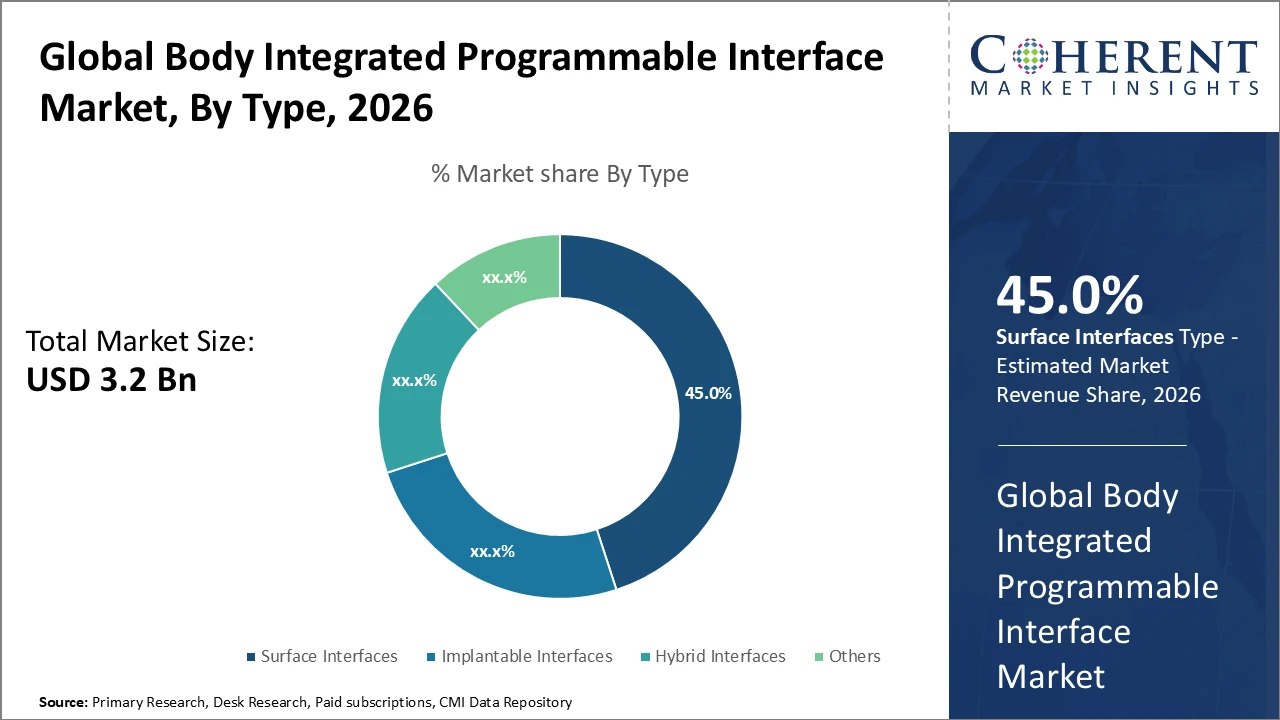
Surface Interfaces dominate the Type segment, accounting for 45% market share fueled by ease of integration and user comfort.
Healthcare Monitoring remains the largest application segment, with a significant rise in adoption due to chronic disease management demands.
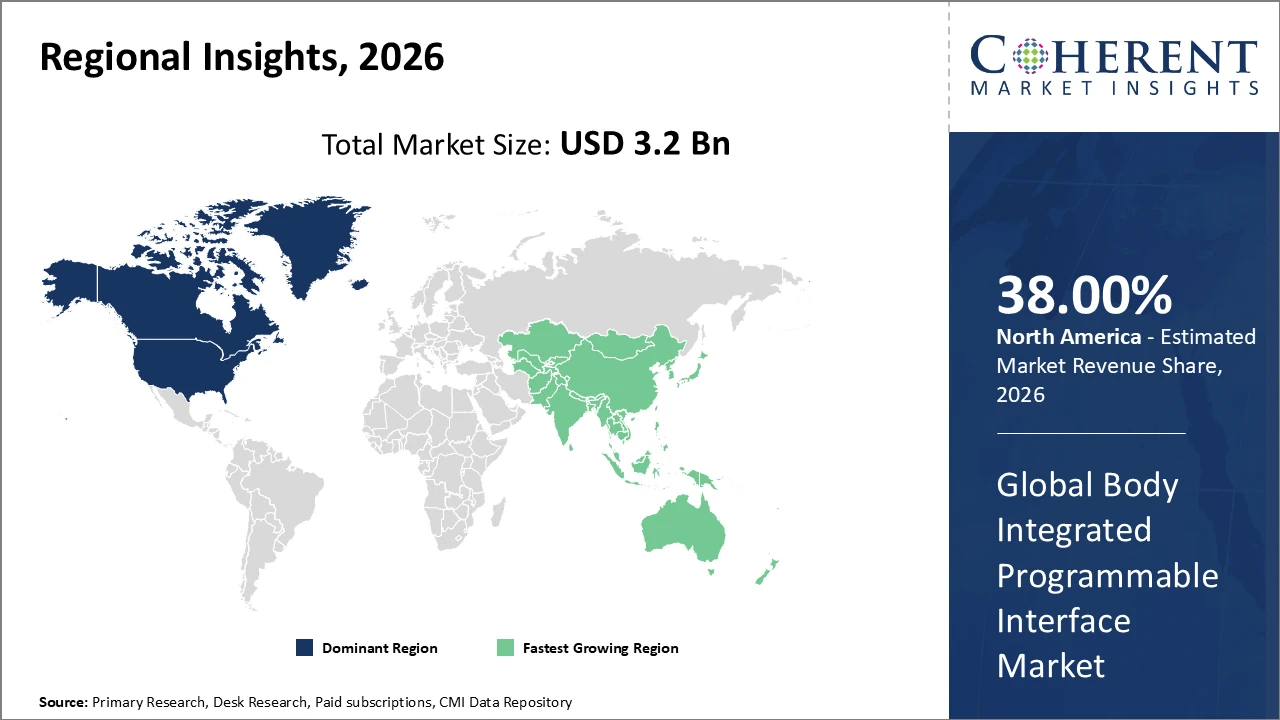
North America leads the regional market, possessing over 38% industry share supported by robust healthcare infrastructure.
Asia Pacific exhibits the fastest CAGR, driven by government incentives and expanding technology adoption in China and India.
Body Integrated Programmable Interface Market Segmentation Analysis
Body Integrated Programmable Interface Market Insights, By Type
Surface Interfaces hold the largest market share at 45%, driven by their non-invasive nature, ease of integration, and superior user comfort. These solutions leverage flexible substrates and textile-based technologies, boosting adoption across consumer electronics and healthcare wearables. Implantable Interfaces are the fastest-growing segment, supported by rising demand in chronic disease management and implantable medical devices, where miniaturization and biocompatibility are essential. Hybrid Interfaces, combining surface and implantable features, are gaining momentum in neuroprosthetics and advanced performance monitoring applications. Other interface types include emerging and specialized solutions under development, targeting niche applications with potential for future growth.
Body Integrated Programmable Interface Market Insights, By Application
Healthcare Monitoring dominates the market, driven by rising chronic disease prevalence and aging populations requiring continuous, accurate physiological data tracking. This segment benefits from advancements such as AI integration and 5G-enabled real-time monitoring. Sports & Fitness is the fastest-growing segment, fueled by increasing adoption of wearable devices for performance tracking and wellness. Consumer Electronics applications, including AR/VR devices and smart wearables, emphasize seamless interaction and customization. Industrial Control focuses on enhancing worker safety and equipment efficiency in demanding environments. These applications rely on reliable, real-time programmable interfaces, with innovations in materials, durability, and user-centric design supporting broader adoption.
Body Integrated Programmable Interface Market Insights, By Technology
Electrical interfaces hold the largest market share due to their maturity, cost-effectiveness, and wide applicability across medical and consumer devices, enabling reliable high-fidelity signal transmission. Optical interfaces are the fastest-growing segment, driven by advantages such as immunity to electromagnetic interference and high data transfer rates, supporting advanced neural and biometric applications. Mechanical interfaces serve niche roles in haptic feedback and structural sensing, enhancing tactile interaction. Emerging technologies, including biohybrid interfaces, are gaining attention for integrating chemical sensing capabilities. Ongoing advancements in photonics, scalable fabrication, and ergonomic design continue to expand functionality, efficiency, and user experience across interface technologies.
Body Integrated Programmable Interface Market Trends
The integration of AI and machine learning in body-integrated devices is enabling advanced predictive health monitoring, with reports indicating a 20% improvement in patient outcome predictions in 2026.
Growing emphasis on sustainability is driving the adoption of eco-friendly and biodegradable materials, with several manufacturers introducing innovative substrates in 2025.
Advancements in 5G connectivity and edge computing are enhancing real-time data exchange and processing capabilities.
Adoption of connected interface technologies has increased by over 25% globally in the past two years, particularly in sports and industrial applications.
Body Integrated Programmable Interface Market Insights, By Geography
North America Body Integrated Programmable Interface Market Analysis and Trends
North America dominates the Body Integrated Programmable Interface market, accounting for approximately 38% of the global share. This leadership is supported by advanced healthcare infrastructure, strong research and development investments, and favorable regulatory frameworks. The region benefits from the presence of major industry players and continuous innovation in wearable and implantable technologies. Government initiatives promoting digital health solutions and supportive reimbursement policies further accelerate adoption across hospitals and clinical settings. Increasing demand for remote patient monitoring and personalized healthcare solutions also contributes to market growth, positioning North America as a key hub for technological advancements and early adoption.
Asia Pacific Body Integrated Programmable Interface Market Analysis and Trends
The Asia Pacific region is witnessing the fastest growth in the Body Integrated Programmable Interface market, driven by rising demand for consumer electronics, expanding healthcare access, and strong government initiatives to digitize health services. Countries such as India and China are leading this surge, recording increases in deployments by 28% and 32% respectively in 2026. Supportive policies, including tax incentives and the development of health-tech incubators, are accelerating innovation and adoption. Additionally, growing domestic manufacturing capabilities and increased investments in digital infrastructure are strengthening the region’s position as a key growth engine for the market.
Body Integrated Programmable Interface Market Outlook for Key Countries
USA Body Integrated Programmable Interface Market Analysis and Trends
The U.S. Body Integrated Programmable Interface market remains a global leader in innovation and adoption, supported by a strong ecosystem of technology providers, healthcare institutions, and clear regulatory frameworks. In 2026, the country accounted for over 30% of global market revenue, driven by advancements such as MedTech Innovations Inc.’s next-generation implantable interfaces, which reduced patient recovery time by 15%. Strategic partnerships between interface developers and healthcare networks have enhanced remote patient monitoring capabilities, facilitating market growth. Additionally, robust intellectual property protections encourage continued research and development, fostering technological innovation and maintaining the U.S.’s competitive edge in the global BIPI market.
Germany Body Integrated Programmable Interface Market Analysis and Trends
Germany’s Body Integrated Programmable Interface market is experiencing steady growth, driven by its strong healthcare infrastructure, advanced engineering capabilities, and high adoption of digital health technologies. The market benefits from government support for medical device innovation, including funding programs for wearable and implantable solutions. German companies are focusing on precision engineering, miniaturization, and integration of AI-driven monitoring systems, enhancing patient care and operational efficiency. Sports, healthcare monitoring, and industrial applications are key growth segments. Additionally, collaborations between research institutions and private enterprises accelerate technological advancements. Sustainability and eco-friendly material adoption are emerging trends shaping the market’s future trajectory.
Analyst Opinion
The supply side of the BIPI market is marked by increased production capacity, driven by semiconductor advancements and component miniaturization, reducing device costs by approximately 11% in 2025. Production volume rose 22% from 2024 to 2026.
Rising consumer adoption in healthcare monitoring and sports wearables has driven demand, with fitness trackers integrating programmable interfaces seeing over a 35% increase in 2025, particularly in North America and Asia Pacific.
Mid-tier programmable interface modules experienced an 18% rise in unit shipments in 2026, benefiting from an optimized cost-to-performance ratio.
Nano-scale interface innovations with enhanced biocompatibility boosted wearable medical device adoption in Europe by 27% in 2025.
- Current Industry Events of 2026
- Market Size Estimation
- Regional Breakdown
- Competitive Landscape
- Customer Intelligence
- Segmental Analysis
- Pricing Analysis
- Key Market Drivers, Challenges & Future Trends
- Customized Insights Section
Market Scope
| Report Coverage | Details | ||
|---|---|---|---|
| Base Year: | 2025 | Market Size in 2026: | USD 3.2 billion |
| Historical Data for: | 2020 To 2024 | Forecast Period: | 2026 To 2033 |
| Forecast Period 2026 to 2033 CAGR: | 14.6% | 2033 Value Projection: | USD 8.5 billion |
| Geographies covered: |
| ||
| Segments covered: |
| ||
| Companies covered: | ViziWear Corp., WearTech Labs, TechBody Inc., MedTech Innovations Inc., Implanta Solutions, PulseWear Technologies, BioFlex Electronics, CircuitSense Corp., EmbedMed Devices, LinkWell Devices | ||
| Growth Drivers: |
| ||
Body Integrated Programmable Interface Market Growth Factors
Rapid advancements in semiconductor technologies are enhancing interface functionality while reducing device footprint, driving market growth. Innovations in flexible printed circuits contributed to a 20% efficiency gain in 2026 devices. Rising global chronic disease prevalence is increasing demand for body-integrated health monitoring systems, with North America and Europe leading, evidenced by a 30% rise in clinical device adoption in 2025. Consumer interest in personalized fitness and wellness accelerates growth, with 42 million fitness wearables featuring programmable interfaces shipped globally in 2026. Additionally, government initiatives in Asia Pacific, including tax incentives in India and Japan since 2024, support ecosystem expansion and revenue growth.
Body Integrated Programmable Interface Market Development
In November 2024, Renesas Electronics Corporation, a leading provider of advanced semiconductor technologies, introduced a new lineup of AnalogPAK integrated circuits. This release features lower-power, automotive-grade devices, as well as the industry’s first programmable 14-bit Successive-Approximation Register (SAR) analog-to-digital converter.
Key Players
Leading Companies of the Market
MedTech Innovations Inc.
CircuitSense Corp.
TechBody Inc.
Implanta Solutions
WearTech Labs
LinkWell Devices
ViziWear Corp.
BioFlex Electronics
EmbedMed Devices
PulseWear Technologies
Several leading companies have pursued aggressive R&D strategies emphasizing miniaturization and biocompatibility to strengthen their market positions. For instance, MedTech Innovations Inc. launched flexible implantable programmable interfaces in 2026, which contributed to a 15% increase in its market share in North America. Similarly, Biowearable Systems Ltd. collaborated with multiple healthcare providers to enable seamless, data-driven integration of their devices, resulting in a 25% growth in healthcare monitoring applications during 2025. These strategic initiatives highlight how innovation and partnerships are driving adoption and expanding the impact of body-integrated programmable interface technologies across key markets.
Body Integrated Programmable Interface Market Future Outlook
The future of the Body Integrated Programmable Interface market is poised for robust growth, driven by ongoing advancements in AI, IoT, and flexible electronics. Increasing adoption of wearable and implantable devices for healthcare monitoring, chronic disease management, and personalized fitness is expected to expand market demand. Integration of 5G and edge computing will enhance real-time data processing and predictive analytics, while sustainable, biocompatible materials will support eco-friendly innovations. Emerging applications in neuroprosthetics, industrial monitoring, and consumer electronics offer new growth avenues. Strategic collaborations, government initiatives, and continuous R&D investments will further accelerate market expansion globally over the coming decade.
Body Integrated Programmable Interface Market Historical Analysis
The Body Integrated Programmable Interface market has experienced steady growth over the past decade, driven by rising demand for wearable and implantable medical devices. Early developments focused on basic biosignal acquisition and patient monitoring systems, primarily in North America and Europe. Advancements in miniaturization, flexible electronics, and biocompatible materials during 2018–2022 enabled broader adoption across healthcare, sports, and consumer electronics applications. Increasing prevalence of chronic diseases and the shift toward remote patient monitoring further accelerated market expansion. Strategic investments in R&D and early collaborations between technology providers and healthcare institutions laid the foundation for the current innovation-driven and rapidly evolving market landscape.
Sources
Primary Research Interviews:
Biomedical engineers, device designers, and clinical researchers in hospitals and wearable technology labs
Product managers, R&D heads, and distribution professionals in medical devices and consumer electronics
Consumer insights specialists and healthcare consultants focusing on wearable health monitoring, implantable devices, and patient behavior
Magazines:
IEEE Spectrum – Wearable Technology, Human-Machine Interfaces, and Electronics Innovations
Medical Device & Diagnostic Industry (MD+DI) – Product Launches, Market Trends, and Technology Developments
Wearable Technologies – Innovations in Body-Integrated Devices and Health Monitoring Systems
Electronics For You – Consumer Electronics Integration and Emerging Interface Technologies
Journals:
Journal of Biomedical Engineering – Research on Implantable and Wearable Interfaces, Sensors, and Biocompatibility
IEEE Transactions on Biomedical Circuits and Systems – Device Performance, Integration, and Signal Processing
Sensors and Actuators A: Physical – Advances in Interface Materials and Biosignal Acquisition
Newspapers:
The Wall Street Journal – Market Developments and Corporate Innovations in Wearable Technology
TechCrunch – Startups, Innovations, and Integration of AI in Body-Integrated Devices
Financial Times – Investment, Market Growth, and Commercialization of BIPI Solutions
Business Insider – Market Updates, Consumer Behavior, and Competitive Analysis in Health Tech
Associations:
IEEE Engineering in Medicine & Biology Society (EMBS) – Research, Standards, and Guidelines for Biomedical Interfaces
International Society for Wearable Technology (ISWT) – Adoption Trends, Research, and Global Market Insights
European Society of Biomedical Engineering (ESBE) – Clinical Applications, Policies, and Professional Development
Get access to 250+ pages report
Every segment, forecast, competitor profile and data table behind the analysis above — available for instant download.
- ESOMAR Member
- ISO 9001:2015 Certified
- D-U-N-S Registered
- GDPR & CCPA Compliant
Missing comfort of reading report in your local language? Find your preferred language:
Transform your Strategy with Exclusive Trending Reports
Frequently Asked Questions
Dominance is held by companies like MedTech Innovations Inc., CircuitSense Corp., and WearTech Labs, who have pioneered miniaturized implantable and surface interface technologies.
The market size is projected to reach USD 8.5 billion by 2033, expanding at a CAGR of 14.6% from 2026.
Healthcare Monitoring stands as the largest growth opportunity segment due to rising chronic disease prevalence and personalized health management solutions.
Expect broader adoption of AI-enabled interfaces, 5G connectivity integrations, and sustainability-driven materials shaping industry trends.
The market is competitive, focusing on technology differentiation and price optimization, with challenges including biocompatibility and regulatory approvals.
Collaborations with healthcare providers, robust R&D in biocompatible materials, and strategic government partnership engagements are prevalent strategies.