

MEA Vacuum Pumps Market Size and Share Analysis: 2026 - 2033
The MEA Vacuum Pumps Market is estimated to be valued at USD 1.51 Bn in 2026 and expected to reach USD 2.45 Bn by 2033, witnessing a CAGR of 7.1% over the forecast period (2026-2033), driven by increasing demand from oil & gas, chemical processing, and industrial manufacturing sectors across the Middle East and Africa.
Key Takeaways
- Based on Region, Middle East region is expected to hold 68% share of the market in 2026.
- Based on Application range, the low vacuum pumps segment is the dominant segment with 41% share of the market in 2026.
- Based on Types, the dry vacuum pumps segment is expected to lead the market with 48% share in 2026.
- Based on End Use Application, the oil and gas segment is expected to lead the market with 44% share in 2026.
Market Overview
The MEA Vacuum pumps market comprises devices designed to remove gas molecules from sealed spaces to create a partial vacuum. This function is necessary for many types of industrial processes. Within the MEA, vacuum pumps find wide application in industries including oil & gas, chemical processing, power generation, food processing, and pharmaceuticals. These processes include distillation, drying, degassing and filtration. The oil and gas sector’s influence is significant in the MEA Vacuum Pumps Market because all types of Vacuum systems are essential to the operations of the refining and petrochemical industries within that sector.
Some major trends affecting growth in this market include the increasing installation of energy efficient vacuum systems, the increasing trend toward dry vacuum technology, and the growing investment into industrial diversification, particularly in Saudi Arabia and the UAE. Also impacting demand for vacuum pumps in the MEA are the increasing number of manufacturing facilities and increasing infrastructure development projects throughout Africa.
Current Events and their Impacts on the MEA Vacuum Pumps Market
Current Event | Description and its Impact |
Saudi Industrial Expansion Program |
|
UAE Smart Manufacturing Initiative |
|
AfCFTA Expansion |
|
How is Artificial Intelligence Impacting the MEA Vacuum Pumps Market?
The application of artificial intelligence to vacuum pumps has grown rapidly, and is now being used in predictive maintenance, performance optimization, and real-time monitoring of the system. The use of AI in analytics offers the potential for reduced downtime, enhanced energy efficiency, and increased equipment lifespan.
In February 5, 2025, Atlas Copco deployed AI-enabled smart vacuum pump monitoring systems across UAE petrochemical plants, enabling predictive maintenance and reducing downtime by over 15%.
- Current Industry Events of 2026
- Market Size Estimation
- Regional Breakdown
- Competitive Landscape
- Customer Intelligence
- Segmental Analysis
- Pricing Analysis
- Key Market Drivers, Challenges & Future Trends
- Customized Insights Section
Segmental Insights
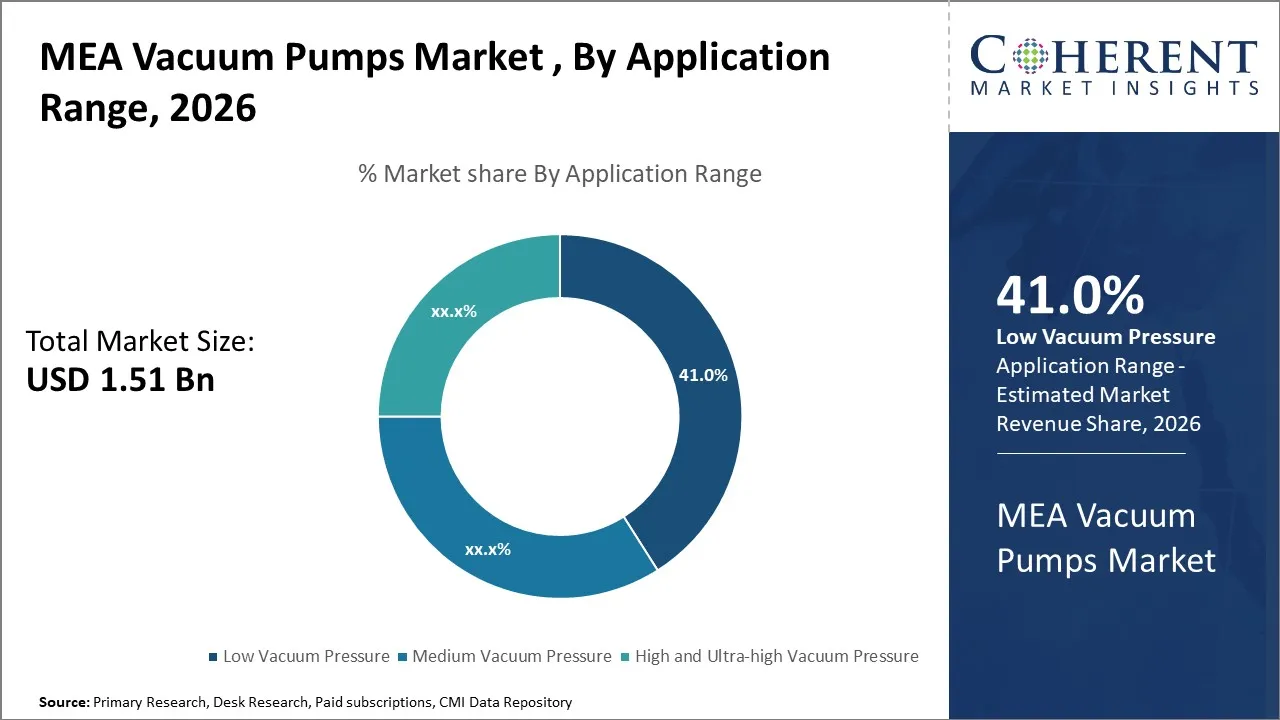
MEA Vacuum Pumps Market Insights, By Application Range - Low vacuum pumps segment is the dominant segment
Low Vacuum pumps accounted for approximately 41% market share in 2026. Low Vacuum Pump segment dominates due to many applications in chemical processing, food packaging, and industrial drying operations. They are most economical and versatile choice when compared to the other pump types for less demanding Vacuum applications across many industries.
In April 2025, Ingersoll Rand announced the launch of its next-generation low vacuum pump systems designed for chemical processing plants in the Middle East, focusing on improved energy efficiency and reduced lifecycle costs.
MEA Vacuum Pumps Market Insights, By Types - The Dry vacuum pumps segment is the dominant segment.
The dry vacuum pumps held approximately 48% market share. Dry vacuum leads the market because they have no oil and have less negative environmental impact and lower maintenance costs. Industries such as pharmaceuticals and electronics require contamination-free environments will be able to use dry vacuum pumps more often.
On June 10, 2025, Edwards vacuum introduced an advanced dry vacuum pump series in the UAE targeting semiconductor and pharmaceutical industries, emphasizing oil-free operation and reduced carbon emissions.
MEA Vacuum Pumps Market Outlook: Region-wise
Middle East remains at the Epicenter of Market with approximately 68% of the market Share.
The MEA vacuum pumps market is largely driven by the Middle East which continues to be major force in oil & gas, petrochemicals, and large-scale industries. The demand for advanced vacuum systems is being maintained by high levels of capital investment in refinery expansions and chemical processing plants.
- Saudi Arabia: Saudi Arabia is leading the region with multiple refinery modernization projects and expansion of petrochemical projects under Vision 20230. This is creating a significant increase in the usage of vacuum pumps throughout Saudi Arabia.
- UAE: The UAE has diversified its economy into manufacturing, food processing and smart industrial infrastructure as well as energy efficient and dry vacuum pumps to support this growth.
Africa remains the Fastest-Growing Region of Market:
Africa has the fastest growth in the MEA Vacuum Pumps Market with a projected CAGR of 8.3% from 2026 to 2033. Rising industrialization, infrastructure development, and increases in foreign direct investment are all key factors driving this in Africa.
- South Africa: South Africa is experiencing strong growth as a result of its well-established mining and industrial base, where vacuum pumps are used extensively in material handling and processing application.
- Nigeria: The expansion of oil refining capacity in Nigeria along with increasing investments in energy infrastructure will significantly drive demand for vacuum pump systems in Nigeria.
Market Report Scope
MEA Vacuum Pumps Market Report Coverage
| Report Coverage | Details | ||
|---|---|---|---|
| Base Year: | 2025 | Market Size in 2026: | USD 1.51 Bn |
| Historical Data for: | 2020 To 2024 | Forecast Period: | 2026 To 2033 |
| Forecast Period 2026 to 2033 CAGR: | 7.1% | 2033 Value Projection: | USD 2.45 Bn |
| Geographies covered: |
| ||
| Segments covered: |
| ||
| Companies covered: | Gardner Denver, Inc., Sterling SIHI GmbH, Pfeiffer Vacuum GmbH, Ebara Corporation, ULVAC, Inc., Dekker Vacuum Technologies, Inc., Oerlikon Leybold Vacuum GmbH, Graham Corporation, Atlas Copco AB, and Tuthill Corporation | ||
| Growth Drivers: |
| ||
MEA Vacuum Pumps Market Driver
Increasing Activities Related to oil and gas expansion
There are ongoing investments into upstream and downstream operations due to the Middle East being a major source of oil worldwide. As such, and given that vacuum pumps play a critical role in refining and processing operations, there is also a continual need for vacuum pumps in this region.
Manufacturing Growth and Economic Diversification
Countries such as the UAE and Saudi Arabia have taken steps to diversify their economies away from oil by investing in other sectors. Each of these additional economic sectors will continue to drive the need for vacuum pump systems.
MEA Vacuum Pumps Market Opportunity
Adoption of technologies to Save Energy
A growing emphasis on energy conservations and sustainability has resulted in many opportunities for manufacturers to create modern vacuum pumping systems with improved efficiency and lower power consumption. The development of industry and infrastructure within Africa creates many avenues for vacuum pump manufacturers to capitalize on unexploited markets.
Analyst Opinion (Expert Opinion)
- There will be a continue rise in the MEA market for vacuum pumps for many years to come due to significant needs from industry in their purchase and to keep up with policies and procedures related to oil & gas and manufacturing. The future of the vapor vacuum pump market will also be affected by the shift to dry and energy-efficient technology, which will provide long-term opportunities for those companies that invest in developing this technology in Africa with their continent’s developing economies.
Speak to the analyst
Want personalized insights?
Take the findings above to one of our principal consultants, or have the report rebuilt around the segments, geographies and competitors you actually track.
MEA Vacuum Pumps Market News
- On September 12, 2025, Gardner Denver introduced high-efficiency vacuum systems tailored for African chemical and food processing industries
Market Segmentation
- MEA Vacuum Pumps Market, By Application Range
- Low Vacuum Pressure
- Medium Vacuum Pressure
- High and Ultra-high Vacuum Pressure
- MEA Vacuum Pumps Market, By Types
- Entrapment Pumps
- Adsorption Pump
- Getter Pump
- Cyropump
- Condenser Pump
- Gas Transfer Pumps
- Positive Displacement Pumps
- Kinetic Vacuum Pumps
- MEA Vacuum Pumps Market, By End-use Application
- Oil & Gas
- Industrial and Manufacturing
- Power
- Chemical Processing
- Semiconductor and Electronics
- Others (Pharmaceutical, Aviation)
- MEA Vacuum Pumps Market, By Region
- MEA
- Iran
- Iraq
- GCC Countries
- North Africa
- South Africa
- Rest of MEA
- Key Players
- Gardner Denver, Inc.,
- Sterling SIHI GmbH,
- Pfeiffer Vacuum GmbH,
- Ebara Corporation,
- ULVAC, Inc.,
- Dekker Vacuum Technologies, Inc.,
- Oerlikon Leybold Vacuum GmbH,
- Graham Corporation,
- Atlas Copco AB,
- Tuthill Corporation
Sources
Primary Research interviews
- Industry experts
- Vacuum pump manufacturers
- Distributors and suppliers
- Maintenance and service providers
- End-users across oil & gas, chemical, power, and water treatment industries in MEA
Databases
- International Trade Centre (Trade Map)
- United Nations Comtrade Database
- World Bank Open Data
- International Monetary Fund
- Organisation for Economic Co-operation and Development
Magazines
- Chemical Engineering Magazine
- Oil & Gas Middle East
- World Pumps Magazine
- Processing Magazine
Journals
- International Journal of Fluid Machinery and Systems
- Journal of Petroleum Technology
- Desalination Journal
- Journal of Mechanical Engineering Science
Newspapers
- Gulf News
- Arab News
- The National
- Business Day Nigeria
Associations
- Hydraulic Institute
- European Vacuum Society
- Society of Petroleum Engineers
- International Water Association
Public Domain sources
- Ministry of Energy websites (UAE, Saudi Arabia, South Africa)
- National statistical agencies across MEA countries
- Company annual reports and investor presentations
- Government publications and regulatory authority reports
- Import-export data portals and customs statistics
Proprietary Elements
- CMI Data Analytics Tool
- Proprietary CMI Existing Repository of Information for the Last 8 Years
Get access to 250+ pages report
Every segment, forecast, competitor profile and data table behind the analysis above — available for instant download.
- ESOMAR Member
- ISO 9001:2015 Certified
- D-U-N-S Registered
- GDPR & CCPA Compliant
Missing comfort of reading report in your local language? Find your preferred language:
Transform your Strategy with Exclusive Trending Reports
Frequently Asked Questions
The fundamental influences for vacuum pump sector are a strong demand experience by the oil and gas, chemical and manufacturing industries and growing levels of industrialization throughout these areas.
Dry vacuum pumps will drive growth within the oil & gas segment, as they are extensively used in refining and petrochemical operations. In additions, dry vacuum pumps lead in terms of market share for vacuum pump type due to their high efficiency and low maintenance requirements.
The Middle East continues to dominate this market because of its large amounts of oil reserves, existing refining capacity, and ongoing investments in industrial development
Some of major trends in this sector include dry vacuum pump adoption, the use of artificial intelligence for predictive maintenance purposes, and growing interest and need for energy-efficient solutions.
Africa presents excellent potential for growing the vacuum pump industry, particularly due to the amount of ongoing industrialization and construction activities occurring, as well as increased oil and gas activity in Nigeria and South Africa.