

Europe Telematics Software And Service Market Size and Forecast – 2026 to 2033
The Europe Telematics Software And Service Market is anticipated to grow at a CAGR of 9.2% with USD 18.6 Bn in 2026 and is expected to reach USD 36.3 Bn in 2033. The growing adoption of connected fleet management solutions drives the Europe Telematics Software and Service Market. According to our research, Fleet Management Market is estimated to be surpass USD 58 Bn in 2033.
Key Takeaways
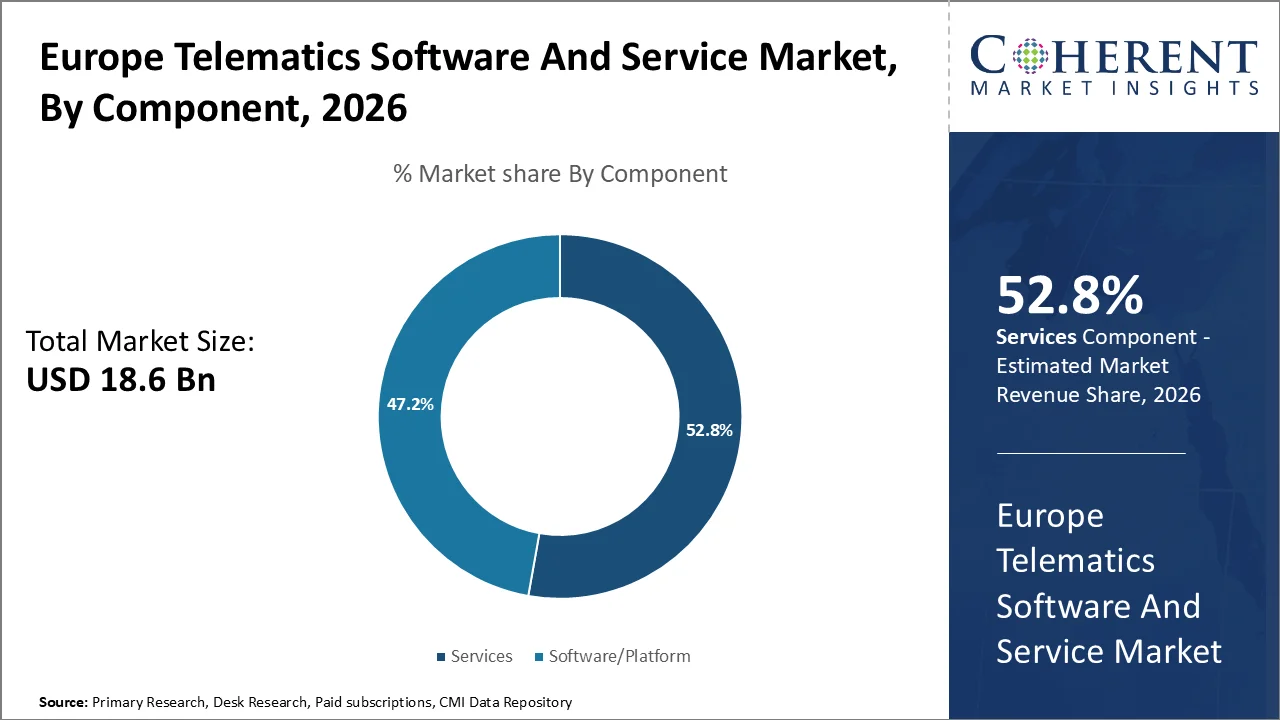
- Services hold the largest market share of 52.8% in 2026 owing to its growing fleet management demand.
- SaaS expected to hold largest market share of 53.7% in 2026 owing to the expansion of connected vehicle ecosystems. By 2025, the global number of connected cars is projected to exceed 400 million, increasing from approximately 237 million in 2021.
- Vehicle Tracking/Recovery (Fleet Management) acquired the largest market share of 42.2% in 2026 owing to its increasing need for real-time fleet visibility.
- Behavioral Management captures the largest market share of 38.8% in 2026 owing to the increasing focus on road safety. Road traffic crashes cause approximately 1.19 million deaths globally each year. In India, roads record over 480,000 accidents and 170,000 fatalities annually, despite ongoing highway modernization efforts.
- Germany is expected to acquire the dominant share of 41.1% in 2026 owing to the strong automotive manufacturing base. Car production in Germany rose to 377,700 units in June 2026, up from 301,600 units in May 2026.
Current Events and Their Impact on the Europe Telematics Software And Service Market
Current Event | Description and its Impact |
EU Data Act Implementation |
|
EU Digital Strategy Shift Toward Controlled Data Sharing (2025–2026 Policy Package) |
|
Segmental Insights
- Current Industry Events of 2026
- Market Size Estimation
- Regional Breakdown
- Competitive Landscape
- Customer Intelligence
- Segmental Analysis
- Pricing Analysis
- Key Market Drivers, Challenges & Future Trends
- Customized Insights Section
Why is Services Acquiring the Largest Market Share?
Services hold the largest market share of 52.8% in 2026. The services segment drives growth in the Europe Telematics Software and Service Market as organizations increasingly adopt connected vehicles and seek efficient fleet management solutions. Businesses invest in managed and professional services to streamline deployment, integrate systems, perform regular software updates, strengthen cybersecurity, and maintain regulatory compliance. They also leverage cloud-based telematics platforms, predictive maintenance, AI-powered analytics, and remote vehicle diagnostics to improve operational efficiency. These trends continue to increase demand for specialized telematics service providers across transportation, logistics, construction, utilities, and public mobility sectors. For instance, in April 2026, Chery Commercial Vehicle launched its Future Super Commercial Vehicle (FSCV) strategy at the Commercial Vehicle Show in Birmingham and introduced its DELIVAN brand globally. The company entered the UK and European markets as an OEM with a full offering that includes vehicles, charging, services, telematics, digital platforms, aftermarket support, and lifecycle solutions.
SaaS expected to hold largest market share
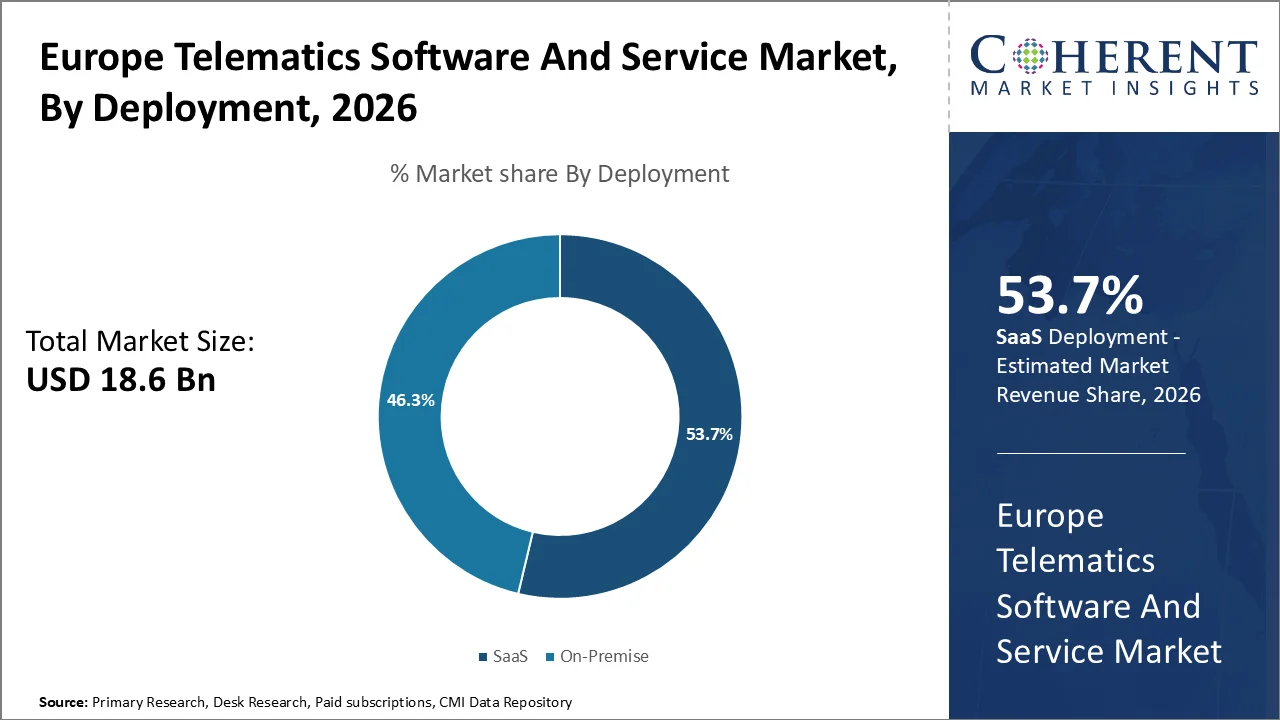
SaaS expected to hold largest market share of 53.7% in 2026 owing to the increasing demand for remote fleet management. Organizations drive growth in the SaaS segment of the Europe Telematics Software and Service Market by increasingly demanding scalable and cost-effective cloud-based fleet management solutions. They adopt SaaS platforms to monitor vehicles in real time, access systems remotely, enable automatic software updates, and integrate them with enterprise systems. Businesses use connected vehicles, AI-powered analytics, and predictive maintenance to enhance efficiency and support better decision-making. They also prefer subscription-based models for greater flexibility, lower infrastructure requirements, improved data security, and easy scalability across geographically dispersed fleets. For instance, Snapper Services launched the Mosaiq Go bus driver app in the UK and Ireland, enabling operators to improve service reliability and gain full visibility across bus and rail replacement networks.
Vehicle Tracking/Recovery (Fleet Management) acquired the largest market share
Vehicle Tracking/Recovery (Fleet Management) acquired the largest market share of 42.2% in 2026 owing to its expansion of E-commerce and last-mile delivery. Organizations drive the Vehicle Tracking and Recovery segment in the Europe Telematics Software and Service Market as they increasingly demand real-time fleet visibility and improved operational efficiency. They deploy tracking solutions to optimize routes, reduce fuel consumption, and enhance asset utilization. Companies adopt recovery-enabled systems due to rising concerns about vehicle theft and cargo security. Growth in e-commerce and last-mile delivery further drives demand for accurate tracking and timely deliveries. Advancements in GPS, IoT, and connected vehicle technologies also support market expansion. For instance, in May 2026, Geotab released its 2026 “Connected Fleets in Europe” report, analyzing insights from 1,817 fleet managers across the continent on current operational challenges. The findings show that fleet connectivity has become essential for building resilient operations across Europe, from construction fleets in Germany to last-mile delivery in France.
Which Application segment dominates the market?
Behavioral Management captures the largest market share of 38.8% in 2026. Organizations drive the Behavioral Management segment in the Europe Telematics Software and Service Market by placing greater emphasis on road safety and accident reduction. Approximately 19,940 people died in road traffic accidents in Europe in 2024, representing a 2% decrease compared with 2023. They use telematics to monitor driver behavior, including speeding, harsh braking, and fatigue, to enhance safety performance. Rising fuel costs push companies to promote efficient driving practices, while regulatory requirements ensure compliance with safety standards. Businesses adopt AI and video telematics to improve driver coaching and risk analysis. Usage-based insurance and sustainability goals also encourage safer and more responsible driving behavior.
Europe Telematics Software And Service Market Trends
- Growing adoption of connected and smart vehicles across Europe accelerates demand for advanced telematics software and services, enabling real-time tracking, diagnostics, and fleet optimization. According to Berg Insight, the installed base of active OEM embedded telematics systems in Europe reached approximately 83.3 million units in 2023 and is expected to continue growing as vehicle connectivity becomes standard.
- Rising emphasis on fleet efficiency and cost reduction encourages organizations to deploy telematics solutions for route optimization, fuel management, predictive maintenance, and improved asset utilization across logistics and transportation sectors. The European Commission estimates that road freight transport accounts for nearly 77% of inland freight transport in the EU, highlighting the large addressable market for fleet telematics.
- Expansion of electric vehicle (EV) fleets drives demand for telematics platforms that monitor battery health, charging status, and energy consumption. According to the European Automobile Manufacturers' Association (ACEA), battery-electric vehicles (BEVs) accounted for 15.4% of new EU passenger car registrations in 2024, reflecting continued growth in connected EV monitoring requirements.
Regional Insights
Germany dominates owing to growing adoption of connected and smart vehicles
Germany is expected to acquire the dominant share of 41.1% in 2026. Germany drives its telematics software and service market through its strong automotive manufacturing base and leadership in connected vehicle innovation. Its large logistics and transportation sector increase demand for fleet optimization, route efficiency, and real-time tracking solutions. Strict environmental regulations and sustainability goals push organizations to adopt fuel-efficient and low-emission fleet management systems. Rapid vehicle electrification, expanding 5G and IoT infrastructure, and rising demand for predictive maintenance and driver safety further support market growth across commercial and passenger vehicle segments. For instance, in October 2025, Webfleet and Questar Auto Technologies launched an AI-powered Predictive Vehicle Health Management (PVHM) solution. Webfleet uses AI algorithms to provide predictive insights that help fleet managers plan maintenance proactively and improve efficiency.
UK Telematics Software And Service Market Trends
Organizations in the UK drive the telematics software and service market through strong demand for efficient fleet management and real-time vehicle tracking across logistics, transportation, and service industries. They respond to growing concerns over road safety and rising insurance costs by adopting driver monitoring and behavioral analytics solutions. Approximately 128,000–133,000 road accidents occur annually on UK roads. Expanding e-commerce and last-mile delivery operations push companies to rely more on telematics for route optimization and timely deliveries.
Who are the Major Companies in Europe Telematics Software And Service Industry
Some of the major key players in Europe Telematics Software And Service are MiX Telematics, Octo Telematics, Trimble INC, Verizon, Aplicom, Astrata and Key Telematics.
Key News
- In April 2026, Volkswagen Commercial Vehicles launched Connect Pro, an upgraded telematics system that gives fleet managers real-time visibility to improve efficiency, reduce costs, and lower operational risks.
Market Report Scope
Europe Telematics Software And Service Market Report Coverage
| Report Coverage | Details | ||
|---|---|---|---|
| Base Year: | 2025 | Market Size in 2026: | USD 18.6 Bn |
| Historical Data for: | 2020 To 2024 | Forecast Period: | 2026 To 2033 |
| Forecast Period 2026 to 2033 CAGR: | 9.2% | 2033 Value Projection: | USD 36.3 Bn |
| Geographies covered: |
| ||
| Segments covered: |
| ||
| Companies covered: | MiX Telematics, Octo Telematics, Trimble INC, Verizon, Aplicom, Astrata and Key Telematics | ||
Analyst Opinion
- The Europe telematics software and service market is not expanding due to incremental digital trends alone; it is being structurally reshaped by regulatory pressure, fleet inefficiencies, and the hard economics of transport operations. Road transport accounts for around three-quarters of inland freight movement in the EU, which makes fleet visibility and optimization a non-negotiable operational requirement rather than a technology upgrade. This scale of dependence forces enterprises to adopt telematics as a core infrastructure layer, not an optional tool.
- Fleet compliance is a major non-discretionary driver. EU mobility and road safety frameworks, including strict enforcement of driver working hours through digital tachographs, cover millions of commercial vehicles across Europe, compelling operators to digitize monitoring and reporting. In Germany alone, authorities conduct over 400,000 roadside inspections annually, reinforcing the need for continuous compliance tracking through telematics systems rather than manual reporting mechanisms.
- Fuel economics further intensify adoption pressure. Fuel typically represents up to one-third of total fleet operating costs, and even marginal inefficiencies such as idling or route deviation materially impact profitability at scale. Large logistics operators have demonstrated that telematics-based route optimization can reduce unnecessary mileage by 5–15% in real-world deployments, making the business case immediate and measurable rather than theoretical.
- The shift toward connected fleets is also being enforced by OEM integration rather than aftermarket preference. A growing share of new commercial vehicles in Europe now ship with embedded telematics capabilities, with leading manufacturers such as Mercedes-Benz Group and Volvo Group integrating fleet connectivity platforms directly into vehicle architecture. This is fundamentally changing market dynamics, shifting telematics from hardware-dependent installations to software-defined fleet ecosystems.
- Electric fleet expansion is adding another layer of dependency. Battery-electric commercial vehicle deployments in Europe are scaling rapidly, and operators increasingly rely on telematics to monitor state-of-charge, charging cycles, and route feasibility in real time. Without these systems, electric fleet utilization becomes operationally constrained rather than optimized, making telematics a prerequisite for electrification rather than a support tool.
- Overall, Europe’s telematics market is being driven less by innovation cycles and more by operational necessity, compliance enforcement, cost compression, and fleet electrification are forcing adoption at an enterprise infrastructure level rather than a discretionary software decision.
Speak to the analyst
Want personalized insights?
Take the findings above to one of our principal consultants, or have the report rebuilt around the segments, geographies and competitors you actually track.
Market Segmentation
- By Component (Revenue, USD Bn, 2021-2033)
- Software/Platform
- Services
- By Deployment (Revenue, USD Bn, 2021-2033)
- On-Premise
- SaaS
- By Solutions (Revenue, USD Bn, 2021-2033)
- Vehicle Tracking/Recovery (Fleet Management)
- Intrusion Detection
- Analytics & Reporting
- Others
- By Application (Revenue, USD Bn, 2021-2033)
- Secured onboard communication
- Behavioral Management
- Emergency Calling /Alerts
- Fuel Management
- Route Planning
- Vehicle maintenance and monitoring
- By Region (Revenue, USD Bn, 2021-2033)
- Europe
- UK
- France
- Germany
- Spain
- Italy
- Russia
- Rest of Europe
- Europe
Sources
Primary Research interviews
- Fleet management solution providers and telematics software vendors across Europe
- Logistics and transportation fleet operators using GPS tracking and behavioral analytics systems
- Automotive OEM connectivity and embedded telematics solution teams
- Insurance companies offering usage-based insurance (UBI) programs
- Commercial vehicle leasing and rental fleet managers
Databases
- Eurostat transport and logistics databases
- European Commission mobility and transport data portals
- National transport authority datasets across Germany, UK, France, and Italy
- Open vehicle registration and commercial fleet datasets
- EU Open Data Portal
Magazines
- Fleet Europe Magazine
- Automotive Logistics Magazine
- Transport Engineer
- Automotive World Europe coverage
- Logistics Manager publications
Journals
- IEEE Transactions on Intelligent Transportation Systems
- Transportation Research Part C: Emerging Technologies
- Journal of Intelligent & Connected Vehicles
- International Journal of Automotive Technology and Management
- European Transport Research Review
Newspapers
- Financial Times (Transport and Automotive sections)
- Reuters mobility and automotive coverage
- The Guardian (transport and environment reporting)
- Handelsblatt (Germany business and mobility coverage)
- Les Echos (France industry reporting)
Associations
- European Automobile Manufacturers’ Association (ACEA)
- International Road Transport Union (IRU)
- European Transport Safety Council (ETSC)
- ITS Europe (Intelligent Transport Systems Europe)
- Freight Transport Association networks across EU countries
Public Domain sources
- European Commission Mobility and Transport reports
- National government transport and road safety publications
- World Bank transport and infrastructure datasets
- United Nations Economic Commission for Europe (UNECE) transport data
- OECD transport and logistics statistics
Proprietary Elements
- CMI Data Analytics Tool
- Proprietary CMI Existing Repository of information for last 10 years
Get access to 250+ pages report
Every segment, forecast, competitor profile and data table behind the analysis above — available for instant download.
- ESOMAR Member
- ISO 9001:2015 Certified
- D-U-N-S Registered
- GDPR & CCPA Compliant
Missing comfort of reading report in your local language? Find your preferred language:
Transform your Strategy with Exclusive Trending Reports
Frequently Asked Questions
The Europe Telematics Software And Service Market is anticipated to grow at a CAGR of 9.2% with USD 18.6 Bn in 2026 and is expected to reach USD 36.3 Bn in 2033.
The market is expected to witness a CAGR of 9.2% during the forecast period.
In the market, sales of high-end vehicles such as sports utility vehicles (SUVs), luxury vehicles is increasing, owing to the rising disposable income of people in many European countries. For instance, according to Stratagem Market Insights, in the year 2019, among the top five high disposable income countries, three are European countries, which is boosting the sales of high-end vehicles in the region.
The Vehicle Tracking/Recovery (Fleet Management) segment held the largest market share among solutions.
Germany region held the largest share in the market.
Key players operating in the market include MiX Telematics, Octo Telematics, Trimble INC, Verizon, Aplicom, Astrata and Key Telematics.