

Affective Computing Market Analysis & Forecast
The Global Affective Computing Market size is estimated to be valued at USD 100.96 Bn in 2026 and is expected to reach USD 473.37 Bn by 2033, exhibiting a compound annual growth rate (CAGR) of 24.7% from 2026 to 2033.
Key Takeaways
- By Component, the Software segment is projected to lead the global Affective Computing Market outlook with a 64.1% share in 2026.
- By Technology, the Touch-based segment is expected to dominate the market with a 57.6% share in 2026.
- By End-use Industry, Healthcare sector is anticipated to drive adoption, accounting for 47.2% of the market share in 2026.
- By Region, North America is forecasted to hold the largest market share at 38.7% in 2026.
Market Overview
The Global Affective Computing Market growth can be attributed to rising demand for advanced conversational artificial intelligence and increased focus on integrating human emotions with machines. Growing need for contactless biometrics and ambient computing experience across industries is further expected to fuel the market expansion. Adoption of affective technology solutions is increasing across various verticals such as BFSI, healthcare, government & defense, IT & telecom, and retail among others due to their ability to offer personalized customer experience and optimize operational efficiencies through emotional data analytics. Integration of affective computing with augmented reality and virtual reality is also anticipated to create new business opportunities for market players. However, complex design and high costs associated with affective computing systems may hamper the market growth.
Current Events and Its Impact on the Affective Computing Market
Event | Description and Impact |
EU Artificial Intelligence Act Implementation (2025) |
|
Semiconductor Supply Chain Developments |
|
Healthcare Sector Breakthroughs |
|
Pricing Analysis
The affective computing market features diverse pricing across software, hardware, and industry-specific solutions driven by AI and IoT advances.
Software pricing ranges from $5,000–$20,000/year for basic SDKs to $50,000–$500,000+ for enterprise multimodal platforms. Cloud APIs charge $0.02–$0.50 per emotion analysis call. Biometric sensors cost between $150 and $5,000 depending on type and sophistication.
Industry solutions vary: healthcare patient monitoring systems cost $10,000–$50,000 per bed; mental health platforms charge $30–$150/user/month. Retail analytics range from $2,000 to $10,000 per location monthly, with CRM integrations up to $250,000 annually. Automotive driver monitoring costs $200–$800 per vehicle.
Enterprise contracts show pricing tiers: healthcare from $50K entry to $2M+ enterprise; retail $20K to $1M+; education $10K to $500K+.
Regionally, North America commands a 20-35% premium, Europe adds 15-25% GDPR surcharges, and Asia-Pacific solutions are 40-60% cheaper. Emerging trends include performance-based pricing, Emotion-as-a-Service models, and growing open-source adoption.
ROI for large investments typically spans 18-24 months, reflecting growing market maturity and integration complexity.
- Current Industry Events of 2026
- Market Size Estimation
- Regional Breakdown
- Competitive Landscape
- Customer Intelligence
- Segmental Analysis
- Pricing Analysis
- Key Market Drivers, Challenges & Future Trends
- Customized Insights Section
Role of Emerging Technologies
Affective computing is rapidly advancing by bridging human emotions with machine intelligence to enable more intuitive and empathetic interactions. Key technological trends include the integration of emotion recognition into everyday devices such as smartphones, wearables, automotive systems, and virtual assistants. This progress is powered by improvements in machine learning, computer vision, and natural language processing, allowing real-time analysis of facial expressions, voice tone, and context.
Beyond recognition, emerging innovations focus on simulating emotions in machines, with virtual agents and emotionally adaptive chatbots enhancing personalization. Emotionally intelligent robots are also gaining traction in healthcare, education, and customer service.
The use of biometric sensors—like heart rate monitors, skin conductance, and eye-tracking—adds deeper physiological insights for accurate emotion detection, particularly benefiting healthcare applications by enabling real-time monitoring of emotional well-being.
Industry adoption is accelerating with new product launches embedding affective computing into automotive safety systems, immersive gaming, and virtual reality experiences. These technologies improve emotion recognition accuracy and foster adaptive, user-friendly interfaces across sectors.
While offering vast opportunities for personalized consumer insights and engagement, affective computing faces challenges around data privacy, algorithmic bias, and ethical use. Responsible development and regulation will be critical to unlocking its full transformative potential.
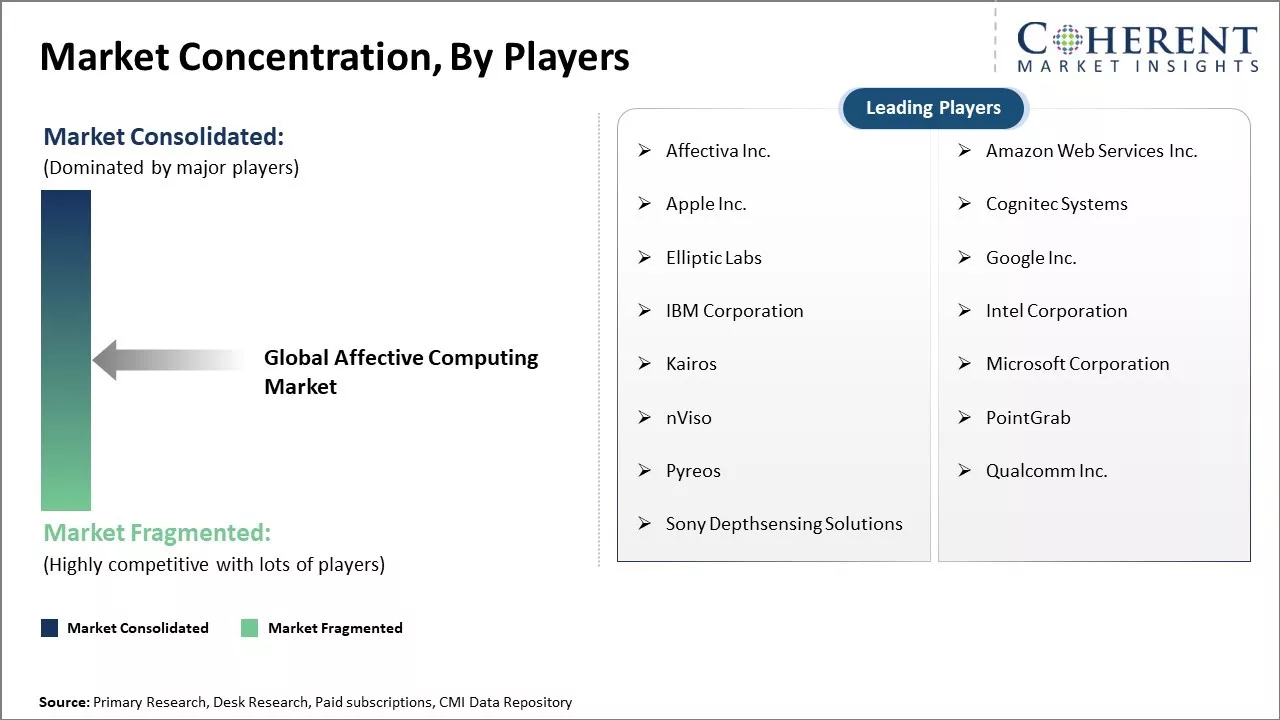
Market Concentration and Competitive Landscape
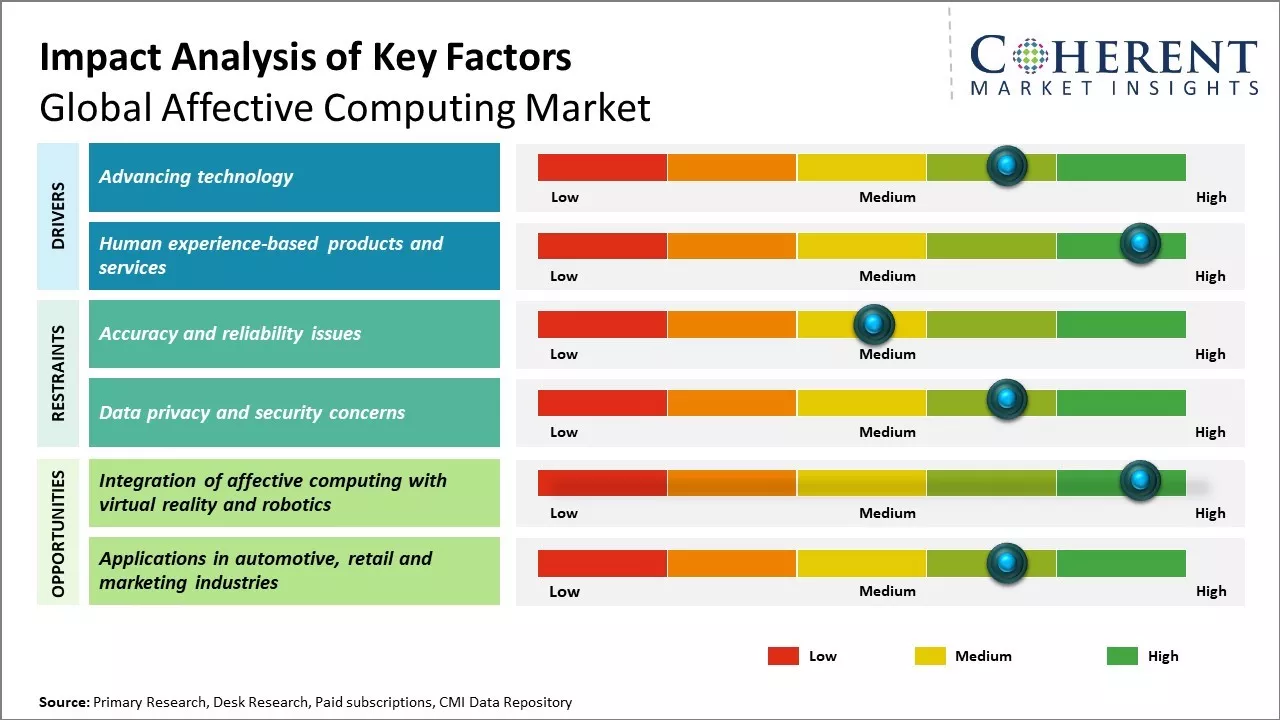
Drivers of the Market
- Advancing technology
One of the major drivers for the growth of the global affective computing market forecast is the rapid advancement in various technologies such as artificial intelligence, cloud computing, sensor technologies, and neuroscience. The development of artificial intelligence and machine learning technologies has enabled companies to create solutions capable of deciphering human emotions and feelings. New sophisticated technology is being developed that recognizes different types of faces, body language, and voice tones, and understands the feelings associated with conversations. This assist machines and computers to interpret human emotions.
At the same time, the wide-spread use of cloud computing is enabling the creation of advanced affective computing solutions. Emotion recognition software and affiliated technologies can be improved based on the vast data available on cloud. The results obtained from deep learning and the tests performed on recognition of emotions can be stored in the cloud and analyzed to be further improved. This is quite helpful to technology companies to create more advanced and human-friendly affective computing tools. Furthermore, there is a rapid development in the miniaturization of a variety of sensors such as cameras, microphones, EEG sensors, etc. which enables their integration into different devices and equipment. Advanced sensors that capture subtle human actions, changes, and physiological signals are now being embedded in wearables, smartphones, and computers which aid in emotion detection.
Human experience-based products and services
With user experience emerging as a pivotal factor for brand differentiation, leading technology firms and institutions are adopting affective computing to deepen their understanding of user engagement with devices and services. Considerable attention is being paid to the development of solutions, devices, platforms, and applications that can automatically detect human emotions and adapt to provide more personalized and insightful interactions.
To illustrate, virtual assistants are being programmed to interpret the emotional context behind questions to respond with appropriate empathy. Similarly, voice assistants are enhancing their perception by adding tonality analysis to gauge user sentiment for adjusting responses. Customer service chatbots are also using affective computing to assess customer anger and escalate calls automatically to human operators when necessary. Beyond consumer technology, however, many sectors are understanding the relevance of affective computing for augmenting user and client interaction engagement.
Market Challenge
- Accuracy and reliability issues
One of the major challenges restraining the growth of affective computing market is issues related to accuracy and reliability of emotional recognition. Affective computing aims to recognize, interpret, process, and simulate human affects. However, existing technology has limitations in accurately recognizing human emotions through facial expressions, speech, text, physiological signals, etc. This is because human emotion is highly complex and influenced by various internal and external factors. What an AI system interprets as anger could be frustration or annoyance for humans.
Similarly, sadness could be due to temporary mood swings rather than a clinical condition. Inaccurate emotion detection can have negative consequences in several applications of affective computing like education, workplace monitoring, healthcare, and customer service. It can also severely impact user experience and trust in the technology.
The lack of labeled data for more granular and diverse human emotions is another factor contributing to accuracy issues. Most available databases only have labels for basic emotions like happy, sad, angry, fear, etc. They do not account for subtle variations and combinations of emotions experienced by humans on a daily basis. This limited labeled data restricts the ability of machine learning algorithms to truly understand complex human affects.
Market Opportunity
- Integration of affective computing with virtual reality and robotics
Integration of affective computing with virtual reality and robotics holds huge potential to drive growth in the global affective computing market in the coming years. Integrating this ability with technologies like VR and robotics can help build profoundly empathetic systems.
VR immerses users in simulated environments and allows for realistic social interactions and experiences. Coupling this with affective computing can enhance user experience tremendously. VR systems equipped with affective abilities may be able to understand users' emotional state and fine-tune the experience accordingly.
For example, a VR simulation meant for trauma therapy could detect if a user is getting distressed or anxious and automatically dial down frightening elements to alleviate their distress. On the other hand, an edutainment VR game may be able to sense enjoyment and raise the challenge level dynamically to maintain user engagement.
Affective computing also has the promise to revolutionize human-robot interactions. Robots integrated with affective skills may be able to understand human emotions, respond compassionately to emotional cues like tone of voice, and adapt their behavior to be more helpful, harmless and honest.
For example, socially assistive robots able to perceive stress or frustration in elderly users' speech may know to slow down instructions or offer emotional comfort. Researchers are also exploring how robots' own facial expressions and movements can be designed to appear warm, harmless and transparent based on human affect recognition feedback.
Affective Computing Market – Segmental Insights
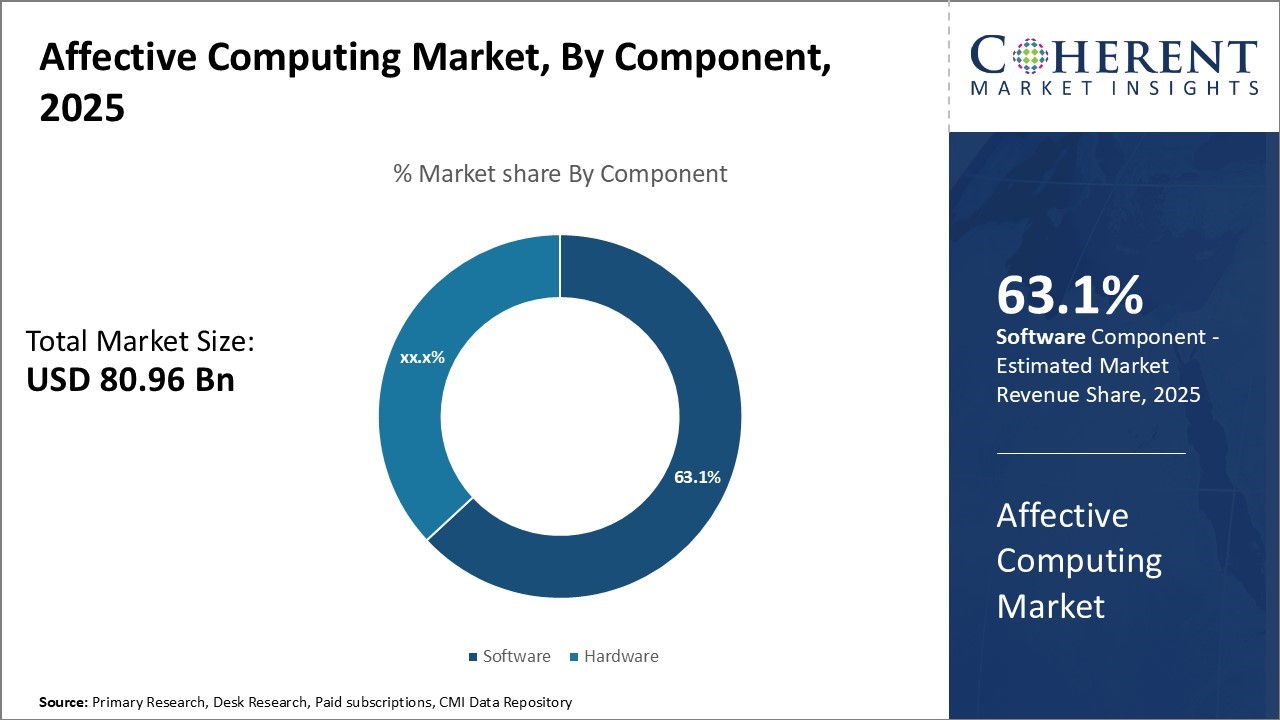
Affective Computing Market Insights, By Component
The software segment is projected to capture the largest share of the affective computing market demand in 2026, with an expected contribution of 64.1%. This expansion stems from the impact that complex software systems have on enabling various affective solutions throughout industries. In particular, software systems that are user-friendly and powerful are more sought after as developments in affective computing progress. These platforms enable organizations to utilize artificial emotions and advanced systems to create customized interactions between humans and computers.
For instance, advanced algorithms and programming can enable devices to analyze speech patterns for anxiety and modify responses accordingly, adjusting in real time. To enhance affective capabilities, continuous updates to software are crucial. Companies integrate new data processing techniques to strengthen the functionalities of emotional intelligence in their products, making it easier to retain competitive positions in rapidly changing markets. The flexible nature of software also allows easy incorporation of new hardware that comes with advancements in technological interfaces. As the use of affective technologies grows across different domains, there will be sustained strong demand for innovative software solutions.
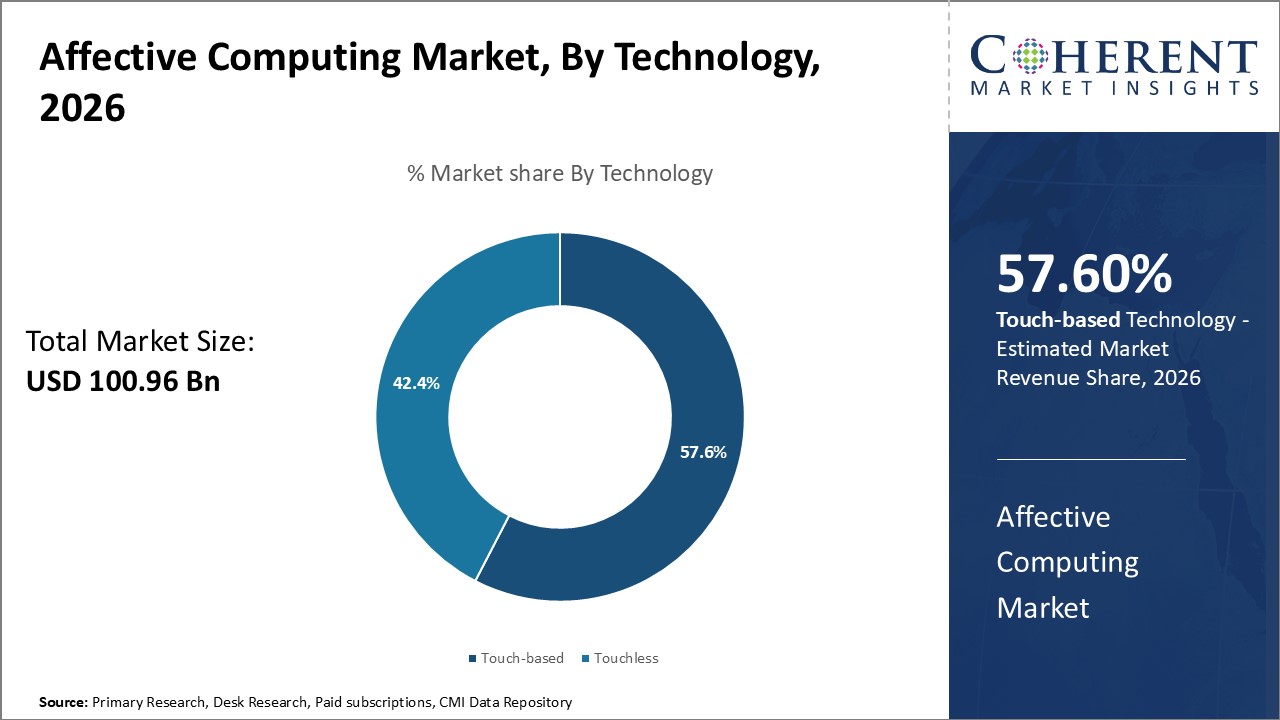
Affective Computing Market Insights, By Technology
The touch-based segment is anticipated to dominate the affective computing market value in 2026, capturing an impressive 57.6% share. This dominance stems from the intuitive nature of touch interfaces, which have become the primary mode of interaction with technology through devices such as smartphones, tablets, and laptops.
Touch-based affective systems are designed to detect subtle variations in user interactions, including touch patterns, pressure levels, and gestures, enabling them to interpret emotions and customize responses accordingly. Applications include interactive museum displays that gauge visitor engagement through touch and adaptive games that respond to stress levels indicated by grip pressure.
The widespread use of touchscreens has facilitated extensive research into affective algorithms, allowing for accurate emotion analysis even with limited datasets. Unlike other modalities that may require specialized hardware or are influenced by environmental factors, touch-based technologies provide a more straightforward and user-friendly approach. As reliance on touch interfaces continues to grow, the affective computing market is poised to leverage this technology to create advanced and accessible emotional solutions.
Affective Computing Market Insights, By End-use Industry
The healthcare sector is projected to account for the largest share of the affective computing market trend in 2026, with an estimated contribution of 47.2%. This growth is attributed to the significant advantages that affective computing offers, such as enhanced emotional detection and analysis, which can lead to improved patient care and provider support.
In healthcare, technologies that can detect and interpret emotional states are increasingly being integrated into patient management systems. For example, affective robots can monitor elderly patients for signs of isolation or mood changes that may indicate health issues. Similarly, virtual assistants equipped with affective computing capabilities can recognize stress levels in healthcare providers and suggest timely interventions, such as relaxation techniques.
Moreover, the ability to analyze large datasets from wearable devices and medical IoT technologies allows for a deeper understanding of the relationship between emotional states and health conditions. This could facilitate breakthroughs in personalized prevention and treatment strategies. As the healthcare industry faces challenges like aging populations and workforce shortages, the adoption of affective computing technologies is becoming essential for enhancing access to care, improving health outcomes, and ensuring quality of life for patients.
Regional Insights
North America Affective Computing Market Analysis and Trends
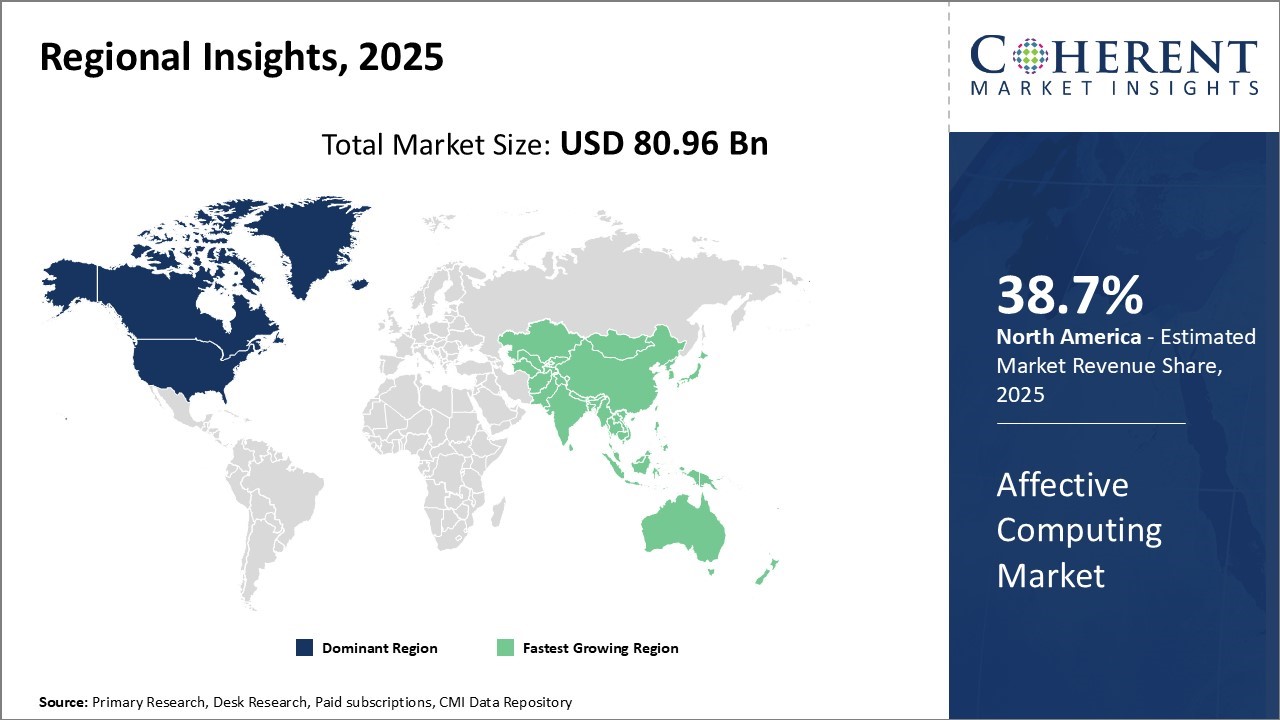
North America is projected to lead the global affective computing market with a 38.7% share in 2026, largely fueled by substantial R&D investments from prominent U.S.-based technology giants such as Microsoft, IBM, and Amazon. North America is at the forefront of the adoption of affective computing technologies due to the strong consumer electronics market and growing need for specialized applications in the healthcare, education, and marketing sectors. Additionally, the government’s funding for research and programs supporting new businesses has reinforced North America’s lead position. The U.S. remains a leader in this market because of ongoing innovation and collaborations, even with other regions experiencing rapid growth.
Asia Pacific Affective Computing Market Analysis and Trends
Asia Pacific, with China at the forefront, is recognized as the fastest growing region in the affective computing market in 2026. Aggressive investments by major Chinese tech companies like Baidu, Alibaba, and Tencent are driving development of AI-powered emotion recognition solutions tailored to local market needs.
The region benefits from a vast population, an expanding middle class, and strong government policies supporting future technology development. These factors collectively enable wide-scale deployment of affective computing products across e-commerce, education, entertainment, and smart city projects. The region’s skilled workforce and rising exports further contribute to its rapid market expansion.
Europe Affective Computing Market Analysis and Trends
Europe’s affective computing market growth is primarily driven by expanding applications in personal healthcare and evolving virtual assistant technologies. Leading technology firms such as SAP and Anthropic, headquartered in Germany and the U.K., are spearheading innovation, while regional startups explore opportunities in cybersecurity, automotive, and defense sectors.
However, market fragmentation and relatively lower R&D expenditure pose challenges to matching the innovation pace seen in North America and Asia Pacific. Nevertheless, demand from multinational corporations operating in the region sustains Europe’s notable market share and development trajectory.
Dominating Countries in the Affective Computing Market
United States Affective Computing Market Analysis and Trends
The U.S. commands the North American affective computing market, supported by a mature technology ecosystem and substantial investments in AI research. The country’s leadership in consumer electronics and enterprise AI solutions fosters ongoing innovation in emotion recognition platforms. Government initiatives and collaborations with academic institutions further strengthen the market, despite challenges such as data privacy regulations influencing technology deployment.
China Affective Computing Market Analysis and Trends
China stands out as a key driver within Asia Pacific’s affective computing segment, propelled by leading tech firms investing heavily in localized AI applications. A large domestic market, combined with favorable government policies and a growing talent pool, enables rapid commercialization and adoption across diverse sectors including smart retail, education, and urban development. The country’s export potential and strategic focus on future technologies position it as a critical player in the global affective computing landscape.
Market Report Scope
Affective Computing Market Report Coverage
| Report Coverage | Details | ||
|---|---|---|---|
| Base Year: | 2025 | Market Size in 2026: | USD 100.96 Bn |
| Historical Data for: | 2020 To 2024 | Forecast Period: | 2026 To 2033 |
| Forecast Period 2026 to 2033 CAGR: | 24.7% | 2033 Value Projection: | USD 473.37 Bn |
| Geographies covered: |
| ||
| Segments covered: |
| ||
| Companies covered: | Affectiva Inc., Amazon Web Services Inc., Apple Inc., Cognitec Systems, Elliptic Labs, Google Inc., IBM Corporation, Intel Corporation, Kairos, Microsoft Corporation, nViso, PointGrab, Pyreos, Qualcomm Inc., and Sony Depthsensing Solutions | ||
| Growth Drivers: |
| ||
| Restraints & Challenges: |
| ||
Key Takeaways from Analyst
- North America currently dominates the affective computing space, led by substantial investments in AI and presence of key players.
- However, Asia Pacific is expected to emerge as the fastest growing regional market, supported by rising electronics consumption and rapid digitization in countries like China and India. As the prices of affective computing technologies decline, their adoption is likely to gain further momentum across developing economies of Asia Pacific and Latin America.
- While miniaturization of sensors, processors, and improved computing power will propel the market, high initial costs and technical complexities still impede the large-scale adoption of affective computing solutions.
- Data privacy and security issues also pose a challenge. However, increasing R&D in the areas of computer vision, facial expressions recognition and multi-model affective computing is likely to augment the capabilities of these solutions over time.
Affective Computing Market: Key Developments
- In May 2025, Affectiva, a subsidiary of Smart Eye AB, announced the integration of its emotion AI technology into advanced driver monitoring systems (DMS) for several European automotive manufacturers. The integration enables real-time analysis of driver drowsiness, distraction, and emotional states, enhancing in-vehicle safety and user experience.
- In February 2025, Microsoft Research unveiled EmotiNet, a deep learning-based affect recognition framework capable of interpreting microexpressions and voice inflections with 89% accuracy. The system is being tested for applications in healthcare diagnostics and remote education tools to improve empathy-driven interactions.
- In November 2024, IBM partnered with the University of Toronto to launch the Human-AI Empathy Lab, a research initiative focused on developing emotionally aware AI agents for use in customer service, mental health triage, and virtual education. The collaboration aims to accelerate responsible innovation in emotion-sensing AI.
- In September 2024, Realeyes, a London-based AI company, secured a multi-million-dollar contract with a major streaming platform to deploy its facial coding and attention measurement technology. The solution analyzes viewers’ emotional reactions to video content in real time, offering deep insights for content optimization and targeted advertising.
Market Segmentation
- By Component (Revenue, USD Bn, 2021 - 2033)
- Hardware
- Software
- By Technology (Revenue, USD Bn, 2021 - 2033)
- Touch-based
- Touchless
- By End-use Industry (Revenue, USD Bn, 2021 - 2033)
- Automotive
- BFSI
- Government
- Healthcare
- IT & Telecom
- Media & Entertainment
- Retail & E-commerce
- Others
- By Region (Revenue, USD Bn, 2021 - 2033)
- North America
- U.S.
- Canada
- Latin America
- Brazil
- Argentina
- Mexico
- Rest of Latin America
- Europe
- Germany
- U.K.
- Spain
- France
- Italy
- Russia
- Rest of Europe
- Asia Pacific
- China
- India
- Japan
- Australia
- South Korea
- ASEAN
- Rest of Asia Pacific
- Middle East
- GCC Countries
- Israel
- Rest of Middle East
- Africa
- South Africa
- North Africa
- Central Africa
- North America
- Key Players Insights
- Affectiva Inc.
- Amazon Web Services Inc.
- Apple Inc.
- Cognitec Systems
- Elliptic Labs
- Google Inc.
- IBM Corporation
- Intel Corporation
- Kairos
- Microsoft Corporation
- nViso
- PointGrab
- Pyreos
- Qualcomm Inc.
- Sony Depthsensing Solutions
Sources
Primary Research Interviews
- Healthcare Technology Providers
- BFSI Sector AI Solution Architects
- Government Defense AI Program Directors
- Retail Customer Experience Executives
- Others
Databases
- IBISWorld Market Intelligence
- Mordor Intelligence Affective Computing Dataset
- Factiva Business Database
- Others
Magazines
- TechCrunch (AI/ML Innovations Section)
- Wired (Emerging Technologies Coverage)
- IEEE Spectrum (Human-Machine Interaction Analysis)
- MIT Technology Review
- Others
Journals
- IEEE Transactions on Affective Computing
- Journal of Artificial Intelligence Research
- ACM Transactions on Interactive Intelligent Systems
- Others
Newspapers
- The Wall Street Journal (Technology Sector Updates)
- Financial Times (AI Market Trends)
- The Economist (Innovation in Computing)
- Others
Associations
- Association for the Advancement of Artificial Intelligence (AAAI)
- ACM Special Interest Group on Artificial Intelligence (SIGAI)
- IEEE Computational Intelligence Society
- Partnership on AI
- Others
Public Domain Sources
- U.S. Patent and Trademark Office (AI-Related Patents)
- National Institutes of Health (Emotion Recognition Studies)
- National Science Foundation (Human-Centered Computing Grants)
- World Health Organization (Healthcare AI Guidelines)
- Others
Proprietary Elements
- CMI Data Analytics Tool
- Proprietary CMI Existing Repository of Information (Last 8 Years)
*Definition: The Global Affective Computing Market consists of companies developing technologies that can interpret human emotions and sentiments. These technologies utilize techniques from psychology, computer science, and neuroscience to recognize, process, and replicate human affects such as emotions, moods, and feelings. Affective computing analyzes human facial expressions, speech, gestures, physiological measures, and other behaviors to evaluate personal psychological states and trait attributes. It has applications in domains such as marketing, health care, education, and human-computer interaction design.
Get access to 250+ pages report
Every segment, forecast, competitor profile and data table behind the analysis above — available for instant download.
- ESOMAR Member
- ISO 9001:2015 Certified
- D-U-N-S Registered
- GDPR & CCPA Compliant
Missing comfort of reading report in your local language? Find your preferred language:
Transform your Strategy with Exclusive Trending Reports
Frequently Asked Questions
The Affective Computing Market size is estimated to be valued at USD 100.96 Bn in 2026, and is expected to reach USD 473.37 Bn by 2033.
The CAGR of the global Market is projected to be 24.7% from 2026 to 2033.
Advancing technology and human experience-based products and services are the major factors driving the growth of global market.
Accuracy and reliability issues and data privacy and security concerns are the major factors hampering the growth of global affective computing industry.
In terms of component, the software segment is estimated to dominate the market in 2026.
Affectiva Inc., Amazon Web Services Inc., Apple Inc., Cognitec Systems, Elliptic Labs, Google Inc., IBM Corporation, Intel Corporation, Kairos, Microsoft Corporation, nViso, PointGrab, Pyreos, Qualcomm Inc., and Sony Depthsensing Solutions are the major players.
North America is expected to lead the global affective computing industry in 2026.