

Virtual and Augmented Reality Market Size and Share Analysis: 2026-2033
The Virtual and Augmented Reality Market size is anticipated to grow at a CAGR of 29.1% with USD 41.8 Bn in 2026 and is expected to reach USD 251 Bn in 2033. The growth is owing to the rising adoption of immersive technologies across gaming, education, healthcare, retail, manufacturing training, and enterprise collaboration. The advanced technologies like spatial computing, AI‑enabled 3D visualization, gesture tracking, haptic feedback, and cloud‑based rendering are improving user experience and operational efficiency. For example, the U.S. Department of Veterans Affairs deployed over 3,500 Virtual Reality (VR) headsets across more than 170 medical centers and outpatient clinics for training and therapy in 2024, thereby showing the growing real‑world adoption in healthcare sector.
Key Takeaways
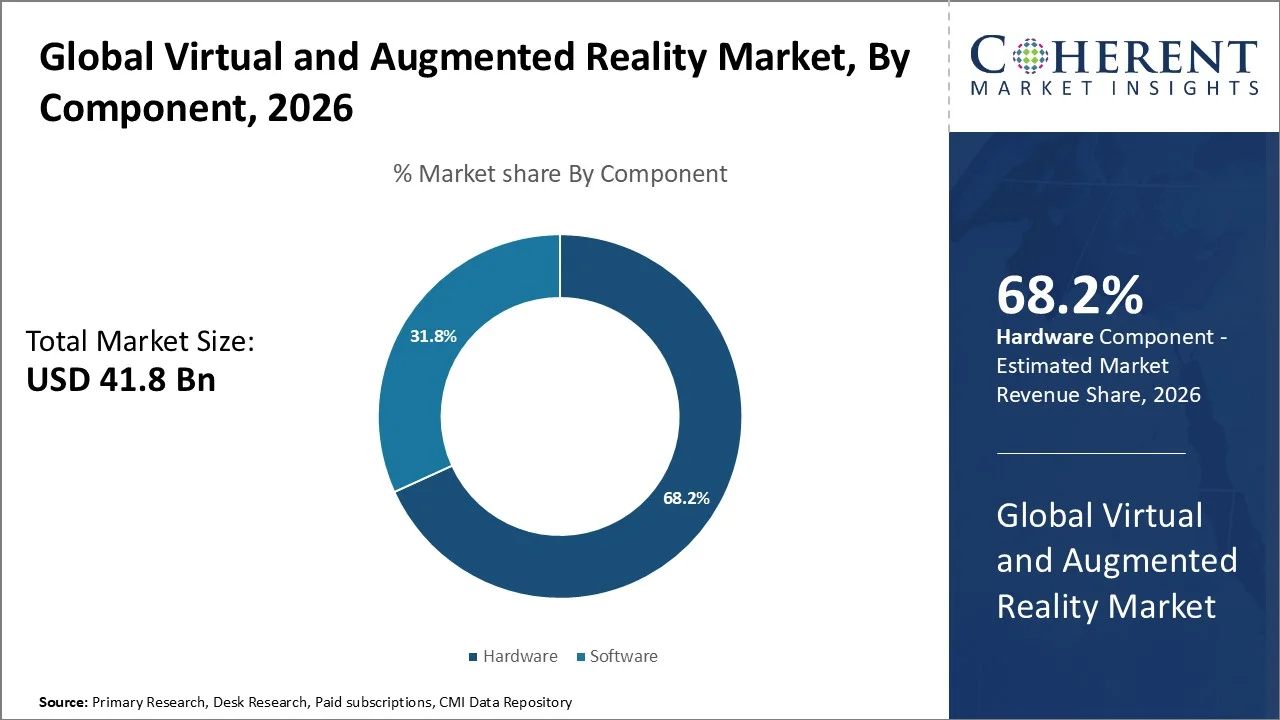
- The hardware segment is expected to account for the largest share of 68.2% in 2026. The segment’s growth is owing to the rising adoption of VR headsets, AR glasses, controllers, sensors, and mixed-reality devices in gaming, training, enterprise collaboration, and immersive content. For example, Meta introduced Quest 3S starting at USD 299.99,
- The gaming & entertainment segment is expected to hold 28.6% market share by 2026. The segment’s growth is owing to the increasing demand for immersive gameplay, virtual events, 3D entertainment, and interactive digital experiences. In the United States, around 205.1 million people regularly play video games. This creates a strong consumer base for the VR-based gaming and entertainment applications.
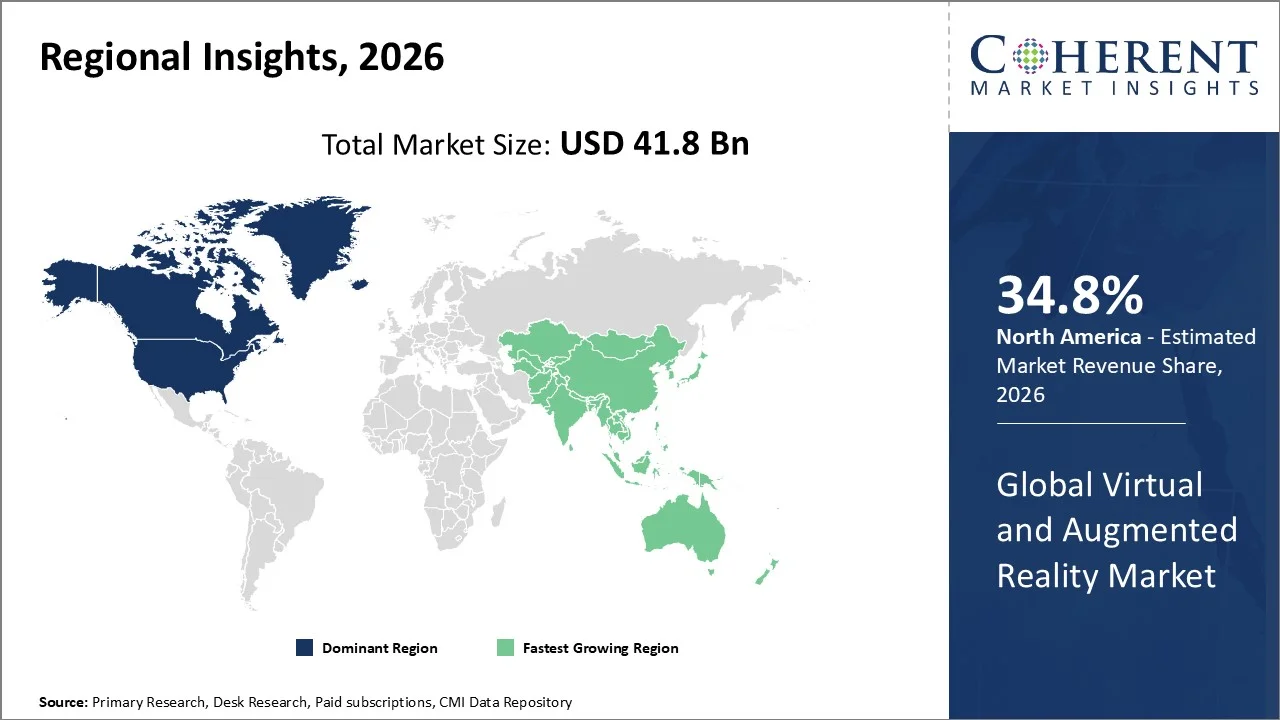
- North America is expected to acquire the dominant share of 34.8% in 2026. The region’s growth is owing to the strong presence of major technology firms, early adoption of mixed reality devices, and high gaming participation. For instance, Apple highlighted Vision Pro use cases across 3D design, employee training, and fieldwork, thereby strengthening the regional adoption.
Enterprise Training and Industrial Workflow Adoption is Transforming the Virtual and Augmented Reality Industry in the US
The adoption of Virtual and Augmented Reality (VR/AR) for enterprise training and industrial workflows is accelerating in the United States. This growth is mainly owing to the need for safer, more efficient employee training as well as operational support.
According to the National Center for Science and Engineering Statistics, nearly 0.5% of firms reported that they have been using augmented reality in 2020. The manufacturing sector specifically reported 0.4% of usage and 0.5% of testing, thereby indicating the early but also measurable adoption of immersive technologies.
The U.S. Bureau of Labor Statistics reported 2.5 million private-industry injury and illness cases in 2024, thereby highlighting a greater need for improved safety training solutions. In response, the firms are integrating VR/AR into procedural simulations, assembly guidance, as well as field-service workflows.
In July 2025, the US Army deployed an IVAS-based augmented reality tool for medic training. The tool allows for real-time procedural guidance and demonstrating VR/AR’s shift from experimental simulation to operational enterprise adoption.
AI-Powered XR Experiences and Digital Twins: A Key Advancement in Virtual and Augmented Reality
AI-powered XR experiences and digital twins are emerging as substantial advancements in the Virtual and Augmented Reality Market. These technologies assist industries in moving beyond simple visuals to real-time simulations, training, as well as better operational decisions.
According to the European Commission, the global virtual worlds market is projected to grow from €27 billion in 2022 to more than €800 billion by the year 2030. This demonstrates the increasing use of immersive digital environments in manufacturing, healthcare, and logistics sectors.
In addition, the Eurostat reported that nearly 73% of EU small and medium enterprises (SMEs) had reached at least a basic level of digital intensity in 2024, thus providing a strong foundation for the XR adoption in enterprise applications.
In December 2025, the European Commission started the European Partnership for Virtual Worlds. The goal was to support research, innovation, standards, and industrial use of XR-based digital twins.
- Current Industry Events of 2026
- Market Size Estimation
- Regional Breakdown
- Competitive Landscape
- Customer Intelligence
- Segmental Analysis
- Pricing Analysis
- Key Market Drivers, Challenges & Future Trends
- Customized Insights Section
Current Events and Their Impact on the Virtual and Augmented Reality Market
Current Event | Description and its Impact |
FinCEN CVC Kiosk Notice and U.S. State-Level Kiosk Rules (2025–2026) |
|
AUSTRAC Minimum Standards for Virtual and Augmented Reality Providers in Australia (2025–2026) |
|
Segmental Insights
Why is Hardware Segment Acquiring the Highest Share in the Market?
By component, hardware segment is projected to account for the largest Virtual and Augmented Reality Market share of 68.2% in 2026. The segment’s growth is owing to continuing demand for headsets, smart glasses, controllers, sensors, and displays as foundational enablers of immersive experiences.
The hardware adoption is also supported by tangible government use cases. As per the US GAO survey 17 out of 23 civilian federal agencies used immersive technologies like AR and VR in 2022–2023 for training, planning, as well as operations. This shows that such hardware is being used in government workflows.
In education, the U.K. Department for Education’s Technology in Schools Survey 2024–25 showcases the growing incorporation of VR/AR headsets in classroom technology planning, thereby underpinning the hardware use in the education sector.
A notable product development was Apple’s launch of Vision Pro in June 2023, thereby expanding premium spatial-computing hardware availability.
Gaming & Entertainment holds the Largest Market Share
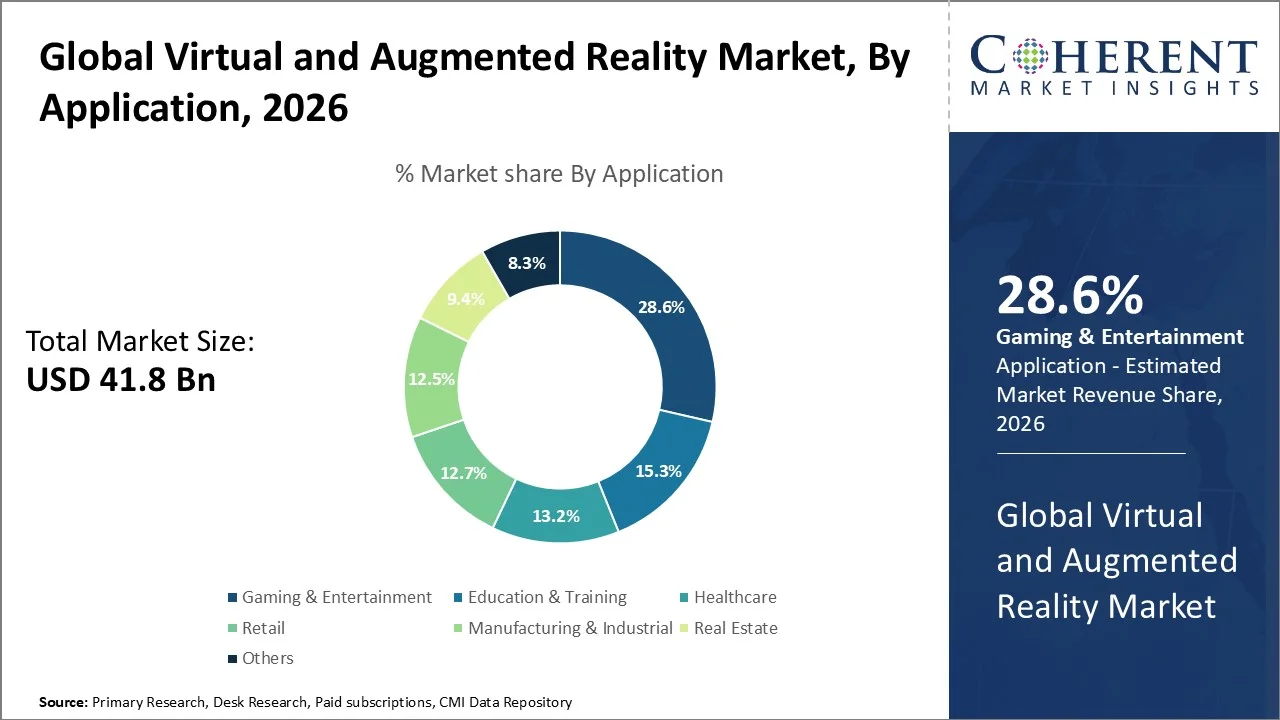
The gaming & entertainment segment is poised to dominate the market and account for a considerable 28.6% share in 2026. The segment’s growth is owing to the expanding gaming audience, increasing affordability of VR/AR headsets, as well as the rising demand for immersive, interactive, and social entertainment experiences.
According to the data from the UK government’s Video Games Research Framework, nearly 60% of adults aged 16 and above and 91% of children aged 3–15 play video games. This highlighting a large potential user base for VR and AR gaming. The Statistics Canada reported that about 15% of youth play online video games for 20 hours or more per week, thereby indicating strong engagement amongst the early adopters.
In January 2025, Sony Interactive Entertainment teamed up with Epic Games to integrate Unreal Engine 6 support in the PlayStation VR2 system. The system allows the developers to create higher-fidelity immersive VR gaming experiences and speeds up the adoption of cutting edge VR content.
Virtual and Augmented Reality Market Trends
- Lightweight AR glasses and mixed-reality headsets is expanding the adoption by reducing device bulk, improving comfort, and supporting everyday AI-assisted experiences.
- Immersive gaming, spatial video, and 3D entertainment are accelerating the consumer usage, as platforms add large app libraries, controller support, and interactive content. The Apple Vision Pro works with over 1 million apps, more than 150 3D games, and over 250 Apple Arcade titles.
- Enterprise training, design review, and remote collaboration are gaining traction as VR enables simulated learning, safer practice, and faster onboarding across distributed teams. PwC found VR learners can train up to four times faster and become 275% more confident in applying skills after training.
- The healthcare adoption is growing with the AR-guided surgical visualization, VR rehabilitation, pain management, mental health therapy, as well as clinical training applications. The U.S. FDA noted that the AR/VR is used across surgery planning, intraoperative procedures, telemedicine, neurological care, and rehabilitation.
- AI-enabled smart glasses are shifting the market from bulky headsets toward wearable computing. The IDC reported global XR device shipments grew 44.4% in 2025 and forecast 33.5% growth in 2026, led mainly by smart glasses.
Regional Insights
North America Virtual and Augmented Reality Market Leadership Driven by Advanced Digital Health Adoption
North America is set to account for the leading position in the Virtual and Augmented Reality Market. The region occupies a substantial 34.8% share in 2026. The growth is mainly driven by the region’s advanced digital health adoption, enterprise XR deployment, and strong U.S. technology commercialization.
The FDA’s AR/VR medical device list shows 109 authorized AR/VR medical devices from January 2015 to October 2025. Thes include surgical navigation, rehabilitation, ophthalmic, and pain-management applications, thereby highlighting strong U.S. clinical and regulatory activity.
In Canada, Statistics Canada’s 2022 Survey of Advanced Technology reported that 1.1% of enterprises adopted virtual reality, augmented reality, or mixed reality technologies. It also noted that nearly 62.1% adopted at least one advanced technology, thereby indicating a broader base for future XR integration.
In September 2025, Boston-based XRHealth launched XR CareCart, a multifunctional virtual reality rehabilitation station. It delivers immersive therapy for mobility, balance, range of motion, and pain relief, making advanced XR-based physical therapy accessible in clinics, hospitals, and community settings
Asia Pacific Virtual and Augmented Reality Market Trends
The Asia Pacific region is poised to be as the fastest-growing region through 2026-2033. The region’s growth is owing to the increasing enterprise adoption, government support, and the expansion of 5G networks that enable immersive content.
China leads the region with its national VR plan, which aims to achieve a total virtual reality industry scale of over 350 billion yuan by 2026 and sell more than 25 million VR terminals, encompassing hardware, software, and applications.
South Korea is also advancing XR adoption through public investment. The Ministry of Science and ICT announced a 400 billion won Virtual Convergence World Fund in March 2025 to support metaverse development, AI-XR convergence, digital twins, as well as international expansion.
These initiatives are expected to boost device demand, accelerate local content creation, and expand enterprise use cases across manufacturing, education, and media in the region.
Increasing Consumer Adoption and Growing Medical Applications Accelerates Virtual and Augmented Reality Market in United States
The United States virtual and augmented reality market is expanding at a swift pace. This is due to the increasing consumer adoption and growing medical applications. The rising investments in VR/AR startups and the proliferation of affordable consumer headsets are also speeding up the market penetration.
An estimated 53 million adults in the US currently own a VR system, with 8% of non-owners actively planning to purchase one, according to Security.org. In healthcare, the FDA approved Luminopia, a VR-based prescription software for treating pediatric amblyopia, thereby validating the use of medical-grade VR therapies.
Concurrently, the federal research agencies like the NIH are funding AR-assisted surgical navigation systems, thereby propelling innovation. These factors collectively strengthen the market growth by enhancing both consumer engagement as well as clinical utility.
China Virtual and Augmented Reality Market Trends
The Virtual and Augmented Reality Market in China is driven by strong government support for digital transformation, increased adoption of immersive technologies in education, healthcare, and enterprise training, alongside the rising consumer interest in gaming and entertainment applications.
The State Council’s Action Plan for Virtual Reality and Industry Integration (2022–2026) targets 100 innovation-driven XR enterprises and 25 million VR/AR terminal units in sales by 2026, thereby signaling large-scale hardware deployment.
In August 2024, Meleap, a leading Japan-based augmented reality sports firm, has opened its global flagship store, Hado Arena, at the Shanghai Landmark Center in Hongkou District.
Who are the Major Companies in Virtual and Augmented Reality Industry
Some of the major key players in Virtual and Augmented Reality industry are Blippar Inc., Cyberglove Systems LLC., Daqri LLC, EON Reality, Inc., Google Inc., Infinity Augmented Reality Inc., Magic Leap, Inc., Meta Company, Metaio GmbH, Microsoft Corporation, Oculus VR, LLC, Osterhout Design Group (ODG), Qualcomm Inc., Samsung Electronics Co., Ltd., Vuzix Corporation.
Key News
- In March 2026, Jos Alukkas, a renowned Indian jewellery brand known for quality, innovation, and trendy designs, launched an Augmented Reality (AR) experience on its website. The AR feature, developed in partnership with mirrAR, allows customers to virtually try on jewellery directly from their smart devices.
- In March 2026, XR Global, Inc. launched the world’s first Augmented Reality (AR) online casino experience. The AR casino games are now available across iOS, Android, and the Immersive Web, setting a new standard for player engagement in iGaming.
- In March 2026, CBS News Sacramento launched a fully AR/VR-driven news studio, becoming the first television station in the Sacramento market to feature an augmented reality and virtual reality-enabled news set.
- In February 2026, Harwin introduced a 3D Virtual Showroom with an integrated Augmented Reality (AR) viewer. This platform allows engineers and customers to explore and interact with high-reliability connectors and cable assemblies in an immersive digital environment.
Market Report Scope
Virtual and Augmented Reality Market Report Coverage
| Report Coverage | Details | ||
|---|---|---|---|
| Base Year: | 2025 | Market Size in 2026: | USD 41.8 Bn |
| Historical Data for: | 2020 To 2024 | Forecast Period: | 2026 To 2033 |
| Forecast Period 2026 to 2033 CAGR: | 29.1% | 2033 Value Projection: | USD 251 Bn |
| Geographies covered: |
| ||
| Segments covered: |
| ||
| Companies covered: | Blippar Inc., Cyberglove Systems LLC., Daqri LLC, EON Reality, Inc., Google Inc., Infinity Augmented Reality Inc., Magic Leap, Inc., Meta Company, Metaio GmbH, Microsoft Corporation, Oculus VR, LLC, Osterhout Design Group (ODG), Qualcomm Inc., Samsung Electronics Co., Ltd., Vuzix Corporation. | ||
| Growth Drivers: |
| ||
| Restraints & Challenges: |
| ||
Analyst Opinion
- The Virtual and Augmented Reality (VR/AR) market is driven by widespread demand for immersive digital experiences across entertainment, education, healthcare, and industrial training. According to PwC, the Augmented reality (AR) and virtual reality (VR) are projected to add USD 1.5 trillion to the global economy by the year 2030. This indicates a foundational need for interactive solutions rather than mere trend adoption.
- Gaming and live entertainment are major growth engines for the market, with an estimated 30 million active VR headset users worldwide in 2026, and nearly 1.02 billion AR-compatible device users. This shows that the adoption is mainly need-driven, as users seek richer experiences as well as enhanced interactivity.
- The enterprise and industrial applications like simulation-based training, remote collaboration, and healthcare visualization are gaining strong traction. The adoption studies indicate that over 85% of early enterprise users report improved productivity and engagement using AR/VR solutions, fueling wider deployment in both mature as well as emerging markets. This adoption momentum supports sustained investment in hardware, software, and content development.
Speak to the analyst
Want personalized insights?
Take the findings above to one of our principal consultants, or have the report rebuilt around the segments, geographies and competitors you actually track.
Market Segmentation
- By Component (Revenue, USD Bn, 2021-2033)
- Software
- Hardware
- Head Mounted Devices
- Input Systems
- By Application (Revenue, USD Bn, 2021-2033)
- Gaming & Entertainment
- Education & Training
- Healthcare
- Retail
- Manufacturing & Industrial
- Real Estate
- Others
- By Region (Revenue, USD Bn, 2021-2033)
- North America
- U.S.
- Canada
- Latin America
- Brazil
- Mexico
- Argentina
- Rest of Latin America
- Europe
- Germany
- U.K.
- France
- Italy
- Spain
- Russia
- Rest of Europe
- Asia Pacific
- China
- India
- Japan
- Australia
- South Korea
- ASEAN
- Rest of Asia Pacific
- Middle East
- GCC
- Israel
- Rest of Middle East
- Africa
- South Africa
- Central Africa
- North Africa
- North America
- Key Players
- Blippar Inc.
- Cyberglove Systems LLC.
- Daqri LLC
- EON Reality, Inc.
- Google Inc.
- Infinity Augmented Reality Inc.
- Magic Leap, Inc.
- Meta Company
- Metaio GmbH
- Microsoft Corporation
- Oculus VR, LLC
- Osterhout Design Group (ODG)
- Qualcomm Inc.
- Samsung Electronics Co., Ltd.
- Vuzix Corporation
Sources
Primary Research Interviews
- VR/AR Device Manufacturers
- VR/AR Content and Software Developers
- Hardware Component Suppliers (e.g., sensors, headsets, displays)
- Enterprise Solutions Integrators (AR/VR for healthcare, retail, industrial)
- Technology Consultants in Immersive Solutions
- Gaming and Entertainment Platform Providers
- Others
Databases
- Bloomberg Terminal
- Thomson Reuters Eikon
- Euromonitor International
- Others
Magazines
- VRScout
- AR Post
- Virtual Reality & Augmented Reality News
- Wired (Tech Section)
- TechCrunch (AR/VR Updates)
- Others
Journals
- IEEE Transactions on Visualization and Computer Graphics
- Journal of Virtual Reality and Broadcasting
- Computers & Graphics
- Presence: Teleoperators and Virtual Environments
- Others
Newspapers
- Financial Times (Technology Section)
- The Wall Street Journal (Tech)
- Reuters Technology
- Bloomberg News (AR/VR coverage)
- Others
Associations
- Virtual Reality and Augmented Reality Association (VRARA)
- IEEE VR Technical Committee
- Augmented Reality Enterprise Alliance (AREA)
- Consumer Technology Association (CTA) – AR/VR Focus
- Others
Public Domain Sources
- U.S. Department of Commerce – International Trade Administration (VR/AR Industry Reports)
- European Commission – Digital Economy & Society Statistics
- World Bank Open Data – Technology Adoption Indicators
- National Institute of Standards and Technology (NIST) – Immersive Tech Guidelines
- Others
Proprietary Elements
- CMI Data Analytics Tool
- Proprietary CMI Existing Repository of Market Data (Last 10 Years)
Get access to 250+ pages report
Every segment, forecast, competitor profile and data table behind the analysis above — available for instant download.
- ESOMAR Member
- ISO 9001:2015 Certified
- D-U-N-S Registered
- GDPR & CCPA Compliant
Missing comfort of reading report in your local language? Find your preferred language:
Transform your Strategy with Exclusive Trending Reports
Frequently Asked Questions
The Virtual and Augmented Reality Market is expected to reach USD 251 Bn in 2033.
Major players operating in the global Virtual and Augmented Reality Market include Blippar Inc., Cyberglove Systems LLC., Daqri LLC, EON Reality, Inc., Google Inc., Infinity Augmented Reality Inc., Magic Leap, Inc., Meta Company, Metaio GmbH, Microsoft Corporation, Oculus VR, LLC, Osterhout Design Group (ODG), Qualcomm Inc., Samsung Electronics Co., Ltd., Vuzix Corporation.
The prohibitive hardware costs, expensive content creation, technical limitations like latency and battery life, and significant data privacy and security concerns are the key factors hampering growth of the market.
The technological advancements in hardware, rising enterprise adoption, and the widespread integration of AI and 5G is boosting demand for Virtual and Augmented Reality.
The Virtual and Augmented Reality Market is anticipated to grow at a CAGR of 29.1% between 2026 and 2033.
Among regions, North America is expected to account for a largest market share in the global Virtual and Augmented Reality Market over the forecast period.