

Missed Call Services Market Size and Share Analysis - 2026 To 2033
The Missed Call Services Market size is anticipated to grow at a CAGR of 7.3% with USD 1,210 Mn in 2026 and is expected to reach USD 1,980 Mn in 2033. The primary drivers are defined by rising mobile-first customer engagement, lead verification, opt-in marketing, two-factor authentication, callback automation, customer support routing, and low-cost campaign tracking. Globally, mobile-cellular subscriptions reached 9.2 billion in 2025, equal to 112 subscriptions per 100 inhabitants. This supports higher demand for missed call-based engagement, verification, and customer acquisition solutions.
Key Takeaways
- The services segment is likely to dominate the market with 62.5% in 2026. The segment’s growth is owing to growing demand for campaign setup, customer support, analytics, number management, and integration services among enterprises using missed call solutions.
- The cloud-based segment is set to lead with 72.4% in 2026. The segment’s growth is owing to the easy scalability, lower upfront cost, faster deployment, and rising adoption of cloud communication platforms by SMEs and large enterprises.
- The SMEs segment is set to lead with 43.2% in 2026. The segment’s growth is owing to the increasing use of low-cost missed call campaigns for customer engagement, lead capture, voting, feedback collection, and promotional marketing. The U.S. Small Business Administration reported 34,752,434 small businesses in the U.S. in 2024, accounting for 99.9% of all U.S. businesses, supporting demand for affordable outreach tools such as missed call services.
- The lead generation segment is set to lead with 42.6% in 2026. The segment’s growth is owing to the growing need for businesses to capture customer interest through simple call-based responses without requiring internet access or long forms.
- The IT & telecom segment is set to lead with 24.8% in 2026. The segment’s growth is owing to the high usage of missed call services for customer verification, recharge campaigns, subscription activation, service requests, and large-scale user engagement. The FCC reported approximately 386.1 Mn mobile voice subscriptions in the U.S. at year-end 2023, supporting strong telecom-led demand for voice-based engagement and verification services.
- North America is expected to acquire the prominent share of 37.5% in 2026. The region’s growth is owing to the strong adoption of cloud telephony, advanced CRM integration, digital marketing automation, and increasing use of call-based engagement solutions by enterprises. The U.S. Census Bureau reported that 59% of businesses considered cloud-based technology very important to their processes or methods, supporting North America’s adoption of cloud-based communication solutions.
Segmental Insights
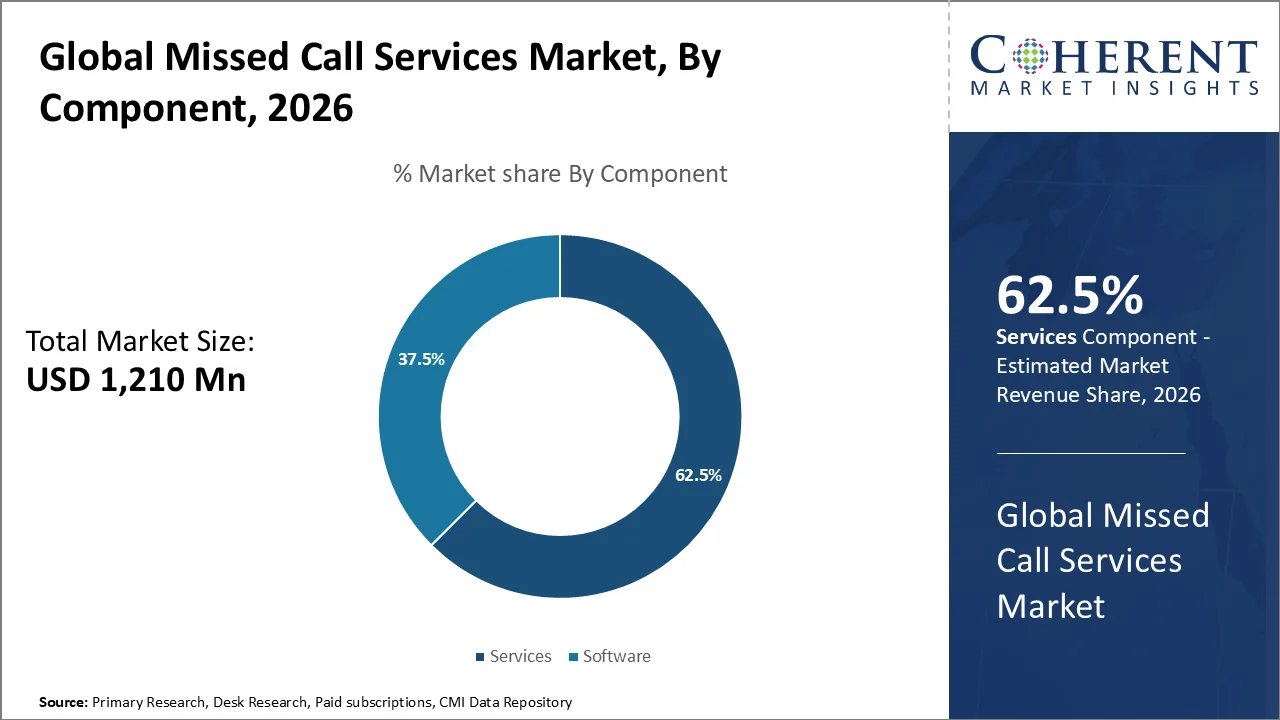
Why is Services Segment Acquiring the Largest Share?
On the basis of component, the services segment is projected to account for the largest Missed Call Services Market share of 62.5% in 2026. The segment’s growth is owing to rising demand for managed campaign execution, virtual number provisioning, call-back support, IVR integration, CRM integration, lead routing, campaign analytics, and compliance support.
The segment is further supported by the rapid expansion of mobile-first communication. According to GSMA Mobile Economy 2026, the mobile industry supported 8.8 billion wireless connections and 5.8 billion unique mobile subscribers, representing around 70% of the global population. This large mobile base is increasing demand for service-led missed call campaigns that allow customers to register interest without call charges.
- Current Industry Events of 2026
- Market Size Estimation
- Regional Breakdown
- Competitive Landscape
- Customer Intelligence
- Segmental Analysis
- Pricing Analysis
- Key Market Drivers, Challenges & Future Trends
- Customized Insights Section
IT & Telecom hold the Largest Market Share
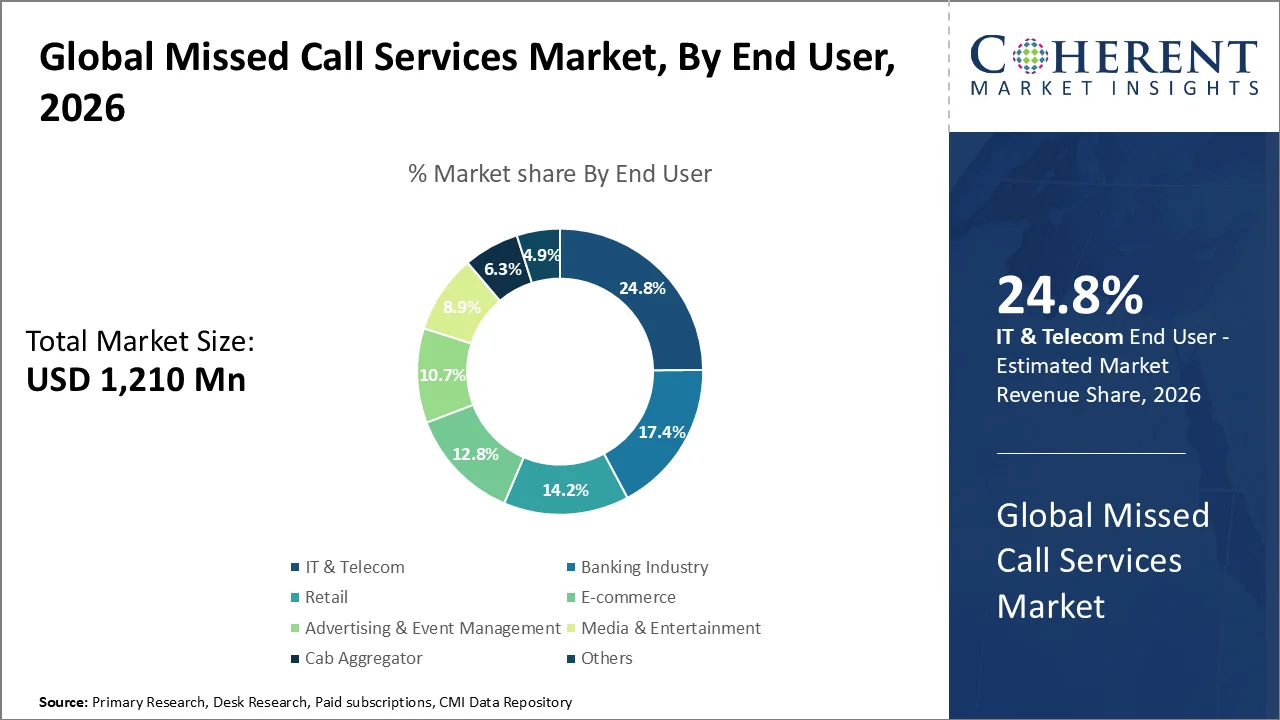
On the basis of end user, the IT & telecom segment lead with a major 24.8% share in 2026. The growth is owing to the need for low-cost, scalable customer verification, lead capture, opt-in campaigns, feedback collection, and missed-call-to-IVR workflows across prepaid, rural, and mass-market users.
India’s telecom base highlights the addressable scale: TRAI reported 1,330.58 million telecom subscribers and 1,282.33 million wireless subscribers as of March 31, 2026, creating a large mobile-first audience for missed-call engagement.
Market Drivers
Rising Innovations in Cloud Telephony are Transforming the Missed Call Services Market in India
India is one of the strongest innovation centers for missed call services due to its large mobile subscriber base, cost-sensitive consumer population, high SME density, and widespread use of cloud telephony for sales and support. Missed call platforms in India are being used for lead generation, campaign opt-ins, missed call alerts, political outreach, customer feedback, insurance enquiries, voter engagement, appointment booking, and call-back automation. TRAI reported that India’s total telephone subscriber base reached 1,306.14 million at the end of December 2025, while wireless mobile subscriptions reached 1,244.20 million, thereby indicating a large base for voice-led engagement.
In February 2026, JioCX highlighted its Missed Call Service as a business engagement tool that allows the firms to collect leads, feedback, surveys, polls, and opt-ins through missed calls. JioCX states that the service can manage high call volumes and allows the businesses to run engagement campaigns at no cost to callers.
AI-enabled Call-back Automation: A Major Breakthrough in Missed Call Services Market
AI-enabled call-back automation is emerging as a major breakthrough in the missed call services market. Traditionally, the missed call systems captured caller numbers and triggered an SMS, IVR response, or manual sales follow-up. However, modern platforms are integrating AI voice agents, real-time routing, transcription, CRM tagging, lead scoring, and automated qualification. This assist the businesses convert missed calls into actionable leads, reduce response delays, and maintain 24/7 customer engagement.
In April 2025, CallRail launched Voice Assist, an AI assistant designed to handle missed calls, answer callers, screen leads, and help businesses capture opportunities outside working hours. CallRail stated that Voice Assist helps businesses transform missed calls into revenue by answering calls after hours or when teams are unavailable. In July 2025, the firm also announced that Voice Assist became available to all businesses, thereby offering customization of tone, availability hours, automatic text responses, as well as lead conversion workflows.
Current Events and Their Impact on the Missed Call Services Market
Current Event | Description and its Impact |
TRAI’s 2025 Tightening of Unsolicited Commercial Communication Rules in India |
|
U.S. TCPA Legal Uncertainty Around Consent and Marketing Calls |
|
Missed Call Services Market Trends
- Rising adoption of cloud telephony platforms is supporting the missed call services, as businesses use virtual numbers, IVR, call tracking, and CRM integration to manage customer responses at scale.
- Growing use of missed call campaigns for lead generation, customer verification, voting, surveys, and callback requests is increasing demand among SMEs and digital-first enterprises.
- Expansion of mobile connectivity is strengthening the market as missed call services work even in low-data environments. Globally, nearly 58% of the population was connected to mobile internet in 2024, while 38% remained within the usage gap, thereby creating a strong scope for simple voice-based engagement tools.
- AI-enabled call analytics and automated callback systems are becoming important, thus helping companies qualify leads, track campaign performance, and improve customer response time. Twilio reported that about 88% of consumers are more likely to buy when engagement is personalized in real time.
- Stronger telecom rules against spam and unsolicited commercial communication are pushing providers toward consent-based missed call campaigns. TRAI’s 2025 amendments aim to strengthen consumer protection and improve transparency in commercial communication, which may benefit compliant service providers.
Regional Insights
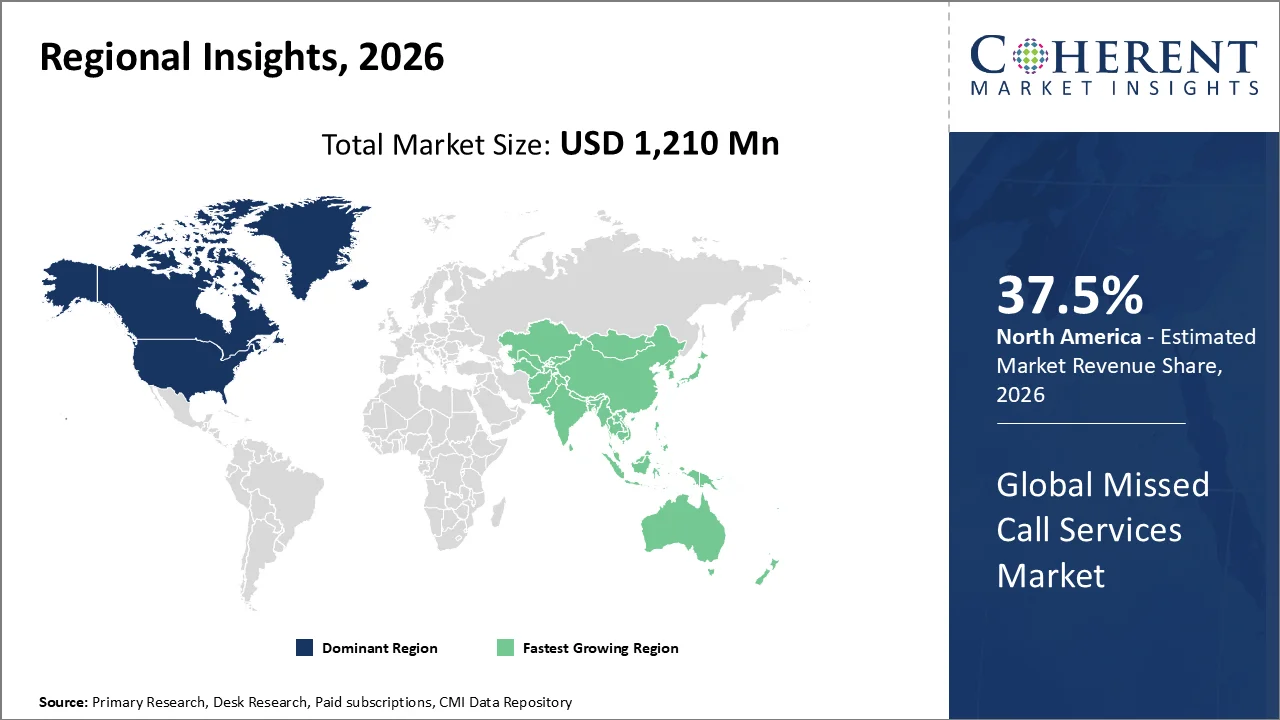
North America Dominates Owing to the High Mobile Penetration
The North America region accounts for 37.5% of the market share in 2026. The region’s growth is owing to high mobile penetration, mature cloud telephony infrastructure, strong SMB adoption of call-tracking tools, and compliance-led demand for consent-based customer engagement.
In the U.S., FCC reported 391 million mobile voice subscriptions in December 2024, creating a large base for missed-call callbacks, lead capture, appointment confirmation, and campaign response tracking. Statistics Canada reported that 93.9% of households had at least one cellphone in Canada, supporting mobile-first engagement across retail, healthcare, BFSI, home services, and local business marketing.
In June 2025, RingCentral announced the general availability of AI Receptionist (AIR), an AI agent that businesses can deploy to answer calls and texts, manage scheduling, support e-commerce workflows, and reduce missed customer interactions.
Asia Pacific Missed Call Services Market Trends
Asia Pacificis expected to witness strong growth in Missed Call Services Market over the forecast period. The region’s growth is owing to the massive feature-phone user base and public sector pushes for financial inclusion.
A public financial awareness survey published via IJFMR indicated that 64% of respondents maintain active awareness and usage of missed call banking services. To capture this demographic, the Reserve Bank of India (RBI) integrated missed call capabilities directly into its official offline payment architecture, UPI 123PAY, allowing non-smartphone users to securely authorize transactions via incoming automated authentication calls.
High Wireless-Only Calling and AI Receptionists are Accelerating the Missed Call Services Market in United States
The United States Missed Call Services Market is driven by wireless-first communication, SMB lead capture, after-hours call handling, and automated follow-up workflows. CDC/NCHS reported that during July–December 2024, 78.7% of U.S. adults lived in wireless-only households, highlighting the shift toward mobile-led voice engagement and supporting demand for missed-call alerts, callbacks, and call-to-SMS workflows.
In April 2025, OpenPhone launched Sona, an always-on AI agent for small businesses and startups. Sona answers business calls 24/7, captures messages, resolves routine questions, and helps businesses avoid missed customer calls.
China Missed Call Services Market Trends
China is expected to show strong growth in the Missed Call Services Market. The trend is driven by mobile-first customer engagement, automated callback campaigns, lead verification, and low-cost response tracking across telecom, e-commerce, BFSI, and public services. China’s Ministry of Industry and Information Technology reported 4.838 million 5G base stations by end-2025, strengthening the digital voice and mobile communication base for call-based engagement.
In March 2025, Tencent Cloud updated its TRTC Call Status Callback feature, allowing business backends to track call results in real time, including missed calls, rejected calls, and unanswered calls.
Who are the Major Companies in Missed Call Services Industry
Some of the major key players in Missed Call Services Market are CloudShope Technologies Pvt. Ltd., C-Zentrix, Exotel Techcom Pvt. Ltd, Hakimi Solutions, Knowlarity Communications Pvt. Ltd., LeadNXT, OneRing.in, OZONETEL, Sarv, SparkTG, WebXion Technologies LLP, ZNI Wireless Pvt. Ltd. and others.
Key News
- In March 2026, 800.com launched 800 AI Agents, AI-powered virtual receptionists for small businesses. The agents answer missed calls, qualify leads, book appointments, capture messages, generate call summaries, and provide next-step recommendations, helping businesses improve response rates and conversions efficiently.
- In December 2025, WhatsApp introduced missed call messages, allowing users to leave voice or video notes when calls go unanswered. The update also added interactive Status stickers, enhanced Meta AI image generation, improved group video calls, and better desktop media search.
Market Report Scope
Missed Call Services Market Report Coverage
| Report Coverage | Details | ||
|---|---|---|---|
| Base Year: | 2025 | Market Size in 2026: | USD 1,210 Mn |
| Historical Data for: | 2020 To 2024 | Forecast Period: | 2026 To 2033 |
| Forecast Period 2026 to 2033 CAGR: | 7.3% | 2033 Value Projection: | USD 1,980 Mn |
| Geographies covered: |
| ||
| Segments covered: |
| ||
| Companies covered: | CloudShope Technologies Pvt. Ltd., C-Zentrix, Exotel Techcom Pvt. Ltd, Hakimi Solutions, Knowlarity Communications Pvt. Ltd., LeadNXT, OneRing.in, OZONETEL, Sarv, SparkTG, WebXion Technologies LLP, ZNI Wireless Pvt. Ltd. and others. | ||
| Growth Drivers: |
| ||
| Restraints & Challenges: |
| ||
Analyst Opinion
- The missed call services market growth is driven by the mobile-first customer engagement. With around 5.8 billion unique mobile subscribers and 8.8 billion wireless connections globally in 2026, businesses can use a simple ring-and-disconnect action to capture leads, verify interest, trigger callbacks, and engage users without requiring internet access or app downloads.
- The market is gaining importance because missed calls directly affect revenue conversion. The industry benchmarks suggest only 37.8% of incoming small-business calls are answered by a live person, while 62.2% go to voicemail or receive no response, thereby making automated callback as well as lead-routing tools critical.
- AI-based voice assistants are strengthening the market adoption by converting missed calls into qualified leads. In 2025, CallRail launched Voice Assist to answer calls after hours, screen callers, support appointment booking, and sync lead data with business tools, helping companies reduce lost opportunities and improve customer response efficiency.
Speak to the analyst
Want personalized insights?
Take the findings above to one of our principal consultants, or have the report rebuilt around the segments, geographies and competitors you actually track.
Market Segmentation
- By Component (Revenue, USD Mn, 2021-2033)
- Software
- Services
- By Deployment Type (Revenue, USD Mn, 2021-2033)
- On-premise
- Cloud-based
- By Enterprise Size (Revenue, USD Mn, 2021-2033)
- SMEs
- Large Enterprises
- By Function (Revenue, USD Mn, 2021-2033)
- Lead Generation
- Surveys & Feedbacks
- New User Activation
- Run Contests & Content on Demand
- By End User (Revenue, USD Mn, 2021-2033)
- Advertising & Event Management
- Banking Industry
- E-commerce
- IT & Telecom
- Cab Aggregator
- Media & Entertainment
- Retail
- Others
- By Region (Revenue, USD Mn, 2021-2033)
- North America
- U.S.
- Canada
- Latin America
- Brazil
- Mexico
- Argentina
- Rest of Latin America
- Europe
- Germany
- U.K.
- France
- Italy
- Spain
- Russia
- Rest of Europe
- Asia Pacific
- China
- India
- Japan
- Australia
- South Korea
- ASEAN
- Rest of Asia Pacific
- Middle East
- GCC
- Israel
- Rest of Middle East
- Africa
- South Africa
- Central Africa
- North Africa
- North America
Sources
Primary Research Interviews
- Telecom service providers
- Missed call service platform providers
- Cloud communication and CPaaS companies
- Digital marketing agencies
- Customer engagement and lead generation managers
- BFSI, retail, healthcare, education, and political campaign users of missed call services
- Call center and contact center solution providers
- Mobile network operators and value-added service providers
- Key opinion leaders (KOLs) in telecom, digital marketing, and customer communication
Databases
- Telecom Regulatory Authority of India (TRAI)
- International Telecommunication Union (ITU)
- World Bank
- GSM Association (GSMA)
- National telecom regulatory databases
- Ministry of Communications and Digital Economy databases
Magazines
- TelecomTalk
- Voice & Data
- Communications Today
- Capacity Media
- Telecom Review
- Mobile World Live
Journals
- Journal of Telecommunications and the Digital Economy
- International Journal of Communication Systems
- Telecommunications Policy
- Journal of Marketing Analytics
- International Journal of Mobile Communications
- Journal of Digital & Social Media Marketing
Newspapers
- The Economic Times
- Business Standard
- Financial Express
- The Hindu BusinessLine
- The Wall Street Journal
- The Guardian
Associations
- Cellular Operators Association of India (COAI)
- GSM Association (GSMA)
- Broadband India Forum
- Internet and Mobile Association of India (IAMAI)
- International Telecommunication Union (ITU)
- Mobile Marketing Association (MMA)
Public Domain Sources
- Company annual reports and investor presentations
- Government telecom ministry publications
- Telecom regulatory reports and consultation papers
- Company websites, press releases, and service brochures
- Industry whitepapers on CPaaS, customer engagement, and cloud telephony
- Digital India and telecom infrastructure reports
Proprietary Elements
- CMI Data Analytics Tool
- Proprietary CMI Existing Repository of Information for the Last 10 Years
Get access to 250+ pages report
Every segment, forecast, competitor profile and data table behind the analysis above — available for instant download.
- ESOMAR Member
- ISO 9001:2015 Certified
- D-U-N-S Registered
- GDPR & CCPA Compliant
Missing comfort of reading report in your local language? Find your preferred language:
Transform your Strategy with Exclusive Trending Reports
Frequently Asked Questions
The Missed Call Services Market is expected to reach USD 1,980 Mn in 2033.
Major players operating in the global Missed Call Services Market include CloudShope Technologies Pvt. Ltd., C-Zentrix, Exotel Techcom Pvt. Ltd, Hakimi Solutions, Knowlarity Communications Pvt. Ltd., LeadNXT, OneRing.in, OZONETEL, Sarv, SparkTG, WebXion Technologies LLP, ZNI Wireless Pvt. Ltd. and others.
The shift toward interactive digital channels, carrier limitations causing delayed or blocked automated callbacks, and strict data privacy regulations are the key factors hampering growth of the market.
The zero cost to the caller, high opt-in conversion rates, and ability to bypass literacy and internet barriers is boosting the demand for Missed Call Services.
The Missed Call Services Market is anticipated to grow at a CAGR of 7.3% between 2026 and 2033.
Among regions, North America is expected to account for a largest market share in the global Missed Call Services Market over the forecast period.
A Missed Call Service is a cloud-based telephony solution that lets businesses interact with customers for free.