

Near Field Communication Market Analysis & Forecast: 2026-2033
The global near field communication market is estimated to be valued at USD 40.12 Bn in 2026 and is expected to reach USD 125.56 Bn by 2033, exhibiting a compound annual growth rate (CAGR) of 17.7% from 2026 to 2033.
Key Takeaways
- By Product Type, Non-auxiliary NFC products segment is accounting for approximately 55.6% of the total market share in 2026.
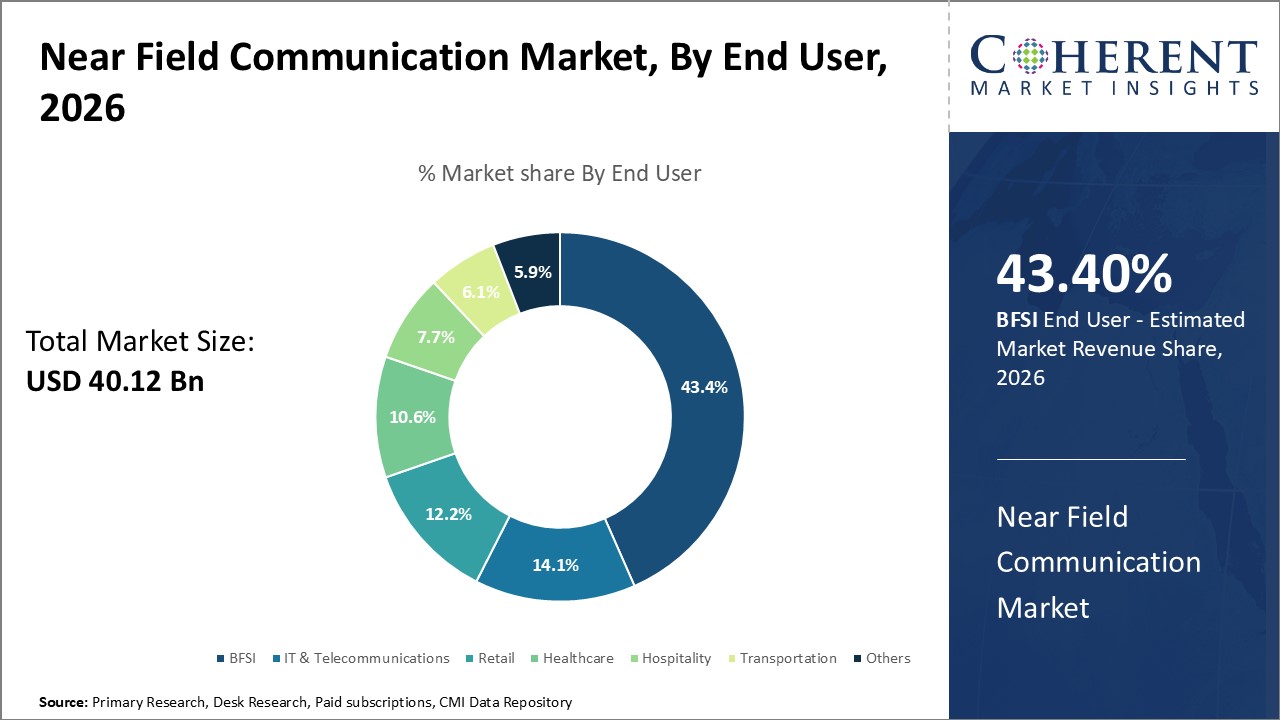
- By End User, BFSI (Banking, Financial Services, and Insurance) sector is expected to hold approximately 43.4% of the global market share. This growth is primarily fuelled by the increased integration of NFC technologies in banking cards, mobile banking apps.
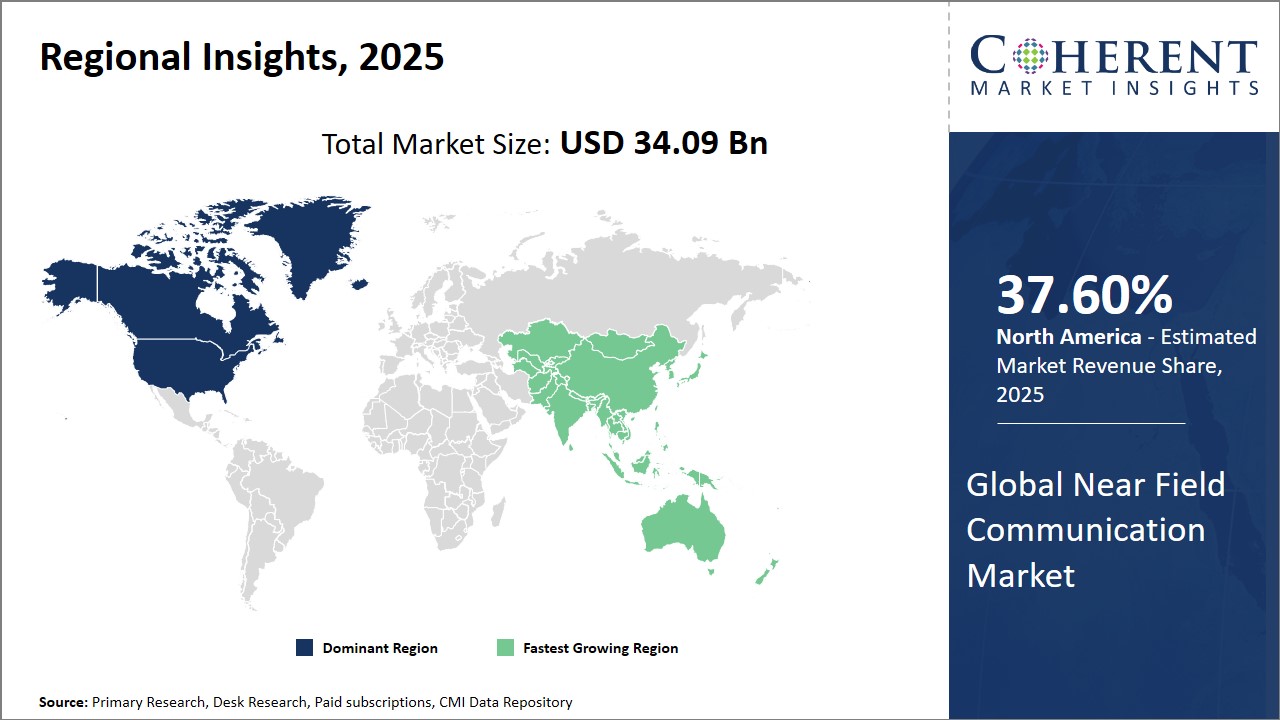
- North America is anticipated to lead the market by capturing approximately 37.6% of the total market share in 2026. This regional strength is underpinned by early technology adoption, robust digital infrastructure.
Market Overview
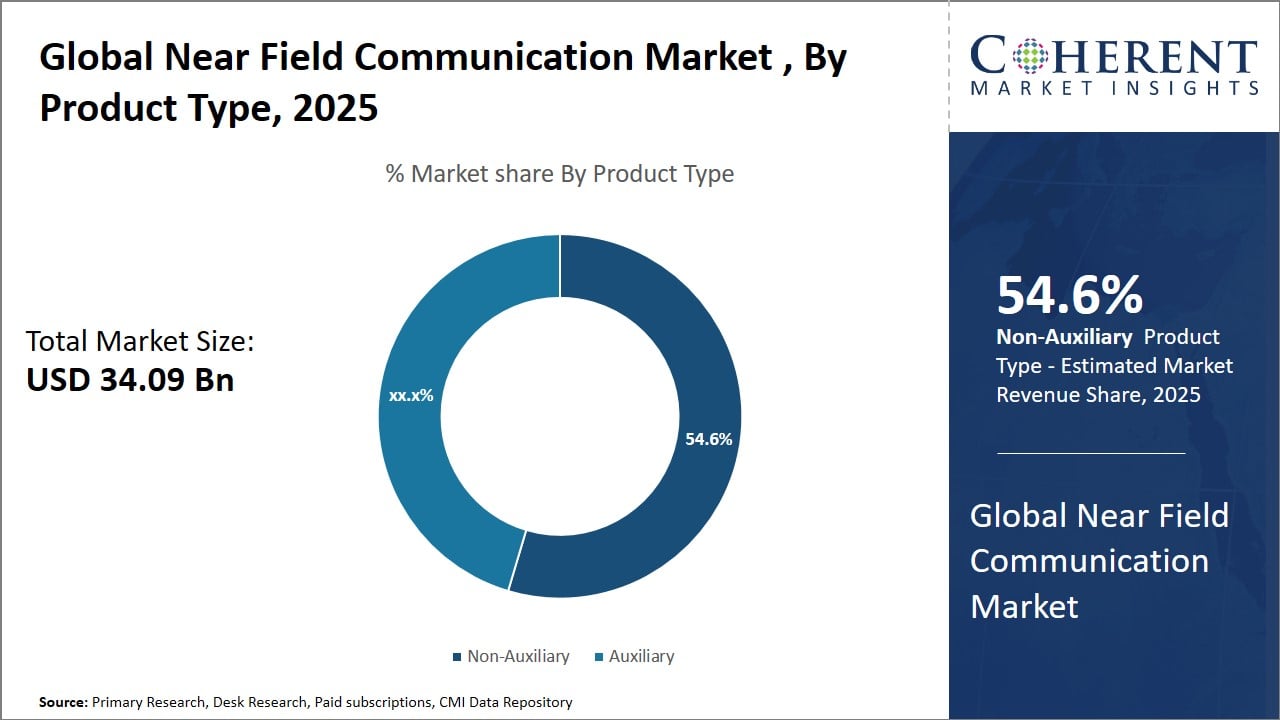
The Near Field Communication (NFC) Market is witnessing robust growth, propelled by the widespread adoption of contactless payment solutions and smart devices. Non-auxiliary NFC products dominate the market with a 54.6% share due to their seamless integration in smartphones and wearable’s. The BFSI sector leads end-user adoption, accounting for 42.4% of the market, driven by enhanced customer experience and secure transactions. North America holds a 37.6% share, supported by advanced digital infrastructure and strong demand for NFC-enabled services.
Current Events and its Impact on the Near Field Communication Market
Current Event | Description and its impact |
Technological Advancements and Product Innovations |
|
Strategic Partnerships and Market Expansion |
|
Regulatory Changes and Data Security Focus |
|
Near Field Communication Market Trends
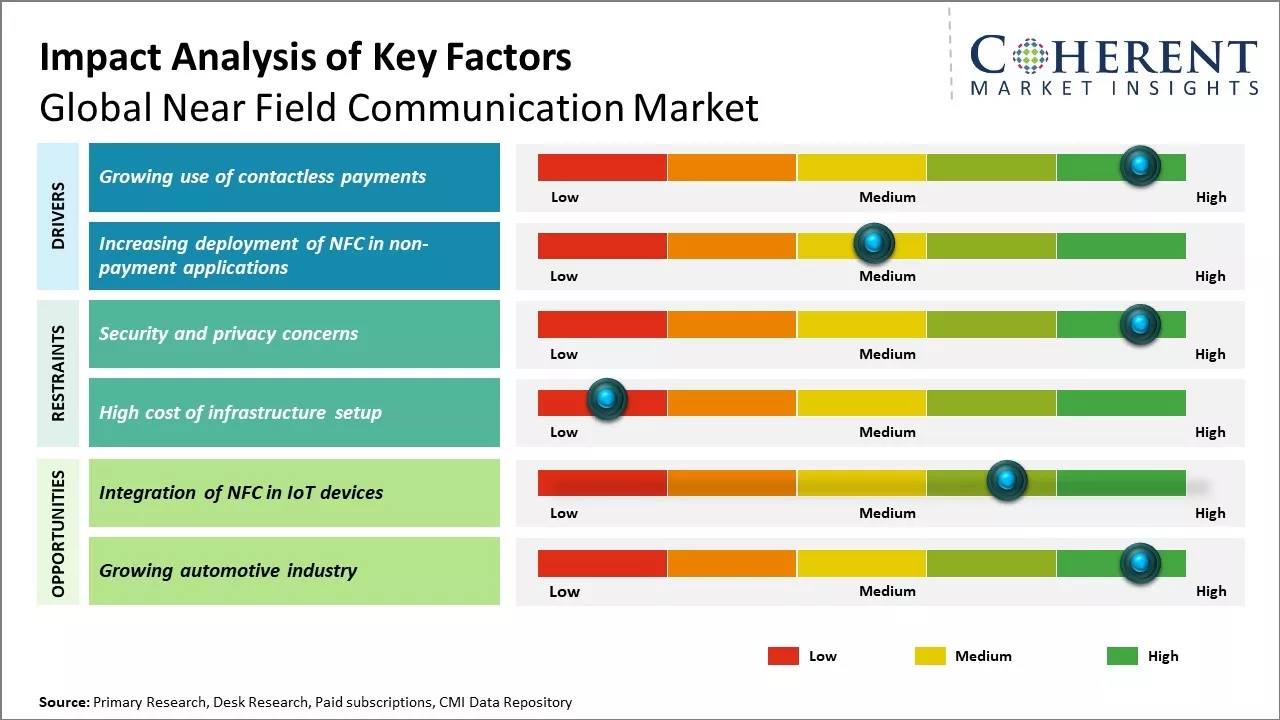
- Growing use of contactless payments
The use of contactless payments through near field communication technology has been growing rapidly in many parts of the world. As consumers have become accustomed to the ease and convenience of tapping their credit or debit cards at point-of-sale terminals, they are increasingly defaulting to contactless transactions over traditional chip-and-PIN or cash payments. This change in consumer payment behavior has been driven by a few key factors.
Moreover, contactless payments simply take less time and are more convenient than inserting a card into a chip reader or handling cash. As lives get busier, customers value speed and efficiency in their daily transactions. Merchants also prefer contactless acceptance as it reduces delays in checkout lines and increases transaction throughput in their stores.
Apart from this, many financial institutions have actively promoted the uptake of contactless payments by upgrading customers' cards and mobile wallets to support NFC technology as standard. Larger payment brands like Visa, MasterCard, and American Express have also raised consumer awareness about contactless through marketing campaigns highlighting the ease and security of tap and pay. The resulting increase in the number of contactless-enabled cards and devices in circulation is directly fueling the growth of contactless transactions.
In July 2024, Apple agreed to allow rival developers access to its Tap‑and‑Go NFC technology in the EU and EEA free of charge for ten years. This move prompted by EU competition regulations opens up NFC access previously limited to Apple Pay, allowing alternative mobile wallet apps and NFC-enabled utilities like digital IDs, car and hotel keys to run on iPhones.
- Increasing deployment of NFC in non-payment applications
While payments remain a core use case, near field communication is increasingly finding diverse applications beyond simply buying goods and services. NFC functionality integrated into smartphones and other connected devices allows for seamless interactions and data transfers between devices with just a tap. Beyond payments, popular domains where NFC is gaining ground include transportation, identification, access control, product information lookup, and social networking/gaming.
Opportunities in the Near Field Communication Market
- Integration of NFC in IoT devices
The integration of NFC technology in IoT devices presents a huge opportunity for the growth of the global Near Field Communication market. With most devices becoming 'smart' these days, the ability to easily share data between devices through tap and go contactless payments will provide a seamless experience to consumers.
Technologies like Bluetooth and WiFi require pairing of devices whereas NFC simplifies the process through proximity. This ease of use will encourage the adoption of NFC among manufacturers of appliances, wearables, and other connected hardware.
Contactless tagging through NFC can enable smart refrigerators to automatically generate shopping lists by scanning food items. Farmers can easily share crop details with buyers by tapping devices. IoT devices with NFC can authenticate users securely for access control without the need for passwords.
- Current Industry Events of 2026
- Market Size Estimation
- Regional Breakdown
- Competitive Landscape
- Customer Intelligence
- Segmental Analysis
- Pricing Analysis
- Key Market Drivers, Challenges & Future Trends
- Customized Insights Section
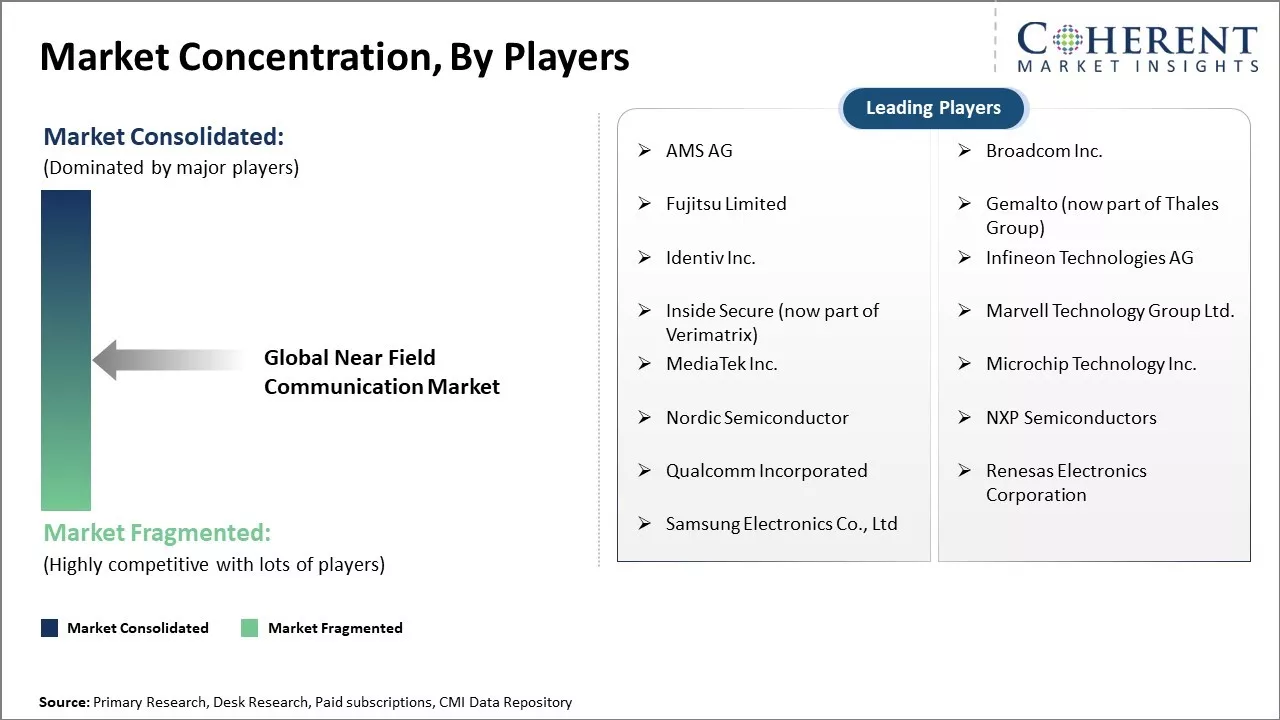
Market Concentration and Competitive Landscape
Segmental Insights
Global Near Field Communication Market Insights, By Product Type
Non-auxiliary NFC products are projected to dominate the global Near Field Communication (NFC) market in 2026, capturing approximately 55.6% of the total market share. This substantial lead is driven by the rapid integration of NFC technology into smartphones, wearables, and point-of-sale (POS) terminals that eliminate the need for additional tags or external readers.
The widespread adoption of contactless payments across sectors such as retail, hospitality, and public transportation has significantly increased the demand for embedded NFC solutions. Consumers are increasingly drawn to NFC for its convenience, speed, and security, especially in fast-paced urban environments where quick digital transactions are preferred.
The proliferation of mobile wallets like Apple Pay, Google Pay, and Samsung Pay, along with the surge in NFC-enabled wearable’s and smart cards, continues to support the segment’s dominance. Governments and financial institutions backing cashless economy initiatives have further accelerated demand for embedded NFC functionality.
As the market evolves toward more compact, energy-efficient, and multifunctional devices, non-auxiliary NFC products are set to retain their leading position, offering scalable and seamless user experiences across digital payment ecosystems, access control, and smart mobility services.
Global Near Field Communication Market Insights, By End User
The Banking, Financial Services, and Insurance (BFSI) sector is expected to lead the end-user segment of the Near Field Communication market in 2026, holding approximately 43.4% of the global market share. This dominance stems from the sector’s strategic push towards digital transformation and contactless service delivery models.
Banks and financial institutions are increasingly deploying NFC-enabled smart cards, ATMs, and mobile banking applications to enhance customer engagement, transaction security, and service efficiency. NFC facilitates faster authentication, real-time fund transfers, and tap-to-pay capabilities, reducing customer wait times and enabling secure, frictionless transactions.
Furthermore, as cyber threats grow, the BFSI industry’s investment in NFC-based encryption and tokenization technologies is increasing, supporting compliance with data security regulations and boosting consumer trust. The introduction of biometric-linked NFC cards and multi-factor authentication in mobile banking also reinforces the sector's commitment to innovation.
Regional Insights
North America near Field Communication Market Trends and Analysis
North America is anticipated to lead the global Near Field Communication (NFC) market in 2026, capturing approximately 37.60% of the total market share. This regional dominance is driven by early technology adoption, well-established digital infrastructure, and a strong presence of fintech giants, consumer electronics firms, and smartphone manufacturers.
The United States and Canada have witnessed a rapid proliferation of NFC-enabled point-of-sale (POS) systems, digital wallets, and contactless smart devices, reinforcing a shift toward a frictionless, contactless-first consumer experience. The widespread use of NFC across retail, transportation, and hospitality is supported by tech-savvy consumers and merchants increasingly preferring tap-to-pay solutions.
North America's focus on data security, privacy regulations, and device interoperability is accelerating the integration of NFC into sectors beyond payments, including healthcare for patient identification, logistics for smart tracking, and corporate environments for secure access control. This illustrates how the Near Field Communication Market with tech adoption is rapidly expanding into cross-industry applications, supported by a digitally mature population and enterprise ecosystem.
Additionally, strategic collaborations between technology providers, financial institutions, and telecom operators are expanding the ecosystem for NFC applications, further strengthening the region’s leadership position. With continued investment in IoT and digital transformation initiatives, North America is expected to remain at the forefront of innovation and adoption in the NFC market through 2026 and beyond.
Near field communication market Dominating Countries
United States
The United States is the leading country in the global Near Field Communication (NFC) market, significantly contributing to North America’s projected 37.6% revenue share in 2026. Its dominance is driven by the rapid adoption of digital wallets, NFC-enabled POS systems, and contactless payment infrastructure across major retail and service industries. With major tech giants such as Apple, Google, and Qualcomm headquartered in the U.S., the nation benefits from continual NFC innovation and system integration into smartphones, wearables, and IoT devices.
Strong regulatory support for secure data handling and increasing demand for tap-and-go services in public transportation, healthcare, and enterprise security further reinforce the U.S.’s leadership. Ongoing investments in fintech, digital banking, and smart city initiatives ensure that the U.S. remains at the forefront of NFC technology development and adoption.
Canada
Canada plays a crucial role in the North American NFC market, leveraging its tech-savvy population, high smartphone penetration rate, and strong digital infrastructure. The country has seen widespread deployment of NFC-enabled bank cards, contactless fare systems, and mobile wallets, especially in urban centres where quick, secure, and seamless transactions are in high demand.
Government-backed initiatives promoting digital inclusion and secure payment standards have created a fertile environment for fintech start-ups and telecom providers to scale up NFC solutions across sectors.
Additionally, Canada's emphasis on Near Field Communication data security has driven innovation in sectors such as healthcare, where NFC-based patient ID systems are being adopted to ensure both efficiency and privacy. This focus on protecting consumer information while fostering innovation further strengthens Canada’s expanding role in the global NFC ecosystem.
Market Report Scope
Near Field Communication Market Report Coverage
| Report Coverage | Details | ||
|---|---|---|---|
| Base Year: | 2025 | Market Size in 2026: | USD 40.12 Bn |
| Historical Data for: | 2020 To 2024 | Forecast Period: | 2026 To 2033 |
| Forecast Period 2026 to 2033 CAGR: | 17.7% | 2033 Value Projection: | USD 125.56 Bn |
| Geographies covered: |
| ||
| Segments covered: |
| ||
| Companies covered: | AMS AG, Broadcom Inc., Fujitsu Limited, Gemalto (now part of Thales Group), Identiv Inc., Infineon Technologies AG, Inside Secure (now part of Verimatrix), Marvell Technology Group Ltd., MediaTek Inc., Microchip Technology Inc., Nordic Semiconductor, NXP Semiconductors, Qualcomm Incorporated, Renesas Electronics Corporation, Samsung Electronics Co., Ltd. | ||
| Growth Drivers: |
| ||
| Restraints & Challenges: |
| ||
Analyst Viewpoint – Near Field Communication Market
- The global Near Field Communication (NFC) market is set for sustained growth, driven by the rising demand for contactless transactions, expanding smartphone penetration, and integration across sectors such as retail, BFSI, transportation, and healthcare. Analysts identify North America as the dominant region, backed by early technology adoption, advanced digital infrastructure, and the strong presence of fintech and consumer electronics giants.
- Industry experts note a shift toward non-auxiliary NFC components, particularly in mobile wallets, wearable devices, and smart cards, as consumers increasingly seek faster, secure, and frictionless payment experiences. The integration of AI and block chain technologies is further enhancing security, authentication, and personalized user engagement in NFC applications.
- Despite challenges such as cyber security risks, data privacy concerns, and high integration costs for small businesses, the NFC market remains on a strong growth path. Continuous innovation, supportive regulatory policies, and growing investment in IoT and smart device ecosystems are expected to fuel long-term market expansion and technological advancement.
Near Field Communication Market: Key Development
- In June 2025, the NFC Forum introduced NFC Release 15, expanding certified NFC contactless range from 0.5 cm to approximately 2 cm quadrupling operational distance. This extended range improves tap‑to‑pay reliability, reduces alignment precision requirements, and enhances usability for compact devices like wearable’s and rings boosting NFC adoption in retail, transit, and access-control use cases.
- In May 2025, PayPal rolled out its first direct tap‑to‑pay NFC capability for iPhone users in Germany, enabled by the EU’s Digital Markets Act mandating third-party app access to iPhone NFC chips. Opens iPhone NFC to competitors beyond Apple Pay, boosting user choice, enhancing competition in digital wallets, and driving NFC acceptance across Europe.
- In August 2024, Apple released the iOS 18.1 update, allowing third-party developers to access the NFC Secure Element and enable tap‑to‑pay within their apps (previously exclusive to Apple Pay). This opened NFC use for in-store payments, transit passes, hotel keys, loyalty cards, and more across markets such as the U.S., UK, Canada, Australia, Japan, Brazil, and New Zealand. This regulatory-driven policy shift broadened Apple's NFC ecosystem, increased competition among digital wallet providers, and accelerated NFC adoption worldwide.
Market Segmentation
- By Product Type (Revenue, USD Bn, 2021 - 2033)
- Non-Auxiliary
- Auxiliary
- By End User (Revenue, USD Bn, 2021 - 2033)
- BFSI
- IT & Telecommunications
- Retail
- Healthcare
- Hospitality and Transportation
- Others
- By Region (Revenue, USD Bn, 2021 - 2033)
- North America
- U.S.
- Canada
- Latin America
- Brazil
- Argentina
- Mexico
- Rest of Latin America
- Europe
- Germany
- U.K.
- Spain
- France
- Italy
- Russia
- Rest of Europe
- Asia Pacific
- China
- India
- Japan
- Australia
- South Korea
- ASEAN
- Rest of Asia Pacific
- Middle East
- GCC Countries
- Israel
- Rest of Middle East
- Africa
- South Africa
- North Africa
- Central Africa
- Key Players Insights
- AMS AG
- Broadcom Inc.
- Fujitsu Limited
- Gemalto (now part of Thales Group)
- Identiv Inc.
- Infineon Technologies AG
- Inside Secure (now part of Verimatrix)
- Marvell Technology Group Ltd.
- MediaTek Inc.
- Microchip Technology Inc.
- Nordic Semiconductor
- NXP Semiconductors
- Qualcomm Incorporated
- Renesas Electronics Corporation
- Samsung Electronics Co., Ltd.
Sources
The Stakeholders Consulted
- Mobile device manufacturers and embedded system engineers
- NFC chip and tag producers
- Payment gateway and fintech solution providers
- Smart card and identity management companies
- Transportation and transit system authorities
- Consumer electronics OEMs and IoT solution integrators
- Retail, healthcare, and logistics end-users leveraging NFC applications
- Telecom operators and secure access control vendors
Databases Opened
- U.S. Federal Communications Commission (FCC) – Wireless Technology Reports
- GSMA Intelligence – Mobile Economy and Contactless Technology Data
- International Telecommunication Union (ITU) – ICT Data and Trends
- Ministry of Electronics and Information Technology (MeitY), India – Emerging Tech Reports
Magazines & Trade Publications
- NFC World
- RFID Journal
- PaymentsSource
- IoT Now – Connectivity & Edge Technology
- Mobile World Live – Contactless Tech Focus
- Embedded Computing Design
Scientific and Industry Journals
- IEEE Transactions on Mobile Computing
- International Journal of Communication Systems
- Sensors and Actuators A Physical
- Journal of Network and Computer Applications
- International Journal of Information Security
Newspapers & Media Outlets
- Bloomberg – Tech & Consumer Electronics
- Reuters – Fintech and Emerging Markets
- The Wall Street Journal – Mobile Payments & Digital Economy
- The Economic Times – Telecom & Smart Infrastructure
- Business Standard – Digital Transformation & Mobility Trends
Associations and Regulatory Bodies
- Near Field Communication Forum (NFC Forum)
- International Organization for Standardization (ISO/IEC 14443, ISO/IEC 18092 standards)
- International Electrotechnical Commission (IEC)
- GSMA – Mobile NFC Initiatives
- Bureau of Indian Standards (BIS) – Electronics & Smart Cards
Public Domain Sources
- U.S. National Institute of Standards and Technology (NIST) – Contactless Standards and Security Guidelines
- European Commission – Digital Economy and Payment Systems Reports
- World Bank – Digital Identification and Fintech Access Reports
- International Telecommunication Union (ITU) – Wireless Communication Frameworks
- OECD Digital Economy Outlook
Proprietary Research Elements
- CMI Data Analytics Tool
- Proprietary CMI Repository of Market Data (covering past 8 years)
- CMI Expert Interviews and Transcripts (focused on NFC deployment, contactless payments, and secure communications)
Get access to 250+ pages report
Every segment, forecast, competitor profile and data table behind the analysis above — available for instant download.
- ESOMAR Member
- ISO 9001:2015 Certified
- D-U-N-S Registered
- GDPR & CCPA Compliant
Missing comfort of reading report in your local language? Find your preferred language:
Transform your Strategy with Exclusive Trending Reports
Frequently Asked Questions
The Near Field Communication Market size is estimated to be valued at USD 40.12 Bn in 2026, and is expected to reach USD 125.56 Bn by 2033.
The CAGR of the global Market is projected to be 17.7% from 2026 to 2033.
Growing use of contactless payments and increasing deployment of NFC in non-payment applications are the major factors driving the growth of global market.
Security and privacy concerns and high cost of infrastructure setup are the major factors hampering the growth of the global market.
In terms of product type, non-auxiliary is estimated to dominate the market revenue share in 2026.
AMS AG, Broadcom Inc., Fujitsu Limited, Gemalto (now part of Thales Group), Identiv Inc., Infineon Technologies AG, Inside Secure (now part of Verimatrix), Marvell Technology Group Ltd., MediaTek Inc., Microchip Technology Inc., Nordic Semiconductor, NXP Semiconductors, Qualcomm Incorporated, Renesas Electronics Corporation, and Samsung Electronics Co., Ltd are the major players.
North America is expected to lead the global near field communication industry in 2026.