

Automated Guided Vehicle Market Size and Share Analysis- 2026 To 2033
The Automated Guided Vehicle Market size is anticipated to grow at a CAGR of 8.0%, with USD 3.01 Bn in 2026, and is expected to reach USD 5.16 Bn by 2033. The primary drivers are largely defined by the rising adoption of warehouse automation, increasing demand for efficient material-handling systems, growing deployment of Industry 4.0 technologies, and wider use of automated guided vehicles across manufacturing, logistics, automotive, healthcare, and e-commerce facilities. According to the International Federation of Robotics (IFR) World Robotics 2025 report, 102,900 transportation and logistics service robots were sold globally in 2024, representing a 14% year-on-year increase and accounting for more than half of professional service robot sales.
Key Takeaways
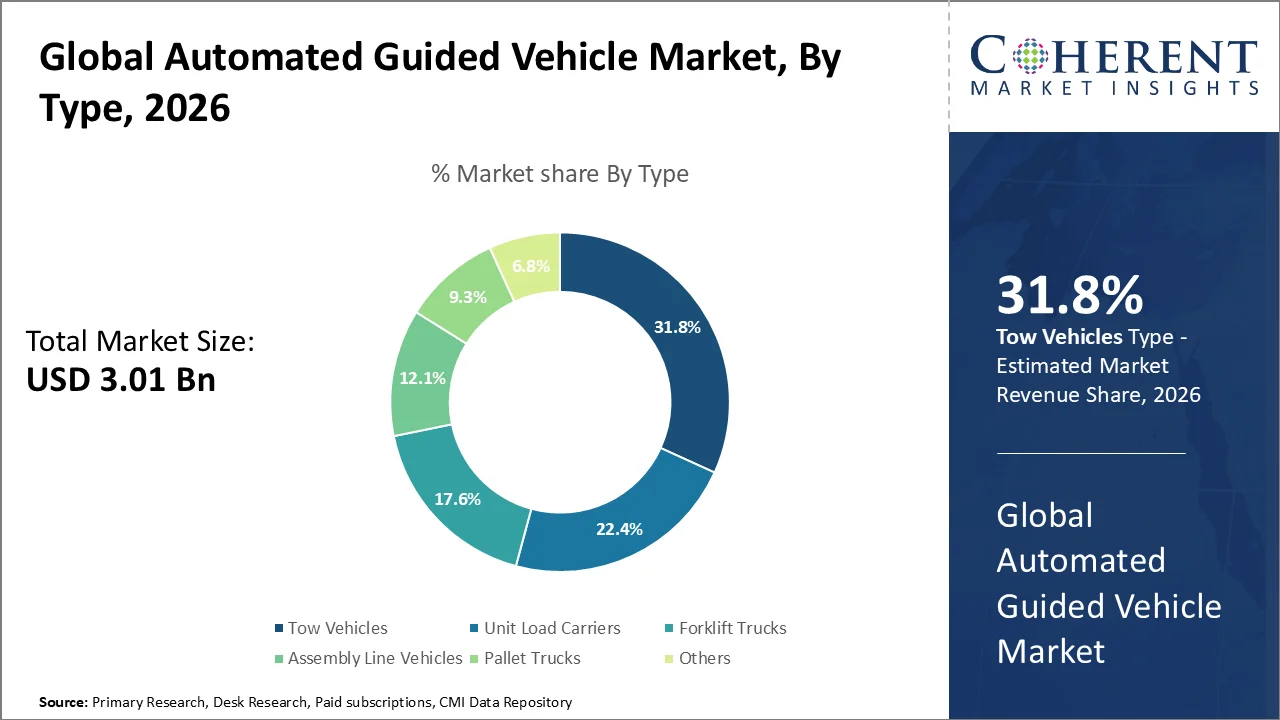
- The tow vehicles category will hold the largest share with 31.8% in 2026. The growing demand for the segment is credited to its capacity to pull many trailers at once, haul hefty materials on set routes, minimize the number of trips made manually, and handle large volumes of materials between plants and warehouses. In October 2024, BMW Group announced that their Regensburg factory runs 50 tugger trains along with 140 smart transport robots, together making about 10,000 trips a day to deliver parts on the production line.
- The laser guidance segment is set to lead with 36.5% in 2026. The segment’s growth is owing to its high positioning accuracy, reliable operation across large facilities, flexible route reconfiguration, and reduced dependence on permanently embedded floor infrastructure. The AGVs use high-precision laser guidance and 360-degree safety scanning, can operate 24 hours a day throughout the year, and function in temperatures as low as −25°C.
- The automotive segment is expected to hold the largest market share of 29.6% in 2026. The segment’s growth is owing to the extensive use of AGVs for component delivery, assembly-line feeding, work-in-progress movement, battery transportation, and just-in-time manufacturing. In June 2026, the International Federation of Robotics reported that the U.S. automotive industry installed 13,500 industrial robots in 2025, remaining the country’s largest robot-adopting industry.
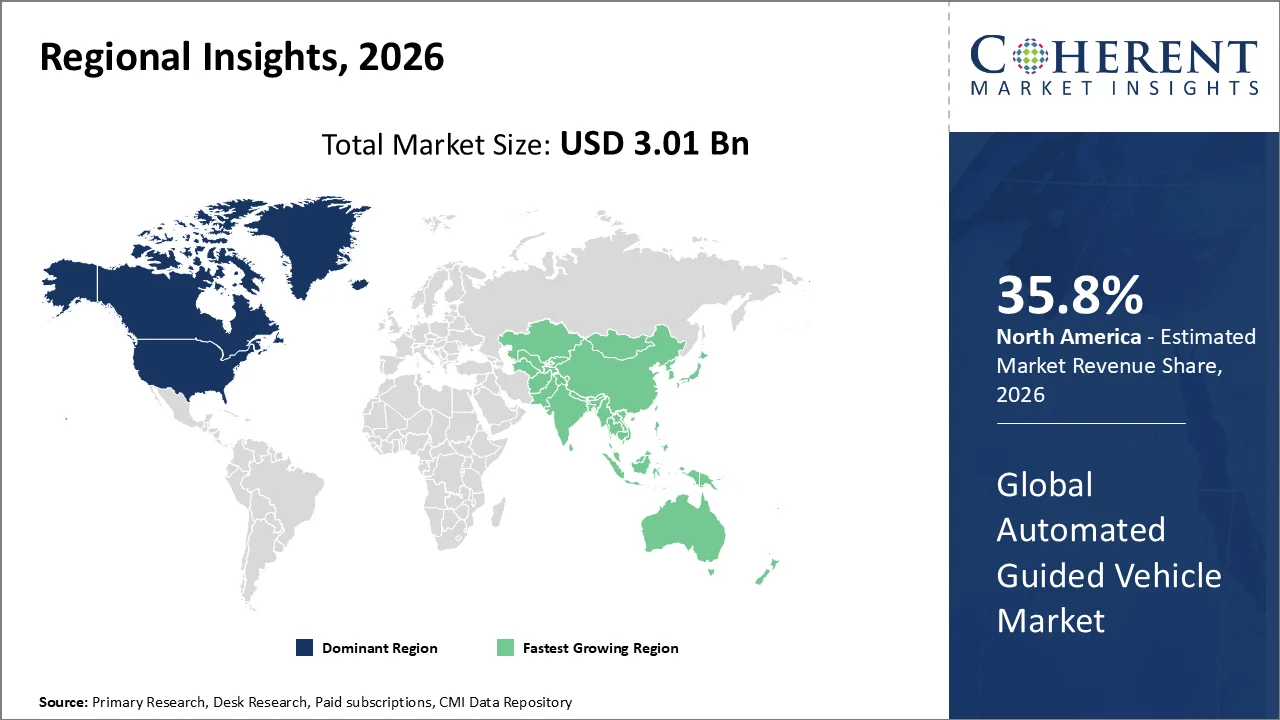
- North America is expected to dominate the Automated Guided Vehicle Market with 35.8% in 2026. The region’s leadership is owing to its advanced warehouse infrastructure, strong automotive manufacturing base, early adoption of autonomous material-handling systems, and continued investment in robotics across logistics, pharmaceuticals, food processing, and general manufacturing. In February 2026, the Association for Advancing Automation reported that North American companies ordered 36,766 robots valued at USD 2.25 Bn during 2025, representing increases of 6.6% in units and 10.1% in order value compared with 2024
Market Drivers
Expansion of E-commerce Fulfilment and Robotic Warehouses is Accelerating the Automated Guided Vehicle Market
The Automated Guided Vehicle Market is expanding owing to the increasing automation of e-commerce fulfilment centres, distribution hubs, and large warehouses. AGVs reduce dependence on manual transportation, support continuous movement of pallets and inventory, and improve order-processing speed during periods of fluctuating demand. Integration with warehouse management systems also enables operators to coordinate vehicle routes, inventory locations, and fulfilment schedules in real time.
Amazon launched the deployment of the one millionth robot, its robots working from its more than 300 worldwide fulfillment centers. Amazon also launched DeepFleet, which is an artificial intelligence system developed to enhance the travel efficiency of its fleet of robots by 10%.
In March 2026, Amazon announced an investment of more than AU$750 million in a new robotics fulfilment centre in Queensland, Australia. The approximately 150,000-square-metre facility is designed to process more than 125 million packages annually, strengthening demand for automated material-transport systems across large-scale e-commerce warehouses.
Smart Automotive Manufacturing is Strengthening Automated Guided Vehicle Deployment
Automotive manufacturers are increasingly adopting AGVs to transport vehicle bodies, batteries, components, and work-in-progress materials between production stages. The technology supports just-in-time manufacturing, mixed-model assembly, flexible production layouts, and safer handling of heavy components. Growing investment in electric vehicle and purpose-built vehicle factories is further increasing the requirement for automated intralogistics systems.
The connected Hyundai Mobis facility can also produce 300,000 battery systems annually, while the adjacent battery-cell plant is targeting 30 GWh of annual capacity, sufficient for approximately 360,000 electric vehicles. Hyundai further plans to expand the plant’s annual vehicle capacity to 500,000 units.
In November 2025, Kia completed its Hwaseong EVO Plant East and began developing EVO Plant West as part of a combined KRW 4 trillion investment covering approximately 297,000 square metres. Once both facilities are operational, the manufacturing hub is expected to have an annual production capacity of 250,000 purpose-built vehicles.
Current Events and Their Impact on the Automated Guided Vehicle Market
Current Event | Description and its Impact |
European Union Prepares for New Machinery Regulation Covering Autonomous Mobile Machinery (2026–2027) |
|
U.S. OSHA Continues Warehouse and Distribution-Centre Safety Enforcement (2025–2026) |
|
- Current Industry Events of 2026
- Market Size Estimation
- Regional Breakdown
- Competitive Landscape
- Customer Intelligence
- Segmental Analysis
- Pricing Analysis
- Key Market Drivers, Challenges & Future Trends
- Customized Insights Section
Segmental Insights
Why Are Tow Vehicles Acquiring the Largest Share?
On the basis of type, the tow vehicles segment is projected to account for the largest Automated Guided Vehicle Market share of 31.8% in 2026. The segment’s growth is driven by automated tow vehicles’ ability to pull multiple trailers or carts during a single trip, support high-frequency line-feeding operations, and transport large volumes of materials without requiring individual lifting mechanisms.
Toyota Material Handling’s automated Core Tow Tractor offers a towing capacity of up to 10,000 lb. The vehicle uses LiDAR-based natural-feature navigation and regenerative braking, while retaining the option for manual operation. These capabilities support repetitive horizontal transportation across factories, warehouses, and distribution facilities.
In December 2025, Motrec International and Anantak Robotics launched the fully autonomous MX340 Tow Tractor for industrial material-handling operations.
Why Does Laser Guidance Hold the Largest Market Share?
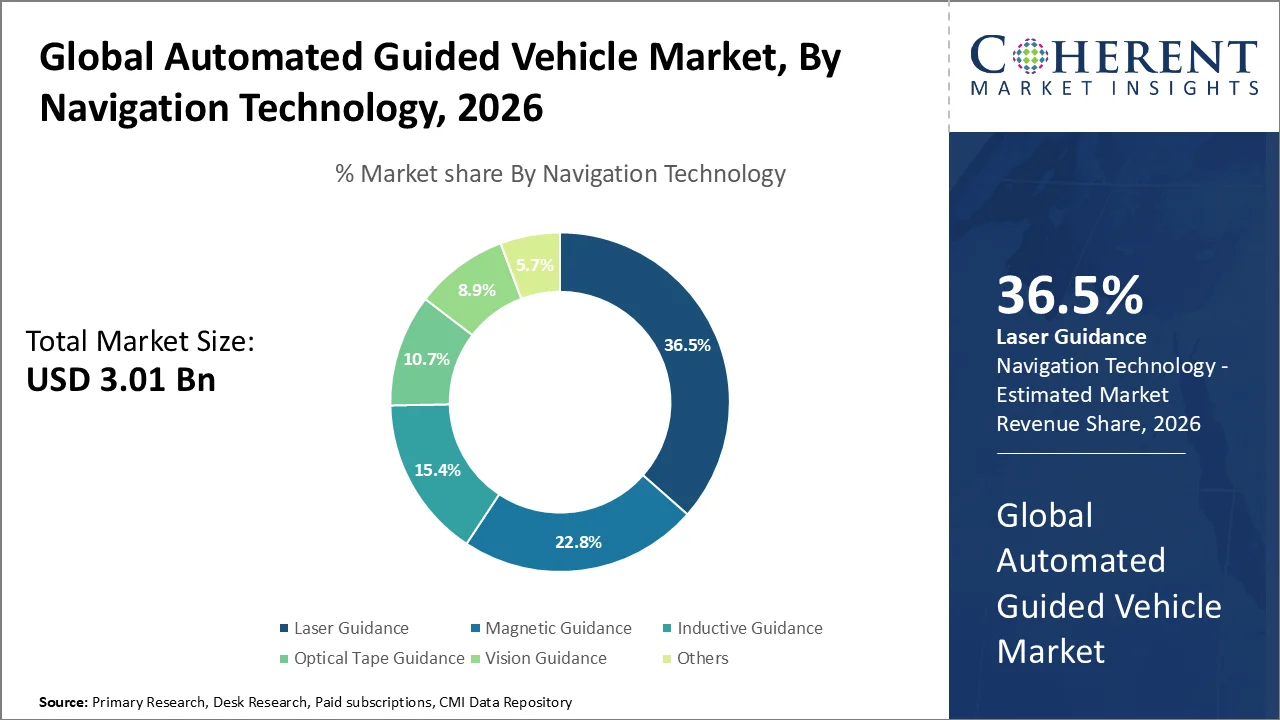
On the basis of navigation technology, the laser guidance segment is anticipated to lead the Automated Guided Vehicle Market with 36.5% in 2026. The segment’s dominance is owing to its accurate vehicle-positioning capability, flexible route configuration, reliable operation across large facilities, and suitability for complex pallet-handling and production-line applications.
E80 Group further states that dynamic simulations used in designing its AGV and LGV systems can validate control logic with 95% reliability. Its laser-guided vehicles can also be configured for double-deep storage and the simultaneous transportation of two side-by-side pallets, supporting higher throughput and space utilization.
In June 2025, Kollmorgen released an upgraded version of its NDC Solutions platform for automated guided vehicles and autonomous mobile robots.
Why Does the Automotive Industry Hold the Largest Market Share?
On the basis of end-use industry, the automotive segment is expected to hold the largest Automated Guided Vehicle Market share of 29.6% in 2026. The segment’s leadership is owing to the extensive use of AGVs for transporting vehicle bodies, batteries, engines, components, and work-in-progress materials between production and assembly stages.
In February 2025, Stellantis announced that its Kénitra automotive plant had established an in-house capacity to manufacture 1,000 AGVs annually. The plant can assemble one AGV every three hours and produced 90 units within four weeks during the project’s initial phase.
Automated Guided Vehicle Market Trends
- The increasing integration of artificial intelligence and centralized fleet-management software is enabling AGVs to optimize routes, avoid congestion, allocate tasks dynamically, and coordinate with warehouse management systems. 39% of supply-chain leaders consider robotics and automation to have a significant or greater disruptive impact, an increase of 16 percentage points from the previous survey. This supports the transition from independently operating AGVs toward connected and intelligently coordinated vehicle fleets.
- The growing adoption of vendor-neutral communication standards is improving interoperability between AGVs, autonomous mobile robots, automated forklifts, and central fleet-control systems. In March 2026, the German Association of the Automotive Industry and VDMA released VDA 5050 Version 3.0.0, providing a standardized interface for managing heterogeneous mobile-robot fleets. The trend is reducing dependence on a single equipment supplier and allowing companies to expand automation systems using vehicles from multiple manufacturers.
- The growing availability of scalable, stand-alone AGV systems is making automation accessible to small and medium-sized facilities that do not require large vehicle fleets. In January 2026, Jungheinrich implemented a single automated high-lift vehicle at HELMA Kartoffelvertrieb to transport pallets along a 120-metre route between filling stations, conveyors, two block-storage areas, and dispatch operations. The system incorporates lithium-ion power, automatic charging, and web-based controls, demonstrating that even one AGV can automate multiple recurring workflows.
Regional Insights
North America Dominates Owing to Strong Manufacturing Automation and Warehouse Modernization
North America is expected to dominate the Automated Guided Vehicle Market, accounting for 35.8% of the market share in 2026. The region’s leadership is owing to the extensive adoption of automated material-handling systems, well-established automotive and manufacturing industries, advanced warehouse infrastructure, and growing investment in labor-saving technologies across the U.S. and Canada.
According to the International Federation of Robotics, industrial robot installations in the U.S. increased by 11% year-on-year to approximately 38,000 units in 2025. The automotive industry remained the largest adopter, installing around 13,500 units, indicating a strong industrial ecosystem for deploying AGVs alongside robotic production systems.
In April 2026, Delta Electronics announced that its MOOV Series wired and wireless charging solutions had charged more than one million industrial vehicles across North America and other global markets.
Asia Pacific Automated Guided Vehicle Market Trends
Asia Pacific is expected to be the fastest-growing region in the Automated Guided Vehicle Market over the forecast period. The region’s growth is owing to rapid manufacturing automation, expanding e-commerce fulfillment infrastructure, increasing smart-factory investments, and strong adoption of AGVs across automotive, electronics, battery manufacturing, logistics, and food processing facilities.
According to the International Federation of Robotics, China installed approximately 295,000 industrial robots in 2024, representing 54% of worldwide installations. The country also had an operational stock of around 2 million industrial robots, providing a substantial automation base for AGV integration within production and intralogistics operations.
In November 2025, Dematic launched its RTS 120 automated reach truck in Australia. The driverless AGV was designed for high-bay, single-selective racking environments and combines autonomous navigation with automated pallet storage and retrieval, strengthening the adoption of advanced AGVs across Asia Pacific warehouses and distribution centers.
High Robot Density and Accessible Lift-Truck Automation are Accelerating the Automated Guided Vehicle Market in the United States
The U.S. Automated Guided Vehicle Market is witnessing strong growth owing to the country’s mature manufacturing automation ecosystem, expanding distribution-center infrastructure, and increasing deployment of autonomous material-handling equipment. According to the International Federation of Robotics, the U.S. recorded 307 operational industrial robots per 10,000 manufacturing employees in 2024, ranking eighth worldwide. This high automation density provides a strong operating environment for AGVs across automotive, food processing, metals, electronics, and warehouse operations.
In March 2026, U.S.-based Cyngn announced the commercial deployment of four DriveMod autonomous tuggers at Vann Family Orchards’ agricultural processing facilities in Northern California.
China Automated Guided Vehicle Market Trends
China is expected to witness strong growth in the Automated Guided Vehicle Market owing to large-scale smart-factory development, expanding domestic robotics production, and rising automation across automotive, electronics, heavy machinery, e-commerce, and industrial warehousing. In February 2025, China’s Ministry of Industry and Information Technology reported that the country had developed more than 30,000 basic-level smart factories, 1,200 advanced-level factories, and 230 excellence-level smart factories.
Who are the Major Companies in Automated Guided Vehicle Industry
Some of the major key players in Automated Guided Vehicle Market are JBT, KION GROUP AG, KUKA AG, TOYOTA INDUSTRIES CORPORATION, Hyster-Yale Materials Handling, Inc., Schaefer Systems International Pvt Ltd., E&K AUTOMATION LIMITED, Oceaneering International, Inc., Murata Machinery, Ltd., KNAPP AG, Swisslog Holding AG, Dematic, Bastian Solutions, Inc., Daifuku Co., Ltd., Seegrid Corporation, Fetch Robotics, Inc., inVia Robotics, Inc., Crown Equipment Corporation, and Meidensha Corporation.
Key News
- In August 2025, KUKA announced the KMP 250P-T autonomous mobile robot tugger, with order availability beginning in December 2025 and commercial availability planned for 2026. The vehicle docks underneath transport trolleys and can tow loads weighing up to 300 kg.
- In February 2026, Daifuku announced that it would demonstrate its CF1500 Automated Guided Vehicle and SOTR-S Sorting Transfer Robot at MODEX 2026 in Atlanta.
Market Report Scope
Automated Guided Vehicle Market Report Coverage
| Report Coverage | Details | ||
|---|---|---|---|
| Base Year: | 2025 | Market Size in 2026: | USD 3.01 Bn |
| Historical Data for: | 2020 To 2024 | Forecast Period: | 2026 To 2033 |
| Forecast Period 2026 to 2033 CAGR: | 8.0% | 2033 Value Projection: | USD 5.16 Bn |
| Geographies covered: |
| ||
| Segments covered: |
| ||
| Companies covered: | JBT, KION GROUP AG, KUKA AG, TOYOTA INDUSTRIES CORPORATION, Hyster-Yale Materials Handling, Inc., Schaefer Systems International Pvt Ltd., E&K AUTOMATION LIMITED, Oceaneering International, Inc., Murata Machinery, Ltd., KNAPP AG, Swisslog Holding AG, Dematic, Bastian Solutions, Inc., Daifuku Co., Ltd., Seegrid Corporation, Fetch Robotics, Inc., inVia Robotics, Inc., Crown Equipment Corporation, and Meidensha Corporation. | ||
| Growth Drivers: |
| ||
| Restraints & Challenges: |
| ||
Analyst Opinion
- The Automated Guided Vehicle Market is benefiting from the rapid expansion of industrial automation across manufacturing and logistics. The International Federation of Robotics reported that 542,000 industrial robots were installed globally in 2024, while the worldwide operational stock reached 4.66 million units, demonstrating a strong infrastructure base for integrating AGVs with robotic production and material-handling systems.
- Rapid e-commerce growth is increasing demand for automated pallet movement, order replenishment, sorting, and warehouse transportation. The U.S. Census Bureau reported that seasonally adjusted retail e-commerce sales reached USD 326.7 billion in the first quarter of 2026, increasing 9.8% year-on-year and representing 16.9% of total retail sales, supporting further investment in AGV-enabled fulfilment facilities.
- Labor availability and workplace safety considerations are strengthening the business case for AGVs. The U.S. Bureau of Labor Statistics projects approximately 1.01 million annual openings for hand laborers and material movers during 2024–2034. These occupations involve repetitive and physically demanding material movement and record comparatively high injury rates, encouraging warehouses and factories to automate routine transport activities.
Speak to the analyst
Want personalized insights?
Take the findings above to one of our principal consultants, or have the report rebuilt around the segments, geographies and competitors you actually track.
Market Segmentation
- By Type (Revenue, USD Bn, 2021-2033)
- Tow Vehicles
- Unit Load Carriers
- Forklift Trucks
- Assembly Line Vehicles
- Pallet Trucks
- Others
- By Navigation Technology (Revenue, USD Bn, 2021-2033)
- Laser Guidance
- Magnetic Guidance
- Inductive Guidance
- Optical Tape Guidance
- Vision Guidance
- Others
- By End Use Industry (Revenue, USD Bn, 2021-2033)
- Automotive
- Metals & Heavy Machinery
- Food & Beverages
- Chemicals
- Healthcare
- Semiconductors & Electronics
- Aviation
- E-commerce
- Others
- Global Automated Guided Vehicle Market , By Region (Revenue, USD Bn, 2021-2033)
- North America
- U.S.
- Canada
- Latin America
- Brazil
- Mexico
- Argentina
- Rest of Latin America
- Europe
- Germany
- U.K.
- France
- Italy
- Spain
- Russia
- Rest of Europe
- Asia Pacific
- China
- India
- Japan
- Australia
- South Korea
- ASEAN
- Rest of Asia Pacific
- Middle East
- GCC
- Israel
- Rest of Middle East
- Africa
- South Africa
- Central Africa
- North Africa
- North America
Sources
Primary Research Interviews
- Automated guided vehicle manufacturers
- Autonomous mobile robot and industrial robotics developers
- Warehouse automation system integrators
- Material-handling equipment manufacturers and distributors
- Fleet-management and warehouse management software providers
- Logistics and supply-chain automation consultants
- Warehouse and distribution-centre operations managers
- Automotive, e-commerce, food processing, healthcare, and manufacturing procurement managers
- Industrial safety, navigation, sensor, and battery-technology experts
- Key opinion leaders in intralogistics and factory automation
Databases
- International Federation of Robotics
- World Bank
- Organisation for Economic Co-operation and Development
- Eurostat
- U.S. Census Bureau
- U.S. Bureau of Labor Statistics
- Occupational Safety and Health Administration
- UN Comtrade Database
- European Commission databases
- National Bureau of Statistics of China
Magazines
- Modern Materials Handling
- Logistics Management
- MHI Solutions
- The Robot Report
- Robotics 24/7
- Supply Chain Management Review
- Material Handling & Logistics
- Warehouse & Logistics News
Journals
- Robotics and Computer-Integrated Manufacturing
- Journal of Manufacturing Systems
- IEEE Transactions on Automation Science and Engineering
- International Journal of Advanced Manufacturing Technology
- International Journal of Production Research
- International Journal of Logistics Management
- Journal of Intelligent Manufacturing
- Industrial Robot: The International Journal of Robotics Research and Application
Newspapers
- The Wall Street Journal
- Financial Times
- Reuters
- The Economic Times
- Nikkei Asia
- The Guardian
- The New York Times
- South China Morning Post
Associations
- International Federation of Robotics
- MHI
- Association for Advancing Automation
- Robotic Industries Association
- VDMA Robotics + Automation
- German Association of the Automotive Industry
- Material Handling Equipment Distributors Association
- International Warehouse Logistics Association
- ANSI Industrial Truck Standards Development Foundation
- European Materials Handling Federation
Public Domain Sources
- Company annual reports, financial statements, and investor presentations
- Government manufacturing, trade, employment, and warehouse statistics
- Company press releases and product-launch announcements
- Publicly available AGV installation and deployment case studies
- Patent databases such as WIPO, USPTO, EPO, and Google Patents
- Government occupational safety and warehouse inspection publications
- University research papers and industrial automation project reports
- Public procurement documents and automation tenders
- ISO 3691-4 standards for driverless industrial trucks and their systems
- VDA 5050 standards for communication between mobile robots and fleet-control systems
- European Union Machinery Regulation and related conformity publications
- Publicly available robotics, logistics, and manufacturing policy reports
Proprietary Elements
- CMI Data Analytics Tool
- Proprietary CMI Existing Repository of Information for the Last 10 Years
Get access to 250+ pages report
Every segment, forecast, competitor profile and data table behind the analysis above — available for instant download.
- ESOMAR Member
- ISO 9001:2015 Certified
- D-U-N-S Registered
- GDPR & CCPA Compliant
Missing comfort of reading report in your local language? Find your preferred language:
Transform your Strategy with Exclusive Trending Reports
Frequently Asked Questions
The Automated Guided Vehicle Market is expected to reach USD 5.16 Bn by 2033, increasing from USD 3.01 Bn in 2026.
Major players operating in the global Automated Guided Vehicle Market include JBT, KION GROUP AG, KUKA AG, TOYOTA INDUSTRIES CORPORATION, Hyster-Yale Materials Handling, Inc., Schaefer Systems International Pvt Ltd., E&K AUTOMATION LIMITED, Oceaneering International, Inc., Murata Machinery, Ltd., KNAPP AG, Swisslog Holding AG, Dematic, Bastian Solutions, Inc., Daifuku Co., Ltd., Seegrid Corporation, Fetch Robotics, Inc., inVia Robotics, Inc., Crown Equipment Corporation, and Meidensha Corporation.
High initial investment costs, complex integration with existing infrastructure, maintenance requirements, cybersecurity risks, and limited flexibility in unstructured environments are the major factors hampering market growth.
Increasing warehouse automation, expanding e-commerce fulfilment operations, rising labor costs, smart-factory development, and growing demand for safe and efficient material-handling systems are driving AGV adoption.
The Automated Guided Vehicle Market is anticipated to grow at a CAGR of 8.0% between 2026 and 2033.
North America is expected to dominate the global Automated Guided Vehicle Market, accounting for approximately 35.8% of the market share in 2026.
An automated guided vehicle is a driverless material-handling vehicle that transports goods, pallets, components, or equipment along predefined or dynamically determined routes within warehouses, factories, and distribution centres.