

Capacitive Sensor Market Analysis & Forecast 2033
Global Capacitive Sensor Market size is valued at USD 35,000 Mn in 2026 and is expected to reach USD 51,320 Mn by 2033, growing at a CAGR of 5.6% between 2026 and 2033, due to the surge in touch-enabled devices, IoT integration, and automotive applications driving widespread adoption across industries. Number of connected IoT devices to grow 14% in 2025 and reach 39 billion in 2030; >50 billion by 2035.
Key Takeaways of the Capacitive Sensor Market
- Touch Sensor segment is expected to dominate the market with 44% share in 2026, as the backbone of capacitive technology, powering billions of devices worldwide. In 2025, resistive touch sensors had 1-2 mm accuracy, 10-15 ms response time and required 30-100 grams of activation force. Durability was 1-5 million touches (4 wire) to 30-35 million (5 wire).
- The consumer electronic segment is expected to lead the market with 40% share in 2026, as the leading driver of capacitive sensor adoption across global markets. According to the Ministry of Electronics and Information Technology (MeitY), India's electronics market is projected to reach $300 Bn by 2025–26.
- Asia Pacific is expected to hold the largest share of the capacitive sensors market by region in 2026, at 38%, driven by electronics manufacturing and rapid EV adoption. China’s electric car sales, which remained ahead of other major markets, exceeded 11 million – more than the number of electric cars sold worldwide just 2 years ago.
- Europe is expected to witness fastest growth regionally due to strong demand from automotive and industrial automation. According to the International Federation of Robotics (IFR), "Germany alone has nearly half of all industrial robots used in Europe. The density of robots in manufacturing was 415 robots per 10,000 employees in 2023, well above the European average (204).
The Expanding Smartphone Market Is Driving Growth in the Capacitive Sensor Market
The capacitive sensor market is directly tied to the smartphone market, as capacitive technology is the basis for touchscreens, fingerprint recognition and gesture controls in all smartphones. Samsung and Apple together accounted for 40% of shipments worldwide in Q1 2025. Chinese firms led sales in Asia, India and Africa. This means that their output volumes directly translate into huge global demand for capacitive sensors.
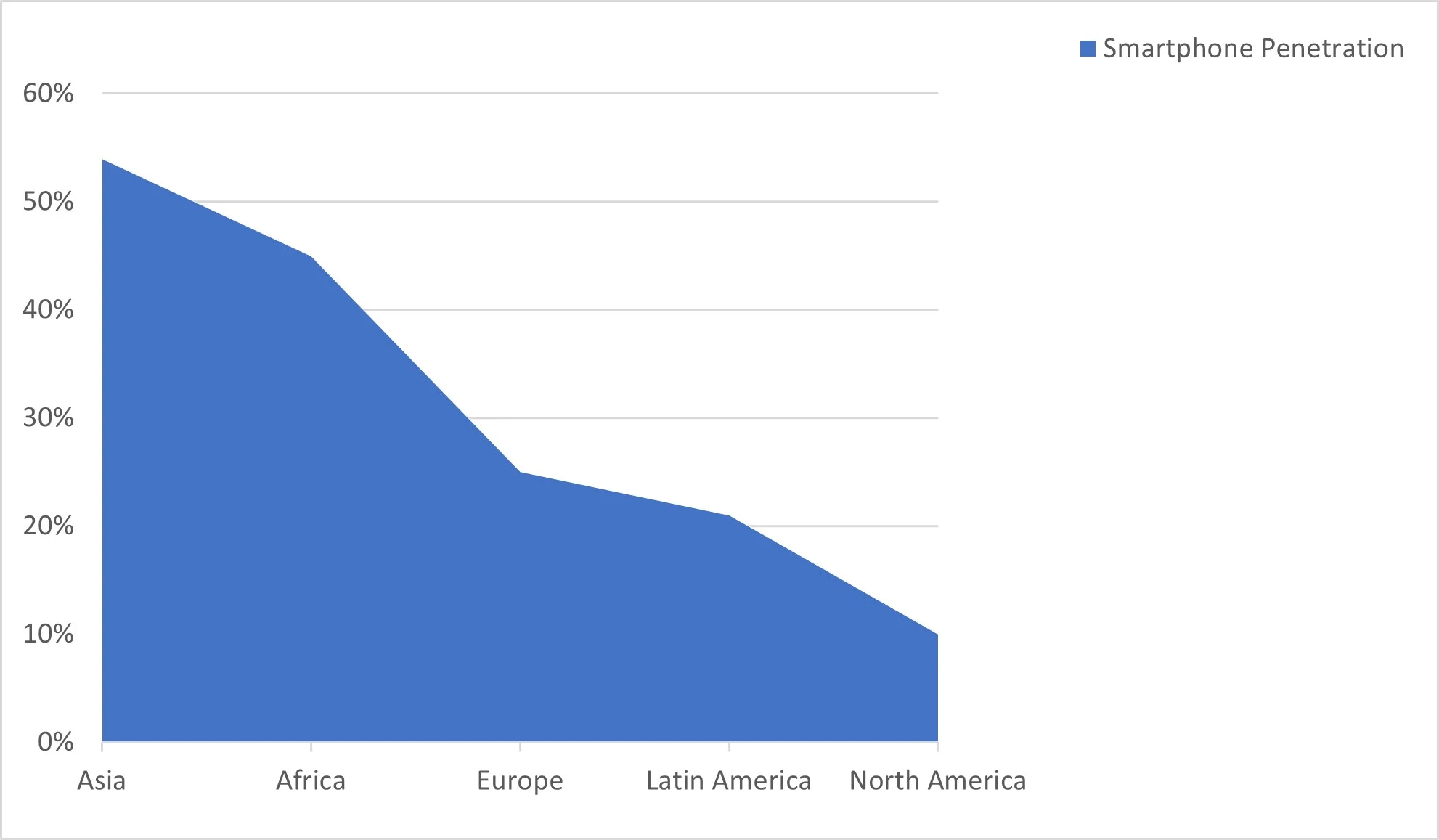
| Smartphone Penetration |
Asia | 54% |
Africa | 45% |
Europe | 25% |
Latin America | 21% |
North America | 10% |
Current Events and their Impacts on the Capacitive Sensor Market
Current Event | Description and its Impact |
Industrial IoT and Smart Manufacturing Growth |
|
Global Electric Vehicle Market Expansion |
|
- Current Industry Events of 2026
- Market Size Estimation
- Regional Breakdown
- Competitive Landscape
- Customer Intelligence
- Segmental Analysis
- Pricing Analysis
- Key Market Drivers, Challenges & Future Trends
- Customized Insights Section
Top 5 Capacitive Sensors Everyone Must Know
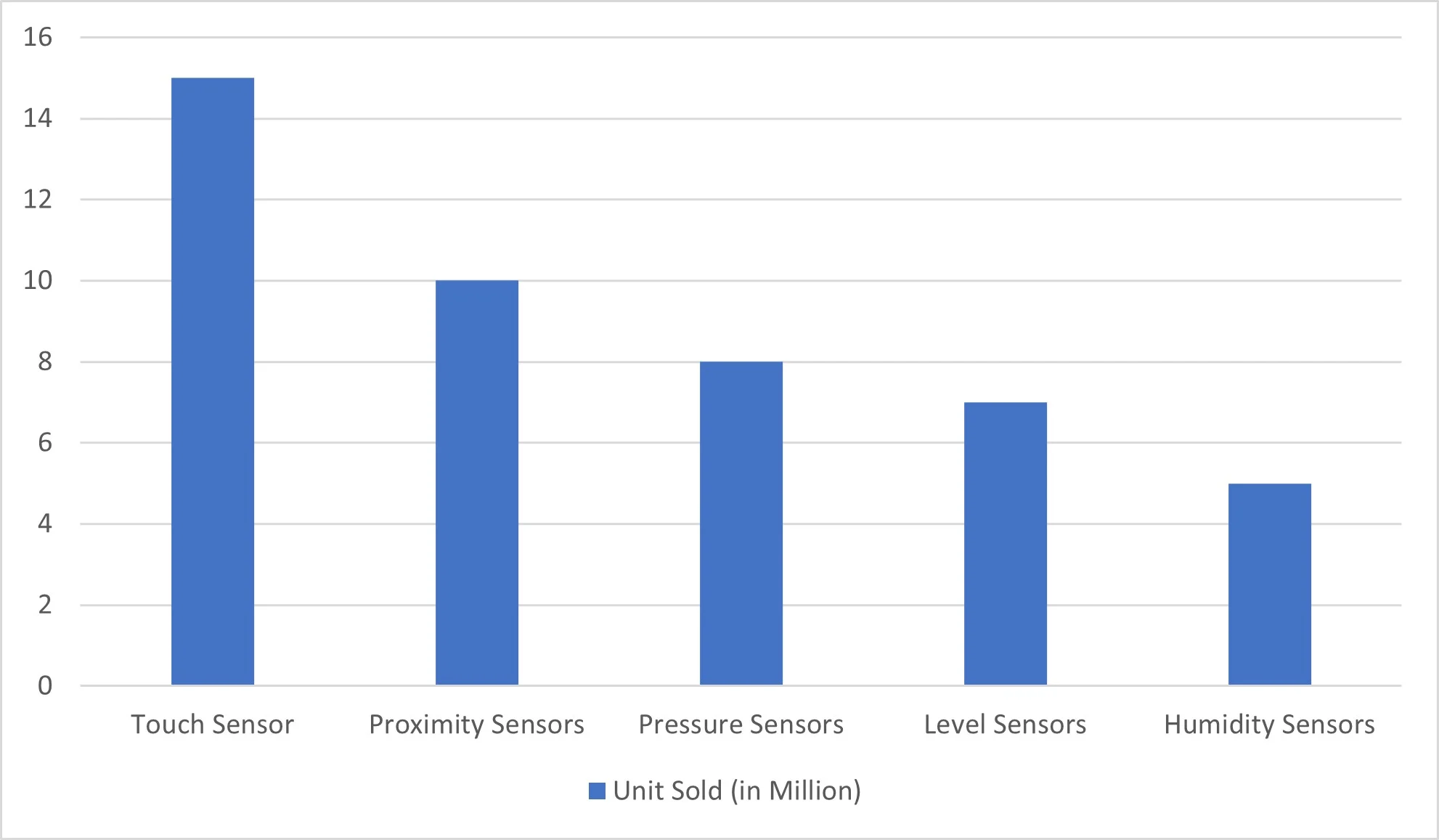
Type of Capacitive Sensors | Unit Sold (in Million) |
Touch Sensor | 15 |
Proximity Sensors | 10 |
Pressure Sensors | 8 |
Level Sensors | 7 |
Humidity Sensors | 5 |
Segmental Insights
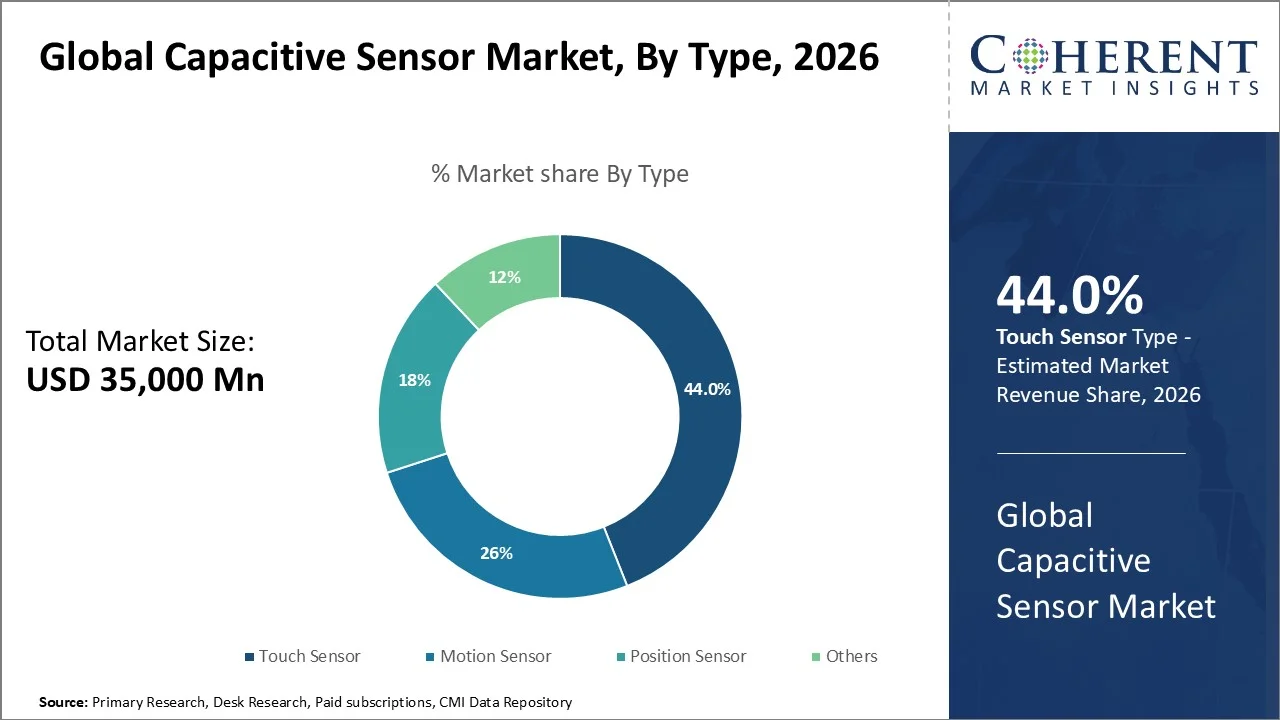
Touch Sensors Surge Ahead as Core Driver of Capacitive Technology in 2026
In terms of type, the Touch sensors segment is expected to dominate the market in 2026, holding 44% share Their ubiquitous integration into smartphones, tablets, laptops and automotive infotainment systems makes them indispensable. This part is the largest one due to the worldwide dependence of capacitive touchscreens for intuitive user interfaces with billions of devices shipped annually. Capacitive touch sensors are the most common type used in modern screens. They can detect changes as small as 0.1–2 picofarads, respond in less than 3 milliseconds, and last for more than 50 million touches. This makes them durable, fast, and precise for use in consumer electronics.
For example, in June 2025, EBE Sensors has introduced its next-generation TCRC capacitive touch technology for extreme conditions such as heat, cold, moisture, and dust. The innovation targets industrial, medical and outdoor applications and provides reliable operation even when wearing gloves or dirty hands, extending the usability of capacitive touch beyond consumer electronics.
Consumer Electronics Surge Forward as Leading Industry for Capacitive Sensor Adoption in 2026
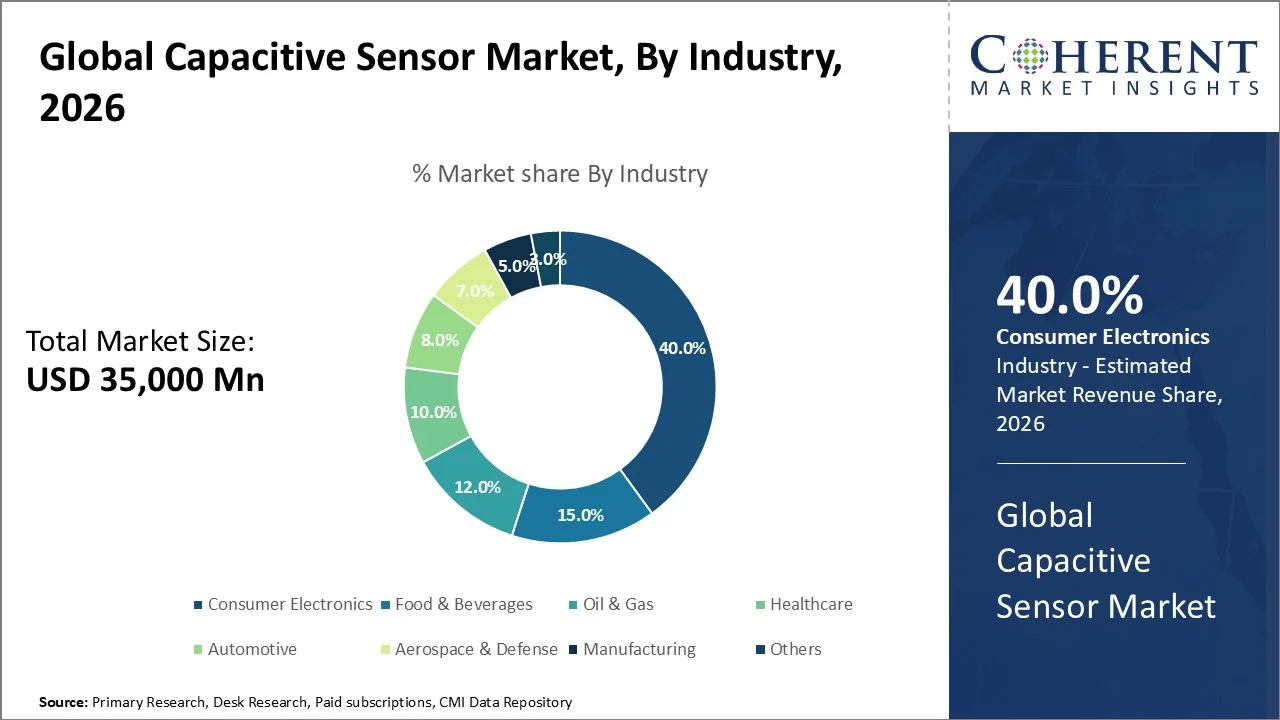
In terms of industry, the Consumer electronics lead with 40% share in 2026. Capacitive sensors are embedded in smartphones, wearables, laptops, and smart home devices for easy touch and gesture control. The highest demand for capacitive sensors is seen in this industry, with over a billion smartphones shipped annually, positioning it as the leading vertical for capacitive sensor adoption. Approximately 4.69 billion individuals own a smartphone. That’s set to grow to 5.83 billion by 2028.
In September 2025, Renesas introduced its RA0L1 ultra-low power microcontrollers with integrated capacitive touch technology, for example. The new MCUs for consumer electronics and small appliances provide responsive, energy efficient touch interfaces with up to 24 channels and reliable operation in various environments, thus enhancing the use of capacitive sensors in everyday devices.
Regional Insights
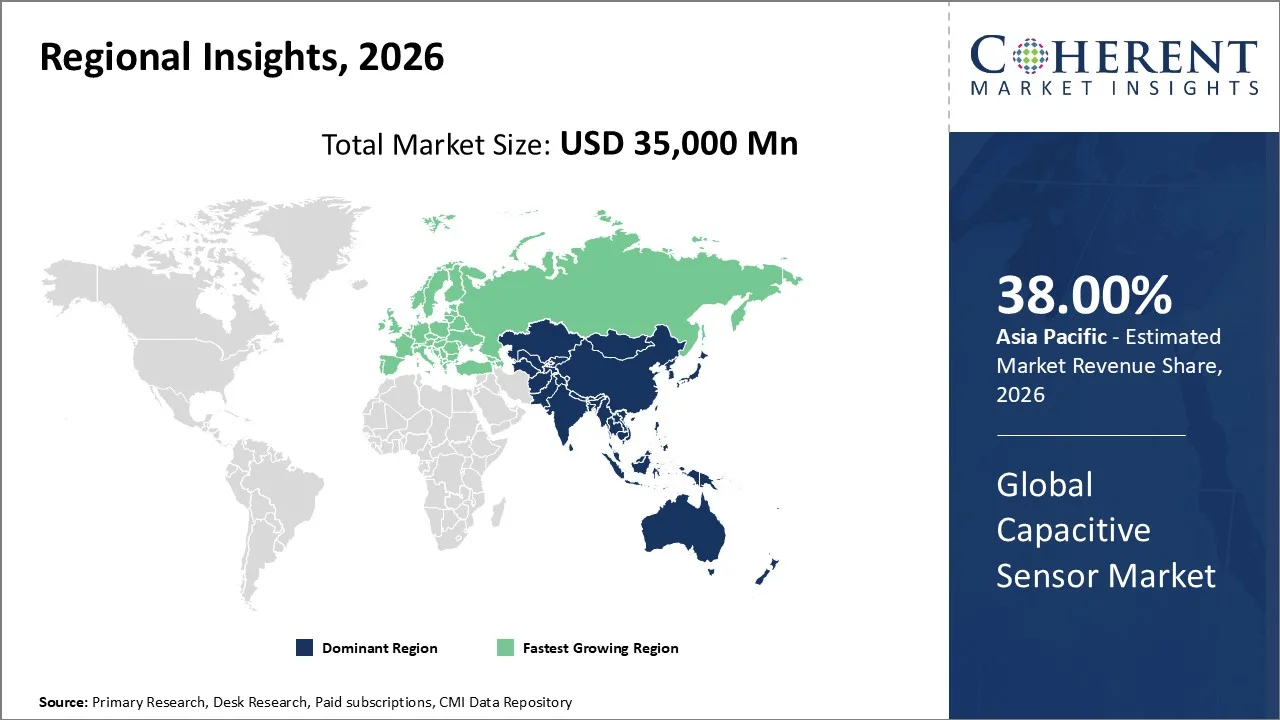
Will Asia‑Pacific Lead as the Dominant Hub for Capacitive Sensors?
Asia‑Pacific dominates the capacitive sensor market in 2026 with 38% share. This explains its dominance as the world's production hub for electronics, particularly smartphones, tablets, and wearables. The demand is driven by China, South Korea, Japan and India. Rapid EV adoption is further accelerating the integration of sensors in automotive infotainment and industrial automation.
For instance, in April 2026, SIGMATEK launched its new generation of Human Machine Interfaces with projected capacitive multitouch technology. In 2023,
Europe Fastest Growing Market for Capacitive Sensors In 2026?
Europe is the fastest growing region in 2026. German, French and Italian automotive giants are leading the charge in adopting capacitive sensors in EV dashboards and ADAS systems. Growth across several industries is also being driven further by industrial automation and pushes for safety and innovation in the EU regulatory. More than 7% of European Union GDP comes from the automotive industry which highlights its importance for the economic well-being of the region. It also provides work for around 13.8 million people, making it one of the biggest sectors in terms of employment in the EU and a pillar of industrial strength and innovation.
For example, in April 2026, Nanomade and PolyIC launched a transparent Human Machine Interface film that combines capacitive touch and force sensing. The technology developed in France and Germany extends the range of multitouch accuracy and pressure sensitivity, furthering European applications in automotive, industrial automation and consumer electronics.
Capacitive Sensor Market Analysis Country-Wise
China Drives Global Capacitive Sensor Demand
China leads the capacitive sensor market in 2026, commanding the largest global demand. The dominance is driven by massive manufacturing of smartphones and tablets, rapidly growing adoption of electric vehicles and growing industrial automation. Together, these sectors play a crucial role in driving the growth and innovation of the global capacitive sensor market.
Scientists from South China University of Technology announced a bio inspired flexible capacitive sensor array in March 2026. The innovation can detect objects coming from up to 90 mm away, withstand 400 kPa of pressure and improve detection depth by 104.56%, improving robotics safety and precision in industrial automation.
Leading consumer electronics growth in South Korea
South Korea is a major contributor to the capacitive sensor market with global leaders such as Samsung and LG. South Korea is a critical player in driving global innovation in consumer electronics and industrial applications, as demand for capacitive sensors is rising due to their dominance in smartphones, tablets and advanced display technologies. As of 2025, Samsung Electronics Co., Ltd. had 128,881 employees worldwide. The net sales revenue of the company increased by 10.88% and the total assets increased by 10.19%. Samsung’s net profit margin expanded 2.1%, reflecting robust financial performance and operational strength across its global business units.
Korean researchers, for example, say they will report progress in February 2026 on flexible and transparent capacitive sensors that will improve applications ranging from smartphones and displays to robotics and human-machine interfaces. Supported by industry leaders Samsung and LG, these innovations improve sensitivity and durability, further establishing South Korea as a key player in global capacitive sensor technology.
Who are the Major Companies in Capacitive Sensor Market
Major players operating in the Global Capacitive Sensor Market are Honeywell International Inc., NXP Semiconductors, Panasonic Corporation, Siemens, STMicroelectronics, Emerson Electric Co., Microchip Technology Inc., Robert Bosch GmbH, TE Connectivity, DENSO CORPORATION, OMRON Corporation, Amphenol Advanced Sensors, Infineon Technologies AG, Analog Devices, Inc., Cypress Semiconductor Corporation, Synaptics Incorporated, Schneider Electric, Renesas Electronics Corporation, FUJITSU, 3M,Eaton,Rockwell Automation, General Electric, ALPS ALPINE CO., LTD.
Key news
- In March 2026, Turck Introduced New Capacitive Sensors for Improved Detection and Control in Industrial Automation. These sensors offer a higher level of sensitivity and reliability even in dusty or wet conditions. The innovation is useful for the packaging and food processing industries in terms of improving efficiency and safety through accurate object detection and process control.
- In June 3, 2025, UltraSense Systems introduced the industry’s first fully integrated controller for both 24‑channel capacitive touch and 8‑channel piezoelectric force sensing: CapForce™ Edge. The innovation, which includes a 16-bit ADC embedded sensor-fusion MCU, improves automotive, consumer electronics and industrial applications with strong, buttonless human-machine interfaces.
Market Report Scope
Capacitive Sensor Market Report Coverage
| Report Coverage | Details | ||
|---|---|---|---|
| Base Year: | 2025 | Market Size in 2026: | USD 35,000 Mn |
| Historical Data for: | 2020 To 2024 | Forecast Period: | 2026 To 2033 |
| Forecast Period 2026 to 2033 CAGR: | 5.6% | 2033 Value Projection: | USD 51,320 Mn |
| Geographies covered: |
| ||
| Segments covered: |
| ||
| Companies covered: | Honeywell International Inc., NXP Semiconductors, Panasonic Corporation, Siemens, STMicroelectronics, Emerson Electric Co., Microchip Technology Inc., Robert Bosch GmbH, TE Connectivity, DENSO CORPORATION, OMRON Corporation, Amphenol Advanced Sensors, Infineon Technologies AG, Analog Devices, Inc., Cypress Semiconductor Corporation, Synaptics Incorporated, Schneider Electric, Renesas Electronics Corporation, FUJITSU, 3M, Eaton,Rockwell Automation, General Electric, ALPS ALPINE CO., LTD. | ||
| Growth Drivers: |
| ||
| Restraints & Challenges: |
| ||
Capacitive Sensor Market Trends
- Consumer Electronics: With 6 billion smartphone users and 79.5% penetration, capacitive sensors power touchscreens, fingerprint readers, and wearables. Over 560 million wearables shipped in 2024, with 60% adults using one in 2025.
- Automotive: 70% of new EVs to have capacitive dashboards, gesture recognition and smart steering by 2025. Car makers such as Tesla, BMW and Hyundai moved towards touchless interfaces, improving driver safety and infotainment experiences.
- Industrial Automation: It is widely used in food, chemical and water industries. The move to robotics boomed with the integration of capacitive tactile arrays for precision handling. 93.4% of US manufacturing firms with less than 100 employees can now afford automation thanks to collaborative robots (cobots).
- Healthcare: Smart scalpels with tissue stiffness and moisture detection using embedded capacitive tactile arrays in surgical tools (2025). Smart sutures were used to monitor healing, reduce complications and improve patient recovery outcomes. Approximately 25% of the respondents agreed to use the smartwatches, compared to 17% of female users.
Analyst Opinion
Capacitive sensor market poised as cornerstone of next-generation electronics in 2024-2026 driven by miniaturization, advanced materials and integration into smart systems. The industry is changing from old touch interfaces to intelligent sensing platforms within automotive, healthcare and industrial ecosystems.
- Advanced materials and precision sensing: Capacitive sensors built from graphene and nanocomposite dielectrics are expected to show as much as 40% improvement in sensitivity over traditional silicon-based designs by 2025. The leap will enable ultra-thin, flexible sensors for wearables and medical diagnostics. By 2026, the healthcare sector is anticipated to utilize capacitive biosensors for sensing biomolecular interactions with concentrations below 10 picomolar, allowing for non-invasive glucose monitoring and early-stage diagnosis of diseases.
- Integration in autonomous and intelligent systems: Capacitive sensors will be key in autonomous vehicles, robotics and smart infrastructure during 2024 to 2026. For example, capacitive sensors are expected to reduce the collision risk in advanced driver-assistance systems by up to 20%. Capacitive proximity sensors are expected to work at >50 mm with sub-mm resolution in industrial automation for safer human-machine collaboration. In 2026, capacitive sensors will be integrated with AI-powered edge computing platforms for real-time adaptive responses in smart factories and urban IoT networks.
Speak to the analyst
Want personalized insights?
Take the findings above to one of our principal consultants, or have the report rebuilt around the segments, geographies and competitors you actually track.
Market Segmentation
- By Type (Revenue, USD Mn, 2021-2033)
- Touch Sensor
- Motion Sensor
- Position Sensor
- Others
- By Industry (Revenue, USD Mn, 2021-2033)
- Consumer Electronics
- Food & Beverages
- Oil & Gas
- Healthcare
- Automotive
- Aerospace & Defense
- Manufacturing
- Others
- By Region (Revenue, USD Mn, 2021-2033)
- North America
- U.S.
- Canada
- Latin America
- Brazil
- Argentina
- Mexico
- Rest of Latin America
- Europe
- Germany
- U.K.
- Spain
- France
- Italy
- Russia
- Rest of Europe
- Asia Pacific
- China
- India
- Japan
- Australia
- South Korea
- ASEAN
- Rest of Asia Pacific
- Middle East & Africa
- GCC Countries
- Israel
- Rest of Middle East & Africa
- North America
- Key Players
- Honeywell International Inc.
- NXP Semiconductors
- Panasonic Corporation
- Siemens
- STMicroelectronics
- Emerson Electric Co.
- Microchip Technology Inc.
- Robert Bosch GmbH
- TE Connectivity
- DENSO CORPORATION
- OMRON Corporation
- Amphenol Advanced Sensors
- Infineon Technologies AG
- Analog Devices, Inc.
- Cypress Semiconductor Corporation
- Synaptics Incorporated
- Schneider Electric
- Renesas Electronics Corporation
- FUJITSU
- 3M
- Eaton
- Rockwell Automation
- General Electric
- ALPS ALPINE CO., LTD.
Sources
Primary Research Interviews
- Electronics Design Engineers
- Semiconductor Component Manufacturers
- Automotive Electronics Procurement Heads
- Industrial Automation Specialists
- Consumer Electronics Product Managers
- IoT Device Developers
- Medical Device Engineers
- Smartphone and Wearable OEMs
- Touchscreen Technology Experts
- Others
Databases
- S&P Global Market Intelligence
- IEEE Xplore Digital Library
- ACM Digital Library
- U.S. Patent and Trademark Office (USPTO)
- European Patent Office (EPO)
- International Electrotechnical Commission (IEC) Standards Database
- Others
Magazines
- EE Times
- Electronic Design
- Sensors Magazine
- Semiconductor Engineering
- Design News
- Automation World
- Embedded Computing Design
- Others
Journals
- IEEE Sensors Journal
- Sensors and Actuators A: Physical
- Journal of Micromechanics and Microengineering
- Measurement Science and Technology
- Microelectronics Journal
- Journal of Intelligent Material Systems and Structures
- Nature Electronics
- Others
Newspapers
- Reuters
- Bloomberg News
- The Wall Street Journal – Technology Section
- Financial Times – Technology
- The New York Times – Technology Section
- The Guardian – Technology Section
- TechCrunch – Hardware
- Electronics Weekly
- Others
Associations
- Institute of Electrical and Electronics Engineers (IEEE)
- International Electrotechnical Commission (IEC)
- American National Standards Institute (ANSI)
- International Society of Automation (ISA)
- European Committee for Electrotechnical Standardization (CENELEC)
- Semiconductor Industry Association (SIA)
- Electronics Components Industry Association (ECIA)
- International Microelectronics Assembly and Packaging Society (IMAPS)
- Others
Public Domain Sources
- U.S. Patent and Trademark Office (USPTO)
- European Patent Office (EPO)
- National Institute of Standards and Technology (NIST)
- International Electrotechnical Commission (IEC)
- World Intellectual Property Organization (WIPO)
- European Commission – Digital and Electronics
- National Renewable Energy Laboratory (NREL) – Sensor Applications
- NASA Technical Reports Server (NTRS)
- Others
Proprietary Elements
- CMI Data Analytics Tool
- Proprietary CMI Existing Repository of information for last 10 years
Get access to 250+ pages report
Every segment, forecast, competitor profile and data table behind the analysis above — available for instant download.
- ESOMAR Member
- ISO 9001:2015 Certified
- D-U-N-S Registered
- GDPR & CCPA Compliant
Missing comfort of reading report in your local language? Find your preferred language:
Transform your Strategy with Exclusive Trending Reports
Frequently Asked Questions
The global Capacitive Sensor Market size was valued at USD 35,000 Mn in 2026 and is expected to reach USD 51,320 Mn in 2033.
The Market is expected to witness a CAGR of 5.6% during the forecast period (2026-2033).
The growing penetration of consumer electronics such as smartphones, tablets, and laptop is expected to drive growth of the global capacitive sensor market during the forecast period.
Touch Sensor segment held the major market share in 2026 owing to rapidly rising population and increasing demand for smart wearables in emerging economies.
Key players operating in the Global Capacitive Sensor Market are Honeywell International Inc., NXP Semiconductors, Panasonic Corporation, Siemens, STMicroelectronics, Emerson Electric Co., Microchip Technology Inc., Robert Bosch GmbH, TE Connectivity, DENSO CORPORATION, OMRON Corporation, Amphenol Advanced Sensors, Infineon Technologies AG, Analog Devices, Inc., Cypress Semiconductor Corporation, Synaptics Incorporated, Schneider Electric, Renesas Electronics Corporation, FUJITSU, 3M,Eaton,Rockwell Automation, General Electric, ALPS ALPINE CO., LTD.