

Data Monetization Market Analysis & Forecast: 2026-2033
The data monetization market size is anticipated to grow at a CAGR of 19% with USD 5.3 Bn in 2026 and is expected to reach USD 19.0 Bn in 2033. The growth is driven by the rapid expansion of digital data ecosystems, a surge in the use of AI-driven analytics, increasing open-data access, and wider internet penetration (with ITU estimating 6.0 billion internet users globally in 2025).
Key Takeaways
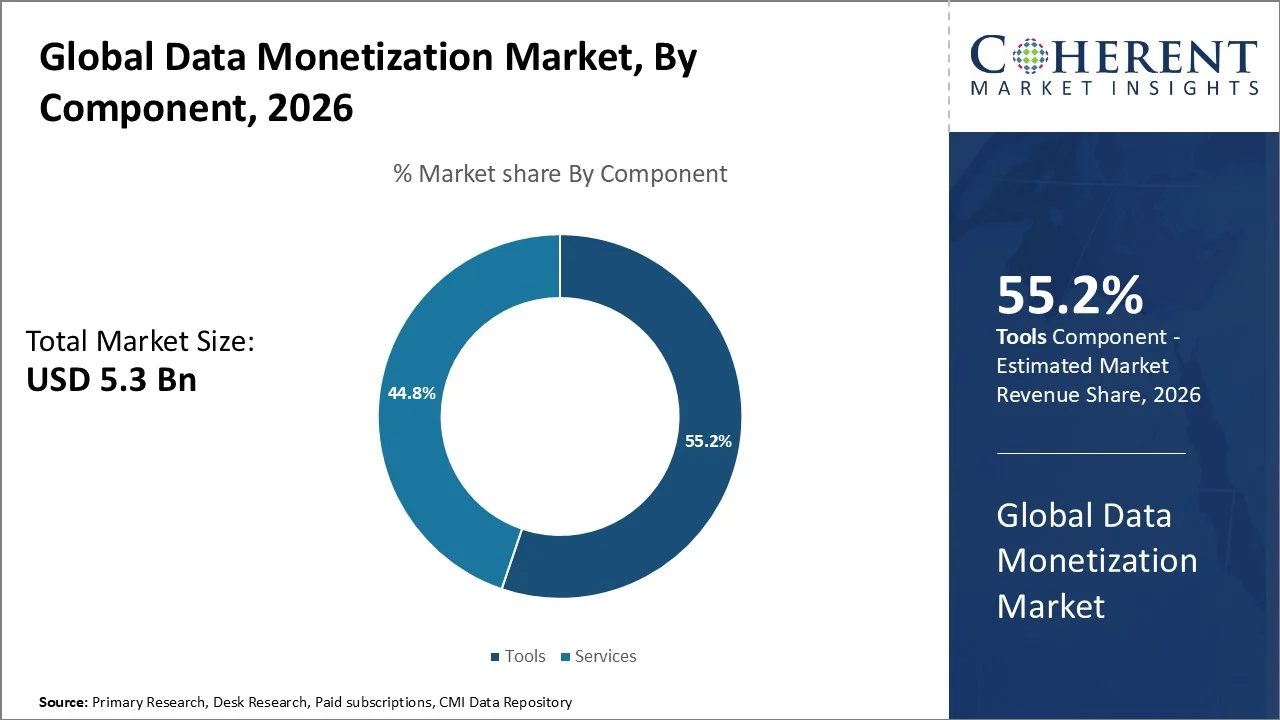
- Tools is expected to account for the largest share of 55.2% in 2026. This is because enterprises are in a greater need for analytics, visualization, AI-enabled data processing, and API-based data-sharing tools to convert raw datasets into commercial insights. The U.S. Data.gov portal currently lists 526,393 datasets, which reflects the expanding availability of reusable public data for applications, dashboards, as well as data products.
- Based on deployment type, the cloud-based solutions are expected to have a 65.4% market share by 2026. These cloud platforms allow for businesses to store, combine, analyze, along with selling large datasets without the need for any extensive on-site infrastructure. In 2025, 52.74% of EU enterprises used paid cloud computing services. While the U.S. Census Bureau reported strong business adoption of cloud-based technologies, thereby supporting broader demand for scalable data monetization platforms.
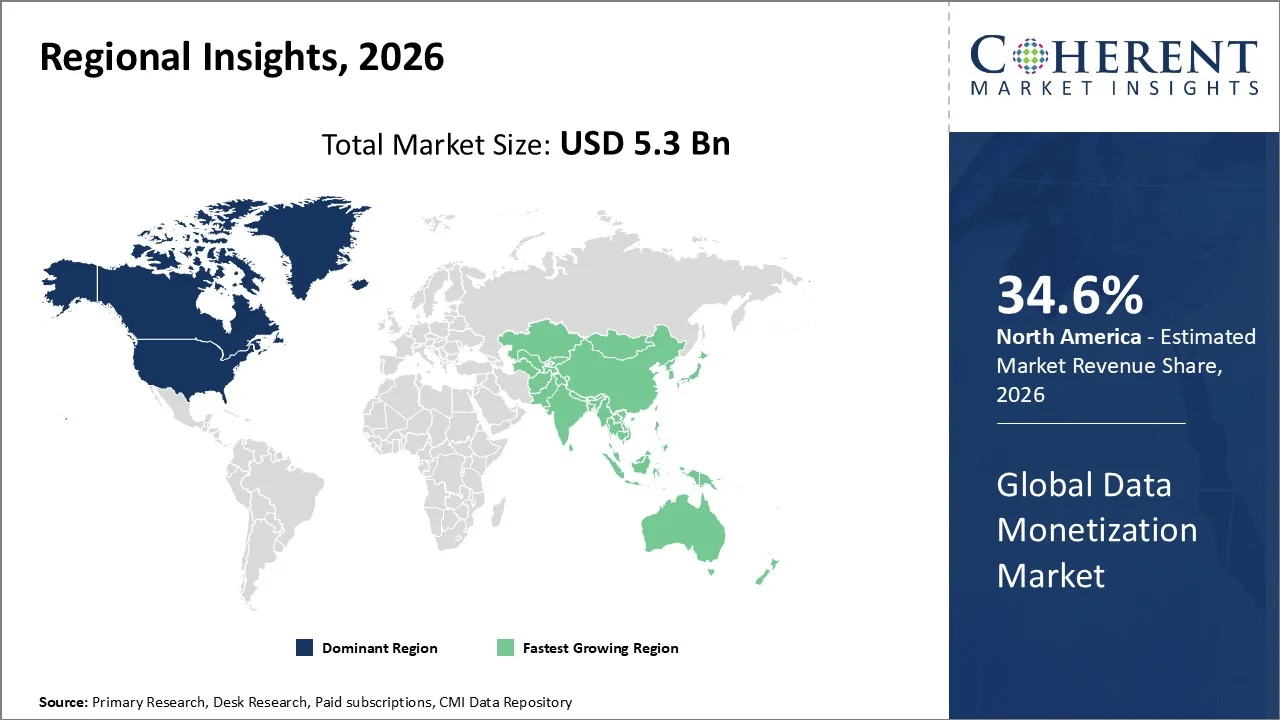
- North America is expected to acquire the dominant share of 34.6% in 2026. The growth is attributable to its mature digital economy, strong enterprise technology adoption, as well as large government-backed open-data ecosystem. The BEA data showcases the U.S. digital economy generated USD 2.41 trillion in value added, which is equal to 10.3% of U.S. GDP, thus strengthening demand for data monetization solutions.
Segmental Insights
Why is Tools Acquiring the Highest Share in the Market?
Tools is projected to account for the largest data monetization market share of 55.2% in 2026. The leadership is mainly attributed to the rising need for analytics, data integration, data catalogs, governance, privacy controls, and AI-enabled platforms that help enterprises convert raw data into usable commercial insights.
Rising adoption of AI and data-driven operations has further increased demand for monetization tools. Enterprises need tools to clean, classify, secure, analyze, and package data before it can be shared internally, sold externally, or used for predictive decision-making. In addition, the OECD notes that better access to public and private-sector data could generate benefits worth 1%–2.5% of GDP.
In April 2026, the U.S. Census Bureau released new Business Trends and Outlook Survey data products on AI use across businesses, based on a sample of 1.2 million businesses. This supports demand for analytics, data governance, and monetization tools.
- Current Industry Events of 2026
- Market Size Estimation
- Regional Breakdown
- Competitive Landscape
- Customer Intelligence
- Segmental Analysis
- Pricing Analysis
- Key Market Drivers, Challenges & Future Trends
- Customized Insights Section
Cloud-based holds the Largest Market Share
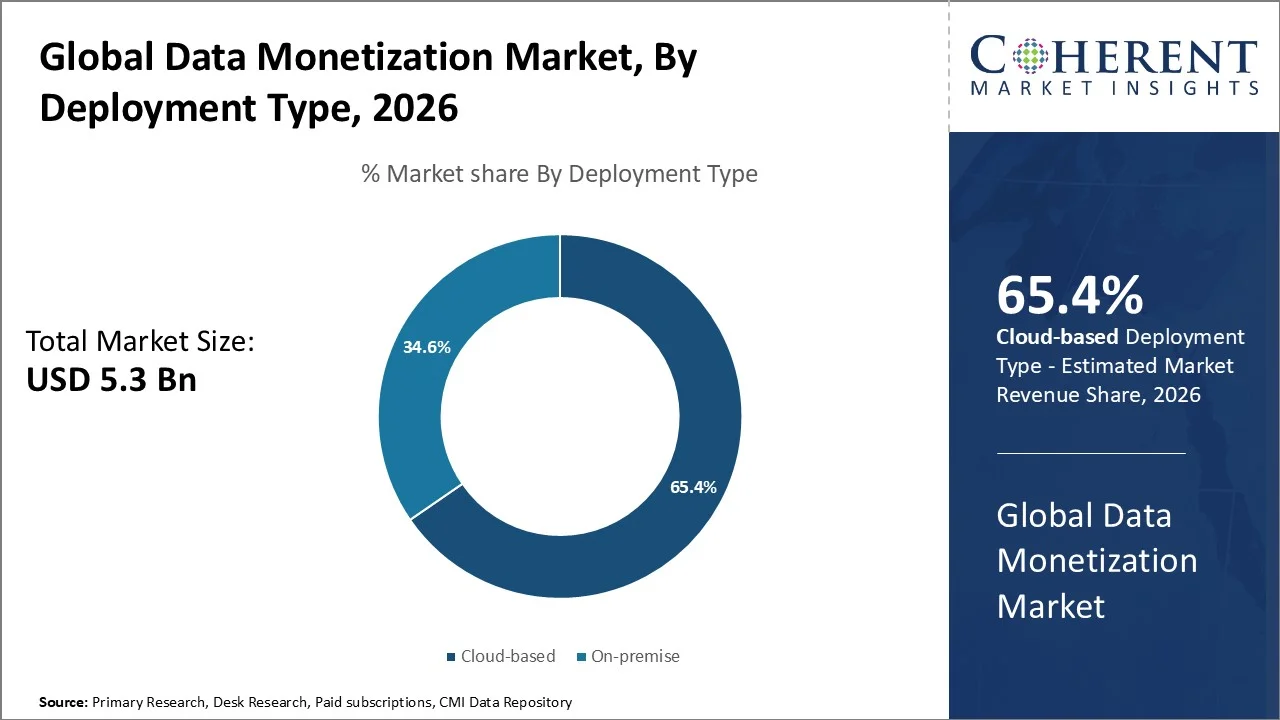
Based on deployment type, cloud-based is poised to dominate the market and accounts for a considerable 65.4% share in 2026. The segment’s growth is mainly due by increasing shift of data to cloud platforms for secure storage, real-time analytics, and scalability. As per our research, 52.74% of enterprises in the European Union used paid cloud computing services in 2025, mainly for storage, software, and data exchange, thereby highlighting broad use across various industries.
The cloud use by the government and public sector also underscores this trend. For instance, a survey of government cloud decision-makers found that 80% of public cloud leaders in government organizations were using hybrid cloud environments by 2025. The survey also found that 71% were leveraging multiple public cloud platforms to improve flexibility and continuity of operations. These official adoption signals reinforce the pivotal role of cloud deployment in enabling enterprises and public agencies to store, manage, share, and commercialize data at scale.
Advanced Technologies is Transforming the Data Monetization Industry in United States
The use of state-of-the-art technologies like artificial intelligence, machine learning, and automated analytics is altering data monetization strategies across industries in the U.S., thereby enabling more efficient extraction of value from both public as well as private datasets.
The U.S. federal open data portal Data.gov lists over 526,000 datasets made available to the public to stimulate innovation and economic activity, providing businesses with vast resources for commercial insights and new data-driven services. Federal statistics from the Department of Commerce’s Bureau of Economic Analysis show that the U.S. digital economy contributed nearly USD 2.6 trillion in value in 2022, underscoring the expanding role of data as an economic asset.
In addition, the recent estimates indicate that industries heavily reliant on government data reached nearly USD 800 billion in revenues in 2022. This highlights the direct commercial impact of open data usage on business decisions and monetization potential. These developments demonstrate how public data initiatives and advanced analytics technologies are fueling data monetization growth and digital innovation in the U.S. market.
Adoption of Real-Time Analytics: A Key Advancement in Data Monetization
A major breakthrough in the data monetization market is the emergence and widespread incorporation of real‑time analytics and data exchange frameworks across enterprises and public data ecosystems. According to the International Telecommunication Union (ITU), about 74% of the global population, were using the Internet in 2025, enabling more data generation and instantaneous processing. Real‑time analytics allows organizations to process user behavior, operational, and transactional data instantly rather than relying solely on historical reports. This increases the flexibility of pricing strategies, enhances personalization, bolsters fraud detection, and also speeds up decision-making in business.
The analytics‑driven model relies on cloud data platforms, AI‑powered tools, as well as automated dashboards, with data acting as a direct revenue‑generating asset rather than just an operational byproduct. In the European Union, the EU Data Act (fully applicable from September 2025) ensures fairer access to data from connected products and services, thereby fostering trusted sharing and commercial use. Meanwhile, the U.S. open data portal Data.gov lists hundreds of thousands of machine‑readable federal datasets, fostering innovation and third‑party insight services.
Firms like Snowflake, Microsoft, AWS, and Google Cloud are strengthening real‑time analytics, marketplace services, and clean‑room capabilities. These advancements help businesses unlock insights faster, create premium data products, and enable monetization beyond traditional reporting systems.
Current Events and Their Impact on the Data Monetization Market
Current Event | Description and its Impact |
EU Data Act Implementation for Connected Device Data Sharing |
|
India’s Digital Personal Data Protection Rules, 2025 |
|
Data Monetization Market Trends
- The rise of AI and machine learning is speeding up data monetization and is helping businesses in finding hidden value and in improving customer engagement strategies.
- Increasing government investment in data infrastructure is facilitating the expansion of data monetization opportunities. For example, the U.S. Data.gov platform now lists around 526,395 open datasets available for public use, thereby powering commercial analytics, applications, and AI model training.
- The U.S. HealthData.gov portal hosts over 23,102 datasets, providing rich public health and clinical information assets that private firms can incorporate into analytics, compliance, and service offerings.
- Open data support in India provides structured data resources across sectors, with 21,074 resources and 2,815 APIs available on the OGD Platform, thereby broadening the foundation for commercial analytics and data services.
- Expansion of data marketplaces is also supported by multi‑sector open data efforts like Indiaand the EU’s consolidated open dataset repository via data.europa.eu. This creates a fertile ground for cross‑border as well as cross‑domain monetization solutions.
Regional Insights
North America Data Monetization Market Leadership Driven by Robust Presence of Tech Giants
North America is set to account for the leading position in the data monetization market. The region occupies a substantial 34.6% share in 2026. The growth is mainly driven by rapid adoption of data-driven technologies and a robust presence of tech giants in the region. The demand for data monetization in the Canada and the United States is fueled by industries utilizing data to improve customer insights and operational efficiency. In the U.S., a considerable proportion of businesses in sectors like retail, healthcare, and finance have implemented data monetization strategies as of 2025. Also, the market is expected to grow further as businesses incline more towards AI and machine learning to drive value from big data.
The technological advancements continue to contribute to the market’s growth. In January 2025, Chainlink teamed up with the U.S. Department of Commerce to bring U.S. government macroeconomic data onto blockchain networks, thus enhancing the ways public data can be accessed as well as monetized in decentralized systems. Dappier AI also launched its AI- enabled data marketplace in mid-2024. Also, in October 2025, the firm partnered with LiveRamp to enhance data monetization through personalized ad targeting. These innovative initiatives are expected to continue driving data monetization market growth in North America.
Asia Pacific Data Monetization Market Trends
The Asia Pacific region is poised to be as the fastest-growing region through 2026-2033. The region’s growth is owing to rapid cloud adoption, expanding digital public infrastructure, and rising enterprise use of analytics and AI. Regional data generation continues to scale as ITU data shows Asia and Pacific active mobile-broadband subscriptions reached 101 per 100 people in 2025. India’s internet subscriber base increased to 1,028.61 million by December 2025, while China had 1.125 billion internet users and 80.1% penetration by end-2025, creating a vast base for data-led personalization, customer intelligence, and platform-based monetization across banking, retail, telecom, manufacturing, and public-sector platforms at scale.
Besides this, governments across China, India, Japan, and Singapore are building trusted data-sharing systems that support secure commercialization of data assets. The API Setu in India allows standardized sharing of government data and services through API. While Japan’s METI selected Ouranos Ecosystem projects for industrial data sharing across automotive, battery, and electricity-use chains. Also, digital economy in Singapore reached USD 113 billion, or 17.7% of GDP, strengthening demand for data analytics, AI, and consent-based data collaboration.
Growing Data Monetization Adoption Accelerates AI-Powered Data Exchange in United States
The United States data monetization market is witnessing robust activity mainly driven by enterprises looking to unlock value from data assets. The market is characterized by a continual shift toward AI-enabled and privacy-centric data commerce. The firms are leveraging predictive analytics and zero-trust architectures to enhance data value extraction and create new monetization channels.
One of the substantial developments include the expansion of Comscore’s AI-Powered Data Partner Network. Launched in September 2025, this network allows third-party data providers to convert ID-based datasets into scalable, privacy-first audience segments, which can be activated programmatically, thus signaling stronger monetization opportunities for audience and consumer data. Statistically, participation in Comscore’s network has drawn over 10 data providers, like AnalyticsIQ and TransUnion, by late 2025, expanding the ecosystem for monetizable audience insights.
In addition, Datavault AI has made substantial strides in the market. The firm signed a USD 750 million in tokenization contracts in Q1 2026, thus generating nearly USD 77 million in associated fees. This showcases the growing commercial demand for tokenized data exchange and monetization infrastructure.
China Data Monetization Market Trends
The China data monetization market is poised for steady growth over the forthcoming years. The growth is owing to rising enterprise demand for data-driven decision-making, AI adoption, and the rapid expansion of digital public as well as commercial data assets. In 2024, China generated 41.06 zettabytes of data, marking 25% year-on-year growth. While core digital industries accounted for around 10% of national GDP. The Data Monetization continues to be integral to converting large-scale enterprise, government, industrial, and consumer datasets into measurable revenue streams in finance, retail, healthcare, and manufacturing.
In addition to this, the government’s regulatory push for public data development and market-based data circulation is propelling organized adoption and expanding the scope of Data Monetization. China’s 2024 public data guidelines aim to establish basic systems by 2025 and a comprehensive utilization framework by 2030. Further, new government data-sharing regulations taking effect from August 2025 are expected to enhance digital governance, data accessibility, and compliant commercial data use.
Who are the Major Companies in Data Monetization Industry
Some of the major key players in Data Monetization Industry are Cisco Systems Inc. (US), Google, Inc., Microsoft, Inc., IBM Corporation, Microsoft, Salesforce.com, inc., Oracle, Infosys Limited, SAP, SAS Institute Inc., Sisense Inc., QlikTech International AB, Domo, Inc., Virtusa Corporation, Accenture, Reltio, Openwave Mobility Inc., Thales Group, Adastra Corporation, Ness Technologies, Inc., NetScout Systems, Inc., Paxata, Inc. and others
Key News
- In January 2026, Datavault AI Inc., a company focused on instant data monetization and enterprise digital twins, announced an expanded collaboration with IBM to deliver enterprise-grade AI performance at the edge in New York and Philadelphia through the SanQtum AI platform.
- In October 2025, Nexxen International announced the general availability of its Curated Marketplace solution, enabling partners like data owners and agencies to monetize data assets through its premium supply channels.
Market Report Scope
Data Monetization Market Report Coverage
| Report Coverage | Details | ||
|---|---|---|---|
| Base Year: | 2025 | Market Size in 2026: | USD 5.3 Bn |
| Historical Data for: | 2020 To 2024 | Forecast Period: | 2026 To 2033 |
| Forecast Period 2026 to 2033 CAGR: | 19% | 2033 Value Projection: | USD 19.0 Bn |
| Geographies covered: |
| ||
| Segments covered: |
| ||
| Companies covered: | Cisco Systems Inc. (US), Google, Inc., Microsoft, Inc., IBM Corporation, Microsoft, Salesforce.com, inc., Oracle, Infosys Limited, SAP, SAS Institute Inc., Sisense Inc., QlikTech International AB, Domo, Inc., Virtusa Corporation, Accenture, Reltio, Openwave Mobility Inc., Thales Group, Adastra Corporation, Ness Technologies, Inc., NetScout Systems, Inc., Paxata, Inc. and others | ||
| Growth Drivers: |
| ||
| Restraints & Challenges: |
| ||
Analyst Opinion
- The data monetization market is expanding as organizations increasingly recognize the value of data in decision-making. According to the U.S. Department of Commerce, data-driven companies are 5 times more likely to make faster decisions and 3 times more likely to have improved customer satisfaction, making data monetization not just a trend, but a necessity for businesses striving to stay competitive.
- The global incorporation of artificial intelligence (AI) and machine learning (ML) is propelling this market's growth, with organizations leveraging data for both predictive analytics and automation. The U.S. National Institute of Standards and Technology (NIST) reports that AI adoption is expected to reach 25% of all businesses by 2026, further fueling data's importance as a monetizable asset.
- The rise of the Internet of Things (IoT) and connected devices has also played a crucial role, with the U.S. Federal Communications Commission (FCC) estimating that, by 2027, more than 41 billion IoT devices will be in operation across the globe. This growth in data generation is prompting businesses to find new revenue streams via data monetization models, thus highlighting the growing need for robust data governance as well as management practices.
Speak to the analyst
Want personalized insights?
Take the findings above to one of our principal consultants, or have the report rebuilt around the segments, geographies and competitors you actually track.
Data Monetization Market Segmentation
- By Component
- Tools
- Services
- By Deployment Type
- On-premise
- Cloud-based
- By Organization Size
- SMEs
- Large Enterprises
- By Vertical
- Government & Defense
- BFSI
- IT & Telecom
- Healthcare
- Retail
- Manufacturing
- Energy & Utility
- Others
- Global Data Monetization Market, By Region:
- North America
- U.S.
- Canada
- Latin America
- Brazil
- Mexico
- Argentina
- Rest of Latin America
- Europe
- Germany
- U.K.
- France
- Italy
- Spain
- Russia
- Rest of Europe
- Asia Pacific
- China
- India
- Japan
- Australia
- South Korea
- ASEAN
- Rest of Asia Pacific
- Middle East
- GCC
- Israel
- Rest of Middle East
- Africa
- South Africa
- Central Africa
- North Africa
- North America
Sources
Primary Research Interviews
- Primary Research Interviews
- Data Monetization Platform Providers
- Cloud Service Providers
- Data Aggregators
- Data Analysts and Scientists
- AI/ML Technology Providers
- Industry-Specific Data Consultants (e.g., finance, healthcare, retail)
- Others
Databases
- Bloomberg Terminal
- Thomson Reuters Eikon
- Euromonitor International
- Others
Magazines
- Data Management Magazine
- InformationWeek
- Data-Driven Business Magazine
- TechCrunch
- CIO Review
- Others
Journals
- Journal of Big Data
- International Journal of Data Science and Analytics
- Data Science Journal
- Journal of the Association for Information Systems
- Business Intelligence Journal
- Others
Newspapers
- The Wall Street Journal
- Financial Times
- Reuters
- The New York Times
- Bloomberg News
- Others
Associations
- Data Monetization Association
- International Data Corporation (IDC)
- Data Governance Professionals Association (DGPA)
- Data & Marketing Association (DMA)
- Big Data and Analytics Association (BDAA)
- Others
Public Domain Sources
- U.S. Department of Commerce - Data Privacy and Protection
- European Union - General Data Protection Regulation (GDPR)
- National Institute of Standards and Technology (NIST)
- World Economic Forum (WEF)
- United Nations - Data for Development
- Others
Proprietary Elements
- CMI Data Analytics Tool
- Proprietary CMI Existing Repository of Information for the Last 10 Years
Get access to 250+ pages report
Every segment, forecast, competitor profile and data table behind the analysis above — available for instant download.
- ESOMAR Member
- ISO 9001:2015 Certified
- D-U-N-S Registered
- GDPR & CCPA Compliant
Missing comfort of reading report in your local language? Find your preferred language:
Transform your Strategy with Exclusive Trending Reports
Frequently Asked Questions
The data monetization market is expected to reach USD 19.0 Bn in 2033.
Major players operating in the global data monetization market include Cisco Systems Inc. (US), Google, Inc., Microsoft, Inc., IBM Corporation, Microsoft, Salesforce.com, inc., Oracle, Infosys Limited, SAP, SAS Institute Inc., Sisense Inc., QlikTech International AB, Domo, Inc., Virtusa Corporation, Accenture, Reltio, Openwave Mobility Inc., Thales Group, Adastra Corporation, Ness Technologies, Inc., NetScout Systems, Inc., Paxata, Inc. and others
The stringent data privacy regulations (GDPR, CCPA), high security risks (breaches, fraud), and significant organizational barriers are the key factors hampering growth of the market.
The exponential increase in enterprise data, the need for new revenue streams, adoption of AI/big data analytics, and the shift towards data-driven decision-making is boosting demand for data monetization.
The data monetization market is anticipated to grow at a CAGR of 19% between 2026 and 2033.
Among regions, North America is expected to account for a largest market share in the global Data Monetization Market over the forecast period.