

Wireless Connected Devices Market Analysis & Forecast: 2026-2033
Wireless connected devices market size is estimated to be valued at USD 130.51 Bn in 2026 and is expected to reach USD 313.84 Bn in 2033, exhibiting a compound annual growth rate (CAGR) of 13.20% from 2026 to 2033.
Key Takeaways
- Based on Technology, the Wi-Fi segment is expected to hold 42% share of the market in 2026.
- Based on Device, the computing/communication device segment is expected to lead the market with 57% share in 2026.
- Based on Region, North America is set to lead the wireless connected devices market with 39% share in 2026. While, Asia Pacific is anticipated to be the fastest growing region.
Market Overview
Wireless connected devices are physical devices, which are connected to each other and other systems through internet. Wireless connected device includes traditional computing hardware such as computers, laptops, mobile devices such as smartphone, and tablets. Moreover, a growing list of wireless connected devices also includes household appliances, heating, and cooling systems, health and fitness monitoring devices. These wireless connected devices are monitored and controlled remotely. They are connected via the internet, with each other, and follow protocols such as Wi-Fi, NFC (Near-field Communication), 3G, and 4G networks.
Current Events and Its Impacts on the Wireless Connected Devices Market
Current Event | Description and its Impact |
U.S.-China Trade Relations and Technology Export Controls |
|
5G Network Infrastructure Rollout and Spectrum Allocation |
|
Which sectors will drive Wireless Connected Devices Market growth?
Sector | Opportunity Highlight | Data / Forecast Example |
Healthcare | Remote monitoring & wearables | Connected healthcare devices > USD 150B by 2030 |
Automotive | V2X & autonomous driving | 95% of new vehicles connected by 2030 |
Agriculture | Smart farming IoT devices | 600M+ devices connected by 2032 |
Energy | Smart meters & smart grids | 1.2B smart meters globally by 2030 |
Retail | IoT shopping & AR | 70% of retail chains using IoT by 2028 |
Defense & Safety | Wireless surveillance, drones, emergency networks | Rising government investments (multi‑billion USD annually) |
- Current Industry Events of 2026
- Market Size Estimation
- Regional Breakdown
- Competitive Landscape
- Customer Intelligence
- Segmental Analysis
- Pricing Analysis
- Key Market Drivers, Challenges & Future Trends
- Customized Insights Section
Segmental Insights
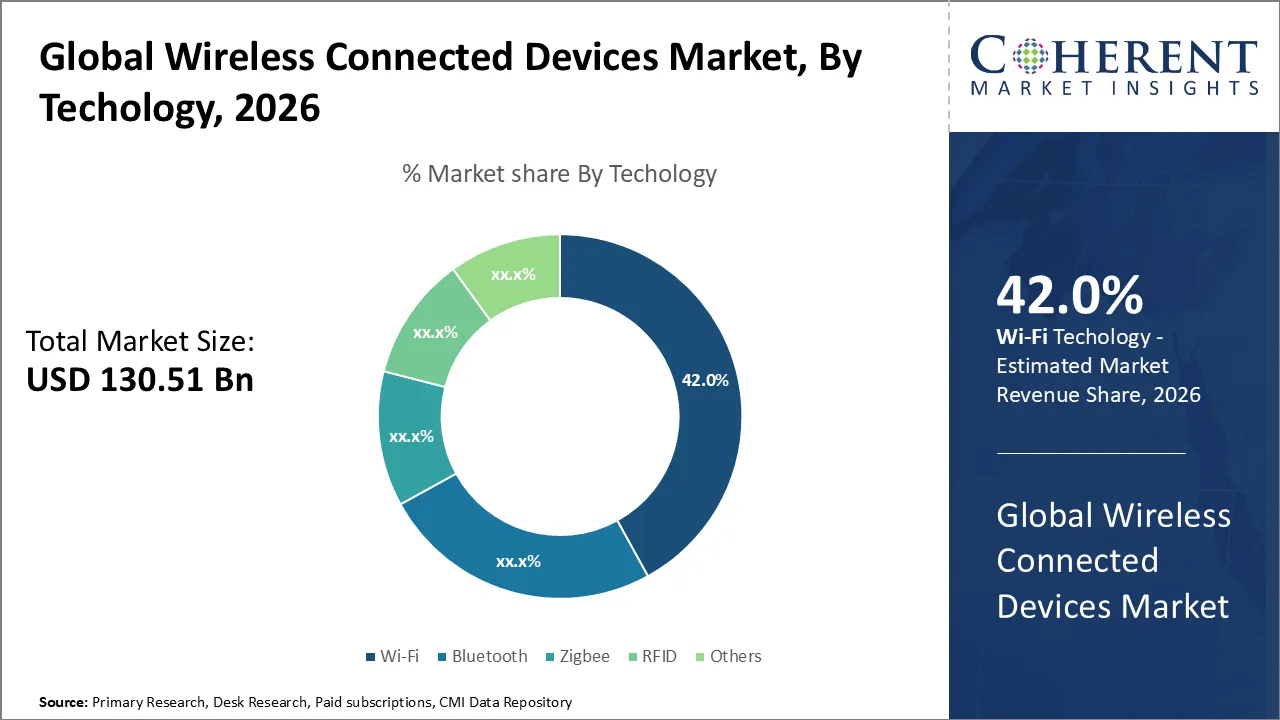
Wireless Connected Devices Market Insights, By Technology - Wi‑Fi leads the wireless connected devices market in 2026 with 42% share, powering global connectivity
In terms of technology, the Wi-Fi segment is expected to hold 42% share of the market in 2026. Its dominance stems from widespread integration in smartphones, laptops, smart homes, and enterprise systems. The rollout of Wi‑Fi 6 and 6E enhances speed, reliability, and efficiency, making it the backbone of connectivity. As IoT adoption accelerates, Wi‑Fi remains the preferred standard for high‑bandwidth applications, ensuring seamless communication across consumer, industrial, and public environments, solidifying its position as the core wireless technology.
For instance, in October 2025, the release of the first Wi-Fi 8 silicon ecosystem by Broadcom is an important advance forward for wireless connectivity. Wi-Fi 8 is designed to power the AI era. It has faster speeds, lower latency, and better efficiency, which strengthens Wi-Fi's position as the most popular technology for connected devices and drives growth in consumer, business, and industrial applications around the world.
Wireless Connected Devices Market Insights, By Device - Computing/Communication dominate in 2026 with 57% share, serving as the primary digital gateways
In terms of device, the computing/communication device segment is expected to lead the market with 57% share in 2026. Their massive installed base and frequent upgrade cycles drive consistent demand. These devices serve as the primary gateways to digital ecosystems, supporting 5G, Wi‑Fi, and Bluetooth connectivity. With rising dependence on mobile computing, cloud services, and remote work, they remain indispensable. Their role as central hubs for entertainment, productivity, and IoT integration ensures continued leadership in connected device adoption.
For instance, in November 2025, the FutureG Wireless Communications Research Center at Georgia Tech works on connectivity that goes beyond 5G. It has a direct effect on computing and communication devices like smartphones and laptops because it focuses on ultra-fast, secure, and smart networks. These devices, which are the most popular in the connected market, will work better, allowing AI, cloud, and immersive apps to be used all over the world.
Regional Insights
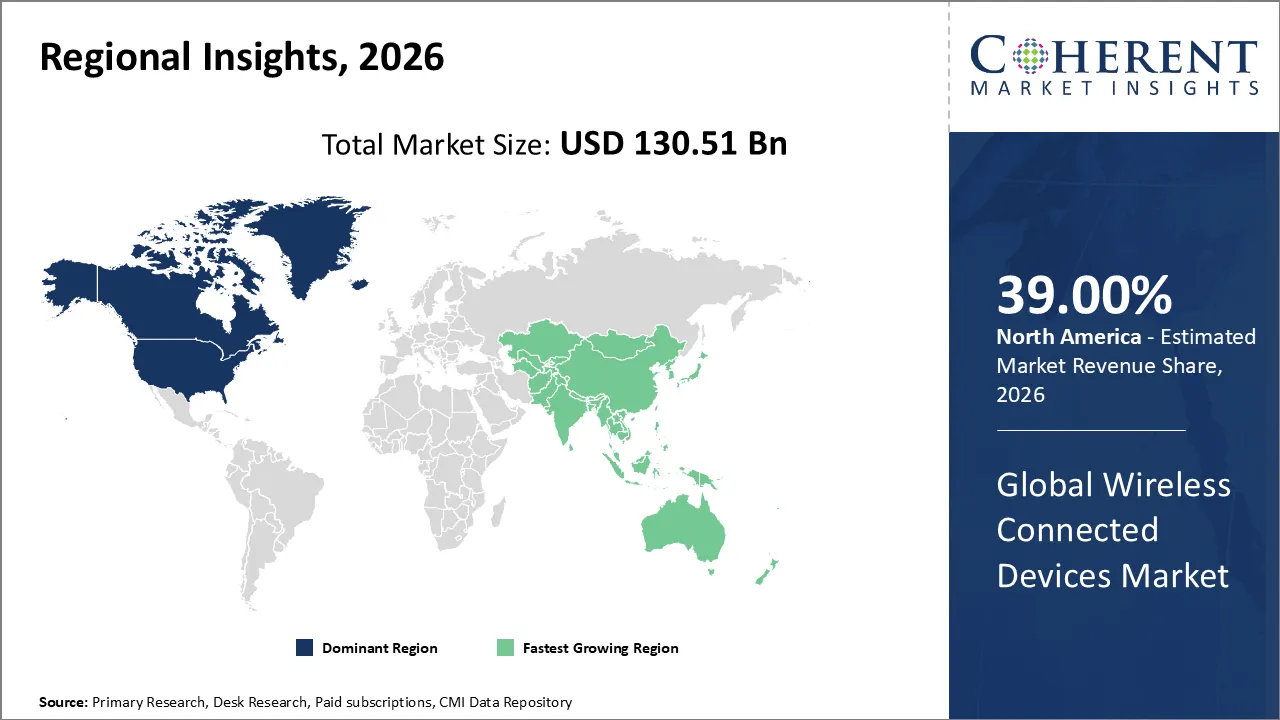
North America Wireless Connected Devices Market Analysis & Trends
North America is expected to lead the wireless connected devices market with 39% share in 2026, due to advanced 5G deployment, widespread adoption of Wi‑Fi 6, and strong IoT integration across industries. High penetration of smartphones, laptops, and smart home systems drives consumer demand, while enterprises accelerate digital transformation with connected solutions. Wearables and entertainment devices further boost adoption, supported by robust infrastructure and innovation from leading tech companies.
For instance, in August 2025, Silex Technology America released a Wi-Fi 6E tri-band embedded module that uses NXP's IW623 chipset. The innovation, which is focused on North America, improves the speed, reliability, and low-latency connectivity of industrial, medical, and business devices. This makes the Wireless Connected Devices Market stronger, which helps with smooth integration across consumer and professional ecosystems all over the world.
Asia Pacific Wireless Connected Devices Market Analysis & Trends
Asia Pacific is anticipated to be the fastest growing region. Massive smartphone penetration in countries like China and India fuels demand, while government‑backed smart city initiatives accelerate adoption of IoT and connected solutions. Industrial automation, logistics, and manufacturing sectors increasingly rely on wireless devices, supported by expanding 5G infrastructure. Rising middle‑class populations and digital transformation programs further boost demand, positioning Asia‑Pacific as the most dynamic growth hub for connected technologies worldwide.
For instance, in January 2025, Acer adds Predator 5G CPE, Wi-Fi 7 mesh routers, and mobile hotspots to its list of connectivity products. These new features make the Wireless Connected Devices Market stronger by improving speed, reliability, and coverage. Acer supports consumer, business, and smart home ecosystems by combining next-generation 5G and Wi-Fi 7. This helps drive adoption and market growth.
Wireless Connected Devices Market Outlook Country-Wise
The U.S. Wireless Connected Devices Market Trends
In 2026, the U.S. drives strong demand in the Wireless Connected Devices Market due to advanced 5G and Wi‑Fi 6/7 infrastructure, widespread adoption of IoT across healthcare, automotive, and industrial sectors, and high penetration of smartphones, laptops, and smart home systems. Consumer interest in wearables, entertainment devices, and connected appliances further accelerates growth. Robust enterprise digital transformation initiatives and innovation from leading tech companies reinforce the U.S. position as the dominant market, accounting for nearly 20% of global demand.
For instance, in December 2025, GTT Communications launched an improved 5G fixed wireless solution in the U.S. that gives businesses high-speed broadband with failover capability. It uses dual SIM technology to make sure that primary or backup applications can always connect. The service allows for quick deployment, unlimited use, and low latency performance.
China Wireless Connected Devices Market Trends
In 2026, China drives strong demand in the Wireless Connected Devices Market due to its massive smartphone user base, rapid 5G expansion, and government‑backed smart city initiatives. Industrial IoT adoption in manufacturing, logistics, and healthcare accelerates connectivity needs, while rising middle‑class populations fuel consumer demand for smart home devices and wearables. Local tech giants and startups innovate aggressively, ensuring widespread integration of wireless solutions. These factors position China as a leading market, accounting for nearly 18% of global demand.
For instance, in June 2025, At MWC Shanghai 2025, Huawei and China Telecom launched their 5G-Advanced Intelligent Ultra Pooling Uplink technology. It supports IoT, wearables, and AI-driven apps by increasing uplink speeds by 15% and lowering latency by more than 30%. This breakthrough makes China's role in the Wireless Connected Devices Market stronger, which helps smart cities and industrial ecosystems grow.
Market Report Scope
Wireless Connected Devices Market Report Coverage
| Report Coverage | Details | ||
|---|---|---|---|
| Base Year: | 2025 | Market Size in 2026: | USD 130.51 Bn |
| Historical Data for: | 2020 To 2024 | Forecast Period: | 2025 To 2032 |
| Forecast Period 2026 to 2033 CAGR: | 13.20% | 2033 Value Projection: | USD 313.84 Bn |
| Geographies covered: |
| ||
| Segments covered: |
| ||
| Companies covered: | Apple Inc., Google, HP Development Company, L.P, Huawei Technologies Co., Ltd, Lenovo, LG Electronics, Microsoft, Samsung Corporation, Xiaomi, Verizon, and ZTE Corporation. | ||
| Growth Drivers: |
| ||
| Restraints & Challenges: |
| ||
Wireless Connected Devices Market Driver
How does IoT growth to 30 Billion devices by 2030 boost Wireless Connected Devices Market?
The Internet of Things (IoT) is a major driver of the Wireless Connected Devices Market, with projections of over 30 billion devices by 2030. Smart homes, healthcare monitoring systems, connected cars, and industrial IoT applications are fueling adoption. This vast ecosystem significantly boosts wireless connected devices market share, as enterprises and consumers increasingly rely on seamless connectivity. The integration of IoT across diverse sectors ensures continuous expansion, making IoT one of the strongest pillars of market growth worldwide.
How do 5G and Wi‑Fi 6/7/8 boost Wireless Connected Devices Market?
The rapid deployment of 5G networks, alongside the evolution toward Wi‑Fi 6, Wi‑Fi 7, and Wi‑Fi 8, is transforming connectivity. These next‑generation standards deliver faster speeds, ultra‑low latency, and more reliable connections for consumer electronics, enterprise systems, and industrial IoT. This technological leap drives wireless connected devices market demand, enabling smart cities, autonomous vehicles, and advanced healthcare solutions. By enhancing performance and scalability, 5G and Wi‑Fi innovations ensure that connected devices remain indispensable across global markets, fueling exponential adoption.
Wireless Connected Devices Market Opportunity
Smart Cities & Infrastructure Projects
Governments in China, India, and the U.S. are accelerating smart city initiatives, creating vast opportunities for connected traffic systems, public safety networks, and energy‑efficient smart grids. These projects rely on wireless sensors, IoT platforms, and advanced connectivity to improve urban efficiency and sustainability. As investments scale, the wireless connected devices market forecast highlights strong adoption in urban infrastructure, where billions of devices will integrate seamlessly to support smarter living environments and enhance public services across global metropolitan regions.
Analyst Opinion (Expert Opinion)
- The market for wireless connected devices is growing quickly as connectivity becomes a basic part of both consumer and industrial ecosystems. Recent tracking of connectivity indicates that the number of connected IoT devices is growing quickly. By the end of 2025, there is expected to be more than 21 billion active wireless connections. This growth shows that Wi-Fi, Bluetooth, and cellular technologies are still being combined in devices like smart appliances and industrial sensors.
- Wireless technologies are the most common way to connect IoT devices. Wi-Fi is an important component of connections since it is so widely used in home and business networks. Bluetooth, on the other hand, is still a key technology for low-power devices like wearables and short-range sensors. Cellular IoT technologies like LTE-M and NB-IoT are used more and more for asset tracking, automotive telematics, and remote monitoring solutions since they can cover larger areas.
- In advanced markets, connected devices are still very popular due to a lot of wireless infrastructure and a lot of people want smart home and wearable products. As for the Asia-Pacific region, growth is driven by more mobile networks, more people moving to cities, and more businesses that need real-time data exchange.
Trends in the supply of chips show that the industry is making strong progress in developing new chips and changing standards that make wireless protocols more secure, energy-efficient, and faster. These improvements are making it easier to use in more areas, such as smart cities, healthcare monitoring, consumer electronics, and manufacturing automation. - Overall, the market for wireless connected devices is growing up, with more uses and smarter deployments that combine data analytics and edge computing. Wireless connectivity remains the essential backbone for next-generation digital transformation initiatives as device ecosystems grow more intricate and widespread.
Speak to the analyst
Want personalized insights?
Take the findings above to one of our principal consultants, or have the report rebuilt around the segments, geographies and competitors you actually track.
Recent Developments
- In January 2025, At CES 2026, MediaTek introduced the Filogic 8000 series, which was the first to support Wi-Fi 8. It gives IoT, smart homes, AR/VR, and business systems more power by making them faster, more reliable, and less likely to fail.
- In October 2025, TP-Link performed the world's first Wi-Fi 8 connectivity test, which confirmed the beacon and data throughput. This breakthrough makes it possible to have very fast, low-latency, and reliable connections that are necessary for IoT, smart homes, and business systems.
Market Segmentation
- By Technology
- Bluetooth
- Wi-Fi
- Zigbee
- RFID
- Others
- By Devices
- Computing/ Communication Devices
- Entertainment Devices
- Wearable Devices
- Others
- By Region
- North America
- U.S.
- Canada
- Latin America
- Brazil
- Argentina
- Mexico
- Rest of Latin America
- Europe
- Germany
- U.K.
- Spain
- France
- Italy
- Russia
- Rest of Europe
- Asia Pacific
- China
- India
- Japan
- Australia
- South Korea
- ASEAN
- Rest of Asia Pacific
- Middle East
- GCC Countries
- Israel
- Rest of Middle East
- Africa
- South Africa
- North Africa
- Central Africa
- North America
- Wireless Connected Devices Market Companies
- Apple Inc.
- HP Development Company
- L.P
- Huawei Technologies Co., Ltd
- Lenovo
- LG Electronics
- Microsoft
- Samsung Corporation
- Xiaomi
- Verizon
- ZTE Corporation
Sources
Primary Research Interviews
- Wireless Device Manufacturers (Smartphones, Wearables, IoT Devices)
- Semiconductor & Connectivity Chipset Providers
- Telecom Network Operators & Service Providers
- IoT Platform & Solution Providers
- System Integrators & Network Infrastructure Engineers
- Others
Databases
- Bloomberg Terminal
- Thomson Reuters Eikon
- Others
Magazines
- Wireless Week
- IEEE Spectrum
- IoT World Today
- Mobile World Live
- Communications Today
- Others
Journals
- IEEE Communications Magazine
- IEEE Internet of Things Journal
- International Journal of Wireless Information Networks
- Wireless Personal Communications Journal
- Others
Newspapers
- The Wall Street Journal
- Financial Times
- Reuters
- Bloomberg News
- Others
Associations
- GSMA (Global System for Mobile Communications Association)
- IEEE (Institute of Electrical and Electronics Engineers)
- 3GPP (3rd Generation Partnership Project)
- Wi-Fi Alliance
- IoT M2M Council
- Others
Public Domain Sources
- U.S. Federal Communications Commission (FCC)
- International Telecommunication Union (ITU)
- World Bank Open Data
- European Commission – Digital Economy & Society
- OECD Digital Economy Outlook
- Others
Proprietary Elements
- CMI Data Analytics Tool
- Proprietary CMI Existing Repository of Information for the Last 8 Years
Get access to 250+ pages report
Every segment, forecast, competitor profile and data table behind the analysis above — available for instant download.
- ESOMAR Member
- ISO 9001:2015 Certified
- D-U-N-S Registered
- GDPR & CCPA Compliant
Missing comfort of reading report in your local language? Find your preferred language:
Transform your Strategy with Exclusive Trending Reports
Frequently Asked Questions
The Wireless Connected Devices Market is estimated to be valued at USD 130.51 Bn in 2026, and is expected to reach USD 313.84 Bn by 2033.
The CAGR of the Wireless Connected Devices Market is projected to be 13.20% from 2026 to 2033.
Internet of Things (IoT) growth and 5G & next‑gen wrireless standards are expected to drive the market growth.
The Wi-Fi is the leading product type segment in the market.
High infrastructure & deployment costs are expected to hinder the global Wireless Connected Devices Market over the forecast period.
The major players operating in the market include Apple Inc., Google, HP Development Company, L.P, Huawei Technologies Co., Ltd, Lenovo, LG Electronics, Microsoft, Samsung Corporation, Xiaomi, Verizon, and ZTE Corporation.