

Marketing Analytics Software Market Size and Forecast — 2026-2033
The Global Marketing Analytics Software Market size is estimated to be valued at USD 6.10 billion in 2026 and is expected to reach USD 14.25 billion by 2033, exhibiting a compound annual growth rate (CAGR) of 12.9% from 2026 to 2033.
Overview
Marketing analytics software enables organizations to measure, manage, and analyze marketing performance to maximize effectiveness and ROI. These platforms consolidate data from various channels—including social media, email, web, and advertising—into unified dashboards for performance tracking and attribution modeling. Equipped with AI and predictive analytics, such software helps marketers understand consumer behavior, optimize campaign strategies, and allocate budgets efficiently. The solutions support both B2B and B2C marketing teams, driving data-backed decisions and improving conversion rates across digital marketing ecosystems.
Key Takeaways
The Cloud-based model dominates the market with over 63% market share, driven by its inherent scalability, cost-effectiveness, and ease of deployment. Cloud solutions are also the fastest-growing segment, with adoption increasing rapidly among SMEs seeking agility.
Customer Analytics leads application segments, comprising 49% market share, reflecting growing emphasis on customer behavior understanding and personalization strategies across sectors. Web & Social Media Analytics follow, reflecting increased social commerce and digital engagement trends.
North America holds the largest industry share, underpinned by robust IT infrastructure, high marketing analytics software adoption, and a strong presence of leading companies. Asia Pacific is the fastest-growing region, with a CAGR exceeding 15% due to increasing digitalization and emerging economies investing heavily in marketing technology infrastructure.
Marketing Analytics Software Market Segmentation Analysis
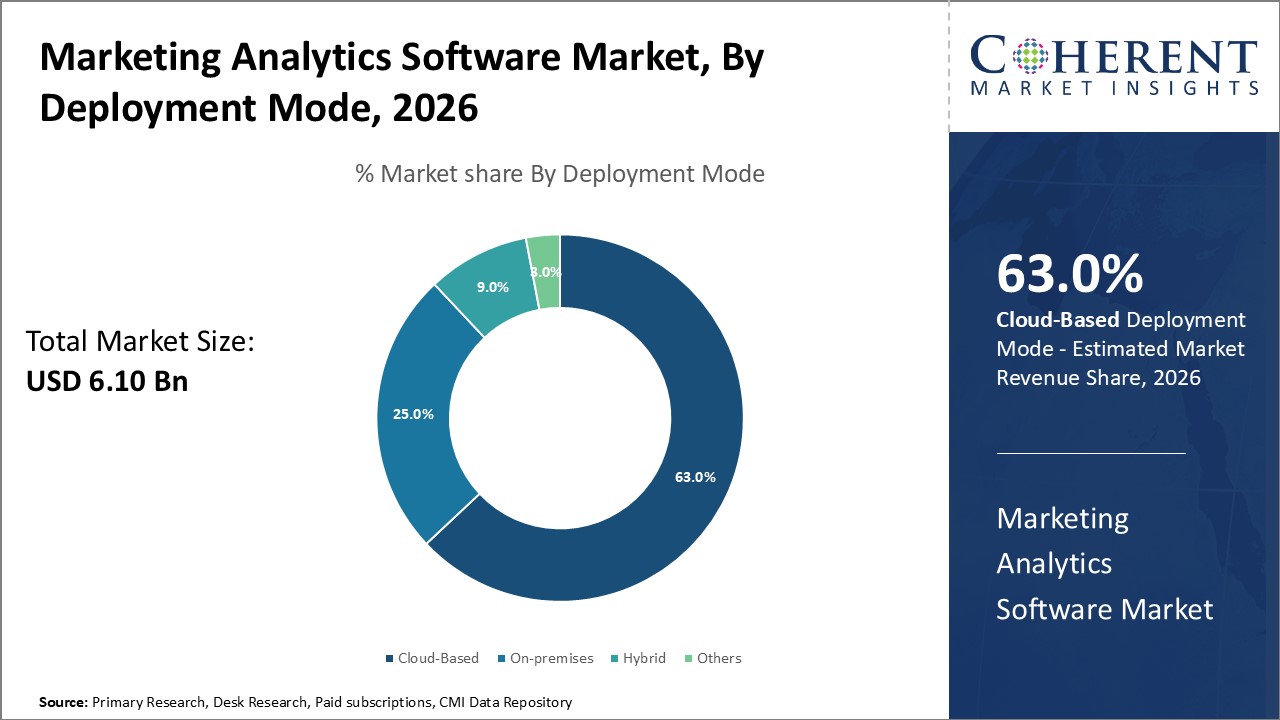
Marketing Analytics Software Market Insights, By Deployment Mode
Cloud-based dominates the market share due to its scalable architecture that enables organizations to manage vast datasets and perform real-time analytics efficiently. Companies adopting cloud solutions benefit from reduced infrastructural costs and accelerated deployment cycles, fueling broad-based market revenue growth. Hybrid deployment is rapidly gaining traction as organizations seek flexibility and control over sensitive data, combining on-premises security with cloud agility.
Marketing Analytics Software Market Insights, By Application
Customer Analytics is dominating the market share. Customer Analytics leads due to heightened emphasis on personalized marketing and predictive customer behavior modeling. This subsegment’s growth is propelled by advanced machine learning models enabling precise segmentation and targeting. Web & Social Media Analytics is the fastest-growing subsegment, fueled by the rise of influencer marketing and social commerce, compelling brands to track engagement metrics more rigorously.
Marketing Analytics Software Market Insights, By End User
Retail & E-commerce are dominating the market share, driven by direct consumer interaction and massive data generation, enabling detailed customer journey mapping and promotional effectiveness measurement. Telecommunications represents the fastest-growing subsegment, spurred by the industry’s focus on customer churn prediction, network optimization, and targeted offerings.
Marketing Analytics Software Market Trends
The market trends emphasize the growing relevance of AI-enhanced predictive analytics, delivering granular insights into customer lifetime value and campaign effectiveness.
For instance, in 2025, companies employing AI-driven tools reported up to a 36% increase in conversion metrics.
Another prominent trend is the unification of data sources across omnichannel marketing platforms, improving attribution accuracy by nearly 31%, as noted in recent enterprise deployments.
Furthermore, the transition toward cloud-native platforms fosters flexibility and faster time-to-market, with cloud adoption in marketing analytics growing by over 41% globally in 2025.
Marketing Analytics Software Market Insights, By Geography
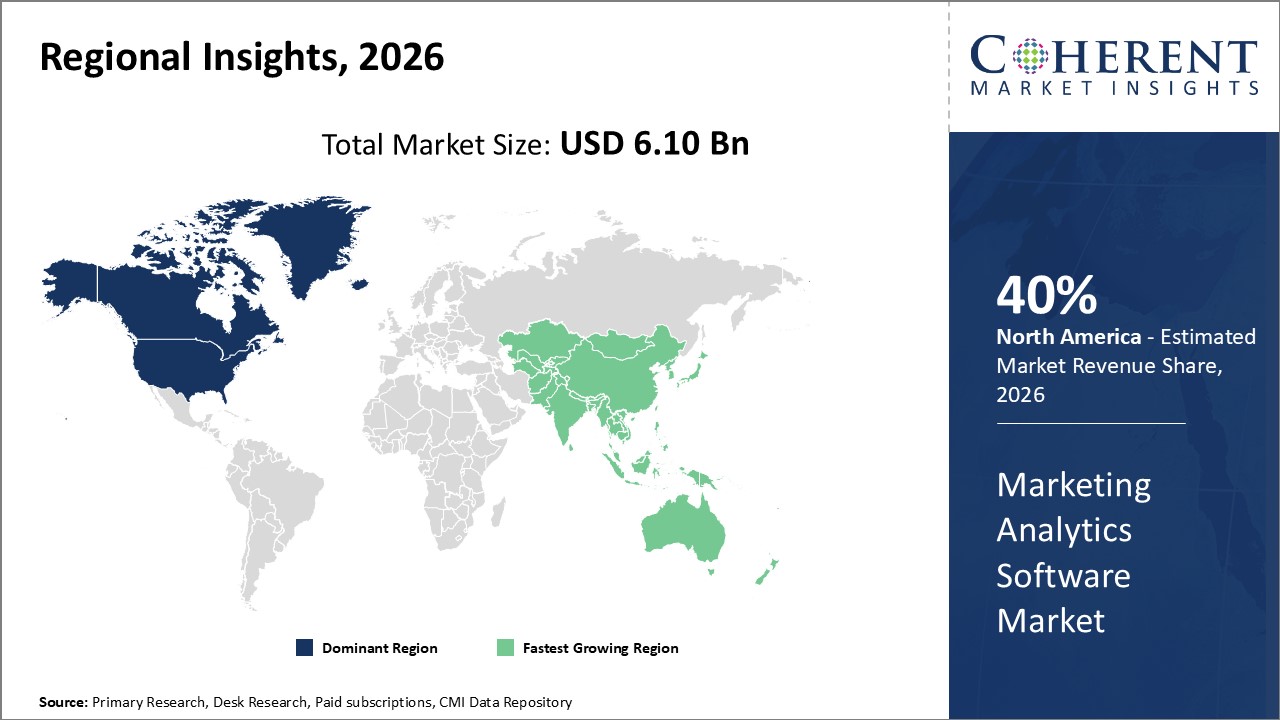
North America Marketing Analytics Software Market Analysis and Trends
In North America, the dominance in the Marketing Analytics Software market is primarily fueled by a mature digital infrastructure, early technology adoption, and the presence of major market players holding significant industry share—estimated at around 40%. The U.S. federal and state government policies favor innovation, while organizations across retail, BFSI, and technology sectors aggressively invest in analytics solutions.
Asia Pacific Marketing Analytics Software Market Analysis and Trends
The Asia Pacific exhibits the fastest growth in the market with a CAGR beyond 15%. This expansion is driven by rising digital penetration, government initiatives supporting digital economies, and increased cloud adoption. Countries like India and China play pivotal roles, supported by burgeoning tech ecosystems and cost-effective software development hubs. Local players partnering globally have accelerated market revenue growth in this region.
Marketing Analytics Software Market Outlook for Key Countries
USA Marketing Analytics Software Market Analysis and Trends
The USA’s marketing analytics software market thrives on advanced technological infrastructure, widespread cloud adoption, and a data-driven marketing culture. Leading companies such as Salesforce, Adobe, and Oracle have significant market presence, driving innovation in AI-powered analytics and customer-focused platforms. The sector benefits from numerous startups and tech giants collaborating on analytics enhancements, leading to a 25% increase in marketing effectiveness reported by enterprises in 2025. Investment in data privacy-compliant solutions further consolidates the market’s growth prospects
India Marketing Analytics Software Market Analysis and Trends
India’s Marketing Analytics Software market is rapidly expanding, supported by extensive digital transformation initiatives and government programs like Digital India. The country serves as a major export hub for software solutions, with companies like Zoho and TCS contributing to increasing regional adoption rates. Enterprises across retail, telecommunications, and banking are aggressively adopting cloud and AI-enabled marketing analytics, resulting in a 20% increase in market revenue in 2025. Strong local demand, combined with cost advantages, drives India’s fast-growing market status.
Analyst Opinion
Market penetration is strongly influenced by increased adoption of omnichannel marketing strategies. The complexity of consumer journeys across digital and physical touchpoints drives demand for integrated analytics platforms that unify data streams. According to recent implementations in 2025, enterprises utilizing marketing analytics software reported a 31% improvement in campaign attribution accuracy, underlining enhanced market share capture through data cohesiveness.
Pricing models are shifting from traditional licensing to subscription-based SaaS offerings, with cloud deployments growing by over 41% year-over-year in 2025. This trend lowers barriers to entry for mid-sized businesses, expanding the market scope and driving remarkable market revenue growth. For example, mid-sized retail chains adopting flexible pricing observed a 26% reduction in total cost of ownership.
Regional import-export dynamics reveal a surge in software exports from Asia Pacific, led by countries like India and China, accounting for approximately 35% of global exports in 2025. This supply-side trend supports increasing global availability and customization of localized marketing analytics solutions tailored to diverse market environments.
The variety of use cases across verticals such as e-commerce, BFSI, and telecommunications is broadening. Telecommunications companies, for instance, increased marketing analytics software investments by 21% in 2025 to optimize customer churn prediction and retention campaigns. This diversification continues to drive sustained market growth and revenue enhancement.
- Current Industry Events of 2026
- Market Size Estimation
- Regional Breakdown
- Competitive Landscape
- Customer Intelligence
- Segmental Analysis
- Pricing Analysis
- Key Market Drivers, Challenges & Future Trends
- Customized Insights Section
Market Scope
| Report Coverage | Details | ||
|---|---|---|---|
| Base Year: | 2025 | Market Size in 2026: | USD 6.10 billion |
| Historical Data for: | 2020 To 2024 | Forecast Period: | 2026 To 2033 |
| Forecast Period 2026 to 2033 CAGR: | 12.9% | 2033 Value Projection: | USD 14.25 billion |
| Geographies covered: |
| ||
| Segments covered: |
| ||
| Companies covered: | Salesforce, Adobe, SAS Institute, Oracle, IBM, Microsoft, Google, HubSpot, Tableau Software, Zoho Corporation, SAP. | ||
| Growth Drivers: |
| ||
Marketing Analytics Software Market Growth Factors
The rapid digital transformation across industries remains a primary growth driver, with marketing analytics software enabling businesses to leverage big data for actionable insights.
Cloud adoption continues to accelerate, facilitating scalability and real-time analytics, which enhances market growth by providing flexibility and cost efficiency. The Asia Pacific region has seen over 50% cloud adoption growth in 2025 alone.
Rising investment in AI and machine learning integration enhances predictive analytics capabilities across marketing functions, enabling personalized customer experiences and improved campaign effectiveness. In 2025, AI-powered marketing analytics tools led to a 36% increase in lead conversion rates for early adopters.
Regulatory frameworks emphasizing data privacy and transparency drive the need for more sophisticated analytics software capable of compliance reporting, especially in North America and Europe. From 2023 to 2026, investments in compliant marketing analytics solutions within these regions grew by 18%.
Marketing Analytics Software Market Development
In October 2026, marketing tech startup Northbeam introduced a new attribution model that links video views and in-app clicks across platforms using first-party transaction data, rather than statistical modeling. This approach aims to help marketers better allocate their advertising budgets amidst the increasing fragmentation of social, video, and e-commerce channels.
In March 2026, Adobe announced the rollout of artificial intelligence (AI) agents designed to aid brands in navigating consumer interactions on their websites. These AI agents allow brands to tailor marketing efforts based on user activity, with the ability to differentiate between varying profiles, such as users coming through TikTok ads versus search results. The tools help websites manage chatbots more effectively and provide personalized suggestions, enhancing user interaction and decision-making.
Key Players
Leading companies of the market:
Salesforce
Adobe
SAS Institute
Oracle
IBM
Microsoft
Google
Tableau Software
Zoho Corporation
SAP
Several market players have aggressively pursued strategies such as strategic acquisitions to enhance their analytic capabilities. For example, Salesforce’s acquisition of Tableau expanded its data visualization footprint, enabling more comprehensive marketing analytics solutions. Adobe’s integration of AI-driven insights in its Experience Cloud has resulted in a 16% year-over-year increase in client retention. Other companies focus on partnerships to offer bundled marketing analytics with customer data platforms, addressing complex market challenges related to unified data management.
Marketing Analytics Software Market Future Outlook
In the coming years, marketing analytics software will become increasingly automated, intelligent, and integrated. Companies will rely heavily on real-time analytics, predictive forecasting, and customer journey mapping to enhance personalization and campaign efficiency. The integration of marketing analytics with CRM, ERP, and sales platforms will enable a unified view of consumer behavior. Data privacy and ethical analytics practices will play a pivotal role in shaping software development, while advancements in generative AI will revolutionize content performance analysis and strategic decision-making.
Marketing Analytics Software Market Historical Analysis
The marketing analytics software market has evolved in parallel with the digital transformation of businesses and the proliferation of data-driven marketing. Initially, analytics platforms focused on tracking campaign performance across limited digital channels. However, the advent of social media, e-commerce, and mobile marketing transformed the landscape, prompting demand for integrated, multi-channel analytics solutions. Over the years, AI, machine learning, and predictive modeling technologies have enhanced the ability to measure ROI and optimize marketing strategies.
Sources
Primary Research interviews:
Marketing Directors
Data Analysts
Brand Managers
CRM Specialists
Databases:
HubSpot Research
Statista Marketing Analytics Reports
Salesforce Marketing Cloud Data
Gartner Digital Marketing Database
Magazines:
Marketing Week
Ad Age
MarTech Today
Analytics Insight
Journals:
Journal of Marketing Research
Journal of Business & Industrial Marketing
International Journal of Market Research
Newspapers:
The Economic Times (Marketing)
The Financial Times (Media & Marketing)
The New York Times (Business)
The Guardian (Advertising)
Associations:
American Marketing Association (AMA)
Digital Analytics Association (DAA)
Marketing Research Association (MRA)
Interactive Advertising Bureau (IAB)
Get access to 250+ pages report
Every segment, forecast, competitor profile and data table behind the analysis above — available for instant download.
- ESOMAR Member
- ISO 9001:2015 Certified
- D-U-N-S Registered
- GDPR & CCPA Compliant
Missing comfort of reading report in your local language? Find your preferred language:
Transform your Strategy with Exclusive Trending Reports
Frequently Asked Questions
Dominant market companies include Salesforce, Adobe, Oracle, IBM, and Microsoft. These entities drive innovation and hold significant market share globally.
The market size is projected to grow from USD 6.10 billion in 2026 to USD 14.25 billion by 2033, reflecting steady market growth supported by digital transformation and cloud adoption.
Retail & e-commerce shows the largest market opportunity, propelled by increased demand for customer analytics and personalized marketing campaigns.
Trends will focus on AI integration, hyper-personalization, cloud-based deployments, and self-service analytics tools, reshaping market dynamics and business growth prospects.
The market is highly competitive with constant innovation, but challenges remain in data privacy compliance, integration complexity, and cost barriers for smaller firms.
Subscription-based SaaS models, strategic acquisitions for capability expansion, partnerships for ecosystem integration, and customer-centric solution customization are the key strategies.