

Digital Rights Management Market Size and Share Analysis - Growth Trends and Forecasts (2026-2033)
The Digital Rights Management Market size is anticipated to grow at a CAGR of 12.1% with USD 7.33 Bn in 2026 and is expected to reach USD 16.30 Bn in 2033. The market is growing with the rising OTT streaming, e-books, gaming, enterprise document protection, and cloud-based content distribution. As per the report by OECD, the fibre reached 44.6% of fixed broadband subscriptions in 2024, thus strengthening demand for DRM-based encryption, licensing, and access control solutions.
Key Takeaways
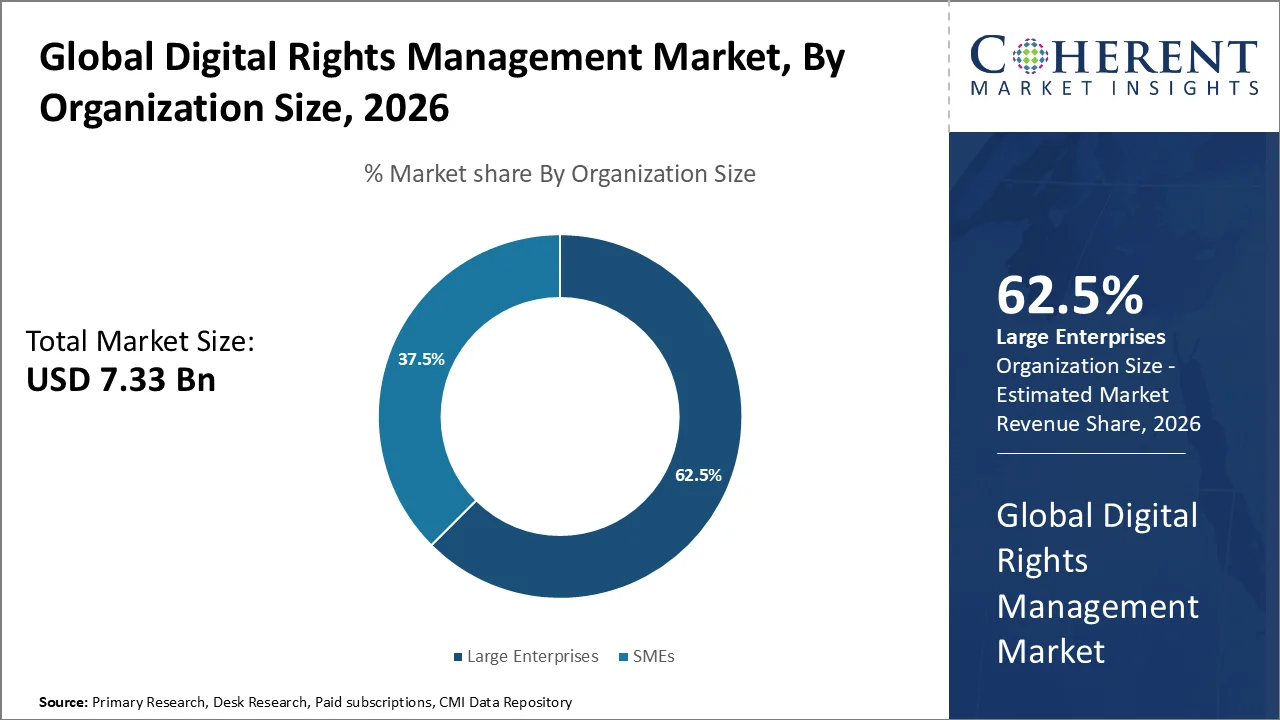
- On the basis of organization size, the large enterprises segment is projected to account for the largest share of 62.5% in 2026, due to higher digital content volumes, stronger cybersecurity budgets, enterprise document protection needs, and compliance-driven access control. The rising connectivity is also expanding the digital asset exposure, as ITU reported nearly 6 billion internet users in 2025, with 5G subscriptions reaching around 3 billion globally.
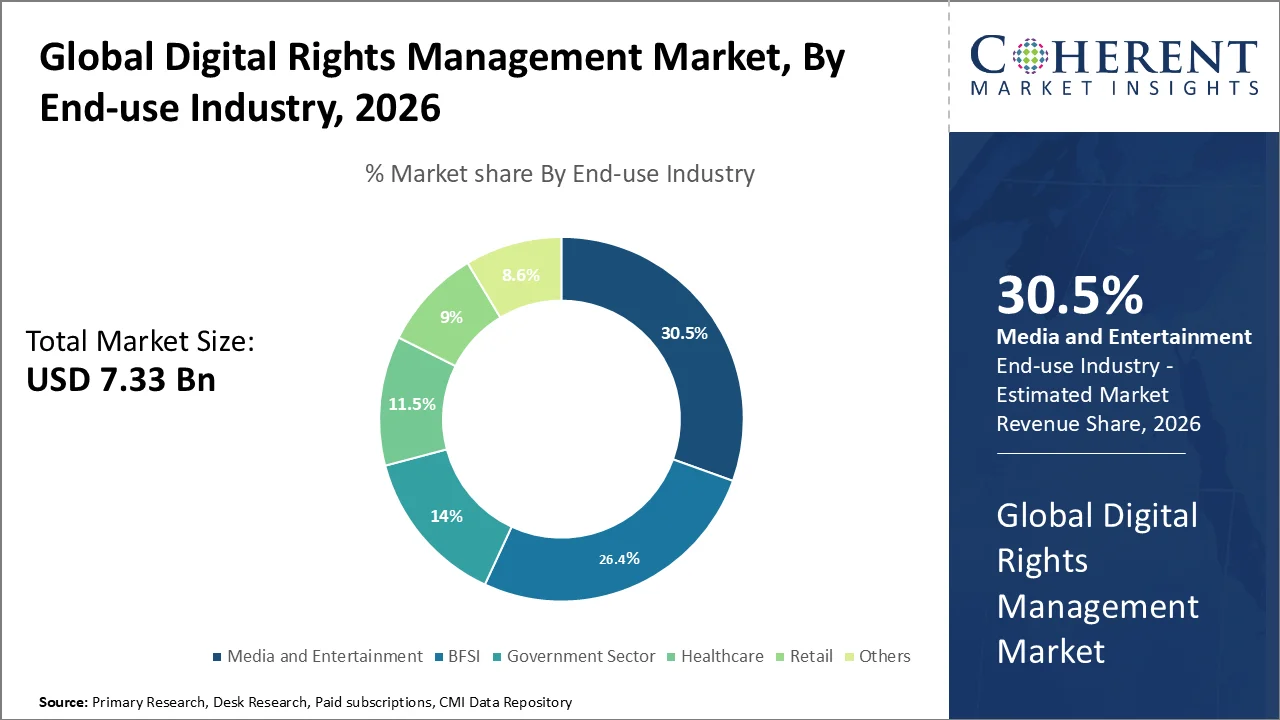
- By end-use industry, the media and entertainment segment are projected to account for the largest share of 30.5% in 2026. The growth is owing to OTT streaming, premium video, music, gaming, as well as e-publishing piracy risks. EUIPO reported that EU internet users accessed illegal content around 10 times per month, with TV content representing nearly half of piracy activity, thereby increasing the need for encryption, watermarking, and license control.
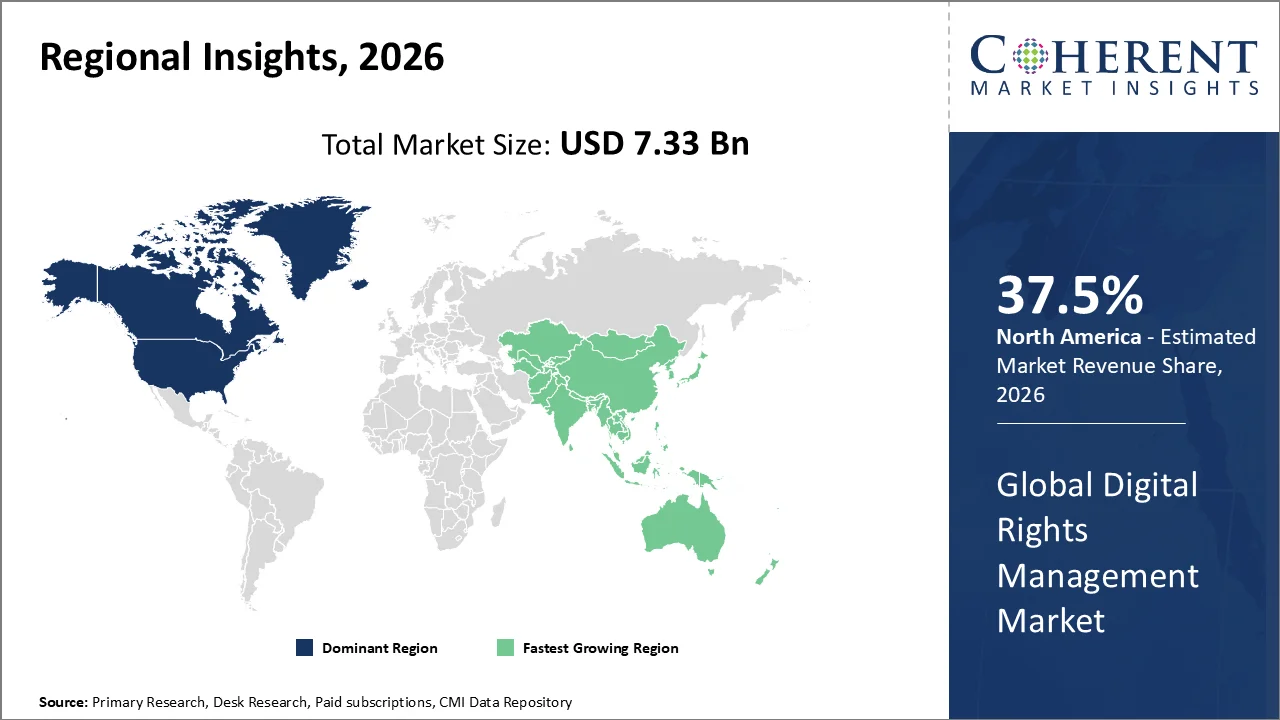
- North America is expected to secure the highest proportion of 37.5% in 2026, attributable to advanced broadband infrastructure, high streaming adoption, alongside strong paid digital content ecosystems. The streaming-only households in Canada increased from 23% in 2023 to 29% in 2024, thus constituting to the DRM demand.
Segmental Insights
Which Organization Size Segment Dominates the Market?
The large enterprises segment accounts for the largest digital rights management market share of 62.5% in 2026. The segment’s growth is driven by large media companies, OTT platforms, software publishers, gaming firms, and enterprise content owners manage premium digital assets across wider user bases and multiple devices. According to OECD Digital Economy Outlook 2024, the large firms are 15 times more likely to use big data analytics as compared to small firms. This shows a stronger digital-system adoption and readiness for cutting edge content-control tools.
In 2026, data showed that 85% of large EU businesses purchased cloud services in 2025, compared to 52% of SMEs, supporting scalable digital delivery and secure access to protected content. A 2024 study by European Union Intellectual Property Office found that EU internet users accessed illegal online content about ten times per month like TV, film, music, software, and publications, thereby increasing piracy risks for major rights holders. According to Google, Widevine DRM is used by leading platforms like YouTube, Netflix, Disney+, Amazon Prime Video, Hulu, Peacock, as well as Paramount+. This confirms the large-enterprise reliance on data rights management for premium content protection.
- Current Industry Events of 2026
- Market Size Estimation
- Regional Breakdown
- Competitive Landscape
- Customer Intelligence
- Segmental Analysis
- Pricing Analysis
- Key Market Drivers, Challenges & Future Trends
- Customized Insights Section
Media and Entertainment Segment to Secure the Largest Share
Media and entertainment segment accounts for the largest digital rights management market share of 30.5% in 2026, as DRM is most heavily used by OTT platforms, broadcasters, film studios, music labels, gaming companies, e-book publishers, and live sports streaming providers to protect copyrighted digital content. The segment’s growth is driven by rising paid video streaming, multi-device viewing, premium content licensing, and piracy risks.
The data rights management allows content owners to control access, prevent illegal downloads, restrict screen recording, manage subscriptions, as well as secure region-based distribution rights. In 2024, the U.S. Census Bureau reported that 95% of U.S. households had a computer and 90% had broadband internet in 2021, thereby supporting large-scale digital media consumption. In 2025, TRAI reported 944.12 million broadband subscribers in India, thus increasing the user base for DRM-protected OTT, music, gaming, as well as digital publishing platforms.
In July 2023, Unison, a private organization that manages music copyright, introduced SOLO, a global platform for managing digital rights. The platform aims to equip artists and creators with professional tools to oversee their digital rights, thus providing solutions for both copyright as well as master rights without the need for intermediaries.
AI-driven, Cloud-Based Content Protection is Transforming the Digital Rights Management Market in the United States
U.S. demand is rising as streaming, OTT platforms, gaming, e-books, and enterprise digital content move toward subscription and multi-device access models. The country has a strong legal base for DRM solutions, as DMCA Section 1201 prohibits bypassing technological measures which control access to copyrighted works like movies, software, books, and games.
This shift is also backed by high digital consumption. The Coherent Research reported in 2025 that 96% of U.S. adults use the internet, thereby increasing the pool of audience for protected digital content. At the same time, piracy risk is prompting studios and platforms to strengthen DRM. In September 2025, the piracy network Streameast was shut down after reportedly attracting more than 1.6 billion visits in one year, with major traffic from the U.S.
The technology providers are also speeding up the adoption. Google’s Widevine, Apple FairPlay Streaming, and Microsoft PlayReady support encrypted delivery, license control, and secure playback across OTT and connected devices, thus making DRM central to streaming monetization in the U.S.
One Major Breakthrough in Digital Rights Management: AI-enabled Forensic Watermarking with Real-time Piracy Tracking
AI-enabled forensic watermarking is transforming the digital rights management market in the U.S. because it helps content owners identify the exact source of illegal sharing, instead of only blocking unauthorized access. This is important as streaming has become the main content channel in the U.S. Nielsen reported that streaming reached 44.8% of the total U.S. TV viewing in May 2025, thus surpassing broadcast and cable combined for the first time.
The piracy pressure is also pushing the adoption of DRM solutions. MUSO reported 216.3 billion visits to piracy websites globally in 2024, thereby showing the scale of illegal digital consumption. This supports wider use of AI watermarking, automated piracy detection, encrypted streaming, and license-based access control in OTT, live sports, gaming, and enterprise content platforms. The technology is becoming a core revenue-protection tool for U.S. media companies.
Current Events and Their Impact
Current Event | Description and its Impact |
European Commission–EUIPO Agreement to Enforce IP Rights Under the Digital Services Act |
|
USTR 2025 Notorious Markets List Highlights Digital Piracy and Illegal Streaming |
|
Digital Rights Management Market Trends
- Rising digital piracy is increasing the need for DRM solutions. The content owners use encryption, access controls, licensing, and copy protection to prevent illegal use of movies, music, e-books, games, and software. The U.S. Copyright Office states that Section 1201 prohibits bypassing technological measures used to protect access to copyrighted works, thus facilitating the demand for DRM-based protection systems.
- Multi-device content consumption is making DRM more important, as users access paid content across smartphones, laptops, smart TVs, tablets, and gaming consoles. In 2025, ITU estimated that 6 billion people, or 74% of the global population, were using the internet, expanding the addressable base for DRM-protected OTT video, gaming, e-books, music, and software services.
- Forensic watermarking is becoming an important DRM extension, especially for premium video, live sports, and OTT platforms. Irdeto reported a 71% decrease in pirated IPTV and credential ads through anti-piracy efforts, showing how DRM-linked tools like watermarking, monitoring, takedowns, and threat intelligence are being used to protect premium digital content.
- Cloud-based DRM adoption is rising as OTT platforms, e-learning providers, gaming companies, and software vendors require scalable license delivery and faster content access across regions. This helps companies manage digital rights, user authentication, and subscription-based access more efficiently.
- Regulatory focus on online content protection is supporting DRM adoption. The EU Digital Services Act introduces rules for online services and platform accountability, while copyright laws like the DMCA protect technological access controls. This creates a stronger compliance environment for DRM solutions.
Regional Insights
North America Leads Owing to Content Economy and Anti-Piracy Efforts
The North America region accounts for 37.5% of the market in 2026. The region’s growth is backed by the region’s large digital content economy, stronger anti-piracy enforcement, and rising need to protect copyrighted video, music, software, gaming, and enterprise documents. In the U.S., broadband-enabled digital access remains a key adoption base, with the U.S. Census Bureau reporting that 91.0% of households had a broadband internet subscription, creating a broad addressable environment for DRM-protected streaming, e-books, software licensing, and cloud-based content access.
The region is also witnessing a stronger demand for data rights management owing to large-scale illegal streaming as well as copyright infringement cases. In July 2025, the U.S. Department of Justice announced that Jetflicks, an illegal paid streaming platform, had made more television episodes available compared to any licensed streaming service. The platform also earned millions of dollars in criminal profits. This situation highlights the urgent need for watermarking, access control, licensing regulations, as well as anti-piracy tracking tools.
Canada is also strengthening the regional outlook as high-bandwidth video consumption grows. The CRTC reported that Canadian residential internet data usage doubled since last few years, partly owing to HD and 4K subscription video-on-demand services. This increases the need for secure content delivery as well as DRM-enabled subscription models. In addition, the USTR’s 2025 Special 301 Report identified online piracy as one of the most challenging copyright enforcement issues, thereby reinforcing DRM adoption across media, entertainment, publishing, gaming, and enterprise IP protection.
In February 2022, XR Immersive Tech Inc. announced its acquisition of Synthesis VR Inc. Following this, Synthesis VR launched comprehensive support for all Android standalone and mobile head-mounted display VR headsets, as well as XR devices. This initiative includes a pioneering digital rights management solution designed for its network of over 300 global VR arcade operators and beyond.
Asia Pacific Digital Rights Management Market Trends
The Asia Pacific region is poised to be as the fastest-growing region through 2026-2033, driven by rapid digital content consumption, stronger anti-piracy enforcement, and rising monetization of OTT, gaming, e-learning, music, anime, manga, and digital publishing platforms. In India, TRAI reported that total internet subscribers has increased to 1,028.61 million by December 2025, thereby creating a large user base for protected streaming, subscription video, as well as premium digital content delivery.
China is also strengthening regional demand for data rights management. The China Internet Network Information Center found that by December 2024, 1.07 billion people watched videos online. This was 96.6% of all internet users. This scale increases the need for DRM, watermarking, access control, and anti-screen-recording tools in video, live streaming, and digital media platforms.
Japan further contributed to the digital rights management market growth via stronger copyright protection. For example, in January 2026, Japan’s METI reported that online piracy losses for Japan-origin digital content reached 5.7 trillion yen in 2025, nearly three times the 2022 survey level. This is pushing publishers, studios, and platforms to adopt stronger DRM, anti-piracy monitoring, and content-protection systems.
In July 2024,
AI-enabled Anti-piracy and Forensic Watermarking is Accelerating the Digital Rights Management Demand in United States
The United States Digital Rights Management Market is witnessing steady growth, OTT platforms, gaming publishers, software vendors, and digital media companies shift from basic access control toward advanced anti-piracy, forensic watermarking, and license enforcement systems. Microsoft’s PlayReady 4.6 is now available, with updates like a single Key Exchange license supporting multiple keys with different algorithms, which strengthens DRM flexibility for premium digital media distribution. Microsoft also defines PlayReady as a platform used for defining, incorporating, and enforcing rights for digital media, enabling providers to control expiration dates, output restrictions, and playback rights.
The market is also being shaped by newer anti-piracy launches and partnerships. In September 2025, Irdeto and Ateme integrated Irdeto TraceMark watermarking into Ateme’s video-delivery ecosystem. TraceMark embeds an invisible and unique forensic watermark into live or on-demand content, helping rights holders identify piracy sources and disrupt illegal streams. In 2026, Irdeto also highlighted that modern forensic watermarking is moving beyond standalone protection and becoming part of a wider anti-piracy architecture connecting monitoring, detection, identification, and enforcement across multiple delivery workflows.
China Digital Rights Management Market Trends
China’s Digital Rights Management Market is supported by the country’s massive connected-user base, strong 5G infrastructure, and fast-growing digital content consumption across online video, short video, live streaming, online literature, gaming, and digital entertainment platforms. According to the National Bureau of Statistics of China, the country had 690.82 million fixed broadband internet users in 2025, including 238.39 million users on broadband speeds of 1000M and above. China also had 1.204 billion 5G mobile phone subscribers and 4.84 million 5G base stations by the end of 2025, creating a strong technical base for secured streaming, app-based content access, and platform-level content protection.
Who are the Major Companies in Digital Rights Management Market
Some of the major key players in digital rights management are Microsoft, Facebook, Inc., Apple, Inc., Oracle, Seclore, Fasoo, VERA, Adobe Inc., Open Text Corporation, DivX, LLC, HP Labs, Dell Inc.,VOBILE INC., RealNetworks, Inc., IBM Corporation, General Electric, Axtia Technologies, Union FinTech, and Conax Technologies
Key News
- In April 2026, Royalty Administration International (RAI) has introduced RaiNet IP, an online portal aimed at streamlining and enhancing the administration of Plant Breeders' Rights (PBR) applications globally managed by RAI.
- In February 2025, TrueRights has launched a digital rights management platform focused on GenAI to safeguard content from unlawful use by generative AI software. The TrueRights platform consolidates approved training data—specifically, images of talent or brands intended for secure AI applications—and provides tools for brands, talent, and agencies.
Market Report Scope
Digital Rights Management Market Report Coverage
| Report Coverage | Details | ||
|---|---|---|---|
| Base Year: | 2025 | Market Size in 2026: | USD 7.33 Bn |
| Historical Data for: | 2020 To 2024 | Forecast Period: | 2026 To 2033 |
| Forecast Period 2026 to 2033 CAGR: | 12.1% | 2033 Value Projection: | USD 16.30 Bn |
| Geographies covered: |
| ||
| Segments covered: |
| ||
| Companies covered: | Microsoft, Facebook, Inc., Apple, Inc., Oracle, Seclore, Fasoo, VERA, Adobe Inc., Open Text Corporation, DivX, LLC, HP Labs, Dell Inc.,VOBILE INC., RealNetworks, Inc., IBM Corporation, General Electric, Axtia Technologies, Union FinTech, and Conax Technologies | ||
| Growth Drivers: |
| ||
| Restraints & Challenges: |
| ||
Analyst Opinion
- The digital rights management market is growing due to the rapid shift toward paid streaming, OTT platforms, e-books, gaming, enterprise content, and AI-generated digital assets. In 2025, global recorded music revenues reached US$31.7 billion, with streaming contributing 70% of income and paid streaming subscribers rising to 837 million, creating a stronger need for license control, encryption, access restriction, and royalty protection.
- Rising online piracy is also pushing media, sports, publishing, and software companies to adopt DRM solutions. EUIPO reported in 2024 that internet users in the EU accessed illegal content around 10 times per month, while TV content accounted for nearly half of pirated accesses. This increases demand for watermarking, anti-screen recording, multi-device authentication, and real-time takedown support.
- The future of DRM is likely to be shaped by AI-era copyright protection, cloud-based content delivery, and multi-platform monetization. The U.S. Copyright Office released AI and copyright reports in 2024 and 2025, reflecting rising regulatory focus on digital replicas, AI-generated outputs, and copyrighted training content. This is expected to expand DRM beyond films and music into AI datasets, digital learning content, enterprise files, gaming assets, and creator-owned digital libraries.
Speak to the analyst
Want personalized insights?
Take the findings above to one of our principal consultants, or have the report rebuilt around the segments, geographies and competitors you actually track.
Market Segmentation
- By Component
- Software
- Service
- By Deployment Type
- On-premise
- Cloud-based
- By Organization Size
- SMEs
- Large Enterprises
- By End-use Industry
- Retail
- BFSI
- Government Sector
- Healthcare
- Media and Entertainment
- Others
- Global Digital Rights Management Market, By Region
- North America
- U.S.
- Canada
- Latin America
- Brazil
- Mexico
- Argentina
- Rest of Latin America
- Europe
- Germany
- U.K.
- France
- Italy
- Spain
- Russia
- Rest of Europe
- Asia Pacific
- China
- India
- Japan
- Australia
- South Korea
- ASEAN
- Rest of Asia Pacific
- Middle East
- GCC
- Israel
- Rest of Middle East
- Africa
- South Africa
- Central Africa
- North Africa
- North America
- Key Players
- Microsoft
- Facebook, Inc.
- Apple, Inc.
- Oracle
- Seclore
- Fasoo
- VERA
- Adobe Inc.
- Open Text Corporation
- DivX
- LLC
- HP Labs
- Dell Inc.
- VOBILE INC.
- RealNetworks, Inc.
- IBM Corporation
- General Electric
- Axtia Technologies
- Union FinTech
- Conax Technologies
Sources
Primary Research Interviews
- Digital Rights Management Solution Providers
- Content Protection Technology Vendors
- Media & Entertainment Platform Operators
- OTT and Streaming Service Providers
- Software Licensing and Compliance Managers
- Cybersecurity Consultants
- Enterprise IT Security Heads
- Others
Databases
- Bloomberg Terminal
- Thomson Reuters Eikon
- Others
Magazines
- Streaming Media Magazine
- Digital TV Europe
- BroadcastPro Middle East
- Cybersecurity Magazine
- Computer Weekly
- Others
Journals
- IEEE Transactions on Information Forensics and Security
- Journal of Cybersecurity and Privacy
- International Journal of Information Security
- ACM Transactions on Multimedia Computing, Communications, and Applications
- Journal of Digital Media Management
- Others
Newspapers
- Financial Times
- The Wall Street Journal
- Reuters
- Bloomberg News
- The Economic Times
- Others
Associations
- Digital Media Association
- Motion Picture Association
- International Federation of the Phonographic Industry
- Software & Information Industry Association
- World Wide Web Consortium
- Others
Public Domain Sources
- U.S. Copyright Office
- European Commission – Digital Strategy
- World Intellectual Property Organization
- National Institute of Standards and Technology
- U.S. Federal Trade Commission
- Others
Proprietary Elements
- CMI Data Analytics Tool
- Proprietary CMI Existing Repository of Information for the Last 10 Years
Get access to 250+ pages report
Every segment, forecast, competitor profile and data table behind the analysis above — available for instant download.
- ESOMAR Member
- ISO 9001:2015 Certified
- D-U-N-S Registered
- GDPR & CCPA Compliant
Missing comfort of reading report in your local language? Find your preferred language:
Transform your Strategy with Exclusive Trending Reports
Frequently Asked Questions
The digital rights management market is expected to reach USD 16.30 Billion in 2033.
The high cost of implementation (software, licensing, and maintenance) and the technical complexity of integrating solutions across diverse platforms are the key factors hampering growth of the market.
The surging OTT streaming consumption, the need to protect intellectual property from piracy, and strict data compliance regulations like GDPR is boosting demand for digital rights management services.
The Digital Rights Management Market is anticipated to grow at a CAGR of 12.1% between 2026 and 2033.
Among regions, North America is expected to account for a largest market share in the global digital rights management market over the forecast period.
Examples of digital rights include the right to privacy (protection of personal data), freedom of expression online, and the right to access the internet and digital information. They also include copyright protection, data ownership rights, as well as the right to digital security against cyber threats.
The digital rights management consists of a collection of technologies, policies, and encryption tools employed by hardware manufacturers, publishers, and copyright holders. These tools regulate access, usage, and distribution of digital content like software, music, movies, as well as the documents.