

Global AI Watermarking Market Size and Forecast – 2026-2033
The global AI watermarking market is estimated to be valued at USD 769.7 Mn in 2026 and is expected to reach USD 3,753.3 Mn by 2033, exhibiting a compound annual growth rate (CAGR) of 25.4% from 2026 to 2033.
Key Takeaways of the Global AI Watermarking Market
- The video segment leads the market holding an estimated share of 40.8 % in 2026.
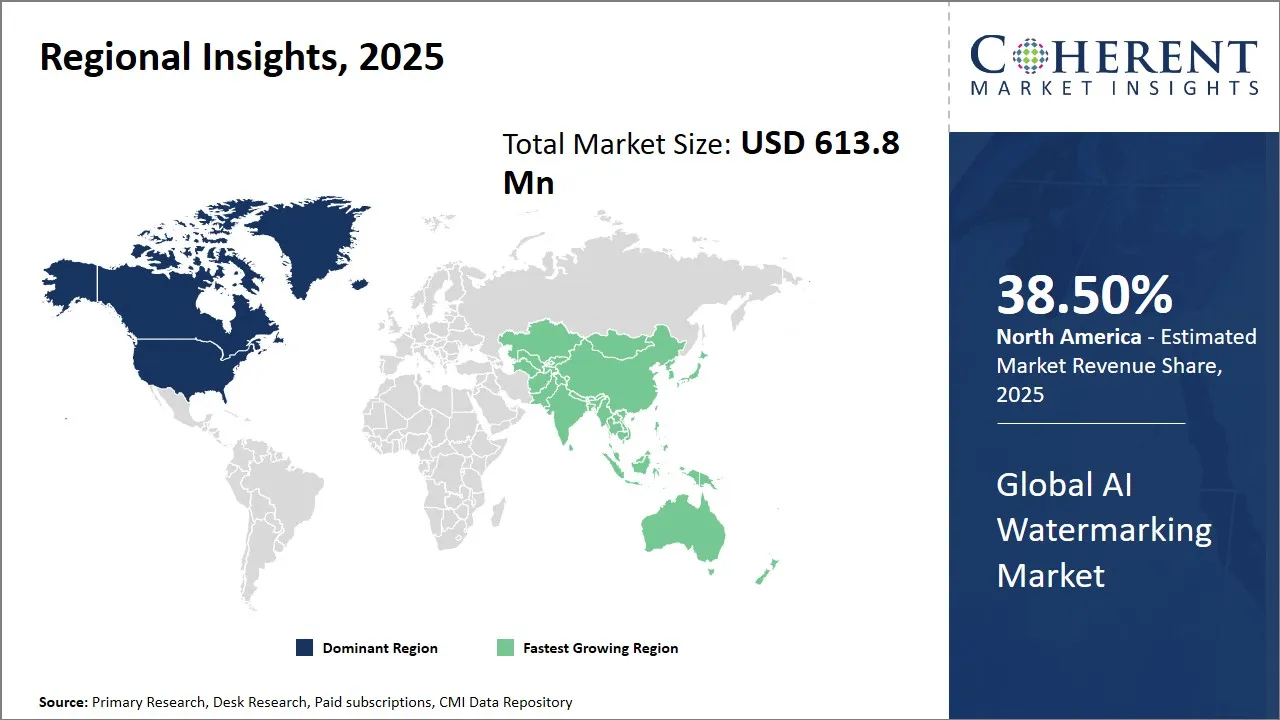
- North America is estimated to lead the market with a share of 38.5 % in 2026.
- Asia Pacific, holding an estimated share of 24.6 % in 2026, is projected to be the fastest growing region.
Market Overview
Market trends indicate a rising preference for AI watermarking technologies due to their ability to provide robust, tamper-proof digital rights management and enhanced data security. Additionally, the integration of AI with blockchain and deep learning techniques is driving innovation, enabling real-time detection and prevention of unauthorized content use. Growing the demand from media, entertainment, and publishing sectors, coupled with stringent regulatory frameworks around digital content protection, is further propelling the market forward.
Current Events and Its Impact
Current Events | Description and its Impact |
Geopolitical and Trade Developments |
|
Economic and Infrastructure Trends |
|
Segmental Insights
- Current Industry Events of 2026
- Market Size Estimation
- Regional Breakdown
- Competitive Landscape
- Customer Intelligence
- Segmental Analysis
- Pricing Analysis
- Key Market Drivers, Challenges & Future Trends
- Customized Insights Section
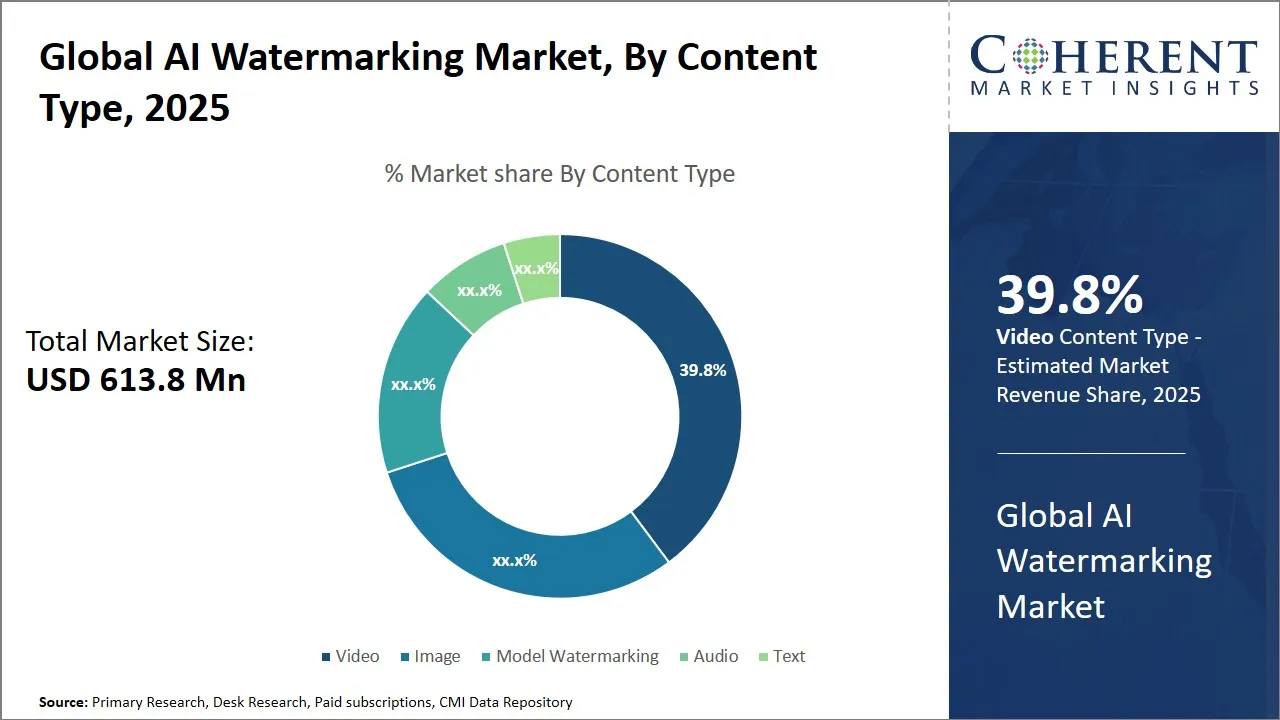
Global AI Watermarking Market Insights, by Content Type – Dominance of Video Segment can be Attributed to Rising AI Watermarking Adoption
The video segment is projected to account for 40.8% share in 2026. The surge in video streaming services, social media video sharing, and online video advertising has resulted in an exponential increase in video content creation and distribution. AI watermarking for video enables embedding imperceptible, robust markers within video frames that preserve content integrity without compromising user experience. The complexity of video files—due to factors like multiple frames, high data volume, and format variations—requires sophisticated AI-based algorithms capable of accurately embedding and detecting watermarks even after compression, editing, or format conversions.
Moreover, the video segment benefits from increasing regulatory scrutiny and stricter intellectual property laws worldwide, encouraging media companies to implement effective digital rights management strategies. The ability of AI watermarking to trace unauthorized copies, verify authenticity, and provide actionable insights on content misuse is particularly valuable for high-value video content such as movies, sports broadcasts, and original web series. Another factor boosting the segment is the rise of user-generated video content and influencer marketing, which necessitates protecting ownership rights in a space prone to rapid sharing and replication.
In March 2024, Netflix announced an expanded rollout of NAGRA’s NexGuard forensic watermarking across its global streaming catalog to combat piracy of premium originals such as Stranger Things and live-event content. The solution embeds imperceptible watermarks in every video frame, allowing Netflix to trace any leaked or redistributed copy back to the exact subscriber or distribution point—even after compression, re-encoding, or format changes.
End User Feedback & Unmet Needs in the Global AI Watermarking Market
- Media companies and newsrooms note that watermark outputs from different vendors (e.g., Adobe Content Credentials vs. Google’s SynthID) are not always mutually readable. A fully unified, cross-platform standard for detection and verification that works across image, video, audio, and text.
- Streaming platforms report that simple transformations—cropping, re-encoding, AI-based upscaling—can weaken or remove watermarks. More resilient algorithms that survive aggressive compression, generative edits, or malicious removal attempts without degrading content quality.
- In 2024, TikTok publicly highlighted the resource intensity of scanning billions of daily uploads when it began auto-flagging AI-generated videos using C2PA-style provenance tags. Lower-latency, high-throughput watermark detection that can operate economically at global social-media scale.
Regional Insights
North America AI Watermarking Market Analysis and Trends
The North America region is projected to lead the market with a 38.5% share in 2026, fueled by a highly advanced technological ecosystem, widespread adoption of AI technologies, and robust digital content creation industries. The presence of major tech hubs in the U.S. and Canada fosters innovation and investment in AI-based content protection solutions. Government policies geared toward cybersecurity and intellectual property protection further drive the market, encouraging the integration of AI watermarking in various sectors such as media, entertainment, and publishing.
Leading technology firms like IBM, Microsoft, and Adobe have been pivotal in the development and deployment of sophisticated AI watermarking tools, strengthening North America’s market leadership. The region's sophisticated trade networks and collaborations also facilitate the rapid diffusion of watermarking technologies across industries.
Asia Pacific AI Watermarking Market Analysis and Trends
The Asia Pacific region, holding a share of 24.6% in 2026, is expected to exhibit the fastest growth in the AI watermarking market, propelled by rapid digitization, exponential growth in digital media consumption, and expanding internet penetration. Governments across the region, including China, India, Japan, and South Korea, are emphasizing digital economy initiatives and intellectual property rights enforcement, thus creating favorable conditions for AI watermarking adoption.
The burgeoning presence of regional tech giants like Alibaba, Tencent, and Samsung, along with startups focusing on AI and cybersecurity, contributes significantly to market expansion. Furthermore, the region’s dynamic manufacturing base and content production industries are increasingly leveraging AI watermarking to secure digital assets, encouraged by evolving regulatory landscapes aimed at combating content piracy and unauthorized use.
AI Watermarking Market Outlook for Key Countries
U.S. AI Watermarking Market Analysis and Trends
The U.S. remains at the forefront of the AI watermarking market due to strong investments in AI research and a comprehensive digital rights management framework. American companies like Adobe and IBM have been instrumental in developing AI-powered watermarking solutions, enhancing the protection of digital media across entertainment, advertising, and publishing sectors. Robust government initiatives surrounding AI ethics and cybersecurity regulations also propel the adoption of AI watermarking technology within the country.
China AI Watermarking Market Analysis and Trends
China AI watermarking market thrives under the government’s ambitious "Digital China" strategy, which promotes technological innovation and intellectual property protection. Leading technology conglomerates such as Alibaba and Tencent drive significant advancements in AI watermarking technology, especially in streamlining content security for e-commerce and digital streaming platforms. The country’s stringent regulatory crackdowns against digital piracy further bolster the need and market for watermarking solutions.
Germany AI Watermarking Market Analysis and Trends
Germany continues to lead the Europe AI watermarking market, backed by its strong industrial base and emphasis on data security and privacy standards driven by GDPR compliance. German companies like Siemens and SAP have begun integrating AI watermarking technologies to safeguard proprietary content and bolster data integrity in industrial applications. Additionally, the country's focus on Industry 4.0 facilitates adoption across manufacturing and media sectors, reinforcing its position in the global market.
India AI Watermarking Market Analysis and Trends
India AI watermarking market is witnessing rapid expansion, fueled by increasing digital content consumption and government-backed initiatives such as the Digital India program. Rising concerns over online content piracy, especially in the growing entertainment and online education sectors, are accelerating the demand for AI watermarking technologies. Local startups and established IT firms like Infosys and Wipro are contributing through innovative AI solutions to support digital copyright enforcement and protection frameworks.
South Korea AI Watermarking Market Analysis and Trends
South Korea benefits from its advanced ICT infrastructure and strong government emphasis on AI and intellectual property rights. Major corporations like Samsung and LG Electronics are at the forefront of developing and deploying AI watermarking technologies, especially within digital media and consumer electronics. The country’s proactive policies to combat digital content infringement create a fertile environment for market growth and technological innovation in watermarking solutions.
Market Players, Key Development, and Competitive Intelligence
Key Developments
- In October 2024, Adobe announced a new free web app, Adobe Content Authenticity, designed to help creators protect and receive attribution for their work with Content Credentials.
- In May 2024, TikTok announced that it will be the first video sharing platform to use Content Credentials, a technology from the industry-wide Coalition for Content Provenance and Authenticity (C2PA), which attaches metadata, such as where or when content was created, to AI-generated content and allows the platform to immediately recognize and label it.
- In February 2024, Digimarc Corporation, a global leader in digital watermarking technologies, announced the availability of its next-generation digital watermarks featuring more advanced security and greater access control.
- In August 2023, Google DeepMind, in partnership with Google Cloud, launched a beta version of SynthID, a tool for watermarking and identifying AI-generated images. This technology embeds a digital watermark directly into the pixels of an image, making it imperceptible to the human eye, but detectable for identification.
Top Strategies Followed by AI Watermarking Market Players
- Established players dominate through substantial investments in research and development, aiming to continually innovate and deliver high-performance products that meet evolving customer needs.
- Google DeepMind continues to expand its SynthID invisible watermarking system, funding research to improve robustness against image edits and scaling it to video and audio formats.
- Mid-level players in the AI watermarking market adopt a distinct approach focused on balancing quality and affordability to cater to price-sensitive customers.
- Verimatrix has rolled out modular forensic watermarking packages that integrate easily with existing OTT platforms, allowing mid-tier streaming providers to deploy anti-piracy measures without the high integration costs typical of enterprise solutions.
- Small-scale players in the AI watermarking market pursue differentiation by concentrating on specialized features or niche innovations that larger firms might overlook.
- Truepic targets the image-capture authenticity niche, offering mobile SDKs and APIs that embed provenance data at the point of capture—an approach distinct from broad multimedia watermarking and attractive to newsrooms and legal-evidence users.
Market Report Scope
AI Watermarking Market Report Coverage
| Report Coverage | Details | ||
|---|---|---|---|
| Base Year: | 2025 | Market Size in 2026: | USD 769.7 Mn |
| Historical Data for: | 2020 To 2024 | Forecast Period: | 2026 To 2033 |
| Forecast Period 2026 to 2033 CAGR: | 25.4% | 2033 Value Projection: | USD 3,753.3 Mn |
| Geographies covered: |
| ||
| Segments covered: |
| ||
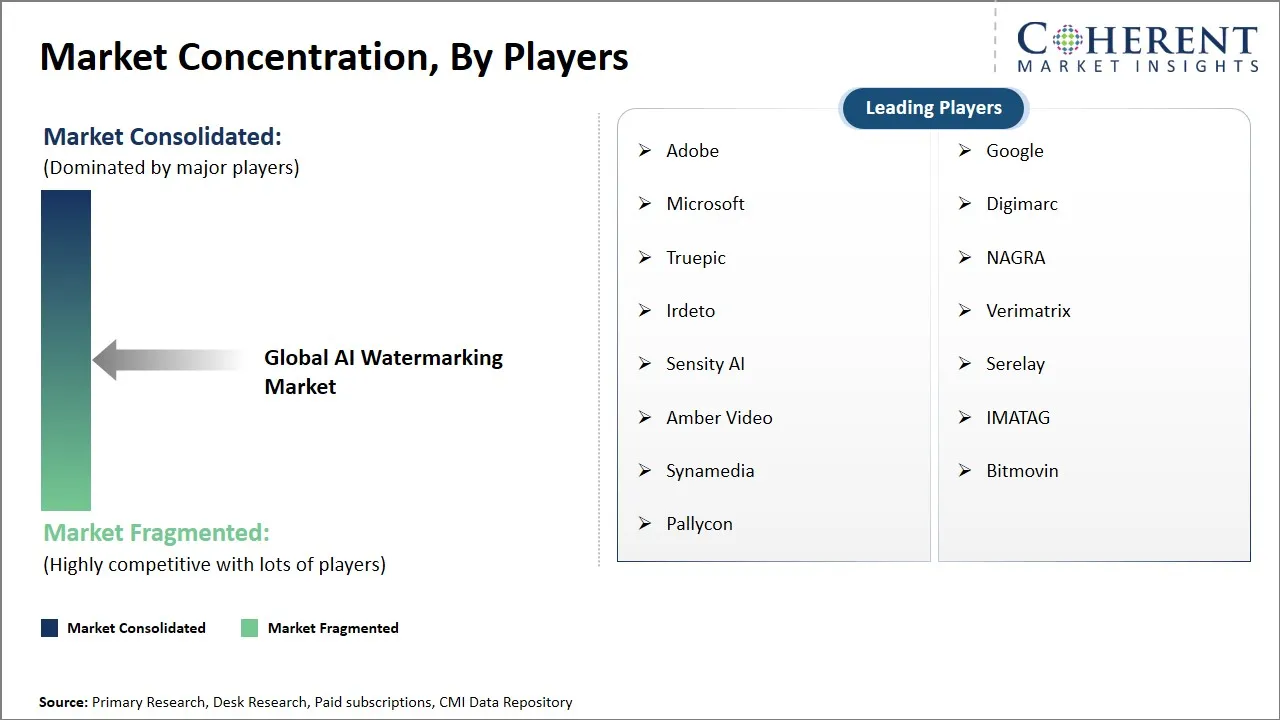
| Companies covered: | Adobe, Google, Microsoft, Digimarc, Truepic, NAGRA, Irdeto, Verimatrix, Sensity AI, Serelay, Amber Video, IMATAG, Synamedia, Bitmovin, and Pallycon | ||
| Growth Drivers: |
| ||
| Restraints & Challenges: |
| ||
Market Dynamics
Global AI Watermarking Market Driver - Rise of Generative AI & Synthetic Content
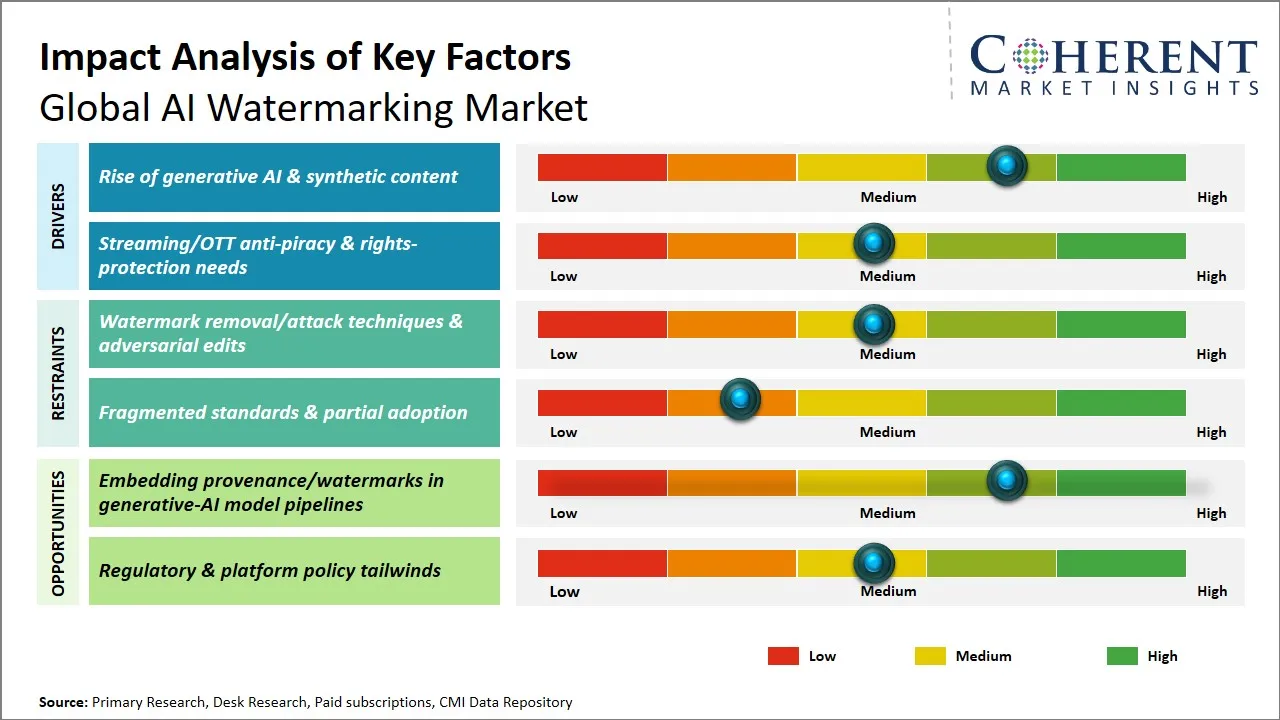
The rapid advancement and widespread adoption of generative AI technologies have fundamentally transformed the way digital content is created, leading to an unprecedented increase in synthetic media such as deepfakes, AI-generated images, videos, and text. This surge has heightened concerns around authenticity, copyright protection, and content manipulation, driving organizations and content creators to prioritize mechanisms that ensure the verifiable origin and integrity of digital assets.
AI watermarking solutions are becoming critical in addressing these challenges, as they provide robust tools to embed traceable, tamper-evident markers within synthetic content, enabling reliable provenance verification and detection of illicit usage. The need to distinguish genuine content from AI-generated fabrications is propelling stakeholders across media, entertainment, publishing, and security sectors to adopt sophisticated watermarking technologies. Consequently, this intensifying focus on maintaining trust and transparency in an environment flooded with synthetic creations is propelling the demand for AI watermarking systems, positioning them as essential enablers for content authentication in the digital age.
Global AI Watermarking Market Opportunity - Embedding Provenance/Watermarks in Generative-AI Model Pipelines
One of the most promising opportunities in the global AI watermarking market lies in the integration of model-level watermarking within generative AI pipelines, specifically for embedding provenance and enabling robust licensing and stewardship frameworks. As generative AI technologies continue to advance and proliferate across industries such as media, entertainment, and software development, ensuring the authenticity and ownership of AI-generated content becomes critical. Embedding watermarks directly into the AI models, rather than solely in the generated output, allows for a deeper level of traceability and control, providing a unique identifier that can verify model provenance throughout the content creation process.
Moreover, model-level watermarking facilitates automated monitoring and detection of unauthorized usage or model replication, thereby strengthening licensing compliance and reducing infringement risks. From a stewardship perspective, this approach enables stakeholders to maintain the integrity of their generative AI tools while fostering trust among consumers and partners.
Analyst Opinion (Expert Opinion)
- Watermarking is moving upstream into the model-training and inference layers. Vendors are embedding identifiers directly in generative models (e.g., image-to-image and large language models) so every output—image, audio, or text—carries a persistent authenticity trail. This protects intellectual property and supports forthcoming AI-labeling regulations.
- Platforms are starting to deploy low-latency watermark detection that works on live video and short-form content. The ability to mark and instantly verify billions of daily uploads is critical for curbing deepfakes and misinformation during elections, crises, or major sporting events.
- Industrial firms are experimenting with watermarking 3D models, CAD files, and IoT sensor feeds used in digital-twin environments. Embedding invisible markers in these high-value assets helps trace leaks, prove ownership, and maintain version control across complex global supply chains.
Speak to the analyst
Want personalized insights?
Take the findings above to one of our principal consultants, or have the report rebuilt around the segments, geographies and competitors you actually track.
Market Segmentation
- Content Type Insights (Revenue, USD Mn, 2021 - 2033)
- Video
- Image
- Model Watermarking
- Audio
- Text
- Regional Insights (Revenue, USD Mn, 2021 - 2033)
- North America
- U.S.
- Canada
- Latin America
- Brazil
- Argentina
- Mexico
- Rest of Latin America
- Europe
- Germany
- U.K.
- Spain
- France
- Italy
- Russia
- Rest of Europe
- Asia Pacific
- China
- India
- Japan
- Australia
- South Korea
- ASEAN
- Rest of Asia Pacific
- Middle East
- GCC Countries
- Israel
- Rest of Middle East
- Africa
- South Africa
- North Africa
- Central Africa
- North America
- Key Players Insights
- Adobe
- Microsoft
- Digimarc
- Truepic
- NAGRA
- Irdeto
- Verimatrix
- Sensity AI
- Serelay
- Amber Video
- IMATAG
- Synamedia
- Bitmovin
- Pallycon
Sources
Primary Research Interviews
Stakeholders
- AI Technology Providers
- Digital Media & OTT Security Managers
- Cloud Infrastructure & SaaS Providers
- Government & Policy Makers focused on AI content regulation
- Cybersecurity Consultants and Forensic Analysts specializing in synthetic-media detection
- Standards Bodies & Consortia Representatives
Databases
- World Intellectual Property Organization (WIPO) Tech Databases
- U.S. Patent and Trademark Office (USPTO) AI-related filings
- European Union Intellectual Property Office (EUIPO) innovation registry
- OECD AI Policy Observatory
- Global OTT Content Protection Database (fictitious internal database)
Magazines
- AI & Security Review
- Digital Content Protection Today
- Streaming Media World
- Computer Vision & Imaging Monthly
Journals
- Journal of Digital Forensics and Watermarking
- IEEE Transactions on Information Forensics and Security
- Journal of Artificial Intelligence Research
- Multimedia Tools and Applications
Newspapers
- TechGuardian (U.K.)
- The Economic Times (India, Technology Section)
- Silicon Valley Daily (fictional industry newspaper)
- Global Data Privacy News
Associations
- International Association for Digital Provenance (fictional)
- Content Authenticity Initiative (CAI)
- World Digital Watermarking Alliance (fictional)
- Association for Computing Machinery (ACM) Multimedia Special Interest Group
Public Domain Sources
- United Nations Educational, Scientific and Cultural Organization (UNESCO) AI Ethics Reports
- World Bank Digital Development Data
- European Commission AI Act Public Documents
- U.S. Federal Trade Commission (FTC) AI Guidelines
- ResearchGate (open-access AI watermarking studies)
Proprietary Elements
- CMI Data Analytics Tool, Proprietary CMI Existing Repository of AI & Digital Watermarking Market Information (last 8 years)
Get access to 250+ pages report
Every segment, forecast, competitor profile and data table behind the analysis above — available for instant download.
- ESOMAR Member
- ISO 9001:2015 Certified
- D-U-N-S Registered
- GDPR & CCPA Compliant
Missing comfort of reading report in your local language? Find your preferred language:
Transform your Strategy with Exclusive Trending Reports
Frequently Asked Questions
The global AI watermarking market is estimated to be valued at USD 769.7 million in 2026 and is expected to reach USD 3,753.3 million by 2033.
The CAGR of the global AI watermarking market is projected to be 25.4% from 2026 to 2033.
Rise of generative AI & synthetic content and streaming/OTT anti-piracy & rights-protection needs are the major factors driving the growth of the global AI watermarking market.
Watermark removal/attack techniques & adversarial edits and fragmented standards & partial adoption are the major factors hampering the growth of the global AI watermarking market.
In terms of content type, the video segment is estimated to dominate the market revenue share in 2026.
It is the process of embedding imperceptible or visible digital marks into AI-generated or AI-edited content (images, video, audio, text) to prove authenticity and origin.
Generative-AI tools produce convincing synthetic media, so platforms and regulators need a reliable way to identify and track AI-created content.