

Accounts Receivable Automation Market Analysis & Forecast: 2026-2033
Accounts Receivable Automation Market is estimated to be valued at USD 4,814.9 Mn in 2026 and is expected to reach USD 11,611.1 Mn in 2033, exhibiting a compound annual growth rate (CAGR) of 13.4% from 2026 to 2033.
Key Takeaways
- By Component, the Solutions segment is accounting for 69% of the total market share, driven by increasing demand for integrated automation tools and compliance-focused platforms.
- By Region, North America is expected to maintain its leadership position with 33% shares in the global accounts receivable automation market in 2026, supported by early technology adoption, strong presence of key vendors, and robust digital infrastructure.
Market Overview
The growing market for Accounts Receivable Automation stems from the growing demand for business automation in the receivable processes as well as e-invoicing solutions. Furthermore, the market is growing due to the demand for better cash flow management and minimization of day’s sales outstanding. Take Billtrust, for example, in 2023, they reported increased adoption of their solutions from large and mid-sized enterprises in the manufacturing, retail and logistics sectors to automate invoicing, eliminate manual processes, and expedite cash collection. This adoption assisted businesses in improving their cash flow and substantially lowering their day’s sales outstanding.
Current Events and Its Impact on the Accounts Receivable Automation Market
Event | Description and Impact |
AI and Machine Learning Technology Advancement |
|
Global Economic Uncertainty and Interest Rate Volatility |
|
Regulatory Compliance and Digital Payment Evolution |
|
Role of Emerging Technologies
Emerging technologies are driving significant transformation in the Accounts Receivable Automation Market, redefining how organizations manage invoicing, collections, and cash flow. At the forefront of this change is the integration of AI and machine learning, which enhances credit risk modeling, payment predictions, and intelligent document processing. These innovations are paramount in the Accounts Receivable Automation Market, enabling faster, more accurate, and data-driven decision-making.
Cloud-native platforms with modular architecture and robust APIs are revolutionizing the adoption of Accounts Receivable Automation Market solutions by ensuring seamless connectivity with ERP and CRM systems. Meanwhile, blockchain and distributed ledger technologies are enhancing transparency, trust, and auditability, particularly for complex, multi-party transactions.
Advanced analytics and RPA have further improved process efficiency by enabling real-time reporting, predictive intelligence, and the automation of intricate workflows. Additionally, self-service customer portals are improving the end-user experience while reducing administrative overhead.
Together, these advancements represent a wave of innovation in the Accounts Receivable Automation Market, establishing new benchmarks in automation, accuracy, and operational control. The Accounts Receivable Automation Market significance now lies in its ability to transform finance operations from manual back-office tasks into strategic growth drivers.
- Current Industry Events of 2026
- Market Size Estimation
- Regional Breakdown
- Competitive Landscape
- Customer Intelligence
- Segmental Analysis
- Pricing Analysis
- Key Market Drivers, Challenges & Future Trends
- Customized Insights Section
Segmental Insights
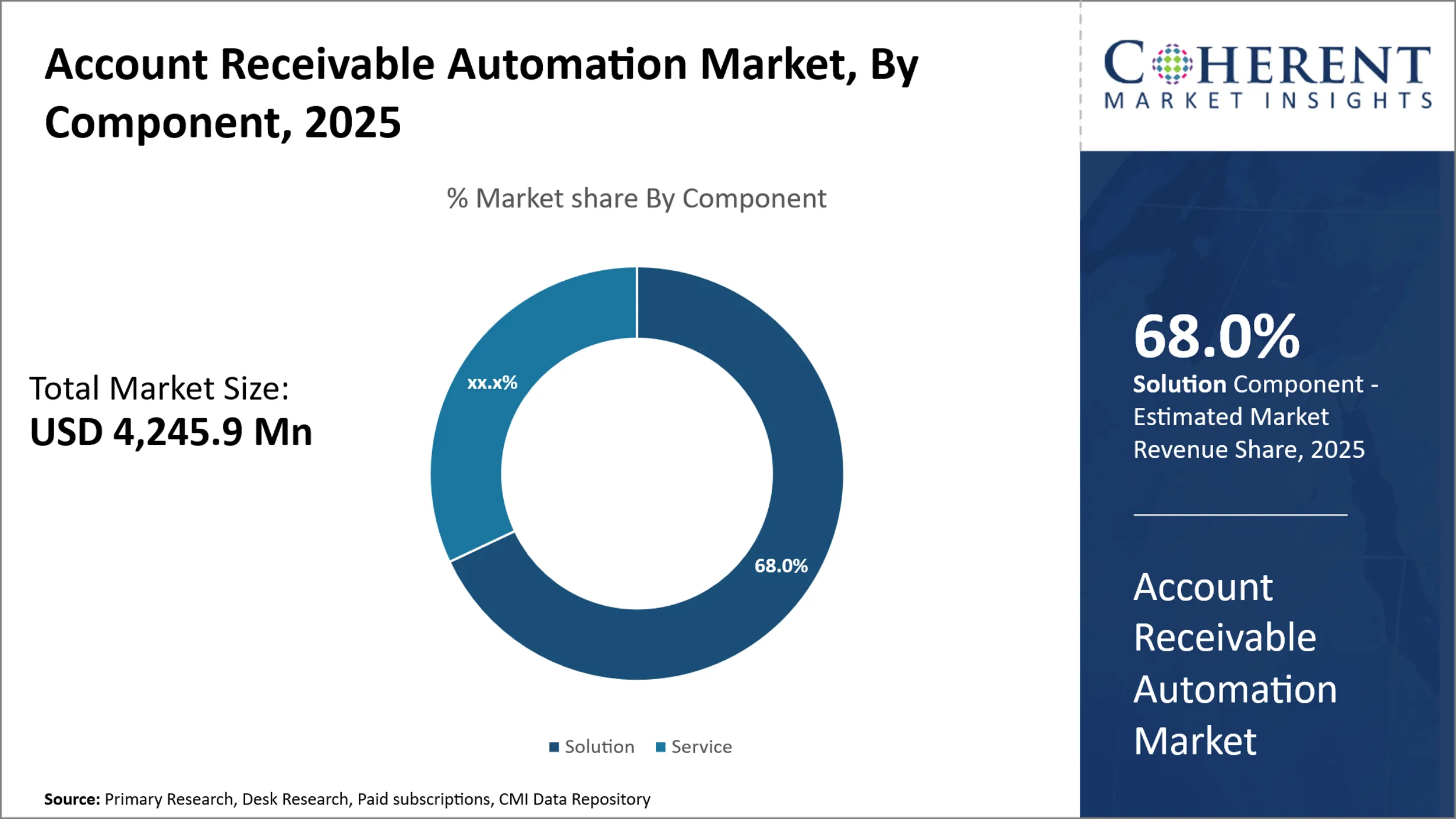
Global Accounts Receivable Automation Market Insights, By Component
In terms of component, the solutions segment is expected to lead the global accounts receivable automation market with 69% share in 2026. This dominance is primarily driven by the increasing complexity of e-invoicing regulations, particularly for Business-to-Government (B2G) and Business-to-Business (B2B) transactions requiring tax authority clearance.
Organizations are turning to automation solutions to streamline compliance, reduce errors, and maintain transparency. As regulatory frameworks tighten globally, the need for scalable, compliant AR solutions is boosting adoption and strengthening the market position of this segment.
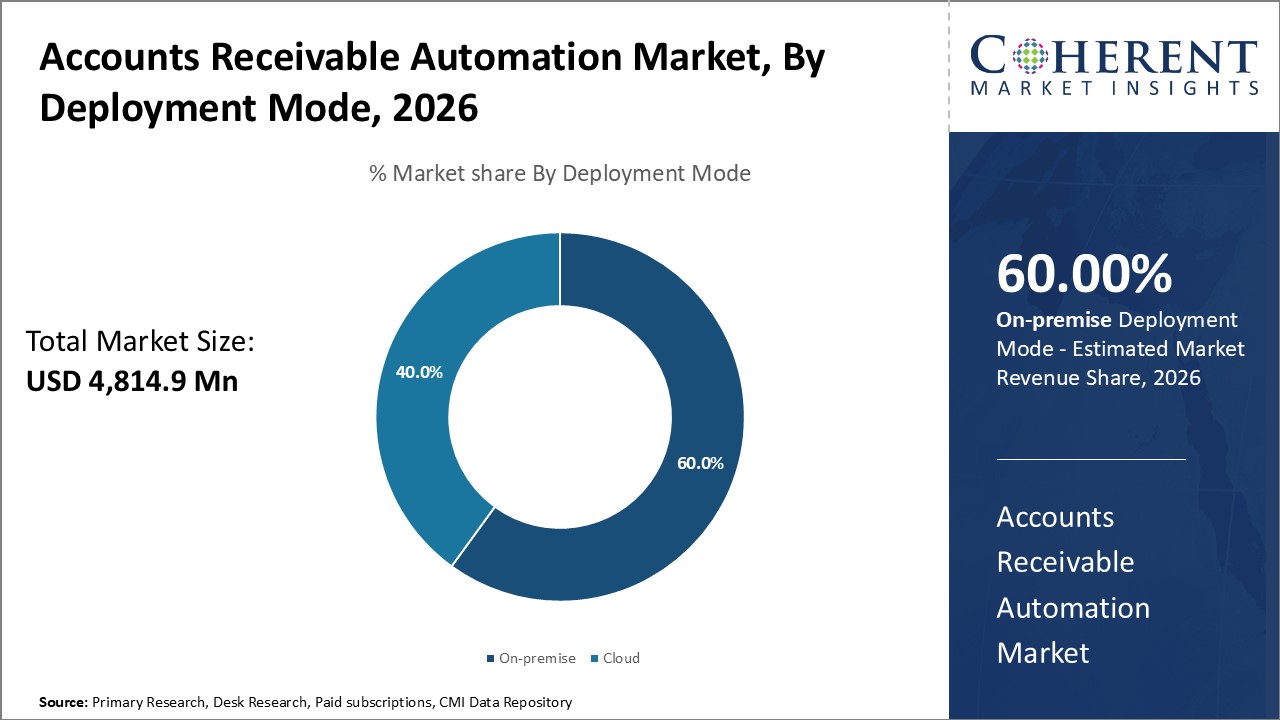
Global Accounts Receivable Automation Market Insights, By Deployment Mode
Based on deployment mode, the on-premise segment is expected to retain the largest market share during the forecast period. This deployment method appeals to enterprises seeking full control over their IT infrastructure and data. On-premise software is hosted internally, offering security, customization, and a one-time licensing fee model, making it a preferred choice for organizations with complex compliance requirements and existing IT frameworks.
Global Accounts Receivable Automation Market Insights, By Organization Size
In terms of organization size, small and medium enterprises (SMEs) are expected to dominate the market over the forecast period. The growing push for automation within SMEs is driving adoption of accounting and AR automation software. With limited staff and rising financial complexities, SMEs are increasingly implementing digital tools to streamline reconciliation and invoicing processes. This shift toward automation is helping SMEs improve efficiency and reduce manual workloads, contributing to the segment's lead.
Global Accounts Receivable Automation Market Insights, By End User Industry
Based on end user industry, the banking, financial services, and insurance (BFSI) sector is expected to dominate the global market. Automation in the financial sector is enabling institutions to simplify operations, reduce overheads, and enhance their credit collection processes. By automating repetitive tasks like invoicing and follow-ups, banks and financial institutions are improving operational efficiency and customer experience, which is driving sustained demand for AR automation tools.
Regional Insights
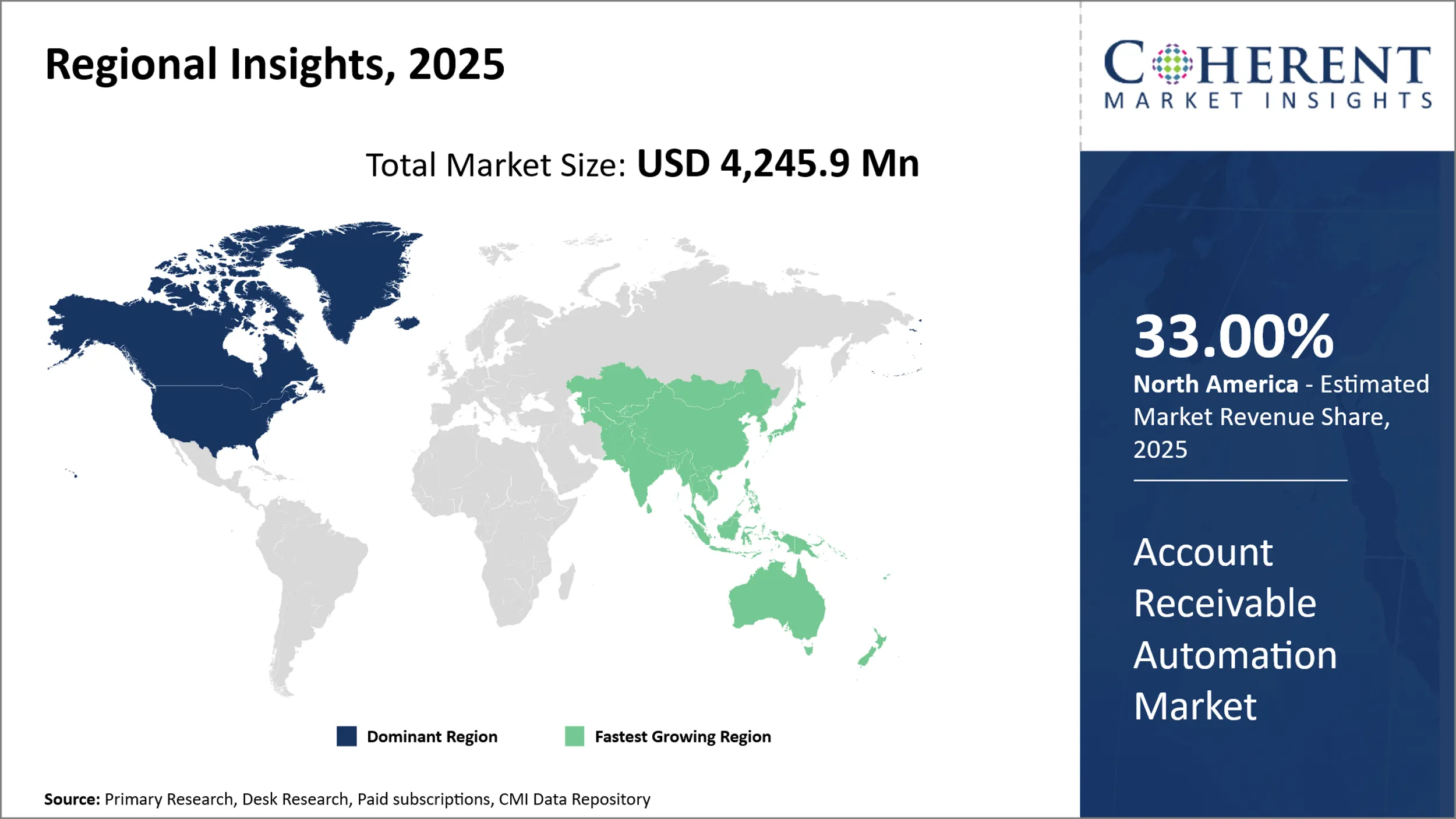
North America Accounts Receivable Automation Market Analysis and Trends
North America is expected to maintain its position as the leading market for accounts receivable automation in 2026, accounting for an estimated 33.00% share of the global market. This leadership is fueled by the strong adoption of automation solutions across key end-user industries, including IT and telecom, retail, healthcare, and BFSI.
The region’s well-established enterprise ecosystem is seeing rapid digital transformation, with companies increasingly prioritizing operational efficiency, compliance, and financial accuracy. U.S. and Canadian organizations are adopting AR automation tools to streamline invoice processing, improve payment collection cycles, and enhance customer experience. Additionally, favorable regulatory environments and tax compliance requirements are prompting businesses to upgrade to advanced AR platforms.
North America also benefits from the strong presence of leading technology vendors and software providers, enabling faster implementation and support. Combined with high digital maturity and significant investments in financial process optimization, these factors solidify the region’s dominance in the global accounts receivable automation market.
Asia Pacific Accounts Receivable Automation Market Analysis and Trends
Asia Pacific is emerging as the fastest-growing region in the global accounts receivable automation market and is projected to play a leading role in the coming years. The region’s rapid industrialization, increasing digital transformation across sectors, and rising demand for streamlined financial operations are fueling adoption of AR automation solutions.
The growth of SMEs, rising middle-class income, and the digital shift across industries such as manufacturing, telecom, healthcare, and BFSI are creating a strong demand for automation tools that can enhance cash flow visibility, speed up payment cycles, and ensure compliance. The growing emphasis on financial accuracy, coupled with increasing adoption of cloud and SaaS-based platforms, is accelerating AR automation deployment across the region.
Government initiatives aimed at promoting enterprise digitalization, tax reform, and business efficiency are further strengthening the regional market landscape. As companies seek solutions to manage complex invoicing and payment processes efficiently, Asia Pacific is becoming a focal point for AR automation innovation and expansion.
Accounts Receivable Automation Market Outlook Country-Wise
China Accounts Receivable Automation Market Analysis and Trends
China is a major force in the Asia Pacific accounts receivable automation market, supported by strong digital transformation across industries and national efforts to modernize enterprise finance systems. The country’s large-scale manufacturing and B2B sectors demand high-volume invoice processing and robust payment tracking capabilities.
Government policies promoting digital finance, combined with rapid cloud adoption and the expansion of e-invoicing regulations, are driving businesses toward AR automation solutions. Local and global vendors are actively investing in the market, leveraging China’s innovation hubs and enterprise demand to scale advanced, AI-driven AR platforms.
India Accounts Receivable Automation Market Analysis and Trends
India’s accounts receivable automation market is witnessing rapid growth, driven by increasing SME digitalization, tax compliance reforms such as GST, and the country’s broader digital finance agenda. The government’s push for paperless and efficient financial operations under programs like Digital India and Startup India is encouraging adoption among startups and mid-sized enterprises.
The rise in demand for real-time payment tracking, automated collections, and integrated accounting workflows is boosting deployment across sectors including retail, healthcare, and IT services. India’s tech-savvy business environment and cost-sensitive market are making cloud-based and subscription-based AR automation solutions especially popular.
Japan Accounts Receivable Automation Market Analysis and Trends
Japan remains a mature and innovation-driven market for accounts receivable automation. With its strong presence of large enterprises and complex B2B transaction environments, there is high demand for accurate, integrated AR solutions that can support compliance, aging reports, and multi-currency invoicing.
Japan’s commitment to digitizing back-office operations, coupled with an aging workforce and labor shortages, is prompting companies to automate manual finance tasks. Major corporations in manufacturing, automotive, and electronics sectors are leading in adoption, creating ample opportunities for both domestic and international AR software vendors.
Australia Accounts Receivable Automation Market Analysis and Trends
Australia is an emerging high-growth market within Asia Pacific for AR automation, driven by robust enterprise IT infrastructure and a focus on improving cash flow management. The country’s strong financial services sector and expanding mid-sized business ecosystem are adopting automation tools to reduce DSO (days sales outstanding), streamline collections, and enhance customer relationships.
Government-backed digital business programs and a shift toward cloud-first strategies across industries are supporting uptake of AR automation tools, particularly in healthcare, education, and logistics. Demand is also growing for integrated solutions that combine AR with analytics and credit risk management.
Market Report Scope
Accounts Receivable Automation Market Report Coverage
| Report Coverage | Details | ||
|---|---|---|---|
| Base Year: | 2025 | Market Size in 2026: | USD 4,814.9 Mn |
| Historical Data for: | 2020 To 2024 | Forecast Period: | 2026 To 2033 |
| Forecast Period 2026 to 2033 CAGR: | 13.4% | 2033 Value Projection: | USD 11,611.1 Mn |
| Geographies covered: |
| ||
| Segments covered: |
| ||
| Companies covered: | Esker Inc., SAP SE, Comarch SA, Oracle Corporation, Bill.com Holdings Inc., SK Global Software, MHC Automation, Quadient(YayPay Inc.), Qvalia AB, Kofax Inc., HighRadius Corporation, Workday Inc., and Corcentric LLC | ||
| Growth Drivers: |
| ||
| Restraints & Challenges: |
| ||
Global Accounts Receivable Automation Market Drivers
- Need for improving business efficiency by improvement of cash flow, cost reduction, and accounting cycle time to drive the market pace
The use of account receivable automation helps boost predictable cash flow. As per YayPay, nearly 60% of business owners are worried about the cash flow each month, and use of account receivable automation offers solution to such issues. With automation, the need for manually sending emails to customers, sending reminders of due payments is eliminated for account receivable staff.
Using accounts receivable automation tools send all these communications to clients automatically. Thus, this is boosting the demand for accounts receivable automation among businesses, which in turn is expected to drive growth of the global accounts receivable automation market during the forecast period.
- Rise in adoption of technologies such as cloud computing to boost the market growth
Several businesses are inclining toward cloud-based solutions, which is further propelled by the digitization of enterprises around the world. As per the data of Leftronic, nearly 90% companies currently have adopted cloud services, with AWS being the main cloud platform. Moreover, the number of businesses shifting their workloads to cloud, due to its better data recovery benefits and mitigating risks.
Global Accounts Receivable Automation Market Opportunities
Growing demand for accounts receivable automation software due to various factors such as working capital of firms, more invoice disputes, less agent productivity among others is expected to create significant growth opportunities in the global accounts receivable automation market during the forecast period.
Increasing number of firms across industries are reviewing accounting automation systems, as companies cannot wait and manage manual accounting challenges. Other factors such as slower collections, and need for standardized, simplified accounts receivable processes is also creating demand for accountable receivable automation. Thus, these factors will bring several growth opportunities in the market.
Moreover, growing adoption of artificial intelligence technology is also anticipated to create lucrative environment for growth opportunities in the global accounts receivable automation market during the forecast period. With increasing use of cloud-based technology, the use of AI is has also increased among several industries.
Global Accounts Receivable Automation Market Trends
- Increasing popularity of partnerships among insurance and finance industries is a major trend
The increasing popularity of partnerships between insurance and finance industries is significantly influencing the Accounts Receivable Automation Market. These collaborations streamline payment processes, enhance credit risk management, and improve cash flow visibility. As insurers and financial institutions adopt automated receivables solutions to boost operational efficiency and customer experience, the demand for integrated platforms is rising. This trend is driving innovation and expanding the Accounts Receivable Automation Market share, especially among enterprises seeking scalable, secure, and compliant financial ecosystems. Strategic alliances are expected to accelerate digital transformation, making automation a core component of financial operations across sectors.
Increasing use of government-regulated digital money for blockchain is a growing trend
The growing use of such digital money regulated by government for blockchain use is becoming important in the accounts receivable automation industry, as this platform can be utilized as management of rewards or alternate currency payment gateways. Furthermore, AI solutions are helping as they analyze invoice data tapping into capabilities such as natural language processing, ML, optical character recognition for capturing customer communications. Thus, development of such technologies is likely to drive demand for accounts receivable automation in the near future.
Analyst Viewpoint
- The Accounts Receivable Automation Market is undergoing rapid growth as companies prioritize cash flow optimization and the reduction of manual inefficiencies in receivables processes.
- Digital transformation initiatives across industries are a key driver, pushing organizations to adopt automated solutions for invoicing, payment tracking, and collections management.
- The rising complexity of B2B transactions and higher invoice volumes are accelerating adoption, as businesses aim to reduce human errors and streamline workflows.
- Cloud-based deployment is gaining traction, especially among SMEs, due to its lower upfront cost, scalability, and ease of integration with ERP systems.
- Vendors offering advanced analytics and real-time reporting capabilities are increasingly favored, as companies demand greater visibility and predictive insights into receivables performance.
- Despite growth, implementation hurdles such as data migration, staff training, and cybersecurity concerns continue to slow adoption, particularly in regulated industries.
- North America remains the leading market due to mature infrastructure and early technology uptake, while Asia-Pacific shows the highest growth potential, driven by rapid digitization in emerging economies.
- Future opportunities lie in AI and machine learning, particularly in credit risk analysis and automated decision-making, with vertical-specific solutions unlocking further market expansion.
Speak to the analyst
Want personalized insights?
Take the findings above to one of our principal consultants, or have the report rebuilt around the segments, geographies and competitors you actually track.
Global Accounts Receivable Automation Market: Key Developments
- In August 2024, Flywire acquired Invoiced, a cash flow management SaaS platform. Invoiced's solution automates Accounts Receivable processes, including payer communication, invoicing, and payment reconciliation with ERP systems.
- In November 2023, Quadient partners with Altares to integrate business decisioning data into its accounts receivable automation solution. The integration aims to enhance customer risk management and payment behavior assessment within Quadient's AR management platform.
- In September 2023, Esker partners with Boost Payment Solutions to automate virtual card processing for accounts receivable departments. The partnership integrates Esker's automation technology with Boost's straight-through processing solution to streamline virtual card acceptance and payment reconciliation.
Market Segmentation
- Global Accounts Receivable Automation Market, By Component (Revenue, USD Mn, 2021 - 2033)
- Solution
- Services
- Global Accounts Receivable Automation Market, By Deployment Mode (Revenue, USD Mn, 2021 - 2033)
- On-premise
- Cloud
- Global Accounts Receivable Automation Market, By Size of the Organization (Revenue, USD Mn, 2021 - 2033)
- Small and Medium Enterprises
- Large Enterprises
- Global Accounts Receivable Automation Market, By End User Industry (Revenue, USD Mn, 2021 - 2033)
- BFSI
- IT and Telecom
- Manufacturing
- Healthcare
- Transportation and Logistics
- Other End User Industries
- Global Accounts Receivable Automation Market, By Geography (Revenue, USD Mn, 2021 - 2033)
- North America
- U.S.
- Canada
- Latin America
- Brazil
- Argentina
- Mexico
- Rest of Latin America
- Europe
- Germany
- U.K.
- Spain
- France
- Italy
- Russia
- Rest of Europe
- Asia Pacific
- China
- India
- Japan
- Australia
- South Korea
- ASEAN
- Rest of Asia Pacific
- Middle East
- GCC Countries
- Israel
- Rest of Middle East
- Africa
- South Africa
- North Africa
- Central Africa
- Company Profiles
- SAP SE
- Oracle Corporation
- SK Global Software
- Quadient(YayPay Inc.)
- Kofax Inc.
- Workday Inc.
- Corcentric LLC
- HighRadius Corporation
- Qvalia AB
- MHC Automation
- Bill.com Holdings Inc.
- Comarch SA
- Esker Inc.
Sources
Primary Research Interviews
- Chief Financial Officers (CFOs) from enterprise companies
- Accounts Receivable Managers and Controllers
- IT Decision Makers and Software Procurement Specialists
- Solution Providers and AR Automation Vendors
- Others
Databases
- Bloomberg Professional Services
- S&P Capital IQ
- IBISWorld Industry Research
- Others
Magazines
- CFO Magazine
- Accounting Today
- Finance & Commerce
- Treasury & Risk Magazine
- Others
Journals
- Journal of Corporate Accounting & Finance
- International Journal of Accounting Information Systems
- Management Accounting Research
- Others
Newspapers
- The Wall Street Journal
- Financial Times
- American Banker
- Business Wire
- Others
Associations
- Institute of Management Accountants (IMA)
- Association for Financial Professionals (AFP)
- International Association of Credit and Collection Professionals (IACCP)
- Accounts Receivable Management Association (ARMA)
- Others
Public Domain Sources
- U.S. Securities and Exchange Commission (SEC) filings
- Company annual reports and investor presentations
- Government statistical databases and publications
- Industry white papers and research publications
- Others
Proprietary Elements
- CMI Data Analytics Tool
- Proprietary CMI Existing Repository of information for last 8 years
*Definition: Accounts Receivable Automation helps businesses improve efficiency and boost cash flow by removing the manual processes that have long occupied their accounting departments. It enables business managers to spend more time on value-added tasks, including financial planning and reporting.
Get access to 250+ pages report
Every segment, forecast, competitor profile and data table behind the analysis above — available for instant download.
- ESOMAR Member
- ISO 9001:2015 Certified
- D-U-N-S Registered
- GDPR & CCPA Compliant
Missing comfort of reading report in your local language? Find your preferred language:
Transform your Strategy with Exclusive Trending Reports
Frequently Asked Questions
The Accounts Receivable Automation Market size is estimated to be valued at USD 4,814.9 Mn in 2026, and is expected to reach USD 11,611.1 Mn by 2033.
The CAGR of the global Market is projected to be 13.4% from 2026 to 2033.
Need for improving business efficiency by improvement of cash flow, cost reduction, and accounting cycle time and rise in adoption of technologies such as cloud computing are fuelling the market.
Solution segment is the leading component segment in the market.
Complexity of procedure of invoicing and payment management and concerns regarding privacy and security are the major factors restraining the market.
Esker Inc., SAP SE, Comarch SA, Oracle Corporation, Bill.com Holdings Inc., SK Global Software, MHC Automation, Quadient(YayPay Inc.), Qvalia AB, Kofax Inc., HighRadius Corporation, Workday Inc., and Corcentric LLC.
The accounts receivable automation market is valued in the hundreds of millions to over a billion dollars, growing rapidly as businesses seek to streamline cash flow management.