

Enterprise Resource Planning Market Size and Forecast — 2026-2033
The Global Enterprise Resource Planning Market size is estimated to be valued at USD 85.66 billion in 2026 and is expected to reach USD 160.66 billion by 2033, exhibiting a compound annual growth rate (CAGR) of 9.4% from 2026 to 2033.
Overview
ERP solutions are integrated software platforms that centralize core business processes, including finance, human resources, supply chain, inventory management, and procurement. These systems provide real-time visibility, data consistency, and workflow automation to enhance operational efficiency. Modern ERP products offer cloud-based deployment, AI-driven analytics, and mobile access, enabling organizations of all sizes to improve decision-making, reduce costs, and streamline complex operations across multiple departments and geographies.
Key Takeaways
The Supply Chain Management segment dominates the ERP market share, reflecting over 31% of total revenue, driven by logistics optimization demands.
Regionally, North America holds a dominant industry share due to mature cloud infrastructure and high technology adoption, commanding approximately 40% of global market revenue.
Meanwhile, the Asia Pacific is the fastest-growing region with a CAGR surpassing 12%, fueled by expanding manufacturing hubs and government initiatives supporting digital transformation in countries like China and India.
Enterprise Resource Planning Market Segmentation Analysis
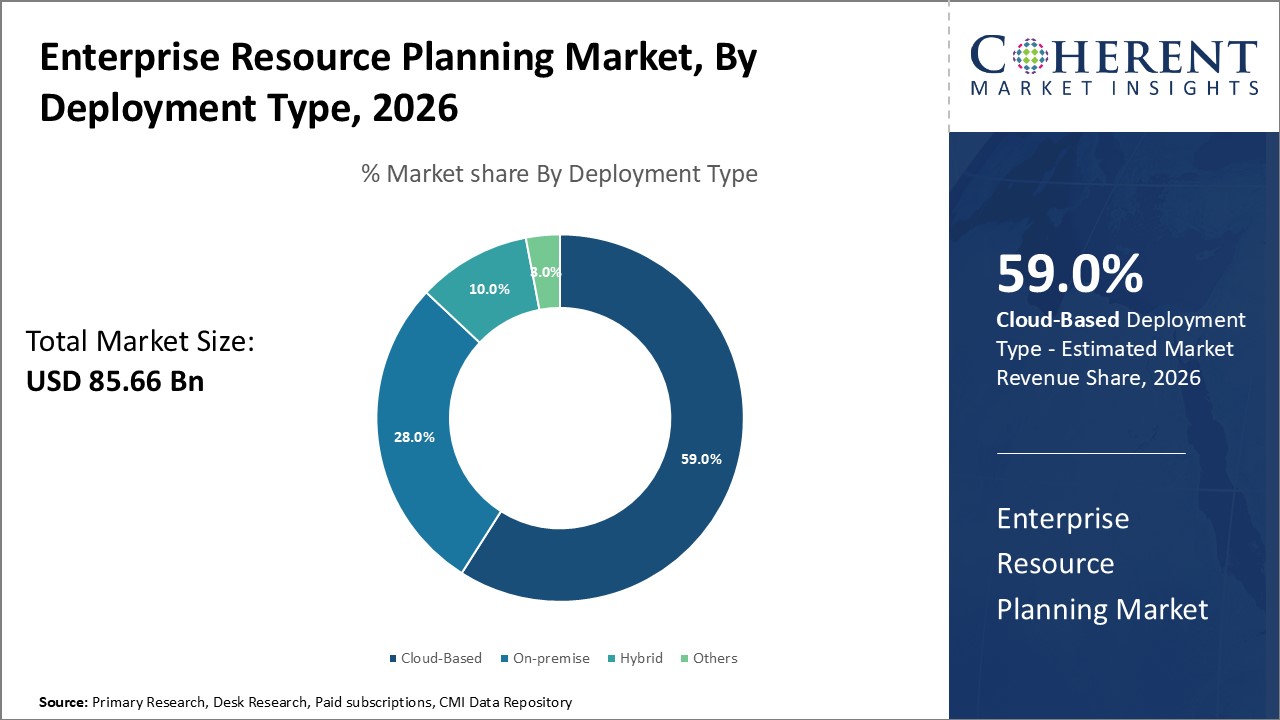
Enterprise Resource Planning Market Insights, By Deployment Type
In terms of Deployment Type, the market is segmented into Cloud, On-premise, Hybrid, and Others, among which Cloud dominates the market share, capturing 59%. This dominance is fueled by the flexibility, scalability, and reduced upfront costs associated with cloud ERP, enabling rapid adoption among SMEs and large enterprises alike. The fastest growing segment within Deployment Type is Hybrid solutions, which combine on-premise and cloud benefits, gaining traction especially in industries with stringent data privacy requirements.
Enterprise Resource Planning Market Insights, By Solution Type
Supply Chain Management dominates the market share by accounting for over 30%, driven by the need to optimize increasingly complex global supply networks. The fastest growing solution type is Financial Management, propelled by automation requirements and compliance pressures that demand real-time auditing and reporting capabilities. Human Capital Management caters primarily to organizations focused on talent retention and workforce analytics, maintaining steady growth.
Enterprise Resource Planning Market Insights, By Organization Size
Large Enterprises continue to dominate the market share, investing heavily in comprehensive ERP suites for end-to-end integration across departments. However, SMEs constitute the fastest-growing segment owing to the emergence of affordable, scalable ERP cloud solutions tailored for smaller operations. Startups are adopting lightweight ERP applications to achieve operational efficiencies early in their business lifecycle. Large enterprises benefit from high customization and multi-module ERPs, whereas SMEs prefer flexible, modular solutions with rapid implementation. Startups often opt for SaaS-based ERP to minimize capital expenses.
Enterprise Resource Planning Market Trends
Market trend analysis reveals a clear pivot towards AI-driven ERP solutions that emphasize automation and predictive insights.
For instance, manufacturers leveraging AI-integrated ERPs have reported a 31% increase in process automation efficiency in 2026.
Additionally, modular deployment and SaaS-based solutions are reshaping customer acquisition models, particularly in SMEs, allowing flexible scaling.
Another notable trend is the incorporation of blockchain for secure transaction records within ERP financial modules, gaining traction in the finance-heavy sectors in 2025.
Enterprise Resource Planning Market Insights, By Geography
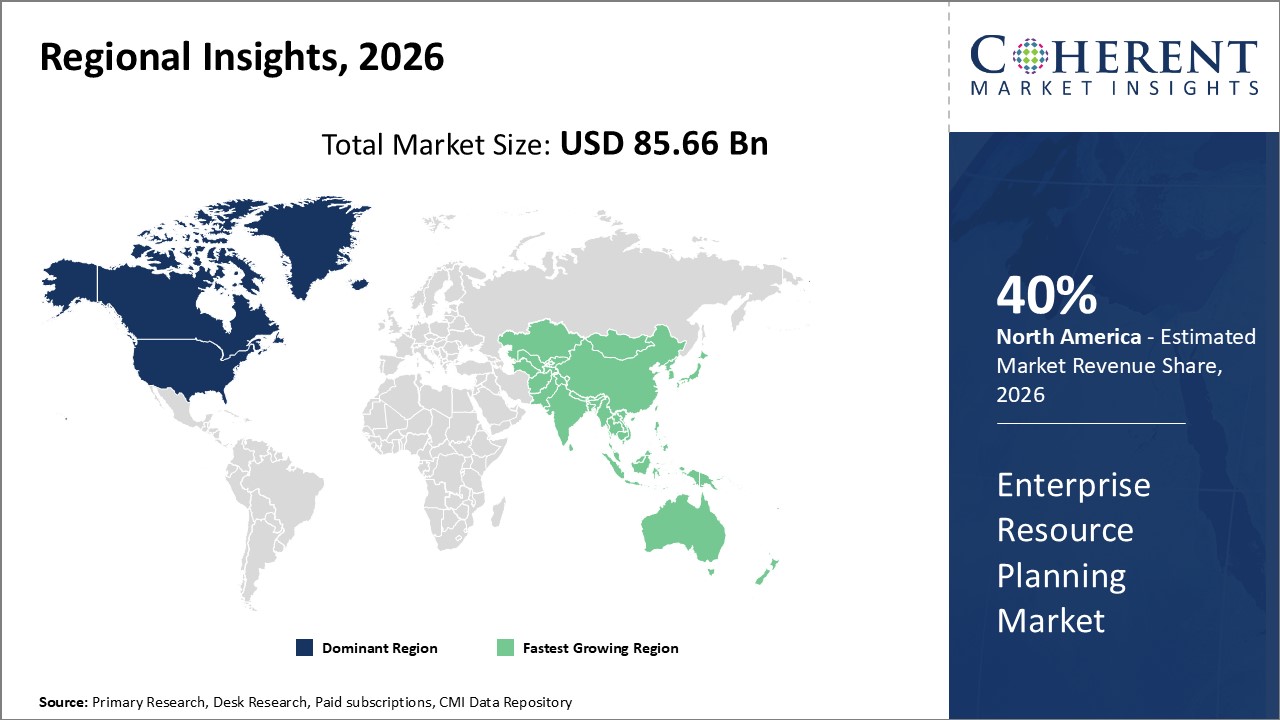
North America Enterprise Resource Planning Market Analysis and Trends
In North America, dominance stems from advanced cloud infrastructure, technology readiness, and strong demand for automated business functions. Businesses across the U.S. and Canada heavily invest in AI-enabled ERP platforms, accounting for roughly 40% of total market revenue. Regulatory requirements, especially in healthcare and finance sectors, drive ERP adoption. Leading companies like Microsoft and Oracle heavily influence this market through continuous innovation and cloud service integration.
Asia Pacific Enterprise Resource Planning Market Analysis and Trends
Meanwhile, the Asia Pacific exhibits the fastest growth due to booming manufacturing industries, rapid digitization, and government policies supporting Industry 4.0. Countries like China and India have witnessed exponential ERP uptake, primarily in cloud-first deployments, resulting in a CAGR exceeding 12%. Local players, along with global ERP vendors, are collaborating to customize solutions that meet diverse regional needs, driving market expansion.
Enterprise Resource Planning Market Outlook for Key Countries
USA Enterprise Resource Planning Market Analysis and Trends
The USA’s market is characterized by high adoption of cloud ERP solutions, with more than 65% of enterprises deploying cloud-based systems by 2026. Government incentives for digital public-sector modernization further accelerate ERP deployment. Leading companies such as Oracle and SAP benefit from deep integrations with AI modules in financial and supply chain management, driving significant business growth. The country’s emphasis on real-time analytics and compliance fuels further innovation and adoption.
India Enterprise Resource Planning Market Analysis and Trends
India’s ERP market is rapidly growing, with SMEs adopting cloud and hybrid ERP systems to manage fragmented operations. Government initiatives like ‘Digital India’ have expanded ERP adoption, particularly in the manufacturing and IT sectors. The rise in startups and the expanding e-commerce ecosystem also stimulates demand for customizable and cost-effective ERP solutions. Prominent global players partnering with local service firms have enhanced solution localization, propelling business revenue growth.
Analyst Opinion
The demand for cloud-based ERP solutions continues to accelerate due to scalability and cost-efficiency. In 2025, cloud ERP deployments accounted for over 59% of total ERP revenues, reflecting a significant market share shift away from on-premise installations. This trend positions cloud ERP as a primary revenue driver for the market’s growth.
Integration capabilities with AI and IoT technologies are becoming essential for market players. Organizations implementing AI-powered analytics within ERP frameworks saw a 36% improvement in operational efficiency in 2026, as reported by industry case examples from the manufacturing sector.
The rise of mid-market enterprises adopting ERP is noticeably pushing market growth. Increased penetration in mid-sized companies is expected to increase segment market share by 13% through 2030, supported by flexible and modular ERP packages tailored for SMEs.
Multi-industry ERP customization is emerging as a key market dynamic. Industries such as healthcare and retail witnessed an 19% year-over-year increase in ERP adoption for compliance management and omnichannel retail operations, respectively, through 2025 and 2026.
- Current Industry Events of 2026
- Market Size Estimation
- Regional Breakdown
- Competitive Landscape
- Customer Intelligence
- Segmental Analysis
- Pricing Analysis
- Key Market Drivers, Challenges & Future Trends
- Customized Insights Section
Market Scope
| Report Coverage | Details | ||
|---|---|---|---|
| Base Year: | 2025 | Market Size in 2026: | USD 85.66 billion |
| Historical Data for: | 2020 To 2024 | Forecast Period: | 2026 To 2033 |
| Forecast Period 2026 to 2033 CAGR: | 9.4% | 2033 Value Projection: | USD 160.66 billion |
| Geographies covered: |
| ||
| Segments covered: |
| ||
| Companies covered: | SAP SE, Oracle Corporation, Microsoft Corporation, Infor Inc., Workday, Inc., Epicor Software Corporation, IFS AB, Sage Group plc, NetSuite Oracle), Unit4, Acumatica, Syspro, Plex Systems. | ||
| Growth Drivers: |
| ||
Enterprise Resource Planning Market Growth Factors
The growing demand for integrated business applications to simplify complex workflows is a critical growth driver. Companies adopting ERP solutions have reported up to a 25% reduction in process cycle times in 2025. The surge in cloud ERP adoption, driven by improved internet infrastructure and reduced TCO (Total Cost of Ownership), enhances accessibility for enterprises of all sizes. Increasing regulatory compliance and the need for real-time compliance reporting across industries such as healthcare and finance further fuel ERP deployments. Additionally, the advancement of AI, machine learning, and advanced analytics integrated within ERP systems creates new avenues for ROI-driven market growth by enabling predictive maintenance and enhanced demand forecasting.
Enterprise Resource Planning Market Development
In March 2026, Acumatica showcased new features in its Cloud ERP Manufacturing and Distribution editions at ProMat. These include improved scheduling views for production, enhanced product configurator, upgraded catalog and pricing control for e-commerce (Shopify integration), unique product attribute handling (e.g., condition, warranty), and advanced order orchestration. Some features were already available; others were previewed ahead of Acumatica’s upcoming product release.
As of mid-2026, SAP’s “Cloud ERP Private Edition” release introduced AI-powered agents (Joule) for areas like Accounts Receivables (automated identification and recommendations for overdue payments) and sales order fulfillment. The update also added workflow improvements in Material Requirements Planning (MRP), such as better filtering, rescheduling proposals, and the ability to mark or “accept” portions of an MRP run to streamline planning.
Key Players
Leading companies of the market:
SAP SE
Oracle Corporation
Microsoft Corporation
Workday, Inc.
Epicor Software Corporation
IFS AB
Sage Group plc
NetSuite (Oracle)
Unit4
Acumatica
Syspro
Plex Systems
Several of these leading companies have strategically expanded their cloud ERP offerings, with Microsoft’s Azure integration enabling over 41% growth in cloud ERP subscribers in 2025. Oracle’s emphasis on AI-embedded ERP modules has increased its market penetration in North America and Europe by 9% since 2023. Meanwhile, SAP’s aggressive acquisition strategy, especially in niche regional markets, has driven business growth and boosted its industry share distinctly in the Asia Pacific.
Enterprise Resource Planning Market Future Outlook
The Enterprise Resource Planning Market is expected to witness robust growth as organizations increasingly focus on digital transformation and data-driven operations. AI-driven predictive analytics, real-time reporting, and workflow automation will become key features of next-generation ERP solutions. Cloud deployment and SaaS models will dominate due to their scalability, reduced upfront costs, and ease of implementation. Integration with IoT, machine learning, and industry-specific modules will allow organizations to optimize operations, respond to dynamic business environments, and maintain a competitive edge. Additionally, ERP platforms will increasingly support global enterprises in managing compliance, sustainability, and workforce efficiency across regions.
Enterprise Resource Planning Market Historical Analysis
The Enterprise Resource Planning Market has evolved from rigid, on-premises software solutions to cloud-based, modular platforms that centralize and streamline diverse business operations. Historically, ERP systems focused on integrating finance, supply chain, and manufacturing functions within large organizations, but their adoption was limited due to high implementation costs and operational complexity. Over the past decade, cloud-based ERP, mobile accessibility, and AI-powered analytics have enabled small and medium-sized enterprises (SMEs) to access centralized data, automate workflows, and enhance decision-making capabilities. The shift toward real-time reporting, predictive analytics, and process automation has allowed companies to achieve operational efficiency, reduce costs, and improve scalability.
Sources
Primary Research interviews:
ERP Solution Architects
Business Process Analysts
IT Managers
Software Implementation Consultants
Databases:
Gartner ERP Systems Database
IDC Enterprise Software Reports
SAP Business Data Hub
Magazines:
ERP Today
CIO Magazine
InformationWeek
TechTarget ERP News
Journals:
Journal of Enterprise Information Management
Information Systems Research
MIS Quarterly
International Journal of Information Systems and Project Management
Newspapers:
The Economic Times (Business Technology)
Financial Times (Enterprise)
The Hindu Business Line (IT)
The Wall Street Journal (Business Tech)
Associations:
Enterprise Application Software Association (EASA)
International Association for Information and Data Quality (IAIDQ)
Association for Information Systems (AIS)
Cloud ERP Alliance
Get access to 250+ pages report
Every segment, forecast, competitor profile and data table behind the analysis above — available for instant download.
- ESOMAR Member
- ISO 9001:2015 Certified
- D-U-N-S Registered
- GDPR & CCPA Compliant
Missing comfort of reading report in your local language? Find your preferred language:
Transform your Strategy with Exclusive Trending Reports
Frequently Asked Questions
The market is led by industry giants such as SAP SE, Oracle Corporation, and Microsoft Corporation, which have robust cloud ERP solutions complemented by AI and analytics.
The ERP market is projected to grow from USD 85.66 billion in 2026 to USD 160.66 billion by 2033, following a CAGR of 9.4% from 2026 to 2033.
Manufacturing and retail sectors present the largest growth opportunities due to their complex supply chains and increased automation needs.
Trends will focus on cloud ERP adoption, AI integration, and industry-specific modular systems to enhance scalability and compliance.
The competitive landscape is dominated by a few key market players pursuing cloud expansion, AI capabilities, and acquisitions. Challenges include integration complexities and evolving regulatory compliance.
Common strategies include partnerships with cloud providers, acquisition of niche ERP vendors, and continuous development of AI-powered modules to differentiate offerings.