

Loyalty Management Market Size and Share Analysis- 2026 To 2033
The loyalty management market size is anticipated to grow at a CAGR of 14.5% with USD 16.2 Bn in 2026 and is expected to reach USD 41.7 Bn in 2033. Broad consumer engagement (with 92% of consumers enrolled in at least one loyalty program) alongside digital transformation, personalization, and mobile integration are propelling growth, supported by increasing use of data‑driven customer retention strategies as well as deeper insights into purchase behavior.
Key Takeaways
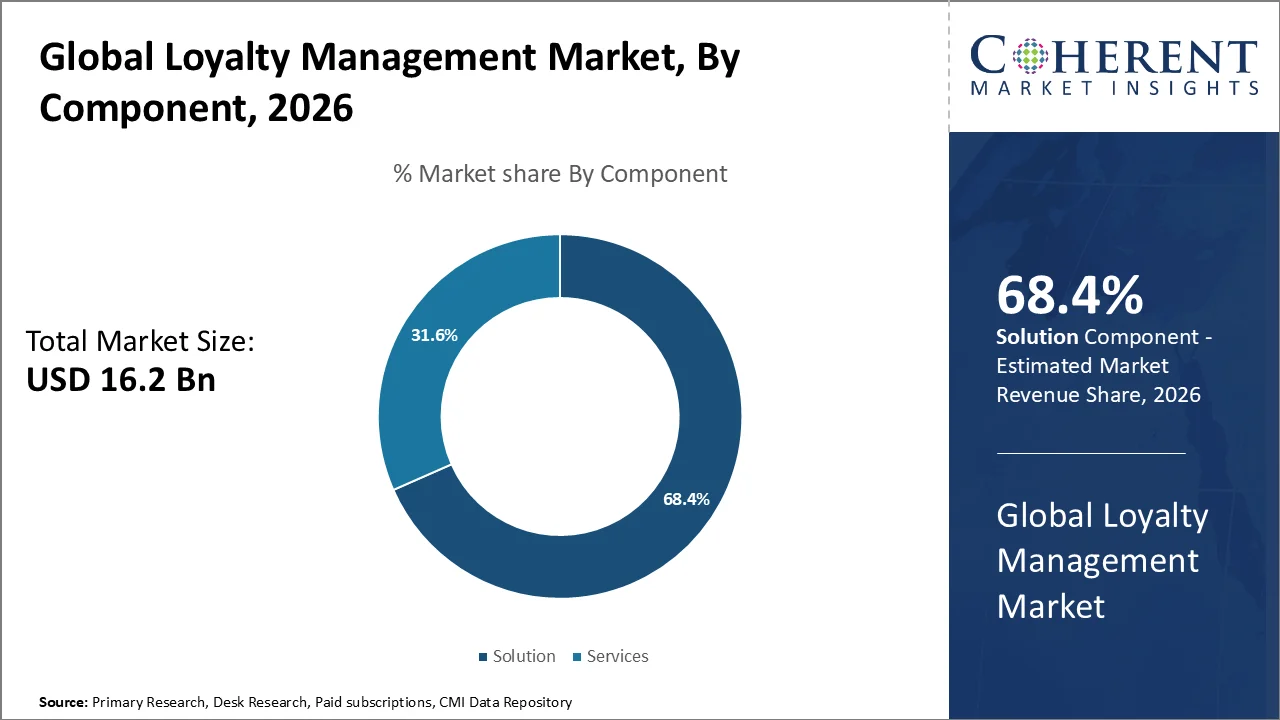
- Solution is expected to account the largest share of 68.4% in 2026, owing to the growing need for integrated platforms which combine customer data, loyalty analytics (73% of consumers state AI helps in enhancing their loyalty experience), and personalized reward management systems.
- Based on deployment type, the cloud segment is set to lead with 61.8% in 2026, backed by the increasing preference for cost-effective, scalable, and flexible solutions. According to the U.S. Department of Commerce, cloud computing adoption in U.S. enterprises is growing with a rapid pace, with over 90% of businesses using cloud services for their operations in 2025.
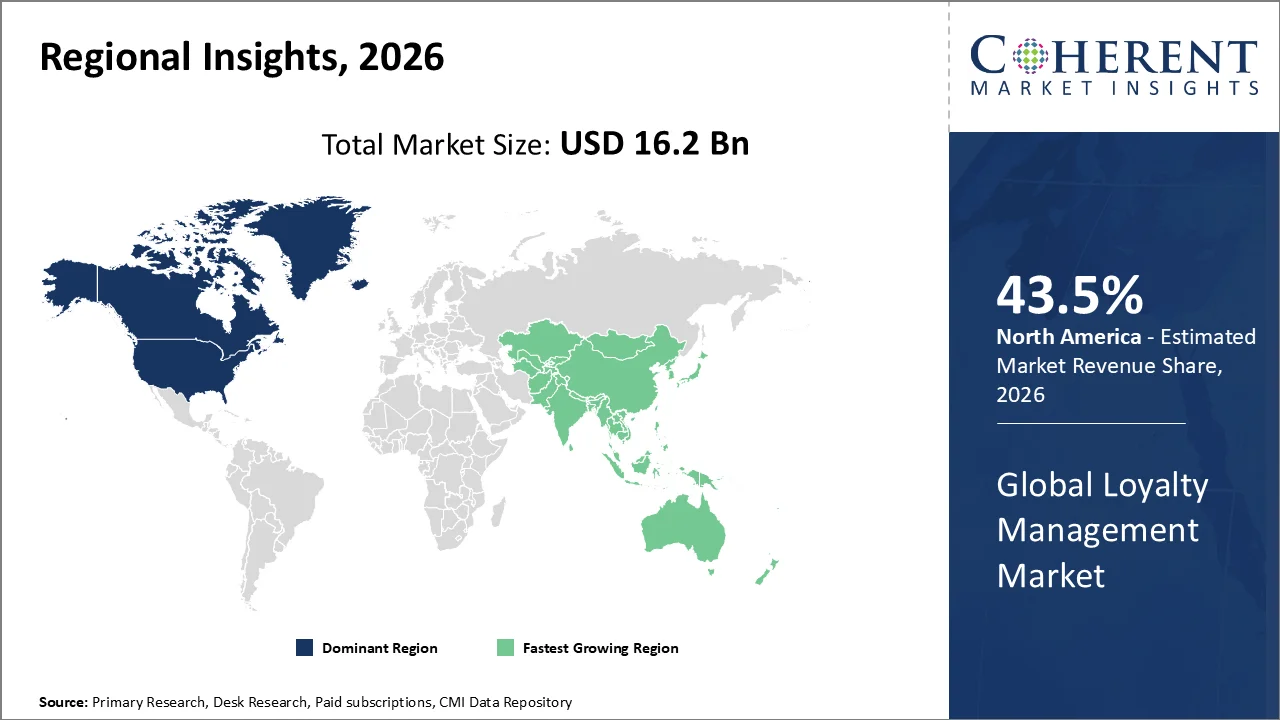
- North America is expected to acquire the dominant share of 43.5% in 2026, mainly attributed to high market maturity, substantial investments in customer experience technologies, and the swift adoption of digital transformation initiatives in the retail as well as e-commerce sectors. The U.S. alone invests more than USD 12 Bn per year in customer loyalty programs, according to the Federal Reserve.
Segmental Insights
Why is Solution Acquiring the Largest Market Share?
By component, solution is projected to account for the largest loyalty management market share in 2026, representing approximately 68.4% of the total volume. The segment’s growth is due to the widespread implementation of digital and AI‑enabled solutions which help in enhancing customer engagement and personalization. The official data shows that across OECD countries, the proportion of firms reporting AI use more than doubled over two years, with 20.2% of firms using AI in 2025, a notable rise from 8.7% in 2023. Thereby indicating strong digital uptake that underpins solution‑centric platforms like cutting edge loyalty systems.
Moreover, the statistics from OECD highlight that larger enterprises are leading in the adoption. Around more than 50% of large firms are using AI, compared with lower rates amongst the smaller firms. This reflects how solution investments are concentrated where customer‑centric systems like loyalty solutions are prioritized.
These official adoption trends support the expectation that solutions will lead the loyalty management by 2026, with more businesses implementing digital tools to improve customer retention and engagement.
- Current Industry Events of 2026
- Market Size Estimation
- Regional Breakdown
- Competitive Landscape
- Customer Intelligence
- Segmental Analysis
- Pricing Analysis
- Key Market Drivers, Challenges & Future Trends
- Customized Insights Section
Cloud holds the Largest Market Share
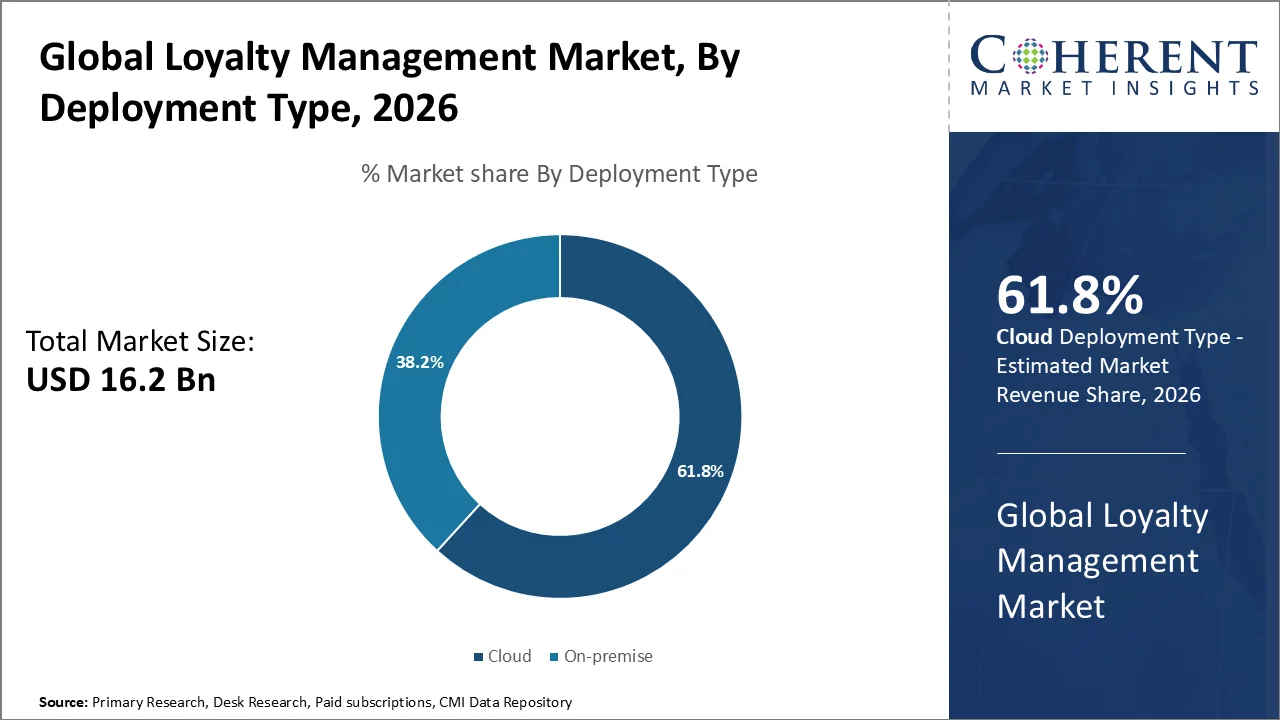
Based on deployment type, the cloud segment is likely to lead the loyalty management marketplace and accounts for a substantial 61.8% share in 2026. This is because more enterprises rely on scalable, flexible, internet‑based services to manage customer engagement and data. The government statistics show that cloud adoption in business IT is now mainstream. 52.7, up substantially from previous years, with usage spanning email, office software, and data hosting — core functions for cloud‑based loyalty platforms.
The large enterprises are especially cloud‑centric, with 85, thereby indicating strong organizational preference for cloud over on‑premises deployment. The governments are also institutionalizing cloud. The U.S. federal policy under the Federal Cloud Computing Strategy (“Cloud Smart”) guides agencies to migrate to cloud services to improve efficiency as well as digital service delivery.
These official digital adoption trends aligns the projection that cloud deployment is leading the loyalty management systems, as organizations prioritize agility, data accessibility, and cost‑effective scalability.
Data ‑Driven Personalization and AI is Transforming the Loyalty Management Industry in United States
Innovations in data-driven personalization and AI are transforming the loyalty management industry in the United States. These technologies allow businesses in better understanding consumer behavior and preferences, thus facilitating for more tailored and effective loyalty programs. The AI-enabled algorithms analyze vast amounts of customer data, thereby propelling personalized offers, rewards, as well as engagement strategies.
By 2025, 18% of firms in the U.S. had incorporated AI, with 78% of organizations using it in the year of 2024, thus showcasing a notable rise of 55% from the previous year as per the Federal Reserve and U.S. Census Bureau. In the public sector, the U.S. federal government has introduced AI technologies like chatbots in order to improve customer service and at the same time provide personalized experiences.
In addition to this, hundreds of AI use cases are emerging in federal agencies, thus indicating broader adoption and the potential for scalability in the private sector. The platforms like Data.gov offer open datasets for businesses to integrate into AI models, thereby driving further innovations in personalized loyalty solutions.
Blockchain and Transparency: A Major Breakthrough in Loyalty Management Industry
Blockchain technology’s decentralized and tamper-resistant ledger has emerged as a game-changer for enhancing transparency in various sectors, including loyalty management. The governments around the world are turning to blockchain to improve data integrity as well as trust. For example, India's National Blockchain Framework, launched with government support, has successfully verified over 340 million digital documents on its blockchain infrastructure. This demonstrates the practical application of blockchain technology for creating immutable and verifiable records. Such features can enhance the transparency of loyalty programs by ensuring that transactions and loyalty points are accurately recorded and remain unaltered.
In addition, OECD member countries have formally recommended blockchain and distributed ledger technologies (DLT) as essential tools for creating verifiable, transparent transaction records. This approach reduces reliance on centralized intermediaries, thus making transactions more secure and trustworthy in customer-facing environments like loyalty programs.
Current Events and Their Impact on the Loyalty Management Market
Current Event | Description and its Impact |
India Notifies Digital Personal Data Protection (DPDP) Rules, 2025 |
|
UK Data (Use and Access) Act, 2025 – Adjustments to UK Data Law |
|
Loyalty Management Market Trends
- Integration of AI and machine learning is transforming customer loyalty programs by offering personalized rewards, enhancing engagement, and improving customer retention strategies. The AI-powered insights assist businesses tailor promotions and incentives to individual preferences.
- Cloud-based loyalty solutions are becoming more popular owing to their scalability, flexibility, and reduced infrastructure costs, particularly in industries like retail and hospitality. Cloud services allow real-time data analysis, thus improving customer targeting.
- Mobile-based loyalty programs are increasing, as consumers are using smartphones to collect and use loyalty points. As of 2025, approximately 60% of global loyalty program members are using digital channels for managing their loyalty rewards.
- The use of stricter data privacy laws like the GDPR in Europe, is shaping loyalty program formats. The firms are focusing more on clear data collection methods, thereby ensuring customer data safety and improving trust. In 2024, 85% of businesses surveyed in Europe changed their loyalty program data practices to comply with GDPR, thus giving importance to customer consent.
- According to the National Restaurant Association 2026 State of the Restaurant Industry report, nearly 70% of U.S. diners reported that loyalty programs help them manage costs amid inflation. Gen Z has become a key driver of new loyalty signups, thus reshaping program expectations toward real‑time rewards and app‑centric experiences.
- A recent Deloitte survey reveals that 72% of consumers say loyalty programs make them more likely to spend with a preferred brand, while 56% increase their overall spending because of the program, thereby highlighting how structured loyalty management directly influences purchase behavior.
Regional Insights
North America Dominates Owing to Digital Connectivity and E ‑Commerce Engagement
North America account 43.5% market share in 2026, supported by one of the world’s highest levels of digital connectivity and e‑commerce engagement. In the United States, 96% of adults reported using the Internet in 2024, thus reflecting widespread access to online platforms that enable digital loyalty program participation. Most households in the U.S. also had broadband internet subscriptions (90%) and smartphones as primary internet devices (90%) in 2021, according to the U.S. Census Bureau, thereby creating a strong foundation for mobile‑based loyalty engagement.
The U.S. retail e This demonstrates the deep integration of online purchasing behavior that loyalty programs often leverage. In Canada, e‑commerce continues to grow, with , thereby underscoring consumer shift toward digital channels.
These robust digital usage patterns in both countries support higher adoption rates of loyalty management solutions in retail, hospitality, and service sectors, thus sustaining North America’s leading position in customer rewards as well as engagement technologies.
Asia Pacific Loyalty Management Market Trends
The Asia Pacific region is poised to be as the fastest-growing region through 2026-2033, expanding at a CAGR of approximately 5.74%. This growth is underpinned by rapid digital adoption and expanding online consumer engagement. About 66, close to the global average, providing a broad base for digital loyalty program uptake. In Southeast Asia specifically, the digital economy is expanding at a fast rate, with three in five people shopping online and more than 60 % of payments conducted digitally as of late 2025. This reflects deepening digital consumption behavior that loyalty platforms can leverage.
Internet connectivity and smartphone penetration are key enablers to the region's growth. The region is still a global hub for information and communication technology (ICT) goods and securely nearly 80 % of the global exports in 2024. This demonstrates strong infrastructure support for digital services. The total internet economy in Southeast Asia is forecast to grow from USD 194 billion to over USD 330 billion by 2025, signaling accelerating e‑commerce and digital engagement. These macro trends assist in the increased incorporation of loyalty management solutions in retail, telecom, travel, and financial services for boosting retention and personalized engagement.
Consumer Behavior and Spending Structures is accelerating the Loyalty Management Demand in United States
The United States Loyalty Management Market is being driven by tangible shifts in U.S. consumer behavior and spending structures. According to the U.S. Consumer Credit Card Market Report (CFPB), hundreds of millions of Americans are enrolled in loyalty programs, with almost 74 million consumers earning rewards via co, showing broad participation in loyalty‑linked spending mechanisms.
Additionally, Federal Reserve Board data indicate that U.S. banks paid more than USD 35 billion annually in credit, underscoring the economic scale of loyalty incentives embedded in payment systems. These government‑sourced figures reflect how integrated loyalty rewards are with consumer finance and spending behavior, speeding up the demand for structured loyalty management solutions in retail, travel, and financial sectors.
China Loyalty Management Market Trends
In China, digital loyalty programs are expanding rapidly, with Yum China’s loyalty programs surpassing 590 million members in 2026, representing over 40 % of the national population, and memberThis reflects deep digital engagement and the integration of loyalty systems with mobile payments and apps in the Chinese market.
Who are the Major Companies in Loyalty Management Industry
Some of the major key players in Loyalty Management Industry are BOND BRAND LOYALTY INC., Kobie, Brierley, Epsilon Data Management, LLC., Aimia Inc., Annex Cloud, ICF International Inc., Apex Loyalty, Apptivo Inc., Fivestars, IBM Corporation, Oracle, Comarch SA, SAP, TIBCO Software Inc., Maritz Holdings Inc., MicroStrategy Incorporated and others
Key News
- In March 2026, Marti Technologies, Inc., the leading mobility super app in Türkiye, unveiled the Marti Shareholder Loyalty Program. This initiative aims to reward long-term retail shareholders while strengthening Marti’s commitment to sustainable growth, aligning with stakeholders, and creating value responsibly.
- In March 2026, Ascendant Loyalty Marketing, a leading U.S.-based consultancy that specializes in designing and launching data-driven loyalty and engagement programs, launched Petals Rewards. Mayesh, a premier supplier of premium cut flowers and floral products worldwide, has developed this new B2B loyalty program.
- In November 2025, Haffner’s, the convenience store division of Northeast retailer and wholesaler Energy North Incorporated, partnered with Liquid Barcodes to launch a comprehensive loyalty program.
- In August 2025, Avalanche, the leading smart contract platform, announced its partnership with Quboid, a top blockchain-based loyalty and customer engagement platform.
Market Report Scope
Loyalty Management Market Report Coverage
| Report Coverage | Details | ||
|---|---|---|---|
| Base Year: | 2025 | Market Size in 2026: | USD 16.2 Bn |
| Historical Data for: | 2020 To 2024 | Forecast Period: | 2026 To 2033 |
| Forecast Period 2026 to 2033 CAGR: | 14.5% | 2033 Value Projection: | USD 41.7 Bn |
| Geographies covered: |
| ||
| Segments covered: |
| ||
| Companies covered: | BOND BRAND LOYALTY INC., Kobie, Brierley, Epsilon Data Management, LLC., Aimia Inc., Annex Cloud, ICF International Inc., Apex Loyalty, Apptivo Inc., Fivestars, IBM Corporation, Oracle, Comarch SA, SAP, TIBCO Software Inc., Maritz Holdings Inc., MicroStrategy Incorporated and others | ||
| Growth Drivers: |
| ||
| Restraints & Challenges: |
| ||
Analyst Opinion
- Consumer loyalty programs are widely adopted, with nearly 80% of U.S. consumers enrolled in at least one loyalty program. This reflects a growing preference for rewards and incentives, especially as digital interactions rise across various industries.
- The retail industry remains one of the largest sectors for loyalty program implementation, with U.S. retail loyalty program memberships estimated at over 3.3 billion, outpacing the country’s total population.
- Data-driven loyalty programs are seeing significant growth, with studies showing that 83% of consumers are more likely to engage with brands that offer personalized experiences. This trend is driving the loyalty management market growth, as businesses increasingly leverage customer data to tailor their loyalty initiatives and boost long-term engagement.
Speak to the analyst
Want personalized insights?
Take the findings above to one of our principal consultants, or have the report rebuilt around the segments, geographies and competitors you actually track.
Market Segmentation
- By Component
- Solution
- Services
- By Deployment Type
- On-premise
- Cloud
- By Organization Size
- Large Enterprises
- SMEs
- By End-User
- Retail
- Healthcare
- Telecom
- BFSI
- Media & Entertainment
- Hospitality
- Education
- Others
- By Region
- North America
- U.S.
- Canada
- Latin America
- Brazil
- Argentina
- Mexico
- Rest of Latin America
- Europe
- Germany
- U.K.
- Spain
- France
- Italy
- Russia
- Rest of Europe
- Asia Pacific
- China
- India
- Japan
- Australia
- South Korea
- ASEAN
- Rest of Asia Pacific
- Middle East
- GCC Countries
- Israel
- Rest of Middle East
- Africa
- South Africa
- North Africa
- Central Africa
- North America
Sources
Primary Research Interviews
- Loyalty Management Platform Providers
- CRM and Customer Engagement Solution Providers
- Retail and E-commerce Loyalty Program Managers
- BFSI Customer Retention and Rewards Program Heads
- Travel, Hospitality, and Airline Loyalty Program Operators
- Marketing Automation and Customer Data Platform Consultants
- Others
Databases
- Bloomberg Terminal
- Thomson Reuters Eikon
- Euromonitor International
- Crunchbase
- Others
Magazines
- CRM Magazine
- CustomerThink
- Retail Dive
- Marketing Week
- Loyalty360
- Others
Journals
- Journal of Marketing Research
- Journal of Service Research
- Journal of Interactive Marketing
- Journal of Retailing and Consumer Services
- International Journal of Market Research
- Others
Newspapers
- Financial Times
- The Wall Street Journal
- Reuters
- Bloomberg News
- The Economic Times
- Others
Associations
- Loyalty360
- Customer Experience Professionals Association (CXPA)
- American Marketing Association (AMA)
- Direct Marketing Association / Data & Marketing Association
- Interactive Advertising Bureau (IAB)
- Others
Public Domain Sources
- U.S. Census Bureau
- Eurostat
- OECD Data
- World Bank Open Data
- Reserve Bank of India (RBI)
- European Commission – Digital Economy and Society
- Others
Proprietary Elements
- CMI Data Analytics Tool
- Proprietary CMI Existing Repository of Information for the Last 8 Years
Get access to 250+ pages report
Every segment, forecast, competitor profile and data table behind the analysis above — available for instant download.
- ESOMAR Member
- ISO 9001:2015 Certified
- D-U-N-S Registered
- GDPR & CCPA Compliant
Missing comfort of reading report in your local language? Find your preferred language:
Transform your Strategy with Exclusive Trending Reports
Frequently Asked Questions
The loyalty management market is expected to reach USD 41.7 Bn in 2033.
Major players operating in the global loyalty management market include BOND BRAND LOYALTY INC., Kobie, Brierley, Epsilon Data Management, LLC., Aimia Inc., Annex Cloud, ICF International Inc., Apex Loyalty, Apptivo Inc., Fivestars, IBM Corporation, Oracle, Comarch SA, SAP, TIBCO Software Inc., Maritz Holdings Inc., MicroStrategy Incorporated and others.
The stringent data privacy regulations (GDPR, CCPA), high implementation costs for SMEs, and complex integration with legacy IT systems are the key factors hampering growth of the market.
The need for enhanced customer retention, the demand for personalized, data-driven experiences, and the rapid adoption of AI and mobile technologies to drive engagement boost demand for loyalty management.
The loyalty management market is anticipated to grow at a CAGR of 14.5% between 2026 and 2033.
Among regions, North America is expected to account for a largest market share in the global Loyalty Management Market over the forecast period.
For small to mid-sized businesses, the costs of loyalty platforms usually range from USD 25 to USD 500 per month for basic, off-the-shelf solutions. The key liabilities associated with these platforms include unredeemed points liability, compliance with legal regulations, the risk of fraud, and the potential for over-discounting.