

Retail Analytics Market Size and Forecast — 2026-2033
The Global Retail Analytics Market size is estimated to be valued at USD 8.69 billion in 2026 and is expected to reach USD 18.50 billion by 2033, exhibiting a compound annual growth rate (CAGR) of 11.4% from 2026 to 2033.
Overview
Retail analytics solutions consist of hardware sensors, software platforms, and data visualization tools that enable real-time insights into customer behavior and store performance. These products include people-counting cameras, heat-mapping sensors, POS-integrated software, and AI-driven dashboards. They analyze metrics like dwell time, customer flow, and basket size, allowing retailers to optimize store layout, marketing, and staffing. The latest products offer cloud-based dashboards, omnichannel tracking, and integration with CRM and ERP systems, providing holistic retail intelligence while ensuring customer data privacy.
Key Takeaways
The Customer Analytics segment dominates with a 36% market share, driven by retailers’ focus on personalized marketing and customer retention strategies.
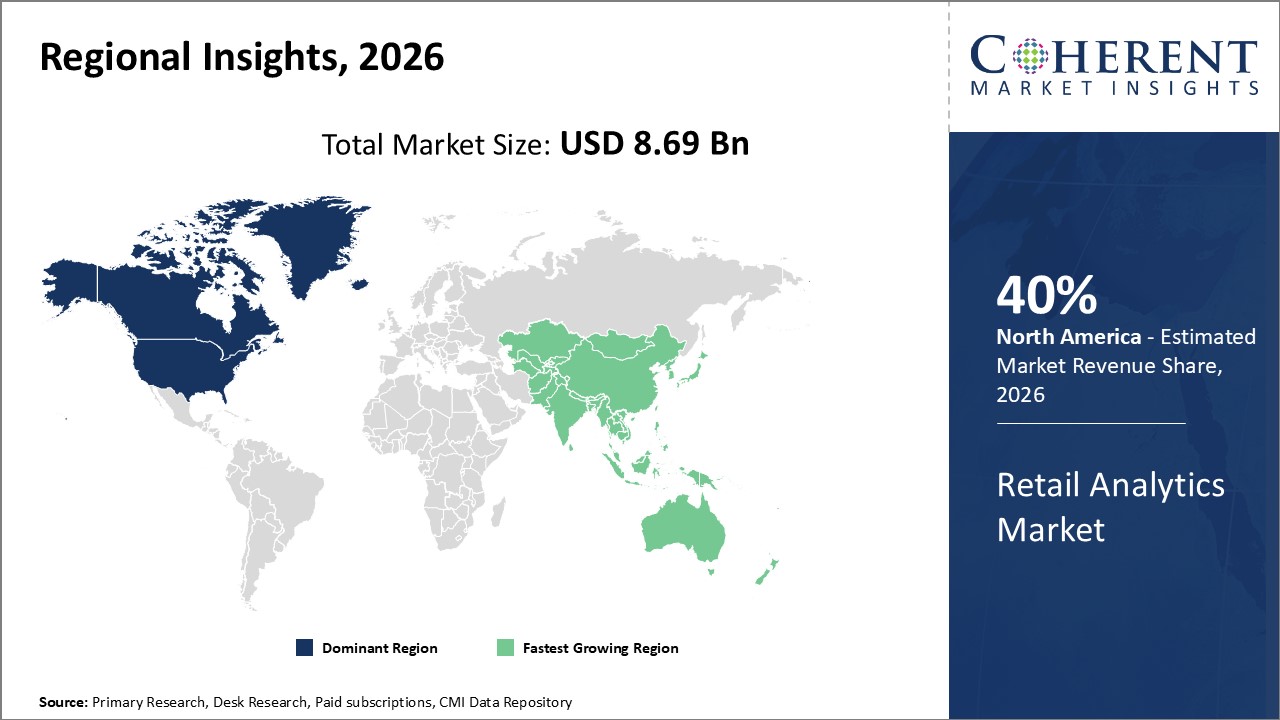
Regionally, North America holds a commanding 40% share of the retail analytics market, underpinned by early technology adoption and strong presence of major market players.
Asia Pacific is the fastest-growing region with a CAGR exceeding 14%, fostered by rapid digitization, expanding e-commerce, and government incentives encouraging digital transformation.
Retail Analytics Market Segmentation Analysis
Retail Analytics Market Insights, By Component
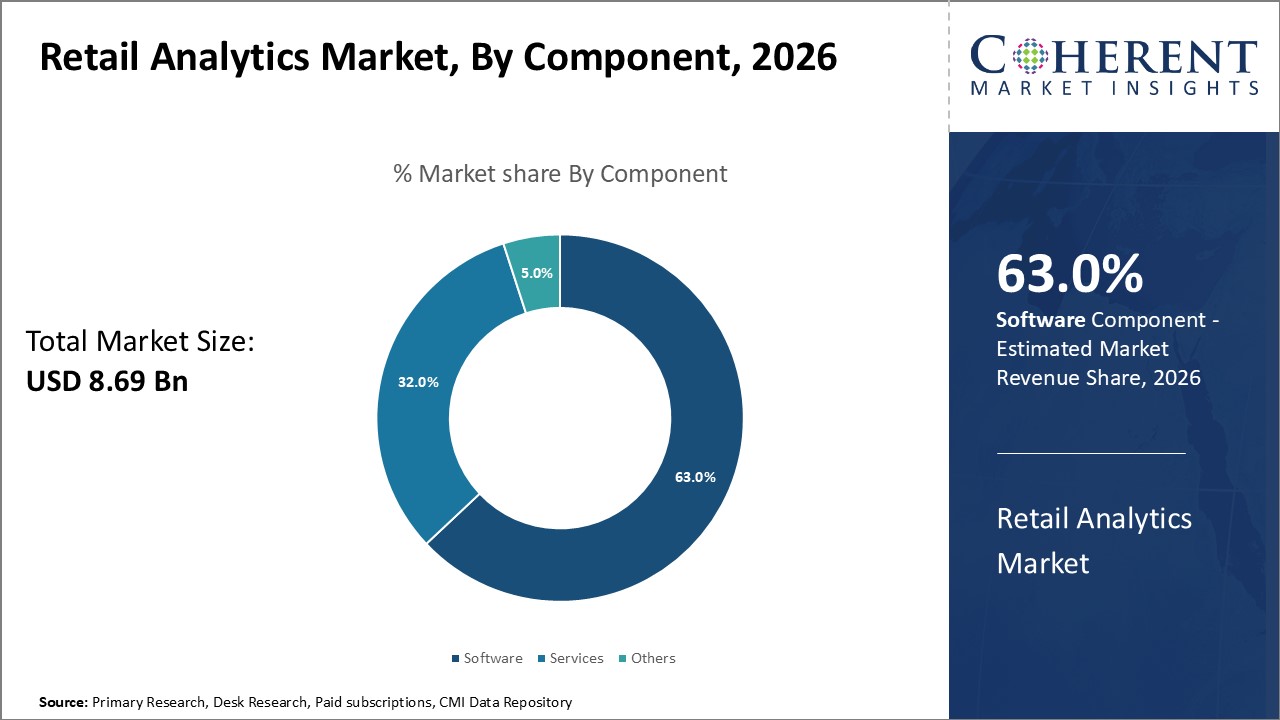
Software dominates the market share with 63%. Software solutions are central to the industry size due to their role in providing comprehensive data aggregation, visualization, and actionable insights. Dominating sub-segment Software enables scalable analytics frameworks across retail operations and integrates AI and machine learning for enhanced predictive capabilities. The fastest growing subsegment is Services, including consulting, integration, and managed services, propelled by the increasing demand for end-to-end retail analytics solutions and adoption support.
Retail Analytics Market Insights, By Deployment Mode
On-premise deployments remain dominant due to legacy system investments and stringent data security policies in larger retailers. However, Cloud’s rapid adoption stems from its scalability, lower upfront costs, and ease of deployment, supporting rapid innovation cycles and remote analytics access. Hybrid deployments are gaining traction by offering a balance between security and flexibility for omnichannel retailers. Others include emerging deployment frameworks such as edge computing. Collectively, these models fulfill diverse retailer requirements, driving overall market expansion and enabling agile market growth strategies.
Retail Analytics Market Insights, By Application
Customer Analytics dominates with the largest market share due to retailers’ unrelenting focus on personalized marketing, customer segmentation, and loyalty management—critical for enhancing business growth. Supply Chain Analytics is the fastest growing application subsegment, propelled by global supply chain complexities and the need for real-time logistics optimization, predictive demand forecasting, and inventory visibility. Pricing & Promotion Analytics and Inventory Analytics support dynamic pricing and stock-level management to react quickly to market fluctuations, benefiting retail revenue streams.
Retail Analytics Market Trends
The Retail Analytics Market trends spotlight escalating adoption of AI-enhanced customer insights solutions that refine personalization and customer engagement.
For example, a Fortune 500 retailer’s deployment of an AI-powered platform in 2026 resulted in a 23% increase in repeat purchases, exemplifying how these tools drive market revenue.
Additionally, cloud migration is accelerating, especially among mid-tier retailers seeking cost-effective scalable analytics, with cloud adoption rates rising by 19% globally in 2025.
Lastly, blockchain-enabled transparency enhances supply chain analytics, reducing fraud and inefficiencies, with pilots by Walmart and Carrefour in 2026 improving traceability by up to 31%.
Retail Analytics Market Insights, By Geography
North America Retail Analytics Market Analysis and Trends
In North America, the retail analytics market dominates with a 40% industry share thanks to mature technology ecosystems, abundant retail giants, and robust data infrastructure. Government policies supporting digital transformation and innovation hubs further drive substantial business growth. Leading companies such as IBM and SAS Institute headquartered here continuously advance market dynamics through R&D investments.
Asia Pacific Retail Analytics Market Analysis and Trends
Meanwhile, Asia Pacific exhibits the fastest growth with a CAGR of over 14%, propelled by expanding e-commerce activities in China and India, burgeoning government digital initiatives, and increasing cloud analytics adoption. Companies like Microsoft and Oracle have launched region-specific products to cater to local market demands, leveraging demographic advantages and growing retail penetration.
Retail Analytics Market Outlook for Key Countries
USA Retail Analytics Market Analysis and Trends
The USA's retail analytics market thrives on high digital maturity and early adoption of AI technologies in retail chains. Leading U.S. retailers invest heavily in cloud-based and AI-powered analytics platforms, evidenced by an estimated 30% increase in market revenue from these solutions in 2025. Major players headquartered in the U.S., including Microsoft and Oracle, drive ecosystem innovation, expanding the overall industry size and influencing global retail analytics trends.
China Retail Analytics Market Analysis and Trends
China’s retail analytics market benefits from an expansive e-commerce ecosystem, ambitious government digital policies, and accelerated cloud analytics infrastructure rollout. Alibaba’s integration of predictive analytics and AI in its retail platforms set new benchmarks in 2026, driving localized insights and operational efficiencies. Tencent and Huawei further contribute by tailoring analytics solutions to support small and medium retailers, thus widening market scope and creating robust growth avenues.
Analyst Opinion
The rising demand for real-time data analytics in omnichannel retailing is a critical driver expanding market scope. For instance, in 2025, over 71% of top retailers in the U.S. reported integrating real-time analytics to enhance store operations and personalized marketing, directly impacting market size through increased adoption rates.
Supply chain optimization via predictive analytics has become a key growth lever. Companies implementing advanced retail analytics reported a 16% reduction in inventory holding costs in 2026, showcasing the pricing and cost-efficiency benefits from the demand side.
The surge in mobile commerce is increasing the need for consumer behavior analytics for better targeting and campaign optimization. In Asia Pacific alone, mobile transactions grew by 23% in Q1 2026 compared to the previous year, reflecting robust market revenue from behavioral analytics applications.
Regulatory focus on data privacy and ethics is emerging as an important market restraint but also a driver for innovation in compliant analytics solutions. For example, several European retailers embraced privacy-first analytics tools in 2025 to ensure GDPR compliance, boosting market share for compliant analytics products.
- Current Industry Events of 2026
- Market Size Estimation
- Regional Breakdown
- Competitive Landscape
- Customer Intelligence
- Segmental Analysis
- Pricing Analysis
- Key Market Drivers, Challenges & Future Trends
- Customized Insights Section
Market Scope
| Report Coverage | Details | ||
|---|---|---|---|
| Base Year: | 2025 | Market Size in 2026: | USD 8.69 billion |
| Historical Data for: | 2020 To 2024 | Forecast Period: | 2026 To 2033 |
| Forecast Period 2026 to 2033 CAGR: | 11.4% | 2033 Value Projection: | USD 18.50 billion |
| Geographies covered: |
| ||
| Segments covered: |
| ||
| Companies covered: | SAS Institute Inc., IBM Corporation, Oracle Corporation, Microsoft Corporation, SAP SE, Salesforce.com Inc., Nielsen Holdings plc, Infosys Limited, TIBCO Software Inc., MicroStrategy Incorporated, Google LLC, Amazon Web Services, Inc | ||
| Growth Drivers: |
| ||
Retail Analytics Market Growth Factors
The Retail Analytics Market expansion is fueled by several critical growth factors. First, the proliferation of big data across retail touchpoints enables granular consumer insights, enhancing business growth and improving market revenue streams. Second, the rapid adoption of omnichannel retailing strategies demands sophisticated data analytics tools to synchronize customer experiences across digital and physical stores. Third, the rising integration of AI and machine learning technologies enhances predictive analytics capabilities, driving improved forecasting and inventory management. In 2026, retailers adopting these technologies reported a 10-16% uplift in sales efficiency metrics. Lastly, the growth of e-commerce in emerging economies is broadening the market scope and creating new opportunities for analytics vendors.
Retail Analytics Market Development
In June 2023, Amazon launched its Rapid Retail Analytics (RRA) platform, a next-generation solution aimed at providing retail advertisers and brands with near real-time insights into sales and advertising performance. Integrated with Amazon Marketing Stream, RRA delivers hourly data streams available within minutes of the hour closing, enabling brands to monitor performance and optimize campaigns almost instantaneously. The platform leverages Amazon’s cloud infrastructure and advanced data processing capabilities to offer actionable intelligence on product demand, conversion rates, and advertising ROI, helping vendors make fast, data-driven decisions in dynamic retail environments.
In late March 2025, during the Adobe Summit, Adobe and Microsoft unveiled plans to integrate Adobe Experience Cloud workflows into Microsoft 365 Copilot, introducing generative AI capabilities for enterprise productivity and marketing workflows. The integration enables users to leverage AI-driven content creation, data insights, and automated campaign management directly within Microsoft 365 applications, streamlining collaboration between marketing, sales, and analytics teams.
Key Players
Leading companies of the market include:
SAS Institute Inc.
IBM Corporation
Oracle Corporation
Microsoft Corporation
SAP SE
Salesforce.com Inc.
Nielsen Holdings plc
Infosys Limited
TIBCO Software Inc.
MicroStrategy Incorporated
Google LLC
Amazon Web Services, Inc.
Leading market companies are aggressively deploying advanced analytics platforms integrated with AI and cloud solutions. For example, IBM’s strategy of combining AI-driven retail analytics with hybrid cloud services has resulted in a 21% consecutive revenue increase in their analytics segment in 2025. Similarly, SAS Institute’s expansion into retail-specific use cases with embedded machine learning frameworks helped secure enterprise contracts in North America, reinforcing market growth strategies that emphasize customization and scalability.
Retail Analytics Market Future Outlook
In the coming years, the retail analytics market is expected to witness accelerated adoption as retailers strive to enhance personalization and operational efficiency. AI-driven analytics will dominate the sector, leveraging big data from multiple touchpoints—online, mobile, and in-store—to predict buying behavior and optimize assortments. The integration of generative AI into customer experience management and the use of digital twins for store simulation will enhance data-driven retail strategy. Privacy-preserving analytics and edge computing will also grow in importance as data regulations tighten globally. Additionally, retailers will increasingly adopt subscription-based analytics models and integrate predictive insights directly into supply chain and merchandising systems.
Retail Analytics Market Historical Analysis
The retail analytics market originated from basic sales and inventory reporting systems in the early 2000s and evolved rapidly with the digital transformation of the retail industry. Initially, analytics tools were confined to POS data aggregation, but the introduction of e-commerce and omnichannel retailing around 2010 created a surge in the demand for consumer behavior insights. The expansion of data collection through in-store cameras, sensors, and mobile applications marked a shift toward predictive analytics and real-time decision-making. Cloud computing and AI-enabled data platforms in the late 2010s further revolutionized retail operations, enabling retailers to optimize pricing, inventory, and customer engagement strategies dynamically.
Sources
Primary Research Interviews:
Retail Data Scientists
Store Operations Directors
POS System Developers
Supply Chain Managers
E-Commerce Analysts
Magazines:
Retail Technology Review
- Chain Store Age
RIS News
Retail Week
Journals:
Journal of Retailing and Consumer Services
International Journal of Retail & Distribution Management
Journal of Business Research
Retail Analytics Journal
Newspapers:
The Wall Street Journal (Retail)
Business Standard (Commerce)
The Guardian (Business)
The Economic Times (Retail)
Associations:
National Retail Federation (NRF)
Retail Industry Leaders Association (RILA)
International Council of Shopping Centers (ICSC)
GS1 Association
Get access to 250+ pages report
Every segment, forecast, competitor profile and data table behind the analysis above — available for instant download.
- ESOMAR Member
- ISO 9001:2015 Certified
- D-U-N-S Registered
- GDPR & CCPA Compliant
Missing comfort of reading report in your local language? Find your preferred language:
Transform your Strategy with Exclusive Trending Reports
Frequently Asked Questions
The dominant players include SAS Institute Inc., IBM Corporation, Oracle Corporation, Microsoft Corporation, and SAP SE, all of whom leverage advanced analytics, AI, and cloud technologies to innovate in this sector.
The market is projected to grow from USD 8.69 billion in 2026 to USD 18.50 billion by 2033, reflecting a CAGR of 11.4%, driven primarily by the increasing adoption of AI-driven analytics and omnichannel retailing.
The retail sector focusing on customer analytics, particularly in e-commerce and omnichannel stores, offers the largest growth opportunities due to continuous innovation in personalized marketing and predictive analytics.
Trends will focus increasingly on AI, cloud deployment, blockchain integration, and privacy-compliant analytics solutions, enabling retailers to harness data for enhanced decision-making and operational efficiency.
The competitive landscape is characterized by rapid innovation and strategic partnerships. Market challenges include data security concerns, integration complexities, and changing regulatory environments that require continual adaptation of analytics tools.
Market players prioritize cloud-based deployments, customized analytics solutions, strategic mergers and acquisitions, and investment in AI to meet evolving client needs and expand their market share.