

Desktop Virtualization Market Size and Share Analysis - 2026 To 2033
The desktop virtualization market is anticipated to grow at a CAGR of 19.5% with USD 41.85 Bn in 2026 and is expected to reach USD 145.5 Bn in 2033. The high adoption of cloud solutions and services is propelling the demand. Higher education institutions are experiencing high demand from students for easy as well as flexible access to online libraries (Finland's library online services are widely used. In 2024, people used these online library services 46.2 million times), learning materials, and other information. However, depending on physical storage systems and campus computers make challenges for these institutions, making it difficult to manage data as well as provide smooth access.
Key Takeaways
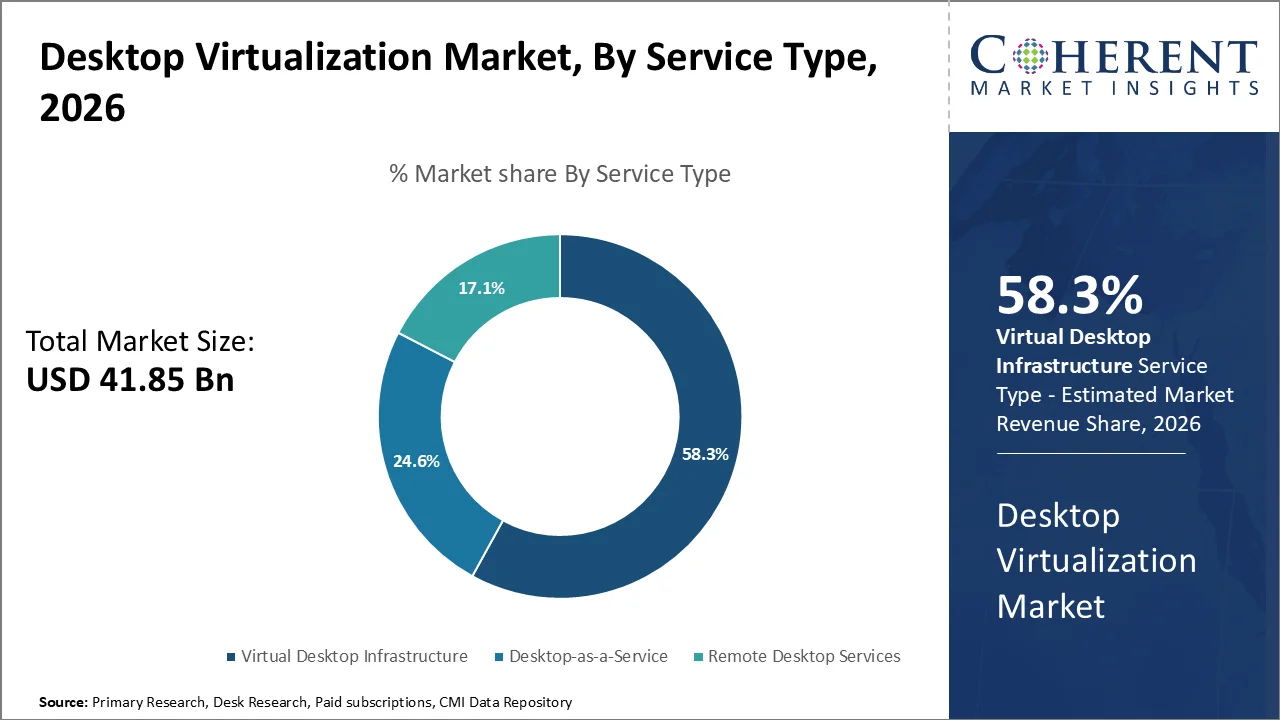
- Virtual desktop infrastructure segment is expected to account the largest share of 58.3% in 2026, VDI is widely adopted by large organizations because it provides centralized desktop management, strong security, better control over applications and data, and easy integration with existing IT infrastructure. According to a 2026 State of Cloud Computing Survey, 66% of IT leaders are actively looking at adopting a new Virtual Desktop Infrastructure (VDI) or Desktop-as-a-Service (DaaS) solution.
- Large enterprises segment will dominate with 64.4% in 2026, large companies require secure access for thousands of employees across multiple locations. They have higher IT budgets as well as greater need for centralized management, compliance, cost control, etc. On average, companies spend 5.7% of their revenue on IT. Depending on the industry, IT budgets usually range from 2% to 10% of revenue, and businesses spend about USD 9,000 to USD 14,000 per employee each year on IT.
- IT & Telecom segment will dominate with 22.2% in 2026, IT and telecom companies are early adopters because they need flexible, secure, and scalable IT infrastructure for remote employees, developers, and global teams. India’s IT industry is expected to grow to USD 350 Bn by 2026. It is also expected to contribute around 10% of India’s GDP, showing the important role of the IT sector in the country’s economy.
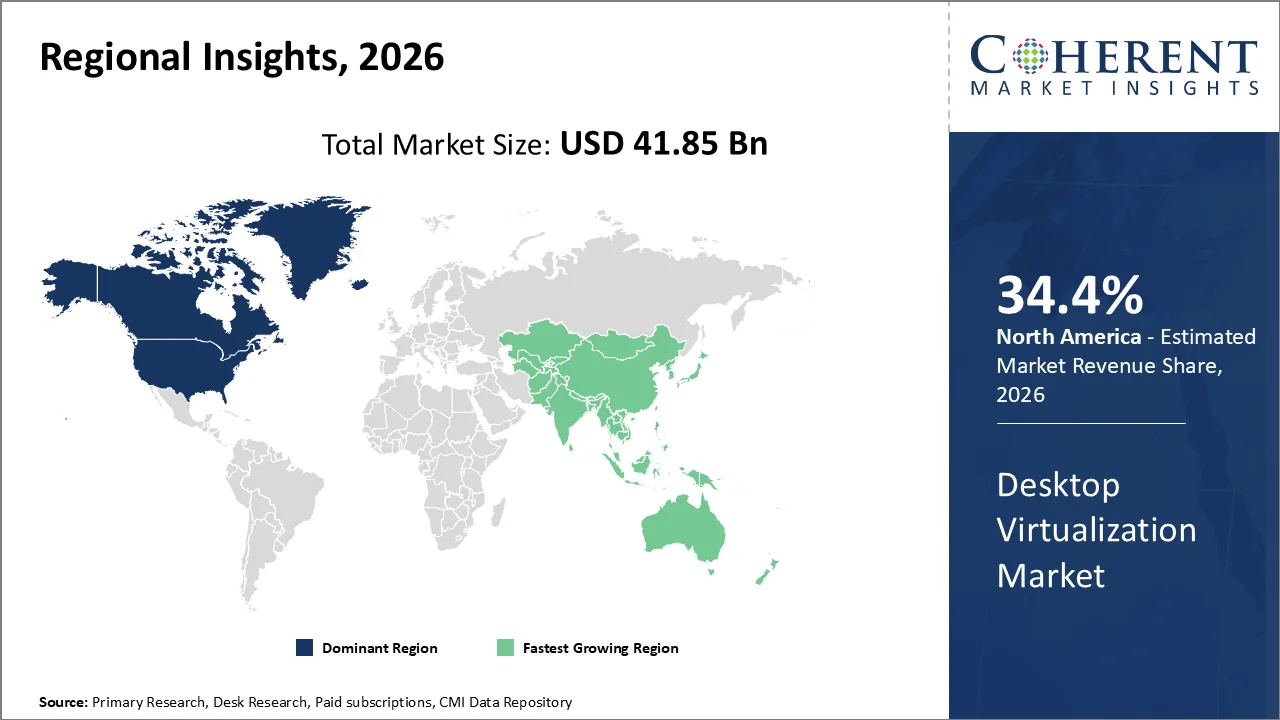
- North America is expected to acquire the dominant share of 34.4% in 2026, North America leads due to strong cloud adoption, advanced IT infrastructure, presence of major virtualization providers, and high demand for remote and hybrid work solutions. The U.S. private investment in artificial intelligence (AI) reached USD 285.9 Bn in 2025. The U.S. ranks 24th globally with a 28.3% share in AI adoption.
Segmental Insights
Why is Virtual Desktop Infrastructure Segment Acquiring the Largest Market Share?
Virtual desktop infrastructure is projected to account for the largest share of service type in 2026, representing approximately 58.3% of the total volume. Primarily because of its better control over desktop environments, security governance, as well as enterprise-grade performance. VDI works by hosting desktop environments on centralized servers within an organization's own data center, enabling IT administrators to push configurations, updates, as well as security patches across all virtualized endpoints simultaneously.
This centralized model has made VDI a go to option for highly regulated industries including healthcare, banking, financial services, insurance (BFSI), government authorities, etc., where data sovereignty, compliance mandates, as well as endpoint security are utmost.
In July 2026, GE HealthCare introduced MIM Anyware, a solution that enable healthcare professionals to access medical imaging tools remotely as well as collaborate in real time. It aid doctors as well as healthcare teams view and share imaging information from different locations.
A strong illustration of dominance of VDI in regulated sectors can be drawn from the United States Department of Defense (DoD) as well as its affiliated agencies, which have extensively deployed VDI architectures as part of their broader zero-trust security initiatives. The DoD's Zero Trust Reference Architecture explicitly endorses centralized virtual desktop environments to lower attack surfaces as well as maintain control over sensitive government data accessed across various endpoints.
- Current Industry Events of 2026
- Market Size Estimation
- Regional Breakdown
- Competitive Landscape
- Customer Intelligence
- Segmental Analysis
- Pricing Analysis
- Key Market Drivers, Challenges & Future Trends
- Customized Insights Section
Large Enterprises Segment holds the Largest Market Share
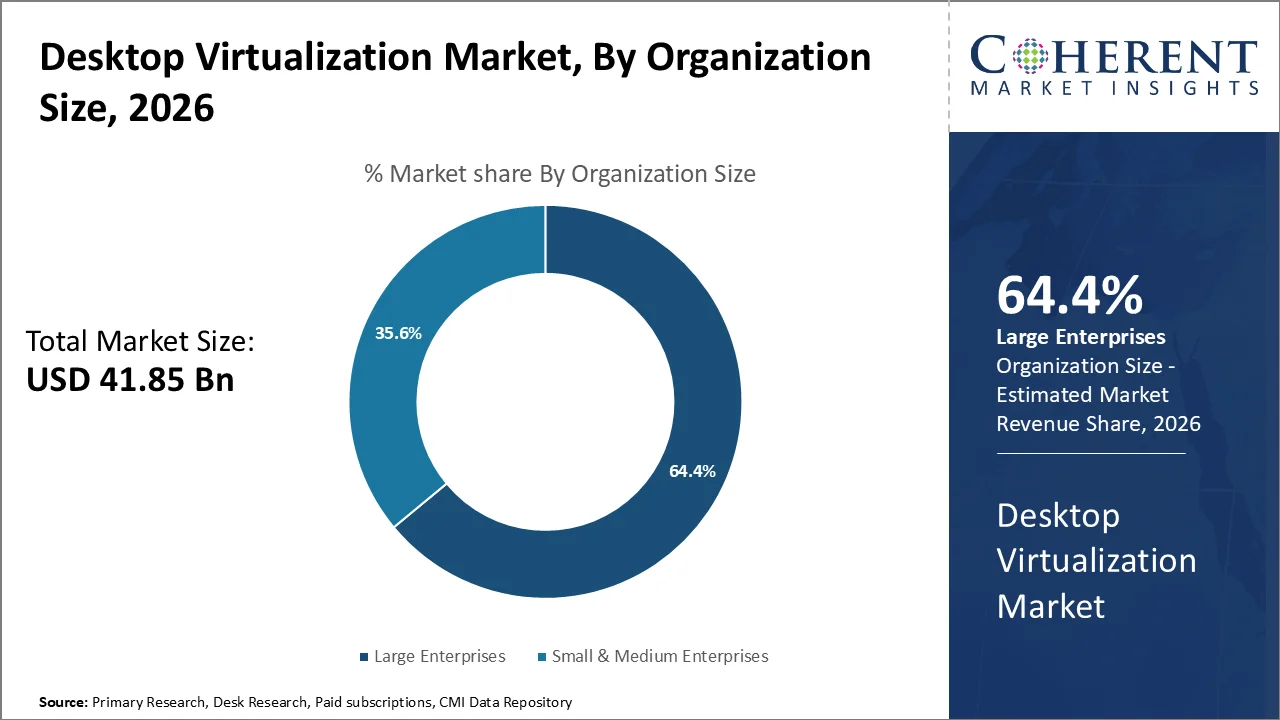
Based on organization size, large enterprises dominates the market, accounting for a significant 64.4% share in 2026. Their high IT budgets, complex infrastructure requirements, as well as the pressing need to manage thousands of distributed endpoints across geographically dispersed locations are the growth inducing factors.
Large enterprises have historically been the earliest adopters of virtualization technologies, given their inherent organizational complexity and the need to standardize desktop environments across global operations. Large global companies usually spend around 5% to 6% of their revenue on IT.
These organizations work with large-scale workforce deployments, usually spanning multiple continents, as well as require a unified, centrally managed computing environment to make sure easy business continuity, data security, and regulatory compliance.
Desktop virtualization, through solutions such as Virtual Desktop Infrastructure (VDI) and Desktop-as-a-Service (DaaS), enables these enterprises to provision, manage, and update thousands of virtual desktops simultaneously without the overhead of physical hardware replacements a capability that is indispensable at the enterprise scale.
IT & Telecom Segment holds the Largest Market Share
Based on verticals, IT & Telecom segment dominates the market, accounting for a significant 22.2% share in 2026. The inherent dependency on scalable, secure, as well as remotely accessible computing infrastructure are the factors propelling the growth. The nature of IT and telecom operations demands continuous uptime, easy collaboration across geographically dispersed teams, as well as robust data security all of which are core value propositions offered by desktop virtualization solutions.
IT organizations routinely manage thousands of endpoints, as well as virtualizing desktops allows IT administrators to centrally provision, patch, manage user environments, etc., without deploying physical hardware at each workstation. This dramatically lowers operational overhead while improving system reliability.
Telecom giants including AT&T, Deutsche Telekom, etc., have highly adopted virtual desktop infrastructure (VDI) to support their large distributed workforces, enabling employees to access centralized computing resources from any location or device. Furthermore, the high adoption of 5G infrastructure along with cloud-native service delivery models in the telecom sector has augmented the demand for virtualization technologies, as telecom companies highly host virtualized network functions (VNFs) as well as digital workspaces in tandem.
Market Drivers
Microsoft Remote Desktop Services (RDS): A major breakthrough in Desktop Virtualization
Microsoft Remote Desktop Services (RDS) is a cost-effective alternative to Virtual Desktop Infrastructure (VDI), especially for organizations that use Microsoft technologies. It uses Windows Server licensing to provide secure access to desktops and applications from different locations.
JPMorgan Chase used VMware Horizon VDI for more than 250,000 virtual desktops across trading floors and remote banking operations. This helped the company reduce endpoint hardware refresh costs by 40%, set up new trading desks in minutes instead of days, reduce patching time from weeks to hours, and support remote work with very little disruption.
Vanderbilt University Medical Center (VUMC) used Citrix Virtual Apps and Desktops to provide secure healthcare applications to doctors, nurses, and staff across multiple hospital locations. The solution improved application load times by 60%, allowed users to access their work from any workstation with a single login, and supported secure handling of patient information.
Current Events and Their Impact on the Desktop Virtualization Market
Current Event | Description and its Impact |
Government-led digital transformation with cloud-first initiatives (2025–2026) |
|
Expansion of cybersecurity regulations and Zero Trust security requirements (2025–2030) |
|
Desktop Virtualization Market Trends
- The post-pandemic workplace is re-shaping IT infrastructure. Enterprises are highly using desktop virtualization services to support geographically dispersed workforces without affecting security, compliance, or rather productivity.
- Cloud-hosted DaaS solutions are gaining prominence over traditional on-premises VDI deployments. Organizations particularly small and medium-sized enterprises (SMEs) are inclining toward DaaS models due to lower capital expenditure requirements, predictable subscription-based pricing, rapid scalability, as well as reduced IT management burden. Citrix DaaS Flex is a fully managed Desktop-as-a-Service solution that provides virtual desktops based on user needs. It is hosted on Citrix cloud infrastructure, enabling organizations to easily deliver, manage, as well as secure desktops without maintaining their own hardware.
- Artificial Intelligence (AI) as well as Machine Learning (ML) are being embedded into desktop virtualization platforms to enable predictive resource allocation, automated user experience optimization, intelligent threat detection, proactive system maintenance, etc.
- High cybersecurity threats have pushed organizations to adopt Zero Trust frameworks, wherein desktop virtualization plays a major role by making sure that sensitive data remains within centralized, controlled environments rather than on endpoint devices.
- Demand for GPU-accelerated virtual desktops is rising sharply in industries requiring high-performance computing, including media & entertainment, architecture, engineering, design, etc.
Regional Insights
North America dominates owing to its widespread enterprise adoption
North America account 34.4% market share in 2026, its deeply entrenched technological infrastructure, high enterprise adoption, as well as robust regulatory frameworks that actively encourage digital transformation initiatives across both public and private sectors. American companies spend an average of 7.5% of their revenue on digital initiatives, compared with the global average of 5.2%.
The United States federal government has been a major driver of desktop virtualization adoption, with the Office of Management and Budget (OMB) mandating cloud-first and virtualization-first policies under its Federal Cloud Computing Strategy, which has forced a number of government agencies to transition toward virtual desktop infrastructure (VDI) environments.
For example, the U.S. Department of Defense has highly deployed virtual desktop solutions across its civilian workforce to make sure secure, centralized data access while maintaining compliance with stringent cybersecurity protocols outlined by the Cybersecurity and Infrastructure Security Agency (CISA).
Asia Pacific Desktop Virtualization Market Trends
The Asia Pacific region is poised to be the fastest-growing region through 2026-2033, expanding at a CAGR of approximately 6.8%. An accelerating digital transformation agenda, expanding IT infrastructure investments, as well as government-led initiatives across economies including China, India, Japan, South Korea, Australia, etc., are the growth inducing factors.
The rapidly expanding workforce of the region, with a surging base of small as well as medium-sized enterprises embracing cloud-hosted virtual desktops as a cost-efficient option to traditional hardware-intensive IT setups, creates sustained momentum for adoption.
The National e-Governance Plan and the GovCloud initiative by Indian government has actively supported public sector institutions to adopt virtualized computing environments, augmenting measurable penetration at state as well as central government agencies.
For instance, the Union Budget 2026 allocated ₹15,000 crore for Digital Public Infrastructure (DPI) 2.0. This investment focuses to strengthen as well as expand India's digital infrastructure as well as improve digital public services across the country.
Japan's Society 5.0 framework, promoted by the Japanese Cabinet Office, shows the integration of advanced digital technologies including virtualized workspaces across manufacturing, healthcare, education sectors, etc. Digital Economy Strategy of Australia, backed by the Department of Industry, Science and Resources, has further accelerated enterprise investment in virtual desktop solutions, in financial services as well as healthcare organizations managing sensitive distributed workloads.
The Widespread Adoption of Cloud-First Strategies is Accelerating the Desktop Virtualization Market Demand in U.S.
The U.S. contributes the highest share in the desktop virtualization market in North America, the high adoption of cloud-first strategies across federal and private sectors, along with the unmatched concentration of Fortune 500 companies in the country are the factors propelling the market growth.
The U.S. federal government authority has been a major driver of desktop virtualization adoption, particularly through mandates and frameworks established by agencies such as the Cybersecurity and Infrastructure Security Agency (CISA) is further propelling the market.
According to the U.S. Office of Management and Budget (OMB), federal agencies have been consistently directed to modernize legacy IT systems, with virtual desktop deployments becoming a standard modernization pathway. The robust hyperscaler ecosystem of the country, including domestic headquarters of global cloud giants, further accelerates enterprise VDI adoption.
China Desktop Virtualization Market Trends
China contributes the highest share in the desktop virtualization market in Asia Pacific, due to its aggressive digital transformation agenda backed by robust government-driven technology policies as well as a sprawling enterprise ecosystem that increasingly demands centralized computing infrastructure.
China's "14th Five-Year Plan for Digital Economy Development," officially released by the State Council of the People's Republic of China, prioritizes cloud computing, virtualization technologies, as well as digital workplace modernization as basic pillars of national economic transformation. This policy framework has directly fueled enterprise adoption of virtual desktop infrastructure (VDI) across industries including manufacturing, banking, telecommunications, etc.
Furthermore, China's base of large-scale enterprises operating across geographically dispersed locations makes an inherent operational need for desktop virtualization solutions that enable centralized data governance, remote workforce management, as well as IT cost rationalization. The Cyberspace Administration of China's data localization and cybersecurity compliance mandates under the Personal Information Protection Law (PIPL) and Data Security Law have further compelled organizations to adopt virtualized desktop environments where sensitive data remains within controlled, server-side architectures rather than distributed across physical endpoints.
Who are the Major Companies in Desktop Virtualization Industry
Some of the major key players in desktop virtualization market include, Cisco Systems, Inc., Citrix Systems, Inc., Ericom Software, Inc., Evolve IP, Hewlett Packard Enterprise, Huawei Technologies Co., Ltd, Microsoft, Ncomputing, Oracle Corporation, Parallels International, Red Hat, and VMware, Inc.
Key News
- In May 2026, Nutanix announced that it is an Azure Virtual Desktop Hybrid launch partner. This allows organizations to run Azure Virtual Desktop on Nutanix AHV, giving them more flexibility to manage virtual desktops in hybrid cloud environments. This supports the Desktop Virtualization Market by making it simple for businesses to adopt cloud-based as well as hybrid virtual desktop solutions. It also aid organizations improve remote access, simplify desktop management, and increase flexibility.
- In July 2026, Arrow Electronics announced that it has earned the Microsoft Azure Virtual Desktop specialization, which is an official Microsoft recognition for partners with expertise in deploying and managing Azure Virtual Desktop solutions.
Market Report Scope
Desktop Virtualization Market Report Coverage
| Report Coverage | Details | ||
|---|---|---|---|
| Base Year: | 2025 | Market Size in 2026: | USD 41.85 Bn |
| Historical Data for: | 2020 To 2024 | Forecast Period: | 2026 To 2033 |
| Forecast Period 2026 to 2033 CAGR: | 19.5% | 2033 Value Projection: | USD 145.5 Bn |
| Geographies covered: |
| ||
| Segments covered: |
| ||
| Companies covered: | Cisco Systems, Inc., Citrix Systems, Inc., Ericom Software, Inc., Evolve IP, Hewlett Packard Enterprise, Huawei Technologies Co., Ltd, Microsoft, Ncomputing, Oracle Corporation, Parallels International, Red Hat, and VMware, Inc. | ||
| Growth Drivers: |
| ||
| Restraints & Challenges: |
| ||
Analyst Opinion
- The desktop virtualization market is experiencing remarkable momentum, driven by the widespread adoption of remote and hybrid work models that have fundamentally transformed enterprise IT infrastructure strategies. As of 2026, about 27% of full-time employees globally work completely remotely, while 52% work in a hybrid model, spending part of their time in the office as well as part working from home.
- Organizations across industries are highly recognizing the operational efficiency as well as cost advantages of centralizing desktop management through virtualization technologies.
- The escalating demand for secure, scalable, as well as flexible computing environments has positioned desktop virtualization as a critical component of modern enterprise digital transformation initiatives. 73% of organizations use a hybrid cloud, combining public as well as private cloud services. Among large organizations, 76% use hybrid cloud
- However, the market faces major restraints, including high initial implementation costs as well as the complexity of migrating legacy systems to virtualized environments, which can deter small and medium-sized enterprises from rapid adoption.
- From an opportunity standpoint, the proliferation of cloud-native virtualization solutions and the integration of artificial intelligence for intelligent resource management present significant growth avenues for market participants.
Speak to the analyst
Want personalized insights?
Take the findings above to one of our principal consultants, or have the report rebuilt around the segments, geographies and competitors you actually track.
Market Segmentation
- By Service Type (Revenue, USD Bn, 2021-2033)
- Virtual Desktop Infrastructure
- Desktop-as-a-Service
- Remote Desktop Services
- By Organization Size (Revenue, USD Bn, 2021-2033)
- Small & Medium Enterprises
- Large Enterprises
- By Verticals (Revenue, USD Bn, 2021-2033)
- IT & Telecom
- BFSI
- Education
- Healthcare
- Government
- Retail & Supply Chain Management
- Media & Entertainment
- Manufacturing & Automotive
- Others
- By Region (Revenue, USD Bn, 2021-2033)
- North America
- U.S.
- Canada
- Latin America
- Brazil
- Mexico
- Argentina
- Rest of Latin America
- Europe
- Germany
- U.K.
- France
- Italy
- Spain
- Russia
- Rest of Europe
- Asia Pacific
- China
- India
- Japan
- Australia
- South Korea
- ASEAN
- Rest of Asia Pacific
- Middle East
- GCC
- Israel
- Rest of Middle East
- Africa
- South Africa
- Central Africa
- North Africa
- North America
Sources
Primary Research Interviews
- IT Infrastructure Managers & CIOs
- Desktop Virtualization Solution Providers
- Cloud Service Providers & Managed Service Providers (MSPs)
- Enterprise End-Users & System Integrators
- Others
Databases
- IDC (International Data Corporation)
- Gartner Research Database
- Statista
- MarketsandMarkets Database
- Others
Magazines
- Computerworld
- InformationWeek
- PC Magazine
- CIO Magazine
- Others
Journals
- Journal of Cloud Computing
- IEEE Transactions on Cloud Computing
- International Journal of Information Management
- Others
Newspapers
- The Wall Street Journal
- Financial Times
- The Economic Times
- Reuters Technology News
- Others
Associations
- Cloud Native Computing Foundation (CNCF)
- CompTIA (Computing Technology Industry Association)
- Virtual Desktop Infrastructure Alliance (VDIA)
- International Association of Cloud & Managed Service Providers (IAMSP)
- Others
Public Domain Sources
- U.S. Bureau of Labor Statistics (BLS)
- European Union Agency for Cybersecurity (ENISA)
- National Institute of Standards and Technology (NIST)
- World Economic Forum (WEF) Digital Reports
- Others
Proprietary Elements
- CMI Data Analytics Tool
- Proprietary CMI Existing Repository of information for last 10 years
Get access to 250+ pages report
Every segment, forecast, competitor profile and data table behind the analysis above — available for instant download.
- ESOMAR Member
- ISO 9001:2015 Certified
- D-U-N-S Registered
- GDPR & CCPA Compliant
Missing comfort of reading report in your local language? Find your preferred language:
Transform your Strategy with Exclusive Trending Reports
Frequently Asked Questions
The desktop virtualization market is expected to reach USD 145.5 Bn in 2033.
Major players operating in the global desktop virtualization market include Cisco Systems, Inc., Citrix Systems, Inc., Ericom Software, Inc., Evolve IP, Hewlett Packard Enterprise, Huawei Technologies Co., Ltd, Microsoft, Ncomputing, Oracle Corporation, Parallels International, Red Hat, and VMware, Inc.
Concerns surrounding network latency, bandwidth dependency, and user experience quality are the major factors that is expected to hamper growth of the market over the forecast period.
The growing demand for secure, scalable, and flexible computing environments is driving growth of the global desktop virtualization market.
The desktop virtualization market is anticipated to grow at a CAGR of 19.5% between 2026 and 2033.
Among regions, North America is expected to account for a largest market share in the global desktop virtualization market over the forecast period.
A Virtual Desktop Infrastructure (VDI) hosts a complete computer desktop inside a central data center or the cloud. Instead of running on a local physical computer, the operating system and apps stream over the internet to a user's device, acting just like a remote screen.