

Mental Health Software Market Analysis & Forecast
Mental Health Software Market size is estimated to be valued at USD 15.99 Bn in 2026 and is expected to reach USD 48.85 Bn in 2033, exhibiting a compound annual growth rate (CAGR) of 17.3% from 2026 to 2033.
Key Takeaways
- By Application, the Hospitals and Clinics segment is forecast to hold the largest piece of the mental-health-software market outlook in 2026, grabbing an expected 39.0% share.
- By Region, North America is projected to dominate the global mental health software market with an estimated 29.2% share in 2026.
Market Overview
Mental health software bundles tools like electronic health records, online appointment booking, telehealth video rooms, clinical assessments, and billing dashboards into one place. By speeding up admin chores and giving clinicians more time with patients, these platforms help elevate the overall quality of mental health care. Added perks such as secure messaging, individualized care plans, and real-time progress tracking drive better results and push the field closer to everyday evidence-based practice.
Current Events and Its Impact on the Mental Health Software Market
Event | Description and Impact |
Regulatory Policy Shifts |
|
Armed Conflicts and Humanitarian Crises |
|
Investment and M&A Resurgence |
|
Pricing Analysis
The global mental-health-software market showcases a broad pricing landscape driven by who buys the service, how complex it is, and what features each platform bri ngs. Individual users often turn to subscription-based self-help apps like Headspace and Calm, priced between $12.99 and $14.99 a month; annual and family bundles shrink that bill.
Virtual-therapy services such as BetterHelp or Talkspace cost $240 to $400 monthly, with the final amount hinging on how many sessions and what format clients choose. Clinics and private practices lean toward management tools like SimplePractice, TherapyNotes, and TheraNest, which charge $39 to $149 each month depending on the number of clinicians and extras such as EHR, billing, or treatment notes.
Higher-end, clinical-grade platforms-such as Ginger or Mindstrong-work mostly on B2B or B2B2C contracts, billing health systems and insurers $50 to $100 for each member every month. Corporate-wellness offerings are quoted on a per-employee-per-month PEPM basis, with suppliers like Lyra Health and Spring Health starting around $4 and reaching $18, a range that shifts with workforce size and the breadth of services included.
Schools and universities face a similar tiered structure, often receiving bulk discounts and options to tailor student access. By moving to modular, scalable SaaS pricing, vendors create flexible packages for every user group and expand reach through freemium plans and high-customization enterprise deals.
- Current Industry Events of 2026
- Market Size Estimation
- Regional Breakdown
- Competitive Landscape
- Customer Intelligence
- Segmental Analysis
- Pricing Analysis
- Key Market Drivers, Challenges & Future Trends
- Customized Insights Section
Role of Artificial Intelligence (AI) and Advanced Technology
- AI integration is moving mental-health apps from rigid programs to smart, flexible tools that provide care in the moment, shaped to each user’s needs. Machine-learning models now sit at the core of many leading services, analyzing clicks, journals, and clinical records to flag risk, spot patterns, and route cases with automatic triage.
- Natural-language processing drives chat-based AIs that echo therapy talk, read emotional tone, and serve context-rich coping tips in plain conversation.
- Ginger, part of Headspace Health, uses its engine to match users with providers and forecast relapse by tracking shifts in app behavior. Woebot Health offers a round-the-clock chatbot built on CBT-logic, easing pressure on therapists while guiding mild and moderate cases.
- Ellipsis Health listens for tell-tale vocal signs- pitch, rhythm, word choice- and flags signs of anxiety or depression, giving doctors an extra early-warning tool. Wearables connected to these platforms feed in real-time data on heart rate, sleep, and movement, creating a fuller picture of daily mood and stress.
- Taken together, these advances are lifting outcomes and widening access, reaching people in rural areas or low-resource clinics who may never visit a practitioner in person.
Segmental Insights
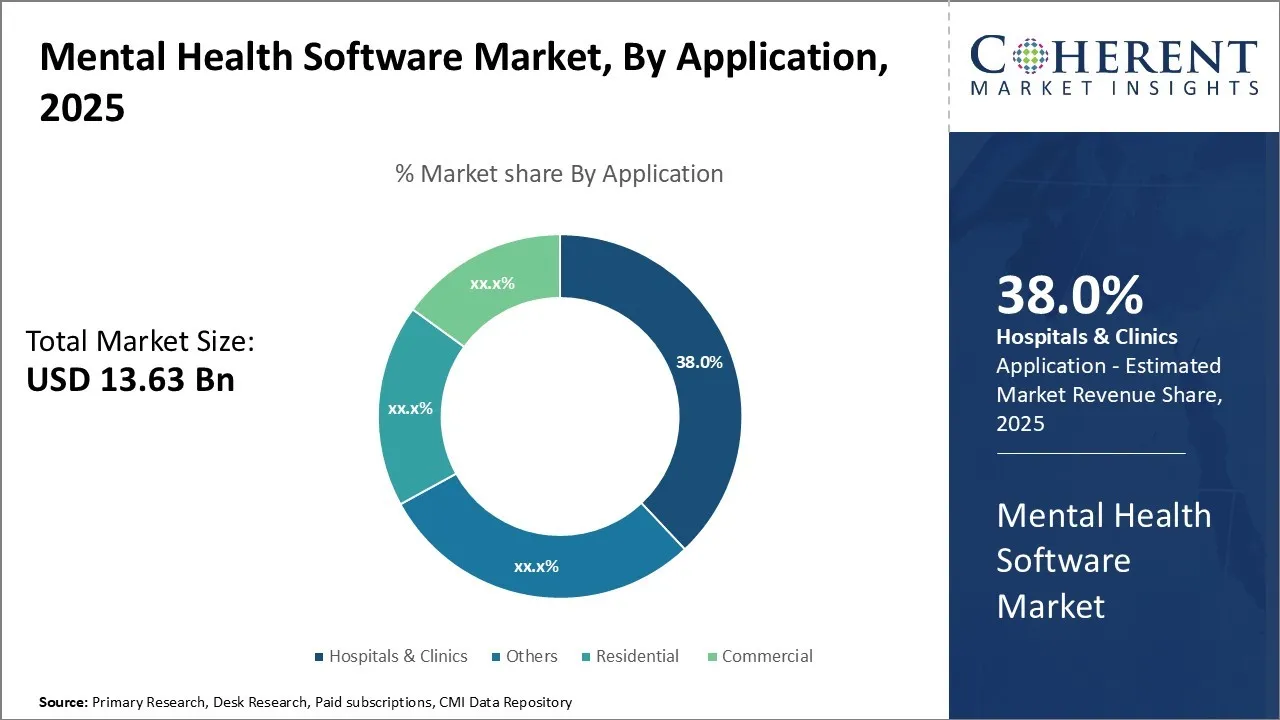
Mental Health Software Market Insights, By Application
In terms of application, the hospitals and clinics segment is expected to dominate the market with a projected 39.0% share in 2026. Clinics now push for all-in-one mental health software because they want seamless care, meet new rules, and handle the rising number of patients admitted for mental health issues. Private businesses and housing facilities follow closely, eager for tailor-made solutions that boost employee well-being or improve services in assisted-living centers. The catch-all group- made up of psychiatrists, therapists, social workers, nurse practitioners, and group facilitators-keeps growing too, as these professionals turn to digital tools for organizing notes, tracking cases, and running remote sessions.
Global Mental Health Software Market: Regional Insights
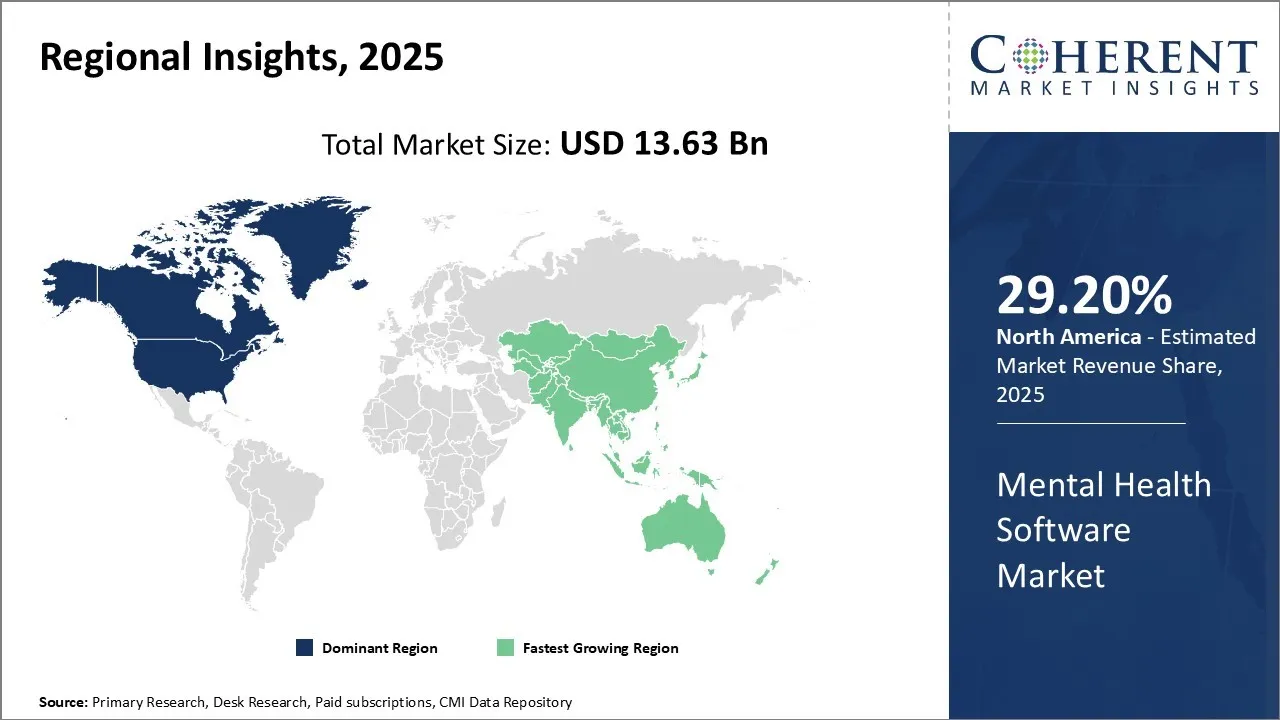
North America Mental Health Software Market Analysis and Trends
North America is projected to dominate the global mental health software market, accounting for approximately 29.20% of the market share in 2026. The region’s leadership is driven by rising demand for technologically advanced digital health platforms that provide high-quality care, streamlined functionality, and cost-effective solutions.
Increased mental health awareness, insurance coverage for behavioral therapies, and integration of telehealth services in clinical workflows further support market expansion. Key players in the region are incorporating innovations such as AI-based therapy support, mobile mental health apps, and cloud-based platforms to meet the growing needs of providers and patients.
Asia Pacific Mental Health Software Market Analysis and Trends
Asia Pacific is expected to be one of the fastest-growing regions during the forecast period, fueled by growing urbanization, increasing mental health awareness, and expanding access to mobile and telepsychiatry platforms. Emerging economies such as India and China are witnessing rapid digitization of healthcare services and adoption of mental health tools in both urban and rural settings. Public-private partnerships, mobile health (mHealth) initiatives, and a growing tech-savvy population are key factors accelerating software penetration across the region.
Dominating Countries in the Mental Health Software Market
United States Mental Health Software Market Analysis and Trends
The United States leads the North American market, backed by a mature digital health ecosystem, extensive insurance reimbursement policies, and wide adoption of EHR and telehealth services. The presence of major software providers and ongoing research in AI-based mental health applications further strengthen the country’s position as a global hub for innovation in this domain.
India Mental Health Software Market Analysis and Trends
India is emerging as a high-potential market in the Asia Pacific region, driven by increasing public discourse on mental wellness, digital health initiatives under the Ayushman Bharat program, and expanding internet penetration. Mental health apps, chatbot-based therapy, and government-backed screening tools are supporting early intervention and scalable service delivery across diverse population segments.
Market Report Scope
Mental Health Software Market Report Coverage
| Report Coverage | Details | ||
|---|---|---|---|
| Base Year: | 2025 | Market Size in 2026: | USD 15.99 Bn |
| Historical Data for: | 2020 To 2024 | Forecast Period: | 2026 To 2033 |
| Forecast Period 2026 to 2033 CAGR: | 17.3% | 2033 Value Projection: | USD 48.85 Bn |
| Geographies covered: |
| ||
| Segments covered: |
| ||
| Companies covered: | Major players operating in the global Mental Health Software market include Welligent Inc., Netsmart Technologies Inc., Cerner Corporation, Valant Medical Solutions Inc., Qualifacts Systems Inc., Nextgen Healthcare Information Systems LLC, MindLinc, Credible Behavioral Health Inc. (Credible), Core Solutions Inc., and Epic Systems Corporation | ||
| Growth Drivers: |
| ||
| Restraints & Challenges: |
| ||
Global Mental Health Software Market- Drivers
- Increasing Demand for Mental Health Services
There has been a growing awareness and recognition of mental health issues worldwide, leading to a higher demand for mental health services and treatments. This increased demand drives the adoption of mental health software solutions to efficiently manage and improve patient care.
- Technological Advancements
Advances in technology, such as telehealth and remote monitoring capabilities, have revolutionized mental health care delivery. Mental health software leverages these technologies to provide more accessible and convenient services, attracting both providers and patients.
Global Mental Health Software Market- Opportunities
- Employer-based Mental Health Support
As employers increasingly recognize the importance of mental health in the workplace, there is an opportunity for mental health software vendors to partner with businesses and organizations to provide employee mental health support and wellness programs.
- Integration with Wearable Devices
Integrating mental health software with wearable devices, such as fitness trackers or smartwatches, can provide real-time data on patients' physiological and emotional states, enabling more personalized and timely interventions.
Global Mental Health Software Market- Trends
- Personalized Treatment Plans
Mental health software was moving towards tailoring treatment plans based on individual patient needs, leveraging patient data and AI-driven algorithms to offer more personalized care.
- Integration with Electronic Health Records (EHR)
With increasing environmental concerns, there was a trend towards the development of more sustainable and energy-efficient Mental Health Software. Manufacturers were focusing on eco-friendly materials and designs to reduce emissions and minimize environmental impact.
Analyst Viewpoint
- The global mental health software market is gaining rapid traction as mental health becomes a central component of public and corporate healthcare agendas.
- Key growth drivers include rising mental health awareness, a global shortage of qualified mental health professionals, and growing employer investment in employee wellness programs.
- AI and machine learning are transforming the landscape by enabling predictive analytics, early diagnosis, and highly personalized therapy recommendations.
- Despite growth potential, challenges such as strict regulatory compliance, fragmented healthcare systems, and data privacy concerns are hindering faster adoption.
- North America continues to lead the market due to its mature digital health ecosystem and supportive reimbursement policies.
- The Asia-Pacific region is witnessing the fastest growth, driven by increasing smartphone usage, digital health initiatives, and mental health awareness among younger populations.
- Integration with wearable technology and IoT platforms opens new avenues for continuous monitoring and real-time intervention in mental wellness.
- Demand for culturally adaptable, multilingual software solutions is growing, especially in underserved regions with limited access to traditional mental health services.
- Corporate wellness platforms and digital-first therapy solutions represent untapped potential for market players seeking high-volume B2B adoption.
Global Mental Health Software Market: Key Developments
- In May 2025, Cerner Corporation launched an AI-powered mental health module within its EHR platform, aimed at streamlining clinical workflows and improving diagnostic accuracy across behavioral health practices.
- In April 2025, Talkspace integrated GPT-based virtual therapists into its mobile app, enhancing patient engagement and enabling automated cognitive behavioral therapy (CBT) at scale.
- In March 2025, Athenahealth acquired digital therapeutics startup MindEase to expand its mental health software portfolio with evidence-based CBT and mood tracking tools.
- In February 2025, Wysa received FDA Breakthrough Device designation for its AI-powered mental wellness chatbot, positioning it for wider clinical adoption in the U.S. market.
- In January 2025, TELUS Health introduced a digital mental health platform tailored for adolescents, addressing rising youth mental health concerns through gamified, mobile-first interventions.
Market Segmentation
- Global Mental Health Software Market, By Product (Revenue, USD Bn, 2021 - 2033)
- Pressure Reducing Mental Health Software
- Safety/Relief Mental Health Software
- Control Mental Health Software
- Globe Mental Health Software
- Plug Mental Health Software
- Gate Mental Health Software
- Ball Mental Health Software
- Butterfly Mental Health Software
- Diaphragm Mental Health Software
- Other Mental Health Software
- Global Mental Health Software Market, By Deployment mode (Revenue, USD Bn, 2021 - 2033)
- On-premise
- Subscription (Cloud-based)
- Global Mental Health Software Market, By Mode of Access (Revenue, USD Bn, 2021 - 2033)
- Desktops/Laptops
- Tablets/Smartphones
- Global Mental Health Software Market, By Function (Revenue, USD Bn, 2021 - 2033)
- Telehealth
- Payroll
- Revenue Cycle Management (RCM)
- Ledger
- Business Intelligence
- Electronic Health Record (HER)
- Clinical Decision Support.
- Global Mental Health Software Market, By Application (Revenue, USD Bn, 2021 - 2033)
- Commercial
- Residential
- Hospitals and Clinic
- Others (Psychiatrists, Social Workers, Psychologists, Counsellors, Nurse Practitioners, and Group Therapists)
- Global Mental Health Software Market, By Region (Revenue, USD Bn, 2021 - 2033)
- North America
- U.S.
- Canada
- Latin America
- Brazil
- Argentina
- Mexico
- Rest of Latin America
- Europe
- Germany
- U.K.
- Spain
- France
- Italy
- Russia
- Rest of Europe
- Asia Pacific
- China
- India
- Japan
- Australia
- South Korea
- ASEAN
- Rest of Asia Pacific
- Middle East
- GCC Countries
- Israel
- Rest of Middle East
- Africa
- South Africa
- North Africa
- Central Africa
- North America
- Company Profiles
- Welligent Inc.
- Netsmart Technologies Inc.
- Cerner Corporation
- Valant Medical Solutions Inc.
- Qualifacts Systems Inc.
- Nextgen Healthcare Information Systems LLC
- MindLinc
- Credible Behavioral Health Inc. (Credible)
- Core Solutions Inc.
- Epic Systems Corporation
Sources
Primary Research Interviews
- Healthcare IT Directors and CIOs
- Online Health Software Vendors and Solution Providers
- Healthcare Facility Administrators and Practice Managers
- Healthcare Technology Consultants
- Others
Databases
- Healthcare Information and Management Systems Society (HIMSS) Database
- Others
Magazines
- Healthcare IT News
- Modern Healthcare Technology
- Health Data Management Magazine
- Healthcare Informatics Magazine
- Others
Journals
- Journal of Medical Internet Research (JMIR)
- International Journal of Medical Informatics
- Health Information Management Journal
- Others
Newspapers
- Healthcare Finance News
- Becker's Health IT Review
- FierceHealthcare
- Healthcare Dive
- Others
Associations
- Healthcare Information and Management Systems Society (HIMSS)
- American Health Information Management Association (AHIMA)
- Healthcare Financial Management Association (HFMA)
- American Medical Informatics Association (AMIA)
- Others
Public Domain Sources
- U.S. Department of Health and Human Services (HHS)
- Centers for Medicare & Medicaid Services (CMS)
- Office of the National Coordinator for Health Information Technology (ONC)
- World Health Organization (WHO) Digital Health Reports
- Others
Proprietary Elements
- CMI Data Analytics Tool
- Proprietary CMI Existing Repository of information for last 8 years
*Definition: The Global Mental Health Software market refers to the worldwide market for software solutions designed to support mental health professionals, patients, and organizations in managing and improving mental health care. These software solutions typically include features such as electronic health records (EHR), telehealth capabilities, appointment scheduling, assessment tools, treatment planning, outcome monitoring, billing management, and secure communication. The market encompasses various software applications and platforms used by mental health practitioners, therapists, psychologists, psychiatrists, counselors, hospitals, clinics, and mental health organizations to enhance the delivery of mental health services.
Get access to 250+ pages report
Every segment, forecast, competitor profile and data table behind the analysis above — available for instant download.
- ESOMAR Member
- ISO 9001:2015 Certified
- D-U-N-S Registered
- GDPR & CCPA Compliant
Missing comfort of reading report in your local language? Find your preferred language:
Transform your Strategy with Exclusive Trending Reports
Frequently Asked Questions
The Mental Health Software Market size is estimated to be valued at USD 15.99 Bn in 2026, and is expected to reach USD 48.85 Bn by 2033.
Global Mental Health Software market is estimated to reach USD 48.85 Bn by 2033.
Some of the key players in the market are Welligent Inc., Netsmart Technologies Inc., Cerner Corporation, Valant Medical Solutions Inc., Qualifacts Systems Inc., Nextgen Healthcare Information Systems LLC, MindLinc, Credible Behavioral Health Inc. (Credible), Core Solutions Inc., and Epic Systems Corporation.
Among function type, the Hospitals and Clinic segment held the largest market share among the in 2026.
The CAGR of the Mental Health Software industry is projected to be 17.3% from 2026 to 2033.