

Software Defined Networking Market Analysis & Forecast 2026-2033
Software Defined Networking Market is estimated to be valued at USD 3,477.9 Mn in 2026 and is expected to reach USD 14,062.8 Mn in 2033, exhibiting a compound annual growth rate (CAGR) of 22.1% from 2026 to 2033.
Key Takeaways
- By End-Use, Cloud service providers are projected to dominate the Software Defined Networking (SDN) market, accounting for approximately 51.0% of the global market share in 2026.
- North America is expected to lead the global Software Defined Networking (SDN) market in 2026, capturing approximately 36.6% of the total revenue share.
Market Overview
The Software Defined Networking (SDN) Market is witnessing steady growth, fuelled by rising demand for agile, programmable network infrastructure and increasing cloud adoption. Cloud service providers dominate end-use with a 50.0% share, leveraging SDN for enhanced scalability and control. North America leads regionally with a 36.6% market share, driven by advanced IT ecosystems and early technology adoption. Expanding 5G deployments, virtualization trends, and growing need for efficient data centre management are accelerating global SDN market expansion and innovation.
Current Events and its Impact on the Software Defined Networking Market
Current Event | Description and its impact |
Technological Innovations and Product Launches |
|
Strategic Collaborations and Regional Expansions |
|
Policy Reforms and Regulatory Trends |
|
Role of Emerging Technologies in the Software Defined Networking (SDN) Market
Emerging technologies are significantly reshaping the Software Defined Networking (SDN) market by enhancing its capabilities, scalability, and efficiency. The integration of Artificial Intelligence (AI) and Machine Learning (ML) with SDN is enabling advanced automation, real-time traffic management, and predictive analytics, reducing manual interventions and optimizing network performance.
The widespread rollout of 5G and rapid adoption of Internet of Things (IoT) devices require agile, programmable networks an area where SDN excels. SDN supports dynamic resource allocation and seamless connectivity essential for handling high data volumes and low-latency applications.
Moreover, Edge Computing is boosting SDN’s relevance by decentralizing data processing while maintaining centralized control. The use of Block chain is also being explored to enhance network security and trust in SDN environments. Combined with Network Function Virtualization (NFV), these technologies are transforming traditional network architectures, driving cost efficiency, flexibility, and broader SDN adoption across sectors.
- Current Industry Events of 2026
- Market Size Estimation
- Regional Breakdown
- Competitive Landscape
- Customer Intelligence
- Segmental Analysis
- Pricing Analysis
- Key Market Drivers, Challenges & Future Trends
- Customized Insights Section
Pricing Analysis of the Software Defined Networking (SDN) Market
The pricing structure of the Software Defined Networking (SDN) market in telecom is influenced by several key factors, including deployment models, network complexity, vendor offerings, and the level of customization required. In the telecom sector, SDN solutions are typically offered under subscription-based or license-based models, with pricing varying significantly based on the scale of deployment from regional telecom operators to large-scale Tier-1 carriers.
Cloud-based SDN deployments are often more cost-effective initially due to reduced hardware and infrastructure requirements, while on premise implementations may involve higher capital expenditure but offer enhanced control and security critical for telecom service providers. Integration with advanced technologies such as AI, Network Functions Virtualization (NFV), and cyber security modules can increase solution costs but significantly boost network efficiency, automation, and performance.
Open-source SDN platforms are also gaining traction among telecom operators aiming to reduce costs, though they demand robust in-house expertise. As competition intensifies and adoption accelerates, especially within the telecom sector, pricing is expected to become increasingly competitive. Nonetheless, the total cost of ownership encompassing implementation, maintenance, training, and support remains a pivotal consideration for telecom enterprises investing in SDN technologies.
Software Defined Networking Market Trends
- Increasing need for mobility
Renewable energy resources have very little impact on the environment and are present in the rising use of mobile data has supported mobile network operators to upgrade their existing systems, and to manage to expand their consumer base and applications & devices. Customers use mobile phones for conducting financial transactions, which in turn, is driving the need for low-latency and high-speed switches.
Telecommunication service providers employ Operations Support Systems (OSS) to manage and support their business through provisioning services. However, re-architecting the entire network to accommodate OSS solutions is a cumbersome task. Companies such as Deutsche Telekom are aiming to establish an SDN model to simplify network operations while reducing costs. Thus, these factors are expected to drive the growth of the global software defined network (SDN) market during the forecast period.
In May 2025, TP‑Link India introduced its Omada Software‑Defined Networking (SDN) platform at Tech Sabha 2025 in Hyderabad. This initiative guides organizations toward simplified, centralized network management and highlights TP‑Link’s vision for modern enterprise connectivity using SDN frameworks.
- Growing cloud service
Many organizations have started storing, computing, and networking through cloud-based infrastructure. This is because cloud infrastructure is flexible, agile, and cost-efficient. A clear understanding of SDN technology is necessary to implement cloud computing services effectively within an organization.
SDN technology can address the concurrent needs for virtualization, mobility, agility, and management in modern network environments and tackle the reliable delivery of new services and applications in the cloud. Currently, the majority of enterprises have infrastructure-based solutions such as infrastructure-as-a-service (IAAS). Thus, these factors are expected to propel the global software defined networking (SDN) market growth over the forecast period.
In July 2025, ePLDT announced the deployment of SDN technology across its VITRO Data Centres in the Philippines. The company stated that SDN will streamline configuration, control, and management of enterprise networks, boosting flexibility, security, and resilience in disaster-prone environments.
Opportunities in the Software Defined Networking Market
- Rising acceptance of BOYD culture can present lucrative growth opportunities
Bring your own device (BOYD) is a policy allowing employees to bring their devices to their workplace and use both devices to access company information and application. BOYD is an emerging trend in the SDN market that poses major opportunities. Many enterprises do not allow employees to bring their devices to the workplace due to the risk of the company’s confidential data and information leakage.
However, with the security benefits of SDN technology, they are allowing BYOD policy in their organization. It is estimated that in coming years, the majority of the IT organization will allow BYOD policy to their employees as they would find it more familiar to use and thus, may become more productive.
Segmental Insights
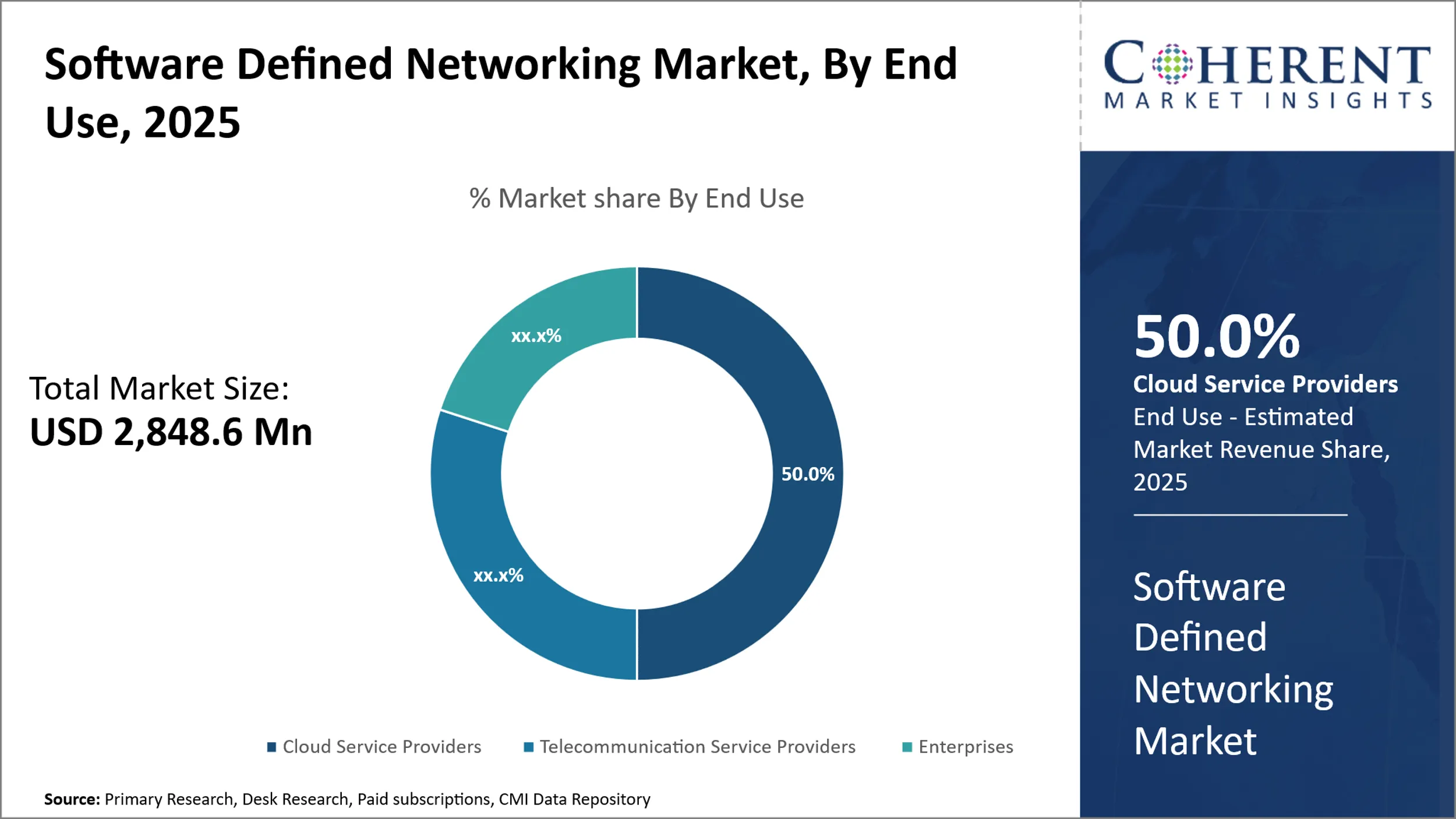
Global Software Defined Networking Market Insights, By End-Use
Cloud service providers are projected to dominate the global Software Defined Networking (SDN) market in 2026, capturing approximately 51% of the total market share. This dominant position is attributed to their rising need for scalable, programmable, and cost-efficient network infrastructure to manage explosive growth in data traffic and support diverse digital services.
SDN empowers cloud providers with dynamic traffic management, automated network provisioning, and real-time scalability key features critical for the success of data-driven operations. As hyper scale data centres and distributed edge computing infrastructure continue to expand, SDN is becoming an essential technology for optimizing network resources, enhancing service agility, and ensuring high availability.
The growing complexity of cloud environments, including multi-cloud and hybrid cloud architectures, further amplifies the demand for SDN-enabled control and visibility. SDN's ability to simplify network orchestration, reduce operational costs, and enhance security posture makes it an ideal solution for large-scale cloud operations.
In light of these factors, cloud service providers are expected to retain their leadership position in the SDN market, playing a pivotal role in driving innovation, adoption, and transformation across the global networking ecosystem.
Software Defined Networking Market: Regional Insight s
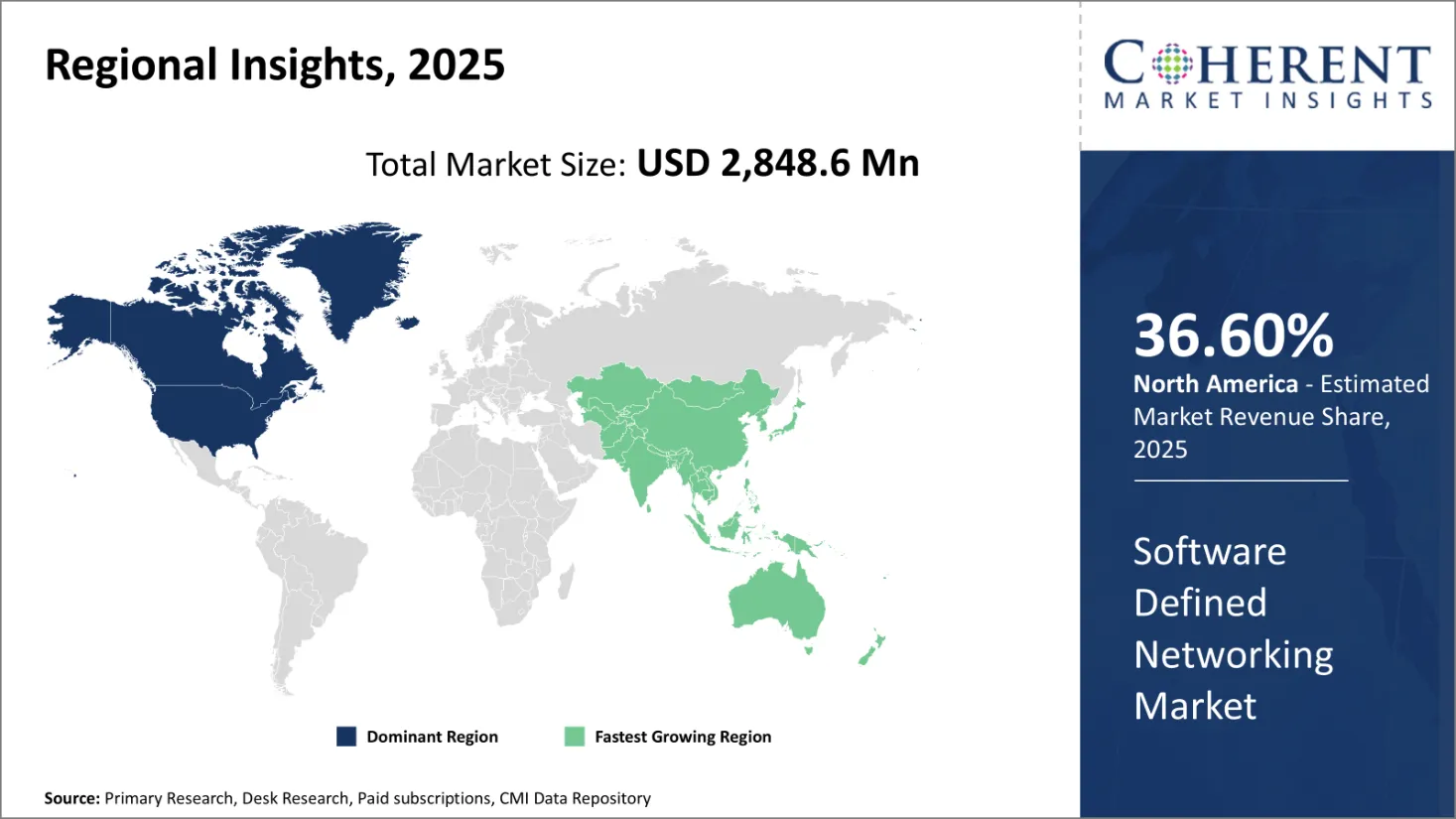
North America Software Defined Networking Market Trends and Analysis
North America is expected to lead the global Software Defined Networking (SDN) market in 2026, capturing approximately 36.60% of the total revenue share. This regional dominance is fuelled by early adoption of advanced networking technologies, a well-established base of cloud service providers, and strong investments in 5G, data centre expansion, and digital transformation initiatives across industries.
The presence of leading technology firms, including major SDN solution providers and cloud infrastructure companies, continues to drive innovation in areas such as network automation, virtualization, and cyber security. These advancements are enabling enterprises to modernize their IT environments and improve operational efficiency.
Additionally, North America's favourable regulatory environment and supportive government policies are accelerating the deployment of SDN technologies in key sectors like healthcare, banking and finance (BFSI), and education. Programs promoting open standards, digital infrastructure upgrades, and public-private partnerships further reinforce the region’s leadership in software-defined networking.
With a mature IT ecosystem, continuous R&D investment, and growing demand for programmable network solutions, North America is poised to maintain its position as the frontrunner in the global SDN market through 2026 and beyond.
Software Defined Networking Market Dominating Countries
United States
The United States is the leading country in the global Software Defined Networking (SDN) market, significantly contributing to North America's projected 36.6% revenue share in 2026. The country’s dominance is driven by its mature IT infrastructure, early adoption of cloud and virtualization technologies, and strong presence of major SDN solution providers such as Cisco, Juniper Networks, and VMware.
With substantial investments in 5G deployment, data centre modernization, and AI-driven networking, the U.S. continues to push the boundaries of software-defined innovation. Federal initiatives promoting digital transformation in healthcare, defence, and public sectors further stimulate SDN demand. The emphasis on cyber security, open standards, and interoperability also positions the U.S. at the forefront of the global SDN landscape.
Canada
Canada plays a critical role in the North American SDN ecosystem, supported by a strong digital infrastructure and progressive regulatory frameworks. The country’s focus on cloud migration, smart city development, and broadband connectivity is driving the adoption of SDN across public and private networks. In particular, the Software Defined Networking Market for enterprises is witnessing strong momentum in Canada, as organizations seek greater agility, scalability, and cost efficiency in their network operations.
Market Report Scope
Software Defined Networking Market Report Coverage
| Report Coverage | Details | ||
|---|---|---|---|
| Base Year: | 2025 | Market Size in 2026: | USD 3,477.9 Mn |
| Historical Data for: | 2020 To 2024 | Forecast Period: | 2026 To 2033 |
| Forecast Period 2026 to 2033 CAGR: | 22.1% | 2033 Value Projection: | USD 14,062.8 Mn |
| Geographies covered: |
| ||
| Segments covered: |
| ||
| Companies covered: | Alcatel-Lucent, Huawei Technologies, Cisco Systems, Inc., Juniper Networks, NEC Corporation, IBM Corporation, Google Inc., VMware, and Hewlett Packard Company. | ||
| Growth Drivers: |
| ||
| Restraints & Challenges: |
| ||
Analyst Viewpoint – Software Defined Networking Market
- The global Software Defined Networking (SDN) market is positioned for sustained expansion, fuelled by the rising demand for agile, scalable, and cost-efficient network solutions across industries. Analysts recognize North America as the leading region, backed by a mature IT infrastructure, strong presence of cloud service providers, and significant investments in 5G, data centres, and enterprise digitization.
- Experts emphasize the increasing convergence of SDN with emerging technologies such as AI, edge computing, and IoT, enabling intelligent network automation, real-time optimization, and improved security. As businesses transition to multi-cloud and hybrid environments, the need for programmable and centrally managed networks continues to drive SDN adoption across sectors including BFSI, healthcare, and telecom.
- While challenges such as high initial deployment costs, interoperability concerns, and security vulnerabilities persist, the overall market outlook remains positive. Ongoing R&D, open-source collaborations, and vendor-neutral architecture initiatives are expected to foster innovation, accelerate deployment, and enhance the long-term value proposition of SDN solutions globally.
Software Defined Networking Market: Key Development
- In July 2025, Hewlett Packard Enterprise completed its acquisition of Juniper Networks following regulatory approval, integrating Juniper’s SDN and Mist AI capabilities into HPE’s networking portfolio. Strengthens HPE’s competitive edge in AI-driven networking, expands its product ecosystem, and intensifies market rivalry in programmable network solutions.
- In June 2025, Verizon Business launched its Edge Transportation Exchange a 5G multi-access edge computing (MEC) platform leveraging SDN to enable real-time V2X applications for connected vehicles and smart infrastructure. Demonstrates SDN’s critical role in ultra-low latency edge architectures. Enhances safety, traffic intelligence, and scalability for emerging edge use cases in transportation.
- In February 2025, Cisco integrated its Silicon One technology with NVIDIA’s Spectrum‑X Ethernet networking platform, enabling deployment of Cisco chips and NVIDIA SuperNICs in unified data‑centre switches. Enhances SDN-enabled AI infrastructure scalability, reduces latency, and promotes high-performance network automation for hyper scale cloud and enterprise applications.
- In April 2024, VMware announced the return of the VeloCloud brand for its SD‑WAN, SASE, and SD‑Access solutions, and launched the Edge 710 appliance integrating SD‑WAN, firewall, router, switch, and Wi‑Fi 6 into a compact unit optimized for branch and remote deployments. The branding refresh and new appliance enhanced the scalability, security, and manageability of SDN infrastructure, especially for small and mid-sized enterprise edge locations .
- In April 2024, Tribune Media successfully migrated over 140 applications onto a VMware NSX-powered SDN framework. Utilizing VMware’s network hypervisor, the deployment distributed virtualized switches, routers, and firewalls across its platform to dynamically manage traffic, enhance security, and improve reliability at scale. Demonstrated enterprise-grade SDN utility for large media operations boosting operational agility, reducing complexity, and enabling secure, scalable application delivery across the network infrastructure.
Market Segmentation
- Global Software Defined Networking Market, By End use (Revenue, USD Mn, 2021 - 2033)
- Enterprises
- Cloud Service Providers
- Telecommunications Service Providers
- Global Software Defined Networking Market, By Solutions (Revenue, USD Mn, 2021 - 2033)
- SDN Switching
- SDN Controllers
- Cloud Provisioning and Orchestration
- Others (Security and Services)
- Global Software Defined Networking Market, By Region (Revenue, USD Mn, 2021 - 2033)
- North America
- U.S.
- Canada
- Latin America
- Brazil
- Argentina
- Mexico
- Rest of Latin America
- Europe
- Germany
- U.K.
- Spain
- France
- Italy
- Russia
- Rest of Europe
- Asia Pacific
- China
- India
- Japan
- Australia
- South Korea
- ASEAN
- Rest of Asia Pacific
- Middle East
- GCC Countries
- Israel
- Rest of Middle East
- Africa
- South Africa
- North Africa
- Central Africa
- North America
- Key Players Insights
- Alcatel-Lucent
- Huawei Technologies
- Cisco Systems, Inc.
- Juniper Networks
- NEC Corporation
- IBM Corporation
- Google Inc.
- VMware
- Hewlett Packard Company
Sources
The Stakeholders Consulted
- Network architects and enterprise IT administrators
- Software-defined networking (SDN) platform vendors and service providers
- Data center operators and cloud infrastructure managers
- Telecom engineers and 5G network designers
- Regulatory and standards bodies in telecom and data infrastructure
- Cybersecurity specialists and SDN solution integrators
- End-users across sectors such as BFSI, healthcare, retail, manufacturing, and education
Databases Opened
- U.S. Federal Communications Commission (FCC) – Network Infrastructure Data
- International Telecommunication Union (ITU) – ICT Statistics
- Ministry of Electronics and Information Technology (India) – Digital Infrastructure Reports
- World Bank Open Data – ICT & Digital Economy Metrics
Magazines & Trade Publications
- Network World
- SDxCentral
- Light Reading
- Telecom Review
- Data Center Dynamics
- Cloud Computing Magazine
Scientific and Industry Journals
- IEEE Communications Magazine
- Journal of Network and Computer Applications
- International Journal of Network Management
- Computer Networks (Elsevier)
- Future Generation Computer Systems
Newspapers & Media Outlets
- Bloomberg – Technology and Telecom
- The Wall Street Journal – Enterprise Tech
- Reuters – Cloud and Telecom News
- The Economic Times – Tech & Startups Section
- Business Standard – ICT & Digital Economy
Associations and Regulatory Bodies
- Open Networking Foundation (ONF)
- Internet Engineering Task Force (IETF)
- IEEE Standards Association (IEEE-SA)
- Telecom Regulatory Authority of India (TRAI)
- National Institute of Standards and Technology (NIST)
Public Domain Sources
- U.S. Department of Commerce – National Telecommunications and Information Administration (NTIA)
- European Commission – Digital Strategy & SDN Reports
- World Bank – Digital Infrastructure & Broadband Reports
- International Telecommunication Union (ITU) – SDN and 5G Readiness Reports
- OECD – Broadband and Network Investment Insights
Proprietary Research Elements
- CMI Data Analytics Tool
- Proprietary CMI Repository of Market Data (covering past 8 years)
- CMI Expert Interviews and Transcripts (focused on SDN deployment, adoption barriers, and sector-specific trends)
Get access to 250+ pages report
Every segment, forecast, competitor profile and data table behind the analysis above — available for instant download.
- ESOMAR Member
- ISO 9001:2015 Certified
- D-U-N-S Registered
- GDPR & CCPA Compliant
Missing comfort of reading report in your local language? Find your preferred language:
Transform your Strategy with Exclusive Trending Reports
Frequently Asked Questions
The Software Defined Networking Market size is estimated to be valued at USD 3,477.9 Mn in 2026, and is expected to reach USD 14,062.8 Mn by 2033.
The CAGR of the global Market is projected to be 22.1% from 2026 to 2033.
Rising need for efficient network infrastructure is attributed to the demand in market.
The market is driven by key players such as Alcatel-Lucent, Huawei Technologies, Cisco Systems, Inc., Juniper Networks, NEC Corporation, IBM Corporation, Google Inc., VMware, and Hewlett Packard Company.
Software Defined Networking (SDN) is reshaping telecom infrastructure by enabling centralized control, dynamic resource allocation, and faster service deployment.
SDN separates network control from hardware, while virtualization abstracts physical resources to create multiple virtual instances.