

Mobile Runtime Application Self-Protection Market Size and Share Analysis: (2026 - 2033)
Mobile Runtime Application Self-Protection Market is set to experience a 41.4% CAGR and capture a market size of USD 1,733.8 Mn in 2026, while by 2033 it is forecasted to capture USD 19,519.6 Mn. The growth in the market can be attributed to various factors such as mobile cyber security threats, growing use of mobile banking/digital payment apps, demand for real-time application security, and growing usage of cloud-enabled mobile applications.
Key Takeaways from the Mobile Runtime Application Self-Protection Market Report
- Cloud-Based segment is projected to hold the maximum market share of 63.4% by 2026 owing to the rising popularity of cloud-native applications on mobile platforms, scalability benefits, and the rising demand for remote threat detection capabilities. According to IBM Security, there has been a significant rise in attacks on cloud applications and mobile-specific cyber-attacks.
- Large Organization segment is expected to hold a 68.7% market share in 2026 due to high cybersecurity budgets, vast mobile application platforms, and compliance with regulatory guidelines. As per Cybersecurity Ventures, the annual cost of cybercrime across the globe is expected to be USD 10.5 trillion; therefore, large enterprises have started making significant investments in mobile application security.
- Banking, Financial Services, and Insurance (BFSI) segment is expected to account for a major market share of about 27.9% by 2026 due to increased usage of mobile banking, growing digital payments, and financial data breaches. There has been an increase in digital banking users globally, leading to an increasing demand for mobile runtime application self-protection tools in financial organizations.
- North America will be the dominant regional market with a forecast market share of 38.6% in 2026, driven by the prevalence of cybersecurity service providers in the region, growing trends in mobile banking, and investments in the security of enterprise mobile applications. According to CISA, cyber threats in mobile and cloud computing are increasing for both enterprises and governments, driving the demand for advanced runtime application self-protection systems.
Rising Mobile Cyberattacks and Application Vulnerabilities are Accelerating Growth in the Mobile Runtime Application Self-Protection Market
The rising number of mobile attacks is a major reason that has increased the demand for Mobile Runtime Application Self-Protection (RASP) among companies around the world. With many companies adopting mobile applications in fields such as banking, healthcare, retail, and corporate activities, the opportunity for cyber criminals to target their applications has increased.
According to Verizon Data Breach Investigations Report, application-layer attacks and credential theft incidents continue to rise globally, increasing enterprise investments in runtime application security solutions.
Current Events and Their Impact on the Mobile Runtime Application Self-Protection Market
Current Event | Description and its Impact |
Expansion of Global Data Privacy and Cybersecurity Regulations |
|
Rapid Adoption of AI-Driven Mobile Security Technologies |
|
- Current Industry Events of 2026
- Market Size Estimation
- Regional Breakdown
- Competitive Landscape
- Customer Intelligence
- Segmental Analysis
- Pricing Analysis
- Key Market Drivers, Challenges & Future Trends
- Customized Insights Section
Segmental Insights
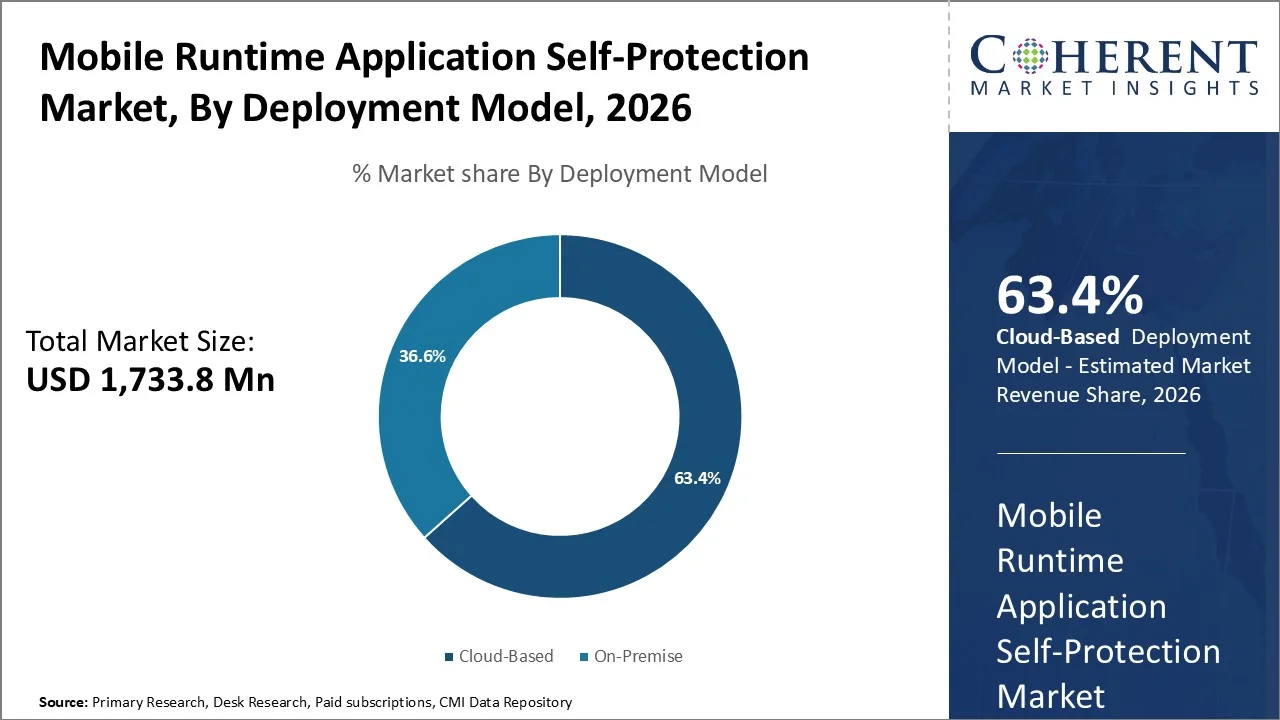
Why is the Cloud-Based Segment Acquiring the Largest Market Share?
The cloud-based deployment segment is expected to account for approximately 63.4% of the global market in 2026. The reason behind such high market share can be attributed to the increasing number of cloud-based mobile applications as well as the rising digitalization efforts by companies. Companies are opting for cloud-based mobile applications due to better operational flexibility and cost savings.
In November 2025, Protectt.ai announced the launch of the latest version of its AppProtectt platform, a cloud-enabled mobile application security solution featuring advanced Runtime Application Self-Protection (RASP) and AI-led behavior monitoring capabilities.
Which Organization Size Segment Dominates the Market?
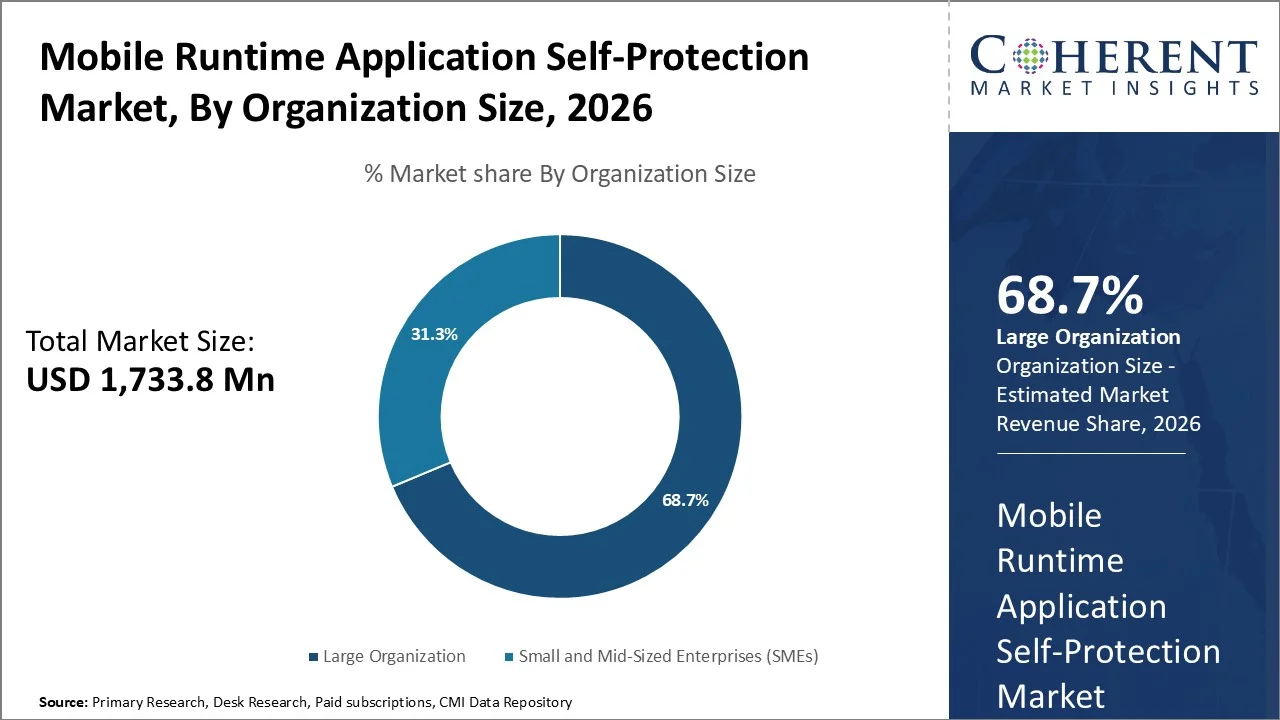
Large Organizations hold the maximum market share of nearly 68.7% in 2026 because they have invested heavily in cybersecurity, have large mobile application environments, and are required to comply with various regulations. Large companies have large amounts of customer data that can be accessed using mobile devices, making them susceptible to sophisticated cyber-attacks such as malware attacks, credential fraud, reverse engineering, and application attacks.
In April 2026, NowSecure introduced Mobile App Risk Intelligence (MARI), a new enterprise-focused platform designed to help large organizations identify hidden AI components, third-party code risks, and sensitive data flows within mobile applications.
Why is BFSI Emerging as the Leading Industry Vertical?
The Banking, Financial Services, and Insurance (BFSI) segment is expected to witness significant growth in market share of nearly 27.9% during 2026, owing to the increased use of mobile banking, an increase in digital payments, and increasing threats of financial data breaches. Mobile banking applications have now been developed by banks and other financial organizations for payments, money transfer, customer engagement, and digital banking services.
The increasing complexity of malware, phishing and banking trojan attacks on mobile devices has resulted in an increased need for Mobile RASP technologies that can detect runtime threats, protect against application modifications, and safeguard confidential customer data.
In December 2025, Perfios launched its AI-powered real-time operating system for BFSI institutions, enabling stronger governance, fraud detection, and secure digital financial operations.
Mobile Runtime Application Self-Protection Market Trends
- The adoption of AI-enabled runtime security tools is increasing because of their ability to provide real-time detection and response features. In March 2026, Sysdig, announced runtime security for AI coding agents. The solution helps organizations securely adopt autonomous development tools by providing real-time visibility into the behavior of coding assistants such as Claude Code, Codex, and Gemini, enabling teams to monitor agent activity and detect potential risks across cloud and development environments.
- Cloud-based and hybrid mobile applications have created a need for cloud-based runtime security platforms.
- Increased mobile malware and phishing incidents are driving the use of runtime application self-protection. This is supported by Kaspersky, which shows that mobile cybersecurity incidents are increasing worldwide.
- Strict cybersecurity policies and stringent data privacy guidelines are making organizations invest more in mobile application security systems. According to World Economic Forum, cyber incidents are one of the major business risks in the world.
Regional Insights
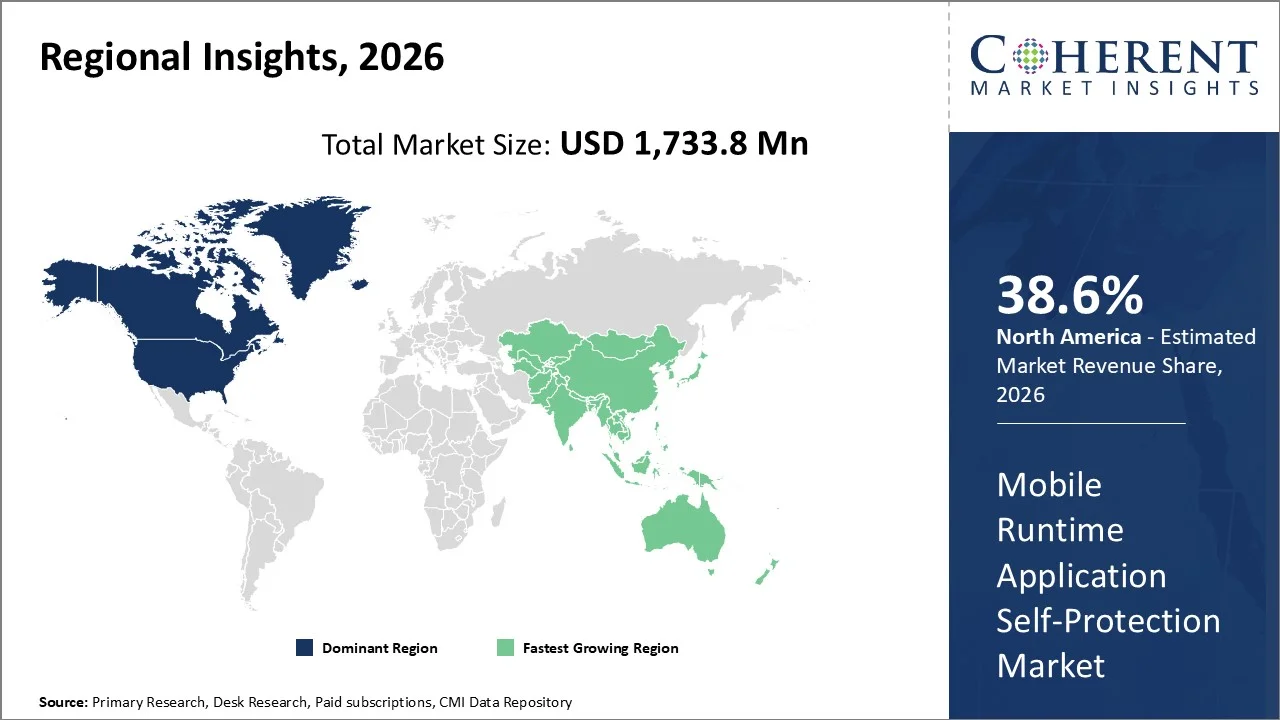
North America Dominates Owing to Strong Cybersecurity Infrastructure and Mobile Banking Adoption
North America is forecasted to represent a 38.6% share of the global Mobile Runtime Application Self-Protection Market in 2026, attributed to the presence of major cybersecurity players, high enterprise spending on mobile application security, and quick adoption of digital banking solutions. The North American region will continue to face increased cyber attacks on enterprise mobile applications, thereby compelling companies to adopt runtime application protection solutions.
Technological innovation also continues to support regional market growth. In October 2025, Palo Alto Networks launched upgraded AI-driven cloud and runtime security platforms including Prisma AIRS 2.0 and Cortex Cloud 2.0 to strengthen enterprise application protection capabilities.
Asia Pacific Mobile Runtime Application Self-Protection Market Trends
Asia Pacific is predicted to experience the highest growth rate during the forecast period 2026-2033 because of its fast-paced digitalization process, rising smartphone usage, and mobile banking ecosystems in countries like China, India, Japan, and Southeast Asia. There is an increased uptake of fintech solutions, digital wallets, and cloud-based mobile apps that boost the need for secure runtime application systems.
According to GSMA, Asia Pacific continues to account for one of the world’s largest smartphone user bases, creating substantial opportunities for mobile application security providers. Additionally, increasing cyberattacks targeting financial applications and rising government focus on cybersecurity regulations are encouraging enterprises to strengthen mobile runtime protection capabilities.
Rising Mobile Banking and Enterprise Cybersecurity Investments are Accelerating the Mobile Runtime Application Self-Protection Market Demand in United States
The United States Mobile Runtime Application Self-Protection Market is experiencing impressive growth owing to the rise in the use of mobile banking services, cyber-attacks against enterprise software applications, and capital investment towards building next-gen cybersecurity frameworks on the cloud platform. There has been a significant growth in the ecosystem of digital payments and enterprise mobility, thus boosting the requirement for application security.
In February 2025, Qualys introduced TotalAppSec, a cloud-based AI-powered application risk management solution aimed at improving enterprise runtime security and API protection.
Japan Mobile Runtime Application Self-Protection Market Trends
The Japan Mobile Runtime Application Self-Protection Market is anticipated to exhibit significant growth over the forecast period, driven by higher penetration of digital banking, widespread use of smartphones, and increased emphasis among enterprises on updating their cyber security systems. The robust digital economy of Japan, higher use of mobile financial applications, and initiatives of the government towards cyber security infrastructure development are key factors driving demand.
In August 2025, Rakuten Mobile announced the launch of “SAIKYO Protection”, an advanced smartphone security service integrating Norton Mobile Security, malware defense, dark web monitoring, and cyber risk protection.
Who are the Major Companies in Mobile Runtime Application Self-Protection Industry
Some of the major key players in Mobile Runtime Application Self-Protection are Pradeo, Micro Focus, Vasco Data Security International Inc. (OneSpan Inc.), CA Veracode, IMMUNIO, Arxan, Signal Science, Promon, Prevoty, Inc., and Waratek.
Key News
- In October 2025, OpenText (Micro Focus) announced new AI-powered cybersecurity capabilities under its OpenText Cybersecurity Cloud portfolio to strengthen application security, threat detection, and DevSecOps automation.
- In January 2026, Veracode announced new platform enhancements focused on software supply chain security and preventive application protection.
Market Report Scope
Mobile Runtime Application Self-Protection Market Report Coverage
| Report Coverage | Details | ||
|---|---|---|---|
| Base Year: | 2025 | Market Size in 2026: | USD 1,733.8 Mn |
| Historical Data for: | 2020 To 2024 | Forecast Period: | 2026 To 2033 |
| Forecast Period 2026 to 2033 CAGR: | 41.4% | 2033 Value Projection: | USD 19,519.6 Mn |
| Geographies covered: |
| ||
| Segments covered: |
| ||
| Companies covered: | Pradeo, Micro Focus, Vasco Data Security International Inc. (OneSpan Inc.), CA Veracode, IMMUNIO, Arxan, Signal Science, Promon, Prevoty, Inc., and Waratek. | ||
| Growth Drivers: |
| ||
| Restraints & Challenges: |
| ||
Analyst Opinion
- Protection for Mobile Runtime Application is becoming necessary due to sensitive information that is handled by mobile applications in industries such as finance, healthcare, and businesses. Cyber-attacks on mobile applications are encouraging the use of real-time application runtime protection technology.
- The growing usage of mobile banking, mobile wallets, and enterprise applications that leverage the cloud platform will lead to an increase in the need for sophisticated mobile application security products in the BFSI, healthcare, and retail sectors.
- AI-driven runtime threat and behavioral analytics technology will revolutionize the market through their ability to identify malware injection, phishing attacks, and application tampering with little or no disruption to user performance.
- Deployment models using cloud technology are highly popular due to scalability, the ability to monitor remotely, and the increasing trend among enterprises to move towards hybrid or cloud-native applications for mobile apps.
- North America represents the largest regional market share owing to high cybersecurity spending and the availability of significant application security vendors, whereas the fastest-growing region will be Asia Pacific due to increased adoption of smartphones.
Speak to the analyst
Want personalized insights?
Take the findings above to one of our principal consultants, or have the report rebuilt around the segments, geographies and competitors you actually track.
Market Segmentation
- By Deployment Model (Revenue, USD Mn, 2021-2033)
- On-Premise
- Cloud-Based
- By Organization Size (Revenue, USD Mn, 2021-2033)
- Large Organization
- Small and Mid-Sized Enterprises (SMEs)
- By Industry Vertical (Revenue, USD Mn, 2021-2033)
- Banking, Financial Services, and Insurance (BFSI)
- Energy & Utilities
- IT & Telecommunication
- Public Sector
- Healthcare
- Manufacturing
- Retail
- Others
- By Region: (Revenue, USD Mn, 2021-2033)
- North America
- U.S.
- Canada
- Latin America
- Brazil
- Mexico
- Argentina
- Rest of Latin America
- Europe
- Germany
- U.K.
- France
- Italy
- Spain
- Russia
- Rest of Europe
- Asia Pacific
- China
- India
- Japan
- Australia
- South Korea
- ASEAN
- Rest of Asia Pacific
- Middle East
- GCC
- Israel
- Rest of Middle East
- Africa
- South Africa
- Central Africa
- North Africa
- North America
- Key Players
- Pradeo
- Micro Focus
- Vasco Data Security International Inc. (OneSpan Inc.)
- CA Veracode
- IMMUNIO
- Arxan
- Signal Science
- Promon
- Prevoty, Inc.
- Waratek
Sources
Primary Research Interviews
- Cybersecurity solution providers
- Mobile application security experts
- Cloud security consultants
- Enterprise IT and cybersecurity managers
- BFSI cybersecurity professionals
- Application developers and DevSecOps specialists
- Key opinion leaders (KOLs) in mobile cybersecurity
Databases
- Cybersecurity and Infrastructure Security Agency (CISA)
- National Institute of Standards and Technology (NIST)
- European Union Agency for Cybersecurity (ENISA)
- International Telecommunication Union (ITU)
- Statista
- Gartner
- IDC
Magazines
- Cybersecurity Insiders
- Dark Reading
- SC Media
- InfoSecurity Magazine
Journals
- Journal of Cybersecurity
- International Journal of Information Security
- IEEE Security & Privacy
- Journal of Information Security and Applications
Newspapers
- The Wall Street Journal
- Financial Times
- The New York Times
- The Guardian
Associations
- Cloud Security Alliance (CSA)
- ISACA
- Information Systems Security Association (ISSA)
- OWASP Foundation
- International Information System Security Certification Consortium (ISC²)
Public Domain Sources
- Company Annual Reports and Investor Presentations
- Government Cybersecurity Publications
- Enterprise Security Whitepaper
- Regulatory and Compliance Framework Documents
- Company Press Releases and Product Launch Announcements
Proprietary Elements
- CMI Data Analytics Tool
- Proprietary CMI Existing Repository of Information for Last 10 Years
Get access to 250+ pages report
Every segment, forecast, competitor profile and data table behind the analysis above — available for instant download.
- ESOMAR Member
- ISO 9001:2015 Certified
- D-U-N-S Registered
- GDPR & CCPA Compliant
Missing comfort of reading report in your local language? Find your preferred language:
Transform your Strategy with Exclusive Trending Reports
Frequently Asked Questions
The Mobile Runtime Application Self-Protection Market is expected to reach USD 19,519.6 Mn in 2033.
Major players operating in the global Mobile Runtime Application Self-Protection Market include Pradeo, Micro Focus, Vasco Data Security International Inc. (OneSpan Inc.), CA Veracode, IMMUNIO, Arxan, Signal Science, Promon, Prevoty, Inc., and Waratek.
High implementation and integration costs of advanced security solutions along with complexity in securing diverse mobile operating systems and devices are major factors restraining market growth.
Rising mobile cyberattacks, increasing adoption of mobile banking and digital payment applications, growing cloud-native mobile applications, and rising demand for real-time runtime threat detection are driving market growth.
The Mobile Runtime Application Self-Protection Market is anticipated to grow at a CAGR of 41.4% between 2026 and 2033.
Among regions, North America is expected to account for the largest market share in the global Mobile Runtime Application Self-Protection Market over the forecast period.