

Process Spectroscopy Market Analysis & Forecast: 2026-2033
Process Spectroscopy Market is estimated to be valued at USD 24,764.0 Mn in 2026 and is expected to reach USD 40,288.7 Mn in 2033, exhibiting a compound annual growth rate (CAGR) of 7.2% from 2026 to 2033.
Key Takeaways
- By Technology, Near-Infrared (NIR) spectroscopy is projected to dominate the global process spectroscopy market, accounting for approximately 54.0% of the total market share in 2026.
- North America is anticipated to lead the global process spectroscopy market in 2026, capturing approximately 46.2% of the total revenue share.
Market Overview
The Process Spectroscopy Market is witnessing steady expansion, fuelled by rising demand for real-time quality monitoring and increased adoption in pharmaceuticals, food, and chemical industries. Growing emphasis on process optimization, regulatory compliance, and Industry 4.0 integration is driving innovation and global market penetration across end-use industries.
Current Events and its Impact on the Process Spectroscopy Market
Current Event | Description and its impact |
Technological Advancements in Spectroscopy Tools |
|
Strategic Collaborations and Market Expansion |
|
Regulatory Initiatives and Industry Standards |
|
Role of Emerging Technologies in the Process Spectroscopy Market
Emerging technologies are reshaping the process spectroscopy market by enhancing precision, efficiency, and real-time monitoring capabilities across industries. The integration of Artificial Intelligence (AI) and Machine Learning (ML) algorithms enables predictive analytics, pattern recognition, and anomaly detection, significantly improving process control and quality assurance.
The development of miniaturized, portable, and handheld spectroscopy devices is expanding the application scope in on-site testing, particularly in pharmaceuticals, food processing, and environmental monitoring. Additionally, advancements in cloud computing and IoT connectivity allow seamless data sharing and remote diagnostics, aligning with Industry 4.0 trends. Technologies like hyper spectral imaging and quantum cascade lasers are further pushing the boundaries of material analysis and molecular detection.
These innovations are fostering automation, reducing human error, and ensuring regulatory compliance in critical sectors. As industries continue to prioritize operational efficiency and digital transformation, emerging technologies will play a pivotal role in driving the growth and evolution of the global process spectroscopy market.
- Current Industry Events of 2026
- Market Size Estimation
- Regional Breakdown
- Competitive Landscape
- Customer Intelligence
- Segmental Analysis
- Pricing Analysis
- Key Market Drivers, Challenges & Future Trends
- Customized Insights Section
Pricing Analysis of the Process Spectroscopy Market
The pricing landscape of the process spectroscopy market is influenced by several factors, including technological sophistication, application-specific requirements, and industry regulations. High-end spectroscopy systems such as FTIR, NIR, and Raman can range from USD 20,000 to over USD 100,000, depending on capabilities like real-time monitoring, integration with automation systems, and cloud service connectivity.
Pharmaceutical and chemical manufacturers often opt for premium models to meet stringent quality and compliance standards. However, the emergence of compact and handheld devices has introduced more affordable options, ranging between USD 5,000 and USD 25,000, catering to SMEs and field-based applications. Furthermore, service models such as equipment-as-a-service (EaaS) and subscription-based software licenses are gaining traction, enabling cost-effective access to advanced tools.
Prices are also influenced by regional factors like import duties, local manufacturing incentives, and R&D subsidies. As demand grows across industries, price competition is intensifying, driving manufacturers to offer scalable, modular, and value-driven spectroscopy solutions.
Process Spectroscopy Market Trends
- Growing focus on matching international quality standards
Many industries across the globe such as pharmaceutical, food & beverage, chemical, and agriculture are focused on improving their product quality, in order to match international quality standards such as ISO or Six Sigma certification. Currently, there are around 162 standard organizations representing ISO in different countries.
Moreover, according to statistics given by Six Sigma, more than 150 companies across the globe have claimed to have successfully implemented Six Sigma models for their operations. These certifications are applicable to business operations as well as the process of manufacturing the products within an industry.
Furthermore, are increasingly demanding packaged food, medicines, seeds for agriculture, and chemicals of the best quality. Therefore, these factors are expected to drive growth of the global process spectroscopy market during the forecast period.
- Rising emphasis on minimizing variable expenses of rework and reducing scrap
Process spectroscopy allows product manufacturers to monitor and control the process of manufacturing their products. Spectroscopy is used to analyse and test the quality of raw materials and to conduct quality checks at every stage of production.
This also helps manufacturers of products, especially medicine, packaged food, and chemicals to analyse and predict the quality of the end product. If results at any stage are negative, then the production is halted at that stage itself. This minimizes the rework of the entire process and scrap produced at the end.
Moreover, it reduces the cost of maintaining huge inventories, and thus the time to market is minimized. Hence, these factors are expected to propel the global process spectroscopy market growth over the forecast period.
Opportunities in the Process Spectroscopy Market
- Establishment of oil & gas, chemical, and pharmaceutical companies in emerging regions
Emerging countries such as Singapore, Qatar, China, India, Saudi Arabia, and Brazil are rich in resources such as labour and land. The cost of land and labour in these countries is significantly less as compared to other parts of the world. This offers lucrative opportunities for companies to establish their manufacturing plant in regions.
- Development of portable instruments with wireless connectivity
The companies worldwide are laying emphasis on developing portable spectrometer instruments for instantaneous results, owing to constant changes in regulations by EMA and U.S. FDA. This, in turn, saves time and reduces the cost of scrap. Moreover, these devices are connected through wireless connections with a computer to directly store the information in a storage disk. These factors offer potential opportunities for companies in process spectroscopy.
Segmental Insights
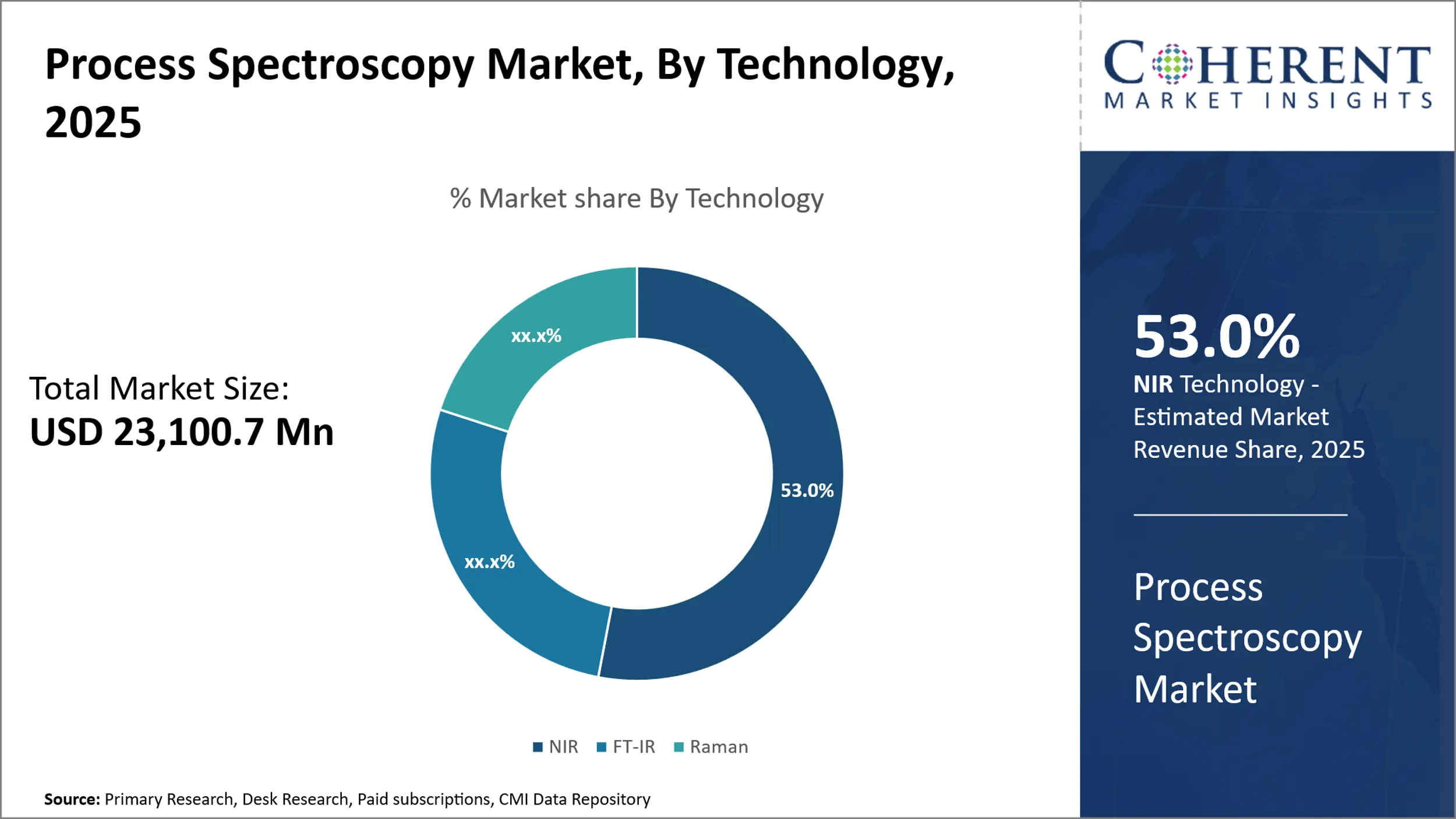
Global Process Spectroscopy Market Insights, By Technology
Near-Infrared (NIR) spectroscopy is projected to dominate the global process spectroscopy market in 2026, capturing approximately 54.0% of the total market share. This leadership position is primarily driven by the technology’s proven advantages in delivering fast, non-destructive, and highly accurate chemical analysis across various industrial processes.
NIR is extensively used in pharmaceuticals, food & beverages, and chemical industries for real-time monitoring of moisture, protein, and fat content during production, helping ensure consistent quality and process optimization.
In particular, the use of process spectroscopy in pharmaceutical quality control is witnessing significant growth. NIR spectroscopy plays a pivotal role in ensuring batch consistency, detecting impurities, and complying with stringent regulatory requirements under frameworks such as GMP and PAT.
The growing integration of NIR systems in PAT frameworks, especially in regulated sectors like pharma, is further fuelling its adoption. Additionally, innovations in miniaturized and handheld NIR devices have enhanced usability, enabling on-site and in-field testing capabilities that reduce analysis time and improve decision-making speed.
As manufacturers worldwide continue to focus on improving operational efficiency, maintaining regulatory compliance, and reducing product variability, NIR spectroscopy stands out as a reliable, scalable, and cost-effective solution. These strengths position it as the leading technology segment within the global process spectroscopy market.
Global Process Spectroscopy Market – Regional Insights
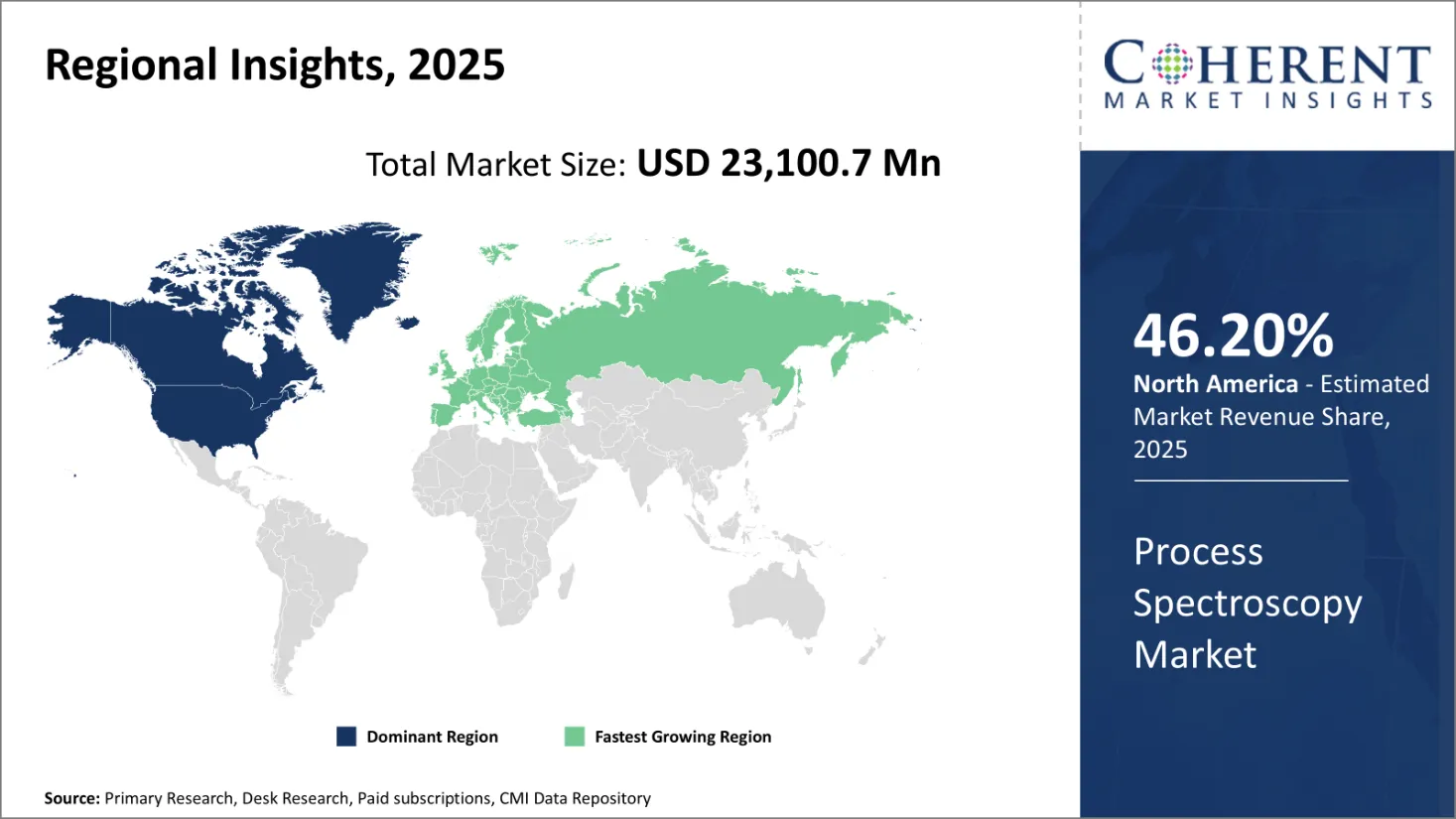
North America Process Spectroscopy Market Trends and Analysis
North America is anticipated to lead the global process spectroscopy market in 2026, capturing approximately 46.20% of the total revenue share. This regional dominance stems from the region’s well-established base of pharmaceutical, chemical, and food processing industries that require precise, real-time analytical solutions for quality assurance and regulatory compliance. The region also benefits from early adoption of advanced technologies, substantial R&D investments, and a mature regulatory framework driven by agencies like the U.S. FDA and EPA.
The growing integration of spectroscopy systems with IoT-enabled and Industry 4.0-based smart manufacturing environments further boosts the demand for real-time process monitoring and automation. North America is also home to several leading spectroscopy equipment manufacturers and solution providers, reinforcing its position as a global innovation hub. With continued emphasis on technological advancement, operational efficiency, and compliance with stringent quality standards, North America is expected to remain at the forefront of the process spectroscopy market in 2026 and beyond.
Process Spectroscopy Market Dominating Countries
United States
The United States is the leading country in the global process spectroscopy market, contributing significantly to North America’s projected 46.2% revenue share in 2026. The country’s leadership is driven by a strong presence of pharmaceutical, biotechnology, and chemical manufacturing industries that require advanced spectroscopy solutions for real-time quality assurance and regulatory compliance.
A key factor in this growth is the widespread adoption of in-line process spectroscopy systems, which enable continuous, real-time monitoring of production processes, reducing downtime and enhancing product consistency.
Germany
Germany plays a critical role in the European process spectroscopy landscape, supported by its advanced industrial manufacturing sector and strong focus on automation and quality control. The country’s engineering excellence and leadership in sectors such as automotive, chemicals, and life sciences drive the demand for precise, in-line analytical techniques offered by process spectroscopy.
Moreover, stringent EU regulatory frameworks and Germany’s commitment to digital transformation and Industry 4.0 strategies encourage the widespread adoption of real-time monitoring technologies. With several leading analytical equipment manufacturers based in Germany, the nation remains a key driver of innovation and market expansion across Europe.
Market Report Scope
Process Spectroscopy Market Report Coverage
| Report Coverage | Details | ||
|---|---|---|---|
| Base Year: | 2025 | Market Size in 2026: | USD 24,764.0 Mn |
| Historical Data for: | 2020 To 2024 | Forecast Period: | 2026 To 2033 |
| Forecast Period 2026 to 2033 CAGR: | 7.2% | 2033 Value Projection: | USD 40,288.7 Mn |
| Geographies covered: |
| ||
| Segments covered: |
| ||
| Companies covered: | ABB Ltd., Shimadzu Corporation, Agilent Technologies, Inc., Sartorius AG, Bruker Corporation, Kett Electric Laboratory, Buchi Labortechnik AG, Horiba Limited, Danaher Corporation, and Foss A/S. | ||
| Growth Drivers: |
| ||
| Restraints & Challenges: |
| ||
Analyst Viewpoint – Process Spectroscopy Market
- The global process spectroscopy market stands at the forefront of a data-driven industrial revolution, where precision, speed, and regulatory compliance are no longer optional they are mission-critical. As manufacturers across pharmaceuticals, chemicals, food & beverages, and oil & gas embrace real-time analytics, spectroscopy has emerged as the linchpin of smart manufacturing. Near-Infrared (NIR) and Raman technologies, once considered high-end, are now mainstream, thanks to advancements in miniaturization, cloud integration, and AI-powered interpretation.
- Analysts observe a decisive shift toward inline and at-line process monitoring, driven by Industry 4.0, zero-defect manufacturing, and environmental accountability. Companies that adopt these tools are not only enhancing product quality but also unlocking significant operational efficiencies.
- With North America leading in adoption and Asia Pacific rapidly catching up, the market is poised for accelerated growth. As innovation converges with affordability, process spectroscopy is transitioning from a quality control tool to a strategic business enabler across the global industrial landscape.
Process Spectroscopy Market: Key Development
- In April 2025, automated Raman spectroscopic systems were introduced for high‑throughput bioprocess labs. A robotic facility now uses automated Raman spectroscopy to measure liquid bioprocess samples with ML‑driven analytics, accelerating data collection and model training, which Enhances consistency and efficiency in biotech process monitoring, reducing calibration burden and speeding innovation in biopharmaceutical development.
- In March 2025, quantum-FTIR (QFTIR) spectroscopy emerged as a novel detection technique. Developed using entangled photon pairs, the QFTIR system accesses mid‑IR vibrational data via near‑IR silicon detectors with exceptionally low probing power. Offers a breakthrough in sensitivity and energy efficiency for process monitoring in sensitive sectors like pharmaceuticals and materials science.
- In January 2025, Bruker launched the LUMOS II ILIM infrared imaging microscope using quantum cascade laser (QCL) technology that Accelerates adoption of high-resolution process spectroscopy in R&D and quality control, boosting demand for sophisticated imaging-enabled NIR/FTIR tools.
- In April 2024, At Analytica 2024 in Munich, companies including Bruker, Agilent, Horiba, WITec, Hamamatsu, and Siemens unveiled new process spectroscopy instruments. These launches enhance the industrial utility of process spectroscopy in food & beverage, pharmaceuticals, and chemical sectors, facilitating inline measurements, robust portability, and system integration in automated production lines.
- In February 2024, Pittcon 2024 highlighted THz‑Raman as an industrially applicable Raman spectroscopy extension. Ondax unveiled a THz‑Raman system offering accessible low-frequency Raman measurements, optimized for industrial real-world process applications. Opens new possibilities for vibronic and molecular analysis in production environments, improving process insight and material characterization.
Market Segmentation
- Global Process Spectroscopy Market, By Technology (Revenue, USD Mn, 2021 - 2033)
- NIR
- FT-IR
- Raman
- Global Process Spectroscopy Market, By End use (Revenue, USD Mn, 2021 - 2033)
- Polymer
- Oil and Gas
- Pharmaceuticals
- Food and Agriculture
- Chemical
- Others
- Global Process Spectroscopy Market, By Geography (Revenue, USD Mn, 2021 - 2033)
- North America
- U.S.
- Canada
- Latin America
- Brazil
- Argentina
- Mexico
- Rest of Latin America
- Europe
- Germany
- U.K.
- Spain
- France
- Italy
- Russia
- Rest of Europe
- Asia Pacific
- China
- India
- Japan
- Australia
- South Korea
- ASEAN
- Rest of Asia Pacific
- Middle East
- GCC Countries
- Israel
- Rest of Middle East
- Africa
- South Africa
- North Africa
- Central Africa
- North America
- Company Profiles
- ABB Ltd.
- Shimadzu Corporation
- Agilent Technologies, Inc.
- Sartorius AG
- Bruker Corporation
- Kett Electric Laboratory
- Buchi Labortechnik AG
- Horiba Limited
- Danaher Corporation
- Foss A/S. Internap
Sources
The Stakeholders Consulted
- Process engineers and plant operators
- Manufacturers and suppliers of spectroscopy instruments
- Quality assurance and control specialists in pharmaceuticals, chemicals, and food industries
- Automation and instrumentation engineers
- Regulatory compliance officers (FDA, EPA, EMA)
- R&D professionals from analytical labs and academic institutions
- Government agencies involved in industrial modernization and smart manufacturing
- End-users from sectors such as pharmaceuticals, chemicals, petrochemicals, food & beverage, and environmental monitoring
Databases Opened
- U.S. Food and Drug Administration (FDA) – Process Analytical Technology (PAT) Database
- European Medicines Agency (EMA) – Guidelines on Analytical Method Validation
- Ministry of Chemicals and Fertilizers (India) – Chemical Industry Insights
- World Bank Open Data – Manufacturing & Industrial Metrics
Magazines & Trade Publications
- Process – International Journal for Chemical and Process Engineering
- Pharmaceutical Manufacturing Magazine
- Food Quality & Safety Magazine
- Chemical Processing Magazine
- Control Engineering Magazine
Scientific and Industry Journals
- Journal of Process Control
- Applied Spectroscopy
- Talanta
- Journal of Near Infrared Spectroscopy
- Analytical and Bioanalytical Chemistry
Newspapers & Media Outlets
- Bloomberg – Technology & Life Sciences Section
- Reuters – Chemical & Pharmaceutical Industry News
- The Wall Street Journal – Health & Industrial Innovation
- The Economic Times – Chemical and Pharma Business
- Business Standard – Manufacturing & Automation
Associations and Regulatory Bodies
- U.S. Environmental Protection Agency (EPA) – Analytical Tools for Industrial Applications
- International Society of Automation (ISA)
- American Chemical Society (ACS)
- European Federation of Chemical Engineering (EFCE)
- Bureau of Indian Standards (BIS) – Instrumentation and Quality Assurance
Public Domain Sources
- U.S. Energy Information Administration (EIA) – Industrial Process Trends
- European Commission – Industrial Innovation & Digitalization Reports
- World Bank – Technology Adoption in Emerging Markets
- International Renewable Energy Agency (IRENA) – Digital Technologies in Manufacturing
Proprietary Research Elements
- CMI Expert Interviews and Technical Transcripts (focused on spectroscopy and real-time process monitoring)
- CMI Proprietary Repository of Market and Patent Data (covering spectroscopy trends from 2016 to 2025)
- CMI Data Analytics Tool (with region- and sector-specific adoption models for spectroscopy)
Get access to 250+ pages report
Every segment, forecast, competitor profile and data table behind the analysis above — available for instant download.
- ESOMAR Member
- ISO 9001:2015 Certified
- D-U-N-S Registered
- GDPR & CCPA Compliant
Missing comfort of reading report in your local language? Find your preferred language:
Transform your Strategy with Exclusive Trending Reports
Frequently Asked Questions
The Process Spectroscopy Market size is estimated to be valued at USD 24,764.0 Mn in 2026, and is expected to reach USD 40,288.7 Mn by 2033.
The CAGR of the global Market is projected to be 7.2% from 2026 to 2033.
Product quality improvement initiatives by regulatory authorities, is attributing the demand of Process Spectroscopy market.
North America region hold the largest share in the market in 2026, accounting for 46.2% share in terms of value.
Key players operating in the market are ABB Ltd., Shimadzu Corporation, Agilent Technologies, Inc., Sartorius AG, Bruker Corporation, Kett Electric Laboratory, Buchi Labortechnik AG, Horiba Limited, Danaher Corporation, and Foss A/S.
Process Spectroscopy is used in biotech for real-time monitoring of cell cultures, fermentation processes, and critical quality attributes to ensure consistent product yields.
Process Spectroscopy delivers high ROI by reducing batch failures, minimizing waste, and optimizing production efficiency through continuous, non-destructive analysis.