

Fitness Trackers Market Analysis & Forecast: 2026 to 2033
Fitness Trackers Market is estimated to be valued at USD 105.39 Bn in 2026 and is expected to reach USD 373.24 Bn in 2033, exhibiting a compound annual growth rate (CAGR) of 19.8% from 2026 to 2033.
Key Takeaways
- Based on Device Type, the Smartwatch segment is expected to lead the market with 86.7% share in 2026, driven by rising adoption and multifunctional health features.
- Based on Display Type, the Colored Display segment is projected to capture the highest share of the market in 2026, driven by superior visuals and rising health awareness.
- Based on Distribution Channel, the Online Store segment is expected to hold the greatest share of the market in 2026, fueled by e-commerce growth and smartphone penetration.
- Based on Compatibility, the Android segment is expected to represent the largest share of the market in 2026, driven by its global adoption and affordability.
- Based on Region, North America is set to lead the fitness tracker market with 32.4% share in 2026. While, Asia Pacific is projected to be the fastest growing region.
Market Overview
The Fitness Trackers Market demand is growing quickly in 2026. This is as consumers are becoming more health-conscious, AI is making products more personalized, and advanced monitoring features are being added. The industry is seeing more use in healthcare, sports, and lifestyle applications, and it is growing across smartwatches, fitness bands, and specialized devices. Fitness trackers are in high demand because they can do things like track glucose levels, analyze sleep patterns, and provide personalized coaching.
Current Events and Its Impacts on the Fitness Trackers Market
Current Event | Description and its Impact |
Advanced AI and Sensor Technology Integration |
|
Regulatory Changes in Health Data and Privacy |
|
Segmental Insights
- Current Industry Events of 2026
- Market Size Estimation
- Regional Breakdown
- Competitive Landscape
- Customer Intelligence
- Segmental Analysis
- Pricing Analysis
- Key Market Drivers, Challenges & Future Trends
- Customized Insights Section
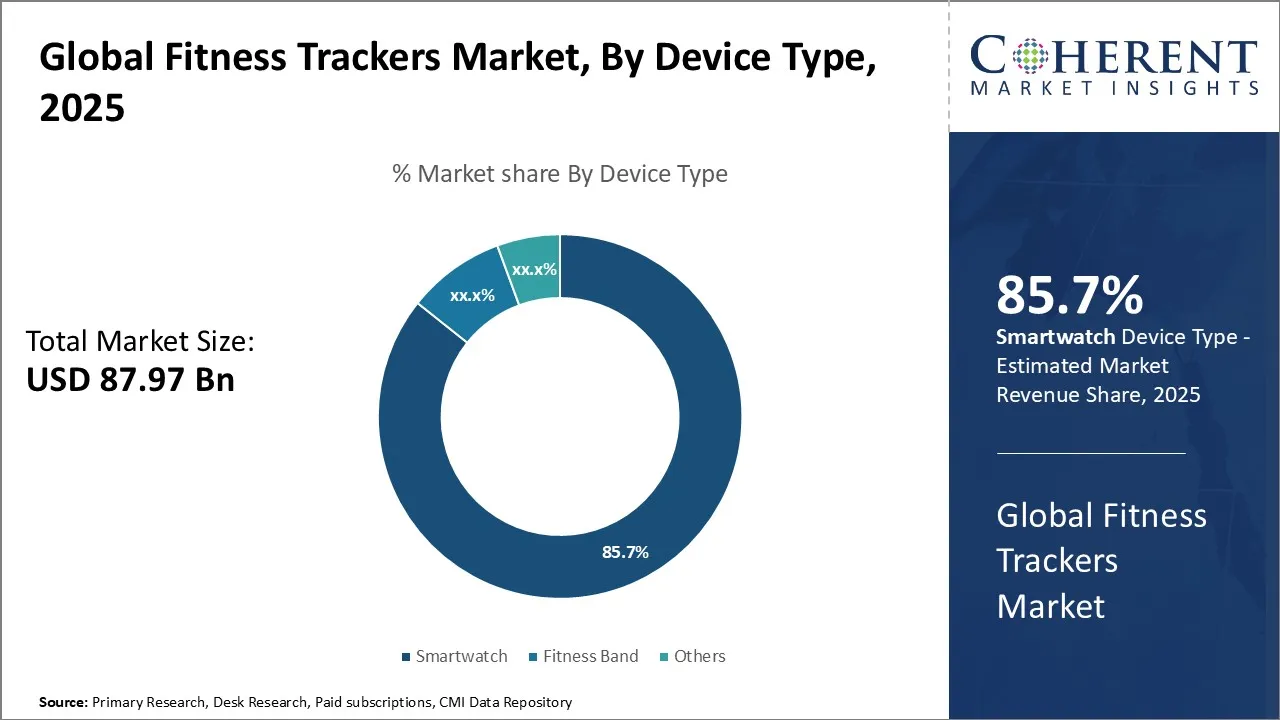
Global Fitness Trackers Market Insights, By Device Type - Smartwatch Dominance Is Driven by Rising Adoption and Multifunctional Health Features
In terms of device type, the smartwatch segment is expected to expected to lead the market with 86.7% share in 2026, owing to the rise in adoption of wearable fitness trackers. Smartwatches have multifunctional capabilities such as heart rate monitoring, GPS, and integration with health apps.
For instance, in September 2205, Fastrack released its MYND AI-powered smartwatch in India, where there are more and more tech-savvy and health-conscious people. The device has advanced AI-driven personalization and fitness tracking. It can track the heart rate, use GPS, and connect to apps.
Global Fitness Trackers Market Insights, By Display Type - Colored Display Dominance Is Driven by Superior Visuals and Rising Health Awareness
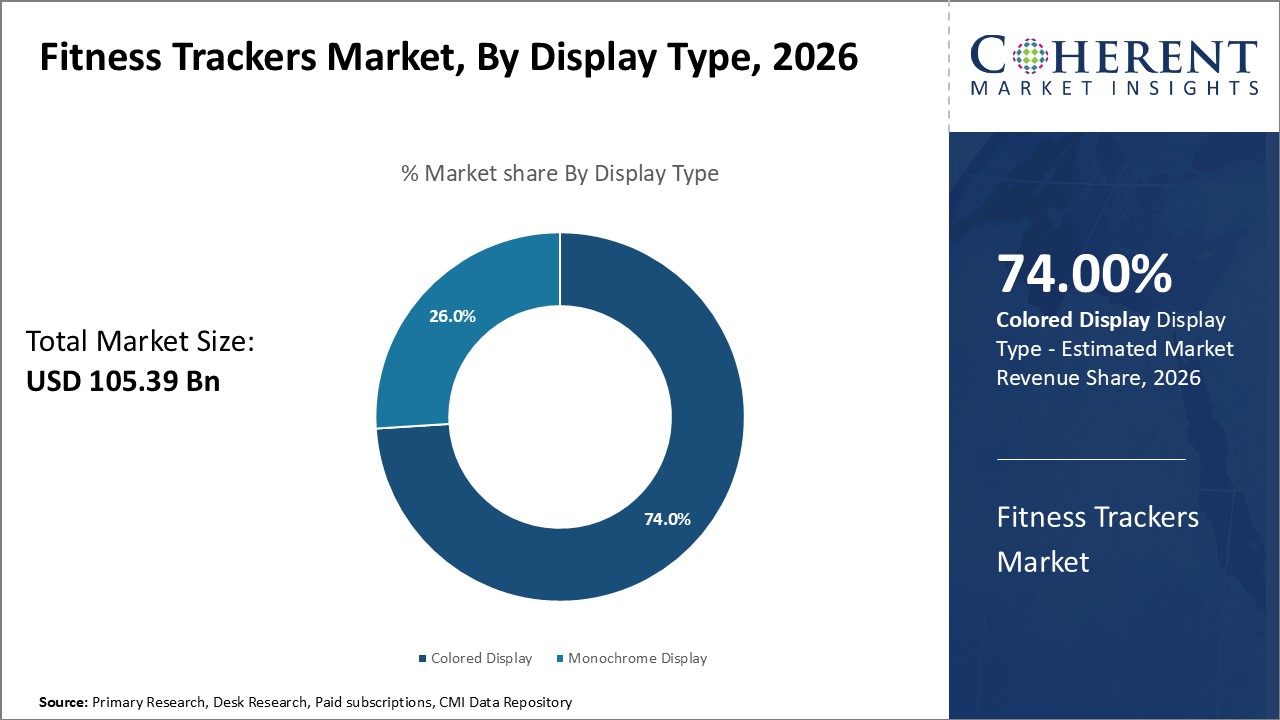
In terms of display type, the colored display segment is expected to dominate the market during the forecast period and this is attributed to the increasing awareness about health and fitness. Colored displays offer better user experience, advanced features and interactive visuals, in comparison to monochrome displays.
For instance, in July 2026, Huawei demonstrated the Watch Fit 4 Pro, which has a 1.82-inch AMOLED color screen that can get as bright as 3000 nits. The smartwatch has
Global Fitness Trackers Market Insights, By Distribution channel - Online Stores Lead Is Fueled by E-Commerce Growth and Smartphone Penetration
In terms of distribution channel, the online stores segment is expected to dominate the market over the forecast period and this is attributed to the growing penetration of the internet and smartphones. Additionally, online stores are surging with e-commerce growth, discounts and wide accessibility.
For instance, in November 2026, Titan Smart released the Evoke 2.0 smartwatch in India. It has advanced fitness tracking and guided wellness insights. The launch gives information about the price and availability of the product. It also shows Titan's push into the rapidly growing "Fitness Trackers Market," where online stores are the main way to buy them because more people are getting smartphones, e-commerce is growing, and consumers can easily access them.
Global Fitness Trackers Market Insights, By Compatibility - Android Dominance Is Driven by Its Global Adoption and Affordability
in terms of compatibility, the android segment is projected to account for the largest share of the market in 2026, owing to increasing number of android users across the globe. Android devices have widespread global adoption and are affordable.
For instance, in January 2026, the Galaxy Fit3 fitness tracker from Samsung is now available in the U.S. for $59.99. The device has a waterproof design, a battery life of almost two weeks, and advanced features like sleep coaching, blood oxygen monitoring, fall detection, and Emergency SOS alerts.
Regional Insights
North America Fitness Trackers Market Analysis & Trends
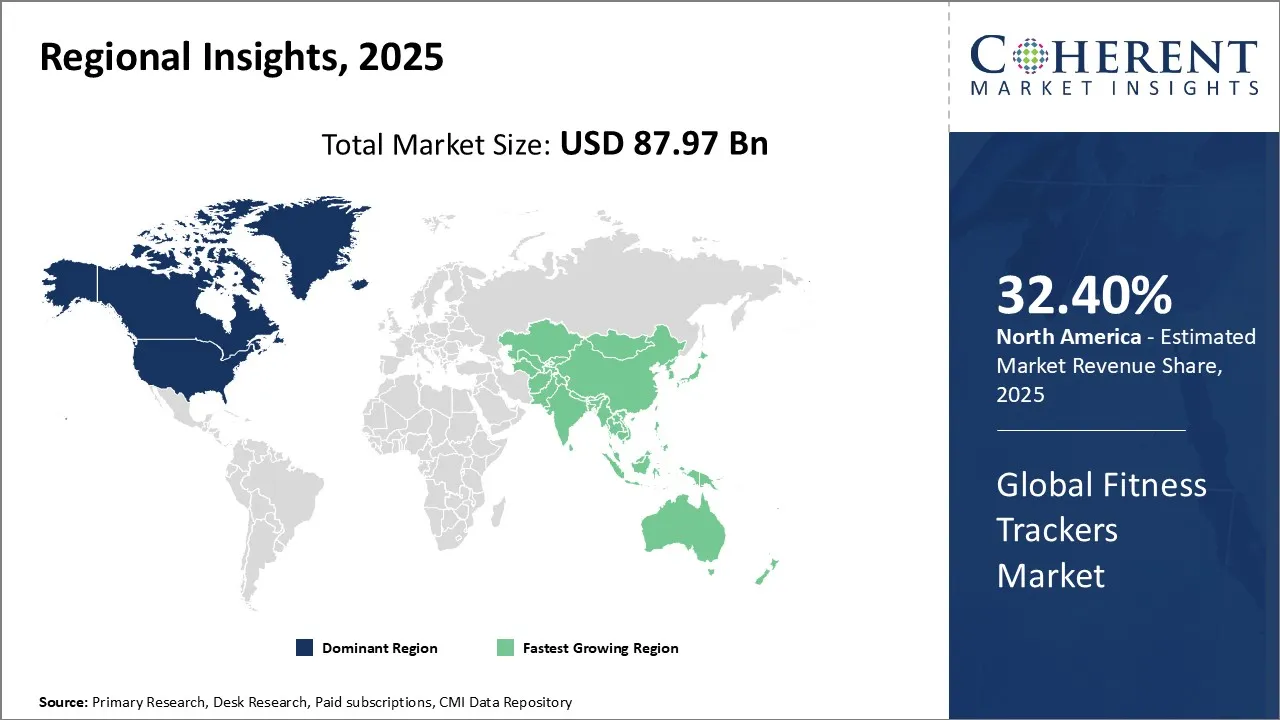
North America is expected to gain highest share of 32.4% in 2026, owing to the increasing awareness regarding fitness and health, growing penetration of the Internet & smartphones, and increasing adoption of fitness trackers.
For instance, in November 2026, Garmin teased a new device that it calls the "future of wearables." Garmin is based in the U.S. The company is known for its high-tech smartwatches and health-focused devices. This new release is expected to make the brand more well-known around the world and change the way people think about fitness and wellness
Asia Pacific Fitness Trackers Market Analysis & Trends
Asia Pacific is anticipated to be the fastest growing region, due to more people are becoming health-conscious, cities are growing steadily, and people have more money to spend. Affordable Android-compatible devices and a strong e-commerce presence are driving adoption in countries like China, India, and Japan. Local brands like Xiaomi and Huawei, along with global companies, drive growth, making Asia-Pacific the region with the fastest growth.
For instance, in August 2026, Amazfit released the Balance 2.0 smartwatch and the Helio Strap, a tracker that does not include a screen, in India. The devices add to Amazfit's line of wearables by being durable, having guided wellness features, and supporting over 170 sports modes.
Fitness Trackers Market Outlook Country-Wise
The U.S. Fitness Trackers Market Trends
The U.S. in 2026 The fitness tracker market is exceptionally competitive considering consumers are becoming aware of their health, preventive healthcare trends are on the rise, and wearable devices are becoming more popular. Consumers increasingly seek advanced features such as heart rate monitoring, sleep analysis, and stress management. Continuous innovation and integration of medical-grade sensors are driving strong adoption across the country.
China Fitness Trackers Market Trend
In 2026, China's fitness tracker market is experiencing an increasing amount of demand when individuals are becoming health-conscious, cities are growing quickly, and younger people like wearable technology. Adoption is growing because of a growing fitness culture, new technologies, and the addition of advanced health monitoring features. This trend makes China a major growth center in the world market.
For instance, in January 2026, Xiaomi and Sony announced collaborated to make a fitness tracker with a PlayStation theme. The device will first be available in the Asia-Pacific region, especially China and Japan, but there is expected to be interest around the world. It combines Xiaomi's wearable technology with Sony's gaming brand appeal.
Market Report Scope
Fitness Trackers Market Report Coverage
| Report Coverage | Details | ||
|---|---|---|---|
| Base Year: | 2025 | Market Size in 2026: | USD 105.39 Bn |
| Historical Data for: | 2020 To 2024 | Forecast Period: | 2026 To 2033 |
| Forecast Period 2026 to 2033 CAGR: | 19.8% | 2033 Value Projection: | USD 373.24 Bn |
| Geographies covered: |
| ||
| Segments covered: |
| ||
| Companies covered: | Adidas AG, Apple Inc., Fitbit, Inc., Garmin Ltd., Jawbone, Moov Inc., Xiaomi Inc., Nike, Inc., Lumo Bodytech Inc., and Samsung Electronics Co. Ltd., among others. | ||
| Growth Drivers: |
| ||
| Restraints & Challenges: |
| ||
Global Fitness Trackers Market Drivers
Rise in burden of cardiovascular diseases and obesity to drive market growth
One of the key factors expected to augment the growth of the global fitness trackers market during the forecast period is the rising prevalence of cardiovascular diseases and obesity. Several studies have shown that obesity results in cardiovascular risk factors such as dyslipidemia, hypertension, type 2 diabetes, and sleep disturbances, thereby resulting in a higher prevalence of cardiovascular disease and deaths across the globe. As per the World Health Organization (WHO), cardiovascular diseases (CVDs) are the leading cause of death taking an estimated 17.9 million lives each year. This in turn is driving the growth of the market.
Increasing awareness about health and fitness to underpin market growth
Another factor which is driving the growth of the global fitness trackers market is the increasing awareness about health and fitness. With the increasing awareness among people about health and fitness, the use or adoption of fitness trackers is also increasing.
Global Fitness Trackers Market Opportunities
Medical-Grade Health Monitoring
The fitness tracker market size continues to grow broader as devices change from counting steps to monitoring health at a medical level. Fitness trackers are becoming important tools for health care because they can do things like measure blood pressure, track glucose levels, and take ECGs. This change opens up chances for partnerships with providers and insurers, which will help the business grow and be used more widely around the world.
Global Fitness Trackers Market Trends
Rise in adoption of wearables is a recent trend
Over the years, wearable fitness trackers, such as smartwatches, have established themselves as an important part of consumer electronics. The most advantageous component of the Smartwatch has been health monitoring. It helps the people (or user) by providing important health parameters and provides information related to the diseases. The popularity of smartwatches is increasing rapidly as every smartwatch comes with a fitness tracker. People are anxious about their health, and thus, there is an increasing demand for wearable fitness trackers.
Growing demand for flagship products is another trend
Technological advancements have enabled the addition of more features in fitness trackers/bands and smartwatches. Flagship products/devices are highly well-designed products and are made very attractive as compared to any other product of the company. Flagship products are typically the reason customers make purchases. They satisfy the customer's wants and serve benefits specific to the design. Thus, increasing demand or adoption of flagship devices/products is expected to propel the growth of the fitness trackers market over the forecast period.
Analyst Opinion (Expert Opinion)
- The global fitness tracker market value is growing steadily as larger populations are becoming aware of their health, more people are developing diseases related to their lifestyles, and more people are using connected health devices. Wearable technology is moving from being niche fitness gadgets to being widely used health-monitoring tools.
- Smartwatches are currently the most popular type of smartwatch, and wrist-worn devices continue to be the most popular type, bringing in a lot of money around the world. People are more and more looking for advanced health monitoring features like tracking their heart rate all the time, analyzing their sleep, and keeping an eye on their stress levels. This shows a shift toward "smart health" instead of just "smart fitness."
- Preventive healthcare trends, the use of wearables with mobile health apps, and the growing use of these products by older people and regular consumers are all important factors in the market. Some of the problems that could slow down adoption in some areas are the high cost of devices, short battery life, and worries about data privacy.
- New trends include combining trackers with wellness programs at work, healthcare services, and non-wrist-based items like smart clothing and shoes.
Speak to the analyst
Want personalized insights?
Take the findings above to one of our principal consultants, or have the report rebuilt around the segments, geographies and competitors you actually track.
Global Fitness Trackers Market: Key Developments
- In November 2025, Oakley and Meta released the HSTN Smart Glasses in India. The wearable has fitness tracking, a Hindi-speaking Meta AI, and UPI payment support. It combines health monitoring and smart lifestyle features. This debut shows how India's role in the market for wearables and fitness trackers is growing, bringing together technology and everyday convenience.
- In September 2025, Polar added the Polar Loop to its line of fitness trackers. It's a wearable that doesn't have a screen or a subscription. Polar, which is based in Finland, is focusing on European markets with this simple device that is affordable and focused on core activity monitoring.
- In July 2025, Temilola, formerly employed to be the Product Lead at Paystack, started Tru Count Inc. and raised $130,000 to make a stylish and accurate fitness tracker. The startup is based in Nigeria and wants to break into the global Fitness Trackers Market with its new wearable.
Market Segmentation
- Global Fitness Trackers Market, By Device Type (Revenue, USD Bn, 2021 - 2033)
- Fitness Band
- Smartwatch
- Others
- Global Fitness Trackers Market, By Display Type (Revenue, USD Bn, 2021 - 2033)
- Monochrome Display
- Colored Display
- Global Fitness Trackers Market, By Distribution Channel (Revenue, USD Bn, 2021 - 2033)
- Online Stores
- Offline Stores
- Global Fitness Trackers Market, By Compatibility (Revenue, USD Bn, 2021 - 2033)
- IOS
- Android
- Windows
- Tizen
- Others
- Global Fitness Trackers Market, By Geography (Revenue, USD Bn, 2021 - 2033)
- North America
- U.S.
- Canada
- Latin America
- Brazil
- Argentina
- Mexico
- Rest of Latin America
- Europe
- Germany
- U.K.
- Spain
- France
- Italy
- Russia
- Rest of Europe
- Asia Pacific
- China
- India
- Japan
- Australia
- South Korea
- ASEAN
- Rest of Asia Pacific
- Middle East & Africa
- GCC Countries
- Israel
- Rest of Middle East & Africa
- North America
- Global Fitness Trackers Market: Key Companies Insights (Revenue, USD Bn, 2021 - 2033)
- Adidas AG
- Apple Inc.
- Fitbit, Inc.
- Garmin Ltd.
- Jawbone
- Moov Inc.
- Xiaomi Inc.
- Nike, Inc.
- Lumo Bodytech Inc.
- Samsung Electronics Co. Ltd.
Sources
Primary Research Interviews
- Fitness Tracker Manufacturers
- Wearable Device OEMs
- Smart Sensor & Component Suppliers
- Digital Health & Wellness Technology Providers
- Sports & Activity Monitoring Solution Integrators
- Healthcare IT Consultants
- Retail & E-commerce Channel Partners
- Others
Databases
- Bloomberg Terminal
- Thomson Reuters Eikon
- Euromonitor International
- IHS Markit
- Statista
- S&P Global Market Intelligence
- Others
Magazines
- Wearable Technologies Magazine
- Digital Health Magazine
- Consumer Electronics Magazine
- Health & Fitness Journal Magazine
- IEEE Consumer Electronics Magazine
- Others
Journals
- Journal of Medical Internet Research (JMIR)
- IEEE Sensors Journal
- Sensors & Actuators Journal
- Health Informatics Journal
- Journal of Sports Sciences
- Others
Newspapers
- Financial Times
- The Wall Street Journal
- Reuters
- Bloomberg News
- Business Standard
- Others
Associations
- Consumer Technology Association (CTA)
- International Society for Wearable Technology (ISWT)
- American College of Sports Medicine (ACSM)
- Digital Health Association
- International Health, Racquet & Sportsclub Association (IHRSA)
- Others
Public Domain Sources
- World Health Organization (WHO) – Digital Health Data
- U.S. Food & Drug Administration (FDA) – Wearable Device Regulations
- Centers for Disease Control and Prevention (CDC) – Physical Activity Data
- International Telecommunication Union (ITU) – Connectivity Data
- World Bank Open Data
- European Commission – Digital Health Initiatives
- Others
Proprietary Elements
- CMI Data Analytics Tool
- Proprietary CMI Existing Repository of Information for the Last 8 Years
*Definition: Fitness tracker is a wearable device or computer application that records a person’s daily physical activity, together with other data relating to their health and/or fitness, such as the number of calories burned, heart rate, etc.
Get access to 250+ pages report
Every segment, forecast, competitor profile and data table behind the analysis above — available for instant download.
- ESOMAR Member
- ISO 9001:2015 Certified
- D-U-N-S Registered
- GDPR & CCPA Compliant
Missing comfort of reading report in your local language? Find your preferred language:
Transform your Strategy with Exclusive Trending Reports
Frequently Asked Questions
The Fitness Trackers Market is estimated to be valued at USD 105.39 Bn in 2026, and is expected to reach USD 373.24 Bn by 2033.
The CAGR of the Fitness Trackers Market is projected to be 19.8% from 2026 to 2033.
Rising prevalence of cardiovascular diseases and obesity and increasing awareness about health and fitness is fueling the growth of the market.
The Smart watch segment is the leading device type segment in the market.
High cost of fitness trackers and risk of data theft are major factors restraining growth of the market.
Major players operating in the market are Adidas AG, Apple Inc., Fitbit, Inc., Garmin Ltd., Jawbone, Moov Inc., Xiaomi Inc., Nike, Inc., Lumo Bodytech Inc., and Samsung Electronics Co. Ltd., among others.