

4G LTE Hotspot Market Size and Share Analysis - 2026 To 2033
The 4G LTE Hotspot Market size is anticipated to grow at a CAGR of 8.4% with USD 4.14 Bn in 2026 and is expected to reach USD 7.25 Bn in 2033. The primary drivers are defined by expanding 4G network coverage, rising mobile data consumption, increasing remote work, and growing demand for portable backup connectivity. According to the International Telecommunication Union, 4G networks covered around 93% of the global population in 2025, thereby supporting the widespread access to LTE-based internet services. This is strengthening the demand for mobile hotspots, pocket routers, multi-device connectivity, secure enterprise communication, and temporary broadband access across homes, offices, vehicles, retail locations, and remote areas.
Key Takeaways
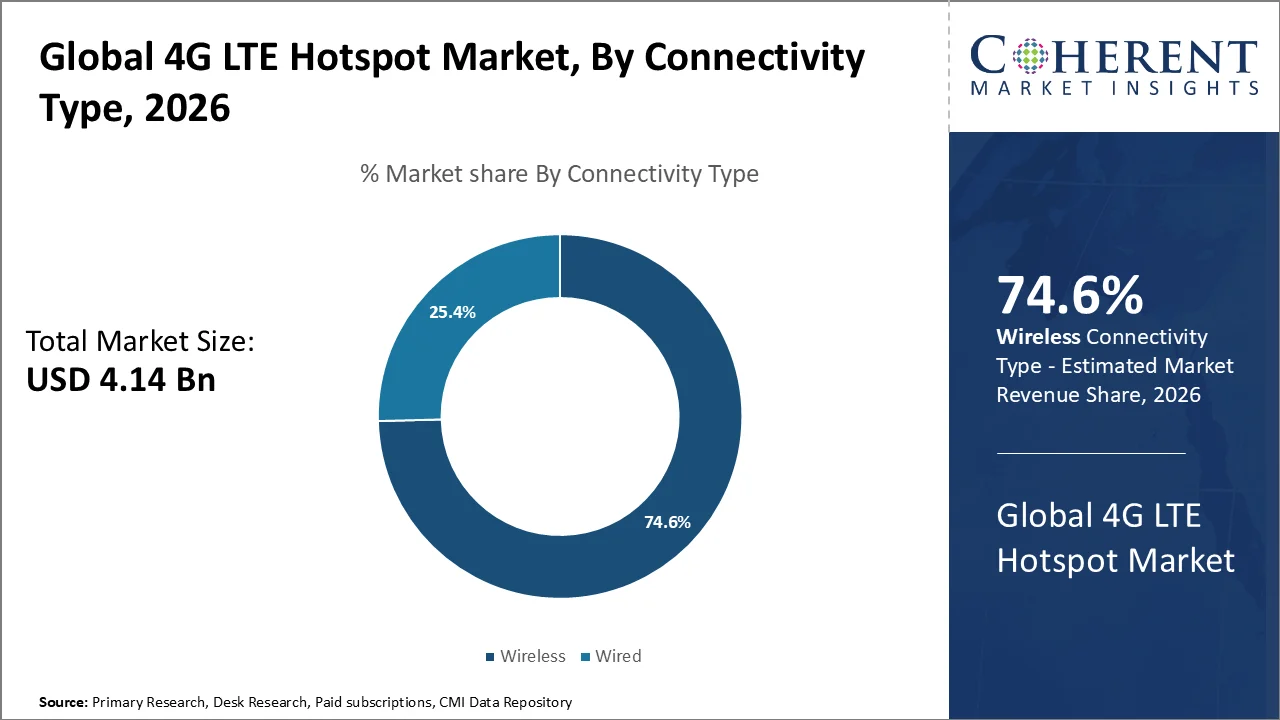
- The wireless segment is likely to dominate the market with 74.6% in 2026. The segment’s growth is owing to portable internet demand, multi-device connectivity, and expanding mobile broadband coverage. In 2025, approximately 6 Bn people, or 74% of the global population, used the internet.
- The commercial segment is set to lead with 59.1% in 2026. The segment’s growth is owing to the increasing adoption across field operations, retail outlets, transportation, temporary offices, and business continuity applications. Mobile technologies and services generated USD 7.6 trillion, equivalent to 6.4% of global GDP, in 2025.
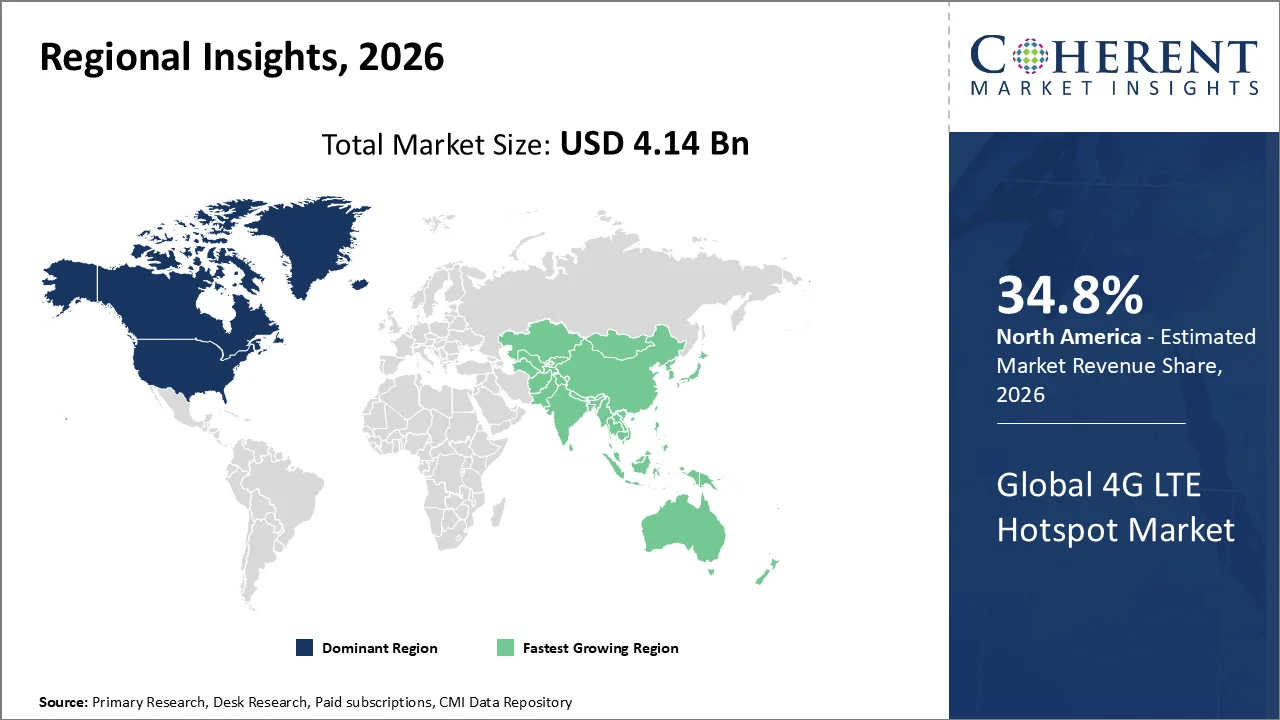
- North America is expected to acquire the prominent share of 34.8% in 2026. The region’s growth is owing to the advanced wireless infrastructure, high mobile data consumption, and widespread connected-device adoption. U.S. wireless connections reached 579 million, while mobile data consumption recorded 132 trillion megabytes in 2024.
Segmental Insights
Why is Wireless Segment Acquiring the Largest Share?
On the basis of connectivity type, the wireless segment is projected to account for the largest 4G LTE Hotspot Market share of 74.6% in 2026. The segment’s growth is owing to the hotspots providing secure internet access across smartphones, laptops, tablets, and field devices without fixed broadband infrastructure.
Ofcom reported in May 2025 that good outdoor 4G coverage from at least one operator reached approximately 96% of the U.K. landmass. The regulator also stated that mobile operators maintained 4G coverage outside at least 99% of U.K. premises. This is supporting reliable hotspot usage for travel, remote work, temporary offices, and emergency connectivity.
In November 2025, NETGEAR launched the Nighthawk M7 portable hotspot with an eSIM marketplace, thereby allowing the users to activate mobile data across more than 140 countries. The device supports both 5G and 4G connectivity for up to 32 devices, strengthening the wireless segment’s global leadership.
- Current Industry Events of 2026
- Market Size Estimation
- Regional Breakdown
- Competitive Landscape
- Customer Intelligence
- Segmental Analysis
- Pricing Analysis
- Key Market Drivers, Challenges & Future Trends
- Customized Insights Section
Commercial hold the Largest Market Share
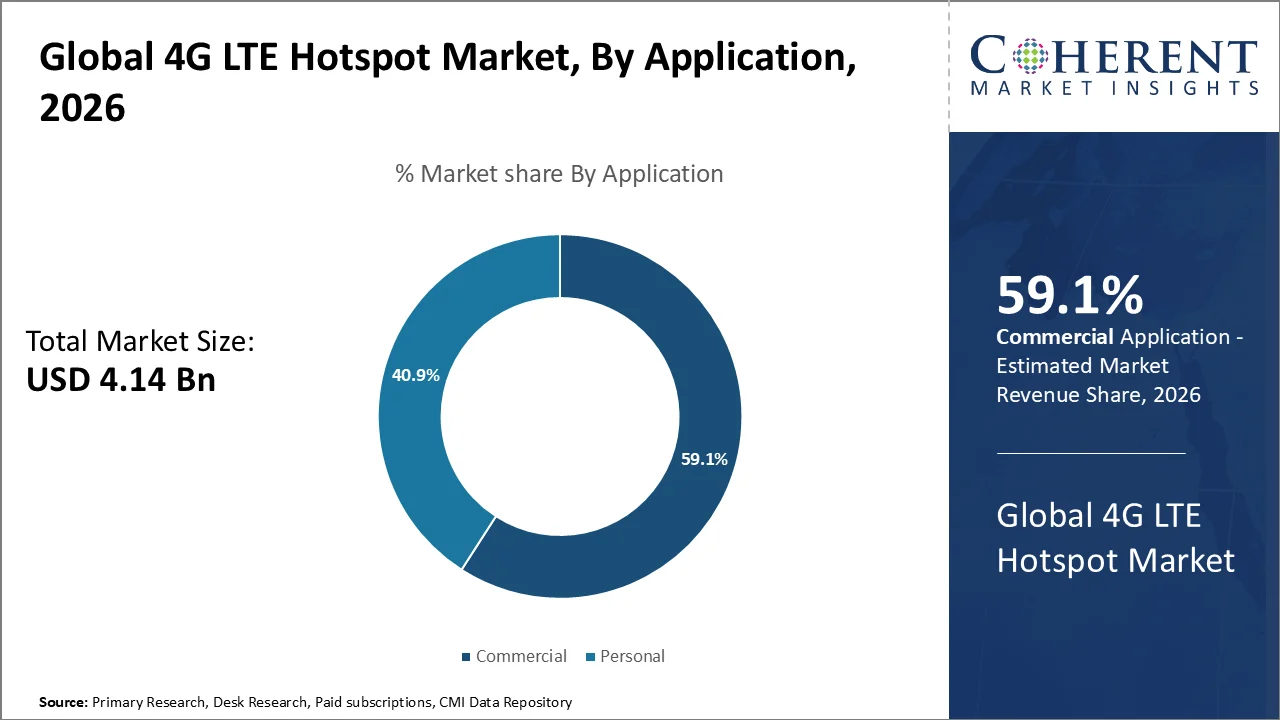
On the basis of application, the commercial segment lead with a major 59.1% share in 2026. The growth is owing to the small enterprises, field personnel, temporary worksites, mobile sales teams, emergency operations, and branch locations requiring secure internet access without fixed broadband installation.
The U.S. Small Business Administration reported nearly 36.2 million small businesses in 2025. This represents almost 46% of private-sector employment, thereby creating a potential user base for portable connectivity. The Federal Communications Commission recorded 416 million internet connections in June 2024, up 2.5% year over year. This demonstrates the increasing dependence on cellular broadband services.
In September 2024, NETGEAR launched the Nighthawk M7 Pro mobile hotspot which combines Wi-Fi 7 with 5G and 4G LTE Cat 20 connectivity. The device supports up to 64 connected devices and includes a 2.5-Gbps Ethernet port, strengthening its suitability for mobile offices, job sites, enterprise backup connectivity, and business-critical applications.
Market Drivers
Rising Portable Connectivity Innovations are Transforming the 4G LTE Hotspot Market
Finland represents an advanced mobile-connectivity environment in which portable hotspots are used for home broadband substitution, travel, remote work, secondary data subscriptions, and connectivity across sparsely populated areas. The Finnish Transport and Communications Agency reported that a 4G network providing maximum download speeds of at least 100 Mbps covered 96% of Finnish households at the end of 2025. However, the same network covered only 28% of Finland’s land area, illustrating the continuing need for devices with stronger antennas, efficient modem systems, external connectivity options, and dependable battery performance.
Finland had approximately 9 million active mobile subscriptions at the end of 2025, equivalent to 1.6 subscriptions per person. Traficom reported that consumers commonly maintain additional subscriptions for mobile broadband, tablets, and other thereby creating favorable conditions for dedicated hotspots that can distribute one mobile connection across multiple devices.
LTE-Advanced Multi-Device Connectivity: A Major Breakthrough in the 4G LTE Hotspot Market
LTE-Advanced multi-device connectivity enables a portable hotspot to receive broadband through an LTE or LTE-Advanced mobile network and redistribute that connection over Wi-Fi, USB, or Ethernet. Compared with basic LTE devices, LTE-Advanced models can use higher modem categories, carrier aggregation, improved uplink capabilities, dual-band Wi-Fi, and more efficient network management.
The FCC classifies 4G LTE as mobile wireless service operating through 3GPP Releases 8 to 14. In the U.S. Broadband Data Collection framework, reported 4G LTE coverage must be modeled at minimum speeds of 5 Mbps download and 1 Mbps upload, with 90% cell-edge coverage probability and at least 50% cell loading. This regulatory definition gives operators and device suppliers a consistent baseline for evaluating LTE service availability.
Device-level improvements have progressed substantially beyond this minimum threshold. TP-Link’s M7350 provides download speeds of up to 150 Mbps, upload speeds of up to 50 Mbps, dual-band Wi-Fi, and connections for up to 10 devices. The example demonstrates how LTE hotspots are evolving from personal internet accessories into compact shared-network platforms.
Current Events and Their Impact on the 4G LTE Hotspot Market
Current Event | Description and its Impact |
2025 FCC Reversal of E-Rate Support for Off-Premises Wi-Fi Hotspots in the U.S.
|
|
EU Cybersecurity Requirements for Internet-Connected Radio Equipment |
|
4G LTE Hotspot Market Trends
- The rising demand for portable, always-on internet connectivity is strengthening the adoption amongst the remote workers, travelers, students, field teams, and small businesses.
- Multi-device connectivity, longer battery life, compact designs, and enhanced network security is strengthening the appeal of dedicated 4G LTE hotspot devices.
- The growing use of hotspots for backup broadband, temporary worksites, remote locations, retail operations, and emergency communications is broadening the commercial applications.
- The wider mobile broadband coverage in developing markets is increasing the access to affordable internet and supporting the sustained hotspot demand. In 2024, around 96% of the global population lived within mobile broadband coverage while 58% used mobile internet on their own devices. Around 38% remained within coverage but unconnected, thereby highlighting a sizeable usage gap and continual opportunity for affordable prepaid hotspot solutions.
- The continual 4G availability along with the uneven 5G deployment is sustaining the demand for LTE-compatible devices. In 2025, 5G covered nearly 55% of the world’s population but reached only 4% in low-income countries. Meanwhile, 5G represented approximately one-third of global mobile subscriptions, thereby indicating that LTE networks are still essential for broad and reliable connectivity.
Regional Insights
North America Dominates Owing to the Extensive LTE Coverage and Enterprise Mobility Demand
The North America region accounts for 34.8% of the market share in 2026. The region’s growth is owing to the extensive LTE coverage, high mobile-data usage, strong enterprise mobility demand, and established carrier distribution.
The U.S. Federal Communications Commission reported around 419 million mobile internet connections in December 2024, up 1.3% year over year, thereby indicating a large addressable base for portable hotspot devices. The FCC also found that 4G LTE service meeting at least 5 Mbps download and 1 Mbps upload was available at 99% of U.S. broadband-serviceable locations. This is strengthening the hotspot usability in urban, suburban, as well as remote areas.
In May 2026, Sonim and AT&T broadened U.S. distribution of the rugged MegaConnect mobile Wi-Fi hotspot for business and FirstNet customers. The device can operate on AT&T’s LTE commercial spectrum when Band 14 is unavailable, supporting field workers, public-safety teams, utilities, transportation companies, and other enterprises requiring dependable mobile connectivity during critical operations.
Asia Pacific 4G LTE Hotspot Market Trends
Asia Pacific is expected to witness strong growth in market over the forecast period. The region’s growth is owing to the expanding mobile broadband adoption, remote working, online education, travel connectivity, and limited fixed-broadband availability across developing economies.
India’s Telecom Regulatory Authority reported that the country’s broadband subscriber base crossed 1 billion in November 2025, indicating consumers and enterprises capable of using portable LTE hotspot devices. In Australia, the Australian Communications and Media Authority found that 97% of adults accessed the internet through mobile phones in 2025, reinforcing demand for portable, multi-device connectivity during travel and temporary work.
Widespread Mobile Connectivity are Accelerating the 4G LTE Hotspot Market in United States
In the United States, the 4G LTE Hotspot Market is influenced by the widespread mobile connectivity, remote work, travel, emergency communications, and demand for backup internet access. The NTIA reported that nearly 72% of people lived in households with both fixed and mobile internet connections in 2023, thereby indicating a large addressable base for portable hotspot services.
In April 2025, Verizon’s Visible brand launched the Visible+ Pro plan with unlimited mobile hotspot access, strengthening consumer availability of shared wireless connectivity.
China 4G LTE Hotspot Market Trends
China’s 4G LTE hotspot market is supported by mobile infrastructure and continued rural coverage programs. The Ministry of Industry and Information Technology reported 7.112 million 4G base stations at the end of 2024, providing a connectivity foundation for portable hotspot devices used by households, small businesses, travelers, and field personnel.
Who are the Major Companies in 4G LTE Hotspot Industry
Some of the major key players in 4G LTE Hotspot Market are Verizon, AT&T, T-Mobile, FreedomPop, Samsung, Internet on the Go, Sprint, Huawei, D-Link, and TP-Link.
Key News
- In October 2025, D-Link expanded its 5G/4G Mobile Access Series with new routers, mobile hotspots, and USB adapters. The portfolio delivers secure, high-speed connectivity for homes, businesses, remote workers, and travelers, combining Wi-Fi 6, portability, VPN support, and power-bank functionality.
- In February 2025, Sonim launched the Spot H100 4G LTE mobile hotspot in Europe through distributors, resellers, and Telia Finland. The compact device supports 32 connections, delivers download speeds of 300 Mbps, and targets professionals, travelers, and adventurers regionwide.
Market Report Scope
4G LTE Hotspot Market Report Coverage
| Report Coverage | Details | ||
|---|---|---|---|
| Base Year: | 2025 | Market Size in 2026: | USD 4.14 Bn |
| Historical Data for: | 2020 To 2024 | Forecast Period: | 2026 To 2033 |
| Forecast Period 2026 to 2033 CAGR: | 8.4% | 2033 Value Projection: | USD 7.25 Bn |
| Geographies covered: |
| ||
| Segments covered: |
| ||
| Companies covered: | Verizon, AT&T, T-Mobile, FreedomPop, Samsung, Internet on the Go, Sprint, Huawei, D-Link, and TP-Link. | ||
| Growth Drivers: |
| ||
| Restraints & Challenges: |
| ||
Analyst Opinion
- The 4G LTE Hotspot Market growth is driven by the need for dependable mobile broadband beyond fixed networks. In 2025, the world recorded 99 mobile-broadband subscriptions per 100 inhabitants, while mobile broadband represented 89% of all mobile subscriptions, supporting sustained demand for portable connectivity devices.
- 4G is still the largest mobile-access technology across the globe. Ericsson reported nearly 4.6 billion 4G subscriptions in Q1 2026, thus providing a substantial installed base for LTE hotspot devices worldwide today.
- Mobile data consumption is increasing at a rapid pace, thereby strengthening the business case for dedicated hotspots used for remote work, travel, backup connectivity, field operations, and shared internet access. The global monthly mobile network traffic reached 210 exabytes in Q1 2026, rising 22% year over year, while video generated about 75% of traffic. This sustained usage supports replacement demand, higher-capacity batteries, carrier aggregation, and secure multi-device LTE connectivity.
Speak to the analyst
Want personalized insights?
Take the findings above to one of our principal consultants, or have the report rebuilt around the segments, geographies and competitors you actually track.
Market Segmentation
- By Connectivity Type (Revenue, USD Bn, 2021-2033)
- Wired
- Wireless
- By Application (Revenue, USD Bn, 2021-2033)
- Commercial
- Personal
- By Region (Revenue, USD Bn, 2021-2033)
- North America
- U.S.
- Canada
- Latin America
- Brazil
- Mexico
- Argentina
- Rest of Latin America
- Europe
- Germany
- U.K.
- France
- Italy
- Spain
- Russia
- Rest of Europe
- Asia Pacific
- China
- India
- Japan
- Australia
- South Korea
- ASEAN
- Rest of Asia Pacific
- Middle East
- GCC
- Israel
- Rest of Middle East
- Africa
- South Africa
- Central Africa
- North Africa
- North America
Sources
Primary Research Interviews
- 4G LTE hotspot manufacturers and device OEMs
- Mobile network operators and telecom service providers
- Chipset and wireless module manufacturers
- Telecom equipment distributors and retailers
- Enterprise IT and network infrastructure managers
- Internet service providers and mobile virtual network operators
- Technology consultants and key opinion leaders in wireless connectivity
Databases
- International Telecommunication Union
- GSMA Intelligence
- World Bank
- Organisation for Economic Co-operation and Development
- Federal Communications Commission
- Global mobile Suppliers Association
- UN Comtrade Database
Magazines
- Light Reading
- RCR Wireless News
- Network World
- Telecom Review
- Mobile World Live
Journals
- IEEE Communications Magazine
- IEEE Wireless Communications
- IEEE Transactions on Mobile Computing
- Computer Networks
- Wireless Networks
Newspapers
- The Wall Street Journal
- Financial Times
- The New York Times
- The Guardian
- The Economic Times
Associations
- GSM Association
- 3rd Generation Partnership Project
- Cellular Telecommunications Industry Association
- Global mobile Suppliers Association
- Telecommunications Industry Association
- Wireless Broadband Alliance
Public Domain Sources
- Company Annual Reports and Investor Presentations
- Telecom Regulatory Authority Publications
- Government Spectrum Allocation and Auction Documents
- Mobile Network Coverage and Subscriber Statistics
- Product Certification and Equipment Authorization Databases
- Customs and International Trade Databases
- Company Product Launches and Press Releases
Proprietary Elements
- CMI Data Analytics Tool
- Proprietary CMI Existing Repository of Information for Last 10 Years
Get access to 250+ pages report
Every segment, forecast, competitor profile and data table behind the analysis above — available for instant download.
- ESOMAR Member
- ISO 9001:2015 Certified
- D-U-N-S Registered
- GDPR & CCPA Compliant
Missing comfort of reading report in your local language? Find your preferred language:
Transform your Strategy with Exclusive Trending Reports
Frequently Asked Questions
The 4G LTE Hotspot Market is expected to reach USD 7.25 Bn in 2033.
Major players operating in the global 4G LTE Hotspot Market include Verizon, AT&T, T-Mobile, FreedomPop, Samsung, Internet on the Go, Sprint, Huawei, D-Link, and TP-Link.
The rapid 5G infrastructure expansion, saturation of mature device markets, and intense competition from integrated smartphone tethering are the key factors hampering growth of the market.
The surge in remote work, global travel, and widespread adoption of connected smart devices is boosting the demand for 4G LTE Hotspot.
The 4G LTE Hotspot Market is anticipated to grow at a CAGR of 8.4% between 2026 and 2033.
Among regions, North America is expected to account for a largest market share in the global 4G LTE Hotspot Market over the forecast period.
The market outlook remains positive due to remote work, expanding digital infrastructure in emerging markets, and the continued necessity of cost-effective, ubiquitous connectivity.