

Hyperlocal Services Market Size and Forecast — 2026 - 2033
The Global Hyperlocal Services Market size is estimated to be valued at USD 15.8 billion in 2026 and is expected to reach USD 37.4 billion by 2033, exhibiting a compound annual growth rate (CAGR) of 12.8% from 2026 to 2033.
Overview
The Hyperlocal Services Market includes a wide range of products and platforms designed to deliver goods and services within a limited geographic area quickly and efficiently. These products typically include mobile applications, web platforms, and software solutions that connect local businesses, service providers, and consumers in real time. Key offerings include food delivery, grocery delivery, pharmacy delivery, home services booking, ride-hailing, and local logistics management tools. Many platforms also provide digital payment integration, order tracking, and customer support features. These solutions help businesses improve last-mile delivery, enhance customer convenience, and enable faster service fulfillment by leveraging location-based technologies and data analytics.
Key Takeaways
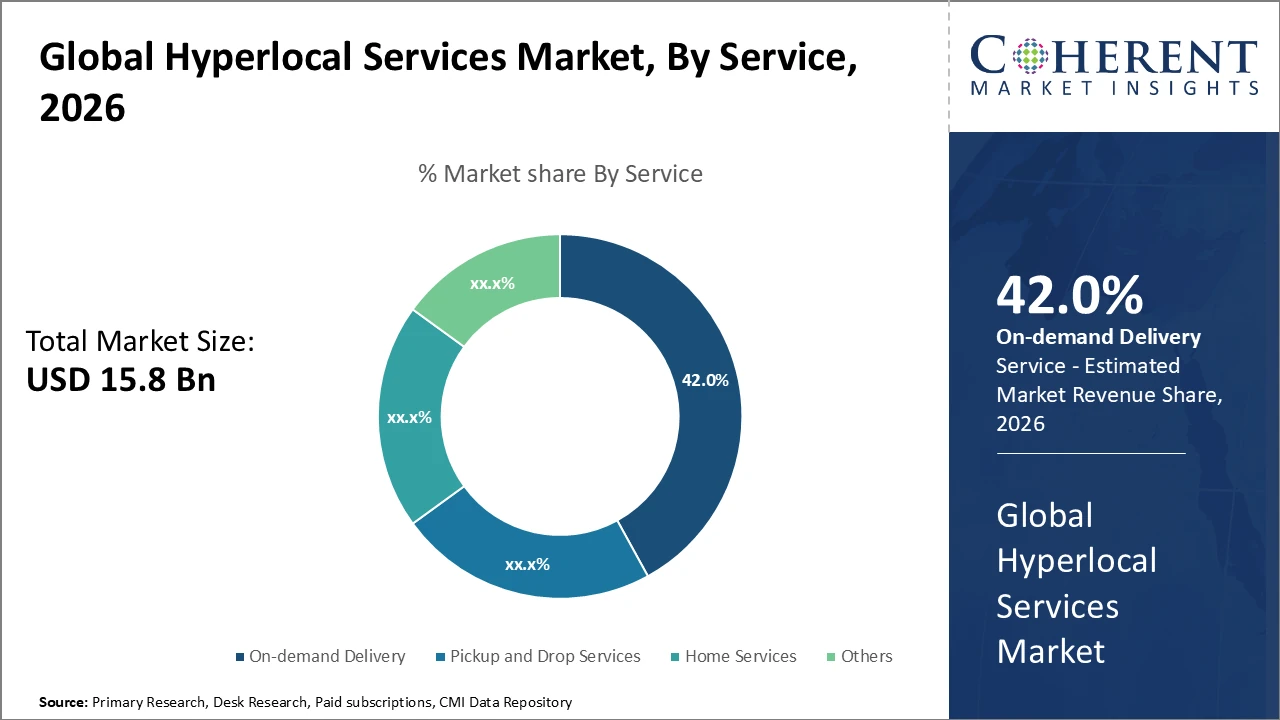
The On-demand Delivery segment dominates with a 42% share, propelled by rapid urban adoption and technological integration that enhances the overall customer experience.
The Grocery application leads market revenue due to the increasing demand for fresh food and daily essentials that can be delivered to consumers within a few hours.
Individual Consumers remain the largest end-user group, reflecting the strong mass appeal and direct-to-consumer nature of hyperlocal service offerings.
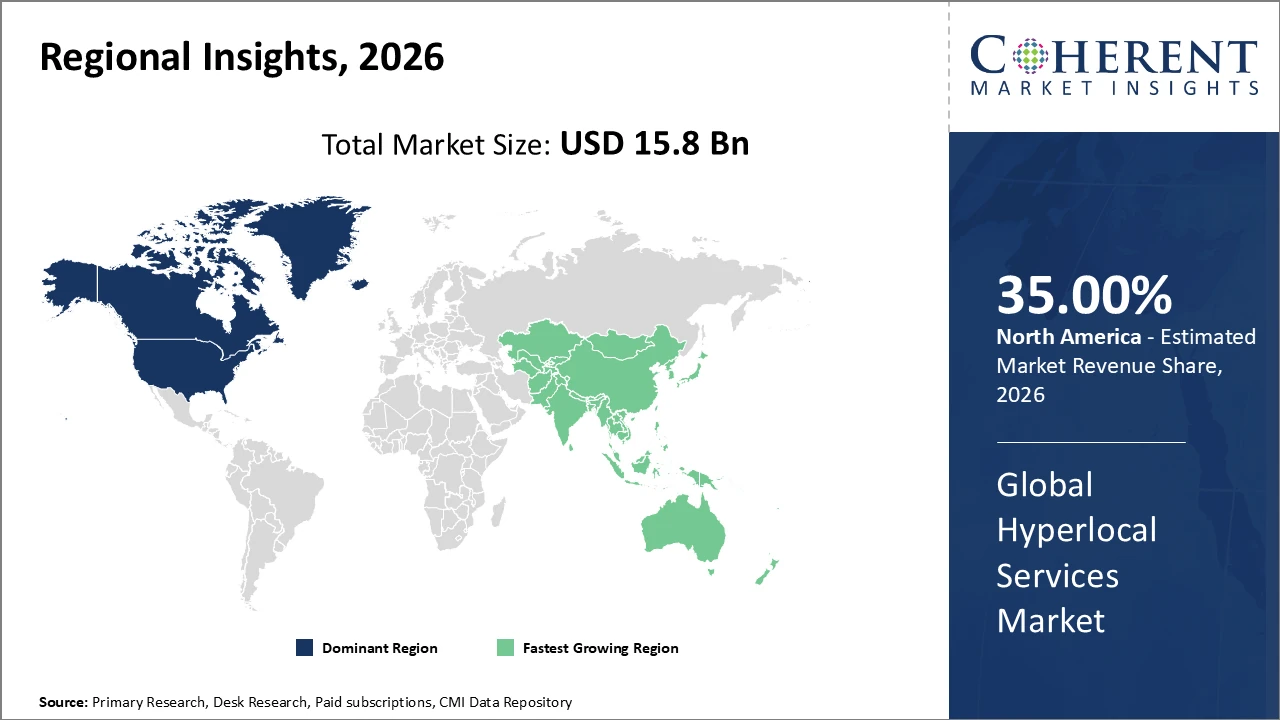
North America holds the dominant regional position with more than 35% market share, supported by advanced digital infrastructure, high consumer spending, and the strong presence of major market companies along with smart city initiatives.
Asia Pacific is the fastest-growing region, exhibiting a CAGR of over 15%, driven by rapid urbanization, rising smartphone penetration, and supportive regulatory policies that encourage innovation among market players.
Europe shows steady market growth, mainly led by countries such as the U.K., Germany, and France, benefiting from well-established logistics networks and increasing focus on sustainability and green delivery initiatives.
Hyperlocal Services Market Segmentation Analysis
Hyperlocal Services Market Insights, By Service
On-demand Delivery dominates the market with a 42% share, driven by rapid urbanization and rising consumer expectations for fast deliveries, especially in food and grocery segments. This segment relies on scalable platforms integrating real-time tracking and dynamic routing algorithms to maintain delivery speeds under one hour in dense urban areas. Pickup & Drop Services represent a growing segment, widely used by small businesses for efficient logistics, including reverse logistics and inter-city transfers. Home Services such as cleaning and repair are expanding due to rising disposable incomes and demand for convenience, though they hold a smaller share. The Others category includes niche services and remains relatively nascent.
Hyperlocal Services Market Insights, By Application
Grocery dominates this segment as the leading application due to everyday consumer demand and pandemic-driven shifts toward contactless shopping. Hyperlocal grocery delivery services experienced a transaction volume surge of nearly 30% in 2025. Food & Beverage services follow closely, supported by strong restaurant partnerships and growing consumer preference for on-demand meal delivery. Healthcare & Pharmacy applications are also seeing rapid adoption, contributing around 18% of hyperlocal transactions in 2026 because of the urgent need for timely medicine and health supply deliveries. Electronics & Appliances delivery through hyperlocal platforms is emerging as consumers seek quick replacements and repair services. The Others subsegment includes niche applications such as pet supplies and stationery, which continue to grow steadily but at a slower pace.
Hyperlocal Services Market Insights, By End-User
Individual consumers dominate the hyperlocal services market, holding the largest share due to the widespread adoption of fast and personalized delivery services across urban and suburban areas. The growth of mobile applications and digital payment systems continues to strengthen this segment, contributing nearly 60% of the total market revenue in 2026. Small and medium-sized enterprises (SMEs) represent the fastest-growing end-user group, using hyperlocal logistics to manage inventory efficiently and expand customer reach. Large enterprises adopt these services mainly for employee convenience and operational logistics, while government organizations use them for emergency response and public service delivery, though both account for smaller shares.
Hyperlocal Services Market Trends
The Hyperlocal Services market is experiencing strong digital transformation, with technologies such as AI and IoT improving operational efficiency and service delivery.
In 2025, companies using AI-based route planning systems reduced delivery times by up to 17%, leading to higher customer satisfaction and lower operational costs.
Asset-light business models that rely on partnerships with local suppliers and vendors are becoming increasingly common, helping companies expand their reach and improve operational flexibility.
For instance, ZipZoom Logistics expanded its network into tier-2 cities in India in 2026, which helped increase its revenue by nearly 30%.
Sustainability is also a key market trend, with companies focusing on environmentally friendly operations and packaging solutions.
Markets in Europe and North America are witnessing a shift toward electric delivery vehicles and biodegradable packaging to comply with stricter environmental regulations introduced during 2025 and 2026.
Hyperlocal Services Market Insights, By Geography
North America Hyperlocal Services Market Analysis and Trends
North America leads the hyperlocal services market with over 35% of the global share, supported by a well-developed digital ecosystem and strong consumer readiness to adopt advanced delivery solutions. The United States acts as a major hub for technological innovation, supported by extensive logistics infrastructure that enables smooth integration of hyperlocal platforms across both urban and suburban regions. Increasing smartphone usage, reliable digital payment systems, and high consumer spending further support market expansion. Additionally, government initiatives focused on smart city development and sustainable logistics are encouraging market growth, helping companies such as DashDelivers Inc. and SwiftServe Technologies expand their services and strengthen operational capabilities across the region.
Asia Pacific Hyperlocal Services Market Analysis and Trends
Asia Pacific represents the fastest-growing region in the hyperlocal services market, registering a CAGR exceeding 15%. This growth is driven by rapid urbanization, expanding smartphone penetration, and supportive government policies promoting digitalization and e-commerce development. Countries such as India and China are witnessing strong adoption of hyperlocal services, particularly in grocery and healthcare delivery segments. The rise of local startups using AI-powered logistics, real-time tracking, and micro-warehousing solutions is further accelerating market expansion. Additionally, the growing middle-class population and increasing disposable income are fueling demand for convenient, on-demand service models, making the region a key growth engine for the global hyperlocal services market.
Hyperlocal Services Market Outlook for Key Countries
USA Hyperlocal Services Market Analysis and Trends
The U.S. hyperlocal services market leads globally, fueled by high consumer demand for instant delivery and sophisticated urban logistics. Investments in AI and machine learning have enabled faster, more cost-efficient delivery models, optimizing route planning and operational workflows. Market leaders leveraging omnichannel strategies—integrating online, offline, and mobile platforms—achieved a 20% revenue increase in 2025. Environmentally conscious consumers are also driving the adoption of green delivery solutions, prompting companies like UrbanSpan Enterprises to invest in electric vehicle fleets and sustainable logistics. These trends collectively strengthen market growth, enhance service efficiency, and position the U.S. as a key innovator in hyperlocal services.
Germany Hyperlocal Services Market Analysis and Trends
Germany’s hyperlocal services market is experiencing steady growth, driven by high urban population density, strong digital infrastructure, and widespread smartphone adoption. Grocery and food delivery dominate the market, supported by partnerships with local retailers and restaurants. Home services, including cleaning, maintenance, and repairs, are gaining traction due to rising disposable incomes and demand for convenience. Sustainability is a key trend, with companies adopting electric vehicles, biodegradable packaging, and eco-friendly delivery practices to meet regulatory standards. Additionally, government initiatives promoting smart city development and digital commerce are encouraging innovation, enabling startups and established players to expand service offerings and enhance operational efficiency across Germany’s hyperlocal services landscape.
Analyst Opinion
The proliferation of smartphones and improved internet connectivity has significantly boosted demand for hyperlocal services, particularly in urban areas. Between 2024 and 2026, mobile internet users grew by approximately 8%, driving app-based platform revenues up by over 15% annually and expanding market share in metro regions.
Supply-side dynamics show a rise in micro-fulfillment centers with advanced inventory management systems. By 2025, over 60% of leading hyperlocal service providers invested in localized warehouses, reducing delivery times and operational costs, directly supporting market growth strategies.
Pricing competitiveness intensified in 2024 as consumers demanded faster delivery and lower fees. Average delivery prices dropped nearly 10% in North America and Asia Pacific, boosting transaction volumes and accelerating market revenue.
Hyperlocal services have diversified beyond food delivery into sectors like healthcare, pharmaceuticals, and electronics. By 2026, healthcare accounted for nearly 18% of total hyperlocal transactions, reflecting broadening applications and enhancing overall market scope.
- Current Industry Events of 2026
- Market Size Estimation
- Regional Breakdown
- Competitive Landscape
- Customer Intelligence
- Segmental Analysis
- Pricing Analysis
- Key Market Drivers, Challenges & Future Trends
- Customized Insights Section
Market Scope
| Report Coverage | Details | ||
|---|---|---|---|
| Base Year: | 2025 | Market Size in 2026: | USD 15.8 billion |
| Historical Data for: | 2020 To 2024 | Forecast Period: | 2026 To 2033 |
| Forecast Period 2026 to 2033 CAGR: | 12.8% | 2033 Value Projection: | USD 37.4 billion |
| Geographies covered: |
| ||
| Segments covered: |
| ||
| Companies covered: | DashDelivers Inc., QuickRoute Solutions, NextDoor Logistics, ZoomGo Delivery, SpeedySpot, ZipZoom Logistics, UrbanSpan Enterprises, ParcelSprint, NimbleHub, CityGrid Dispatch | ||
| Growth Drivers: |
| ||
Hyperlocal Services Market Growth Factors
Key drivers propelling the hyperlocal services market include the growing consumer preference for fast delivery solutions as urban lifestyles become increasingly time-sensitive. In 2025, 65% of metropolitan consumers prioritized delivery within one hour, significantly boosting market growth. The expansion of e-commerce platforms integrating hyperlocal fulfillment also played a major role, with nearly 40% of total e-commerce orders involving hyperlocal delivery in 2024. Improvements in urban infrastructure and smart city initiatives across Asia Pacific and North America enhanced logistics efficiency, reducing delivery failures by 22% in 2025. Additionally, evolving consumer behaviors favoring contactless delivery amid public health concerns drove global adoption, particularly in healthcare-related hyperlocal services, which grew 20% in 2026.
Hyperlocal Services Market Development
In June 2025, Delhivery announced the full rollout of its on-demand intracity shipping app, Delhivery Direct, in Delhi-NCR and Bengaluru. The expansion follows earlier statements during the Q4FY25 earnings call that the service—initially launched in Ahmedabad—would soon be introduced in other major metro cities.
Key Players
Leading Companies of the Market
DashDelivers Inc.
QuickRoute Solutions
NextDoor Logistics
ZoomGo Delivery
SpeedySpot
ZipZoom Logistics
UrbanSpan Enterprises
ParcelSprint
NimbleHub
CityGrid Dispatch
Competitive strategies in the hyperlocal services market include strong collaborations with local retailers to broaden service networks, as seen in SwiftServe Technologies’ 2025 partnership with regional grocers, which led to a 25% increase in order volume. Companies such as NextDoor Logistics implemented AI-driven route optimization systems in 2024, reducing delivery times by 30% and improving both customer satisfaction and market share. UrbanSpan Enterprises focused on sustainability by investing in green delivery fleets, targeting environmentally conscious consumers and achieving a 15% increase in brand loyalty by 2026. These strategies reflect a combination of technological innovation, partnerships, and eco-friendly initiatives shaping market competitiveness.
Hyperlocal Services Market Future Outlook
The future outlook for the hyperlocal services market is highly promising, driven by continued urbanization, rising smartphone adoption, and evolving consumer expectations for faster, personalized deliveries. Integration of emerging technologies such as artificial intelligence, IoT, and predictive analytics is expected to enhance operational efficiency and real-time tracking capabilities. Expansion into sectors beyond food and groceries, including healthcare, pharmaceuticals, and electronics, will diversify revenue streams. Sustainability initiatives, such as electric vehicle fleets and eco-friendly packaging, will become increasingly important. Additionally, supportive government policies and smart city developments across regions will further enable market growth, making hyperlocal services a key component of the digital economy.
Hyperlocal Services Market Historical Analysis
The historical analysis of the hyperlocal services market highlights rapid growth over the past decade, driven by urbanization, increased smartphone penetration, and the rise of e-commerce platforms. Early adoption focused on food and grocery delivery, with startups and established players introducing app-based ordering and real-time tracking solutions. Between 2018 and 2024, the market witnessed significant technological integration, including AI for route optimization and automated inventory management, improving efficiency and reducing delivery times. Consumer demand for convenience and contactless delivery, accelerated by the COVID-19 pandemic, further propelled market expansion. Investments in micro-fulfillment centers and strategic partnerships laid the foundation for scalable and sustainable growth.
Sources
Primary Research Interviews:
Hyperlocal delivery service providers and startups
Grocery, food, and pharmacy retailers partnering with hyperlocal platforms
Logistics and last-mile delivery companies
Technology solution providers for AI, IoT, and route optimization
Urban planners and smart city officials
Magazines:
Supply Chain Digital – Last-Mile Delivery & Logistics
TechCrunch – Hyperlocal Startups & App-based Services
Logistics Management – Delivery Innovations & Urban Logistics
Business Today – On-demand Services & Quick Commerce
Journals:
Journal of Retailing and Consumer Services – Hyperlocal Consumer Behavior
Journal of Business Research – On-demand & Urban Service Models
Transportation Research Part E – Logistics and Hyperlocal Operations
Newspapers:
The Wall Street Journal – E-commerce & Delivery Market Trends
Financial Times – On-demand Logistics & Urban Services
Reuters – Hyperlocal Startups & Delivery Innovations
Bloomberg – Quick Commerce & Last-Mile Logistics
Nikkei Asia – Technology-driven Delivery Services
Associations:
International Association of Movers (IAM) – Urban & Local Logistics
Global eCommerce Logistics Association (GeLA) – Hyperlocal Delivery Insights
World Logistics Organization (WLO) – Urban Delivery & Smart Logistics
Urban Delivery Association – Last-Mile and Hyperlocal Services
Get access to 250+ pages report
Every segment, forecast, competitor profile and data table behind the analysis above — available for instant download.
- ESOMAR Member
- ISO 9001:2015 Certified
- D-U-N-S Registered
- GDPR & CCPA Compliant
Missing comfort of reading report in your local language? Find your preferred language:
Transform your Strategy with Exclusive Trending Reports
Frequently Asked Questions
Dominance is shared among market players such as DashDelivers Inc., QuickRoute Solutions, and UrbanSpan Enterprises, all noted for their extensive service networks and technology-driven delivery models.
The market size is expected to grow from USD 15.8 billion in 2026 to USD 37.4 billion by 2033, driven by evolving consumer demands and expanded service applications.
Individual consumers represent the largest segment; however, the healthcare and pharmacy applications within hyperlocal services are rapidly emerging, signifying high growth potential.
Increased adoption of AI, IoT, and sustainability practices alongside diversification into new verticals such as pharmaceuticals will define market shifts and growth.
The landscape is highly competitive with strategic partnerships and technological investments at the forefront, while challenges include operational efficiency and last-mile delivery infrastructure.
Key strategies involve expansion of hyperlocal micro-fulfillment centers, AI-driven route optimization, and collaborations with local retailers for network enhancement.