

Disaster Recovery As A Service Market Size and Forecast – 2026 to 2033
The Disaster Recovery As A Service Market is anticipated to grow at a CAGR of 9.8% with USD 15.7 Bn share in 2026 and is expected to reach USD 28.2 Bn in 2033. Rising cyberattacks broader cloud adoption, stronger business continuity needs, and stricter data protection requirements are driving organizations to adopt Disaster Recovery as a Service solution.
Key Takeaways
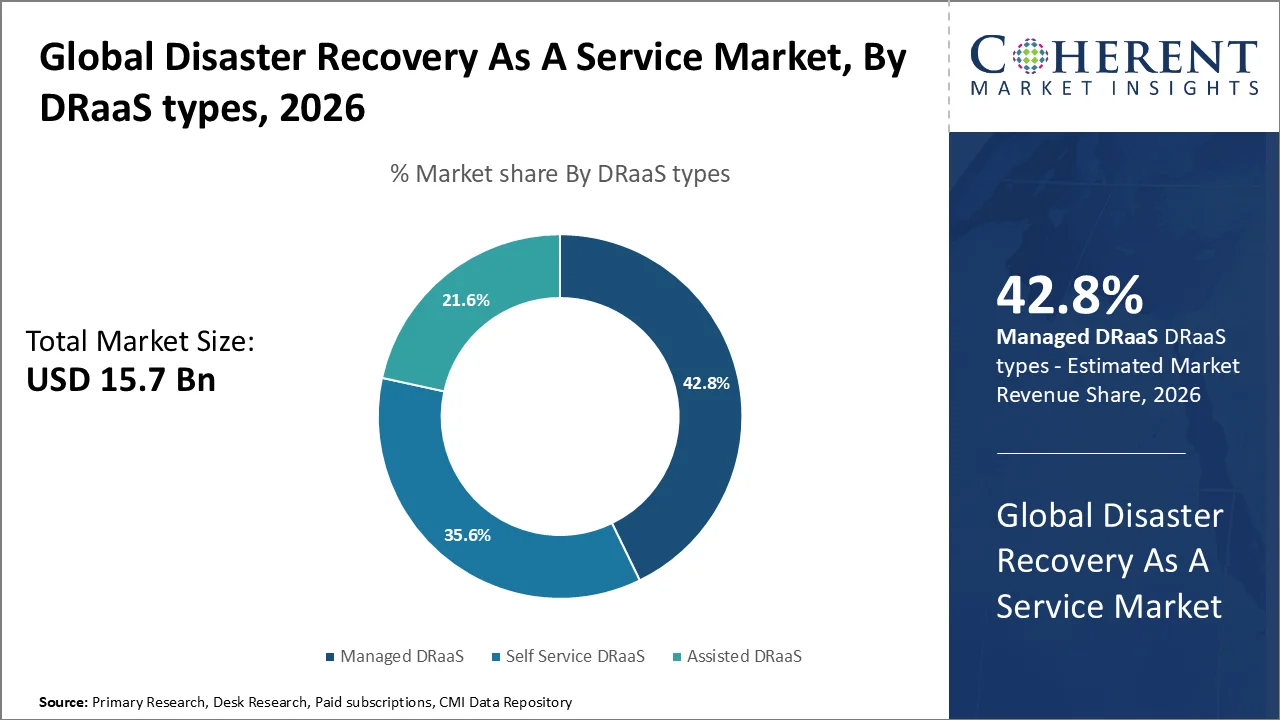
- Managed DRaaS hold the largest market share of 42.8% in 2026 owing to its growing frequency of cyberattacks and ransomware. Organizations worldwide experienced an average of 2,086 cyberattacks per week in early 2026, representing a 9.6% increase compared with the same period in 2025.
- Training & Consulting expected to hold largest market share of 39.7% in 2026 owing to the growing shortage of skilled disaster-recovery professionals. The global emergency, disaster, and recovery management sector employs more than 2.2 million people, with approximately 97,800 jobs added in 2024.
- Cloud Service provider acquired the prominent market share of 38.6% in 2026 owing to the rapid adoption of cloud computing.
- Public cloud captures the largest market share of 45.7% in 2026 owing to its rapid adoption of public cloud infrastructure. Public cloud end-user spending is projected to increase by 21.3% in 2026, reaching approximately USD 850 Bn.
- Small & medium enterprises (SMEs) is expected to account the largest share of 52.7% in 2026 owing to the limited IT budgets and capital constraints.
- North America is expected to acquire the dominant share of 41.3% in 2026 owing to its mature cloud infrastructure and high cloud adoption.
Current Events and Their Impact on the Disaster Recovery As A Service Market
Current Event | Description and its Impact |
EU Digital Operational Resilience Act (DORA) Became Applicable on January 17, 2025 |
|
EU NIS2 Cybersecurity Rules Entered the Implementation Phase in 2024–2026 |
|
Segmental Insights
- Current Industry Events of 2026
- Market Size Estimation
- Regional Breakdown
- Competitive Landscape
- Customer Intelligence
- Segmental Analysis
- Pricing Analysis
- Key Market Drivers, Challenges & Future Trends
- Customized Insights Section
Why is Managed DRaaS Acquiring the Largest Market Share?
Managed DRaaS hold the largest market share of 42.8% in 2026. Organizations are driving Managed DRaaS adoption as they seek end-to-end disaster recovery management, continuous monitoring, automated recovery, and specialized technical expertise. Rising ransomware attacks, expanding cloud adoption, and increasingly complex hybrid IT environments make it challenging for companies to manage recovery operations internally. In 2024, the United States was the most targeted country for ransomware attacks, with more than 1.3 million attacks detected. Thailand ranked second, recording approximately 1.1 million detections. Globally, monthly ransomware detections peaked in November 2024 at 632 incidents. Managed DRaaS providers help organizations reduce operational complexity by handling testing, maintenance, replication, and recovery activities. These services also strengthen business continuity, minimize downtime, improve resilience, and reduce the need for organizations to invest in and maintain dedicated disaster-recovery infrastructure. In July 2026, ValorC3 Data Centers launched its fully managed Disaster Recovery as a Service (DRaaS) solution, enabling businesses to recover critical workloads across its Boise, Idaho, and St. George, Utah, regions. The solution supports workloads on Valor Cloud and ValorC3 infrastructure while also replicating data from external environments.
Training & Consulting expected to hold largest market share
Training & Consulting expected to hold largest market share of 39.7% in 2026 owing to the need for regular DR testing and simulation. Organizations drive demand for training and consulting in the DRaaS market as they manage increasingly complex cloud and hybrid IT environments, limited disaster recovery expertise, rising cyber threats, and stricter compliance requirements. They rely on expert consultants to develop recovery strategies, evaluate risks, define RTOs and RPOs, and conduct regular recovery tests. Training programs equip IT teams to manage emerging technologies and improve preparedness. By strengthening resilience, reducing downtime, closing skills gaps, and maximizing DRaaS investments, these services support effective disaster recovery. In September 2025, Civix launched Civix Consulting Group (CCG) by consolidating its disaster recovery, community planning, resilience, and right-of-way practices.
Which Enterprise segment dominates the market?
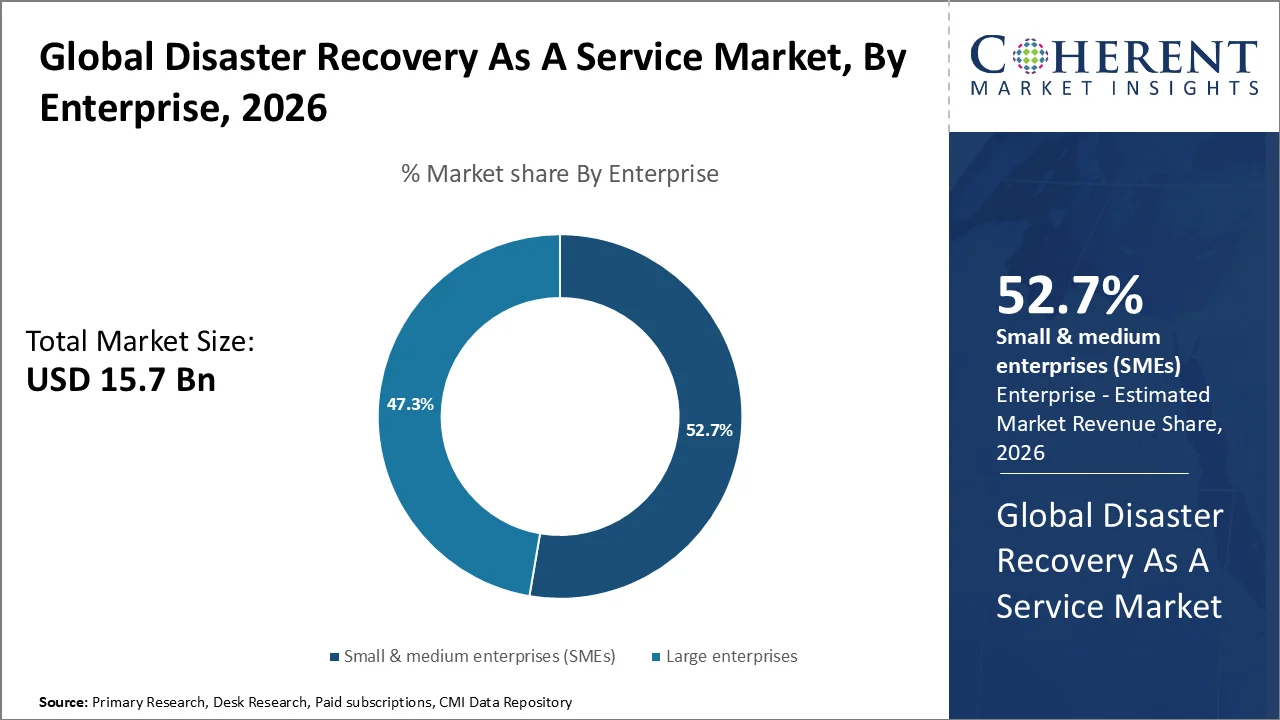
Small & medium enterprises (SMEs) is expected to account the largest share of 52.7% in 2026. SMEs increasingly adopt DRaaS to achieve cost-effective disaster recovery, overcome limited IT resources, strengthen protection against cyber threats, and access flexible cloud solutions. Small and medium-sized businesses use cloud-based recovery services to lower infrastructure expenses while gaining scalable backups, faster recovery, and improved business continuity. As digital operations expand, downtime creates greater business risks, encouraging SMEs to strengthen resilience. DRaaS providers help SMEs address skills shortages by offering specialized expertise, managed services, and automated recovery capabilities without requiring dedicated internal teams.
Disaster Recovery As A Service Market Trends
- Rising adoption of cloud-native and hybrid DRaaS solutions enables organizations to protect workloads across public cloud, private cloud, and on-premises environments, providing greater scalability, flexibility, and business continuity. Hybrid and multi-cloud configurations are becoming increasingly important as enterprises operate distributed IT environments. The regulatory emphasis on cloud and third-party resilience is also increasing: the EU's Digital Operational Resilience Act (DORA), applicable since January 17, 2025, specifically addresses ICT third-party risk, including risks associated with providers supporting financial entities. DORA also establishes an EU-level oversight framework for critical ICT third-party providers.
- Increasing integration of AI, automation, and intelligent recovery orchestration is enhancing disaster recovery through predictive analytics, anomaly detection, automated failover, and faster response to disruptions. This trend is supported by the rapid expansion of enterprise AI adoption. Microsoft's 2025 Work Trend Index found that more than 80% of business leaders expected AI agents to be moderately or extensively integrated into their AI strategy within 12–18 months. As AI becomes embedded in business processes, organizations have greater incentive to automate recovery workflows and reduce manual intervention during disruptions.
- Growing focus on ransomware protection and cyber resilience is encouraging organizations to adopt immutable or isolated backups, zero-trust controls, and clean recovery environments. The scale of the recovery challenge is reflected in Veeam's 2026 Data Trust and Resilience Report: 90% of surveyed organizations said they were confident they could recover from a cyber incident within their RTOs, but only 28% of organizations affected by ransomware reported fully recovering all affected data. This gap between recovery confidence and demonstrated recovery capability supports demand for DRaaS solutions with recovery validation, ransomware-resilient backups, and automated recovery orchestration.
Regional Insights
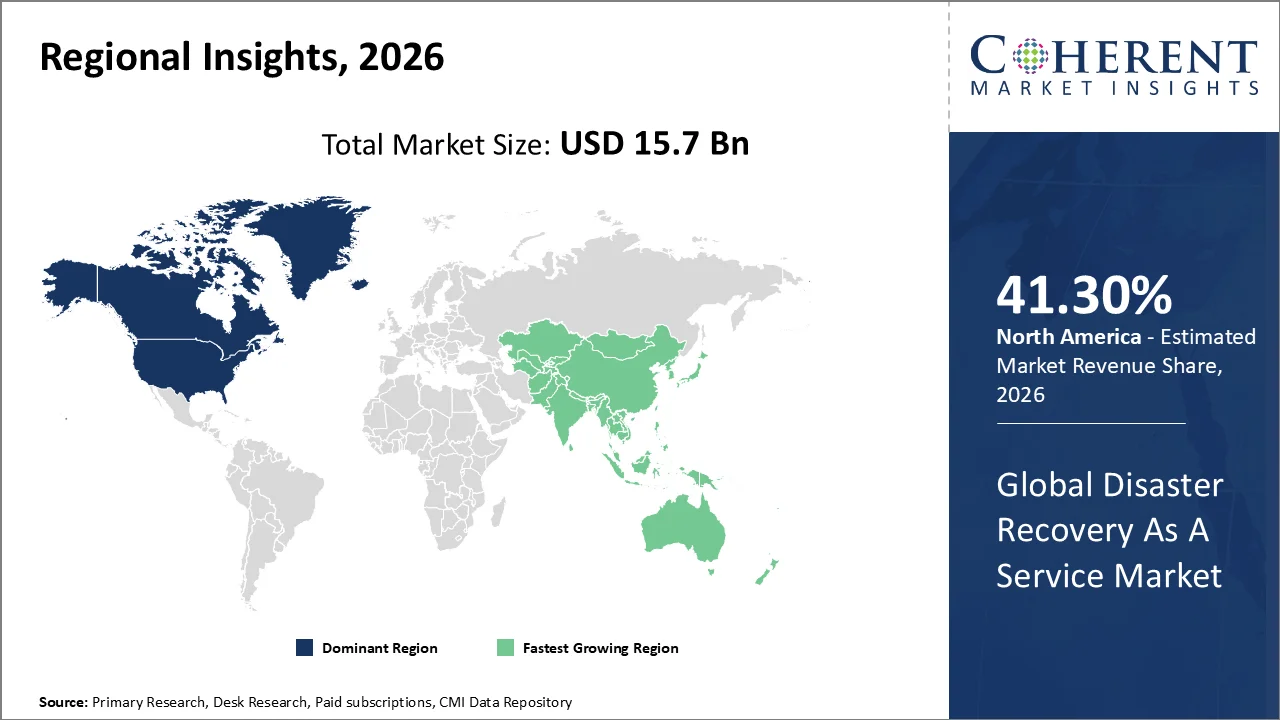
North America dominates owing to high cost of maintaining traditional disaster-recovery infrastructure
North America is expected to acquire the dominant share of 41.30% in 2026. Organizations across North America are driving DRaaS adoption through rising cyber threats, widespread cloud use, advanced IT infrastructure, and growing business continuity needs. Businesses increasingly deploy DRaaS to protect critical data and applications from ransomware, data breaches, outages, and other disruptions. The region’s rapid adoption of hybrid and multi-cloud environments further increases demand for flexible and scalable recovery solutions. Additionally, organizations seek cost savings and faster recovery while meeting regulatory requirements, and established technology providers support businesses in strengthening their disaster recovery capabilities. For instance, in May 2026, the Acronis Cyber Foundation Program, in partnership with U.S.-based MSP NetFusion, opened a new STEAM robotics lab at ChildHope School in San José, Costa Rica, to expand access to technology education and IT skills.
Asia Pacific Disaster Recovery As A Service Market Trends
Asia Pacific’s DRaaS market is driven by rapid cloud adoption, digital transformation, and growing business continuity needs. Rising ransomware attacks, data breaches, and cyber threats encourage businesses to strengthen backup and recovery systems. An estimated 52%–64% of organizations in India experienced ransomware attacks over the past year, placing the country among the most heavily targeted markets in the Asia-Pacific region. Stricter data protection regulations, expanding hybrid and multi-cloud adoption, and limited in-house IT expertise are also prompting enterprises and SMEs to adopt scalable, managed DRaaS solutions. For instance, in August 2026, Siliconops.ai launched siliconcloud.in, a sovereign cloud platform designed for India’s regulated enterprises, emphasizing data control and digital sovereignty.
United States Disaster Recovery As A Service Market Trends
The United States Disaster Recovery as a Service market is expanding as organizations respond to rising ransomware attacks, data breaches, and the need to maintain business continuity. Companies increasingly adopt cloud and hybrid IT environments, driving them to replace traditional recovery infrastructure with scalable cloud-based solutions. Regulatory and cybersecurity requirements further encourage organizations to strengthen backup, recovery, and resilience capabilities. Growing adoption across healthcare, financial services, government, and technology sectors, combined with continued digital transformation investments, further accelerates DRaaS demand nationwide. For instance, in August 2026, Lendistry Home Loans launched a Disaster Recovery Mortgage Pilot to help homeowners displaced by the 2025 Pacific Palisades and Eaton fires overcome rebuilding challenges.
Japan Disaster Recovery As A Service Market Trends
Japan’s Disaster Recovery as a Service (DRaaS) market is expanding as frequent earthquakes, tsunamis, typhoons, and other natural disasters push organizations to strengthen business continuity. Rising cyberattacks, ransomware threats, and data-security risks are also prompting businesses to improve their disaster recovery capabilities. In 2025, Japan recorded 134 ransomware incidents, a 17.5% increase from 2024. Organizations are increasingly adopting cloud technologies, digital transformation initiatives, remote work models, and scalable IT infrastructure, which further supports DRaaS demand. Regulatory compliance requirements, along with the need to minimize downtime, lower infrastructure costs, and simplify recovery processes, are encouraging adoption across financial services, manufacturing, healthcare, and government sectors.
Who are the Major Companies in Disaster Recovery As A Service Industry
Some of the major key players in Disaster Recovery As A Service are Acronis International, Amazon Web Services, Cisco Systems, Microsoft Corporation, IBM Corporation, Sungard Availability Services, VMWare, Hewlett Packard Enterprise, iland Internet Solutions, and NTT Communications Corporation.
Key News
- In February 2026, Gremlin launched Disaster Recovery Testing to safely test zone, region, and data-center failovers, helping businesses strengthen digital resilience, ensure compliance, and maintain continuity during major disruptions.
Market Report Scope
Disaster Recovery As A Service Market Report Coverage
| Report Coverage | Details | ||
|---|---|---|---|
| Base Year: | 2025 | Market Size in 2026: | USD 15.7 Bn |
| Historical Data for: | 2020 To 2024 | Forecast Period: | 2026 To 2033 |
| Forecast Period 2026 to 2033 CAGR: | 9.8% | 2033 Value Projection: | USD 28.2 Bn |
| Geographies covered: |
| ||
| Segments covered: |
| ||
| Companies covered: | Acronis International, Amazon Web Services, Cisco Systems, Microsoft Corporation, IBM Corporation, Sungard Availability Services, VMWare, Hewlett Packard Enterprise, iland Internet Solutions, and NTT Communications Corporation. | ||
Analyst Opinion
- DRaaS demand is being driven less by optional cloud modernization and more by the financial consequences of downtime. Gartner estimates that IT downtime can cost organizations thousands of dollars per minute, making outsourced recovery increasingly attractive for businesses that cannot justify maintaining fully redundant in-house infrastructure. In my view, this shifts DRaaS from an IT convenience to a business-risk management priority.
- Cyber resilience is becoming the strongest adoption trigger. The global average cost of a data breach remains in the multimillion-dollar range, while ransomware continues to disrupt operations across industries. From an analyst perspective, organizations increasingly view DRaaS as a critical recovery layer against ransomware, particularly when immutable backups and isolated recovery environments can help prevent attackers from compromising both primary and backup systems.
- The market’s strongest opportunity lies in hybrid and cloud-native recovery rather than traditional backup outsourcing. Microsoft reported that more than 60% of organizations worldwide use cloud services, while enterprises increasingly distribute workloads across multiple environments. This complexity makes conventional disaster recovery harder to manage. DRaaS providers that combine automated failover, continuous replication, orchestration, and recovery testing will gain a structural advantage because customers increasingly want measurable recovery readiness rather than simply storing backup copies.
- Regulatory pressure is also turning disaster recovery into a board-level requirement. Financial institutions, healthcare organizations, and government agencies face strict expectations around data availability, operational resilience, and recovery capabilities. The European Union’s Digital Operational Resilience Act (DORA), for example, requires financial entities to strengthen ICT risk management and resilience. These requirements will favor DRaaS vendors capable of providing documented recovery objectives, automated testing, compliance reporting, and geographically resilient infrastructure rather than vendors competing primarily on storage costs.
- The competitive differentiator will ultimately be recovery performance, not backup capacity. Organizations increasingly expect recovery point objectives (RPOs) and recovery time objectives (RTOs) to move from hours toward minutes for mission-critical workloads. Providers that can demonstrate rapid, repeatable recovery through automation and frequent testing to capture greater enterprise demand, particularly as ransomware, cloud outages, and operational disruptions make “having a backup” fundamentally different from “being able to recover.”
Speak to the analyst
Want personalized insights?
Take the findings above to one of our principal consultants, or have the report rebuilt around the segments, geographies and competitors you actually track.
Market Segmentation
- By DRaaS types (Revenue, USD Bn, 2021-2033)
- Self Service DRaaS
- Assisted DRaaS
- Managed DRaaS
- By Services (Revenue, USD Bn, 2021-2033)
- Training & Consulting
- Maintenance & Support
- System Integration
- By Providers (Revenue, USD Bn, 2021-2033)
- Cloud Service provider
- Managed Service Provider
- Telecom and Communication Service Provider
- Others
- By Deployment models (Revenue, USD Bn, 2021-2033)
- Public cloud
- Private cloud
- Hybrid Cloud
- By Enterprise (Revenue, USD Bn, 2021-2033)
- Small & medium enterprises (SMEs)
- Large enterprises
- By End use industry (Revenue, USD Bn, 2021-2033)
- BFSI
- Government
- Retail & consumer goods
- Manufacturing
- Healthcare
- IT & Telecommunication
- Media & Entertainment
- Others
- By Region (Revenue, USD Bn, 2021-2033)
- North America
- U.S.
- Canada
- Latin America
- Brazil
- Mexico
- Argentina
- Rest of Latin America
- Europe
- Germany
- U.K.
- France
- Italy
- Spain
- Russia
- Rest of Europe
- Asia Pacific
- China
- India
- Japan
- Australia
- South Korea
- ASEAN
- Rest of Asia Pacific
- Middle East
- GCC
- Israel
- Rest of Middle East
- Africa
- South Africa
- Central Africa
- North Africa
- North America
Sources
Primary Research interviews
- CIOs, CTOs, CISOs, IT infrastructure managers, cloud architects, disaster recovery managers, and business continuity professionals
- Interviews with enterprise IT decision-makers across banking, financial services, healthcare, manufacturing, retail, telecommunications, and government
- Discussions with DRaaS service providers, cloud infrastructure specialists, system integrators, cybersecurity professionals, and data-center operators
- End-user interviews focused on DRaaS adoption, RTO/RPO requirements, recovery testing, cloud migration, cybersecurity resilience, and vendor selection
Databases
- U.S. Census Bureau
- Eurostat
- World Bank Open Data
- OECD Data
- International Telecommunication Union (ITU) Statistics
- United Nations Data
- Federal Reserve Economic Data (FRED)
- U.S. Bureau of Economic Analysis (BEA)
- U.S. Bureau of Labor Statistics (BLS)
- National Institute of Standards and Technology (NIST) publications and datasets
Magazines
- CIO
- Computerworld
- InformationWeek
- CSO
- Network World
- IEEE Spectrum
- ITPro
- SC Media
Journals
- IEEE Transactions on Cloud Computing
- IEEE Transactions on Dependable and Secure Computing
- ACM Computing Surveys
- Journal of Cloud Computing
- International Journal of Information Management
- Computers & Security
- Reliability Engineering & System Safety
- Future Generation Computer Systems
Newspapers
- The Wall Street Journal
- The New York Times
- Financial Times
- The Guardian
- The Economic Times
- The Hindu
- Business Standard
- Nikkei Asia
Associations
- Cloud Security Alliance — DRaaS architecture, cloud security, and best-practice resources
- IEEE
- ISACA
- Information Systems Audit and Control Association
- Business Continuity Institute
- Association for Computing Machinery
Public Domain sources
- National Institute of Standards and Technology (NIST) — contingency planning, cybersecurity recovery, cloud computing, RTO/RPO, and resilience guidance
- Cybersecurity and Infrastructure Security Agency (CISA) — critical-infrastructure security and resilience guidance
- U.S. Government Publishing Office (GovInfo) — federal technology and contingency-planning publications
- International Organization for Standardization (ISO) — ISO 22301 business continuity and ISO 22336 organizational resilience standards
- International Telecommunication Union (ITU)
- U.S. Department of Homeland Security (DHS)
- Federal Emergency Management Agency (FEMA)
- U.S. Cybersecurity and Infrastructure Security Agency (CISA)
- Government statistical agencies and regulatory bodies across major markets
Proprietary Elements
- CMI Data Analytics Tool
- Proprietary CMI Existing Repository of information for last 10 years
Get access to 250+ pages report
Every segment, forecast, competitor profile and data table behind the analysis above — available for instant download.
- ESOMAR Member
- ISO 9001:2015 Certified
- D-U-N-S Registered
- GDPR & CCPA Compliant
Missing comfort of reading report in your local language? Find your preferred language:
Transform your Strategy with Exclusive Trending Reports
Frequently Asked Questions
The Disaster Recovery As A Service Market is anticipated to grow at a CAGR of 9.8% with USD 15.7 Bn share in 2026 and is expected to reach USD 28.2 Bn in 2033.
The market is primarily driven by rising ransomware and cyberattack risks, growing dependence on cloud-based applications, and the need to minimize operational downtime.
DRaaS reduces the need for organizations to build and maintain expensive secondary data centers and dedicated recovery infrastructure.
Ransomware has made rapid and reliable recovery a strategic priority.
Financial services, healthcare, manufacturing, retail, telecommunications, government, and IT services are among the key adopting sectors.
Cloud adoption is a major catalyst because it allows companies to replicate workloads and data across geographically distributed environments without investing heavily in physical infrastructure.