

Enterprise Network Lan Equipment Market Size and Forecast — 2026 - 2033
The Global Enterprise Network LAN Equipment Market size is estimated to be valued at USD 15.2 billion in 2026 and is expected to reach USD 28.6 billion by 2033, exhibiting a compound annual growth rate (CAGR) of 9.1% from 2026 to 2033.
Overview
The enterprise network LAN equipment market comprises hardware and software solutions that enable efficient, secure, and high-speed connectivity within organizational networks. Key products include switches, routers, and hubs that form the backbone of data transmission, along with wireless access points that provide seamless Wi-Fi connectivity. Network controllers and firewalls ensure centralized management, security, and traffic optimization. Additionally, network management software supports monitoring, configuration, and performance analytics. Advanced products incorporate features such as SDN (Software-Defined Networking) compatibility, cloud integration, and IoT device support. These solutions cater to diverse enterprise needs, enhancing operational efficiency, data security, and scalability across small, medium, and large organizations.
Key Takeaways
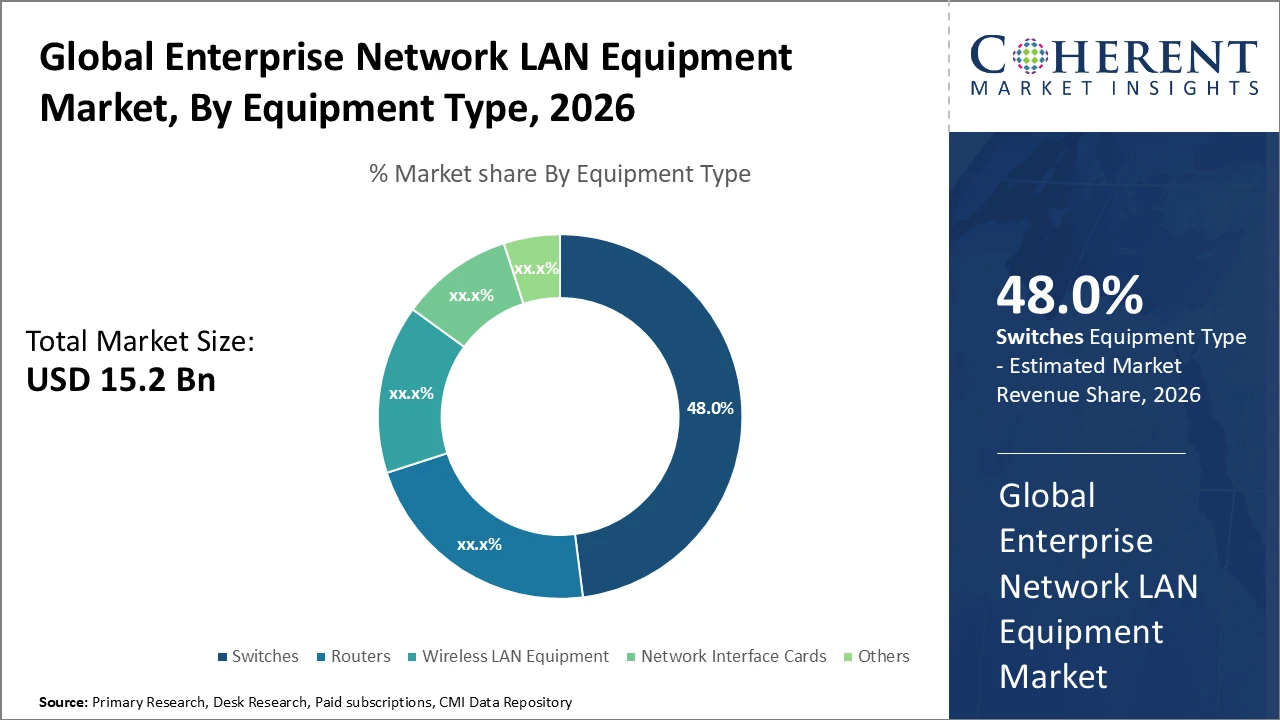
The switches segment dominates the market with a 48% share, owing to its essential role in enterprise connectivity and backbone network operations.
Wireless LAN equipment is the fastest-growing subsegment, driven by hybrid work models and rising adoption of Wi-Fi 6 and Wi-Fi 7 technologies.
Other equipment categories, including routers and NICs, remain relevant due to evolving network architectures and demand for flexible connectivity solutions.
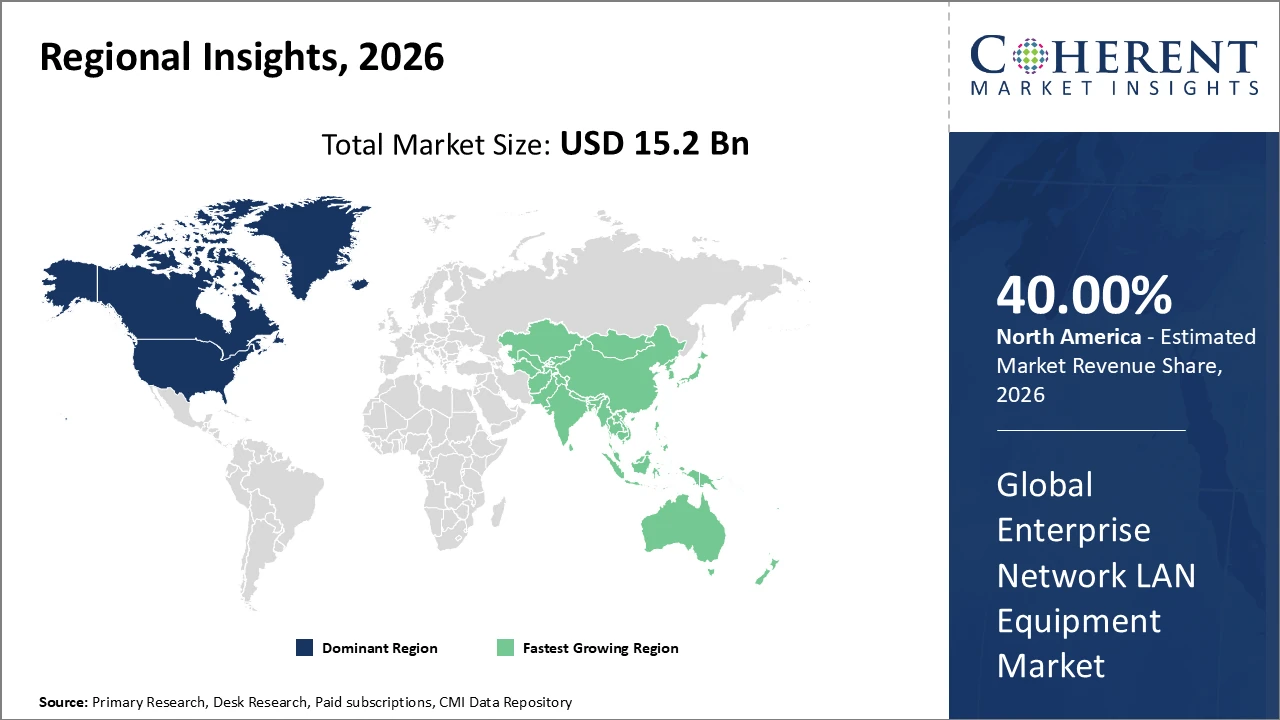
North America holds the largest regional market share, supported by advanced IT infrastructure and early technology adoption.
Asia Pacific is the fastest-growing region, with a CAGR exceeding 12%, fueled by expanding manufacturing sectors and government investment in digital infrastructure.
Europe demonstrates steady market growth, driven by increased cloud adoption and strict network security regulations.
Enterprise Network Lan Equipment Market Segmentation Analysis
Enterprise Network Lan Equipment Market Insights, By Equipment Type
Switches dominate the enterprise network LAN equipment market due to their critical role in managing high volumes of data traffic, supported by advancements in multi-gigabit and programmable architectures that enable scalable data center and campus networks. The fastest-growing subsegment is Wireless LAN equipment, driven by hybrid work adoption and substantial investments in Wi-Fi 6/7 infrastructure, offering higher throughput and lower latency. Routers remain essential for complex network routing and multi-site connectivity, while NICs provide versatile interface options, particularly for server virtualization, though growth is moderate.
Enterprise Network Lan Equipment Market Insights, By End User Industry
The IT & Telecom sector captures the highest market share, driven by ongoing network infrastructure upgrades and expanding cloud services requiring advanced LAN equipment. The fastest-growing segment is Manufacturing, fueled by Industry 4.0 initiatives that deploy private 5G and integrated LAN solutions to enhance production efficiency. BFSI experiences steady growth due to stringent cybersecurity and uptime demands necessitating reliable networks. Healthcare demand rises from digital health records and telemedicine, requiring secure, high-speed connectivity. Government and Defense investments in modernized network infrastructure expand market scope but face constraints from complex compliance requirements. Retail leverages wireless LAN equipment for e-commerce and omnichannel operations.
Enterprise Network Lan Equipment Market Insights, By Deployment Mode
On-premises deployment dominates the enterprise network LAN equipment market, driven by strict data security requirements and legacy system investments among large enterprises and government agencies that necessitate dedicated infrastructure. The fastest-growing segment is hybrid deployment, reflecting a shift toward combining centralized cloud management with on-site network control to balance flexibility, scalability, and security. Cloud-based deployments are increasingly adopted by SMEs and fast-growing technology firms due to lower capital expenditure and improved network visibility.
Enterprise Network Lan Equipment Market Trends
The enterprise network LAN equipment market is being transformed by AI integration, advanced wireless connectivity, and network programmability.
Adoption of AI-powered network tools has improved uptime and operational efficiency, with enterprises reporting a 25% reduction in network-related disruptions in 2026.
The rollout of Wi-Fi 7 technology is set to revolutionize enterprise wireless networks, with early 2025 deployments demonstrating a 40% increase in throughput in dense office environments.
The shift toward software-defined networking reflects a broader trend of infrastructure flexibility and rapid scalability, supported by hybrid cloud deployments growing over 30% year over year.
Enterprise Network Lan Equipment Market Insights, By Geography
North America Enterprise Network Lan Equipment Market Analysis and Trends
In North America, the enterprise network LAN equipment market is dominated by a mature IT ecosystem, substantial R&D investments, and early adoption of next-generation networking technologies. The region holds over 40% of the global market share, driven by large-scale deployments across enterprises in the U.S. prioritizing digital transformation, cloud integration, and hybrid work models. Advanced infrastructure, high IT spending, and proactive technology adoption contribute to the region’s leadership. Organizations are increasingly investing in AI-enabled network management, Wi-Fi 6/7 upgrades, and software-defined networking to enhance operational efficiency, scalability, and security, reinforcing North America’s position as a key market for LAN equipment.
Asia Pacific Enterprise Network Lan Equipment Market Analysis and Trends
Asia Pacific is experiencing the fastest growth in the enterprise network LAN equipment market, with a CAGR exceeding 12%, driven by the expansion of manufacturing hubs, government-led digital infrastructure initiatives, and growing adoption of networking technologies among SMEs. Rapid industrialization and urbanization in countries like China and India are fueling demand for high-speed, reliable, and scalable network solutions. Investments in smart factories, hybrid workplaces, and cloud integration further accelerate LAN equipment deployment. Additionally, government policies supporting ICT development and digital transformation initiatives are creating favorable market conditions, positioning Asia Pacific as a key growth region in the global enterprise network LAN equipment landscape.
Enterprise Network Lan Equipment Market Outlook for Key Countries
USA Enterprise Network Lan Equipment Market Analysis and Trends
The U.S. enterprise network LAN equipment market remains highly influential, led by major players such as Cisco, Arista Networks, and Juniper Networks, which set technology standards and capture significant revenue. Widespread adoption of cloud-managed network services, coupled with early Wi-Fi 7 deployments in financial and technology sectors, has further stimulated market demand, establishing the U.S. as a global innovation hub. Government investments in secure network infrastructure for defense, public services, and critical sectors also contribute to sustained growth. Combined, enterprise modernization, regulatory support, and advanced technology adoption reinforce the U.S. market’s leadership in the global LAN equipment landscape.
Germany Enterprise Network Lan Equipment Market Analysis and Trends
Germany’s enterprise network LAN equipment market is characterized by strong demand for high‑performance, secure, and scalable network solutions across industrial, automotive, and public sectors. The country’s focus on Industries 4.0 initiatives and smart manufacturing drives adoption of advanced LAN technologies, including SD‑WAN, Wi‑Fi 6/7, and AI‑enabled network management tools. German enterprises prioritize network security and compliance with stringent data protection standards, influencing purchasing decisions. Additionally, collaborations between local technology vendors and global OEMs support innovation and tailored solutions. Steady investments in digital infrastructure, coupled with growing cloud integration and hybrid work adoption, underpin ongoing market development and technology adoption trends.
Analyst Opinion
Enhanced demand for high-capacity switches is significantly driving market revenue. In 2025, enterprises upgrading from 1G to 10G switches recorded a 35% increase in LAN equipment spending, reflecting the need for higher throughput to support data-intensive applications and virtualized environments.
Pricing trends show a gradual decline in WLAN equipment costs, enabling wider adoption among SMEs. By 2026, competitive pressures reduced the average selling price of wireless access points by nearly 10%, improving accessibility for cost-conscious enterprises.
The rise of private 5G networks is creating new LAN equipment use cases in campus and industrial settings. In 2024, private 5G deployments grew over 50% in Asia Pacific manufacturing hubs, indicating a shift toward integrated LAN-cellular network designs.
Import-export dynamics affect regional market balances, as North American enterprises increasingly rely on Asian-manufactured LAN hardware. In 2026, U.S. LAN equipment imports rose 12% year-on-year, reflecting supply expansion and diversification strategies impacting costs and market shares.
- Current Industry Events of 2026
- Market Size Estimation
- Regional Breakdown
- Competitive Landscape
- Customer Intelligence
- Segmental Analysis
- Pricing Analysis
- Key Market Drivers, Challenges & Future Trends
- Customized Insights Section
Market Scope
| Report Coverage | Details | ||
|---|---|---|---|
| Base Year: | 2025 | Market Size in 2026: | USD 15.2 billion |
| Historical Data for: | 2020 To 2024 | Forecast Period: | 2026 To 2033 |
| Forecast Period 2026 to 2033 CAGR: | 9.1% | 2033 Value Projection: | USD 28.6 billion |
| Geographies covered: |
| ||
| Segments covered: |
| ||
| Companies covered: | Cisco Systems Inc., Juniper Networks Inc., NETGEAR Inc., D-Link Corporation, Fortinet Inc., Nokia Corporation, IBM Corporation, Ciena Corporation, Extreme Networks Inc., Dell Technologies Inc. | ||
| Growth Drivers: |
| ||
Enterprise Network Lan Equipment Market Growth Factors
The surge in large-scale data center expansions is driving demand for high-performance LAN switching equipment capable of handling bandwidth-intensive workloads. Hybrid work models further increase adoption of scalable and secure wireless LAN solutions, evidenced by a 30% rise in deployments across global corporate offices in 2025. Accelerated cloud adoption is supporting cloud-managed LAN infrastructures, improving network visibility and management, with cloud-based deployments growing at double-digit rates in 2026. Additionally, heightened regulatory focus on network security has prompted enterprises to invest in next-generation LAN equipment with integrated security features, highlighted by a 22% increase in secure LAN deployments in the government sector in 2024.
Enterprise Network Lan Equipment Market Development
In May 2025, Nokia launched Aurelis Optical LAN, a next-generation fiber-based solution designed to deliver high-performance, efficient, and future-ready connectivity for enterprise and campus networks.
Key Players
Leading Companies of the Market
Cisco Systems Inc.
Juniper Networks Inc.
NETGEAR Inc.
Nokia Corporation
IBM Corporation
Ciena Corporation
Dell Technologies Inc.
Fortinet Inc.
D-Link Corporation
Extreme Networks Inc.
Leading market players are focusing on competitive strategies such as product innovation and strategic partnerships to strengthen their market positions. In 2026, Cisco integrated AI-driven network management tools, resulting in a 15% increase in enterprise client retention. Simultaneously, HPE emphasized edge computing-enabled LAN solutions, expanding its presence in the manufacturing sector and increasing its market share in Asia Pacific by 8% in 2025. These strategic initiatives have intensified competition across the enterprise network LAN equipment market, fostering innovation, driving adoption of advanced technologies, and shaping key industry trends toward intelligent, scalable, and secure networking solutions.
Enterprise Network Lan Equipment Market Future Outlook
The enterprise network LAN equipment market is poised for strong growth, driven by increasing digital transformation, hybrid work adoption, and data-intensive applications across enterprises. Future trends include widespread deployment of Wi-Fi 7, AI-enabled network management, and software-defined networking, enhancing scalability, performance, and security. Cloud-managed LAN solutions and hybrid deployments will gain traction among SMEs and large organizations seeking flexible, cost-efficient infrastructure. Integration with edge computing and IoT devices will create new use cases, particularly in manufacturing and smart campus environments. Regulatory emphasis on network security and increased investment in private networks will further support market expansion and technological innovation over the coming decade.
Enterprise Network Lan Equipment Market Historical Analysis
The enterprise network LAN equipment market has evolved steadily over the past decade, driven by increasing enterprise digitization and the rise of data-centric operations. Initially dominated by basic switches, routers, and NICs, the market gradually incorporated wireless LAN solutions and advanced network management tools to support growing connectivity demands. Between 2015 and 2020, adoption of cloud services, virtualization, and hybrid work models accelerated the need for scalable and secure LAN infrastructures. North America led early growth due to advanced IT ecosystems, while Asia Pacific emerged as a key market with expanding manufacturing and SME adoption. Regulatory focus on network security also shaped investment trends historically.
Sources
Primary Research Interviews:
IT infrastructure managers and network operations executives
LAN equipment manufacturers and solution providers
AI, SDN, and cloud networking technology developers
Industry analysts and consultants specializing in enterprise networking
Magazines:
Network World – Enterprise Networking and LAN Equipment Updates
Enterprise Networking Planet – Technology Innovations and Deployments
CIO Magazine – Networking Strategies and IT Infrastructure Developments
InformationWeek – Enterprise Networking Trends and Case Studies
Journals:
IEEE Communications Surveys & Tutorials – LAN Technologies and Performance Studies
Journal of Network and Computer Applications – Enterprise Networking Research
International Journal of Network Management – LAN Deployment and Optimization
Computer Networks – Advances in Enterprise Network Infrastructure
Newspapers:
The Wall Street Journal – Enterprise Networking and IT Infrastructure Markets
Financial Times – Networking Technologies and Enterprise IT Developments
Reuters – Enterprise LAN Equipment and Technology News
Bloomberg – Networking Hardware Market Trends and Enterprise Deployments
Associations:
Institute of Electrical and Electronics Engineers (IEEE) – Networking Standards and Research
Open Networking Foundation (ONF) – SDN and LAN Innovation
Telecommunications Industry Association (TIA) – LAN Infrastructure Guidelines
Get access to 250+ pages report
Every segment, forecast, competitor profile and data table behind the analysis above — available for instant download.
- ESOMAR Member
- ISO 9001:2015 Certified
- D-U-N-S Registered
- GDPR & CCPA Compliant
Missing comfort of reading report in your local language? Find your preferred language:
Transform your Strategy with Exclusive Trending Reports
Frequently Asked Questions
The market is dominated by industry leaders such as Cisco Systems, Juniper Networks, Fortinet Inc., and Dell Technologies Inc., which collectively drive significant market revenue and innovation.
The market size is projected to reach USD 28.6 billion by 2033, expanding at a CAGR of 9.1% from 2026 to 2033, indicating robust industry trends and business growth potential.
The IT and Telecom sector exhibits the largest growth opportunity, accounting for the predominant share in market usage due to ongoing digital transformations and expanded network infrastructure needs.
Market trends will evolve towards increased integration of AI-driven network management, Wi-Fi 7 adoption, and the integration of LAN with SDN, facilitating enhanced network flexibility and automation.
The landscape is highly competitive, characterized by rapid innovation cycles and pricing pressures. Market restraints include complex deployment challenges and stringent security regulations impacting market growth strategies.
Leading market players adopt product innovation, strategic alliances, and cloud-managed service models to enhance market penetration and customer retention, successfully navigating market dynamics.