

Chatbots For Banking Market Size and Forecast — 2026 - 2033
The Global Chatbots for Banking Market size is projected to be valued at USD 1.35 billion in 2026 and is anticipated to reach USD 4.78 billion by 2033, growing at a compound annual growth rate (CAGR) of 19.8% during the forecast period from 2026 to 2033.
Overview
The growth of chatbots in the banking sector is driven by rising demand for enhanced customer experience, cost-efficient operations, and 24/7 service availability. Banks are adopting AI-powered chatbots to handle routine queries, facilitate account management, and enable instant transaction support, reducing wait times and operational burden on staff. Integration of natural language processing (NLP) and machine learning enhances personalization, fraud detection, and predictive insights. The surge in digital banking, mobile app usage, and customer preference for self-service solutions further fuels adoption. Regulatory encouragement for secure digital interactions and competitive pressure among banks also accelerate chatbot deployment.
Key Takeaways
Customer support holds the dominant share due to its widespread use in handling routine inquiries, while fraud detection is the fastest-growing subsegment, driven by rising cybercrime incidents in recent years.
The retail banking end-user segment leads in industry share because of high chatbot adoption for personal finance management solutions, whereas corporate banking shows rapid growth fueled by chatbot-enabled credit risk assessment tools.
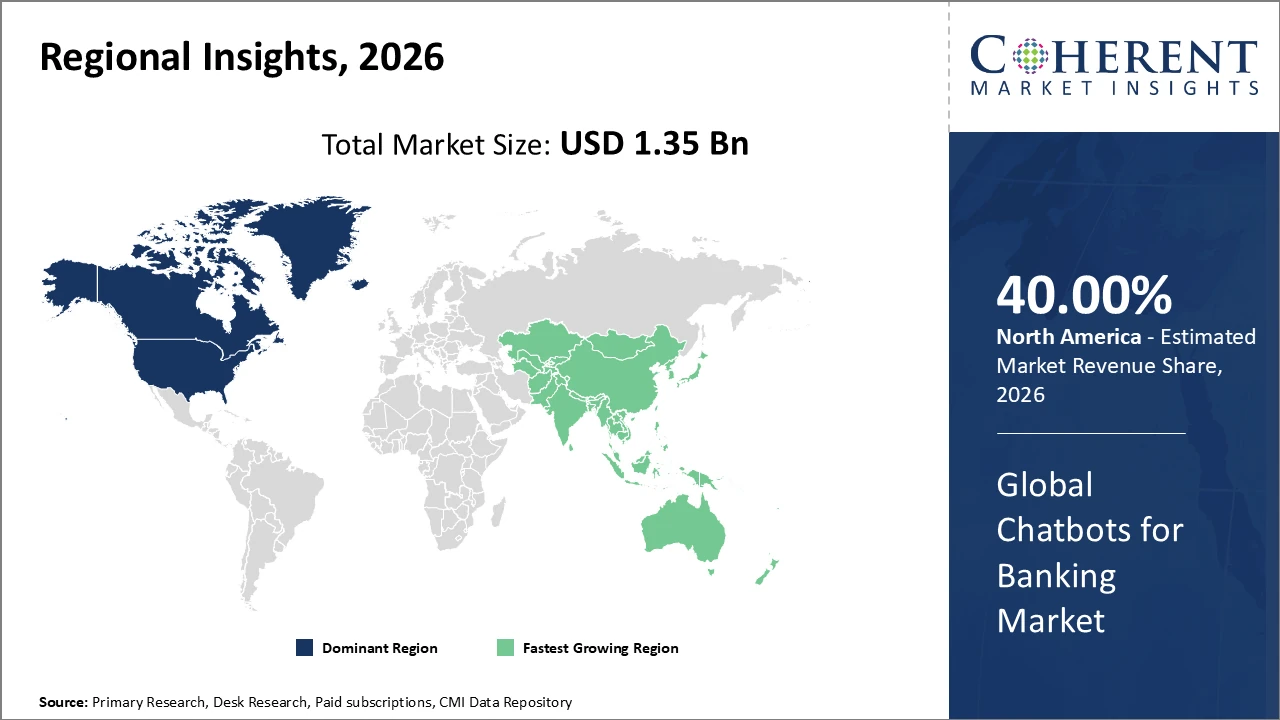
North America accounts for over 40% of the market share, supported by advanced AI infrastructure and strong digital banking penetration. Asia Pacific records the highest CAGR due to increasing smartphone adoption and expanding digital banking ecosystems, especially in India and China.
Europe’s regulatory emphasis on data privacy strengthens chatbot security protocols, creating a stable environment for market growth.
Chatbots for Banking Market Segmentation Analysis
Chatbots for Banking Market Insights, By Deployment Mode
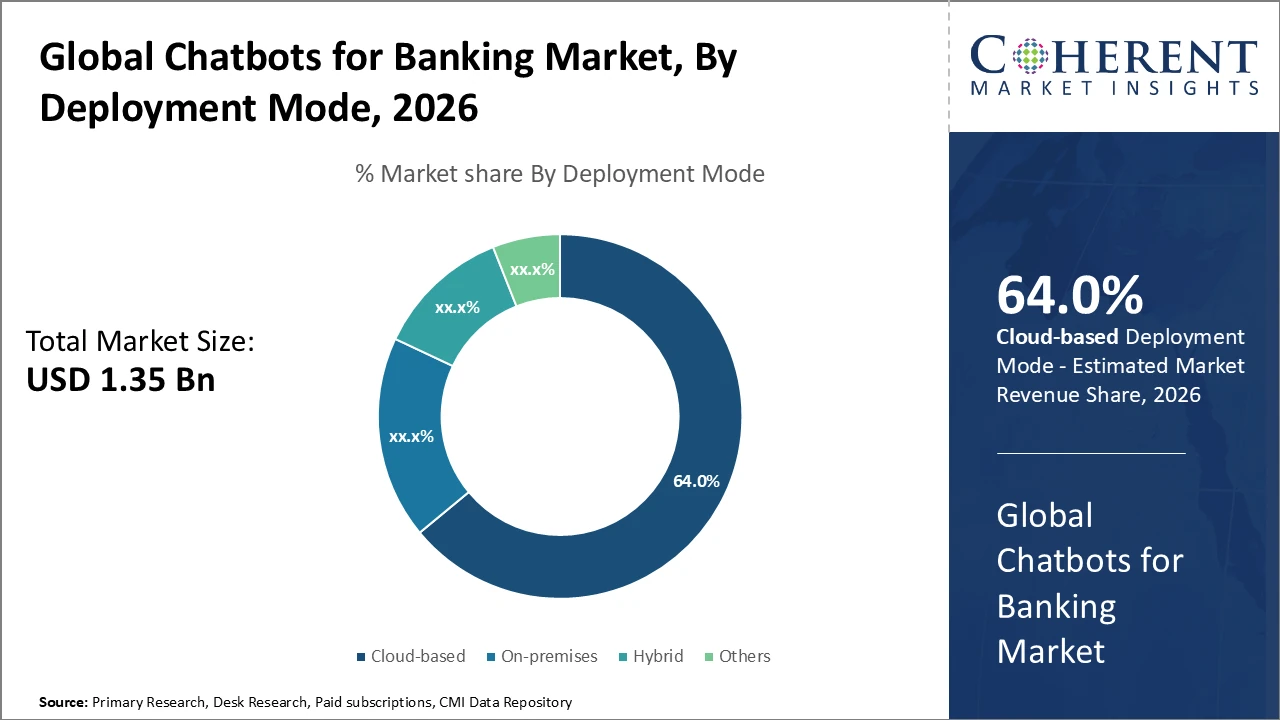
Cloud-based deployment dominates the chatbots for banking market, holding approximately 64% share due to its scalability, cost-effectiveness, and capability for continuous updates. It enables seamless integration across multiple banking channels and supports rapid feature enhancements. The fastest-growing subsegment is hybrid deployment, which combines the security of on-premises systems with cloud flexibility, gaining traction in highly regulated environments requiring data localization. On-premises deployment continues to serve banks with strict security protocols and legacy infrastructure.
Chatbots for Banking Market Insights, By Application
Customer support is the leading subsegment in the chatbots for banking market, capturing the majority share due to its widespread use in automating routine inquiries and enhancing response times. Fraud detection is the fastest-growing subsegment, driven by rising cyber threats and the need for AI-powered real-time risk analysis. Personalized banking chatbots provide tailored financial advice and product recommendations, improving customer satisfaction and engagement. Transaction processing bots manage transfers and payments, showing steady growth supported by regulatory approvals.
Chatbots for Banking Market Insights, By End User
Retail banking dominates the chatbots for banking market, supported by large consumer bases seeking efficient digital interfaces and multiple self-service options, including balance inquiries, fund transfers, and loan management. Corporate banking is the fastest-growing end-user segment, driven by chatbots assisting with complex processes such as credit assessments, invoicing, and compliance reporting. Investment banking increasingly leverages chatbots for client advisory services, market analytics, and portfolio management alerts, enhancing decision-making and client engagement.
Chatbots for Banking Market Trends
Market trends indicate a strong shift toward AI-driven contextual interactions, enhancing personalized and relevant customer experiences.
Omnichannel deployment is gaining traction as banks aim to provide seamless support across mobile apps, websites, and messaging platforms.
IBM’s Watson-assisted chatbots, deployed in 2025, showed a 25% improvement in query accuracy across various banking services, highlighting the impact of advanced AI.
There is an increasing preference for voice-based banking solutions, exemplified by Google’s Dialogflow, reflecting a move toward more interactive and accessible customer interfaces.
Chatbots for Banking Market Insights, By Geography
North America Chatbots for Banking Market Analysis and Trends
North America leads the chatbots for banking market, driven by advanced AI capabilities, robust banking infrastructure, and high consumer adoption of digital banking services. The United States represents over 35% of the regional market share, supported by significant investments in chatbot research and development and the integration of AI-powered solutions into widely used mobile banking apps. Leading banks, including JPMorgan Chase and Bank of America, have implemented intelligent chatbots for customer support, personalized financial advice, and transaction management. The region’s mature fintech ecosystem, regulatory support for innovation, and strong digital literacy continue to reinforce North America’s market dominance.
Asia Pacific Chatbots for Banking Market Analysis and Trends
The Asia Pacific region is experiencing the fastest growth in the chatbots for banking market, with a compound annual growth rate exceeding 22%. This rapid expansion is fueled by increasing digital adoption, widespread smartphone penetration, and supportive government initiatives encouraging fintech innovation. Countries such as India and China are leading the charge, leveraging mobile banking, digital payment platforms, and AI-driven customer service solutions to enhance financial inclusion. The growing demand for efficient, 24/7 banking services and personalized customer interactions further drives chatbot adoption. Overall, the region is becoming a key hub for advanced banking automation and AI-enabled financial services.
Chatbots for Banking Market Outlook for Key Countries
USA Chatbots for Banking Market Analysis and Trends
The USA chatbots for banking market has seen significant investments in AI-powered solutions, with major banks adopting advanced natural language processing models to enhance efficiency and reduce customer waiting times by 40% in 2025. Initiatives such as Wells Fargo’s AI chatbot integrations have boosted digital self-service adoption by more than 30%, improving customer engagement and operational efficiency. Supportive regulatory frameworks promoting digital banking and customer interaction have further encouraged innovation among both startups and established financial institutions. These combined factors have accelerated market growth, strengthened AI adoption in banking services, and reinforced the USA’s position as a global leader in chatbot technology.
Germany Chatbots for Banking Market Analysis and Trends
The Germany chatbots for banking market is witnessing steady growth, driven by increasing digitalization, customer demand for instant services, and the adoption of AI technologies by financial institutions. Banks are integrating chatbots for tasks such as account management, payments, loan inquiries, and personalized financial advice. Trends include the use of natural language processing for more human-like interactions, multilingual support to cater to diverse customer bases, and advanced analytics for predictive insights. Security and compliance remain key focus areas, while omnichannel deployment across mobile apps, websites, and messaging platforms enhances accessibility. Overall, German banks are leveraging chatbots to improve efficiency and customer engagement.
Analyst Opinion
Chatbot deployment is driving cost efficiency in banking operations, with automation reducing operational costs by up to 30%. For example, Bank of America’s Erica chatbot handled over 60 million client interactions in 2025, lowering call center workload by 40%.
Rising demand for personalized user experiences is expanding market revenue, as advanced AI chatbots adapt to customer preferences in real-time. A 2026 survey showed 55% of banking customers prefer chatbots for routine inquiries due to speed and customization.
Integration with omnichannel banking systems amplifies market growth, with banks combining chatbots with mobile apps, social media, and voice assistants, resulting in a 25% increase in digital engagement by early 2025.
Regulatory compliance and data security concerns influence market dynamics, prompting banks to follow strict protocols certified by GDPR and CCPA. In 2024, regulatory audits in Europe led to more robust chatbot deployment frameworks, enhancing investor confidence and supporting market expansion.
- Current Industry Events of 2026
- Market Size Estimation
- Regional Breakdown
- Competitive Landscape
- Customer Intelligence
- Segmental Analysis
- Pricing Analysis
- Key Market Drivers, Challenges & Future Trends
- Customized Insights Section
Market Scope
| Report Coverage | Details | ||
|---|---|---|---|
| Base Year: | 2025 | Market Size in 2026: | USD 1.35 billion |
| Historical Data for: | 2020 To 2024 | Forecast Period: | 2026 To 2033 |
| Forecast Period 2026 to 2033 CAGR: | 19.8% | 2033 Value Projection: | USD 4.78 billion |
| Geographies covered: |
| ||
| Segments covered: |
| ||
| Companies covered: | IBM Corporation, Nuance Communications, Infosys Limited, Google LLC, Microsoft Corporation, Oracle Corporation, Clinc, Avaamo Inc., Creative Virtual, Kasisto Inc. | ||
| Growth Drivers: |
| ||
Chatbots for Banking Market Growth Factors
The rise in smartphone penetration, coupled with the expansion of mobile banking platforms, has significantly boosted chatbot adoption as customers increasingly prefer 24/7 digital assistance. In 2024, mobile banking penetration reached 75% in North America, directly driving higher chatbot usage. Advanced AI algorithms have enhanced chatbots with contextual understanding and predictive analytics, enabling applications across banking services such as fraud prevention and loan processing. Regulatory support for contactless and digital banking, particularly through COVID-19 recovery initiatives in 2025, prompted banks worldwide to upgrade digital touchpoints, including chatbot deployments. Rising customer expectations for instant responses further accelerated adoption, resulting in a 35% reduction in average query resolution time at several US banks during 2026.
Chatbots for Banking Market Development
In September 2025, SoFi Technologies integrated its AI chatbot Konecta, powered by Galileo, enhancing efficiency and customer engagement. The rollout delivered faster responses, reduced costs, and higher satisfaction. Its impact is best understood in comparison with peers like Bank of America’s Erica and Wells Fargo’s Fargo.
Key Players
Leading Companies of the Market
IBM Corporation
Google LLC
Microsoft Corporation
Oracle Corporation
Infosys Limited
Nuance Communications
Clinc
Avaamo Inc.
Creative Virtual
Kasisto Inc.
Microsoft’s Azure Cognitive Services enhanced its banking chatbot API in 2025, achieving a 20% reduction in response latency for clients, improving overall service efficiency. Around the same time, IBM Watson partnered with a major European bank to deploy AI-driven chatbots with multilingual capabilities, significantly broadening regional market reach and accessibility. In 2026, Infosys introduced its Finacle Digital Engagement Suite, integrating chatbots with blockchain technology to enable secure financial transactions. This innovation provided a competitive advantage, strengthened client trust, and accelerated customer acquisition, reflecting the growing trend of combining AI and emerging technologies to enhance banking chatbot functionality and market differentiation.
Chatbots for Banking Market Future Outlook
The future outlook for the chatbots for banking market is highly promising, driven by rapid advancements in artificial intelligence, machine learning, and natural language processing. Banks are expected to increasingly adopt intelligent chatbots for personalized financial guidance, fraud detection, and seamless transaction management. Integration with voice assistants, open banking platforms, and omnichannel services will further enhance customer convenience. Additionally, the focus on data security, regulatory compliance, and AI ethics will shape product development. Emerging trends such as predictive analytics, emotion recognition, and multilingual support will enable more human-like interactions, positioning chatbots as essential tools for improving efficiency, engagement, and customer satisfaction.
Chatbots for Banking Market Historical Analysis
The historical analysis of the chatbots for banking market shows a gradual evolution from basic rule-based systems to advanced AI-driven solutions. Initially, banks used simple automated responses to handle FAQs and routine customer inquiries. Over time, the adoption of natural language processing and machine learning enabled chatbots to offer more interactive, personalized, and context-aware services. Early implementations focused on cost reduction and 24/7 customer support, while later developments emphasized customer engagement, predictive insights, and transaction capabilities. The market’s growth has been fueled by increasing smartphone penetration, digital banking trends, and the rising demand for efficient, convenient, and automated financial services.
Sources
Primary Research Interviews:
Bank executives, branch managers, and customer service heads responsible for implementing digital solutions and AI-based customer support.
IT directors, digital transformation leads, and procurement specialists overseeing chatbot platform selection and deployment.
AI solution providers, software product managers, and regulatory compliance experts involved in developing conversational AI and banking automation tools.
Magazines:
Banking Technology – Updates on AI, chatbots, and digital banking innovations.
Finextra – Insights into financial services technology trends, customer engagement, and automation.
The Banker – Coverage of banking innovations, fintech partnerships, and digital transformation strategies.
Journals:
Journal of Financial Services Research – Studies on AI adoption, customer experience, and chatbot effectiveness in banking.
International Journal of Bank Marketing – Research on digital channels, automation, and conversational banking tools.
AI in Financial Services – Focus on machine learning, NLP, and customer interaction analytics in banking.
Newspapers:
Financial Times – Global banking technology investments, market trends, and regulatory updates.
Reuters – Product launches, AI adoption in banking, and digital transformation news.
Bloomberg – Strategic initiatives, R&D in fintech, and corporate developments in digital banking services.
Associations:
European Banking Federation (EBF) – Guidelines, research updates, and best practices for AI and digital banking.
FinTech Association Germany – Conferences, market research, and innovation updates on banking chatbots.
International Finance Corporation (IFC) – Reports on digital financial services, AI adoption, and global trends in banking technology.
Get access to 250+ pages report
Every segment, forecast, competitor profile and data table behind the analysis above — available for instant download.
- ESOMAR Member
- ISO 9001:2015 Certified
- D-U-N-S Registered
- GDPR & CCPA Compliant
Missing comfort of reading report in your local language? Find your preferred language:
Transform your Strategy with Exclusive Trending Reports
Frequently Asked Questions
Dominant players include IBM Corporation, Microsoft Corporation, Google LLC, Infosys Limited, and Nuance Communications, consistently innovating with AI-powered banking solutions.
The market size is poised to grow from USD 1.35 billion in 2026 to approximately USD 4.78 billion by 2033, driven by widespread digitization.
Retail banking presents the largest growth opportunity due to its vast customer base and increasing demand for personalized, automated assistance.
Trends will evolve towards more emotionally intelligent chatbots, voice-assisted banking, and integration with open banking ecosystems enhancing user engagement.
The competitive landscape is marked by technological innovation, with challenges including data security, regulatory compliance, and scalability.
Key strategies include strategic partnerships, AI platform enhancements, geographical expansion, and focusing on tailored industry solutions.