

Exploration And Production (E&P) Software & Services Market Analysis & Forecast: 2026-2033
Exploration And Production (E&P) Software & Services Market is estimated to be valued at USD 13,537.7 Mn in 2026 and is expected to reach USD 35,574.4 Mn in 2033, exhibiting a compound annual growth rate (CAGR) of 14.8% from 2026 to 2033.
Key Takeaways
- Based on Software & Services, the Seismic & Subsurface Software segment is projected to account for the largest share of the global market in 2026, due to advanced reservoir analysis needs.
- Based on Solution Type, the Standalone Software segment is expected to capture 55.4% share of the market in 2026, due to its modularity and task-specific precision.
- Based on Deployment Type, the On-Premise segment is expected to account for the highest share of the market in 2026, due to data security and infrastructure control.
- Based on Operation Type, the On-shore segment is projected to capture the greatest share of the market in 2026, due to easier access and lower costs.
- Based on Region, North America is set to lead the market with 34.2% share. While, Middle East & Africa is anticipated to be the fastest growing region with 30.6% share in 2026.
Market Overview
The Exploration and Production (E&P) Software & Services Market demand is rising as energy firms adopt digital tools for seismic analysis, reservoir modeling, and drilling optimization. Enhanced data integration, real-time monitoring, and AI-driven insights are transforming upstream operations. Global demand is fueled by efficiency, sustainability, and the need for smarter resource management.
Current Events and their Impact on the Exploration and Production (E&P) Software & Services Market
Current Event | Description and its Impacts |
Oil Market Volatility and Price Pressures |
|
Cybersecurity Threats and Data Protection Requirements |
|
Micro And Macroeconomic Factors Affecting the Exploration and Production (E&P) Software & Services Market
Microeconomic Factors
These are internal, company-level or industry-specific influences
- Operational Costs
- Rising costs of drilling, data acquisition, and software deployment impact profitability.
- Companies seek cost-effective software solutions to optimize workflows.
- Technology Adoption
- The pace at which firms adopt AI, cloud, and automation affects competitiveness.
- Resistance to digital transformation can slow market growth.
- Skilled Workforce
- Availability of geoscientists, data engineers, and software specialists influences implementation success.
- Talent shortages may hinder software utilization.
- Vendor Competition
- Intense competition among software providers drives innovation but compresses margins.
- Smaller vendors may struggle against integrated oilfield service giants.
- Project Lifecycle
- Software demand fluctuates with exploration cycles, drilling activity, and production phases.
- Delays or cancellations in upstream projects directly affect service uptake.
Macroeconomic Factors
These are broader, external forces shaping the market
- Global Energy Demand
- Rising consumption, especially in emerging economies, fuels upstream investment and software adoption.
- Oil Prices
- Volatile crude prices influence exploration budgets and software spending.
- High prices encourage investment; low prices trigger cost-cutting.
- Geopolitical Stability
- Conflicts, sanctions, and trade restrictions can disrupt supply chains and regional operations.
- Political uncertainty affects investor confidence in energy markets.
- Environmental Regulations
- Stricter ESG and climate policies push companies toward digital tools for compliance and sustainability tracking.
- Currency Fluctuations
- Exchange rate volatility affects international software licensing, cloud hosting, and service contracts.
- Infrastructure Development
- Expansion of cloud networks, data centers, and connectivity in oil-producing regions supports software growth.
- Current Industry Events of 2026
- Market Size Estimation
- Regional Breakdown
- Competitive Landscape
- Customer Intelligence
- Segmental Analysis
- Pricing Analysis
- Key Market Drivers, Challenges & Future Trends
- Customized Insights Section
Segmental Insights
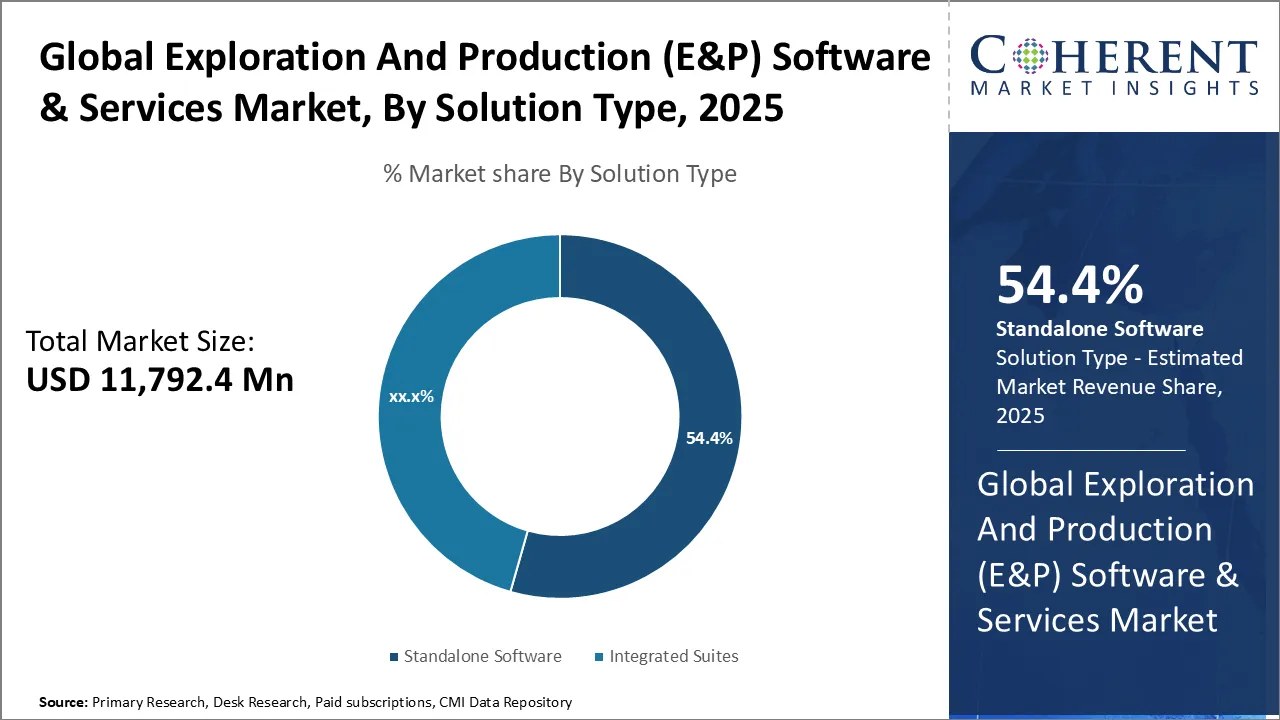
Exploration and Production (E&P) Software & Services Market Insights, By Solution Type - Standalone Software Leads Due To Its Modularity and Task-Specific Precision
In terms of solution type, the standalone software segment is expected to contribute 55.4% share in 2026, due to its flexibility, modular deployment, and cost-effectiveness. Companies prefer standalone solutions for specific tasks like seismic analysis, drilling optimization, or reservoir simulation, allowing tailored integration with existing systems. This approach supports focused innovation and easier upgrades without overhauling entire platforms.
For instance, in July 2026, Ansys introduced Discovery, a standalone 3D design software that integrates real-time physics simulation with interactive modeling. Aimed at accelerating product development, Discovery empowers engineers to explore design concepts quickly and validate performance early. Its intuitive interface and simulation-driven workflow make it ideal for industries seeking rapid innovation, including energy, manufacturing, and automotive sectors.
-software-&-services-market-by-deployment-type.webp "Exploration And Production (E&P) Software & Services Market, By Deployment Type")
Exploration and Production (E&P) Software & Services Market Insights, By Software & Solutions - Seismic & Subsurface Software dominates Due To Advanced Reservoir Analysis Needs
In terms of software & solution, the Seismic & Subsurface Software segment is expected hold the largest share of the market in 2026, due to its critical role in subsurface imaging, reservoir characterization, and simulation, which are essential for reducing exploration risks and optimizing hydrocarbon recovery. Advanced tools like seismic inversion, 3D modeling, and history matching enable precise resource evaluation and planning. As global energy firms prioritize data-driven exploration, the demand for these solutions continues to rise. Their integration with AI and real-time analytics further enhances operational efficiency, making Seismic & Subsurface Software the cornerstone of modern upstream strategies.
For instance, in April 2025, SLB announced a strategic partnership to accelerate deployment of subsurface digital technology across global energy operations. The collaboration aims to enhance reservoir modeling, seismic imaging, and data-driven exploration workflows. This move reinforces SLB’s commitment to advancing digital transformation in the upstream sector.
Exploration and Production (E&P) Software & Services Market Insights, By Deployment Type - On-premises Dominates Due To Data Security and Infrastructure Control
In terms of deployment type, the on-premise segment is expected to contribute the highest share of the market in 2026, due to its superior control over data, infrastructure, and security. Energy companies handling sensitive geological and operational data prefer localized systems to ensure compliance with internal protocols and regulatory standards. On-premises solutions offer robust customization, seamless integration with legacy systems, and reduced reliance on external networks, making them ideal for remote or offshore operations. Despite the growing popularity of cloud-based platforms, many firms continue to invest in on-premises deployments to maintain operational continuity, safeguard proprietary data, and support mission-critical applications in complex exploration environments.
For instance, in May 2025, Sercel secured a five-year contract with ONGC to deploy its Marlin offshore logistics management solution. The on-premise software will enhance operational planning, vessel tracking, and helicopter transit management across ONGC’s offshore assets. This strategic deployment supports ONGC’s efficiency and carbon neutrality goals while strengthening Sercel’s footprint in India’s energy sector.
Exploration and Production (E&P) Software & Services Market Insights, By Operation Type - On-shore Dominates Due To Easier Access and Lower Costs
In terms of operation type, the on-shore segment is expected to contribute the greatest share of the market in 2026, due to lower operational costs, easier accessibility, and faster deployment of digital solutions. On-shore operations benefit from established infrastructure and quicker integration of software tools for seismic analysis, drilling, and production, making them the preferred choice for many energy companies.
For instance, in February 2026, Baker Hughes unveiled three electrification technologies Electro™, Volt™, and Charge™ to support onshore and offshore oil and gas operations. These innovations aim to reduce emissions, enhance energy efficiency, and enable cleaner power delivery. The launch reflects Baker Hughes’ commitment to sustainable energy solutions and digital transformation across upstream exploration and production environments.
Regional Insights
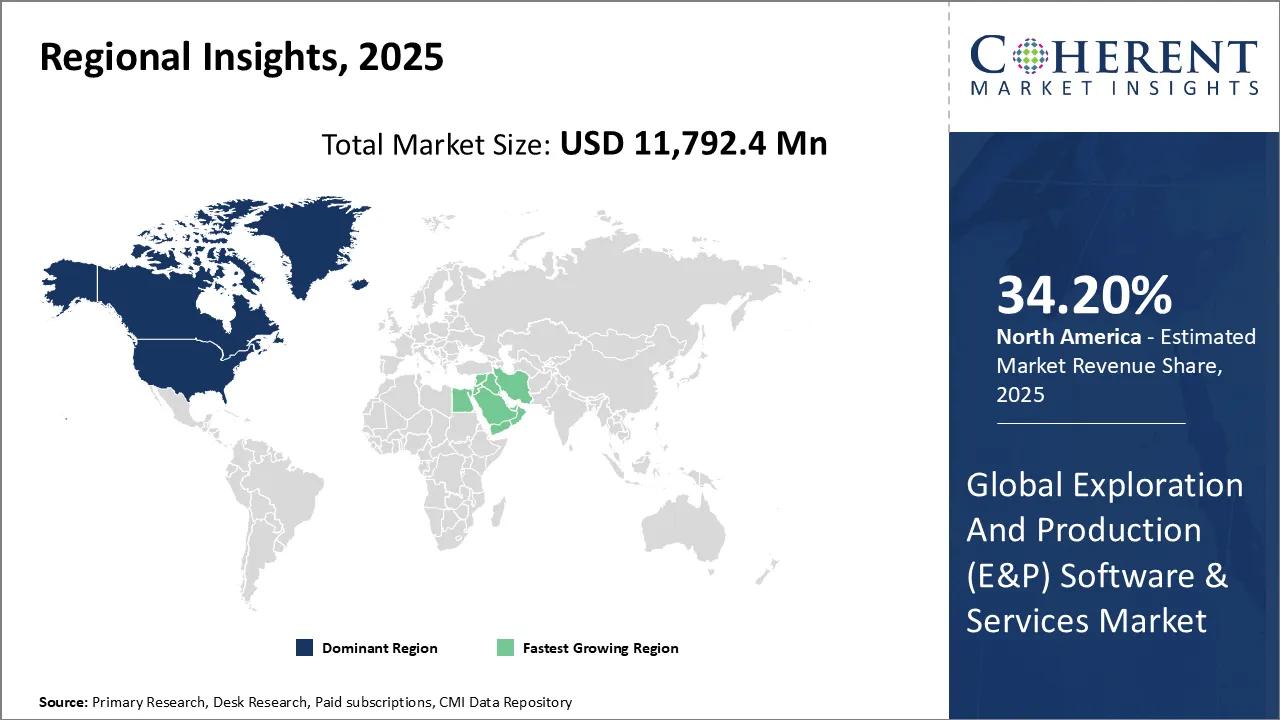
North America Exploration and Production (E&P) Software & Services Market Analysis & Trends
North America has established itself as the dominant region in 2026, with 34.2% share stems from its advanced energy infrastructure, active shale exploration, and strong digital adoption. The region’s oil and gas companies prioritize operational efficiency, safety, and data-driven decision-making, driving investment in seismic analysis, reservoir modeling, and drilling optimization tools. Regulatory compliance and environmental monitoring also boost software usage.
The presence of major industry players and ongoing technological innovation, especially in AI, cloud computing, and real-time analytics, further accelerates demand. Additionally, North America’s focus on unconventional resources like tight oil and gas requires sophisticated software to manage complex subsurface conditions and optimize production.
For instance, in January 2026, Halliburton and Coterra Energy launched the industry’s first fully automated hydraulic fracturing program, powered by Halliburton’s SmartFleet™ intelligent fracturing system. The initiative integrates real-time data, automation, and digital controls to optimize well stimulation, reduce emissions, and enhance safety. This milestone marks a major leap in digital transformation for upstream oil and gas operations.
Middle East & Africa Exploration and Production (E&P) Software & Services Market Analysis & Trends
The Middle East & Africa region is poised to be the fastest growing region with 30.6% share in 2026, due to vast oil and gas reserves, rising offshore activity, and digital transformation initiatives. National oil companies and global operators are adopting advanced tools for seismic analysis, reservoir modeling, and drilling optimization. Energy reforms, foreign investment, and infrastructure expansion, especially in countries like Saudi Arabia, UAE, Nigeria, and Angola are accelerating software adoption.
Hybrid deployment models, combining on-premise and cloud platforms, support secure and scalable operations. As exploration intensifies and efficiency becomes critical, the region is emerging as a key growth hub for standalone E&P software and services.
For instance, in September 2026, Kongsberg Digital and Petroleum Development Oman have signed an agreement to deploy the Kognitwin® Energy digital twin platform across PDO’s assets. Powered by AI, the solution will enhance operational efficiency, safety, and sustainability in upstream oil and gas operations. This marks a major step in digital transformation for Oman’s energy sector.
Exploration and Production (E&P) Software & Services Market Outlook Country-Wise
The U.S. Exploration and Production (E&P) Software & Services Market Trends
The U.S. commands the largest share of the global E&P software market at 30.7%, driven by its leadership in shale oil and gas production. Advanced digital tools are essential for managing complex horizontal drilling, hydraulic fracturing, and reservoir modeling. The country’s competitive energy sector encourages rapid adoption of AI, cloud platforms, and real-time analytics to optimize exploration and reduce operational costs.
U.K. Exploration and Production (E&P) Software & Services Market Trends
Holding a 2.2% market share, the U.K. sees demand primarily from its mature offshore fields in the North Sea. These require sophisticated software for enhanced oil recovery and asset life extension. Operators rely on digital twins, predictive maintenance, and compliance tools to manage aging infrastructure. The U.K.’s push toward energy transition and decarbonization also drives investment in cleaner, more efficient upstream software solutions.
China Exploration and Production (E&P) Software & Services Market Trends
China accounts for 3.5% of the E&P software market, fueled by its strategic focus on domestic energy security. State-owned enterprises like CNPC and Sinopec are integrating AI, IoT, and cloud-based platforms to modernize operations. Government policies support digital transformation across the energy sector, making software a key enabler for seismic analysis, drilling automation, and smart field development.
For instance, in July 2026, Shenkai Petroleum acquired a 51% stake in BOET for ¥60 million, advancing its smart wellsite strategy. BOET specializes in AI-driven E&P software, including intelligent drilling and geosteering platforms. The move strengthens Shenkai’s position in China’s upstream oil and gas sector, integrating advanced digital tools across over 3,000 wells nationwide.
Brazil Exploration and Production (E&P) Software & Services Market Trends
With a 2.9% market share, Brazil’s demand is anchored in its offshore pre-salt reserves in the Santos and Campos basins. These deepwater environments require high-performance software for exploration and reservoir simulation. Petrobras and other operators use advanced tools to manage complex subsurface conditions. Liberalized energy policies attract foreign investment, bringing cutting-edge E&P software into play for optimizing field development.
For instance, in April 2026, Brazil will showcase 47 companies at OTC 2026 in Houston, aiming to strengthen its presence in the global offshore technology market. Organized by ApexBrasil and IBP, the national pavilion highlights Brazil’s innovation in offshore energy, fostering international partnerships and promoting technological advancements in exploration, production, and subsea operations.
GCC Countries Exploration and Production (E&P) Software & Services Market Trends
GCC nations including Saudi Arabia, UAE, and Kuwait, collectively hold a substantial 19.8% share of the global E&P software market. These countries possess some of the world’s largest oil reserves and are aggressively modernizing upstream operations. National strategies like Saudi Vision 2030 promote digital transformation, including AI-powered platforms, digital twins, and cloud-integrated software. These tools are vital for managing vast onshore and offshore assets efficiently and sustainably.
In November 2024, Baker Hughes inaugurated its new Surface Pressure Control Solutions Center in Abu Dhabi, enhancing support for regional oil and gas operations. The facility offers advanced wellhead systems, pressure control equipment, and digital services, reinforcing Baker Hughes’ commitment to innovation and operational efficiency in upstream exploration and production across the Middle East.
Market Report Scope
Exploration And Production (E&P) Software & Services Market Report Coverage
| Report Coverage | Details | ||
|---|---|---|---|
| Base Year: | 2025 | Market Size in 2026: | USD 13,537.7 Mn |
| Historical Data for: | 2020 To 2024 | Forecast Period: | 2026 To 2033 |
| Forecast Period 2026 to 2033 CAGR: | 14.8% | 2033 Value Projection: | USD 35,574.4 Mn |
| Geographies covered: |
| ||
| Segments covered: |
| ||
| Companies covered: | Schlumberger Limited, Halliburton, Baker Hughes Company, Emerson, P2 Energy Solutions, Weatherford International, IBM, Pason Systems Corp., CGG, Ikon Science, Petex, AVEVA, KBC, Beicip-Franlab, Petrosys Pty Ltd, PetroChina, ONGC, Petronas, POSCO International, INPEX | ||
| Growth Drivers: |
| ||
| Restraints & Challenges: |
| ||
Exploration and Production (E&P) Software & Services Market Driver
Increasing Global Energy Demand
The rising global energy demand is driving the need for advanced Exploration and Production (E&P) software and services. As countries seek to secure reliable energy sources, oil and gas companies are adopting digital tools to streamline exploration, drilling, and production processes. These technologies enable faster decision-making, reduce operational risks, and improve resource recovery, helping meet growing consumption efficiently
Exploration and Production (E&P) Software & Services Market Opportunity
AI and Machine Learning Integration
AI and machine learning are revolutionizing the Exploration and Production (E&P) Software & Services Market by enabling smarter, faster, and more accurate upstream operations. These technologies enhance seismic data interpretation, automate drilling processes, and improve reservoir modeling through predictive analytics. As energy companies seek greater efficiency and reduced operational risk, AI-driven platforms are becoming essential for real-time decision-making and dynamic resource management. Forecasts suggest that AI integration will continue to expand across cloud-based E&P software, supporting scalable and collaborative workflows. This shift is transforming traditional exploration into a data-driven, intelligent process that aligns
Analyst Opinion (Expert Opinion)
The Exploration & Production (E&P) Software & Services market value is undergoing a pivotal transformation, driven by measurable productivity gains and a shift from pilot-scale projects to enterprise-wide digital deployment. Despite years of experimentation, less than 1% of generated subsurface and operational data is effectively utilized, underscoring the vast untapped potential of data-driven decision-making. Operators that successfully operationalize digital workflows as seen with Equinor’s Echo digital twin and SLB’s integrated AI platforms — have demonstrated tangible value through reduced downtime, optimized drilling schedules, and improved reservoir modeling accuracy.
However, the industry’s chief constraint remains organizational rather than technological. Many initiatives remain trapped in “pilot purgatory,” where digital projects fail to scale due to fragmented governance and underestimated data integration costs. Hybrid cloud architectures and OSDU-compliant platforms are emerging as preferred choices, offering both performance flexibility and regulatory compliance.
In this evolving landscape, vendors that deliver measurable outcomes, such as production optimization or cost reduction per well, rather than generic software capabilities will define leadership. The market’s winners will not be determined by innovation rhetoric but by the ability to turn complex E&P data into repeatable, governed, and monetizable operational intelligence.
Speak to the analyst
Want personalized insights?
Take the findings above to one of our principal consultants, or have the report rebuilt around the segments, geographies and competitors you actually track.
Recent Developments
- In September 2025, ONGC and Oil India Ltd. planned to launch a ₹3,200 crore stratigraphic drilling campaign across 12 sedimentary basins in India next year. The initiative aims to unlock untapped hydrocarbon potential in regions like Mahanadi, Saurashtra, and Ganga, marking a major step in boosting domestic exploration and reducing reliance on energy imports.
- In September 2025, ISN partnered with Esso Exploration Angola Limited to enhance contractor management in Angola’s upstream oil and gas sector. Using ISNetworld, the collaboration aims to improve safety, compliance, and operational efficiency across exploration and production activities. This marks a strategic step in digitalizing contractor oversight for one of Africa’s key energy-producing regions.
- In August 2025, Halliburton invested $55.15 million in Petroleum Place, Inc. to expand its e-business strategy. Through Landmark Graphics, Halliburton will offer online access to its E&P software, streamlining oil and gas property transactions. The move enhances digital integration in asset evaluation and supports faster, more efficient decision-making in upstream exploration and production.
Market Segmentation
- Software & Services Insights (Revenue, USD, 2021 - 2033)
- Software
- Seismic & Subsurface Software
- Seismic Risk Management & Mapping
- Seismic Amplitude & Attribute Analysis
- AVO (Amplitude Variation with Offset)
- Seismic Inversion
- Seismic Data Processing & Interpretation
- 2D/3D/4D Seismic Modeling
- Time-lapse Imaging
- Survey Navigation & Planning
- Survey Design Software
- Real-time Positioning Systems
- Subsurface Resource Valuation
- Reservoir Characterization
- Reservoir Simulation
- Black Oil Models, Compositional and Thermal Simulation
- History Matching and Forecasting
- Drilling
- Well Planning
- Trajectory Design
- Survey Database
- Drilling Engineering
- Casing Design
- Cement Design
- Hydraulics Modeling
- Mud Design and Analysis
- BHA Design & Analysis
- Well Barrier Management
- AFE Software
- Drilling Operations
- Drilling Optimization
- Operational Efficiency – KPI Monitoring
- Wellsite Reporting
- Data Aggregation
- Drilling Automation
- Drilling Data Management
- Well Control
- Production
- Production Engineering
- Production Optimization
- Artificial Lift Design and Optimization
- Flow Assurance Analysis
- Hydraulic Fracturing Simulation Software
- Production Operations
- Others
- Services
- Professional Services
- Technical Consulting
- Data Management
- Software Deployment
- Support Services
- Managed Services
- Solution Type Insights (Revenue, USD, 2021 - 2033)
- Standalone Software
- Integrated Suites
- Deployment Type Insights (Revenue, USD, 2021 - 2033)
- On-premises
- Cloud-based
- Operation Type Insights (Revenue, USD, 2021 - 2033)
- On-shore
- Off-shore
- Regional Insights (Revenue, USD Mn, 2021 - 2033)
- North America
- U.S.
- Canada
- Latin America
- Brazil
- Mexico
- Argentina
- Rest of Latin America
- Europe
- Germany
- U.K.
- Spain
- France
- Italy
- Russia
- Rest of Europe
- Asia Pacific
- China
- India
- Japan
- Australia
- South Korea
- ASEAN
- Rest of Asia Pacific
- Middle East
- GCC
- Israel
- Rest of Middle East
- Africa
- North Africa
- Central Africa
- South Africa
- North America
- Key Players Insights
- Schlumberger Limited
- Halliburton
- Baker Hughes Company
- Emerson
- P2 Energy Solutions
- Weatherford International
- IBM
- Pason Systems Corp.
- CGG
- Ikon Science
- Petex
- AVEVA
- KBC
- Beicip-Franlab
- Petrosys Pty Ltd
- PetroChina
- ONGC
- Petronas
- POSCO International
- INPEX
Sources
Primary Research Interviews from the following stakeholders
Stakeholders
- Interviews with oil & gas operators, E&P service providers, geoscience teams, reservoir engineers, IT and digital transformation leads, and procurement heads across leading global markets.
Specific stakeholders
- Digital transformation and IT leads at upstream oil & gas operators (e.g., ExxonMobil, Shell, Reliance Industries, Saudi Aramco)
- Reservoir and production engineers at exploration firms and national oil companies (e.g., Petrobras, ONGC, TotalEnergies)
- Operations and asset managers at offshore and onshore production facilities
- Geoscientists and data analysts at seismic and subsurface service providers
- Product managers and technical leads at E&P software providers (e.g., subsurface modeling, production optimization, asset management tools)
- IT infrastructure heads at engineering, procurement, and construction (EPC) contractors supporting oil & gas projects
Databases
- U.S. Energy Information Administration (EIA)
- International Energy Agency (IEA) Statistics
- OPEC Annual Statistical Bulletin
- United Nations Comtrade Database
- Ministry of Petroleum & Natural Gas (India)
- National Bureau of Statistics of China (Energy Section)
- Eurostat – Energy Statistics
- BP Statistical Review of World Energy
Magazines
- Oil & Gas Journal
- World Oil
- Offshore Engineer
- Petroleum Economist
- Hart Energy Publications
- Rigzone – News & Analysis
- Journal of Petroleum Technology (JPT)
Journals
- Journal of Petroleum Science and Engineering
- Energy Exploration & Exploitation
- SPE Reservoir Evaluation & Engineering
- Journal of Natural Gas Science and Engineering
- Offshore Technology Journal
Newspapers
- The Wall Street Journal – Energy & Resources
- The Economic Times – Energy & Oil & Gas
- Financial Times – Oil & Gas Markets
- Nikkei Asia – Energy & Commodities
- The Hindu Business Line – Energy Sector
Associations
- Society of Petroleum Engineers (SPE)
- International Association of Oil & Gas Producers (IOGP)
- American Petroleum Institute (API)
- Petroleum Exploration Society of Great Britain (PESGB)
- Energy Institute (EI), UK
- Offshore Technology Conference (OTC)
Public Domain Sources
- Ministry of Petroleum & Natural Gas, India
- U.S. Department of Energy (DOE)
- National Energy Board, Canada
- NITI Aayog – Energy Reports
- India Investment Grid – Oil & Gas Sector
- European Commission – Energy & Digitalization Reports
- S. International Trade Commission (USITC) – Energy Software Imports/Exports
Proprietary Elements
- CMI Data Analytics Tool, and Proprietary CMI Existing Repository of E&P software and services usage data spanning over 8 years across software modules, asset types, and regional deployments.
Definition: The Exploration and Production (E&P) Software & Services Market provides digital tools and services for upstream oil and gas operations. It includes seismic analysis, reservoir modeling, drilling optimization, and production management. Rising demand stems from the need for efficient resource exploration, data-driven decision-making, and enhanced operational performance across global energy sectors.
Get access to 250+ pages report
Every segment, forecast, competitor profile and data table behind the analysis above — available for instant download.
- ESOMAR Member
- ISO 9001:2015 Certified
- D-U-N-S Registered
- GDPR & CCPA Compliant
Missing comfort of reading report in your local language? Find your preferred language:
Transform your Strategy with Exclusive Trending Reports
Frequently Asked Questions
The global Exploration and Production Software & Services market is projected to reach USD 13,537.7 million in 2026, growing significantly through 2033 to 35,574.4 million.
The market is expected to grow at a strong CAGR of 14.8% during the forecast period from 2026 to 2033.
High implementation costs, data integration challenges, and limited skilled workforce are key factors hampering market growth and adoption.
Schlumberger Limited, Halliburton, Baker Hughes Company, Emerson, P2 Energy Solutions, Weatherford International, IBM, Pason Systems Corp., CGG, Ikon Science, Petex, AVEVA, KBC, Beicip-Franlab, Petrosys Pty Ltd, PetroChina, ONGC, Petronas, POSCO International, INPEX
North America will lead the market due to advanced infrastructure, high energy demand, and strong investment in digital exploration tools.
Reservoir characterization, seismic data analysis, and drilling optimization services dominate E&P software offerings in 2026.
Digital data, seismic, geological, and geophysical is the primary raw material driving E&P software functionality and analytics capabilities.