

Operational Predictive Maintenance Market Analysis & Forecast: 2026-2033
Operational Predictive Maintenance Market size is estimated to be valued at USD 8.31 Bn in 2026 and is expected to reach USD 45.53 Bn in 2033, exhibiting a compound annual growth rate (CAGR) of 27.5% from 2026 to 2033.
Key Takeaways
- By Deployment Model, the Cloud Based segment is expected to capture the largest share of 61% in 2026 revenue towards Operational Predictive Maintenance Market outlook during due to its scalability, real-time analytic features, and overall cost-efficiency for SMEs and large enterprises.
- By Region, Asia Pacific is estimated to have a substantial share growth capturing 32.8% by 2026 due to growing industrial investments, digitization of manufacturing systems, and rapid growth of adoption of Industry 4.0 in China, India along with Southeast Asia.
Market Overview
With the amalgamation of IoT, generative AI, and Machine Learning technologies, the operational predictive maintenance market value is growing at a remarkable pace. Real-time monitoring and predictive analytics now enable industries to forecast equipment failures and minimize maintenance-related downtimes. Moreover, the overall shift towards cloud solutions provides scalable and remote accessibility which makes predictive maintenance easier to access. Along with the ever-increasing complexity of industrial machinery requiring sophisticated maintenance strategies, there is an accelerating demand driving market growth.
Current Events and Its Impact on the Operational Predictive Maintenance Market
Event | Description and Impact |
Geopolitical Tensions in Semiconductor Supply Chains |
|
Technological Advancements & Regulatory Compliance |
|
Energy Market Volatility & Sustainability Pressures |
|
Pricing Analysis: Operational Predictive Maintenance Market
The operational predictive maintenance market forecast features varied pricing models influenced by deployment type, solution complexity, industry, and region.
- Cloud-Based Solutions usually are priced in the range of $50–$500, per device monthly, with simple monitoring services priced between $80 and $120, while advanced AI predictions can go beyond $400 per asset monthly. Subscription Plans on a yearly basis start from $10,000 – $30,000 for smaller systems and scale up to $100,000 for enterprise-wide systems.
- On-Premise Solutions have more fixed costs in the form of licensing fees which start from $20,000 to $500,000. Alongside these, there are yearly support fees of around 15-20% of the license fee.
- Cost Components: Software platforms from $15,000–$200,000/year, with sensors priced at $100–$2,000 each. Consulting costs $150–$300/hour, while managed services can total $1 million in a year.
- Industry Variations: Manufacturing spends $250–$600 for each machine on a yearly basis; energy sectors spend millions on plant-wide analytics; transportation costs depend on assets and their usage.
- Regional Pricing: North America ($1,200–$2,500 for each asset), Europe ($900–$1,800), Asia-Pacific ($400–$1,100).
- Future Trends: There's a predicted 12–18% reduction in software costs due to AI tools, while sensor costs are expected to decrease by half by 2030. It's expected that cloud subscription services will lead the market with more than 70% share by 2027.
- Current Industry Events of 2026
- Market Size Estimation
- Regional Breakdown
- Competitive Landscape
- Customer Intelligence
- Segmental Analysis
- Pricing Analysis
- Key Market Drivers, Challenges & Future Trends
- Customized Insights Section
Segmental Insights
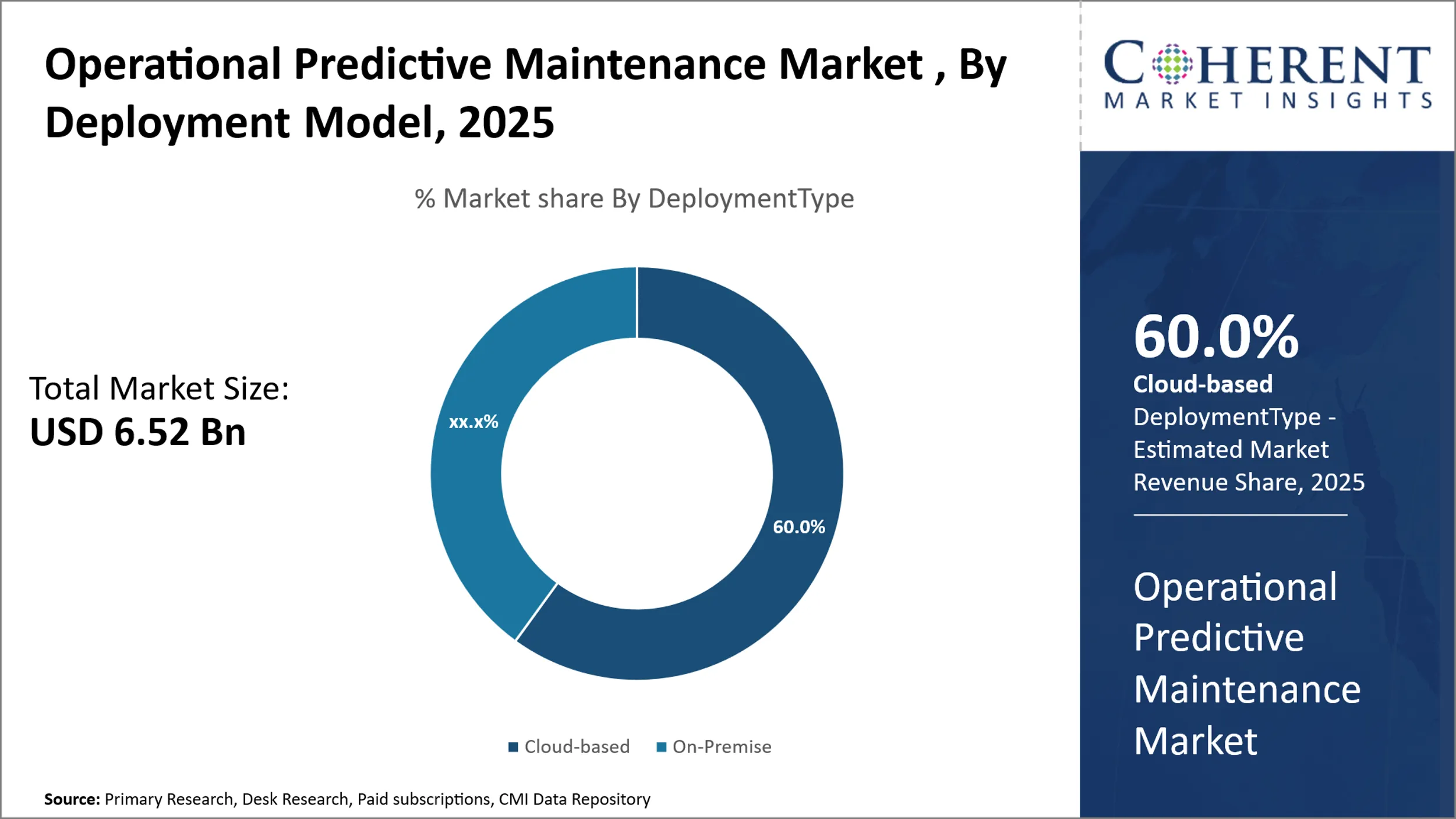
Operational Predictive Maintenance Market Insights, By Deployment Model
The cloud-based segment is projected to dominate the global operational predictive maintenance market demand with 61% share in 2026, driven by its scalability, real-time analytics capabilities, and cost-effectiveness. Cloud deployment models are increasingly favored by both SMEs and large enterprises due to their ease of integration, lower upfront infrastructure costs, and flexibility in data accessibility and storage.
Leading market players are leveraging cloud technologies to enhance product offerings, with continued investments in AI-powered analytics and remote monitoring platforms. These advancements are expected to further strengthen the cloud-based segment’s market leadership by enabling faster, more accurate failure detection and predictive insights.
In contrast, the on-premise segment is anticipated to account for 40.0% of the market share in 2025, supported by its advantages in data control, system customization, and heightened security. This deployment model remains the preferred choice in sectors such as defense, manufacturing, and energy, where sensitive data and mission-critical operations demand higher levels of confidentiality and compliance.
Vendors are also focusing on hybrid solutions that combine on-premise security with cloud flexibility, catering to evolving customer needs while maintaining robust data governance. This trend reflects the enduring relevance of on-premise models in high-security environments despite the broader industry shift toward cloud computing.
Regional Insights
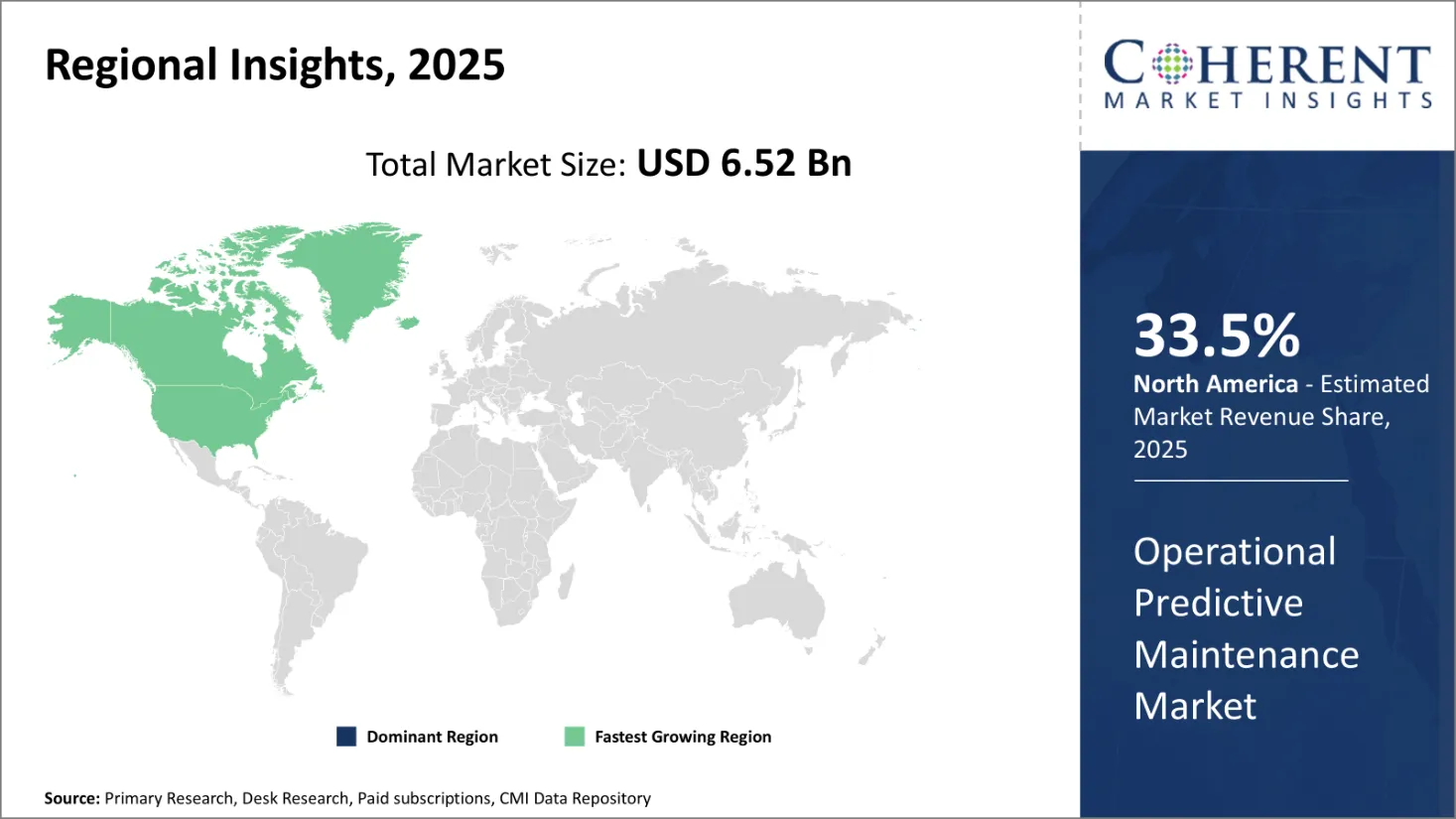
North America Operational Predictive Maintenance Market Analysis and Trends
North America is anticipated to dominate the global operational predictive maintenance market trend outlook in 2026, supported by a mature industrial ecosystem and early adoption of advanced technologies. The region’s leadership is primarily driven by the widespread integration of AI, IoT, and machine learning into industrial automation processes across sectors such as manufacturing, energy, and transportation.
The U.S., in particular, stands out due to its strong presence of key technology providers, innovation-driven industrial base, and substantial investments in predictive analytics platforms. Companies in North America are actively pursuing digital transformation initiatives that prioritize real-time asset monitoring and predictive insights to minimize downtime and optimize operations. These factors collectively reinforce the region’s commanding position in the market.
Asia Pacific Operational Predictive Maintenance Market Analysis and Trends
Asia Pacific is projected to experience rapid growth in the operational predictive maintenance market, capturing a significant 32.8% share by 2026. This momentum is largely fueled by escalating industrial investments, growing emphasis on smart manufacturing, and the accelerated adoption of Industry 4.0 technologies across emerging economies like China, India, and Southeast Asia.
The region is witnessing increased deployment of predictive maintenance solutions in sectors such as automotive, electronics, and heavy machinery, as enterprises seek to enhance equipment reliability and reduce operational costs. Supportive government policies promoting digitalization and infrastructure modernization are further catalyzing regional market expansion. Asia Pacific's cost-efficient manufacturing base and rising digital literacy are expected to make it a pivotal contributor to the global predictive maintenance landscape.
Dominating Countries in the Operational Predictive Maintenance Market
United States Operational Predictive Maintenance Market Analysis and Trends
The U.S. leads the North American market due to its robust industrial base and aggressive investment in emerging technologies. The country is home to a wide array of major players in AI, cloud computing, and industrial IoT who are driving innovation in predictive maintenance solutions. Continued government and private-sector focus on improving operational efficiency, safety, and asset lifespan supports sustained market growth.
China Operational Predictive Maintenance Market Analysis and Trends
China is a key driver of Asia Pacific’s market growth, driven by its large-scale manufacturing sector and national focus on smart factory initiatives. Government-led programs such as "Made in China 2026" have accelerated the adoption of advanced industrial technologies, including predictive maintenance systems. China’s strong domestic tech ecosystem and increasing adoption of AI-powered analytics tools position it as a regional leader in the predictive maintenance space.
Market Report Scope
Operational Predictive Maintenance Market Report Coverage
| Report Coverage | Details | ||
|---|---|---|---|
| Base Year: | 2025 | Market Size in 2026: | USD 8.31 Bn |
| Historical Data for: | 2020 To 2024 | Forecast Period: | 2026 To 2033 |
| Forecast Period 2026 to 2033 CAGR: | 27.5% | 2033 Value Projection: | USD 45.53 Bn |
| Geographies covered: |
| ||
| Segments covered: |
| ||
| Companies covered: | General Electric Company, IBM Corporation, eMaint Enterprises LLC, Software AG, Schneider Electric SE, SAS Institute Inc., Rockwell Automation Inc., PTC, Inc., and Robert Bosch GmbH. | ||
| Growth Drivers: |
| ||
| Restraints & Challenges: |
| ||
Global Operational Predictive Maintenance Market Drivers
- Regulatory Compliance and Safety
The manufacturing, energy, and transportation sectors are some of the most operationally sophisticated industries with a high level of organizational complexity and regulation. These industries are fundamentally driven by compliance and safety. As part of Operational Safety, predictive maintenance aids businesses in staying within set boundaries with regard to the level of equipment functionality and reduces the likelihood of safety incidents. Companies that implement predictive maintenance improve compliance regarding asset integrity, enhancement, and defined industry standards and regulations.
One example is in the Manufacturing industry where a company functioning within a regulated environment is subject to prescribed compliance as well as safety challenges. Such companies, in the case of operational predictive maintenance, track the operation and status of critical equipment using remote sensing technology. AI techniques or accurate analysis of time-series data in numerous cases leads to real-time identification and alerting of issues that would otherwise materially change steered parameters throughout the system.
- Growing Awareness and Adoption Operational Predictive Maintenance
Sectors such as manufacturing, energy, and transportation that are heavily regulated focus on safety and compliance. Meeting safety and compliance requirements is much easier when equipment is reliably functioning within set parameters and the risk of safety incidents is low. Enabling equipment to function within goals through predictive maintenance improves safety and accuracy in meeting industry defined standards and regulations.
To illustrate within the regulated sector of manufacturing, a company has sophisticated safety and compliance regulations. Operational predictive maintenance enables the company to track and supervise the performance of all equipment which is extremely vital all the time. Anticipatory Data-driven maintenance strategies are applied to avert detected potential issues or identified discrepancy issues. The scheduling of maintenance activities removes interference with operations and ensures that equipment is in compliant functioning both autonomously and systematically.
Analyst Viewpoint
- As a market research analyst at a leading tier-one consulting firm, I foresee robust expansion in the Operational Predictive Maintenance Market over the next few years. This growth trajectory is primarily fueled by the rapid integration of Industry 4.0 technologies—namely, IoT, artificial intelligence (AI), and machine learning (ML).
- These innovations are revolutionizing equipment maintenance by enabling real-time monitoring and intelligent data analysis, which enhances predictive accuracy, minimizes unplanned downtime, and improves asset longevity.
- The momentum is further supported by growing pressure across industries to reduce operational costs and maximize asset utilization. Organizations are increasingly turning to predictive maintenance as a strategic tool to achieve operational excellence.
- Nevertheless, the market is not without its constraints. High upfront costs associated with implementing predictive maintenance systems and the shortage of skilled professionals capable of managing and interpreting complex data remain key barriers. Additionally, data security and compliance concerns—especially in tightly regulated sectors—may temper adoption rates.
- Despite these headwinds, long-term growth prospects remain strong. Rising demand for energy efficiency, coupled with the need to extend the life of aging industrial infrastructure, is set to accelerate adoption, particularly within the energy and utilities sector.
- Meanwhile, the Asia-Pacific region is emerging as a hotspot for growth, propelled by rapid industrialization and the urgent need to enhance manufacturing productivity. Established markets in North America and Europe will continue to lead, underpinned by advanced infrastructure and early adoption of predictive technologies.
Global Operational Predictive Maintenance Market: Key Developments
- In March 2025, Siemens expanded its Industrial Copilot offering, introducing new generative AI-powered features for Senseye Predictive Maintenance. The updated solution now supports the full maintenance cycle—from prediction and prevention to repair and optimization—empowering customers across design, engineering, operations, and service stages.
- In March 2025, TIBCO global software company that specializes in integration, analytics, and event processing unveiled a range of improvements to its TIBCO Spotfire and other scalable analytics solutions.
- In February 2023, Uptake, a prominent provider of predictive analytics software, announced that it had established a commercial partnership with DTNA (Daimler Truck North America LLC).
Global Operational Predictive Maintenance Market: Key Companies Insights
The key companies operating in the global operational predictive maintenance market are General Electric Company, IBM Corporation, eMaint Enterprises LLC, Software AG, Schneider Electric SE, SAS Institute Inc., Rockwell Automation Inc., PTC, Inc., and Robert Bosch GmbH.
Market Segmentation
- Global Operational Predictive Maintenance Market, By Type (Revenue, USD Bn, 2021 - 2033)
- Software
- Services
- Global Operational Predictive Maintenance Market, By Deployment Model (Revenue, USD Bn, 2021 - 2033)
- Cloud-based
- On-premise
- Global Operational Predictive Maintenance Market, By End User (Revenue, USD Bn, 2021 - 2033)
- Public Sector
- Automotive
- Manufacturing
- Healthcare
- Energy & Utility
- Transportation
- Others
- Global Operational Predictive Maintenance Market, By Region (Revenue, USD Bn, 2021 - 2033)
- North America
- U.S.
- Canada
- Latin America
- Brazil
- Mexico
- Argentina
- Rest of Latin America
- Europe
- Germany
- U.K.
- France
- Italy
- Spain
- Russia
- Rest of Europe
- Asia Pacific
- China
- India
- Japan
- Australia
- South Korea
- ASEAN
- Rest of Asia Pacific
- Middle East
- GCC
- Israel
- Rest of Middle East
- Africa
- South Africa
- Central Africa
- North Africa
- North America
- Company Profiles
- General Electric Company
- IBM Corporation
- eMaint Enterprises LLC
- Software AG
- Schneider Electric SE
- SAS Institute Inc.
- Rockwell Automation Inc.
- PTC, Inc.
- Robert Bosch GmbH
Sources
Primary Research Interviews
- Industry experts
- Manufacturers
- Distributors
- Technology providers
- Others
Databases
- Factiva
- Bloomberg
- Hoovers
- Others
Magazines
- Predictive Maintenance Today
- Maintenance Technology
- Plant Engineering
- Reliability Web
- Others
Journals
- Journal of Quality in Maintenance Engineering
- International Journal of Prognostics and Health Management
- Reliability Engineering & System Safety
- Others
Newspapers
- The Wall Street Journal
- The New York Times
- Financial Times
- The Economic Times
- Others
Associations
- Prognostics and Health Management Society (PHM Society)
- Society for Maintenance and Reliability Professionals (SMRP)
- European Federation of National Maintenance Societies (EFNMS)
- Plant Maintenance Resource Center (PMRC)
- Others
Public Domain Sources
- International Organization for Standardization (ISO)
- National Institute of Standards and Technology (NIST)
- European Committee for Standardization (CEN)
- Occupational Safety and Health Administration (OSHA)
- Others
Proprietary Elements
- CMI Data Analytics Tool
- Proprietary CMI Existing Repository of information for last 8 years
*Definition: The global operational predictive maintenance market refers to the market for technologies, solutions, and services that enable organizations to proactively monitor, predict, and maintain the operational health of their equipment and assets.
Get access to 250+ pages report
Every segment, forecast, competitor profile and data table behind the analysis above — available for instant download.
- ESOMAR Member
- ISO 9001:2015 Certified
- D-U-N-S Registered
- GDPR & CCPA Compliant
Missing comfort of reading report in your local language? Find your preferred language:
Transform your Strategy with Exclusive Trending Reports
Frequently Asked Questions
The Operational Predictive Maintenance Market size is estimated to be valued at USD 8.31 Bn in 2026, and is expected to reach USD 45.53 Bn by 2033.
The CAGR of the global Market is projected to be 27.5% from 2026 to 2033.
Regulatory compliance and safety and growing awareness and adoption are the key factors driving growth of the market.
Data quality and availability and integration challenges are the major factors restraining the growth of the market.
The key companies operating in the market are General Electric Company, IBM Corporation, eMaint Enterprises LLC, Software AG, Schneider Electric SE, SAS Institute Inc., Rockwell Automation Inc., PTC, Inc., and Robert Bosch GmbH.