

Patient Throughput & Capacity Management Market Size and Forecast – 2026 to 2033
The Patient Throughput & Capacity Management Market is anticipated to grow at a CAGR of 8.3% with USD 14.3 Bn share in 2026 and is expected to reach USD 18.8 Bn in 2033. Rising Patient Volume & Aging Population, Workforce Shortages in Healthcare and Growing Focus on Patient Experience & Outcomes.
Key Takeaways
- By Product Type, Workflow Management Solutions hold the largest market share of 36.6% in 2026 owing to the rising patient volume & capacity constraints. According to the American Hospital Association, hospital use is increasing, with inpatient days expected to rise 9% to 170 million per year by 2034.
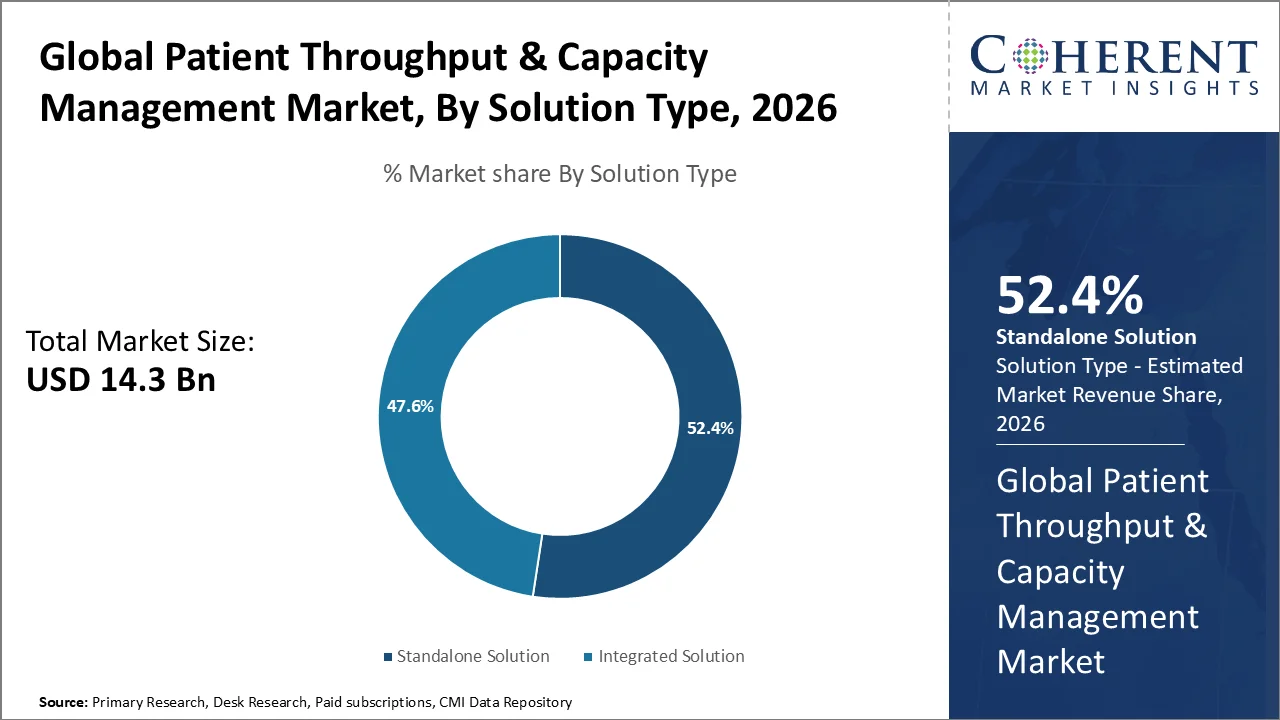
- By Solution Type, Standalone Solution expected to hold largest market share of 52.4% in 2026 owing to the need for targeted, task-specific optimization.
- By Delivery Mode, Cloud based acquired the prominent market share of 53.3% in 2026 owing to its lower upfront costs & reduced IT burden. About 70%–83% of healthcare organizations use cloud services, with 57%–71.6% leveraging them for EHRs, telemedicine, and data storage.
- By Region, North America is expected to acquire the dominant share of 39.2% in 2026 owing to its advanced healthcare IT infrastructure. In July 2025, eight health systems joined a Trump administration initiative to fast-track integrated patient-facing technologies in healthcare.
Current Events and Their Impact on the Patient Throughput & Capacity Management Market
Current Event | Description and its Impact |
Global Healthcare Workforce Shortages (WHO + 2025 Outlook) |
|
Immigration & Labor Policy Shifts (U.S. H-1B Healthcare Restrictions, 2025) |
|
Segmental Insights
- Current Industry Events of 2026
- Market Size Estimation
- Regional Breakdown
- Competitive Landscape
- Customer Intelligence
- Segmental Analysis
- Pricing Analysis
- Key Market Drivers, Challenges & Future Trends
- Customized Insights Section
Why Workflow Management Solutions hold the largest market share?
Workflow Management Solutions hold the largest market share of 36.6% in 2026 owing to the Shift Toward Value-Based & Patient-Centric Care. Rising patient volumes and increasing pressure on hospital capacity drive healthcare providers to adopt workflow management solutions in the Patient Throughput and Capacity Management market. Hospital admissions continue to rise in 2025, with private admissions reaching a record 230,000 in Q3, up 1% from 2024. Providers streamline admissions, transfers, and discharges to reduce delays, improve coordination, and enhance patient experience while controlling costs. They accelerate adoption by leveraging digital technologies, real-time data systems, and automation.
Standalone Solution Expected to Hold Largest Market Share
Standalone Solution expected to hold largest market share of 52.4% in 2026. The need for cost-effective, easy-to-deploy tools drives healthcare providers to adopt standalone solutions in the Patient Throughput and Capacity Management market. Providers use these solutions to quickly improve functions such as bed management, patient scheduling, and discharge processes without overhauling existing systems. Limited IT infrastructure and integration challenges further push their adoption. Additionally, hospitals choose standalone systems for their flexibility, rapid implementation, and ability to deliver immediate, measurable improvements in workflow efficiency and patient flow management.
Cloud Based Acquired The Prominent Market Share
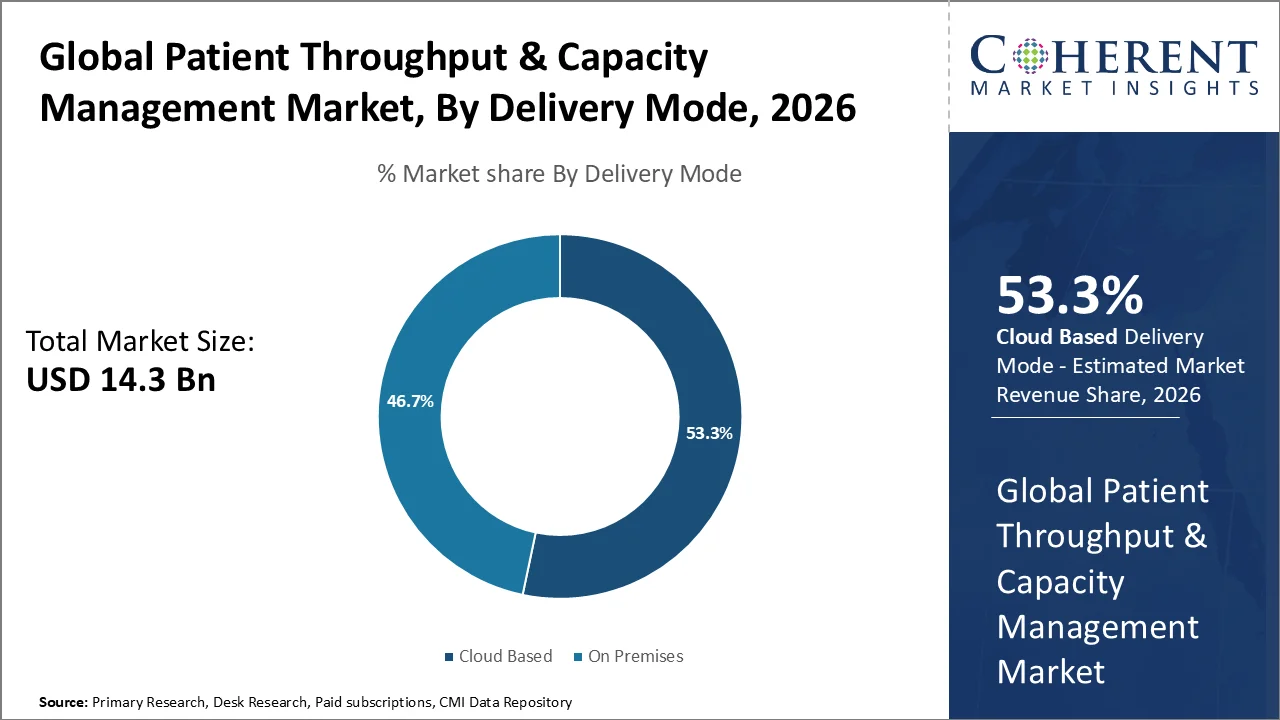
Cloud based acquired the prominent market share of 53.3% in 2026 owing to its Digital Transformation & EMR/EHR Adoption. The need to reduce IT infrastructure costs and enable scalable operations drives healthcare providers to adopt cloud-based solutions in the Patient Throughput and Capacity Management market. Providers use cloud platforms to access real-time data, improve coordination, and support faster decision-making across departments. The shift toward digital health systems and growing demand for remote accessibility further accelerate adoption. Additionally, cloud solutions deliver quick deployment, automatic updates, and better interoperability, helping hospitals enhance workflow efficiency, manage patient flow effectively, and adapt to changing capacity demands.
Regional Insights
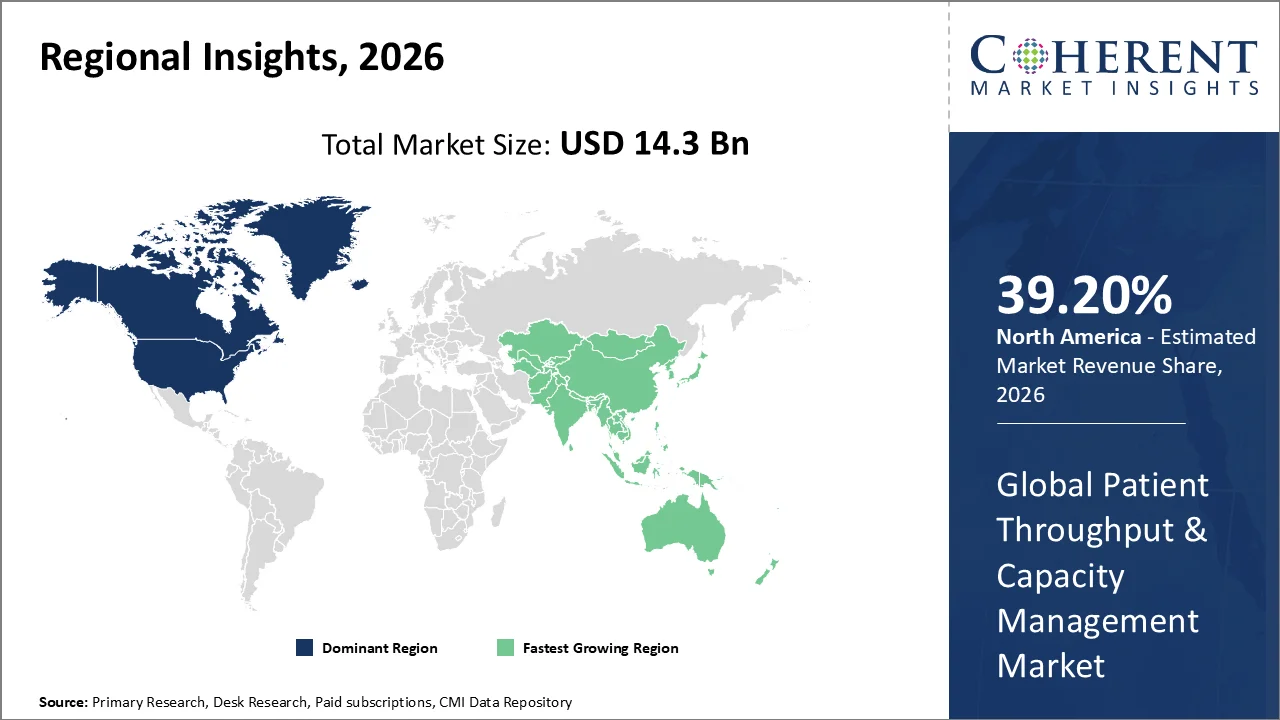
North America is expected to acquire the dominant share of 39.2% in 2026.
Strong healthcare infrastructure and early adoption of advanced digital technologies drive North America’s leadership in the Patient Throughput and Capacity Management market. Hospitals in the region implement AI, analytics, and real-time tracking systems to improve patient flow and enhance operational efficiency. By 2024–2025, AI adoption in U.S. hospitals became mainstream, with over 70% using predictive AI in EHR systems, up from 66% in 2023. High healthcare spending and rising pressure to reduce costs while improving outcomes further accelerate adoption. Regulatory frameworks that emphasize value-based care and quality performance also push hospitals to optimize capacity, minimize delays, and improve overall patient care delivery.
Asia Pacific expected to hold largest market share
Rapid expansion of healthcare infrastructure and rising patient volumes drive the Patient Throughput and Capacity Management market in Asia Pacific. Hospitals adopt digital health technologies to improve efficiency, reduce congestion, and manage increasing demand for care. Governments increase investments in healthcare modernization and digital transformation, further supporting adoption. India’s 2026–27 health budget exceeds ₹1,06,530 crore, about a 10% increase year-on-year, aimed at boosting infrastructure and research. Public health spending remains around 1.2%–1.3% of GDP, with a target of 2.5%, alongside a growing shift toward insurance-led models like Ayushman Bharat. This is further expected to propel the market growth.
United States Patient Throughput & Capacity Management Market Trends
Strong healthcare infrastructure and early adoption of advanced digital technologies drive the Patient Throughput and Capacity Management market in the United States. Hospitals deploy AI, analytics, and real-time tracking systems to improve patient flow and enhance operational efficiency. Rising healthcare costs and pressure to improve outcomes push providers to optimize capacity and reduce delays. In 2024, U.S. healthcare spending rose to $5.3 trillion ($15,474 per capita), representing 18% of GDP, with costs increasing 7.2% due to higher utilization and mainly funded by private insurance and federal programs, each contributing 31%. Regulatory requirements focused on value-based care and quality performance further support adoption. Additionally, increasing patient volumes and chronic disease prevalence compel hospitals to strengthen workflow management and improve resource utilization.
Japan Patient Throughput & Capacity Management Market Trends
Advanced healthcare infrastructure and a strong focus on quality care drive the Patient Throughput and Capacity Management market in Japan. Hospitals adopt digital health technologies, automation, and real-time monitoring systems to improve patient flow and enhance operational efficiency. A rapidly aging population and rising prevalence of chronic diseases increase pressure on hospital capacity. Japan has the world’s oldest population, with over 36 million people aged 65+ (nearly 30% of the population). Among those 75 and older, about 65% have three or more chronic conditions, mainly hypertension and cardiovascular diseases. Healthcare labor shortages further push providers to automate workflows. Government estimates suggest Japan will be short about 570,000 care workers by fiscal 2040 due to its aging population.
Who are the Major Companies in Patient Throughput & Capacity Management Industry
Some of the major key players in Patient Throughput & Capacity Management are STANLEY Healthcare, Awarepoint Corporation, Sonitor Technologies, Inc., McKesson Corporation, Central Logic, CERNER CORPORATION, Care Logistics LLC, TeleTracking Technologies, Inc., and Allscripts.
Key News
- In March 2026, the Hospital Capacity Management Consortium launched the Excellence in Hospital Capacity Management Award to recognize hospital leaders for outstanding strategic and operational capacity management that supports high-quality care.
- In June 2025, LeanTaaS, Inc., a leader in AI-driven cloud capacity and patient-flow software, launched iQueue for Surgical Clinics, an end-to-end platform for coordinating surgical care from clinic intake to hospital operating rooms.
Market Report Scope
Patient Throughput & Capacity Management Market Report Coverage
| Report Coverage | Details | ||
|---|---|---|---|
| Base Year: | 2025 | Market Size in 2026: | USD 14.3 Bn |
| Historical Data for: | 2020 To 2024 | Forecast Period: | 2026 To 2033 |
| Forecast Period 2026 to 2033 CAGR: | 8.3% | 2033 Value Projection: | USD 18.8 Bn |
| Geographies covered: |
| ||
| Segments covered: |
| ||
| Companies covered: | STANLEY Healthcare, Awarepoint Corporation, Sonitor Technologies, Inc., McKesson Corporation, Central Logic, CERNER CORPORATION, Care Logistics LLC, TeleTracking Technologies, Inc., and Allscripts. | ||
Analyst Opinion
- Patient Throughput & Capacity Management adoption is driven by structural inefficiency in hospital operations rather than incremental digital transformation. Studies indicate that nearly 25–30% of hospital inefficiencies globally are linked to poor patient flow, including delayed admissions, bottlenecks in diagnostics, and discharge delays, making throughput optimization a clinical necessity rather than an operational upgrade.
- Emergency department congestion is a persistent trigger. In the United States, data shows that over 90% of hospitals report ED boarding issues, with admitted patients often waiting several hours for inpatient beds, directly increasing demand for real-time bed management and capacity orchestration systems. This pressure is not episodic but systemic across high-volume tertiary care centers.
- Hospital bed utilization constraints continue to intensify demand. OECD data highlights that average hospital occupancy in many developed systems frequently operates near optimal limits, with 85–90% occupancy thresholds commonly associated with increased risk of overcrowding and delayed care. This pushes hospitals to adopt predictive capacity planning tools rather than reactive scheduling models.
- Workforce shortages amplify dependency on workflow automation. The WHO projects a global shortfall of 10 million healthcare workers by 2030, and hospitals are already experiencing nurse-to-patient ratio stress in critical care units. This shortage directly accelerates adoption of automated patient tracking, digital triage, and workflow orchestration platforms to maintain service continuity without proportional staff expansion.
Speak to the analyst
Want personalized insights?
Take the findings above to one of our principal consultants, or have the report rebuilt around the segments, geographies and competitors you actually track.
Market Segmentation
- By Product Type
- Workflow Management Solutions
- Asset Management Solutions
- Bed Management Solutions
- Quality Patient Care Solutions
- Real Time Locating System (RTLS)
- Event Driven Solutions
- Online Registration Solution
- Attendance Management Tool
- Event Driven Patient Tracking
- Others
- By Solution Type
- Standalone Solution
- Integrated Solution
- By Delivery Mode
- On premise
- Cloud based
- By Region
- North America
- U.S.
- Canada
- Latin America
- Brazil
- Mexico
- Argentina
- Rest of Latin America
- Europe
- Germany
- U.K.
- France
- Italy
- Spain
- Russia
- Rest of Europe
- Asia Pacific
- China
- India
- Japan
- Australia
- South Korea
- ASEAN
- Rest of Asia Pacific
- Middle East
- GCC
- Israel
- Rest of Middle East
- Africa
- South Africa
- Central Africa
- North Africa
- North America
Sources
Primary Research interviews
- Hospital administrators and healthcare operations managers
- Clinical directors and nursing leadership teams
- Health IT specialists and digital transformation consultants
- Capacity planning and bed management coordinators
Databases
- National health statistics repositories
- Hospital utilization and admissions databases
- Government healthcare data portals
- Clinical workflow and EHR usage datasets
Magazines
- Healthcare technology and hospital management publications
- Medical operations and digital health magazines
- Health IT and clinical efficiency-focused periodicals
Journals
- Peer-reviewed healthcare operations research journals
- Clinical informatics and health systems engineering journals
- Medical management and hospital administration studies
Newspapers
- National and international healthcare news coverage
- Business newspapers covering healthcare transformation
- Technology and innovation-focused news sections
Associations
- Hospital administration and healthcare management associations
- Medical informatics and digital health professional bodies
- Nursing and clinical operations organizations
- Healthcare quality and patient safety associations
Public Domain sources
- Government health ministry publications and reports
- World health and public health organization datasets
- Public hospital performance and utilization reports
- Open-access clinical research repositories
Proprietary Elements
- CMI Data Analytics Tool
- Proprietary CMI Existing Repository of information for last 8 years
Get access to 250+ pages report
Every segment, forecast, competitor profile and data table behind the analysis above — available for instant download.
- ESOMAR Member
- ISO 9001:2015 Certified
- D-U-N-S Registered
- GDPR & CCPA Compliant
Missing comfort of reading report in your local language? Find your preferred language:
Transform your Strategy with Exclusive Trending Reports
Frequently Asked Questions
The Patient Throughput & Capacity Management Market is anticipated to grow at a CAGR of 8.3% with USD 14.3 Bn share in 2026 and is expected to reach USD 18.8 Bn in 2033.
It refers to systems and solutions that help healthcare providers manage patient flow efficiently across admission, transfer, treatment, and discharge while optimizing hospital resources such as beds, staff, and facilities.
Patient throughput is critical because it reduces waiting times, prevents overcrowding, improves bed utilization, and ensures timely delivery of care, directly impacting patient outcomes and hospital efficiency.
Key components include bed management systems, patient tracking tools, discharge planning solutions, real-time location systems (RTLS), workflow automation platforms, and predictive analytics tools.
Adoption is driven by rising patient volumes, hospital capacity constraints, workforce shortages, demand for operational efficiency, and increasing focus on value-based healthcare delivery.
Technologies such as AI, machine learning, real-time data analytics, cloud computing, and automation help hospitals predict patient flow, allocate resources efficiently, and reduce bottlenecks.