

Workflow Management System Market Size and Share Analysis - Growth Trends and Forecast (2026 - 2033)
The global workflow management system market size is estimated to reach USD 23.0 Bn in 2026 and USD 114.6 Bn by 2033, exhibiting a CAGR of 25.8% during the forecast period (2026–2033). This projected growth is mostly due to increasing digital transformation across enterprises, rising demand for workflow automation, and growing adoption of AI-powered cloud-based workflow management solutions.
Key Takeaways from the Workflow Management System Market Report
- Software segment is expected to lead the market with a share of 76.8 % in 2026 due to its widespread use for automating workflows as well as improving operational efficiency and reducing manual tasks. For instance, an OECD survey of over 6,000 firms found that 90% of U.S. firms use at least one software-based workflow automation (algorithmic management) tool, highlighting the growing adoption of workflow automation solutions.
- Web-based workflow systems are projected to account for the largest market share of 33.7 % in 2026 because they support remote work, require minimal installation, and are easy to update. For instance, OECD data show that 29% of city workers worked remotely in 2022, increasing demand for web-based workflow solutions that can be accessed from anywhere.
- Cloud segment is slated to hold 71.5 % of the global workflow management system market share in 2026 due to lower upfront costs, scalability, automatic updates, and remote access. For instance, Eurostat reported that 45.2% of EU enterprises purchased cloud computing services in 2023, reflecting the growing adoption of cloud-based business software.
- North America is anticipated to dominate the global workflow management system industry with a share of 39.8 % in 2026, owing to high digital transformation spending, widespread cloud adoption, advanced IT infrastructure, and early adoption of AI-enabled business process automation. For instance, the U.S. Census Bureau reported that 37% of U.S. firms with at least 250 employees used AI in 2026.
- Asia Pacific, registering a CAGR of 29%, is poised to emerge as the fastest-growing market for work flow management systems during the forecast period due to rapid digitalization, rising cloud adoption, and increasing enterprise automation.
Workflow Management System Market Overview
The global workflow management system market is poised to record stellar growth during the forecast period. This growth is primarily driven by ongoing digital transformation across industries, rising adoption of cloud-based workflow automation solutions, growing demand for improved operational efficiency and business process automation, and expanding integration of artificial intelligence and low-code/no-code platforms.
Increasing need for remote and hybrid work collaboration tools is also expected to fuel demand for workflow management systems. Moreover, organizations are investing in workflow management systems to streamline complex business processes, enhance productivity, reduce manual errors, ensure regulatory compliance as well as improve decision-making through real-time process visibility and analytics.
Workflow management system is software designed to facilitate the setup, execution, and monitoring of workflows in an organization. A workflow is a sequence of operational, industrial, or administrative processes through which work passes from initiation to execution and completion. Various advantages, such as reduced manual labor, improved accountability, streamlined processes, and shorter project durations, are boosting adoption of workflow management systems across various industries.
Expansion of remote and hybrid work models is expected to boost the workflow management system market growth during the forecast period. The rise of hybrid workplaces is increasing the need for centralized workflow platforms that enable task tracking, collaboration, document sharing, and real-time communication across geographically dispersed teams.
For example, in November 2025, Appian launched new AI capabilities to automate complex work and accelerate application modernization. Likewise, Nintex released new on-premises AI and simplified identity management for Nintex K2 in April 2026. Such advancements will likely benefit the workflow management system market during the forecast period.
Segmental Insights
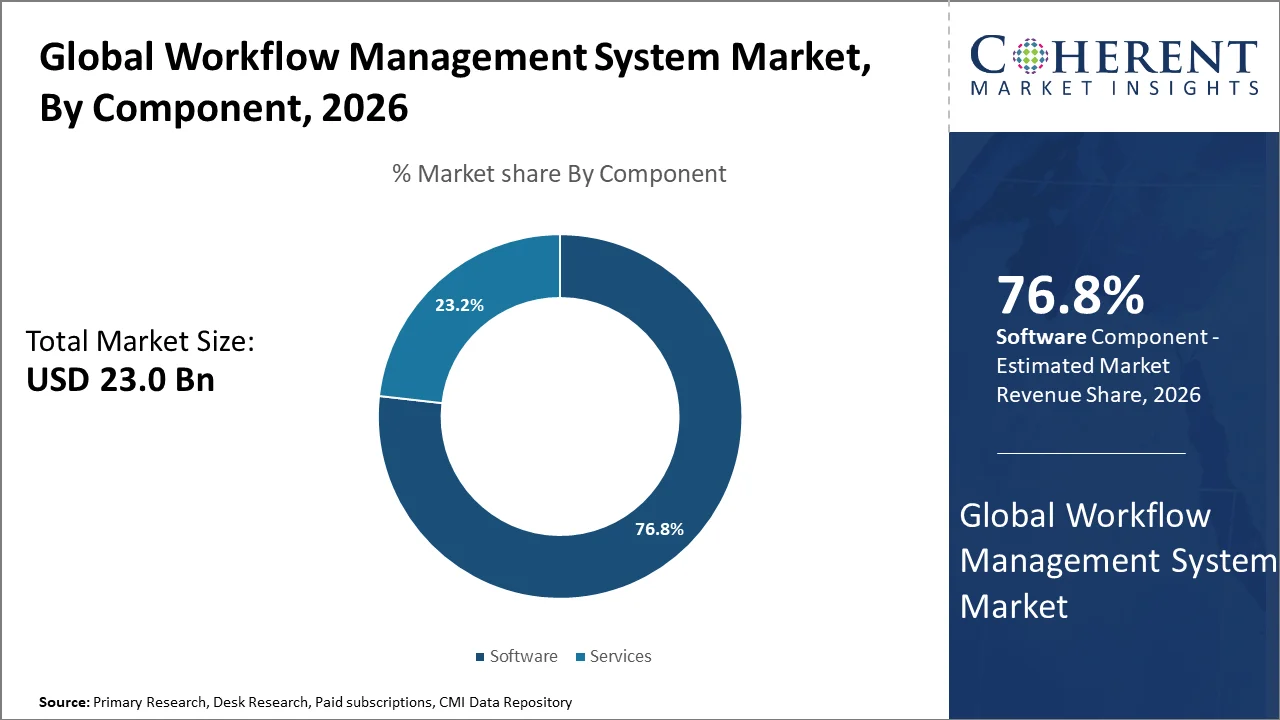
Which Component Accounts for the Largest Workflow Management System Market Share?
Software Segment Accounts for More Than Three-Fourths of the Market
As per Coherent Market Insights’ latest workflow management system market analysis, software segment is set to account for the largest revenue share of 76.8% in 2026. This dominance can be attributed to growing adoption of workflow automation solutions across industries to streamline business processes, improve operational efficiency, and reduce manual tasks.
Organizations in the contemporary are increasingly investing in cloud-based and AI-enabled workflow management software to automate approvals, document management, task scheduling, and collaboration. For instance, according to Microsoft's 2025 Work Trend Index, 82% of business leaders expect to use digital labor to expand their workforce within the next 12–18 months.
Rising demand for digital transformation, low-code and no-code platforms, seamless integration with enterprise applications, and real-time process monitoring is also driving software adoption. As a result, software segment is anticipated to retain its dominant position during the forecast period.
- Current Industry Events of 2026
- Market Size Estimation
- Regional Breakdown
- Competitive Landscape
- Customer Intelligence
- Segmental Analysis
- Pricing Analysis
- Key Market Drivers, Challenges & Future Trends
- Customized Insights Section
Why is Cloud Deployment Emerging as the Preferred Choice?
Scalability, Flexibility, and Lower Costs Drive Cloud Adoption
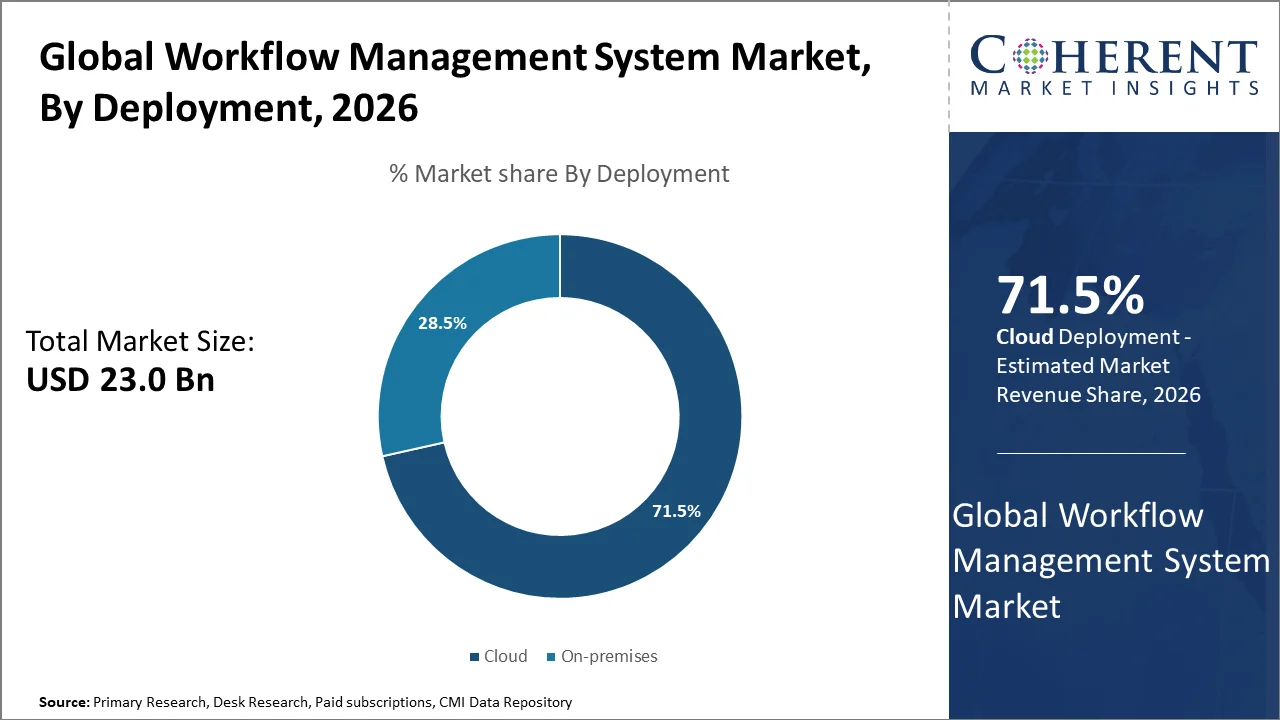
Based on deployment, cloud segment is projected to lead the work flow management system market, holding a share of 71.5% in 2026. Cloud deployment is emerging as the preferred choice in the workflow management system market due to its scalability, cost efficiency, and ease of implementation.
Organizations increasingly prefer cloud-based solutions because they eliminate the need for significant upfront infrastructure investments while enabling remote access, automatic software updates, and seamless integration with enterprise applications. Growing adoption of hybrid work models, rising demand for digital transformation, and increasing use of AI-powered workflow automation are also accelerating cloud deployment.
For example, Flexera's 2025 State of the Cloud Report found that 89% of organizations have adopted a multi-cloud strategy. This number shows the enterprise shift toward cloud-based IT environments and applications.
In addition, cloud platforms offer enhanced data security, business continuity, and flexible subscription-based pricing, making them an attractive option for businesses of all sizes. Thus, demand for cloud-based workflow management systems is expected to remain high throughout the forecast period.
Market Dynamics
Workflow Management System Market Growth Drivers
Rising Demand for Business Process Automation: Increasing emphasis on business process automation is expected to drive growth of the workflow management system market during the forecast period. Organizations are increasingly replacing manual and paper-based processes with automated workflows to improve efficiency, reduce errors, and accelerate decision-making. This is driving demand for workflow management solutions. Automation also helps streamline repetitive tasks, improve productivity, and optimize resource utilization across departments.
For example, according to PwC's 2025 Global Business Services Study, 72% of organizations are actively implementing automation solutions, up from 35% in 2020. This trend reflects the growing adoption of workflow automation technologies across business functions and is expected to support demand for workflow management systems.
Workflow Management System Market Opportunities
Rapid Digital Transformation Across Industries: Increasing digital transformation initiatives are expected to create lucrative opportunities for the workflow management system market during the forecast period. Enterprises across sectors such as BFSI, healthcare, manufacturing, retail, and government are digitizing their operations to improve productivity, enhance customer experience as well as increase operational agility. This, in turn, is driving demand for workflow management systems.
Workflow Management System Market Trends
Growing Adoption of Cloud-Based Workflow Solutions: Rising adoption of cloud-based workflow solutions is a key growth-shaping trend in the workflow management system market. Cloud deployment offers scalability, lower implementation costs, remote accessibility, and faster software updates. Businesses are increasingly choosing cloud-based workflow platforms because they have the tendency to support distributed operations and reduce IT infrastructure costs.
Current Events and Their Impact
Current Event | Description and its Impact |
EU AI Act Rules for AI-Based Workflow Automation (2025–2026) |
|
U.S. Federal Cloud Adoption Policy Expansion |
|
Regional Insights
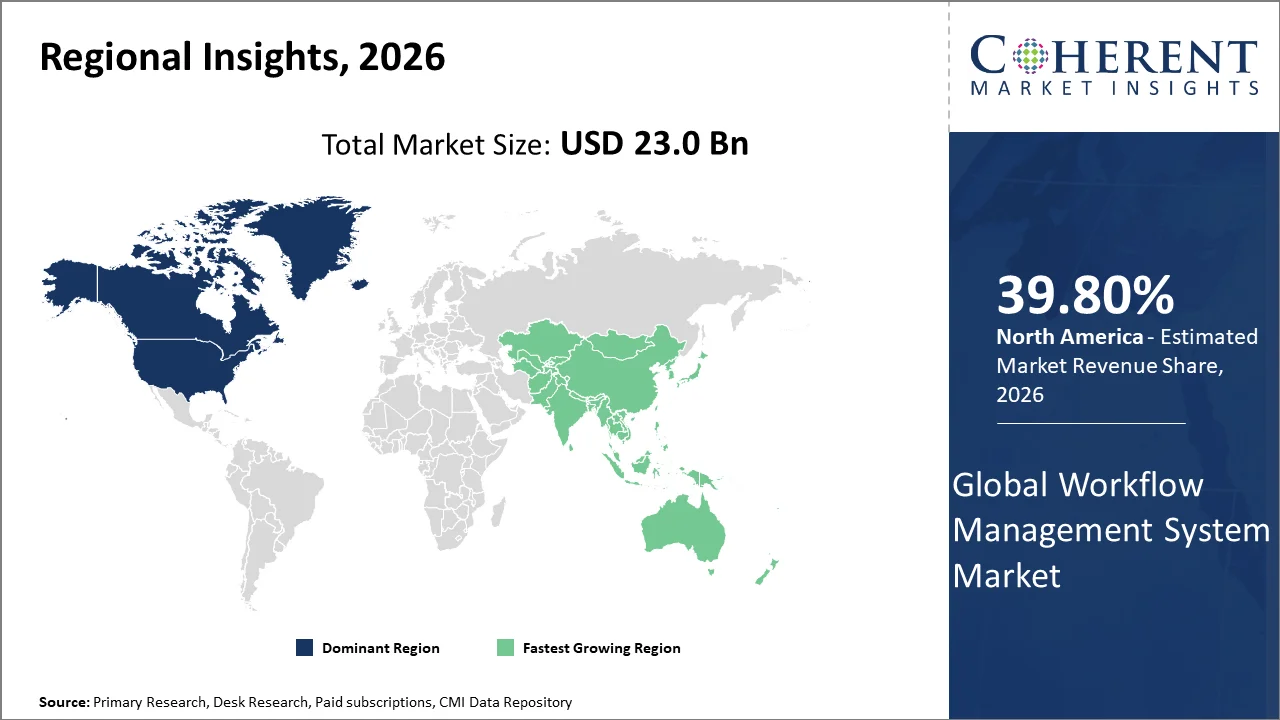
North America Leads in Workflow Management System Adoption
North America is expected to dominate the global workflow management system market, accounting for a share of 39.80% in 2026. This can be attributed to high adoption of cloud-based workflow platforms, increasing use of AI and low-code automation tools as well as growing focus on improving business productivity across industries.
Large enterprises in the U.S. and Canada are increasingly automating repetitive business processes to reduce costs and improve operational efficiency. This, in turn, is expected to fuel demand for work flow management system during the forecast period.
Rapid adoption of low-code automation platforms is boosting North America workflow management system market. Microsoft reported that its Power Platform surpassed 33 million monthly active users, highlighting the growing demand for workflow automation and citizen development across enterprises. The widespread use of such platforms is encouraging organizations to digitize and automate business workflows at scale.
Asia Pacific Becoming a Hotbed for Workflow Management System Companies
Asia Pacific workflow management system market is poised to grow at the highest CAGR of 29% during the forecast period, making it a highly lucrative pocket for work flow management system providers. This is mostly due to rapid digital transformation, increasing adoption of cloud technologies, expanding AI implementation, and rising investments in business process automation across nations like China, India, Japan, and South Korea.
Digital transformation is creating strong demand for workflow management solutions across the region. According to Rockwell Automation's 2026 State of Smart Manufacturing Report, 95% of manufacturers in Asia Pacific said digital transformation is essential for their competitiveness. Likewise, 71% plan to increase AI and machine learning adoption within the next 12 months. These trends are attracting investments in workflow automation platforms to streamline business operations as well as improve efficiency.
Workflow Management System Market Outlook – Country-wise
North America Workflow Management System Market Trends
The United States is anticipated to remain a leading market for workflow management systems during the forecast period. This is attributable to strong adoption of AI-powered workflow automation, widespread use of cloud-based enterprise software, increasing investment in digital workplace transformation, and the presence of leading workflow management solution providers. Organizations across industries are increasingly deploying intelligent workflow platforms to improve operational efficiency, automate repetitive tasks, and support hybrid work environments.
China Workflow Management System Market Forecast
The workflow management system market in China is poised to exhibit stupendous growth throughout the forecast period. This is mainly due to rapid digital transformation among enterprises, government support for industrial digitalization, expanding adoption of cloud computing, and rising demand for workflow automation among small and medium-sized businesses (SMEs). Increasing implementation of smart manufacturing, AI-enabled business processes, and digital office solutions is also supporting market expansion across the country.
Who are the Major Companies in the Workflow Management System Market?
Some of the major players in workflow management system market are Appian, Bizagi, IBM Corporation, Newgen Software Technologies Ltd. Nintex Global Limited, Oracle Corporation, Pegasystem Inc., Software AG, Source code Technology Holdings Inc., and Xerox Corporation.
Key Strategies Adopted by Industry Players
Leading workflow management system vendors are adopting various organic and inorganic strategies to boost their revenue as well as gain a competitive edge in the industry. These include new product launches, mergers, partnerships, collaborations, partnerships, acquisitions, and new facility expansions.
- In July 2026, S&P Global launched Adaptive Retrieval, a new service for AI agents and large language models (LLMs). It allows users to access and assemble licensed S&P Global data using natural language queries.
- In June 2026, Pegasystems Inc. announced the Pega Solution Designer Initiative. The initiative aims to help organizations close the gap between business intent and production-ready execution, a major barrier to AI success.
- In August 2025, Appian announced new platform enhancements to improve business operations and AI capabilities. The updates provide faster insights, greater platform stability, and more secure access to AI across applications.
- In October 2024, Oracle introduced new AI-driven workflows for customer service. The new workflows help organizations automate the complete customer service lifecycle.
Market Report Scope
Workflow Management System Market Report Coverage
| Report Coverage | Details | ||
|---|---|---|---|
| Base Year: | 2025 | Market Size in 2026: | USD 23.0 Bn |
| Historical Data for: | 2020 To 2024 | Forecast Period: | 2026 To 2033 |
| Forecast Period 2026 to 2033 CAGR: | 25.8% | 2033 Value Projection: | USD 114.6 Bn |
| Geographies covered: |
| ||
| Segments covered: |
| ||
| Companies covered: | Appian, Bizagi, IBM Corporation, Newgen Software Technologies Ltd. Nintex Global Limited, Oracle Corporation, Pegasystem Inc., Software AG, Source code Technology Holdings Inc., and Xerox Corporation. | ||
| Growth Drivers: |
| ||
| Restraints & Challenges: |
| ||
Analyst Opinion (Expert Opinion)
- Increasing adoption of AI is raising the demand for intelligent workflow automation. In fact, according to This promotes the integration of AI in workflow platforms to automate decision making, processing documents and other activities.
- Operations that involve cloud technologies provide a more robust base for workflow platforms. Flexera's State of the Cloud report states that 89% of organizations apply a multi-cloud approach. The increased usage of cloud environments raises the demand for workflow solutions with the possibility of flexible integration and access to them.
- Hybrid work is increasing the need for better process visibility and collaboration tools. Microsoft’s Work Trend Index surveyed 31,000 people across 31 countries and highlighted the shift toward new workplace models and digital collaboration. This is driving organizations to adopt workflow systems to coordinate tasks, approvals, and team activities.
- Low code automation helps more businesses to develop and customize workflows rapidly. Indeed, according to Microsoft Power Platform, low code tools allow organizations to build applications with little coding effort.
Speak to the analyst
Want personalized insights?
Take the findings above to one of our principal consultants, or have the report rebuilt around the segments, geographies and competitors you actually track.
Market Segmentation
- By Component (Revenue, USD Bn, 2026–2033)
- Software
- Services
- By System Type (Revenue, USD Bn, 2026–2033)
- Production Workflow System
- Messaging-Based Workflow System
- Web-Based System
- Suite-Based System
- Others
- By Deployment (Revenue, USD Bn, 2026–2033)
- Cloud
- On-premises
- By Organization Size (Revenue, USD Bn, 2026–2033)
- Small Enterprises
- Medium Enterprises
- Large Enterprises
- By Verticals (Revenue, USD Bn, 2026–2033)
- BFSI
- Healthcare
- Retail and Consumer Goods
- IT and Telecom
- Media and Entertainment
- Travel and Hospitality
- Government
- Others
- Global Workflow Management System Market, By Region: (Revenue, USD Bn, 2026-2033)
- North America
- U.S.
- Canada
- Latin America
- Brazil
- Mexico
- Argentina
- Rest of Latin America
- Europe
- Germany
- U.K.
- France
- Italy
- Spain
- Russia
- Rest of Europe
- Asia Pacific
- China
- India
- Japan
- Australia
- South Korea
- ASEAN
- Rest of Asia Pacific
- Middle East
- GCC Countries
- Israel
- Rest of Middle East
- Africa
- South Africa
- North Africa
- Central Africa
- North America
- Key Players
- Appian
- Bizagi
- IBM Corporation
- Newgen Software Technologies Ltd.
- Nintex Global Limited
- Oracle Corporation
- Pegasystems Inc.
- Software AG
- Source Code Technology Holdings Inc.
- Xerox Corporation
Sources
Primary Research interviews
- Interviews with industry executives, technology providers, software vendors, IT managers, digital transformation leaders, and workflow automation solution users.
Databases
- Company annual reports and investor presentations
- SEC filings and regulatory disclosures
- Government technology and digital economy databases
- Enterprise software adoption databases
- IT spending and digital transformation datasets
Magazines
- CIO
- InformationWeek
- Computerworld
- TechTarget publications
- The Register
- Forbes Technology Council
Journals
- IEEE Xplore Digital Library
- ACM Digital Library
- Journal of Information Technology
- International Journal of Information Management
- Business Process Management Journal
Newspapers
- The Wall Street Journal
- The Financial Times
- The Economic Times
- The Hindu BusinessLine
- Reuters Technology News
Associations
- Association for Computing Machinery (ACM)
- IEEE Computer Society
- Information Systems Audit and Control Association (ISACA)
- Business Process Management Initiative (BPMI)
- Object Management Group (OMG)
Public Domain sources
- Government digital transformation initiatives and policy documents
- European Union digital strategy and AI governance publications
- National Institute of Standards and Technology (NIST) publications
- International Telecommunication Union (ITU) reports
- World Bank digital economy publications
- Company websites, product documentation, press releases, and customer case studies
Proprietary Elements
- CMI Data Analytics Tool, Proprietary CMI Existing Repository of information for last 10 years
Get access to 250+ pages report
Every segment, forecast, competitor profile and data table behind the analysis above — available for instant download.
- ESOMAR Member
- ISO 9001:2015 Certified
- D-U-N-S Registered
- GDPR & CCPA Compliant
Missing comfort of reading report in your local language? Find your preferred language:
Transform your Strategy with Exclusive Trending Reports
Frequently Asked Questions
The global market is estimated to be valued at USD 23.0 Bn in 2026.
The global Workflow Management System Market value is expected to reach USD 114.6 Bn by 2033.
The global market is poised to exhibit a CAGR of 25.8% from 2026 to 2033.
Major growth factors include increasing adoption of digital transformation initiatives, rising demand for process automation, growing need for improved operational efficiency, and integration of artificial intelligence (AI) and machine learning (ML) technologies into workflow platforms.
Software segment is expected to lead the market with a share of 76.8% in 2026.
Some major companies in the Workflow Management System Market include Appian, Bizagi, IBM Corporation, Newgen Software Technologies Ltd. Nintex Global Limited, Oracle Corporation, Pegasystem Inc., Software AG, Source code Technology Holdings Inc., and Xerox Corporation.
North America, with a 39.8% share in 2026, is set to lead the market during the forecast period.