

Business Software and Services Market Analysis & Forecast
Business Software and Services Market is estimated to be valued at USD 687.78 Bn in 2026 and is expected to reach USD 1,298.22 Bn in 2033, exhibiting a compound annual growth rate (CAGR) of 9.5% from 2026 to 2033.
Key Takeaways
- Based on the Software, the Finance segment dominates the market due to the benefits of financial management software solutions.
- Based on the Service, the Consulting segment dominates the market due to the rise in demand for different consulting services.
- Based on the Deployment, the Cloud segment dominates the market due to the increasing deployment of cloud-based solutions.
- Based on the Enterprise size, the Large Enterprises segment dominates the market due to the growing adoption of business software solutions.
- Based on the End-User, the Aerospace & Defense segment dominates the market due to the increasing development of intelligent business management software solutions.
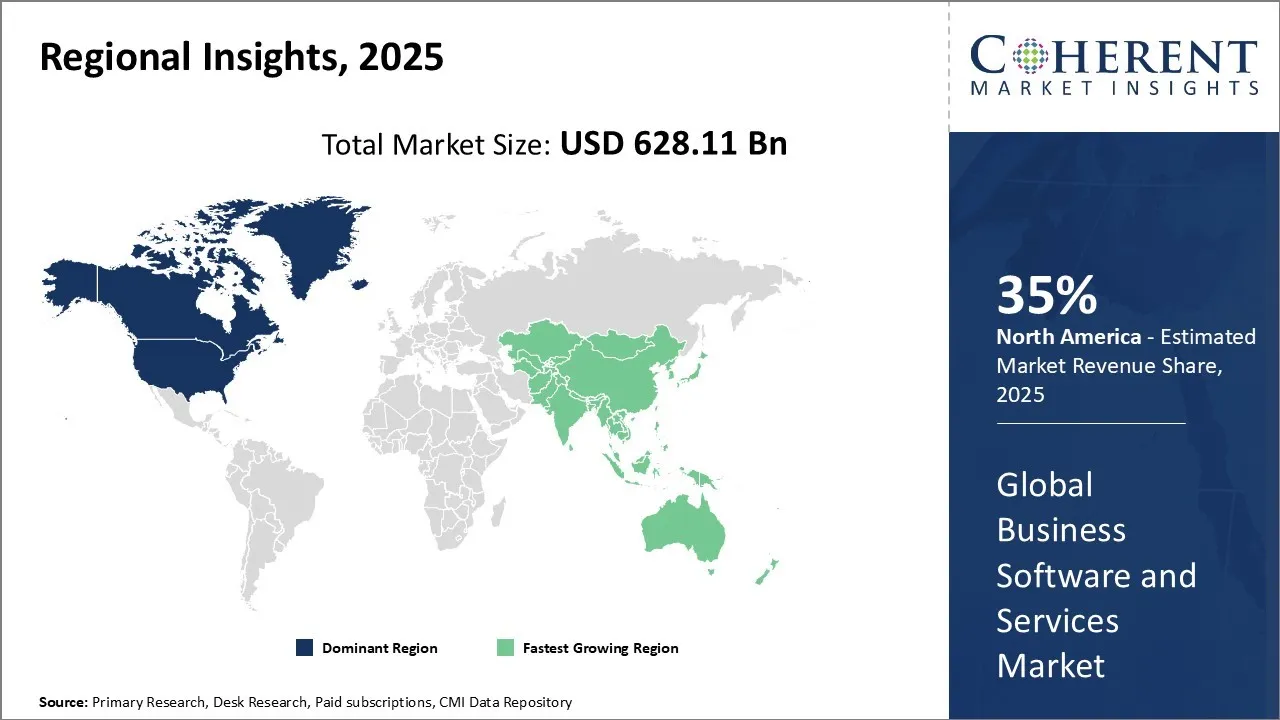
- Based on Region, North America dominates the global Business Software and Services Market with 35% of market share.
Market Overview
Increasing deployment of business software and services in various organizations and government sectors for better profitability, lower inventory costs, and faster decision-making fuels the business software market growth. Moreover, the growing need for advanced IT infrastructure and high-speed data networks is expected to propel the market demand in the upcoming years.
Current Events and Their Impact on the Business Software and Services Market
Current Events | Description and its impact |
Market Consolidation and Innovation Trends |
|
Sector-Specific Demand Shifts |
|
Regulatory and Trade Dynamics |
|
Economic Policy Changes Influencing Investment |
|
End Use Application for Business Software and Services Market
- BFSI (Banking, Financial Services, and Insurance): The BFSI sector uses business software to manage daily tasks like handling customer data, improving service, and meeting rules set by regulators. Banks use tools to spot fraud, while insurance companies use software to speed up claims and policy work.
- Healthcare: Hospitals and clinics use business software to keep patient records, manage staff and supplies, and offer online care. Many are switching to cloud-based systems that help doctors with faster diagnosis, better patient support, and ensure they follow health rules.
- Retail and E-commerce: Retailers use business software to manage stock, sales, and customer data. Online stores like those using Shopify or Magento track sales in real-time, send targeted ads, and improve delivery systems to give shoppers a better and faster experience.
- IT and Telecom: Companies in IT and telecom use software for teamwork, managing services, and talking to customers. Telecom firms use it for billing and customer service, while software companies rely on project tracking tools to deliver better apps and services on time.
- Current Industry Events of 2026
- Market Size Estimation
- Regional Breakdown
- Competitive Landscape
- Customer Intelligence
- Segmental Analysis
- Pricing Analysis
- Key Market Drivers, Challenges & Future Trends
- Customized Insights Section
End-user Feedback and Unmet Needs in the Business Software and Services Market
End-user Feedback
- Ease of Integration: Users value software that works well with their current systems. This smooth connection helps reduce the time it takes to set up and avoids problems during installation, allowing businesses to continue their work without major interruptions.
- User Interface & Experience: Customers often give good feedback when the software is easy to use and understand. Simple dashboards and clear layouts, especially in CRM and ERP tools, help staff learn quickly and improve daily use without needing much training.
- Customer Support & Updates: Users appreciate quick and helpful customer service when they face issues. Regular software updates that fix bugs and add improvements are also seen as a plus, especially when these updates come without extra charges or delays.
Unmet Needs
- Customization & Flexibility: Many businesses find it hard to change the software to fit their specific needs. When tools are too fixed and cannot adjust to different work styles, it slows down work and forces users to change their normal way of operating.
- Data Interoperability: Users often struggle to bring together data from different software systems. When tools do not share information properly, it becomes hard to get full insights or make smart decisions based on complete and up-to-date information.
- Affordability for SMEs: Smaller companies often find business software too expensive. High costs and complicated pricing make it hard for them to invest. These users want more flexible and lower-priced options that can grow with their business over time.
Segmental Insights
Business Software and Services Market Insights, By Deployment
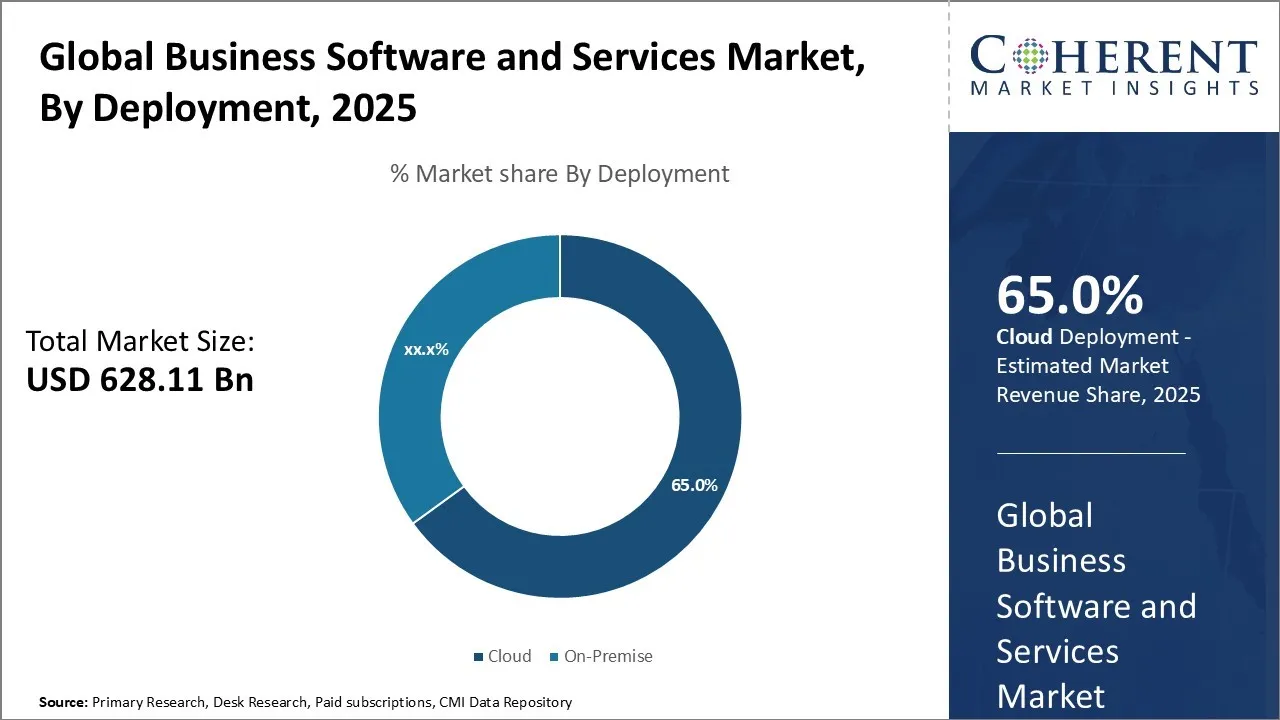
The Cloud segment dominates the market due to the increasing deployment of cloud-based solutions
Based on Deployment, the market is segmented into Cloud and On-premise. Out of which, Cloud is expected to dominate the global market over the forecast period and this is attributed to the increasing deployment of cloud-based solutions of various business software and services. This offers various benefits, such as a reduced need for regular manual upgrades and access to data from any location without hassle. For instance, Oracle is providing cloud solutions to accelerate SAP ERP, HCM, and Payroll, including data migration services, modernization, and streamlining business operations.
The on-premise segment is also expected to witness significant growth soon, owing to the increasing shift by companies from manual systems to automated systems for various operations, leading to a rise in demand for on-premise software. Owing to the various advantages of this deployment method, the segment is likely to show steady growth in the future.
Business Software and Services Market Insights, By Software
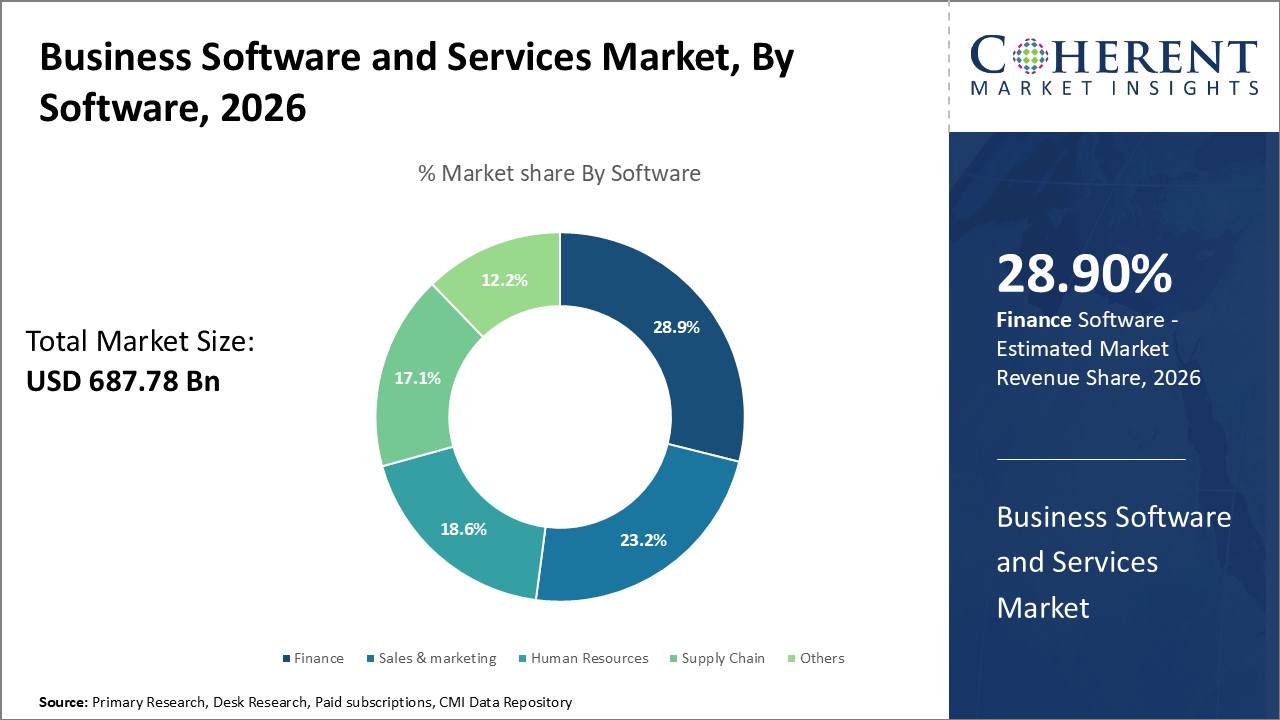
The Finance segment dominates the market due to the benefits of financial management software solutions
Based on Software, the market is segmented into Finance, Sales & Marketing, Human Resources, Supply Chain, and Others. Finance is expected to dominate the global market over the forecast period, and this is attributed to the various benefits of financial management software solutions, such as tools for budgeting, planning, analysis, and reporting. Moreover, these solutions also offer businesses a complete suite of accounting functions for tracking their financial operations and generating annual and quarterly financial statements. For instance, Newgen Software introduced low-code, end-to-end trade finance platform in the Middle East. Banks and financial companies in the region can now use Newgen’s advanced platform to bring together and modernize old and disconnected systems. This helps them work more efficiently, grow faster, and find new business opportunities.
Apart from this, the sales & Marketing segment is also expected to witness significant growth soon, and this is owing to the widespread use of sales acceleration software among businesses for combining sales procedures and tasks. This software offers businesses a detailed overview of a company’s sales team’s work in different locations, products, services, and customers. Due to its various benefits, the adoption of sales and marketing management solutions is increasing, which in turn is driving the growth of this segment.
Business Software and Services Market Insights, By Service
The Consulting segment dominates the market due to the rise in demand for different consulting services
Based on Service, the market is segmented into Consulting, Managed Services, and Support & Maintenance. Consulting is expected to dominate the global market over the forecast period, and this is attributed to the rise in demand for different consulting services in end-user industries to manage risks related to businesses and detect growth opportunities. The Managed Services segment is also expected to witness significant growth soon, and this is owing to the rise in dependence of enterprises on IT assets to improve their productivity.
Along with this, managed services integrate and manage cloud as well as conventional infrastructures, which in turn drives demand for these services. This is further driving the business software and services market growth. For instance, Uniqus launched a new Tech Consulting practice with digital expertise alongside its financial consulting services.
Business Software and Services Market Insights, By Enterprise size
The Large Enterprises segment dominates the market due to the growing adoption of business software solutions
Based on Enterprise Size, the market is segmented into Large Enterprises and Small & Medium Enterprises. Out of which, Large Enterprises are expected to dominate the global market over the forecast period, and this is attributed to the growing adoption of business software solutions in large enterprises owing to the presence of a large amount of data. The related processes and operations need different high-tech tools, which include process blueprints, advanced analytical engines, and real-time data compilation tools. As a result, a rise in the adoption of business software and services in these enterprises. The Small & Medium Enterprises segment is also expected to witness significant growth soon, and this is owing to the increasing government initiatives through SME campaigns, such as social media marketing, video marketing, and search engine marketing.
Business Software and Services Market Insights, By End-User
The Aerospace & Defense segment dominates the market due to the increasing development of intelligent business management software solutions
Based on End-Use, the market is segmented into Aerospace & Defense, BFSI, Government, Healthcare, IT & Telecom, Manufacturing, Retail, Transportation, and Others. Out of which, Aerospace & Defense is expected to dominate the global market over the forecast period and this is attributed to the increasing development of intelligent business management software solutions using real-time analytics, leading to real-time visibility into manufacturing operations, optimized inventory levels, and extended supply chain and manufacturing processes. For instance, Honeywell introduced Honeywell Forge Performance+ for Aerospace, a cloud-based platform that uses AI and machine learning to help commercial aerospace manufacturing and maintenance (MRO) facilities improve their processes and reduce costs through digital tools.
Besides this, the BFSI segment is also expected to witness significant growth in the near future, and this is owing to the widespread use of business software in banking and financial institutions due to its enhanced client experience. Moreover, the benefits offered by this software and services such as live tracking of operating transactions, secure transactions, and constant access to the client database. This is further propelling the business software and software services market revenue.
Regional Insights
North America Business Software and Services Market Trends
North America is anticipated to exhibit major growth in the global business software and services market with an estimated market share of 35% in 2026. The region is witnessing growing demand for high-speed data networks, and robust presence of major software vendors. These factors are further leading to a rise in demand for business software and services in the region, which in turn is expected to drive the global business software and services market growth in the region. For instance, the American company Adobe launched Adobe Experience Platform Agent Orchestrator for Businesses to Activate AI Agents in Customer Experiences and Marketing Workflows.
Europe Business Software and Services Market Trends
Europe is projected to show significant growth in the global business software and services market over the forecast period. The rise in investments by major firms and the adoption of advanced technologies in enterprises and industries in the region are primarily driving market growth.
Moreover, due to the growing focus on cloud-based facilities and endeavors for developing corporate intelligence solutions, the need for enterprise solutions is increasing in the region, further driving the growth of the market. For instance, the British company PwC introduced Agent OS, a platform that supports advanced multi-agent AI systems for businesses. It brings together AI agents from Anthropic, Google Cloud, and Microsoft Azure to collaborate on complex tasks, encouraging smooth cooperation between different agents.
United States Business Software and Services Market Trends
The growth of the United States Business Software and Services market is driven by fast digital changes, wide use of cloud technology, and the growing need for automation across industries. Companies are spending on AI, machine learning, and smart data tools to improve decisions and work faster. Also, flexible work models and rising concerns about online safety are increasing the need for secure and flexible solutions. Government backing for digital systems and higher spending on software by businesses are also helping the market grow, especially for small and mid-sized firms. For instance, the American company IBM announced tools that let users create AI agents in under five minutes using its Granite models and support for 3rd party agents like Salesforce, Workday, and Adobe.
India Business Software and Services Market Trends
The growth of India’s Business Software and Services market is being supported by fast digital changes in different industries, government programs like Digital India, and more use of cloud services by small and medium businesses. There is a rising need for automation, data analysis, and AI-based tools, which are changing how companies work.
Also, more spending on IT systems, a strong startup network, and the move to remote and flexible work are speeding up BSS use, making India an important market for global providers. For instance, the government of India has launched programs like the Visvesvaraya PhD Scheme and NIELIT centers to encourage research and training in emerging technologies.
Market Report Scope
Business Software and Services Market Report Coverage
| Report Coverage | Details | ||
|---|---|---|---|
| Base Year: | 2025 | Market Size in 2026: | USD 687.78 Bn |
| Historical Data for: | 2020 To 2024 | Forecast Period: | 2026 To 2033 |
| Forecast Period 2026 to 2033 CAGR: | 9.5% | 2033 Value Projection: | USD 1,298.22 Bn |
| Geographies covered: |
| ||
| Segments covered: |
| ||
| Companies covered: | Acumatica, Inc., Unit4, Deltek, Inc., Totvs SA, Epicor Software Corporation, SYSPRO, International Business Machines Corporation, SAP SE, Infor, Inc., Oracle Corporation, Microsoft Corporation, and NetSuite Inc. | ||
| Growth Drivers: |
| ||
| Restraints & Challenges: |
| ||
Global Business Software and Services Market Drivers
Increasing need for operational efficiency and transparency in business operations to boost market growth
The use of business software and services is increasing rapidly in end-use industries due to their support in streamlining business processes. These solutions help large enterprises to provide quick and easy access to unstructured data gathered through data analytics methods. They also help these enterprises to achieve the data security goals of a company. Moreover, implementing business management software in an enterprise offers a significant reduction in the costs of inventory and raw materials, which further helps businesses boost profitability. Thus, with the rising need for operational efficiency and transparency in these operations, the demand for business software and services is increasing, which is further expected to fuel market growth.
A rise in the shift toward cloud computing is expected to accelerate market growth
Cloud computing technology uses remote servers and the internet for maintaining data and different types of applications. Several businesses are adopting cloud computing technology due to its advantages, such as security, mobility, reduced total cost of ownership, scalability, optimized business processes, customization, and others. The use of cloud computing technology provides scalability through which businesses can customize their computing requirements by either increasing or decreasing them depending on the market demand.
Global Business Software and Services Market Opportunities
Various advantages, such as a major decrease in costs of raw materials and inventory of enterprise solutions, are creating growth opportunities in the global business software and services market over the forecast period. This further increases the profitability of organizations. Several companies are using business management solutions to increase their efficiency in operations through the integration of administrative processes into a single piece of software. The modules of business solutions can integrate departmental data into real-time updates, which further improves data transparency.
Growing applications in the healthcare industry are expected to offer multiple growth opportunities in the global business software and services market over the forecast period. The demand for improved outcomes and cost-efficiency of supply chain and human resource management software solutions is increasing in the healthcare sector. As a result, demand for supply chain and human resource management software is increasing in hospitals. This is further creating major growth opportunities in the global market.
Global Business Software and Services Market Trends
Rise in adoption of growth strategies by market players is a major trend
The demand for mobility and data portability is increasing, leading to the need for data-centric solutions and software for businesses. Thus, market players are increasingly engaging in various growth strategies such as product launches, collaborations, contracts, mergers, and acquisitions to gain a competitive edge in the market. For instance, in October 2022, Epicor introduced various novel features in its Epicor Kinetic software, a cloud-based industry ERP software solution for the manufacturing sector.
Global Business Software and Services Market: Key Developments
- In July 2025, Intuit (INTU) introduced a set of proactive AI agents for its QuickBooks accounting software for small businesses. Intuit said the AI tools save businesses up to 12 hours a month on bookkeeping.
- In April 2025, IBM also announced that it would invest USD 150 billion in the United States.
- In April 2025, the TCS SovereignSecure Cloud, which aims to strengthen India’s data sovereignty and accelerate the country’s artificial intelligence (AI) capabilities, leveraged Tata Communications Limited’s data centers in the availability zones of Mumbai and Hyderabad.
Analyst Opinion (Expert Opinion)
- The Business Software and Services (BSS) market is undergoing a critical inflection point, shaped less by technological innovation per se and more by the enterprise mandate to recalibrate operations around resilience, data centrality, and time-to-value.
- Line-of-business (LoB) leaders now control 57% of IT spending. This shift has redefined product-market fit in BSS—from monolithic platforms to composable, modular systems that empower functions like finance, HR, and procurement to independently select and scale tools aligned with operational KPIs, not IT constraints. For instance, Workday’s land-and-expand strategy with adaptive planning modules has enabled it to penetrate non-core departments in enterprise accounts once dominated by legacy ERP vendors.
- Vertical SaaS has eroded the defensibility of broad enterprise suites by delivering depth over breadth. In the manufacturing sector, for example, Plex Systems (acquired by Rockwell Automation) has displaced incumbent ERP vendors in over 300 mid-market firms by delivering real-time plant-floor visibility—a feature generalized ERP suites consistently fail to operationalize at scale. The implicit assumption that integrated platforms reduce complexity is being challenged; enterprises now realize that suite integration is only as valuable as the weakest application in the bundle.
Speak to the analyst
Want personalized insights?
Take the findings above to one of our principal consultants, or have the report rebuilt around the segments, geographies and competitors you actually track.
Market Segmentation
- Global Business Software and Services Market, By Software
- Finance
- Sales & Marketing
- Human Resource
- Supply Chain
- Others
- Global Business Software and Services Market, By Service (Revenue, USD Bn, 2021 - 2033)
- Consulting
- Managed Services
- Support & Maintenance
- Global Business Software and Services Market, By Deployment
- Cloud
- On-premise
- Global Business Software and Services Market, By Enterprise Size
- Large Enterprises
- Small & Medium Enterprises
- Global Business Software and Services Market, By End-Use
- Aerospace & Defense
- BFSI
- Government
- Healthcare
- IT & Telecom
- Manufacturing
- Retail
- Transportation
- Others
- Regional Insights (Revenue, USD Bn, 2021 - 2033)
- North America
- U.S.
- Canada
- Latin America
- Brazil
- Argentina
- Mexico
- Rest of Latin America
- Europe
- Germany
- U.K.
- Spain
- France
- Italy
- Russia
- Rest of Europe
- Asia Pacific
- China
- India
- Japan
- Australia
- South Korea
- ASEAN
- Rest of Asia Pacific
- Middle East
- GCC Countries
- Israel
- Rest of Middle East
- Africa
- South Africa
- North Africa
- Central Africa
- North America
- Company Profiles
- Acumatica, Inc.
- Deltek, Inc.
- Epicor Software Corporation
- International Business Machines Corporation
- Infor, Inc.
- Microsoft Corporation
- NetSuite Inc.
- Oracle Corporation
- SAP SE
- SYSPRO
- Totvs SA
- Unit4
Sources
Interviews from the following stakeholders
Stakeholders
Interviews with CIOs, digital transformation heads, enterprise architects, IT procurement leads, implementation consultants, cloud infrastructure strategists, product managers at enterprise software firms, SaaS solution architects, industry-specific ERP integrators, AI/ML application developers, mid-market CTOs, and business development executives involved in the design, deployment, and scaling of enterprise software solutions across BFSI, manufacturing, retail, healthcare, and logistics sectors.
Databases
- OECD – Enterprise digitalization and ICT investment benchmarks
- World Bank Enterprise Surveys – Software utilization by company size and geography
- UN Comtrade – Software and IT services export/import trade data under CPC/EBOPS
- Eurostat – ICT usage in enterprises and digital infrastructure data
- India Brand Equity Foundation (IBEF) – Digital transformation in India’s services economy
- Ministry of Electronics & IT (India) – SaaS and enterprise software incentives and policy support
- U.S. Bureau of Economic Analysis (BEA) – IP-related software investments and IT services exports
- Companies House (UK) – Financials of enterprise software vendors in the UK market
Magazines
- CIO Magazine
- InformationWeek
- TechCrunch Enterprise
- Enterprise Times (UK)
- Forbes Technology Council
- ZDNet – Enterprise IT Section
- SiliconANGLE – The Cube Interviews
- Business Today – Tech Section (India)
- The Enterprisers Project
- ITPro Today
Journals
- MIS Quarterly (Management Information Systems)
- Journal of Strategic Information Systems
- Information Systems Research (INFORMS)
- Journal of Enterprise Information Management
- International Journal of Information Management
- Communications of the ACM
- Decision Support Systems Journal
- Journal of Cloud Computing Advances, Systems and Applications
- IEEE Transactions on Software Engineering
Newspapers
- The Economic Times – Tech and CIO Strategy Section
- Business Standard – Digital Transformation & SaaS Features
- The Hindu BusinessLine – Enterprise IT Trends
- Mint – Enterprise Tech, SaaS, and India Stack Coverage
- Reuters – Global SaaS and B2B Software Insights
- Financial Times – Cloud and Enterprise IT Reports
- Times of India – Business Software Developments
Associations
- National Association of Software and Service Companies (NASSCOM)
- Software and Information Industry Association (SIIA)
- International Association of Microsoft Channel Partners (IAMCP)
- Cloud Native Computing Foundation (CNCF)
- SaaSBOOMi (India)
- IEEE Computer Society – Enterprise Software Working Groups
- Association of Enterprise Architects (AEA)
- Project Management Institute (PMI) – Digital transformation frameworks
- Open Group – TOGAF and Enterprise Architecture Guidance
- Global Industry Council on Digital Transformation (GIC-DT)
Public Domain Sources
- Ministry of Electronics & IT (India) – Digital Public Infrastructure and enterprise SaaS guidelines
- U.S. National Institute of Standards and Technology (NIST) – Software and cloud security frameworks
- UK Cabinet Office – Government SaaS Procurement and G-Cloud Framework
- European Commission – Digital Europe Program, enterprise IT regulation
- OECD – Digital Economy Papers and Software Sector Policy Notes
- U.S. General Services Administration (GSA) – Enterprise software procurement and security benchmarks
- World Bank – Digital adoption, software use in emerging markets
- India’s DPIIT – SaaS and Tech Innovation Policy
- Cybersecurity and Infrastructure Security Agency (CISA, U.S.) – Guidelines on enterprise software security
- Digital Public Goods Alliance (DPGA) – Open-source software for business services
Proprietary Elements
- CMI Data Analytics Tool, and the Proprietary CMI Existing Repository of information for the last 8 years.
*Definition: Business software allows managers to access a database of important information, such as invoices and client details. Such programs can also help to track the performance of staff and improve efficiency by automating tasks.
Get access to 250+ pages report
Every segment, forecast, competitor profile and data table behind the analysis above — available for instant download.
- ESOMAR Member
- ISO 9001:2015 Certified
- D-U-N-S Registered
- GDPR & CCPA Compliant
Missing comfort of reading report in your local language? Find your preferred language:
Transform your Strategy with Exclusive Trending Reports
Frequently Asked Questions
The Business Software and Services Market is estimated to be valued at USD 687.78 Bn in 2026 and is expected to reach USD 1,298.22 Bn by 2033.
The CAGR of the Business Software and Services Market is projected to be 9.5% from 2026 to 2033.
The increasing need for operational efficiency and transparency in business operations and the rise in the shift toward cloud computing are fuelling the market.
The cloud segment is the leading segment in the market.
The high cost of licensing and support, and the complexity and operational issues of business software solutions are the major factors restraining the growth of the market.
Acumatica, Inc., Unit4, Deltek, Inc., Totvs SA, Epicor Software Corporation, SYSPRO, International Business Machines Corporation, SAP SE, Infor, Inc., Oracle Corporation, Microsoft Corporation, and NetSuite Inc.