

Sales Acceleration Software Market Size and Share Analysis: 2026 - 2033
The sales acceleration software market was valued at USD 1.7 Bn in 2026 and is forecast to reach a value of USD 3.0 Bn by 2033 at a CAGR of 10% between 2026 and 2033.
Key Takeaways
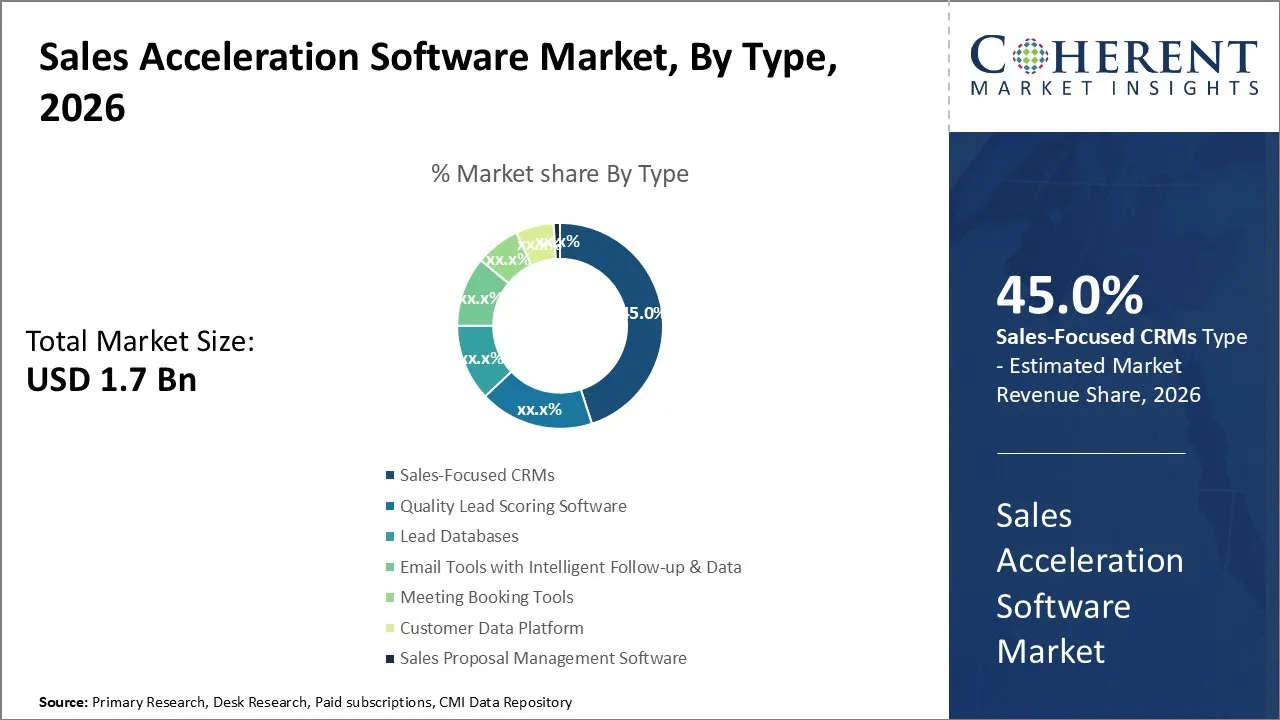
- Based on type, the sales-focused CRMs segment is expected to hold 45% share of the market in 2026.
- Based on enterprise size, the large enterprises segment is projected to account for 65% share of the market in 2026.
- Based on industry vertical, the BFSI segment is expected to lead the market with 40% share in 2026.
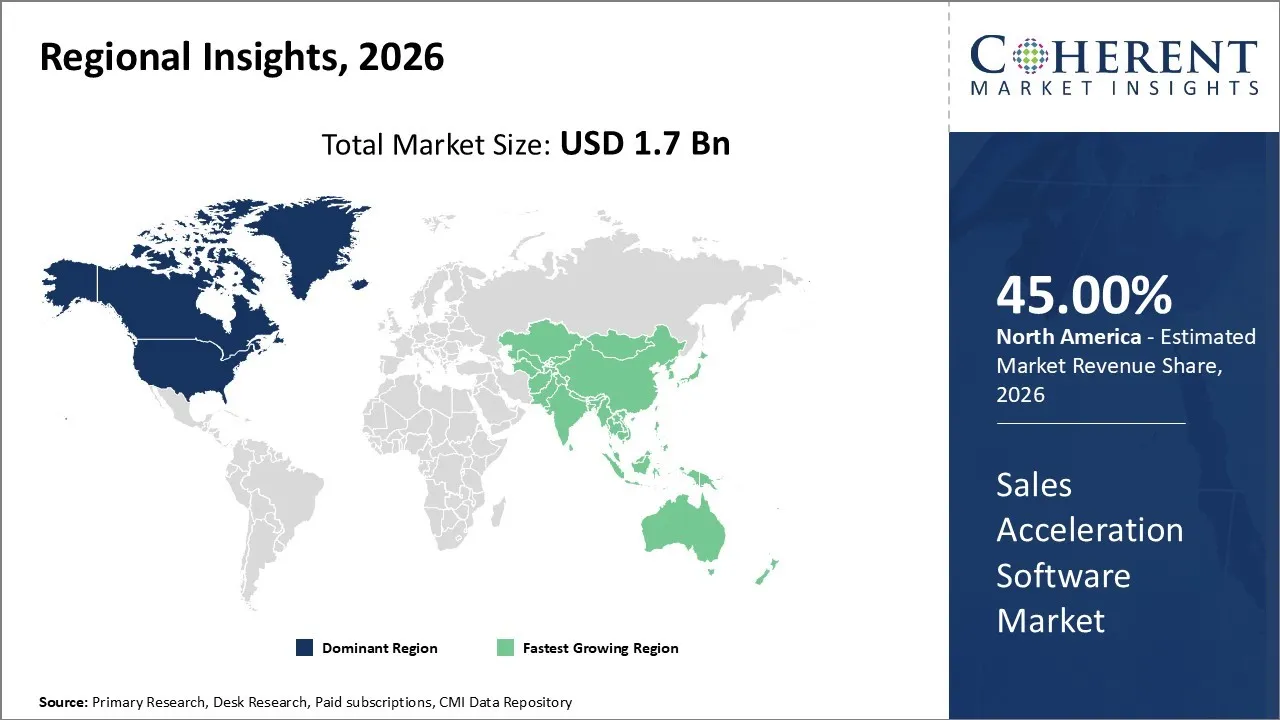
- Based on Region, North America is set to lead the Sales Acceleration Software market with 45% share in 2026. While, Asia Pacific is anticipated to have the fastest growing region.
Market Overview
Businesses utilize a set of tactics called sales acceleration to more quickly move leads through the sales funnel. Databases, research tools, tracking technologies, and analytics capabilities are all part of this technology, which speeds up the sales process and enables sales representatives to close more deals in a shorter amount of time. Activity trackers can be integrated into your CRM (Customer Relationship Management) automation platform by sales acceleration software, giving you access to all the data you require in a single location. This enables representatives and management to spot patterns for increasing and improving sales quickly. Using automated processes and planning tools, it even assists reps in creating a schedule for their daily operations.
Current Events and their Impacts on the Sales Acceleration Software Market
Current Event | Description and its Impact |
Utilization of AI-Powered Sales Tools by BFSI and Enterprise Companies |
|
Digital Transformation along with Remote Work Trends |
|
Segmental Insights
- Current Industry Events of 2026
- Market Size Estimation
- Regional Breakdown
- Competitive Landscape
- Customer Intelligence
- Segmental Analysis
- Pricing Analysis
- Key Market Drivers, Challenges & Future Trends
- Customized Insights Section
Sales Acceleration Software Market Insights, By Type - Sales-Focused CRMs represent the largest in the market because they combine multiple important sales functions
In terms of type, the Sales-Focused CRMs segment is expected to lead the market with 45% share in 2026, owing to their comprehensive nature and ability to serve as the central nervous system for sales operations across organizations of all sizes. The dominance of Sales-Focused CRMs can be attributed to their multifunctional capabilities that encompass contact management, opportunity tracking, sales pipeline visualization, forecasting, as well as performance analytics all within a single integrated platform.
For instance, major technology companies have invested heavily in developing sophisticated CRM solutions, with Salesforce leading the charge by serving over 150,000 companies globally and continuously expanding its ecosystem through acquisitions and platform integrations.
Sales Acceleration Software Market Insights, By Enterprise Size - Large Enterprises dominate the market owing to their larger sales teams, more complex sales processes, and bigger budgets
In terms of enterprise size, the large enterprises segment is expected to hold 65% share of the market in 2026. They have more money, bigger and more complicated organizations, and larger sales teams, so they need advanced software to manage sales. Large companies often work in many locations, keep large customer databases, and coordinate big sales teams to reach their revenue goals.
For instance, a 2024 European Commission report said that large companies are only 0.2% of all companies in the EU, but they employ 36% of the workforce and make 51% of the total revenue. This shows why big companies use more sales acceleration software than smaller ones.
Sales Acceleration Software Market Insights, By Industry Vertical - BFSI dominates the market because the Banking, Financial Services, and Insurance sector has large sales teams
In terms of industry vertical, the BFSI segment is projected to account for 60% share of the market in 2026. Owing to the sector's inherent complexity in managing diverse financial products, stringent regulatory compliance requirements, and the critical need for sophisticated customer relationship management systems. The Banking, Financial Services, and Insurance sector has historically been at the edge of technology adoption, particularly when it comes to customer-facing solutions that can enhance revenue generation as well as streamline sales processes.
Major financial institutions like JPMorgan Chase, Bank of America, and Wells Fargo have invested heavily in sales acceleration platforms to manage their extensive product portfolios ranging from personal banking services to complex investment products. The sector's dominance is further supported by the regulatory frameworks established by organizations such as the Federal Reserve and the Securities and Exchange Commission, which mandate detailed tracking as well as reporting of customer interactions, making sales acceleration software not just beneficial but often necessary for compliance purposes.
Regional Insights
North America Sales Acceleration Software Market Analysis & Trends
North America is expected to dominate the Sales Acceleration Software market with 42.7% share in 2026, due to the mature business ecosystem that focuses data-driven sales methodologies and customer relationship optimization. Major technology hubs including Silicon Valley, Seattle, Boston, as well as Austin have fostered an environment where sales acceleration technologies are not merely used but continuously innovated upon.
For instance, in June 2025, Calix, Inc. launched a new Sales Acceleration Program to help broadband service providers (BSPs) improve their sales. The program helps companies grow faster and become better broadband experience providers (BXPs). Many BSPs do not have strong sales strategies, so this program gives them plans, training, and tools to build strong, efficient sales teams.
Asia Pacific Sales Acceleration Software Market Analysis & Trends
Asia Pacific is expected to exhibit the fastest growth, fueled by rapid digital transformation initiatives as well as increasing emphasis on data-driven sales processes among local enterprises. The acceleration is particularly pronounced in countries like India, Indonesia, and Vietnam, where digitalization programs by government authorities such as India's Digital India initiative and Indonesia's Making Indonesia 4.0 roadmap have fastened enterprise technology adoption.
For instance, Japanese companies like SoftBank and Rakuten have significantly expanded their sales acceleration capabilities to support their pan-Asian operations, implementing advanced analytics and artificial intelligence-driven sales tools developed specifically for Asian market dynamics.
Sales Acceleration Software Market Outlook Country-Wise
The U.S. Sales Acceleration Software Market Trends
The U.S. contributes the highest share in the sales acceleration software market in North America owing to its robust technological infrastructure, massive concentration of enterprise-level organizations, as well as early adoption of digital transformation initiatives. The United States houses the majority of Fortune 500 companies, with states like California, New York, and Texas serving as major business hubs that fuels substantial demand for sales automation solutions.
The presence of tech giants such as Salesforce, Microsoft, and HubSpot, which are headquartered in the U.S., has made a mature ecosystem for sales acceleration technologies. According to the U.S. Bureau of Labor Statistics, the professional, scientific, as well as technical services sector employs over 9.2 million people, representing a significant user base for sales acceleration platforms.
India Sales Acceleration Software Market Trends
India contributes the highest share in the Sales Acceleration Software Market, owing to its rapid digital transformation initiatives across enterprises as well as the strong support by government authorities towards technological advancement through programs like Digital India. The leading position of the country is fundamentally driven by its enormous pool of tech-savvy workforce, with over 4.4 million IT professionals according to NASSCOM, creating an ecosystem where sales acceleration tools are not just adopted but actively developed and customized.
Market Report Scope
Sales Acceleration Software Market Report Coverage
| Report Coverage | Details | ||
|---|---|---|---|
| Base Year: | 2025 | Market Size in 2026: | USD 1.7 Bn |
| Historical Data for: | 2020 To 2024 | Forecast Period: | 2026 To 2033 |
| Forecast Period 2026 to 2033 CAGR: | 10% | 2033 Value Projection: | USD 3.0 Bn |
| Geographies covered: |
| ||
| Segments covered: |
| ||
| Companies covered: | LeadSquared, Zendesk, Freshworks Inc., Sage Group plc, Salesloft, Inc., QorusDocs Ltd., EngageBay, SENDER, INC., Yesware, Inc., HubSpot, Inc., ProProfs.com | ||
| Growth Drivers: |
| ||
| Restraints & Challenges: |
| ||
Sales Acceleration Software Market Driver
Growing demand for sales automation and productivity enhancement
The contemporary business landscape has witnessed an unprecedented surge in demand for sales automation and productivity enhancement tools, fundamentally reshaping how organizations approach revenue generation and customer acquisition. This transformation stems from mounting pressure on sales teams to achieve higher performance metrics while managing increasingly complex customer journeys and expanding digital touchpoints.
Increasing adoption of AI and machine learning in sales processes
The integration of artificial intelligence and machine learning technologies into sales processes has fundamentally transformed how organizations approach customer acquisition and revenue generation, creating unprecedented demand for sophisticated sales acceleration software platforms. Modern sales teams are leveraging AI-powered tools that provide predictive lead scoring, automated customer segmentation, and intelligent pipeline management, enabling sales representatives to focus their efforts on high-probability prospects while reducing time spent on administrative tasks.
Sales Acceleration Software Market Opportunity
Integration with emerging technologies like generative AI and predictive analytics
The integration of generative AI and predictive analytics represents a paradigm shift in sales acceleration software, fundamentally transforming how organizations approach customer engagement and revenue generation. Generative AI capabilities are revolutionizing content creation, enabling sales teams to automatically generate personalized proposals, email sequences, and presentation materials tailored to specific prospect profiles and industry contexts.
Analyst Opinion (Expert Opinion)
- The sales acceleration software market is experiencing robust momentum driven by organizations' urgent need to optimize sales performance and reduce lengthy sales cycles. Digital transformation initiatives across enterprises are compelling sales teams to adopt intelligent tools that streamline lead qualification, automate repetitive tasks, and enhance customer engagement throughout the sales funnel.
- Key market drivers include the growing emphasis on data-driven sales strategies, integration of artificial intelligence for predictive analytics, and the shift toward remote selling models accelerated by changing business landscapes. Sales organizations are highly leveraging these platforms to attain competitive advantages through improved lead scoring, automated email sequences, as well as real-time performance insights.
- However, market growth faces certain restraints including high implementation costs, complexity in integrating with existing CRM systems, as well as resistance from traditional sales teams adapting to new technologies. Data security concerns as well as the need for extensive training programs also pose challenges for high adoption.
- Significant opportunities emerge from the high demand for personalized customer experiences, expansion of SME markets looking for affordable solutions, and advancement in machine learning capabilities. The integration of conversational AI and voice analytics presents additional growth avenues.
- North America currently dominates the market landscape, fueled by early technology adoption as well as presence of major software vendors. However, the Asia-Pacific region demonstrates the fastest growth trajectory, fueled by rapid digitalization, expanding startup ecosystems, and increasing investments in sales technology infrastructure across emerging economies like India and Southeast Asian markets.
Speak to the analyst
Want personalized insights?
Take the findings above to one of our principal consultants, or have the report rebuilt around the segments, geographies and competitors you actually track.
Global Sales Acceleration Software Market: Key Developments
- In October 2025, Force Management announced a new feature called Ascender AI in its Ascender platform. Ascender AI gives real-time coaching and guidance to salespeople and managers, helping them follow best practices, remember training, and get better results across the company.
Market Segmentation
- By Type
- Quality Lead Scoring Software
- Lead Databases
- Sales-Focused CRMs
- Email Tools with Intelligent Follow-up & Data
- Meeting Booking Tools
- Customer Data Platform
- Sales Proposal Management Software
- By Enterprise Size
- SMEs
- Large Enterprises
- By Industry Vertical
- BFSI
- Healthcare
- Automotive
- Real Estate
- Ecommerce
- Others (Travel, Education etc.)
- By Region
- North America
- U.S.
- Canada
- Latin America
- Brazil
- Argentina
- Mexico
- Rest of Latin America
- Europe
- Germany
- U.K.
- Spain
- France
- Italy
- Russia
- Rest of Europe
- Asia Pacific
- China
- India
- Japan
- Australia
- South Korea
- ASEAN
- Rest of Asia Pacific
- Middle East & Africa
- GCC Countries
- Israel
- Rest of Middle East & Africa
- North America
- Key Players
- LeadSquared
- Zendesk
- Freshworks Inc.
- Sage Group plc
- Salesloft, Inc.
- QorusDocs Ltd.
- EngageBay
- SENDER, INC.
- Yesware, Inc.
- HubSpot, Inc.
- ProProfs.com
Sources
Primary Research Interviews
- Sales Automation Managers
- CRM Solution Providers
- Market Analysts
- Technology Consultants
- Others
Databases
- Gartner
- IDC
- Forrester
- Others
Magazines
- Sales & Marketing Management
- CRM Magazine
- CIO Magazine
- Business Technology Magazine
- Others
Journals
- Journal of Marketing Analytics
- Journal of Business & Industrial Marketing
- International Journal of Sales Transformation
- Others
Newspapers
- The Wall Street Journal
- Financial Times
- Business Insider
- The Economic Times
- Others
Associations
- Sales Management Association
- American Marketing Association
- Customer Relationship Management Association
- SaaS Industry Association
- Others
Public Domain Sources
- Company Websites
- Government Trade Data
- SEC Filings
- Press Releases
- Others
Proprietary Elements
- CMI Data Analytics Tool
- Proprietary CMI Existing Repository of Information for the Last 8 Years
Get access to 250+ pages report
Every segment, forecast, competitor profile and data table behind the analysis above — available for instant download.
- ESOMAR Member
- ISO 9001:2015 Certified
- D-U-N-S Registered
- GDPR & CCPA Compliant
Missing comfort of reading report in your local language? Find your preferred language:
Transform your Strategy with Exclusive Trending Reports
Frequently Asked Questions
The global sales acceleration software market size was valued at USD 1.7 Bn in 2026 and is expected to reach USD 3.0 Bn in 2033.
Major players operating in the market include LeadSquared, Zendesk, Freshworks Inc., Sage Group plc, Salesloft, Inc., QorusDocs Ltd., EngageBay, SENDER, INC., Yesware, Inc., HubSpot, Inc., ProProfs.com
Among type, the Sales-Focused CRMs segment estimated significant revenue in 2026.
Increasing digitalization in the retail and E-commerce industry is the primary factor contributing to growth of the market during the forecast period.
The market is estimated to exhibit a CAGR of 10% till 2033.
Among region, North America is expected to witness significant growth over the forecast period.