

Global Functional Safety Market
The global functional safety market size was valued at USD 5,182.0 Mn in 2026 and is anticipated to witness a compound annual growth rate (CAGR) of 11.7% from 2026 to 2033.
Key Takeaways
- Based on Device Type, the Safety Sensors segment is projected to capture the largest share of the market in 2026, due to their critical role in detecting hazards, monitoring machinery, and preventing accidents.
- Based on Safety Systems, the Emergency Shutdown System (ESD) segment is projected to account for the highest share of the market in 2026, as they are heavily adopted as they prevent catastrophic accidents in high-risk industries.
- Based on End User Industry, the Oil And Gas segment is expected to capture the greatest share of the market in 2026, due to its inherently high-risk operations, including drilling, refining, and transportation.
- Based on Region, North America is expected to lead the global functional safety market in 2026 with a 31.4% share. While, Asia Pacific is expected to be the fastest growing region during the forecast period.
Market Overview
The functional safety market is expected to experience significant growth in the coming years. The market is driven by the demand for reliable and secure safety systems. Major drivers of growth include increasing adoption of automation technology across various industries, strict government regulations regarding product safety standards, and the growth of the oil and gas industry. Moreover, the rising emphasis on industrialization in developing nations is also expected to drive the market.
Current Events and their impact on the Functional Safety Market
Current Event | Description and its Impact |
Automotive Industry Digital Transformation and Cybersecurity Evolution |
|
Regional Regulatory Harmonization and Market Expansion |
|
Role of Artificial Intelligence (AI) in Functional Safety Market
AI-powered functional safety solutions are increasingly being adopted to enhance operational safety and efficiency in industrial environments. By leveraging machine learning algorithms and advanced data analytics, these systems can continuously monitor machinery, detect abnormal behavior, and predict potential failures before they escalate into accidents. In high-risk sectors such as oil & gas, power generation, and chemical manufacturing, AI-enabled safety solutions help in real-time hazard detection, minimizing downtime, and ensuring compliance with stringent safety standards. Furthermore, AI facilitates adaptive safety protocols, allowing systems to respond dynamically to changing operational conditions, thereby reducing human error and improving overall process reliability. Integration with Industrial IoT (IIoT) devices and supervisory control systems enhances situational awareness, enabling proactive risk management and smarter decision-making in complex industrial operations.
For instance, in April 2025, SGS introduced ISO/PAS 8800, a new standard focusing on the functional safety of Artificial Intelligence (AI) systems in road vehicles. These standard complements existing frameworks like ISO 26262 and ISO 21448 by providing specific guidelines for AI technologies. ISO/PAS 8800 aims to ensure the safe integration of AI in automotive systems, addressing potential risks associated with AI-driven decision-making processes.
- Current Industry Events of 2026
- Market Size Estimation
- Regional Breakdown
- Competitive Landscape
- Customer Intelligence
- Segmental Analysis
- Pricing Analysis
- Key Market Drivers, Challenges & Future Trends
- Customized Insights Section
Segmental Insights
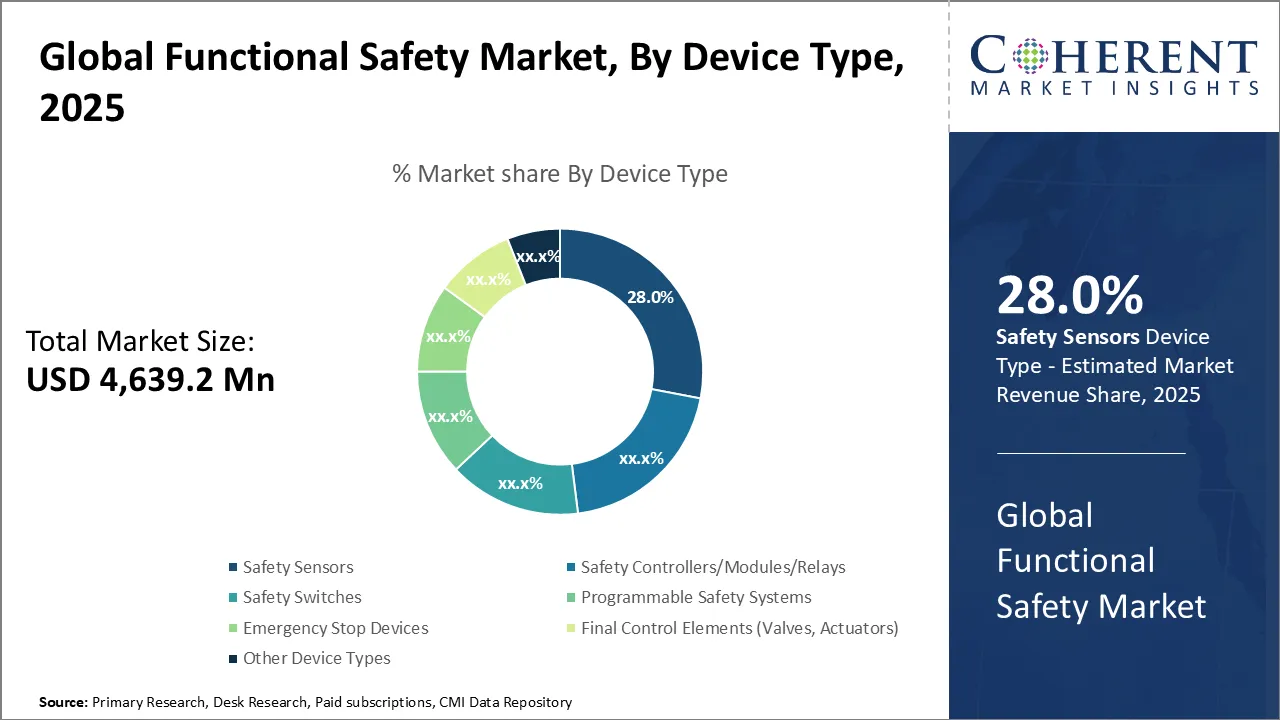
Functional Safety Market Insights, By Device Type, Safety Sensor Dominated Due To It Critical Role in Real-Time Hazard Detection and Machinery Monitoring
In terms of device type, the safety sensors segment is expected to dominate the global market with the largest share of 29% in 2026, due to their critical role in detecting hazards, monitoring machinery condition, and preventing accidents. They are essential for industrial automation and process safety across oil & gas, automotive, and pharmaceutical industries. Their reliability, real-time monitoring capabilities, and integration with advanced control systems drive adoption and market growth.
For instance, in June 2025, SICK unveiled the multiScan100-S, a 3D LiDAR sensor designed for safety systems in dynamic and harsh outdoor environments, including container terminals. Certified to Performance Level b (ISO 13849) and Performance Class B (IEC TS 62998-1), it offers a 62m scanning range and a 20m safety-related range. The sensor's rugged IP69K housing and advanced filtering ensure reliable operation in challenging conditions.
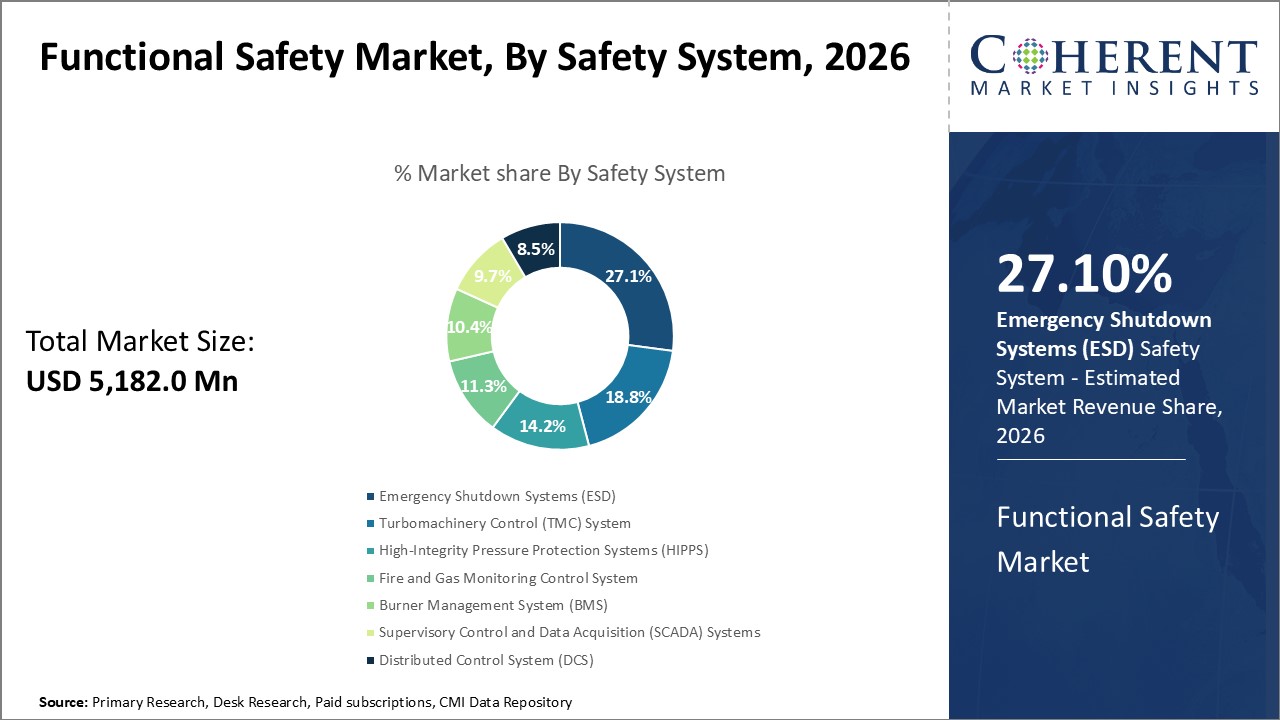
Functional Safety Market Insights, By Safety System, Emergency Shutdown Systems (ESD) as it Ensures rapid automatic shutdowns in emergencies, minimizing risks, protecting personnel, and meeting regulatory requirements.
In terms of safety systems, the emergency shutdown system (ESD) segment is projected to capture the highest share of the market in 2026, as they are heavily adopted as they prevent catastrophic accidents in high-risk industries such as oil & gas and power generation. ESDs ensure rapid, automatic shutdowns during emergencies, minimizing safety hazards, protecting personnel, and preventing equipment damage. Regulatory compliance and risk mitigation requirements further fuel their demand globally.
For instance, in August 2025, Emerson introduced the PACSystems RX3i CPS400 Safety Controller, designed to support Safety Integrity Level 2 (SIL2) applications such as fire and gas, burner management, and emergency shutdown systems. This compact, high-performance controller offers up to 2,000 I/O points, 64 MB memory, and robust security features including Secure Boot and Trusted Platform Module (TPM) standards.
Functional Safety Market Insights, By End User Industry, High-risk operations and strict safety regulations make oil & gas the largest adopter of functional safety solutions
In terms of end user industry, the oil and gas segment is expected to dominate the global market with the greatest share in 2026, due to its inherently high-risk operations, including drilling, refining, and transportation. Stringent safety regulations, hazardous working environments, and the need to prevent financial and environmental losses drive widespread adoption of sensors, ESD systems, and other functional safety solutions in this sector.
For instance, in May 2025, the Government of Newfoundland and Labrador is supporting a St. John's-based company developing a wearable safety device aimed at preventing workplace injuries. Minister Steve Crocker announced the initiative, emphasizing the province's commitment to fostering innovation and enhancing workplace safety. This support aligns with the government's broader strategy to promote technological advancements and economic growth within the region.
Regional Insights
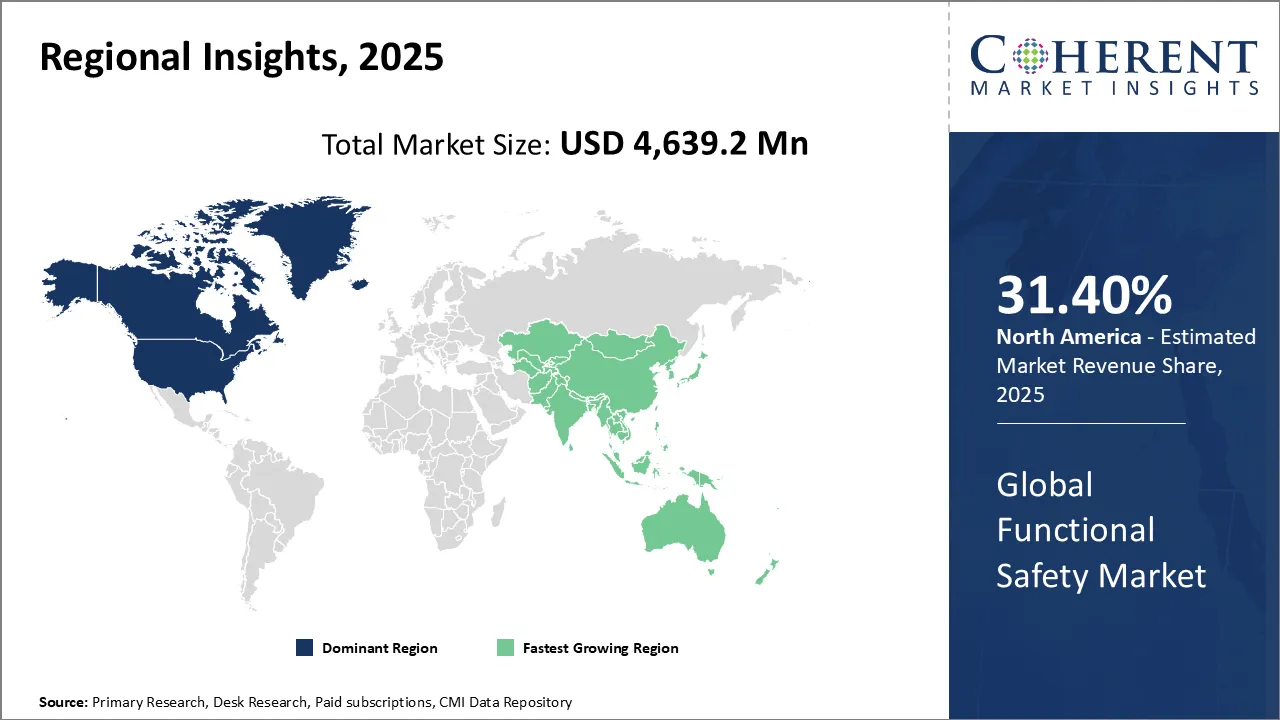
North America Functional Safety Market Analysis & Trends
North America region is projected to lead the market with a 31.4% share in 2026, due to strict industrial safety regulations, advanced automation adoption, and the presence of large oil & gas, automotive, and power generation sectors. Industries prioritize safety systems, sensors, and ESDs to mitigate risks, ensure regulatory compliance, and protect personnel and assets, driving strong regional market growth.
For instance, in September 2026, ESDEMC launched the upgraded ES806 Explosive ESD Testing System, featuring a redesigned interface with a large touchscreen for easier operation. The system supports test voltages up to 50 kV, surpassing the 30 kV range of similar systems. It includes pluggable RC modules for flexible configuration, enhanced safety features, and a rear high-voltage output for improved operator safety.
Asia Pacific Functional Safety Market Analysis & Trends
Asia Pacific region is expected to exhibit the fastest growth in the market, due to rapid industrialization, increasing automation in oil & gas, power, and manufacturing sectors, and strict government safety regulations. Growing adoption of advanced safety systems, such as ESDs and sensors, along with rising investments in process safety and smart manufacturing technologies, is fueling regional market growth.
For instance, in VVDN Technologies has partnered with QNX, a division of BlackBerry, to deliver safety-critical solutions across automotive and embedded sectors. This collaboration combines QNX’s safety-certified software stack with VVDN’s expertise in hardware design and manufacturing. The alliance aims to accelerate development in areas like Software-Defined Vehicles, ADAS, digital cockpits, and eMobility solutions, enhancing innovation and functional safety.
Functional Safety Market Outlook Country-Wise
The U.S. Functional Safety Market Trends
The functional safety market is demanding in the U.S. due to the country’s large-scale industrial operations, including oil & gas, power generation, automotive, and chemical manufacturing. Strict regulatory standards from agencies like OSHA and ANSI, combined with the growing adoption of automation, robotics, and advanced control systems, drive the need for safety sensors, ESDs, and other functional safety solutions to ensure operational safety and compliance.
For instance, in July 2026, nVent launched its Rack Safety Plus power distribution unit (PDU) in the U.S., offering a UL-certified, plug-and-play solution for automated test systems. This compact 3U, 19-inch rack-mounted unit integrates an emergency stop function and complies with EN 60947-5-1 and EN 60204-1 standards. With up to 300,000 configurable options, it aims to reduce lead times, lower costs, and enhance safety in testing environments.
Japan Functional Safety Market Trends
In Japan, the functional safety market is driven by its advanced manufacturing and robotics sectors, where automation and high-precision processes demand reliable safety solutions. Stringent government and industry regulations require implementation of safety systems such as ESDs, safety sensors, and programmable controllers to prevent accidents, ensure operational continuity, and maintain compliance, making Japan a key adopter of functional safety technologies.
For instance, in May 2026, Epson commenced volume production of its M-G355QDG0 inertial measurement unit (IMU), the company's first to meet IEC 61508 SIL1 functional safety standards. This advancement enables Epson's IMUs to be utilized in applications requiring high stability and reliability, such as precision agriculture, satellite systems, and industrial control.
Market Report Scope
Functional Safety Market Report Coverage
| Report Coverage | Details | ||
|---|---|---|---|
| Base Year: | 2025 | Market Size in 2026: | USD 5,182.0 Mn |
| Historical Data for: | 2020 To 2024 | Forecast Period: | 2026 To 2033 |
| Forecast Period 2026 to 2033 CAGR: | 11.7% | 2033 Value Projection: | USD 11,242.6 Mn |
| Geographies covered: |
| ||
| Segments covered: |
| ||
| Companies covered: | Banner Engineering Corporation, Rockwell Automation Inc., Pepperl+Fuchs SE, Emerson Electric Company, Panasonic Industry Europe GmbH (Panasonic Corporation), Honeywell International Inc., Sick AG, Yokogawa Electric Corporation, Omron Corporation, ABB Ltd., General Electric Company, Schneider Electric SE, and Siemens AG | ||
| Growth Drivers: |
| ||
| Restraints & Challenges: |
| ||
Market Dynamics
Global Functional Safety Market Drivers
Rise in standards for industrial safety to boost growth of market
Due to the introduction of rigorous approaches in different international and regional standards of industrial safety, the over lifecycle of safety of a system has been enhanced as compared to the use of best engineering design practices that were used in the past. Thus, industrial safety standards are increasingly being implemented within industries. Moreover, rise in number of hazardous areas, and frequency of accidents in these areas has also contributed to increased demand for functional safety. Thus, rise in standards for industrial safety is expected to propel growth of the global functional safety market over the forecast period.
Growing adoption of functional safety systems in several industries to drive the market pace
The use of functional safety systems and a datacentric approach offers needed functionalities enabling automatic prevention of hazardous failures and control in instances of such occurrences in various industries. These systems also offer facilities that cannot be mimicked by humans. The number of enterprises increasingly depend on such electronic, electrical, and programmable electronic safety-related systems for protecting the environment, people, and physical assets in different industries. Thus, the adoption of functional safety systems is increasing, which in turn is expected to boost growth of the market.
Global Functional Safety Market Opportunities
Increasing growth of services market is expected to create several growth opportunities in the global functional safety market over the forecast period. Due to rise in adoption of safety instrumented systems (SIS) that are produced by manufacturing companies and increasing demand for functional safety in the chemical and oil & gas industries, the services market relate to functional safety is witnessing strong growth. This in turn is offering various business opportunities in the market.
Growing number of work-related injuries is creating demand for functional safety systems, which is anticipated to offer various business opportunities in the global functional safety market over the forecast period. For instance, as per the Coherent Market Insights, 1.3 million workers suffered work-related injuries or illnesses; over 72,702 employee suffered non-fatal injuries, and more than 144 workers died due to work related incidences. Thus, these factors are increasing demand for functional safety systems, which in will support growth of the market.
Global Functional Safety Market Trends
Growing adoption of industrial internet of things (IIoT) is a major trend
The adoption IIoT has created new avenues for integrated safety and compliances services. IIoT can acquire data from sensors measuring level, pressure, temperature, flow, and vibration and then transfer this information to monitoring systems. The use of IIoT allows companies to integrate their processes with safety systems and monitor the system in real time. IIoT makes monitoring, analyzing, and controlling quick, which offers virtual management of physical systems. This ultimately improves the performance. Thus, the rise in adoption of IIoT is expected to continue in the market over the forecast period.
Increasing growth of food and beverage industry is recent trend
The food and beverage industry focuses on achieving high quality and consistent production at lower price. To achieve this, the food and beverage plants should be made more safe, flexible and profitable, by going for an integrated approach of automated safety control systems. Along with this, the manufacturing plants in the industry use various dangerous machines that should be following safety regulations for avoiding penalties. And lately, manufacturers in this industry are relying more on automated controls for production. Thus, this in turn is expected to create significant demand for functional safety solutions, which in turn is expected to boost the market growth.
Analyst Opinion (Expert Opinion)
The global functional safety market is undergoing a significant transformation, driven by the imperative need for stringent safety protocols across various high-risk industries. This evolution is not merely a response to regulatory pressures but a proactive strategy to mitigate risks associated with complex systems.
In sectors such as oil and gas, power generation, and chemicals, the adoption of functional safety measures is no longer optional but a critical necessity. These industries are characterized by intricate processes where the failure of safety systems can lead to catastrophic consequences, including loss of life, environmental disasters, and significant financial losses. Implementing robust functional safety systems ensures that these industries can operate safely, even in the event of component failures, by maintaining control over hazardous situations.
The functional safety market is heavily influenced by stringent international standards such as IEC 61508 and ISO 26262, which provide frameworks for the design and implementation of safety-related systems. Compliance with these standards is mandatory in many jurisdictions and is often a prerequisite for market entry. For instance, ISO 26262 is specifically tailored for the automotive industry, ensuring that electronic and electrical systems within vehicles meet high safety integrity levels. Non-compliance can result in severe legal and financial repercussions, underscoring the importance of adhering to these standards.
Speak to the analyst
Want personalized insights?
Take the findings above to one of our principal consultants, or have the report rebuilt around the segments, geographies and competitors you actually track.
Key Developments
- In June 2025, Hesai Technology announced that its ATX lidar sensor has received ISO 26262 ASIL B functional safety certification from SGS-TÜV. This achievement positions the ATX as a key component for large-scale deployment in Advanced Driver Assistance Systems (ADAS). It joins the company's Pandar128, QT128, and AT128 models in meeting the stringent ISO 26262 standards, reinforcing Hesai's leadership in automotive-grade lidar solutions.
- In March 2025, BlackBerry's QNX division unveiled a new Functional Safety (FuSa) platform for advanced robotics, developed in collaboration with Intel and NexCOBOT. This safety-certifiable solution consolidates robotic and safety controls onto a single NexCOBOT board, powered by Intel® Core™ i7 processors and QNX® OS for Safety. The platform aims to provide manufacturers and developers with greater cost savings, lower power consumption, improved thermal efficiency, and reduced risk of hardware failures.
Global Functional Safety Market Companies
- Banner Engineering Corporation
- Rockwell Automation Inc.
- Pepperl+Fuchs SE
- Emerson Electric Company
- Panasonic Industry Europe GmbH (Panasonic Corporation)
- Honeywell International Inc.
- Sick AG
- Yokogawa Electric Corporation
- Omron Corporation
- ABB Ltd.
- General Electric Company
- Schneider Electric SE
- Siemens AG.
Market Segmentation
- Global Functional Safety Market, By Device Type (Revenue, USD Mn, 2021 - 2033)
- Safety Sensors
- Safety Controllers/Modules/Relays
- Safety Switches
- Programmable Safety Systems
- Emergency Stop Devices
- Final Control Elements (Valves, Actuators)
- Other Device Types
- Global Functional Safety Market, By Safety Systems (Revenue, USD Mn, 2021 - 2033)
- Burner Management System (BMS)
- Turbomachinery Control (TMC) System
- High-Integrity Pressure Protection Systems (HIPPS)
- Fire and Gas Monitoring Control System
- Emergency Shutdown Systems (ESD)
- Supervisory Control and Data Acquisition (SCADA) Systems
- Distributed Control System (DCS)
- Global Functional Safety Market, By End User Industry (Revenue, USD Mn, 2021 - 2033)
- Oil and Gas
- Power Generation
- Food and Beverage
- Pharmaceutical
- Automotive
- Other End user Industries
- By Region (Revenue, USD Mn, 2021 - 2033)
- North America
- U.S.
- Canada
- Latin America
- Brazil
- Argentina
- Mexico
- Rest of Latin America
- Europe
- Germany
- U.K.
- Spain
- France
- Italy
- Russia
- Rest of Europe
- Asia Pacific
- China
- India
- Japan
- Australia
- South Korea
- ASEAN
- Rest of Asia Pacific
- Middle East
- GCC Countries
- Israel
- Rest of Middle East
- Africa
- South Africa
- North Africa
- Central Africa
- North America
Sources
Primary Research Interviews from the following stakeholders
Stakeholders
- Interviews with safety engineers, control system designers, industrial automation specialists, operations managers, and procurement heads across leading global industries.
Specific stakeholders
- Functional safety and automation leads at oil & gas, power, and manufacturing companies (e.g., Shell, Siemens Energy, ABB)
- Safety managers at automotive OEMs and suppliers (e.g., Bosch, Continental, Tata Motors)
- Process control engineers and plant managers at chemical and pharmaceutical plants (e.g., BASF, Cipla)
- IT and infrastructure heads overseeing industrial IoT deployments
- Safety consultants and integrators for industrial automation and robotics
- Product managers at safety instrumented system (SIS) and sensor OEMs (e.g., Emerson, Honeywell, Yokogawa)
Databases
- International Electrotechnical Commission (IEC) Standards Database
- ISO Standards Repository
- S. Bureau of Labor Statistics (BLS) – Industrial Safety Data
- Eurostat – Industrial Safety and Automation Statistics
- UN Comtrade Database – Industrial Machinery & Automation
- China Customs Statistics – Safety Instruments & Control Systems
- Directorate General of Commercial Intelligence and Statistics (DGCIS), India
- Korea Customs Service Data Portal
Magazines
- Control Engineering
- ISA InTech
- Industrial Safety & Hygiene News (ISHN)
- Automation World
- Process Safety & Environmental Protection
- Plant Engineering
- Manufacturing Automation Magazine
Journals
- Journal of Loss Prevention in the Process Industries
- IEEE Transactions on Industrial Informatics
- Safety Science (Elsevier)
- Journal of Hazardous Materials
- Reliability Engineering & System Safety
- International Journal of Critical Infrastructure Protection
Newspapers
- The Wall Street Journal – Technology & Industrial Safety
- The Economic Times – Manufacturing & Automation
- Financial Times – Industrial Technology & Safety
- Nikkei Asia – Automotive & Industrial Automation
- The Hindu Business Line – Industrial & Energy Sectors
Associations
- International Society of Automation (ISA)
- International Electrotechnical Commission (IEC)
- Institute of Electrical and Electronics Engineers (IEEE) – Industrial Applications Society
- Society of Automotive Engineers (SAE) – Safety & Functional Safety Committees
- European Process Safety Centre (EPSC)
- Confederation of Indian Industry (CII) – Safety & Industrial Automation Forum
Public Domain Sources
- National Institute of Standards and Technology (NIST), U.S.
- Ministry of Electronics and IT (Government of India)
- Ministry of Economy, Trade and Industry (METI), Japan
- S. Occupational Safety and Health Administration (OSHA)
- S. International Trade Commission (USITC)
- NITI Aayog – Industrial Automation & Safety Reports
- EU Single Market Observatory – Industrial Technology & Safety
Proprietary Elements
- CMI Data Analytics Tool and Proprietary Repository of functional safety deployments across industries, including SIS systems, automotive, and manufacturing sectors spanning over 8 years.
Get access to 250+ pages report
Every segment, forecast, competitor profile and data table behind the analysis above — available for instant download.
- ESOMAR Member
- ISO 9001:2015 Certified
- D-U-N-S Registered
- GDPR & CCPA Compliant
Missing comfort of reading report in your local language? Find your preferred language:
Transform your Strategy with Exclusive Trending Reports
Frequently Asked Questions
The global Functional Safety Market size was valued at USD 5,182.0 million in 2026 and is expected to reach USD 11,242.6 million in 2033.
The global functional safety market size is estimated to be valued at US$ 5,182.0 Million in 2026 and is expected to exhibit a CAGR of 11.7% between 2026 and 2033.
Rise in standards for industrial safety and growing adoption of functional safety systems in several industries are fueling the market.
The Safety Controllers/Modules/Relays segment is the leading device type segment in the market.
Rise in complexity along with high initial and maintenance costs and lack of awareness and complexity of global standards are the major factors restraining market.
Banner Engineering Corporation, Rockwell Automation Inc., Pepperl+Fuchs SE, Emerson Electric Company, Panasonic Industry Europe GmbH (Panasonic Corporation), Honeywell International Inc., Sick AG, Yokogawa Electric Corporation, Omron Corporation, ABB Ltd., General Electric Company, Schneider Electric SE, and Siemens AG
Software enables monitoring, diagnostics, and control systems, ensuring compliance with safety standards and reducing operational hazards.