

Oil and Gas Chemicals Market Size and Share Analysis - 2026 To 2033
The Oil and Gas Chemicals Market is projected to grow from USD 89.67 Bn in 2026 to USD 130.36 Bn by 2033, registering a CAGR of 5.5% during the forecast period. Growth in global demand for oil and natural gas, increase in upstream/downstream exploration activities, increased usage of production/drilling chemicals, and rise in refinery activities are some of the factors driving the growth of the oil and gas chemicals market. The oil and gas market is expanding steadily, supported by ONGC’s initiation of over 45 exploration and development wells in early 2025.
Key Takeaways from the Oil and Gas Chemicals Market Report
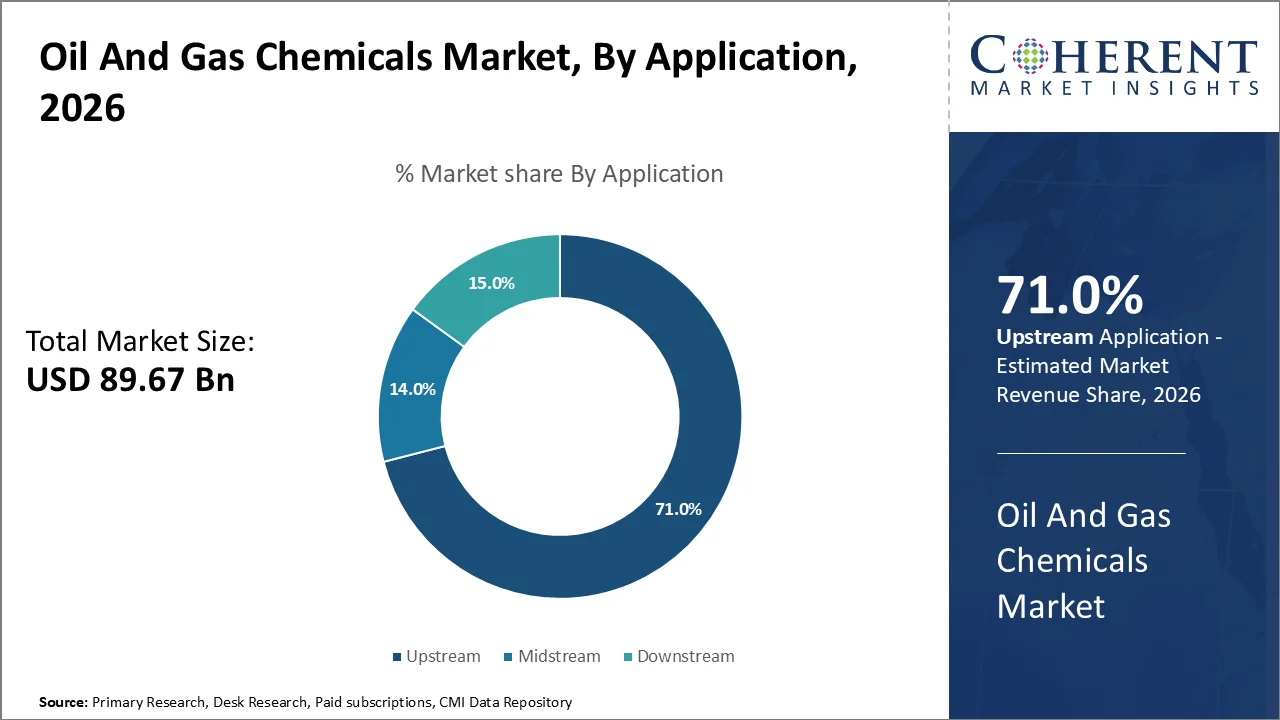
- The Upstream segment is anticipated to hold a major market share of 71% in the forecast period 2026 driven by the growth in exploration & production (E&P) activity, shale gas recovery activity and increasing requirement of drilling and stimulation chemicals. The U.S. Energy Information Administration (EIA) indicates that the global liquid fuels consumption would continue to increase supported by increasing upstream activity, which further increases chemical consumption in drilling and production process.
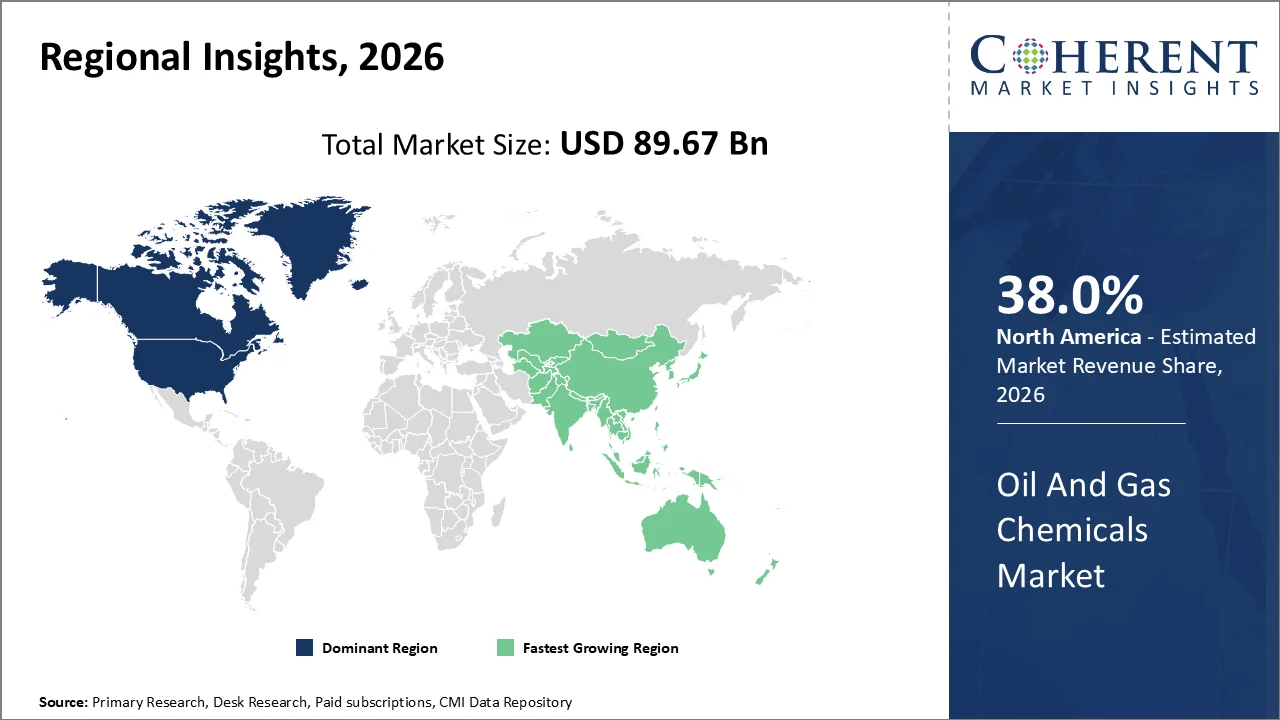
- North America is likely to be the leading player in the Oil and Gas Chemicals Market, with a projected market share of 38% in 2026, due to large-scale extraction of shale oil and gas, widespread drilling operations, and growing demand for enhanced oilfield chemicals in upstream applications. Based on official figures provided by the EIA, the United States produced an average of 12.9 million barrels of crude oil per day in 2023, becoming the world’s largest crude oil producer for the sixth consecutive year.
Rising Upstream Exploration and Shale Production is Driving Growth in the Oil and Gas Chemicals Market
Rising exploration efforts upstream of oil and gas extraction are boosting the demand for oilfield chemicals. Drilling, stimulation, corrosion inhibition, and EOR chemicals are seeing increasing acceptance owing to rising interest in unconventional oil and gas. Rising activity around shale drilling, deep water exploration, and hydraulic fracking is driving up consumption of chemicals during production processes. Modern oilfield chemicals offer increased efficiency, reduced corrosion, better flow assurance, and optimized hydrocarbon extraction, ensuring productive operations in upstream operations.
According to EIA, the forecast indicates that the production of crude oil in the USA is expected to stay at record levels owing to shale production and upstream activities, especially in the Permian basin. An increase in drilling activity is expected to contribute significantly to demand for drilling fluids, rheology additives, corrosion inhibitors, and stimulation fluids.
Increasing Refinery Modernization and Petrochemical Expansion is Supporting Market Growth
The rising trend in refining and petrochemical capacity expansions is leading to an increased demand for oil and gas downstream chemicals on a global scale. Refinery process chemicals, fuel additives, desalting chemicals, antifoulants, and corrosion inhibitors are becoming increasingly essential for improving refining efficiency and meeting stringent fuel quality standards.
According to the official International Energy Agency (IEA), global oil demand is expected to exceed 105 million barrels per day by 2030, supported by rising petrochemical feedstock demand and industrial consumption in emerging economies.
- Current Industry Events of 2026
- Market Size Estimation
- Regional Breakdown
- Competitive Landscape
- Customer Intelligence
- Segmental Analysis
- Pricing Analysis
- Key Market Drivers, Challenges & Future Trends
- Customized Insights Section
Current Events and Their Impact on the Oil and Gas Chemicals Market
Current Event | Description and its Impact |
OPEC+ Production Policies and Global Supply Adjustments |
|
Increasing Refinery Modernization and Cleaner Fuel Regulations |
|
Segmental Insights
Why is the Upstream Segment Acquiring the Largest Market Share?
The Upstream segment is expected to have the maximum share of the Oil and Gas Chemicals Market in the year 2026 with nearly 71% of the overall market revenue. This growth can be attributed to increased exploration & production (E&P) activity globally, higher exploration in shale gas, and investments made in deep water and unconventional oil extraction. Drilling fluids, stimulation chemicals, anti-corrosion chemicals, rheological chemicals, and enhanced oil recovery (EOR) chemicals play an essential role in the Upstream segment.
Based on the Official Baker Hughes Rig Count data, more than 580 active rigs were operating in the United States in 2024 due to continuous drilling efforts and exploration of shales in basins like Permian and Eagle Ford.
In March 2025, SLB (Schlumberger) introduced new AI-enabled drilling optimization technologies and advanced production chemistry solutions aimed at improving recovery rates and reducing operational downtime in unconventional oil & gas fields. Such innovations are accelerating growth in the upstream oilfield chemicals market.
Oil and Gas Chemicals Market Trends
- Rising shale oil and gas extraction is boosting the need for drilling fluids and stimulation chemicals. As noted by the official U.S. Energy Information Administration (EIA), the Permian Basin extracted more than 6 million barrels per day of crude oil in 2025, spurring demand for chemicals for upstream processes.
- Refinery upgrade programs are supporting the demand for refinery process chemicals and fuel additives.
- The rising investments in offshore and deepwater exploration activities have been driving demand for flow assurance and production chemicals. As per the latest report by the IEF, the global upstream oil and gas investment crossed US$ 600 billion in 2024.
- The increasing awareness about sustainability is driving demand for environmentally-friendly and biodegradable oilfield chemicals.
Regional Insights
North America Dominates Owing to Strong Shale Oil & Gas Production
North America is projected to hold 38% market share in 2026 owing to significant shale oil and gas production, increased drilling, and growing use of oilfield chemicals. North America remains a global leader in crude oil production due to extensive hydraulic fracturing activity and unconventional resource development, including shale resources from the Permian, Eagle Ford, and Bakken formations.
According to the U.S. Energy Information Administration (EIA), the Permian Basin was able to produce approximately 6.3 million barrels per day of crude oil in 2024, which constituted almost half of the country’s total production capacity. The EIA also forecasted growth of crude oil production in the region owing to increased development of shale and upstream drilling.
Asia Pacific Oil and Gas Chemicals Market Trends
Asia Pacific region is expected to be the fastest growing region between 2026 and 2033, witnessing growth at a CAGR of about 6.3% because of increasing energy consumption, refinery projects, and investments in petrochemicals in countries like China, India, and other nations in South East Asia. Increasing industrialization and urbanization have led to higher use of chemicals in refining, fuels, and water treatment.
In April 2025, IndianOil signed an MoU with the Government of Odisha to establish a major petrochemical complex at Paradip with an investment of approximately ₹61,077 crore. The project includes a dual-feed cracker and downstream petrochemical units.
Rising Shale Production and Upstream Investments are Accelerating the Oil and Gas Chemicals Market Demand in United States
The United States Oil and Gas Chemicals Market is seeing impressive growth owing to increased production of shale oil and gas, rising upstream exploration efforts, and higher investment in enhanced oil recovery technology. The U.S. remains one of the world’s leading crude oil producers, resulting in high demand for drilling chemicals, stimulation chemicals, corrosion inhibitors, and flow assurance chemicals among others.
In May 2025, Halliburton launched EarthStar 3DX horizontal look-ahead resistivity service, the industry’s first 3D horizontal resistivity technology that helps operators improve well placement and drilling efficiency.
Japan Oil and Gas Chemicals Market Trends
Japan Oil & Gas Chemicals Market is expected to witness a steady growth in coming years driven by increased activities related to refinery modernization, increased demand for petrochemicals, and increased use of clean fuel technologies. Japan is expected to continue its efforts towards energy conservation and reduction of refinery emissions, leading to increased demand for various chemicals.
Innovation in advanced refining and petrochemical integration technologies continues to support market growth. In May 2025, ENEOS Holdings announced continued investments in sustainable refining operations and petrochemical optimization projects aimed at improving fuel efficiency and reducing carbon emissions across its refinery network.
Who are the Major Companies in Oil and Gas Chemicals Industry
Some of the major key players in Oil and Gas Chemicals are Baker Hughes, Akzo Nobel NV, Elementis Plc., NALCO Champion, Newpak Resources Inc., The Lubrizol Corporation, Halliburton Company, Solvay SA, and others.
Key News
- In February 2026, Baker Hughes announced a multiyear agreement with Marathon Petroleum to provide downstream chemical technologies across 12 U.S. refineries and 2 renewable fuel facilities.
- In May 2025, Halliburton launched EarthStar 3DX horizontal look-ahead resistivity service, the industry’s first 3D horizontal resistivity technology designed to improve well placement and drilling efficiency through real-time geological mapping up to 50 feet ahead of the drill bit.
Market Report Scope
Oil and Gas Chemicals Market Report Coverage
| Report Coverage | Details | ||
|---|---|---|---|
| Base Year: | 2025 | Market Size in 2026: | USD 89.67 Bn |
| Historical Data for: | 2020 To 2024 | Forecast Period: | 2026 To 2033 |
| Forecast Period 2026 to 2033 CAGR: | 5.5% | 2033 Value Projection: | USD 130.36 Bn |
| Geographies covered: |
| ||
| Segments covered: |
| ||
| Companies covered: | Baker Hughes, Akzo Nobel NV, Elementis Plc., NALCO Champion, Newpak Resources Inc., The Lubrizol Corporation, Halliburton Company, Solvay SA, and others | ||
| Growth Drivers: |
| ||
| Restraints & Challenges: |
| ||
Analyst Opinion
- Oil & gas chemicals remain essential for maintaining drilling efficiency, corrosion protection, flow assurance, and refinery performance across upstream, midstream, and downstream operations. Despite energy transition initiatives, global oil demand continues to support long-term chemical consumption.
- Upstream applications continue to dominate the market due to increasing shale drilling and enhanced oil recovery (EOR) activities.
- Digital oilfield technologies are becoming a major growth catalyst for the market. AI-enabled drilling optimization, automated hydraulic fracturing, and real-time production monitoring are increasing adoption of advanced specialty chemicals to improve well productivity and operational efficiency.
- Refinery modernization and cleaner fuel regulations are accelerating demand for refinery process chemicals, fuel additives, and water treatment chemicals globally. Petrochemical expansion in Asia Pacific is expected to create significant long-term growth opportunities for chemical suppliers.
- Sustainability is reshaping product innovation across the industry. Oilfield service companies are increasingly developing biodegradable and environmentally acceptable chemical formulations to comply with stricter environmental regulations and reduce operational impact in offshore and shale projects.
Speak to the analyst
Want personalized insights?
Take the findings above to one of our principal consultants, or have the report rebuilt around the segments, geographies and competitors you actually track.
Market Segmentation
- By Application (Revenue, USD Bn, 2021-2033)
- Upstream
- Drilling Chemicals
- Weighting Materials
- Viscosifiers
- Defoamers and Foaming Agents
- Shale Inhibitors
- Fluid Loss Agents
- Loss Control Absorbents
- Rheology Modifiers
- Wetting Agents
- Biocides
- Other
- Cementing Chemicals
- Fluid Control Additives
- Accelerators and Retarders
- Extenders
- Biocides
- Others
- Production Chemicals
- Demulsifiers
- Corrosion & Scale Inhibitors
- Asphaltene & Paraffin Inhibitors
- Others
- Work-over and Completion Chemicals
- Stimulation Chemicals
- Fracturing Fluid Additives
- Gelling Agents
- Acids
- Others
- EOR Chemicals
- Surfactants
- Swelling Agents
- Acid Gas Thickeners
- Polymers Gel
- Others
- Midstream
- Flow Assurance
- Biocides
- Gas Hydrate Inhibitors
- Drag Reducers
- Paraffin Inhibitors
- Pour Point Depressants
- Scale Inhibitors
- Asphaltene Inhibitors
- Emulsion Breakers
- Wax Dispersants
- Others
- Cargo Additives
- Water Treatment Chemicals
- Oxygen Scavengers
- Tank Cleaners
- Solids Release Agents
- Flocculants
- CO2 and H2S Absorbents
- Nanofiltration Membranes
- Others
- Desalting Chemicals
- Slop Oil Movement
- Others
- Drilling Chemicals
- Downstream
- Petrochemical Additives
- Antifoams
- Antifoulants
- Antioxidants
- Antipolymerants
- Neutralizers
- Wetting Agents
- Passivators
- Dehazers and Emulsion Preventatives
- Aldol Inhibitors
- Dispersants
- Others
- Refinery Process Chemicals
- Corrosion Inhibitors
- Surry Setting Aids
- Polymers
- Conductivity Improvers
- Reactor Bed Agglomerants
- Demulsifiers
- Cleaners
- Others
- Refinery and Finished Fuel Additives
- Biocides
- Mercaptan Scavengers
- Pipeline/Rust Corrosion Inhibitors
- Pour Point Depressants
- Lubricity Additives
- Cold Flow Plugging Point Additives
- Multipurpose Additives Packages
- Stability Additives
- Metal Deactivators
- Low Temperature Flow Test Additives
- Others
- Petrochemical Additives
- Upstream
- By Region (Revenue, USD Bn, 2021-2033)
- North America
- U.S.
- Canada
- Latin America
- Brazil
- Mexico
- Argentina
- Rest of Latin America
- Europe
- Germany
- U.K.
- France
- Italy
- Spain
- Russia
- Rest of Europe
- Asia Pacific
- China
- India
- Japan
- Australia
- South Korea
- ASEAN
- Rest of Asia Pacific
- Middle East
- GCC
- Israel
- Rest of Middle East
- Africa
- South Africa
- Central Africa
- North Africa
- North America
Sources
Primary Research Interviews
- Oilfield chemical manufacturers
- Upstream drilling service providers
- Refinery and petrochemical plant operators
- Pipeline infrastructure companies
- Oil & gas exploration companies
- Industry consultants and key opinion leaders (KOLs)
- Chemical distributors and suppliers
Databases
- U.S. Energy Information Administration (EIA)
- International Energy Agency (IEA)
- Organization of the Petroleum Exporting Countries (OPEC)
- Baker Hughes Rig Count Database
- International Energy Forum (IEF)
Magazines
- Oil & Gas Journal
- Hydrocarbon Processing
- Offshore Magazine
- World Oil
- Petroleum Economist
Journals
- Journal of Petroleum Science and Engineering
- SPE Journal
- Energy & Fuels
- Journal of Natural Gas Science and Engineering
- Petroleum Science
Newspapers
- Reuters
- The Wall Street Journal
- Financial Times
- The Economic Times
- Bloomberg
Associations
- American Petroleum Institute (API)
- Society of Petroleum Engineers (SPE)
- International Association of Oil & Gas Producers (IOGP)
- Independent Petroleum Association of America (IPAA)
- International Energy Forum (IEF)
Public Domain Sources
- Company Annual Reports and Investor Presentations
- Government Energy Ministry Publications
- Refinery and Petrochemical Industry Reports
- Corporate Press Releases and Product Launch Announcements
- Energy Regulatory Agency Publications
Proprietary Elements
- CMI Data Analytics Tool
- Proprietary CMI Existing Repository of Information for Last 10 Years
Get access to 250+ pages report
Every segment, forecast, competitor profile and data table behind the analysis above — available for instant download.
- ESOMAR Member
- ISO 9001:2015 Certified
- D-U-N-S Registered
- GDPR & CCPA Compliant
Missing comfort of reading report in your local language? Find your preferred language:
Transform your Strategy with Exclusive Trending Reports
Frequently Asked Questions
The Oil and Gas Chemicals Market is expected to reach USD 130.36 Bn by 2033.
Major players operating in the global Oil and Gas Chemicals Market include Baker Hughes, Akzo Nobel N.V., Elementis Plc., NALCO Champion, Newpark Resources Inc., The Lubrizol Corporation, Halliburton Company, Solvay SA.
High costs of specialty oilfield chemicals, stringent environmental regulations, volatility in crude oil prices, and the growing shift toward renewable and clean energy sources are major factors restraining market growth.
Increasing upstream oil & gas exploration activities, rising shale gas and tight oil production, growing refinery modernization projects, and rising demand for drilling and production chemicals are driving market growth.
The Oil and Gas Chemicals Market is anticipated to grow at a CAGR of 5.5% between 2026 and 2033.
Among regions, North America is expected to account for the largest market share in the global Oil and Gas Chemicals Market over the forecast period due to strong shale oil production and increasing upstream drilling activities.
The Upstream segment dominates the market due to increasing exploration & production (E&P) activities, rising shale drilling, and growing demand for drilling fluids, stimulation chemicals, corrosion inhibitors, and enhanced oil recovery (EOR) chemicals.