

Propylene Oxide Market Size and Forecast — 2026-2033
Overview
Propylene oxide (CH3CHCH2O) is a colorless volatile liquid. It is an organic compound used in the production of polyether polyols, which in turn is used in the production of polyurethane plastics. Propylene oxide can be produced by hydrochorination or oxidation. Propylene oxide has various applications in automotive and construction industries. Flexible foams, paints, sealants, coolants, car seats brakes, and hydraulic fuels are components which propylene oxide in the automotive industry Also, it is used as a chemical for paints & coatings, adhesives, grouts, and materials. However, availability of substitutes for propylene oxide are restraining growth of the market.
Propylene Oxide Market Size and Forecast – 2026 – 2033
The Propylene Oxide Market size is estimated to be valued at USD 7.77 billion in 2026 and is expected to reach USD 11.99 billion by 2033, exhibiting a compound annual growth rate (CAGR) of 6.4% from 2026 to 2033.
Key Takeaways
In the application segment, polyurethane production dominates, accounting for over 51% of total market share in propylene oxide size, driven primarily by its extensive use in the automotive and construction sectors. Glycol production remains the fastest growing application, propelled by expanding pharmaceutical and antifreeze industries.
Asia Pacific leads in propylene oxide market share, holding approximately 42% of the global industry size, supported by vast industrial ecosystems and significant government incentives in countries like China and India. North America exhibits the highest CAGR owing to innovation-driven growth, new capacity additions, and increasing exports.
Europe’s stringent environmental policies drive adoption of cleaner technologies, creating opportunities for manufacturers focusing on green chemistry and sustainable growth strategies. The Middle East & Africa market is expanding steadily due to rising construction activities and petrochemical investments.
Propylene Oxide Market – Segmentation Analysis
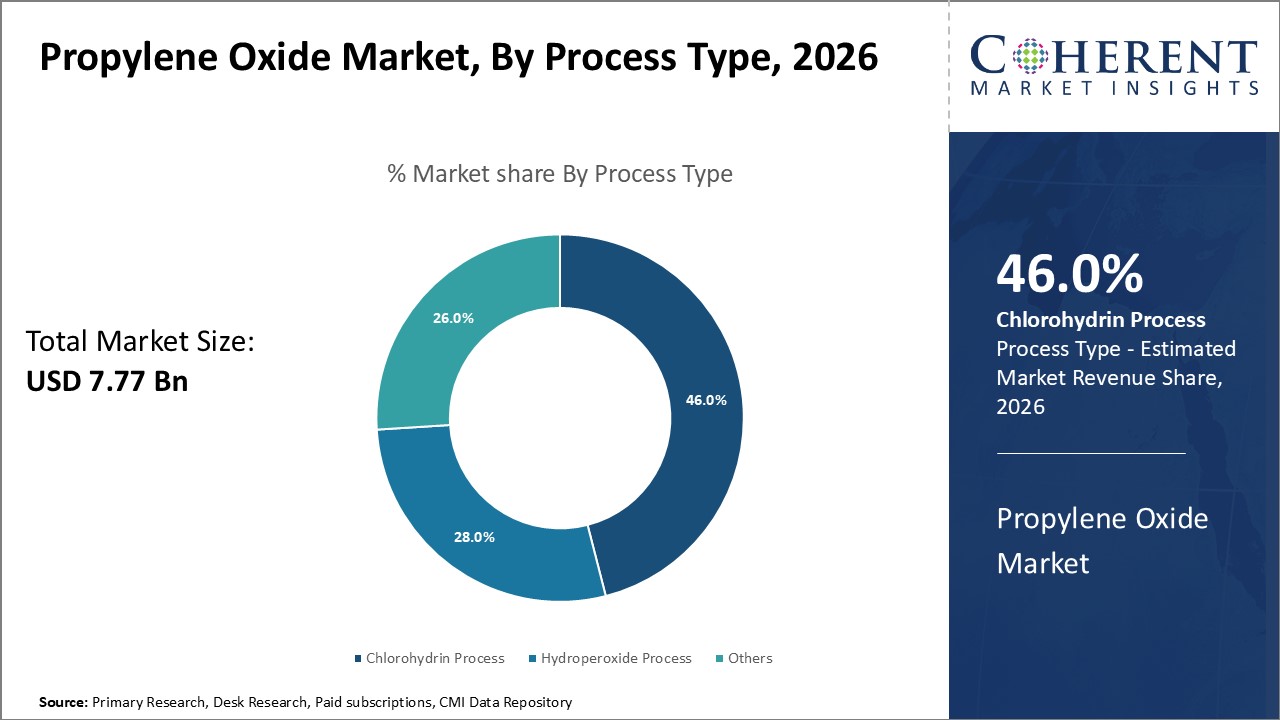
Propylene Oxide Market Insights, By Process Type
In regard to process type, the market is divided into three segments: hydroperoxide, chlorohydrin, and others. Of these, chlorohydrin processes account for the majority of the market share 46%, because of its great production capacity, cost-effectiveness, and well-established infrastructure, the chlorohydrin process continues to dominate.
Propylene Oxide Market Insights, By Application
Considering applications, the market is divided into three segments: polyurethane production, glycol production, and others. Polyurethane production holds a dominant market share of over 50%. The high need for polyurethane in flexible foam goods, insulation, and auto parts drives its manufacture.
Propylene Oxide Market Insights, By End-Use Industry
The market is split into several end-use industries, including automotive, construction, packaging, pharmaceuticals, and others. The automotive industry holds a dominant market share because of its extensive use of polyurethanes in the production of interior and exterior elements.
Propylene Oxide Market Insights, By Geography
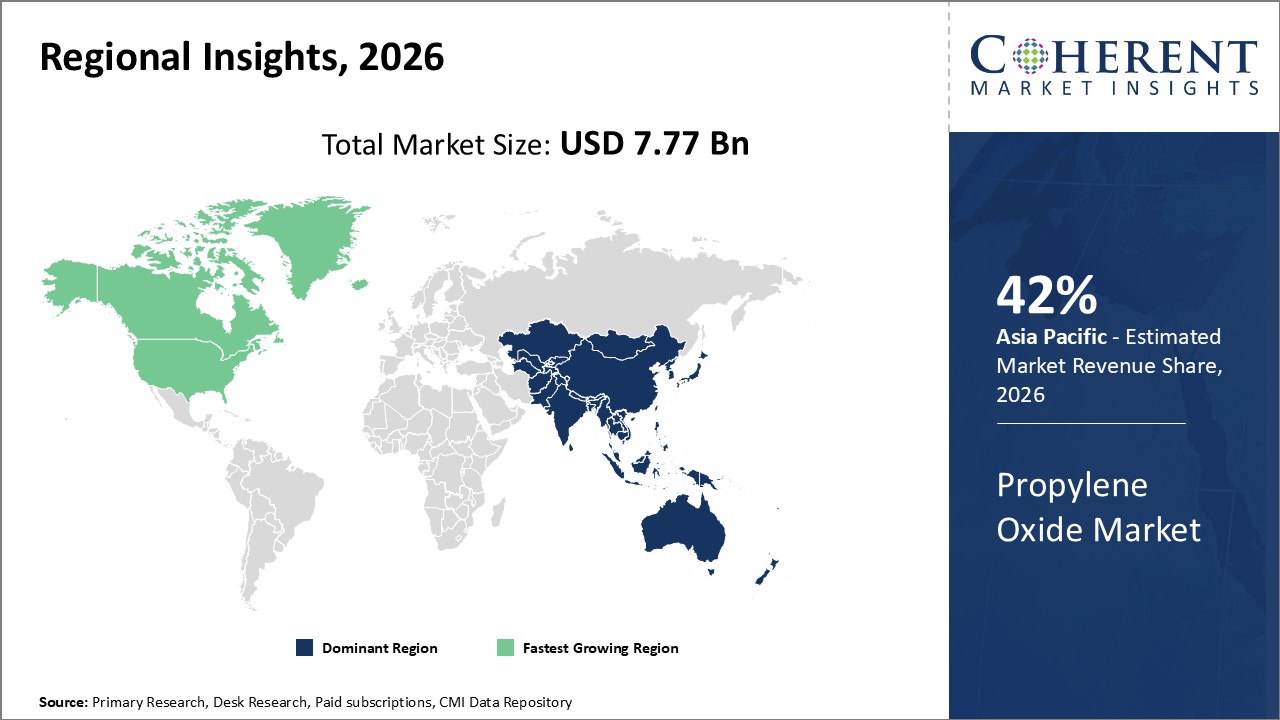
Asia Pacific Propylene Oxide Market: An Analysis and Trends
A strong industrial ecosystem underpins the market dominance of propylene oxide in Asia Pacific, with China and India playing a major role. Asia Pacific holds a 42% market share, largely due to the region's significant investments in infrastructure for the production of chemicals and growing end-use industries like building and automobile manufacture. Growth prospects are further enhanced by government incentives to develop cleaner manufacturing technology, which draw top producers of propylene oxide to the area.
Europe Propylene Oxide Market: An Analysis and Trends
Disciplined production tactics and supply and demand balance are hallmarks of the Europe region's steady recovery. Reduced feedstock propylene costs and lessened global supply pressures especially as a result of selective production cuts in China that benefit European producers have an impact on this market. Cosmetics, semiconductors, de-icing solutions, and rising intra-European consumption are some of the major demand drivers. As a result, exports and imports have decreased, highlighting the significance of local supply.
Propylene Oxide Market Outlook for Key Countries
Market Analysis and Trends for Propylene Oxide in the United States
The growing supply of feedstock from shale gas has a significant impact on the U.S. propylene oxide industry, enabling American firms to remain cost competitive internationally. Companies like LyondellBasell and Dow Chemical dominate the industry thanks to their large capacity and inventive use of environmentally friendly production techniques.
Market Analysis and Trends for Propylene Oxide in the China
The enormous local demand for propylene oxide in the construction, automotive, and packaging sectors, as well as government initiatives supporting the production of advanced chemicals and environmental compliance, are driving the market in China. Chinese businesses are now the world leaders in sustainable production after increasing their hydroperoxide process capabilities by around 15% in 2025.
Analyst Opinion
Supply-side dynamics are pivotal in influencing the propylene oxide market share. Expansion of production capacities in Asia Pacific and the U.S. has resulted in increased availability and competitive pricing. For instance, new multi-megaton capacity projects commissioned in China in 2025 have boosted regional supply by approximately 15%, directly impacting global export volumes.
Demand-side factors show a rising trend in automotive and construction sectors, which together accounted for over 55% of total propylene oxide consumption in 2025. The surge in demand for lightweight polyurethane components and insulation materials has driven market revenues notably in North America and Europe. Data from the American Chemistry Council highlights a 7% year-on-year consumption growth in automotive polyurethanes during 2025.
Import-export balance displays a shifting trend with North America increasingly exporting propylene oxide derivatives to Latin America and parts of Europe. U.S. export volumes rose by 12% in 2025, reflecting strategic supply chain realignments due to trade agreements and domestic production optimization.
Microeconomic indicators, such as pricing fluctuations influenced by raw material propylene feedstock availability, play a crucial role in market revenue stability. The volatility of propylene prices in 2023 and early 2025 led to temporary price adjustments but was offset by innovations in catalyst technology improving yield efficiencies by up to 4%.
- Current Industry Events of 2026
- Market Size Estimation
- Regional Breakdown
- Competitive Landscape
- Customer Intelligence
- Segmental Analysis
- Pricing Analysis
- Key Market Drivers, Challenges & Future Trends
- Customized Insights Section
Market Scope
| Report Coverage | Details | ||
|---|---|---|---|
| Base Year: | 2025 | Market Size in 2026: | USD 7.77 billion |
| Historical Data for: | 2020 To 2024 | Forecast Period: | 2026 To 2033 |
| Forecast Period 2026 to 2033 CAGR: | 6.4% | 2033 Value Projection: | USD 11.99 billion |
| Geographies covered: |
| ||
| Segments covered: |
| ||
| Companies covered: | LyondellBasell Industries, The Dow Chemical Company, Shell Chemicals, BASF SE, Mitsui Chemicals, Huntsman Corporation, Sumitomo Chemical, INEOS Group, SABIC, LG Chem, Celanese Corporation. | ||
| Growth Drivers: |
| ||
Growth factors
The growing demand for polyurethane-based products in industries such as automotive and construction has been instrumental in propylene oxide market growth, supported by urbanization and infrastructure development trends globally. The increasing environmental regulations are encouraging the adoption of cleaner production technologies, which reduce emissions and waste in propylene oxide synthesis, thereby attracting investments and expanding market scope.
Rising demand for propylene glycol produced using propylene oxide as an antifreeze agent and in pharmaceutical fine chemicals it has created new revenue streams, reflected by a 9% increase in glycol sector consumption in 2025. Additionally, expanding end-use applications in packaging, especially flexible and sustainable packaging solutions, are expected to accelerate industry size through 2033, as consumer preferences shift toward eco-friendly materials.
Propylene Oxide Market Development
- In April 2026, In order to start commercial production at its expanded propylene glycol plant, Chennai-based Manali Petrochemicals Ltd (MPL), a prominent petrochemical manufacturer and a division of Singapore-based AM International, has notified stock exchanges that it is awaiting the Tamil Nadu State Pollution Control Board's Consent to Operate (CTO). The business has already submitted an application for permission and intends to start manufacturing as soon as it is approved.
Market Trends
The propylene oxide market is progressively shifting toward sustainable production, as evidenced by the increasing adoption of the hydroperoxide process, which offers a lower environmental footprint compared to the chlorohydrin method.
In 2025, Asia Pacific accounted for approximately 61% of new installations adopting this greener technology, in a direct response to tighter environmental standards set by governing bodies.
Another notable trend is the integration of digital technologies for real-time process monitoring and predictive maintenance, improving operational efficiency and reducing downtimes.
The pharmaceutical industry’s rising reliance on propylene oxide derivatives for novel drug formulations also presents niche growth prospects, contributing to diversification of the application landscape.
Key Players
The Dow Chemical Company
Shell Chemicals
BASF SE
Mitsui Chemicals
Huntsman Corporation
Sumitomo Chemical
INEOS Group
SABIC
LG Chem
Celanese Corporation
Many leading companies focus on strategic capacity expansion and backward integration to strengthen market positions. For example, LyondellBasell’s recent investment in the U.S. Gulf Coast facility increased its production capacity by 20%, enabling better supply chain control and reducing import dependency.
Meanwhile, BASF SE adopted sustainability-driven innovations, successfully launching bio-based propylene oxide derivatives, which helped the company capture new market segments and grow revenue by 9% in 2025. The competitive landscape also witnesses companies optimizing pricing strategies and forming regional alliances to capitalize on emerging markets.
Propylene Oxide Market Future Outlook
The market for propylene oxide is expected to grow in the future due to strong demand from important sectors like packaging, electronics, construction, and automobiles. To address sustainability issues and regulatory challenges, industry players are concentrating on technological innovation and greener manufacturing technologies, including bio-based and hydrogen peroxide-based approaches.
Growth is anticipated to be fueled by the growing usage of propylene oxide in polyurethane foams for consumer products, lightweight automotive components, and insulation, as well as by growing urbanization and industrialization in Asia-Pacific and emerging regions. A competitive environment focused on advanced material applications and environmental stewardship is being shaped by the adoption of energy-efficient construction solutions, changing sectoral needs, and ongoing process advancements.
Historical Analysis
The propylene oxide market in the Asia Pacific region was gaining significant traction, owing to the high demand for propylene oxide from end-use industries. The demand for propylene had substantially increased due to new developments in infrastructure, construction, and the automotive industry. China, India, Japan, and South Korea were the economies that majorly contributed to the growth of propylene oxide. The reduction in taxes for the small engine car section in China resulted in the increased sale of cars, in turn fueled the growth of the market for propylene oxide.
Production of automobiles was expected to grow over the forecast period, owing to the presence of leading automotive companies in North America such as Ford, General Motors, and Fiat. Moreover, the New Building Canada Fund had targeted an investment of US$ 10 billion over a 10-year period i.e., 2014–24 to build public infrastructure.
Propylene was the major raw material for the production of propylene oxide, which was produced from crude oil. Demand for propylene oxide in the Middle East was growing, owing to rampant growth of the construction and oil and gas industries. Moreover, new investments in Qatar and Saudi Arabia for the FIFA World Cup 2022 were expected to substantially increase construction of hotels, stadiums, malls, and public infrastructure. This in turn, was expected to boost the growth of the propylene oxide market.
Sources
Primary Research interviews:
Polyurethane foam producers
Polyols manufacturers
Surfactant & glycol producers
Databases:
OECD Statistics
FAOSTAT
US Energy Information Administration (EIA)
Magazines:
Chemical Engineering News (C&EN)
European Coatings Journal
Plastics News
Journals:
Industrial & Engineering Chemistry Research
Journal of Chemical Technology and Biotechnology
Journal of Cleaner Production
Newspapers:
The Wall Street Journal
Business Standard
The Hindu Business Line
Associations:
Indian Chemical Council (ICC)
Japan Chemical Industry Association (JCIA)
China Petroleum and Chemical Industry Federation (CPCIF)
Get access to 250+ pages report
Every segment, forecast, competitor profile and data table behind the analysis above — available for instant download.
- ESOMAR Member
- ISO 9001:2015 Certified
- D-U-N-S Registered
- GDPR & CCPA Compliant
Missing comfort of reading report in your local language? Find your preferred language:
Transform your Strategy with Exclusive Trending Reports
Frequently Asked Questions
The propylene oxide market is led by major chemical companies including LyondellBasell, Dow Chemical, BASF, and Shell Chemicals, which collectively hold significant industry share through capacity leadership and diversified product portfolios.
The propylene oxide market size is projected to grow from USD 7.77 billion in 2026 to USD 11.99 billion by 2033, reflecting a CAGR of 6.4%, driven by demand across automotive, construction, and pharmaceutical applications.
The automotive sector leads propylene oxide market growth opportunities with its expanding use in lightweight polyurethane components, followed closely by the construction industry’s insulation and packaging demands.
Market development trends will focus on sustainability with increased adoption of low-emission production processes like the hydroperoxide method, coupled with technological integration in manufacturing and expanding niche pharmaceutical applications.
The competitive landscape is characterized by capacity expansions, process innovation, and strategic alliances. Market challenges include raw material price volatility, regulatory hurdles, and the need to reduce environmental impact.
Leading companies employ strategies such as backward integration, product diversification into bio-based derivatives, strategic geographic expansions, and sustainability-focused R&D investments to strengthen market presence.