

Liquid Injection Molding Market Size and Forecast — 2026 - 2033
The Global Liquid Injection Molding Market size is estimated to be valued at USD 2.8 billion in 2026 and is expected to reach USD 5.1 billion by 2033, exhibiting a compound annual growth rate (CAGR) of 9.2% from 2026 to 2033.
Overview
The Liquid Injection Molding (LIM) market focuses on producing high-performance elastomer and thermoset components using liquid silicone rubber and other reactive polymers. Key products include automotive seals, gaskets, and vibration-damping parts; medical devices such as tubing, seals, and flexible components; and consumer electronics parts like keypads and connectors. LIM enables precise, complex shapes with excellent dimensional stability, chemical resistance, and thermal performance. Growing demand stems from industries requiring durable, lightweight, and flexible components. Innovations in multi-shot LIM, high-temperature silicones, and bio-compatible materials are expanding applications, making the technology increasingly vital in automotive, healthcare, electronics, and industrial manufacturing sectors.
Key Takeaways
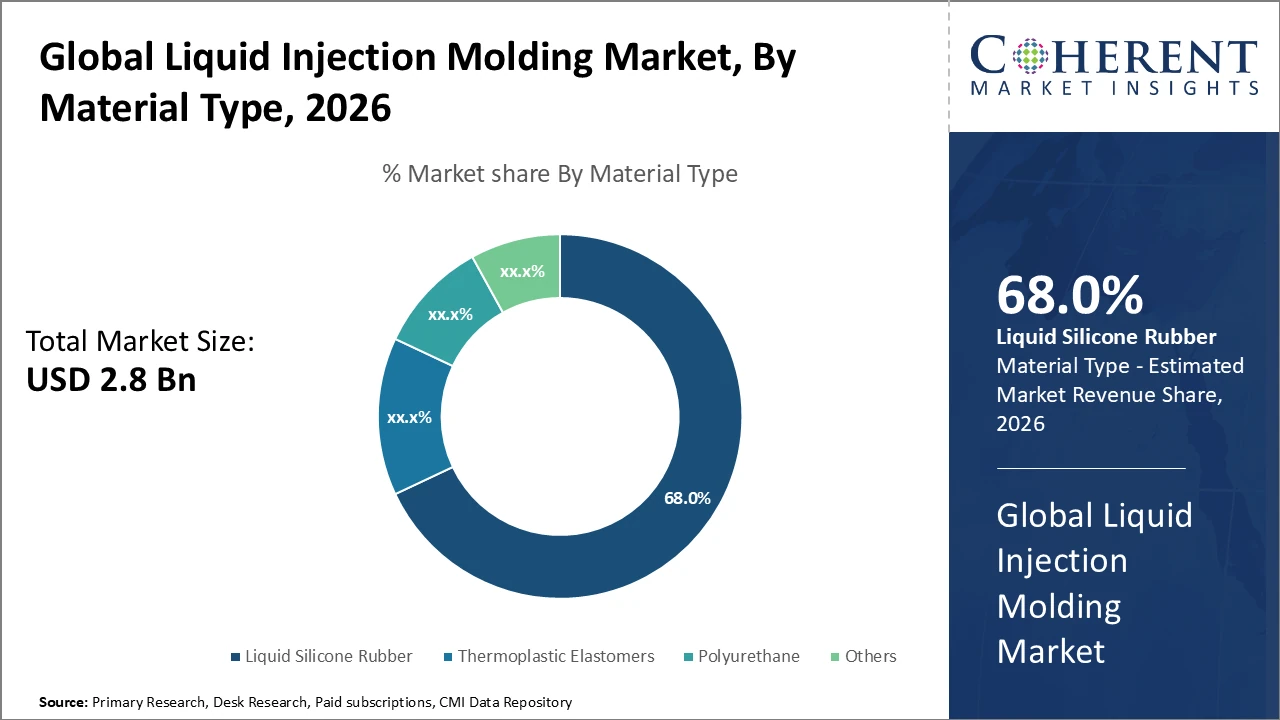
The Liquid Silicone Rubber (LSR) segment dominates the market, accounting for 68% of industry share due to its versatility across multiple applications.
The automotive application segment is experiencing strong growth, driven by demand for lightweight and emission-compliant components.
Two-component injection molding is the most prevalent process type, offering an effective balance between complexity and cost efficiency.
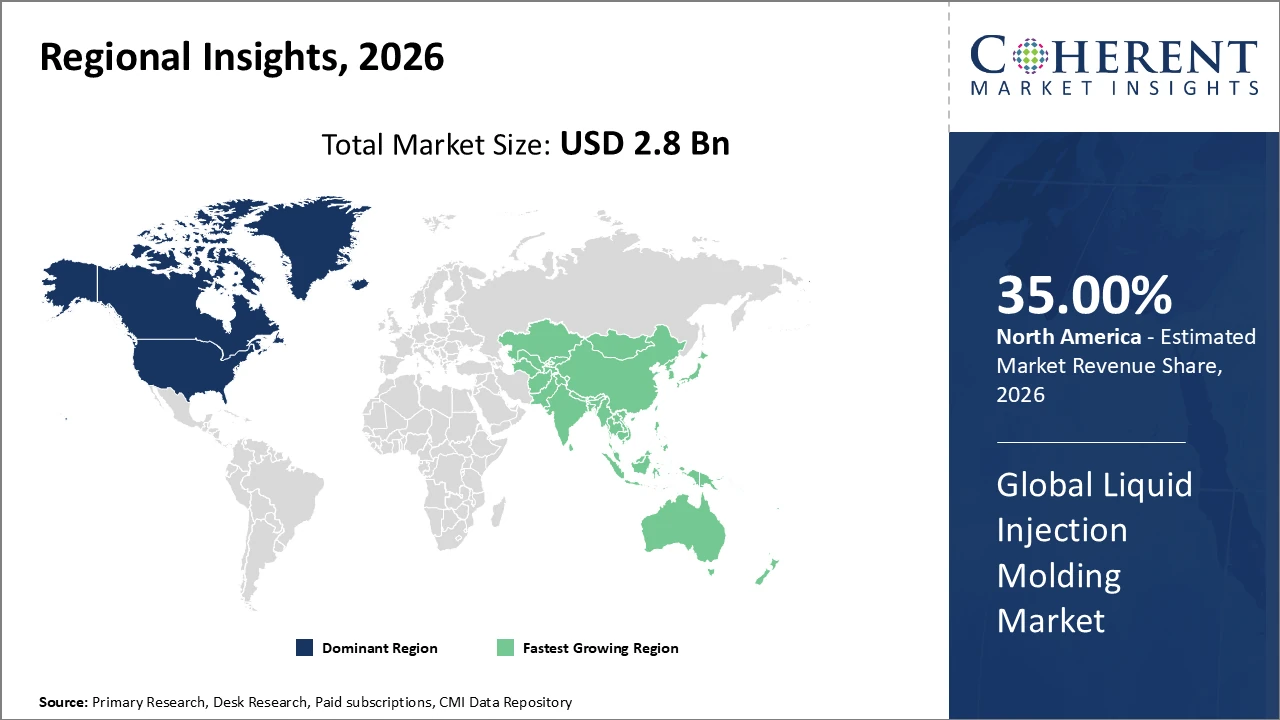
North America leads regionally with a 35% market share, supported by robust automotive and medical device sectors and well-established infrastructure.
Asia Pacific is the fastest-growing region, with a CAGR of 11.3% between 2026 and 2033, fueled by expanding manufacturing ecosystems and government incentives in automotive and electronics sectors.
Liquid Injection Molding Market Segmentation Analysis
Liquid Injection Molding Market Insights, By Material Type
Liquid Silicone Rubber (LSR) dominates the market with a 68% share, driven by its thermal stability, biocompatibility, and versatility across automotive gaskets, medical devices, and other applications. Its compatibility with two-component injection molding enables complex, high-precision parts, further boosting adoption. Thermoplastic Elastomers (TPEs) are the fastest-growing subsegment, capturing around 14% growth in 2026 due to recyclability, faster cycle times, and increasing use in consumer electronics and industrial machinery, offering a sustainable alternative. Polyurethane (PU) serves niche industrial applications with excellent abrasion resistance but higher processing costs, while the ‘Others’ category includes specialty blends designed for customized performance requirements.
Liquid Injection Molding Market Insights, By Application
Automotive dominates the Liquid Injection Molding market, generating significant revenue as demand grows for lightweight, durable silicone parts that meet emission regulations and enhance fuel efficiency. LSR components are increasingly integrated for sealing, vibration dampening, and electrical insulation in vehicles. The fastest-growing application segment is Medical Devices, driven by the adoption of biocompatible silicone parts for surgical instruments, implants, and diagnostic tools, supported by regulatory approvals and the rise of minimally invasive procedures. Consumer Electronics maintain a strong presence due to precision-molded seals and gaskets enhancing waterproofing and usability. Industrial Machinery, though smaller, steadily uses multi-component molding for durable, high-performance components.
Liquid Injection Molding Market Insights, By Process Type
Two-Component Injection Molding dominates the Liquid Injection Molding market, offering efficiency and flexibility for producing complex parts, especially in medical and automotive applications where multiple material properties are integrated into a single component. The fastest-growing process type is Multi-Component Injection Molding, driven by demand for combining silicone with plastics or other elastomers to produce functional, customizable parts with enhanced performance. This method is expanding in consumer electronics and automotive sectors, where design complexity continues to rise. The ‘Others’ segment includes specialized techniques such as micro-injection molding, catering to ultra-small components, reflecting potential growth as miniaturization trends advance across industries.
Liquid Injection Molding Market Trends
The Liquid Injection Molding market is increasingly adopting sustainable materials such as bio-based silicones, with leading manufacturers achieving around a 10% reduction in carbon footprint in 2026.
Integration of automation and IoT-based real-time quality monitoring systems has improved production efficiency, boosting yield rates by approximately 12% in high-volume manufacturing facilities.
Digital transformation is enhancing process control, enabling more consistent output and reduced defects across complex molding operations.
Advanced simulation tools and rapid prototyping are driving customization trends, reducing product development and launch timelines by nearly 20%.
These advancements collectively support faster adaptation to changing customer requirements and evolving end-use industry specifications.
Liquid Injection Molding Market Insights, By Geography
North America Liquid Injection Molding Market Analysis and Trends
In North America, the Liquid Injection Molding market is dominated by a strong presence of automotive OEMs and medical device manufacturers investing in lightweight, durable, and high-performance components. The region holds about 35% of the global market share, driven by government initiatives that encourage technological innovation and enforce strict regulatory standards for safety and environmental compliance. Major players, including Wacker Chemie AG and Dow Inc., are expanding production capacities and advancing technology adoption, supporting the development of complex, high-precision LIM components. This combination of industrial demand, regulatory support, and innovation makes North America a key hub for liquid injection molding solutions.
Asia Pacific Liquid Injection Molding Market Analysis and Trends
Asia Pacific is projected to be the fastest-growing region in the Liquid Injection Molding market, with a CAGR of 11.3% through 2033. Growth is fueled by expanding electronics manufacturing hubs in China, South Korea, and Japan, alongside favorable government policies supporting export-oriented production. Increasing investments in automotive component manufacturing and rising urbanization further stimulate demand, while higher disposable incomes boost consumption of consumer electronics and medical devices incorporating molded silicone parts. Leading companies, including Shin-Etsu Chemical and Kuraray Co., Ltd., are establishing regional facilities to leverage these opportunities, positioning Asia Pacific as a critical growth hub for LIM technologies.
Liquid Injection Molding Market Outlook for Key Countries
USA Liquid Injection Molding Market Analysis and Trends
The USA is a central market for Liquid Injection Molding, driven by a mature automotive industry increasingly adopting emission-reducing technologies that rely on LSR components. In 2025, U.S. manufacturers generated over 40% of North America’s market revenue, supported by government incentives promoting sustainable manufacturing practices. Leading companies such as Dow Inc. and Wacker Chemie AG have invested in capacity expansions and product innovations targeting medical device and consumer electronics applications. Their efforts in high-performance, durable, and biocompatible components reinforce the country’s market leadership, making the U.S. a critical hub for LIM technology development and advanced manufacturing solutions.
Germany Liquid Injection Molding Market Analysis and Trends
Germany’s Liquid Injection Molding market is driven by a strong automotive and industrial machinery base, coupled with stringent environmental and safety regulations. The country emphasizes high-performance LSR and thermoplastic elastomer components, particularly for automotive gaskets, seals, and vibration-damping parts. Technological advancements, including multi-component and precision molding, support complex designs and high-quality standards. Growing demand in medical devices and consumer electronics further contributes to market expansion, with biocompatible and sustainable materials gaining traction. Germany also benefits from well-established R&D infrastructure and strategic investments by key players such as Wacker Chemie AG and Dow Inc., positioning it as a leading European hub for LIM innovation.
Analyst Opinion
Rising automotive demand is a key supply-side indicator, with OEMs increasing procurement of molded silicone parts by 15% in 2025 due to stringent emission regulations and a push for lightweight alternatives, boosting LIM market share in the sector.
Consumer electronics adoption of miniaturized silicone components reflects demand-side dynamics; in 2024, smartphone manufacturers used over 30% more liquid injection molded seals and gaskets, enhancing water resistance and durability while increasing market revenue.
Production capacity expansions in Asia Pacific by mid-2025 resulted in a 25% combined increase, reflecting strategic investments to meet regional demand and support market growth.
In medical devices, biocompatible liquid silicone rubber usage surged by 20% in 2026 compared to 2024, driven by regulatory approvals and demand for sterilizable, durable components.
- Current Industry Events of 2026
- Market Size Estimation
- Regional Breakdown
- Competitive Landscape
- Customer Intelligence
- Segmental Analysis
- Pricing Analysis
- Key Market Drivers, Challenges & Future Trends
- Customized Insights Section
Market Scope
| Report Coverage | Details | ||
|---|---|---|---|
| Base Year: | 2025 | Market Size in 2026: | USD 2.8 billion |
| Historical Data for: | 2020 To 2024 | Forecast Period: | 2026 To 2033 |
| Forecast Period 2026 to 2033 CAGR: | 9.2% | 2033 Value Projection: | USD 5.1 billion |
| Geographies covered: |
| ||
| Segments covered: |
| ||
| Companies covered: | Wacker Chemie AG, Dow Inc., Elkem ASA, BYK-Gardener, KCC Corporation, Nusil Technology LLC, Shin-Etsu Chemical Co., Momentive Performance Materials | ||
| Growth Drivers: |
| ||
Liquid Injection Molding Market Growth Factors
Market growth in liquid injection molding is driven by the increasing use of lightweight, high-durability materials in automotive manufacturing, prompted by global fuel efficiency regulations. Precision requirements in miniaturized consumer electronics components, such as smartphones and wearables, further boost demand as advanced LSR technology enhances product resilience and performance. The medical device sector contributes significantly, with biocompatible, sterilizable components experiencing 20% growth in 2026 alone. Additionally, advancements in multi-component injection molding expand design flexibility, enabling more complex and functional parts. These trends collectively enhance adoption across automotive, electronics, medical, and industrial machinery applications, reinforcing overall market expansion.
Liquid Injection Molding Market Development
In June 2025, APSX LLC introduced the APSX-LSR, a benchtop liquid silicone rubber injection system. Aimed at engineers, med-tech startups, and research labs, it delivers production-quality silicone parts while operating on standard 115V AC power with under 1 kW consumption, producing a 6-gram shot in 63 seconds.
Key Players
Leading Companies of the Market
Shin-Etsu Chemical Co.
Wacker Chemie AG
Dow Inc.
Nusil Technology LLC
Elkem ASA
BYK-Gardener
KCC Corporation
Momentive Performance Materials
To enhance market share and strengthen regional presence, Shin-Etsu Chemical carried out strategic capacity expansions in North America, achieving a 12% increase in output in 2025. Concurrently, Wacker Chemie AG focused on sustainability-driven product development, launching bio-based liquid silicone rubber variants in 2026, which successfully penetrated new consumer electronics applications. Dow Inc. leveraged partnerships with automotive component manufacturers to introduce multi-component injection molding solutions, boosting business growth and market revenue within the medical devices segment. These combined strategies of capacity expansion, sustainable innovation, and collaborative product development have reinforced the competitive positioning of key players in the LIM market.
Liquid Injection Molding Market Future Outlook
The future of the Liquid Injection Molding market is poised for robust growth, driven by increasing demand for lightweight, durable, and high-precision components across automotive, medical, consumer electronics, and industrial sectors. Adoption of bio-based and sustainable materials will accelerate, supported by global environmental regulations. Technological advancements, including multi-component and micro-injection molding, along with automation and IoT-enabled quality monitoring, will enhance efficiency, customization, and product complexity. Rapid industrialization in Asia Pacific and continued investments in R&D by key players will expand regional and global market penetration. Overall, the LIM market is set to experience sustained innovation-driven growth and wider application adoption.
Liquid Injection Molding Market Historical Analysis
The historical analysis of the Liquid Injection Molding market highlights steady growth driven by the adoption of liquid silicone rubber (LSR) and thermoplastic elastomers in automotive, medical, and consumer electronics sectors. Early demand was fueled by the need for lightweight, durable, and high-precision components, particularly in automotive gaskets and seals. Technological advancements, such as two-component injection molding and multi-shot processes, improved efficiency and part complexity. Regional expansion, especially in North America and Europe, was supported by established automotive and medical device industries. Increasing awareness of sustainability and regulatory compliance laid the foundation for the subsequent shift toward bio-based materials and advanced LIM applications.
Sources
Primary Research Interviews:
Materials scientists, R&D managers, and production engineers from companies manufacturing liquid silicone rubber (LSR), thermoplastic elastomers (TPEs), and polyurethane components.
Project managers and technical specialists from firms producing multi-component injection molding solutions, medical-grade silicone parts, and automotive LIM components.
Industry experts from equipment providers specializing in precision injection molding, micro-injection, and automation systems for high-performance LIM applications.
Magazines:
Coatings World – Market trends, technological innovations, and LIM applications.
European Coatings Journal – Developments in sustainable materials, multi-component molding, and industrial adoption.
Plastics Today – Updates on LIM technologies, processing techniques, and performance materials.
Journals:
Journal of Injection Molding Technology – Studies on process optimization, material performance, and part design.
Polymer Engineering & Science – Research on thermoset and elastomer materials, molding techniques, and durability.
Journal of Materials Processing Technology – Insights on LIM manufacturing, multi-shot molding, and automation integration.
Newspapers:
The Wall Street Journal – Corporate activities, mergers, and investments in the LIM sector.
Financial Times – Market trends, regulatory developments, and industrial growth affecting LIM.
Reuters – Industry news on technology adoption, production volumes, and market performance.
Bloomberg – Company strategies, revenue trends, and global LIM market growth.
Associations:
Society of Plastics Engineers (SPE) – Standards, research, and data on injection molding technologies.
European Plastics Converters (EuPC) – Updates on European markets, regulatory compliance, and innovation.
International Plastics and Rubber Federation (IPRF) – Insights on global LIM industry trends, events, and advancements.
Get access to 250+ pages report
Every segment, forecast, competitor profile and data table behind the analysis above — available for instant download.
- ESOMAR Member
- ISO 9001:2015 Certified
- D-U-N-S Registered
- GDPR & CCPA Compliant
Missing comfort of reading report in your local language? Find your preferred language:
Transform your Strategy with Exclusive Trending Reports
Frequently Asked Questions
The market is predominantly led by firms such as Shin-Etsu Chemical, Wacker Chemie AG, and Dow Inc., who leverage capacity expansion and sustainability innovations to solidify leadership.
The market is expected to grow from USD 2.8 billion in 2026 to USD 5.1 billion by 2033 at a CAGR of 9.2%, underscoring robust market growth opportunities.
Automotive applications hold the largest growth potential due to increasing regulations for lightweight components and enhanced safety requirements.
Advancements in sustainable materials and Industry 4.0 integration will define market shifts, enabling greater efficiency and customization.
The competitive landscape features increasing capacity expansions and product innovation, while challenges involve raw material price volatility and complex regulatory environments.
Companies primarily adopt strategic partnerships, sustainability-driven product development, and regional capacity expansions to enhance market penetration and revenue.