

Tannin Market Size and Forecast — 2026-2033
The Tannin Market size is estimated to be valued at USD 1.53 billion in 2026 and is expected to reach USD 2.63 billion by 2033, exhibiting a compound annual growth rate (CAGR) of 8.0% from 2026 to 2033.
Overview
Tannin is a biomolecule extracted from fruits and plants. It can be found in the seeds, stem tissues, roots, leaves, and bark of plants. Tannin is most common in gymnosperm and angiosperm plants. It protects the plants from predation and helps in the synthesis of plant hormones. Fruits such as oranges, grapes, walnuts, pecans, hazelnuts, strawberries, blueberries, and cranberries have rich content of tannin.
The global tannin market is expected to grow significantly during the forecast period. The increasing demand from the various end-use industries such as leather, wine, and wood adhesives is the major driving factor for the growth of tannins market. The anti-oxidation and decomposition properties of tannins are a major factor for the demand of tannins in the leather manufacturing and wine fermenting industries. The increasing consumption of alcohol is expected to boost the growth of tannin market. Moreover, the demand for tannin in the manufacturing of wood adhesives and medicines is expected to drive the growth of tannin market positively over the forecast period.
Key Takeaways
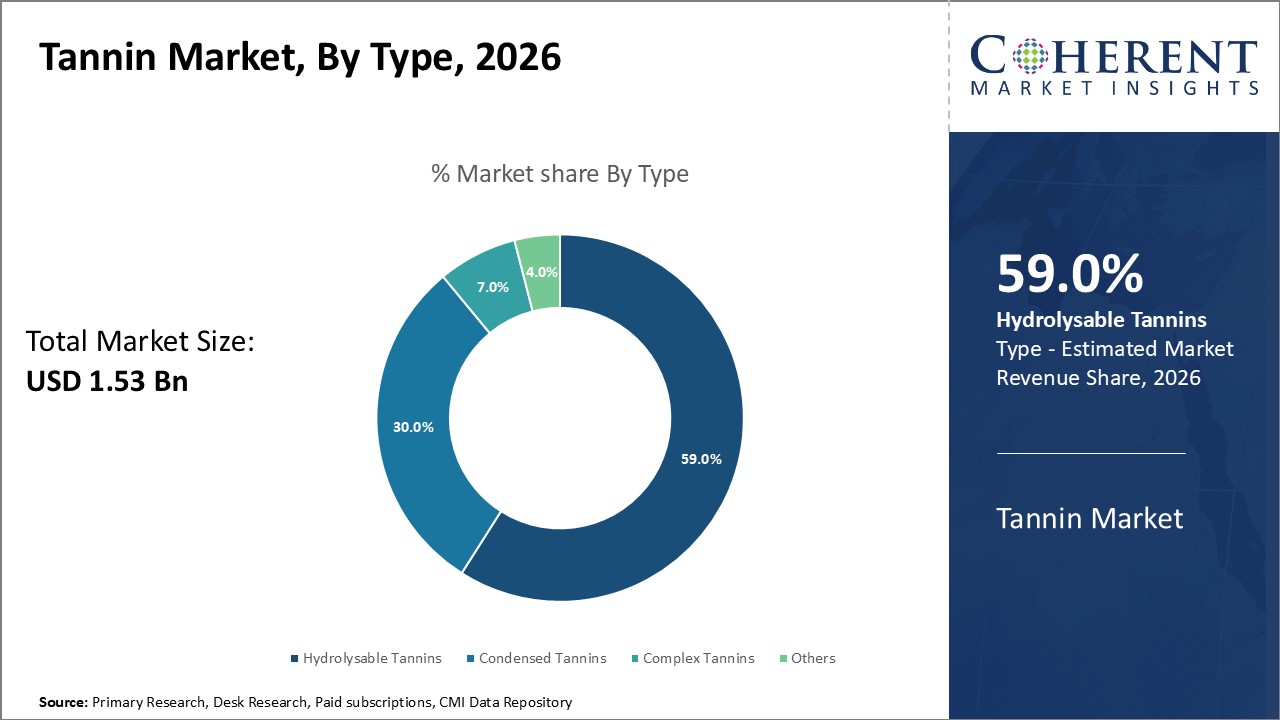
The hydrolysable tannins segment continues its dominance with over 59% market share, driven by superior performance in leather tanning and pharmaceutical applications.
Leather tanning remains the largest application, contributing 53% to industry revenue, underscoring its vital role in the tannin market’s expansion.
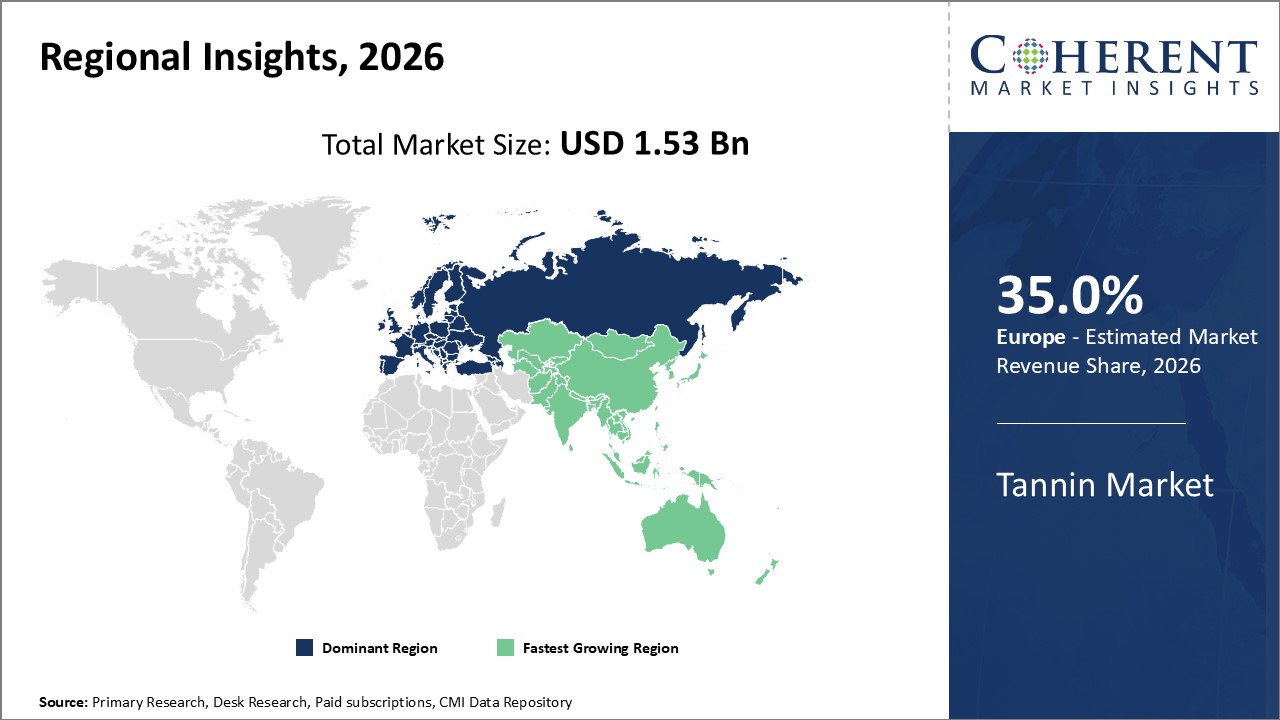
Europe holds a commanding share in the industry size with rigorous environmental policies driving adoption of natural tannins.
Asia Pacific exhibits the highest CAGR due to booming leather manufacturing hubs and increasing government support for bio-based industries in countries like India and China.
Tannin Market – Segmentation Analysis
Tannin Market Insights, By Type
By type, Hydrolyzable tannins hold a 59% market share. Their high solubility and wide range of uses, particularly in pharmaceutical and leather tanning products, are the reasons for their dominance. These tannins, which are more easily broken down chemically compared to non-hydrolyzable tannins, influence important processes such as wine aging and flavor development.
Tannin Market Insights, By Application
In terms of Application, Leather Tanning dominates with a 52% market share. Leather tanning’s dominance stems from ongoing global leather production shifts to vegetable and hydrolysable tannin processes driven by environmental regulations. This segment is driven by the critical role tannins play in stabilizing collagen fibers in leather, which enhances durability, water resistance, heat resistance, and protection against microbial attacks.
Tannin Market Insights, By Source
Source-wise, Quebracho dominates the market share and is perfect for industrial uses. This market segment is primarily driven by the increasing demand for natural and eco-friendly tanning agents. Quebracho extract, sourced mainly from South America, particularly Argentina and Paraguay, is valued for its effectiveness in producing durable and high-quality leather products.
Tannin Market Trends
The tannin market is witnessing a significant shift toward sustainable extraction technologies, with green solvents and enzyme-assisted processes becoming mainstream in 2025. This trend is reflected in the 12% increased adoption rate among manufacturers focusing on eco-compliance. Additionally, diversification of tannin applications into novel sectors such as high-performance adhesives for electronics and biodegradable packaging materials is reshaping market dynamics.
A notable instance is the collaboration between a major tannin supplier and leading packaging firms in Europe, which resulted in the launch of fully tannin-based biodegradable containers in early 2026. Moreover, growing consumer preference for natural ingredients in cosmetics has opened an emerging vertical, supported by clinical trials illustrating the anti-inflammatory benefits of tannins in skincare.
Tannin Market Insights, By Geography
The Development and Patterns of the European Tannin Market
Strict environmental laws and a well-established leather sector that widely uses natural tannins are the main drivers of Europe's supremacy in the tannin business. With more than 35% of the market, the region gains from nations like Italy and Germany that make significant investments in the production of sustainable chemicals. Leading European enterprises have strengthened their market projection and industry share by speeding up research and development on tannin derivatives for a variety of industries.
The Development and Patterns of the Asia Pacific Tannin Market
The fastest-growing region, Asia Pacific, has a compound annual growth rate (CAGR) of over 9%. This growth is fueled by the expansion of raw material plantations, expanded capacity for local production, and supportive government policies that support bio-based products in nations like China and India. These countries' growing leather production centers and increasing export potential highlight the region's explosive market expansion trajectory.
Tannin Market Outlook for Key Countries
United States Tannin Market Trends
The U.S. market is characterized by high demand from the pharmaceutical and food sectors, supported by robust research into tannin-based health supplements. Recent government funding aimed at sustainable chemical innovation in 2025 accelerated market growth, with companies like BioTannin Co. leading the transition to biobased products.
India Tannin Market Trends
Due to the vast quebracho and mimosa plantations that serve as the main source of raw materials, India's tannin business is expanding quickly. Since 2023, government export incentives and subsidies have improved market enterprises' capacity to modernize extraction technologies.
Analyst Opinion
Technological innovation in extraction methods is a pivotal driver for market expansion. For instance, the adoption of enzymatic extraction techniques in 2025 resulted in a 16% increase in tannin yield efficiency as per industry data, directly contributing to enhanced market revenue. This efficiency improvement not only reduces costs but also supports sustainable production practices.
Demand-side dynamics reveal continuous growth in the leather industry segment, where tannins account for approximately 56% of total raw material usage in leather processing globally as of 2026. The surge in eco-conscious consumers has pushed leather manufacturers to adopt vegetable-tannin processes, driving market share in this subsegment.
Pricing mechanisms in the adhesive sector demonstrate favorable trends with tannin-based adhesives recording a price stability index of 92.3 in 2025 compared to synthetic variants, encouraging a switch in industrial preference. This has been instrumental in expanding market revenue in packaging and wood industries.
Export volumes from major producing countries evidenced a 10.5% YoY growth in 2026, supported by increased cross-border trade agreements and tariff reductions specifically targeting natural extract exports. This growth in exportation strengthens the global supply chain, amplifying overall market size and competitive pressure among market companies.
- Current Industry Events of 2026
- Market Size Estimation
- Regional Breakdown
- Competitive Landscape
- Customer Intelligence
- Segmental Analysis
- Pricing Analysis
- Key Market Drivers, Challenges & Future Trends
- Customized Insights Section
Market Scope
| Report Coverage | Details | ||
|---|---|---|---|
| Base Year: | 2025 | Market Size in 2026: | USD 1.53 billion |
| Historical Data for: | 2020 To 2024 | Forecast Period: | 2026 To 2033 |
| Forecast Period 2026 to 2033 CAGR: | 8.0% | 2033 Value Projection: | USD 2.63 billion |
| Geographies covered: |
| ||
| Segments covered: |
| ||
| Companies covered: | PlantExtracts Inc., BioTannin Co., NaturTan Corp., GreenChem Solutions, LeafExtract Ltd., PureBio Resources, EcoTannins Global, Chestnut Extractors, TanninSynth Industries | ||
| Growth Drivers: |
| ||
Growth factors for Tannin Market
Market drivers shaping the tannin market include the escalating global demand for sustainable leather tanning methods, which reduce toxic waste compared to synthetic alternatives. This shift garnered a market revenue increase of nearly USD 200 million in 2025 alone. Additionally, expanding applications in the food and beverage sector, particularly as antioxidants and natural preservatives, continue to fuel demand with a growth rate mirroring industry size expansion.
Increasing government initiatives supporting bio-based chemical adoption, such as emission reduction policies across Europe and North America, further bolster market growth by incentivizing greener product usage. Lastly, the rising awareness about tannins’ health benefits, including cardiovascular protection, stimulates growth in nutraceutical products, contributing to consumer-driven market growth dynamics.
Tannin Market Development
In April 2026, The Italian leather chemicals manufacturer Silvateam spearheaded the LIFE I'M TAN initiative, which has effectively created a new generation of modified natural tannins intended to enhance sustainability in vegetable tanning and retanning procedures. The research, which was funded by the EU's LIFE Programme (LIFE20 ENV/IT/000759), aimed to improve the functionality of plant-based tanning agents made from quebracho and chestnut wood.
Key Players
PlantExtracts Inc.
BioTannin Co.
NaturTan Corp.
GreenChem Solutions
LeafExtract Ltd.
PureBio Resources
EcoTannins Global
Chestnut Extractors
TanninSynth Industries
Competitive strategies focus on product diversification and vertical integration. For example, GreenChem Solutions expanded its portfolio by developing bio-based tanning synthetics, boosting market revenue by 18% in the U.S. during 2025.
NaturTan Corp. leveraged strategic acquisitions to enter emerging APAC markets, resulting in a 23% market share boost in that region as recorded in 2026.
Innovation-led partnerships between LeafExtract Ltd. and pharmaceutical firms enhanced product application breadth, directly driving an increase in advisory market growth strategies focused on health-beneficial extracts.
Tannin Market Future Outlook
The market for tannins will have a bright future ahead of it, with rapid expansion being fueled by consumers' growing desire for sustainable and natural products. Because of tannins' practical advantages such as preservation, antioxidant qualities, and environmental friendliness, important industries like food and beverage production, pharmaceuticals, and leather processing will use them more and more.
There will be a clear trend toward bio-based and environmentally responsible sourcing and production methods, with companies focusing on innovation to enhance product quality and application scope.
Emerging markets, particularly in Asia-Pacific and Latin America, will become significant contributors to market expansion due to increasing demand across multiple sectors.
Regional leaders in traditional industries like Europe will continue to drive innovation and sustainable practices, reinforcing the market’s shift toward greener alternatives.
Meanwhile, the challenges of sustainable raw material sourcing and competition from synthetic substitutes will encourage ongoing research and development to secure long-term growth and market resilience.
Overall, the tannin market’s future will reflect a balance of expanding application opportunities, sustainability efforts, and global demand diversification.
Historical Development
In June 2017, Tannin Corporation finalized an agreement for purchasing Marden Wild Corporation, a manufacturer of high-quality tanning oils and fat liquors. This acquisition was expected to help the company in expanding its product portfolio and thereby increase its customer base.
In October 2018, Tannin Corporation launched its two new fat liquors and wax segment. This launch helped the company in expanding its product portfolio and thereby gained a competitive edge over its other competitors.
In April 2013, TANAC SA presented its leather tanning and re-tanning products such as SYNTAC CA and SYNTAC DC at the APLF 2013, a leather trade show in Hong Kong. This helped the company in displaying its products on a large scale and thereby attracted a larger customer base during the forecast period.
Sources
Primary Research interviews:
Food & beverage companies
Pharmaceutical companies
Animal feed producers
Databases:
World Bank Data
USDA Foreign Agricultural Service (FAS)
Eurostat
Magazines:
Wine Spectator
Food & Beverage Magazine
Chemical & Engineering News
Journals:
Industrial Crops and Products
Food Chemistry
Journal of Applied Polymer Science
Newspapers:
Financial Times
The Wall Street Journal
The Hindu Business Line
Associations:
International Council of Tanners
International Organisation of Vine and Wine (OIV)
Leather & Hide Council of America (LHCA)
Get access to 250+ pages report
Every segment, forecast, competitor profile and data table behind the analysis above — available for instant download.
- ESOMAR Member
- ISO 9001:2015 Certified
- D-U-N-S Registered
- GDPR & CCPA Compliant
Missing comfort of reading report in your local language? Find your preferred language:
Transform your Strategy with Exclusive Trending Reports
Frequently Asked Questions
The market is dominated by PlantExtracts Inc., BioTannin Co., and NaturTan Corp., among others, who lead through innovation and geographical expansion.
It is forecasted to grow from USD 1.53 billion in 2026 to approximately USD 2.63 billion by 2033, exhibiting a CAGR of 8.0%.
The leather tanning industry currently holds the largest growth opportunity, accounting for over half the market share, driven by demand for eco-friendly tanning solutions.
Market trends will pivot around sustainable extraction methods, diversification into food and pharma applications, and progressive regional penetration in Asia Pacific.
Competitive strategies focus on product diversification, tech-driven extraction advancements, and regional expansion, while key challenges include raw material availability and price volatility.
Strategies like innovation partnerships, mergers and acquisitions, and tapping emerging regions are predominant among leading market companies to maximize footprint and growth.