

Road Marking Materials Market Size and Forecast — 2026 - 2033
The Global Road Marking Materials Market size is estimated to be valued at USD 4.8 billion in 2026 and is projected to reach USD 7.3 billion by 2033, growing at a compound annual growth rate (CAGR) of 6.2% from 2026 to 2033.
Overview
The road marking materials market is driven by rising investments in road infrastructure, highway expansion, and urban development projects worldwide. Governments are increasingly focusing on road safety regulations, boosting demand for durable and highly visible road markings. Growth in smart transportation systems and increasing vehicle ownership are also supporting market expansion. Additionally, the adoption of advanced materials such as thermoplastics, waterborne coatings, and reflective paints enhances durability and visibility, encouraging wider use. Maintenance and refurbishment of existing roads further contribute to demand. Environmental concerns and regulations promoting eco-friendly, low-VOC marking materials are also driving innovation and market growth across developed and emerging economies.
Key Takeaways
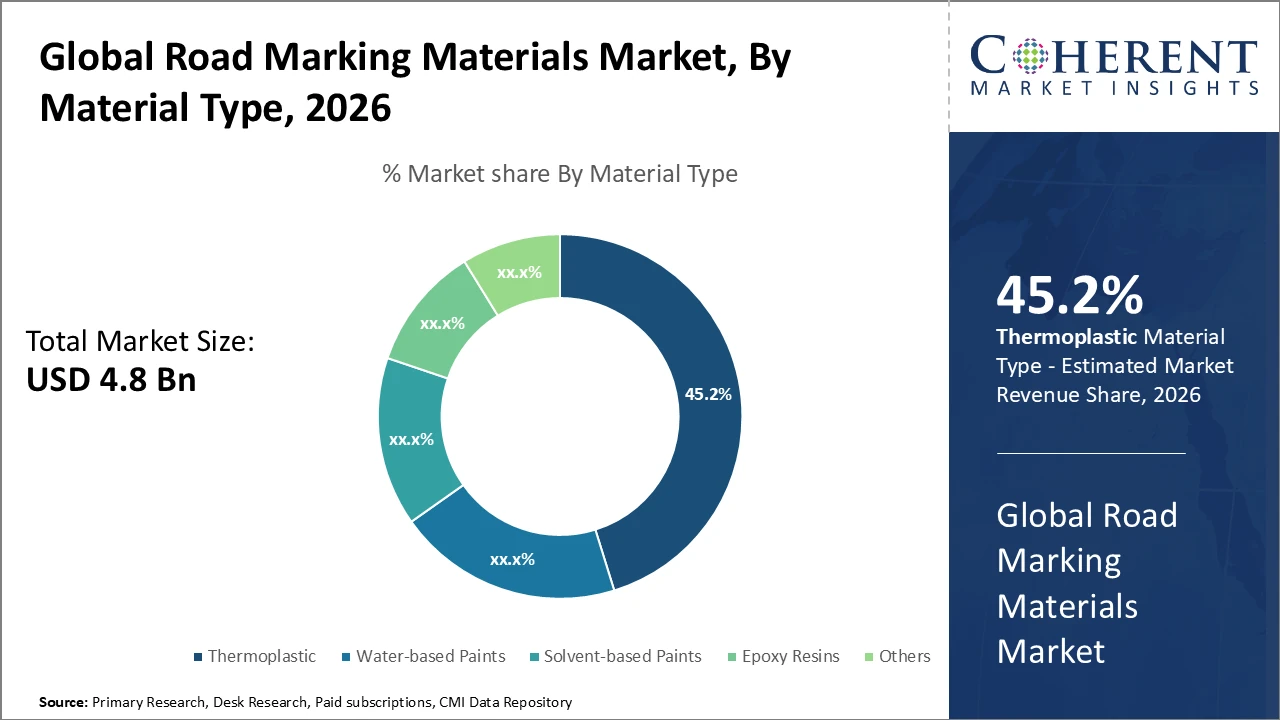
Thermoplastic materials dominate the market with a 45.2% share, driven by durability, longevity, and high reflectivity benefits.
Highways account for over 40% of application demand, reflecting robust infrastructure development.
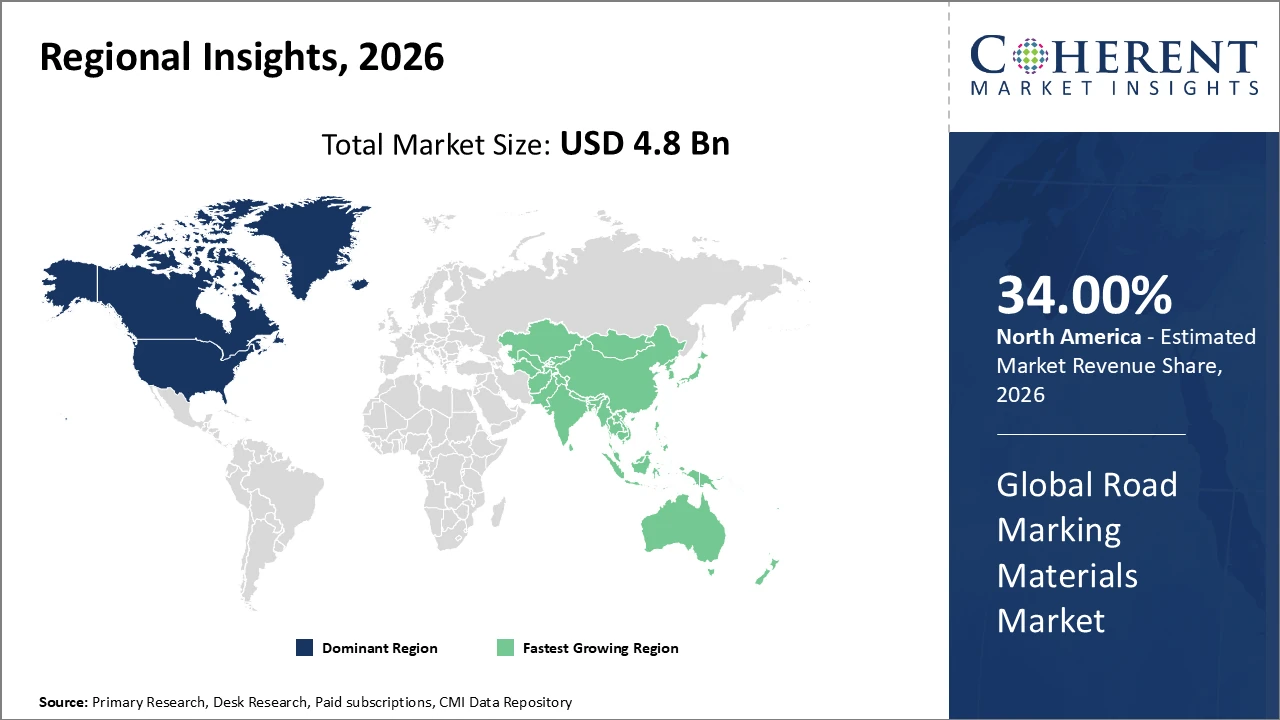
North America holds a dominant regional market share of approximately 34%, supported by stringent safety norms and advanced road infrastructure.
Asia Pacific exhibits the highest CAGR, fueled by rapid urbanization and government investments exceeding USD 1 trillion in road projects by 2026.
Europe maintains steady growth, driven by sustainability initiatives and technological innovations in road marking materials suitable for diverse climates.
Road Marking Materials Market Segmentation Analysis
Road Marking Materials Market Insights, By Material Type
Thermoplastic dominates the market share at 45.2%, favored for its durability, high retroreflectivity, and adaptability across varied road surfaces, making it ideal for highways and busy urban roads. Water-based paints are the fastest-growing subsegment, driven by stringent VOC regulations in North America and Europe, offering quick drying, low emissions, and eco-friendly application. Solvent-based paints retain relevance due to cost efficiency but face declining adoption amid environmental restrictions. Epoxy resins are used in specialized areas like airport runways, providing chemical resistance and long-lasting performance, while the Others category includes innovative hybrid materials designed to withstand diverse regional climates and traffic conditions.
Road Marking Materials Market Insights, By Application
Highways dominate the market with a 40.1% share, fueled by substantial investments in long-distance road networks across both developed and emerging regions, necessitating durable, highly visible marking materials for enhanced safety. Airport runways represent the fastest-growing application, driven by global airport expansion and modernization initiatives, requiring abrasion-resistant and long-lasting materials such as specialized thermoplastics and epoxy resins. Urban roads contribute significantly due to rising metropolitan development but face regulatory fragmentation that limits growth. Parking lots and other applications, including pedestrian zones, remain smaller yet stable segments, collectively supporting the overall market scope and reinforcing diverse demand across infrastructure projects.
Road Marking Materials Market Insights, By Technology
Preformed Thermoplastic technology leads the market due to its precision, reduced installation time, and thick multilayered markings, providing superior reflectivity and extended service life—qualities essential for high-traffic highways. The fastest-growing subsegment is Waterborne technology, driven by environmental regulations and enhanced adhesion properties across diverse surfaces. Solvent-borne technology, once widely used for cost-effectiveness and ease of application, is gradually declining due to stringent VOC restrictions. Sprayable solutions cater to temporary markings and maintenance needs but hold a smaller market share. The Others category includes emerging smart technologies integrating sensors, expected to transform road marking practices in the coming years.
Road Marking Materials Market Trends
Technological innovation drives the market, exemplified by sensor-based smart road markings improving vehicle safety, tested in pilot programs in Germany and Singapore during 2024-2025.
Environmental consciousness is accelerating adoption of water-based paints, with North America seeing an 18% revenue increase by 2026 due to strict VOC regulations.
Diversification of applications into airport runways, urban cycling lanes, and pedestrian zones is expanding market reach.
Smart and durable marking solutions, including preformed thermoplastics and multilayered materials, enhance longevity and reflectivity, supporting growth in high-traffic areas.
Regulatory frameworks promoting sustainability and road safety further reinforce adoption and innovation trends globally.
Road Marking Materials Market Insights, By Geography
North America Road Marking Materials Market Analysis and Trends
In North America, the Road Marking Materials market is dominated by well-established highway networks and stringent road safety regulations. The U.S. and Canada account for roughly 34% of the regional market, driven by widespread use of durable thermoplastic materials and eco-friendly waterborne paints. Government initiatives, including the U.S. Infrastructure Investment and Jobs Act with multi-billion-dollar allocations for road modernization in 2025–2026, further strengthen market growth. Major players such as 3M and PPG Industries maintain substantial regional operations, leveraging technological innovation and strategic partnerships to enhance product adoption, reinforce competitive positioning, and support sustained industry expansion.
Asia Pacific Road Marking Materials Market Analysis and Trends
The Asia Pacific region is the fastest-growing market for road marking materials, with a CAGR exceeding 8%, driven by extensive infrastructure projects across India, China, and Southeast Asia. Rapid urbanization and government investments exceeding USD 1 trillion in 2026 for road expansions are fueling demand for durable and reflective marking solutions. The region’s growth is further supported by increasing industrial activity, heightened awareness of road safety standards, and adoption of advanced technologies such as preformed thermoplastics and waterborne paints. Domestic manufacturers in China and India are innovating rapidly, while global players are expanding their presence to capitalize on emerging opportunities.
Road Marking Materials Market Outlook for Key Countries
USA Road Marking Materials Market Analysis and Trends
The U.S. Road Marking Materials market remains a key driver of global industry revenue, supported by extensive highway networks and stringent safety regulations. Federal investments through the 2025 Infrastructure Investment and Jobs Act led to a 15% rise in procurement of durable thermoplastic materials for road markings. Leading companies like 3M and PPG Industries dominate supply while promoting sustainability via water-based paints, which saw a 12% sales increase in 2026. Heightened public safety campaigns and emphasis on high-visibility markings have further fueled demand, enhancing market penetration, reinforcing competitive positioning, and driving consistent growth across the sector.
Germany Road Marking Materials Market Analysis and Trends
Germany’s Road Marking Materials market is characterized by steady growth driven by advanced infrastructure development and stringent road safety regulations. Highways dominate demand due to heavy traffic volumes, requiring durable thermoplastic and epoxy-based materials. Environmental policies encouraging low-VOC and water-based paints are reshaping product adoption, with German manufacturers increasingly investing in sustainable solutions. Urban expansion and modernization of airport runways further diversify market applications. Leading domestic and international companies are leveraging technological innovations, such as preformed thermoplastics and smart markings, to enhance reflectivity and longevity. Overall, Germany combines regulatory rigor, technological advancement, and sustainability focus, underpinning a resilient market trajectory.
Analyst Opinion
The surge in demand for thermoplastic road marking materials significantly drives market revenue, with thermoplastic solutions holding over 45% market share in 2026. Their superior durability and reflectivity are crucial for high-traffic zones, demonstrated by a 35% improvement in nighttime visibility from 2025 deployments on major highways in Germany and the USA.
Water-based paints are increasingly adopted due to stringent environmental regulations, particularly in North America and Europe, with sales rising 18% from 2024 to 2026. These eco-friendly solutions address solvent-based product restraints and align with sustainability goals.
Emerging applications such as airport runways and urban bike lanes are expanding, with Asia Pacific witnessing a 22% rise in usage in 2025, diversifying the market and opening new growth opportunities.
Supply chain optimizations and stable raw material prices have strengthened market dynamics, with manufacturers in China and India reporting a 12% reduction in production costs in 2026, enabling competitive pricing in cost-sensitive regions.
- Current Industry Events of 2026
- Market Size Estimation
- Regional Breakdown
- Competitive Landscape
- Customer Intelligence
- Segmental Analysis
- Pricing Analysis
- Key Market Drivers, Challenges & Future Trends
- Customized Insights Section
Market Scope
| Report Coverage | Details | ||
|---|---|---|---|
| Base Year: | 2025 | Market Size in 2026: | USD 4.8 billion |
| Historical Data for: | 2020 To 2024 | Forecast Period: | 2026 To 2033 |
| Forecast Period 2026 to 2033 CAGR: | 6.2% | 2033 Value Projection: | USD 7.3 billion |
| Geographies covered: |
| ||
| Segments covered: |
| ||
| Companies covered: | 3M Company, PPG Industries Inc., Hempel A/S, RPM International Inc., Ennis-Flint, Eurovia, Tiger Coatings, BASF SE, Jotun Group, Tiger paints | ||
| Growth Drivers: |
| ||
Road Marking Materials Market Growth Factors
Rising global investment in infrastructure, particularly in Asia Pacific and North America, is a key driver for the Road Marking Materials market, exemplified by India’s USD 1.5 trillion National Infrastructure Pipeline in 2026. Regulatory emphasis on road safety has increased adoption of durable thermoplastic and epoxy resin markings, with the U.K.’s 2025 program reducing accidents by 12% through improved visibility. Environmental concerns are shifting demand toward sustainable water-based paints, with North American sales up 18% in 2025 due to stricter emission norms. Additionally, smart city initiatives integrating sensor-based and reflective markings in Singapore and Germany since 2024 are expanding market opportunities.
Road Marking Materials Market Development
In September 2025, Kyrgyzstan launched its first domestic facility for producing thermoplastic road-marking materials, marking a major advancement in infrastructure and industrial development. The project was implemented through a partnership between the Ministry of Transport and Communications’s Production and Innovation Center and Vokko LLC. Located in the Sokuluk district, the initiative operates from a 1,000-square-meter manufacturing facility established for the project.
Key Players
Leading Companies of the Market
3M Company
PPG Industries Inc.
Hempel A/S
RPM International Inc.
Ennis-Flint
Eurovia
Tiger Coatings
BASF SE
Jotun Group
Tiger Paints
Leading companies in the Road Marking Materials market have pursued strategic mergers and acquisitions to strengthen their product offerings and expand their geographic presence. Notably, 3M’s acquisition of Ennis-Flint in 2025 enhanced its capabilities in thermoplastic and preformed road markings, resulting in a 15% increase in U.S. market revenue. Likewise, PPG Industries’ investment in eco-friendly water-based paint technologies between 2024 and 2026 drove a 20% growth in its European market share, reflecting the effectiveness of targeted investments in sustainable solutions and innovative materials to capture emerging market opportunities.
Road Marking Materials Market Future Outlook
The Road Marking Materials market is expected to witness robust growth driven by increasing global infrastructure development, urbanization, and road safety regulations. Advancements in durable, reflective, and eco-friendly materials, such as thermoplastics with embedded glass beads and water-based paints with low VOC content, are projected to expand adoption. Smart road marking solutions integrated with IoT sensors for autonomous vehicle navigation are anticipated to emerge as a key trend. Additionally, government investments in highway expansion and maintenance in Asia Pacific and North America will accelerate demand. The market is poised for steady growth, with sustainability and technological innovation shaping future product development and applications.
Road Marking Materials Market Historical Analysis
The Road Marking Materials market has experienced steady growth over the past decade, driven by expanding road networks, urbanization, and stringent traffic safety regulations. Traditional paint-based markings initially dominated due to low cost and ease of application, but their limited durability prompted a shift toward thermoplastics and epoxy-based solutions. Europe and North America led early adoption of reflective and durable marking materials, while Asia Pacific gradually increased usage in response to rapid infrastructure development. Technological advancements such as glass bead incorporation and quick-drying formulations improved visibility and longevity, establishing a foundation for the current market landscape and setting the stage for future innovations.
Sources
Primary Research Interviews:
Engineers, R&D managers, and product developers from companies manufacturing road marking paints, thermoplastics, and reflective coatings.
Civil engineers, highway maintenance supervisors, and transportation department officials using road marking materials.
Industry experts from firms providing smart road marking solutions, reflective aggregates, and eco-friendly coatings.
Magazines:
Road & Transport Technology – Updates on road construction, marking innovations, and industry trends.
Construction & Building Materials – Insights on new road marking products, durability studies, and application techniques.
Highway Engineering – Case studies, procedural developments, and comparative analyses of marking materials.
Journals:
Journal of Transportation Engineering – Research on road marking effectiveness, visibility studies, and material performance.
Transportation Research Record – Studies on roadway safety, marking materials, and traffic management solutions.
International Journal of Pavement Engineering – Insights on durability, weather resistance, and lifecycle of marking materials.
Newspapers:
The Wall Street Journal – Company strategies, mergers, and investments in road construction and marking industries.
Financial Times – Global infrastructure spending, regulatory updates, and market trends in transportation materials.
Reuters – News on product launches, technological advancements, and market developments in road marking solutions.
Bloomberg – Corporate performance and market insights in infrastructure and road materials sectors.
Associations:
International Road Federation (IRF) – Guidelines, best practices, and standards for road marking and safety.
American Traffic Safety Services Association (ATSSA) – Protocols, training, and recommendations for marking applications.
World Road Association (PIARC) – Global recommendations, research, and safety standards for road infrastructure and marking materials.
Get access to 250+ pages report
Every segment, forecast, competitor profile and data table behind the analysis above — available for instant download.
- ESOMAR Member
- ISO 9001:2015 Certified
- D-U-N-S Registered
- GDPR & CCPA Compliant
Missing comfort of reading report in your local language? Find your preferred language:
Transform your Strategy with Exclusive Trending Reports
Frequently Asked Questions
The dominant players include 3M Company, PPG Industries, Hempel A/S, and RPM International Inc., all leveraging strategic acquisitions and sustainable product innovations to maintain market leadership.
The market is projected to grow from USD 4.8 billion in 2026 to USD 7.3 billion by 2033, achieving a CAGR of 6.2%, driven by expanding infrastructure projects and stringent road safety regulations.
Highways represent the largest segment, holding over 40% market share, supported by government investments in road safety programs and long-distance road network expansions.
Trends will increasingly focus on eco-friendly materials, smart markings, and integration with autonomous vehicle technologies, as seen in pilot initiatives in Singapore and Europe since 2024.
Competition is high, with companies emphasizing sustainability, technological innovation, and strategic partnerships; challenges include raw material price volatility and strict regulatory compliance.
Strategies include mergers and acquisitions (e.g., 3M’s acquisition of Ennis-Flint), R&D in environmentally friendly materials, and geographic expansion into high-growth regions like Asia Pacific and Europe.