

Pharmaceutical solvents Market Size and Forecast – 2026-2033
Pharmaceutical solvents market is estimated to be valued at USD 4.24 Bn in 2026 and is expected to reach USD 6.33 Bn by 2033, exhibiting a compound annual growth rate (CAGR) of 5.9% from 2026 to 2033.
Key Takeaways
- Based on Type, the Alcohol segment is expected to lead the market holding a share of 30.3% in 2026, owing to a wide range of application in pharmaceutical manufacturing
- Based on Application, Active Pharmaceutical Ingredient segment is projected to dominate the market by 43% share in 2026, due to sheer volume of solvents required for large-scalp API.
- Based on region, North America is estimated to lead the market with a revenue share of 37.1% in 2026. This is due to the well-established pharmaceutical industry.
Market Overview
Pharmaceutical solvents are liquids that’s are used to dissolve or dilute other substance in the production, this help is chemical reactions, extraction, and purification processes. This is a crucial process applied in formulation of drugs, and transforming raw material into finish product such as creams. Some of the commonly used pharmaceutical solvents are water, ethanol, glycerin, propylene glycol, oils, and other organic solvents.
There is steady growth projected in the pharmaceutical solvents market over the forecast period. This is mainly attributed to rising pharmaceutical Research and Development (R&D) initiatives and increasing production of active pharmaceutical ingredients (APIs) across the globe. Additionally, growing generic and biopharmaceutical industry is further expected to drive the demand for various solvents such as ethyl acetate, isopropyl alcohol, and others.
Current Events and Their Impact on the Pharmaceutical Solvents Market
Current Events | Description and their Impacts |
Regulatory Shifts Toward Sustainability |
|
Breakthroughs in Solvent Technology |
|
Role of Artificial Intelligence (AI) in Pharmaceutical Solvents Market
Incorporation of artificial intelligence in pharmaceutical solvents industry is proven to transform the workflow and product outcome. AI-driven advancements hold the potential to transform the drug discovery, chemical synthesis process through optimization and sustainability approach. AI can accelerate solvent selection and formulation. For instance, Exscientia’s Centaur Chemist uses machine learning to predict optimal chemical interactions, which extends to solvent choices for drug synthesis. This also reduced the trial-and-error experimentation, potentially cutting solvent waste by 20-30% in early-stage research.
- Current Industry Events of 2026
- Market Size Estimation
- Regional Breakdown
- Competitive Landscape
- Customer Intelligence
- Segmental Analysis
- Pricing Analysis
- Key Market Drivers, Challenges & Future Trends
- Customized Insights Section
Segmental Analysis
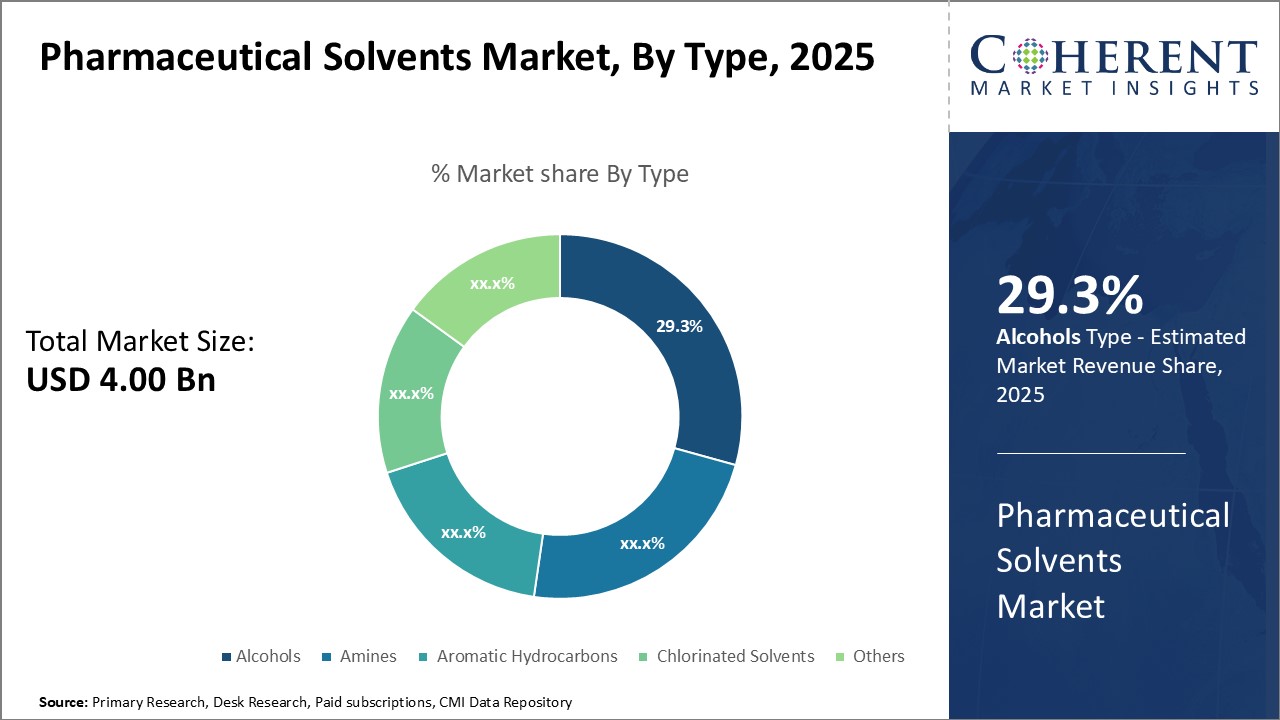
Pharmaceutical Solvents Market Insights, By Type: Alcohols Dominate Due to Wide Applications in Pharmaceutical Manufacturing
Alcohols segment is estimated to contribute the highest market share of 30.3% in the pharmaceutical solvents market by type in 2026. This is primarily attributed to the versatile nature and wide applications of alcohol solvents in various pharmaceutical manufacturing and R&D processes. Different types of alcohols like ethanol, isopropyl alcohol, and others exhibit excellent solvency properties for both hydrophilic and hydrophobic drug substances. This facilitates alcohol solvents to efficiently dissolve, extract, and purify active pharmaceutical ingredients during drug synthesis and formulation.
Wide availability from domestic and international suppliers at competitive costs further supports alcohol solvent consumption. Ongoing advancements to develop environment-friendly bio-based alcohol solvents will potentially drive future market opportunities. However, flammability issues necessitate specialized handling of alcohol solvents in production settings. Nonetheless, the overall benefits have ensured alcohol solvents remain the solvent of choice for a majority of pharmaceutical applications.
In February 2025, Greenfield Global, Inc. and Alco Energy Canada, these two are the Canada’s largest fuel ethanol producers, and Grain Farmer of Ontario, launched the Farms and Fuels Alliance (FFA), a groundbreaking coalition uniting Canada’s domestic ethanol industry and agricultural sector. This collaboration will Champion policies that strengthen Canadian biofuel production, promote fir market opportunities and drive ahead with sustainable growth.
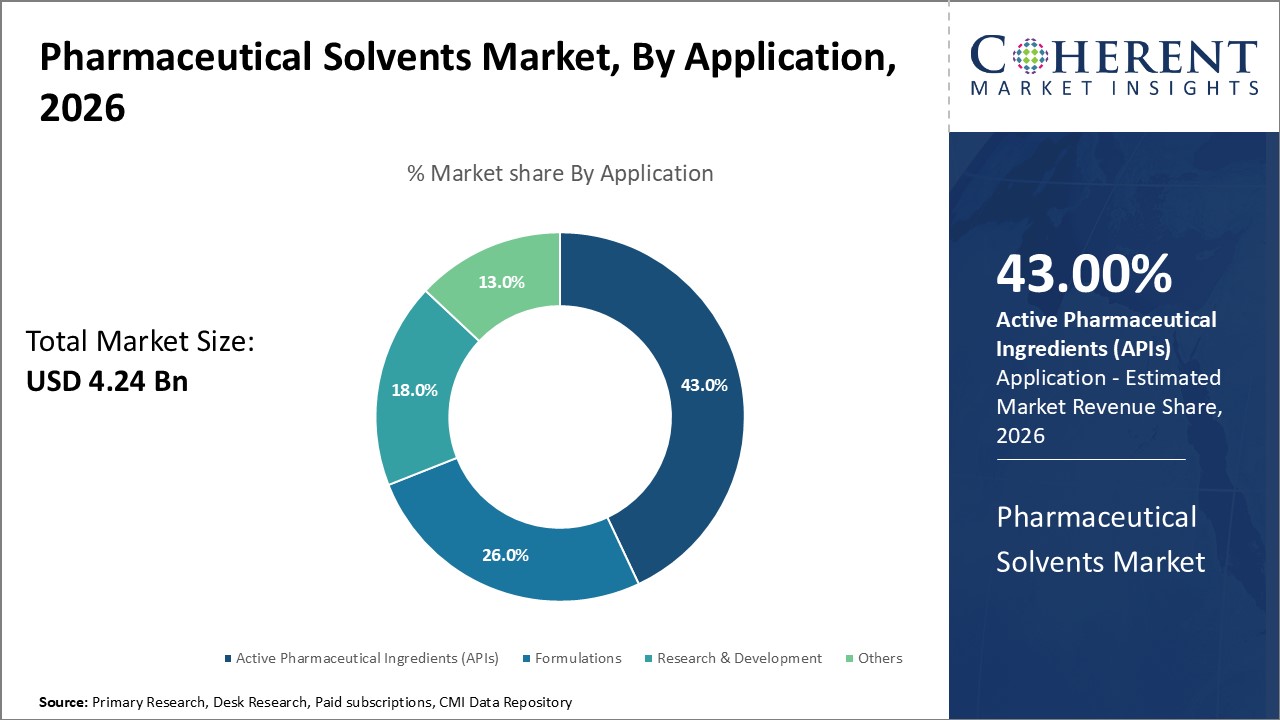
Pharmaceutical Solvent Market Insights by Application: Active pharmaceutical ingredient synthesis dominates on large scale manufacturing needs
The Active Pharmaceutical Ingredients (APIs) segment is estimated to contribute the highest market share of 43% in the pharmaceutical solvents market by application in 2026. This is primarily attributed to the sheer volumes of solvents required for large-scale API synthesis in the pharmaceutical industry. Right from laboratory-scale R&D to commercial-scale bulk drug manufacturing, solvents play a vital role in recrystallization, extraction, and purification of APIs. Their ability to efficiently dissolve target molecules and induce phase separations facilitates effective isolation of high-purity API crystals.
Advancements in continuous API manufacturing technologies also contribute by enabling non-stop solvent-based purification trains. While downstream formulation activities also involve solvents, their usage volumes pale in comparison to multi-ton scale API plants. Hence, the towering needs of API manufacturers for purifying raw materials cement the leadership of this application segment in the pharmaceutical solvents market.
In November 2024, Clariant Health Care showcased 8 new products in its portfolio of high-performing pharmaceutical ingredients to support the evolution of safe and effective medicines. The company is leveraging India’s manufacturing capabilities to provide high-purity excipients to global pharmaceutical market.
Regional Insights
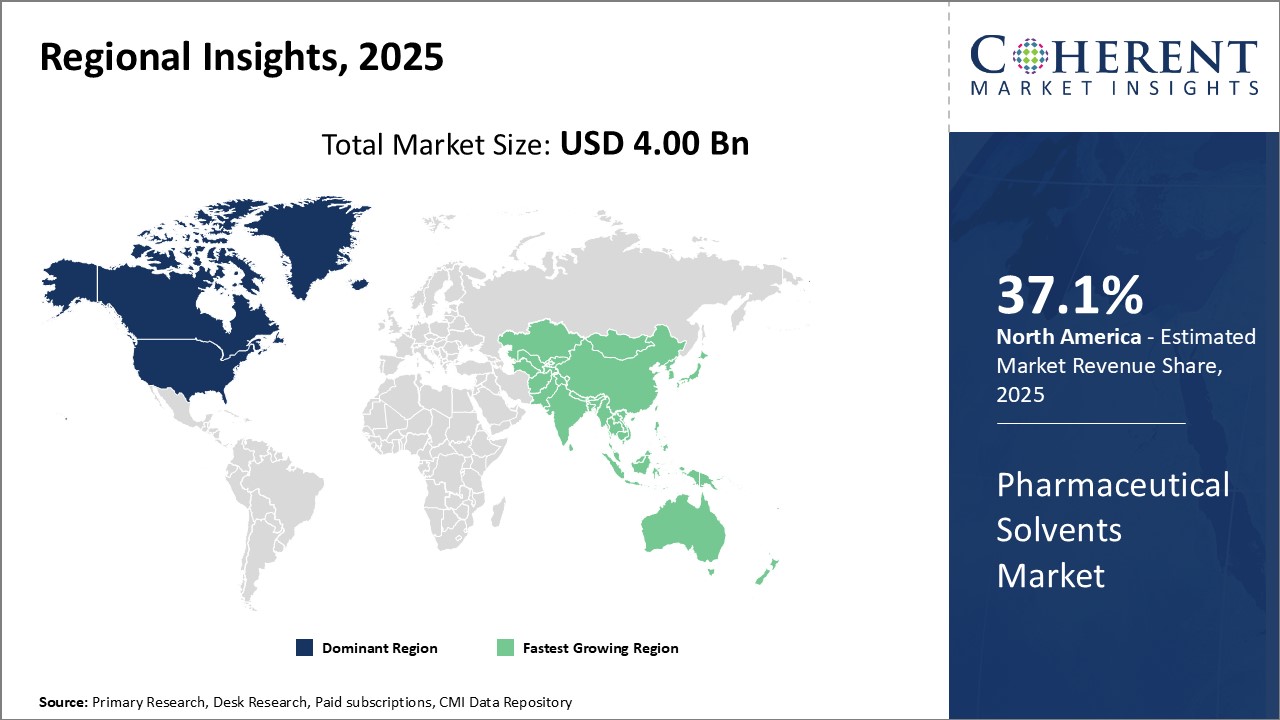
North America Pharmaceutical Solvents Market Trends
North America is poised to remain the dominant region in the global pharmaceutical solvents market. The region is expected to capture 37.1% of the total market share in 2026. This leadership position is largely driven by the presence of a well-established pharmaceutical industry, particularly in the U.S. and Canada. The pharmaceutical industry is the United States is estimated to be USD 602.19 billion in 2023, and USD 48.62 billion in Canada. The region boasts numerous major pharmaceutical companies that rely heavily on solvents for the production of active pharmaceutical ingredients (APIs) and formulations. Additionally, the increasing focus on research and development, coupled with significant investments in biopharmaceuticals, further fuels the demand for high-quality solvents. Moreover, stringent regulatory standards governing drug quality and safety necessitate the use of compliant and effective solvents, enhancing their market relevance. The growing trend towards sustainable and green chemistry also influences manufacturers to innovate and adopt eco-friendly solvent alternatives, positioning North America at the forefront of these advancements. This is further expected to pharmaceuticals solvents market growth.
Asia Pacific Pharmaceutical Solvents Market Trends
The Asia Pacific region has emerged as the fastest growing market for pharmaceutical solvents in recent times on account of increasing production of pharmaceutical formulations. Countries like India, China, Japan, and South Korea are major global suppliers of generic drugs and active pharmaceutical ingredients. This has spurred huge investments by international as well as local players to construct or expand manufacturing plants. For Instance, in 2024, South Korea allocated 5.2% of its GDP to R&D, whilst China and Japan committed 2.4% and 3.3% respectively. Governments in developed countries such as Mainland China, Japan, and South Korea are increasing investments to foster an innovative life sciences ecosystem.
The presence of large patient pools also motivates drug companies to boost local production of medicines. Additionally, Asia Pacific governments are promoting the life sciences sector through business-friendly policies and incentives. Rising incomes in developing nations have also enhanced people's access to healthcare and medications. These factors have significantly augmented the requirement for pharmaceutical ingredients and production chemicals including solvents.
United States Pharmaceutical Solvents Market Trends
The United States is gaining continuous popularity towards pharmaceutical solvents. The primary drivers are committed innovation in the nation and stringent regulatory environments which boosts the market growth. The U.S. is a home for major players in the global pharmaceutical market, with a significant number of pharmaceutical companies and research institutions. There is an establishment of 1,296 manufacturers, contributing 20-40% of the total market, 45% of global pharmaceutical sales and 22% of global production. Along with the Unites States leads the pharmaceutical research and development, driving the need for solvents in drug discovery and formulation processes. In 2024, the Unites States spent over USD 96 billion on R&D. This is further expected to pharmaceuticals solvents market demand in United States.
China Pharmaceutical Solvents Market Trends
China is the leading country in pharmaceutical solvents market from Asia pacific region. The country captures a significant market size and shares in the global market. The largest shares from China are due to the rapid growing pharmaceutical industry. China is considered as the second-largest pharmaceutical market, after the United STATES. In 2026, the China market is expected to reach USD 125.05 billion. China has the largest population and increasing demand for medication. According to World Health Organization (WHO), the pharmaceutical industry in China is spent approximately 30% of the total health expenditure in 2018. By the end of 2023, there were 896,000 current register drug consumers in China, which is further accelerating pharmaceuticals solvents market share.
Pharmaceutical Solvent Market Trends
- Sustainability and Regulatory Shifts: The pharmaceutical solvent industry is experiencing a gradual shift driven by sustainability goals and evolving regulatory frameworks. The adoption of green chemistry practices is the key trend for companies increasingly focusing on solvent recycling and development of high-purity formulations. This aim is to minizine the environmental impacts while reducing operational costs.
- Aging population: The global aging population is poised to significantly influence the pharmaceutical demands in the coming decade. According to the World Health Organization (WHO), the number of individual aged 60 and above is expected to reach 2.1 billion by 2050, marking it a drastic demographic shift. The increasing aging population are directly associated by higher prevalence of chronic conditions such as cardiovascular disease, diabetes, arthritis, and neurodegenerative disorders, all which required a long-term pharmacological intervention.
Pharmaceutical solvents Market Driver - Increasing demand for pharmaceutical products globally
With the growing global population and rising healthcare needs, the demand for pharmaceutical products has increased tremendously over the past few decades. For instance, according to data by National Library of Medicine, as of 2025, the global population is approximately 8.1 billion, having grown from 7.8 billion in mid-2020 and 7 billion in 2010. This growth reflects an annual increase of about 83 million, or 1.1% per year. Key factors driving this growth in demand include the aging population, rise of chronic and lifestyle-related diseases, improving access to medicines in developing markets, and growing affordability of drugs.
A much larger and aging global population means there are higher patients and cases of various illnesses that require medical treatment. Diseases related to old age such as cancer, cardiovascular conditions, and diabetes are on the rise worldwide. At the same time, lifestyle changes and lack of physical activity have led to sharp growth in cases of obesity, hypertension and other non-communicable diseases across both developed and developing nations.
Pharmaceutical Solvent Market Restraints - Stringent regulations regarding the use of solvents
Pharmaceutical solvents market has been facing stringent regulations regarding the use of certain solvents. Many regulatory bodies across the globe are emphasizing on minimizing or eliminating the use of hazardous solvents during the drug manufacturing process. This is posing a major challenge to the manufacturers as they aim to identify substitutes for those solvents. The process of identifying green alternatives and validating them as per the regulatory standards is expensive and time consuming. Moreover, changing the existing manufacturing procedures according to the solvent substitution requires huge capital investments. This regulatory pressure is further intensified by the rising environmental and health concerns associated with the use of toxic organic solvents. The manufacturers need to comply with diverse regulatory frameworks across different markets, which makes compliance a complex task. All these factors associated with changing regulatory landscape are restricting the growth prospects of many players operating in the pharmaceutical solvents market.
Pharmaceutical Solvents Market Opportunity - Development of green and sustainable solvents
The growing emphasis on the development of green and sustainable technologies across industries provides a huge market opportunity for participants in the pharmaceutical solvents market. Rising environmental awareness and stringent norms are driving the manufacturers to focus on innovating bio-based and eco-friendly solvent alternatives. For instance, in December 2024, Ecosigns introduced a revolutionary material that promises to reshape industry standards for recyclability and environmental sustainability. This pioneering material is the first of its kind, fully recyclable and compatible with a wide range of printing technologies, including eco-solvent, solvent, UV, and latex printers. The market is witnessing significant innovations in the area of green solvents which include alcohol, glycols, supercritical CO2 technology, and ionic liquids. The adoption of these green solvent technologies helps pharmaceutical companies gain a competitive edge by enabling regulatory compliance and enhancing sustainability credentials. It also improves their brand image significantly.
Pharmaceutical Solvents Market Report Coverage
| Report Coverage | Details | ||
|---|---|---|---|
| Base Year: | 2025 | Market Size in 2026: | USD 4.24 Bn |
| Historical Data for: | 2020 To 2024 | Forecast Period: | 2026 To 2033 |
| Forecast Period 2026 to 2033 CAGR: | 5.9% | 2033 Value Projection: | USD 6.33 Bn |
| Geographies covered: |
| ||
| Segments covered: |
| ||
| Companies covered: | BASF SE, Dow Chemical Company, Merck Group, Eastman Chemical Company, Solvay S.A., Huntsman Corporation, LyondellBasell Industries N.V., Evonik Industries AG, Ashland Global Holdings Inc., INEOS Group Limited, Sigma-Aldrich (Merck KGaA), Mitsubishi Gas Chemical Company, Inc., Shell Chemicals, Arkema S.A., Tosoh Corporation, Afton Chemical Corporation, Clariant AG, Kuraray Co., Ltd., Albemarle Corporation, and KMG Chemicals | ||
| Growth Drivers: |
| ||
| Restraints & Challenges: |
| ||
Pharmaceutical Solvents Industry News
- In April 2025, AustinPx launched the KinetiLease™ program, allowing pharmaceutical companies to lease its KinetiSol™ research-scale equipment for enhancing bioavailability in their R&D labs.
- In December 2024, Veolia Water Technologies introduced its mobile water services for the pharmaceutical, cosmetics, and life sciences sectors across Europe. This offering includes a complete suite of technologies and services, available as a rental, designed to provide reliable, continuous, and sustainable solutions for manufacturing, cleaning, and the management of complex liquid waste offsite in compliance with industry standards.
- In June 2024, Aurorium, a manufacturer of specialty ingredients and materials innovation partner, announced the introduction of Haelium Pharmaceutical Solutions.
- In September 2023, BASF, a chemical company, launched a new line of bio-based solvents for pharmaceutical applications. This innovative product range is derived from renewable resources, making it a more sustainable alternative to traditional petroleum-based solvents. By offering bio-based solvents, BASF demonstrates its commitment to developing eco-friendly solutions that support the pharmaceutical industry's efforts to reduce its environmental impact while maintaining high standards of quality and safety. This launch positions BASF as a leader in providing innovative and sustainable solutions for the pharmaceutical sector.
- In July 2023, Eastman Chemical a chemical company, expanded its production capacity for specialty solvents. This strategic move is aimed at meeting the growing demand for high-performance solvents across various industries, including coatings, adhesives, and personal care. By increasing its production capabilities, Eastman Chemical reinforces its commitment to delivering innovative and sustainable solutions while enhancing its competitive position in the specialty chemicals market. This expansion is expected to support customers with a reliable supply of quality solvents tailored to their specific needs.
Analyst Opinion (Expert Opinion)
- Pharmaceutical solvents market is poised to grow at a steady pace over the forecast period driven by higher drug research and development activities. Growing prevalence of chronicdiseases and increasing demand for sophisticated drugs will fuel the demand for various solvents used across primary and secondary purification and crystallization applications. Further, intensifying regulatory approvals for drugs and strong pipeline of complex generics are anticipated to propel the consumption of solvents in pharmaceutical manufacturing.
- However, stringent regulatory norms pertaining to emissions and environmental protection, especially in North America and Europe may challenge market participants to some extent. These regulations curtail the usage of toxic and hazardous solvents thus compelling firms to invest in alternatives. Nonetheless, developing versions that address regulatory compliances without affecting process efficiency presents lucrative opportunities for solvent suppliers.
- Among regions, North America currently dominates the region, while Europe currently capture substantial shares of the global pharmaceutical solvents market owing to high R&D expenditures and the presence of major pharmaceutical companies. However, the Asia Pacific region is expected to witness the fastest gains and emerge as the new hotspot over the coming years. This can be accredited to low-cost manufacturing environment, increasing foreign investments, and rising generic drug production in China and India. Moreover, growing healthcare spending of the large consumer base and improving digital connectivity will further augment regional demand.
Speak to the analyst
Want personalized insights?
Take the findings above to one of our principal consultants, or have the report rebuilt around the segments, geographies and competitors you actually track.
Market Segmentation
- Type Insights
- Alcohols
- Amines
- Aromatic Hydrocarbons
- Chlorinated Solvents
- Others
- Application Insights
- Active Pharmaceutical Ingredients (APIs)
- Formulations
- Research & Development
- Others
- Regional Insights
- North America
- U.S.
- Canada
- Latin America
- Brazil
- Argentina
- Mexico
- Rest of Latin America
- Europe
- Germany
- U.K.
- Spain
- France
- Italy
- Russia
- Rest of Europe
- Asia Pacific
- China
- India
- Japan
- Australia
- South Korea
- ASEAN
- Rest of Asia Pacific
- Middle East
- GCC Countries
- Israel
- Rest of Middle East
- Africa
- South Africa
- North Africa
- Central Africa
- North America
- Key Players Insights
- BASF SE
- Dow Chemical Company
- Merck Group
- Eastman Chemical Company
- Solvay S.A.
- Huntsman Corporation
- LyondellBasell Industries N.V.
- Evonik Industries AG
- Ashland Global Holdings Inc.
- INEOS Group Limited
- Sigma-Aldrich (Merck KGaA)
- Mitsubishi Gas Chemical Company, Inc.
- Shell Chemicals
- Arkema S.A.
- Tosoh Corporation
- Afton Chemical Corporation
- Clariant AG
- Kuraray Co., Ltd.
- Albemarle Corporation
- KMG Chemicals
Sources:
Primary Research Interviews from the following stakeholders:
Stakeholders:
- Interviews with chemical engineers, pharmaceutical formulation scientists, process development experts, and regulatory affairs specialists focused on pharmaceutical manufacturing and excipient selection.
- Specific stakeholders: Organic chemists, pharmacologists, quality assurance managers, manufacturing plant supervisors, and environmental health and safety officers in pharmaceutical production.
Databases:
- PubChem
- PubMed
- TOXNET
- DrugBank
Magazines:
- Chemical & Engineering News
- Pharmaceutical Technology
- PharmaTimes
- Pharma Manufacturing
Journals:
- International Journal of Pharmaceutics
- Journal of Pharmaceutical Sciences
- European Journal of Pharmaceutical Science
- Chemical Reviews
Newspapers:
- The Wall Street Journal
- The Financial Times
- The New York Times
- The Guardian
- Nikkei Asia
Associations:
- International Pharmaceutical Excipients Council (IPEC)
- American Chemical Society (ACS)
- International Society for Pharmaceutical Engineering (ISPE)
- European Medicines Agency (EMA)
- U.S. Pharmacopeia (USP)
Public Domain Sources:
- U.S. Food and Drug Administration (FDA)
- European Medicines Agency (EMA)
- World Health Organization (WHO)
- National Institutes of Health (NIH)
- Occupational Safety and Health Administration (OSHA)
Proprietary Elements:
- CMI Data Analytics Tool, and Proprietary CMI Existing Repository of information for last 8 years
*Definition: The pharmaceutical solvents market consists of various organic chemical solvents that are used in manufacturing, processing and purification steps of pharmaceutical drugs and medications. These solvents help in dissolving, extracting, purifying and crystallizing active pharmaceutical ingredients during pharmaceutical R&D and manufacturing. Some common pharmaceutical solvents include ethanol, methanol, acetone, isopropanol, ketones, chloroform, ethyl acetate and dichloromethane.
Get access to 250+ pages report
Every segment, forecast, competitor profile and data table behind the analysis above — available for instant download.
- ESOMAR Member
- ISO 9001:2015 Certified
- D-U-N-S Registered
- GDPR & CCPA Compliant
Missing comfort of reading report in your local language? Find your preferred language:
Transform your Strategy with Exclusive Trending Reports
Frequently Asked Questions
The Pharmaceutical Solvents Market is estimated to be valued at USD 4.24 Bn in 2026, and is expected to reach USD 6.33 Bn by 2033.
The CAGR of the Pharmaceutical Solvents Market is projected to be 5.9% from 2026 to 2033.
Increasing demand for pharmaceutical products globally and growth in the biopharmaceutical sector are the major factors driving the growth of the pharmaceutical solvents market.
Stringent regulations regarding the use of solvents and fluctuating raw material prices are the major factors hampering the growth of the pharmaceutical solvents market.
In terms of type, alcohols is estimated to dominate the market revenue share in 2026.
BASF SE, Dow Chemical Company, Merck Group, Eastman Chemical Company, Solvay S.A., Huntsman Corporation, LyondellBasell Industries N.V., Evonik Industries AG, Ashland Global Holdings Inc., INEOS Group Limited, Sigma-Aldrich (Merck KGaA), Mitsubishi Gas Chemical Company, Inc., Shell Chemicals, Arkema S.A., Tosoh Corporation, Afton Chemical Corporation, Clariant AG, Kuraray Co., Ltd., Albemarle Corporation, and KMG Chemicals are the major players.
North America is expected to lead the pharmaceutical solvents market in 2026.