

Sodium Sulfide Market Size and Forecast — 2026-2033
The sodium sulfide market is estimated to be valued at USD 680.5 Mn in 2026 and is expected to reach USD 919.9 Mn by 2033, exhibiting a compound annual growth rate (CAGR) of 4.4% from 2026 to 2033.
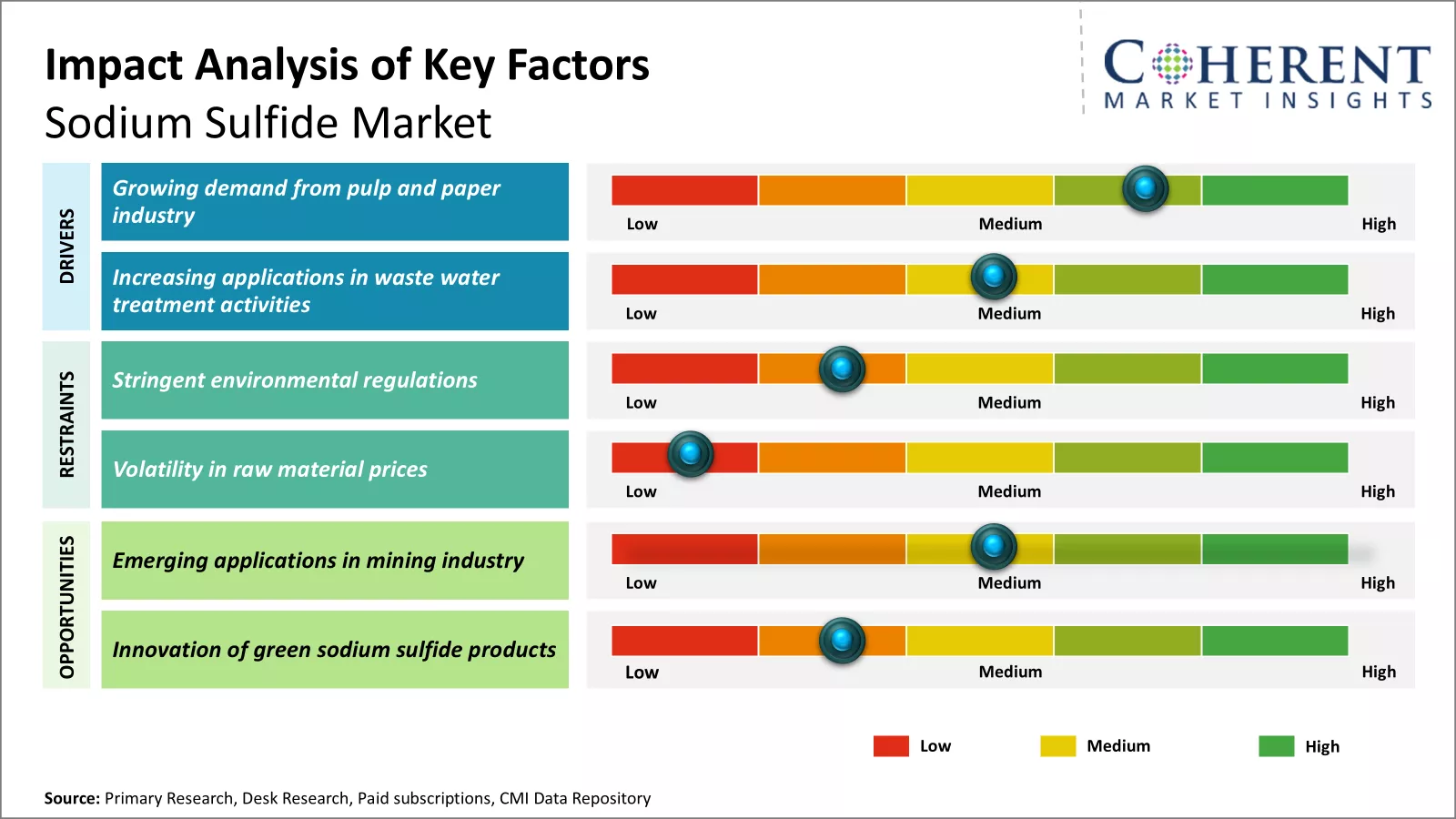
Sodium sulfide finds wide application in the pulp and paper, water treatment, mining, and tanning industries. It is used as a reagent in the kraft process for the delignification of wood. The market is expected to witness steady growth over the forecast period due to rising demand from the pulp & paper industry and wastewater treatment plants. Additionally, growth in the mining industry is driving the consumption of sodium sulfide.
Insights By Product
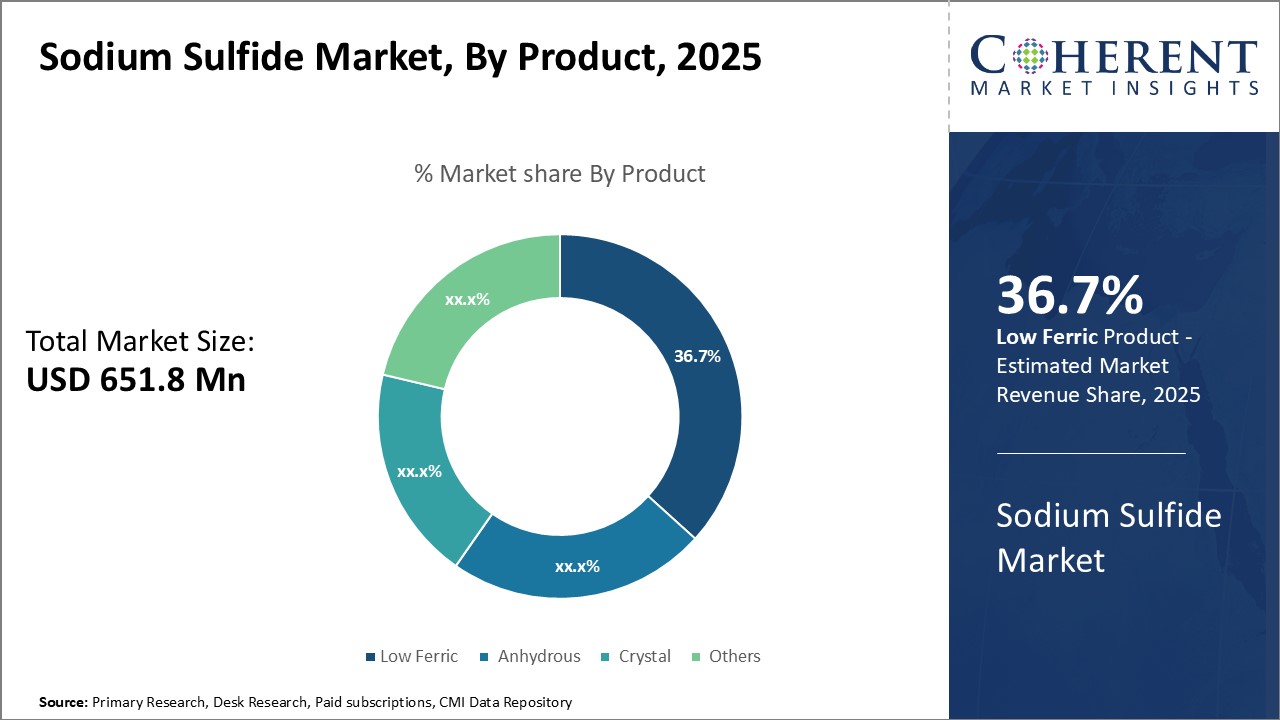
Insights By Product - Superior corrosion resistance drives the dominance of low ferric segment
In terms of product, low ferric segment is estimated to contribute the highest market share of 37.7% in 2026. Containing little to no ferrous iron impurities, low ferric sodium sulfide is crucial for applications where corrosion must be minimized such as in pulp and paper manufacturing. The alkaline conditions prevalent in papermaking would readily cause corrosion issues with conventional sodium sulfide grades containing higher iron levels.
Insights By Grade
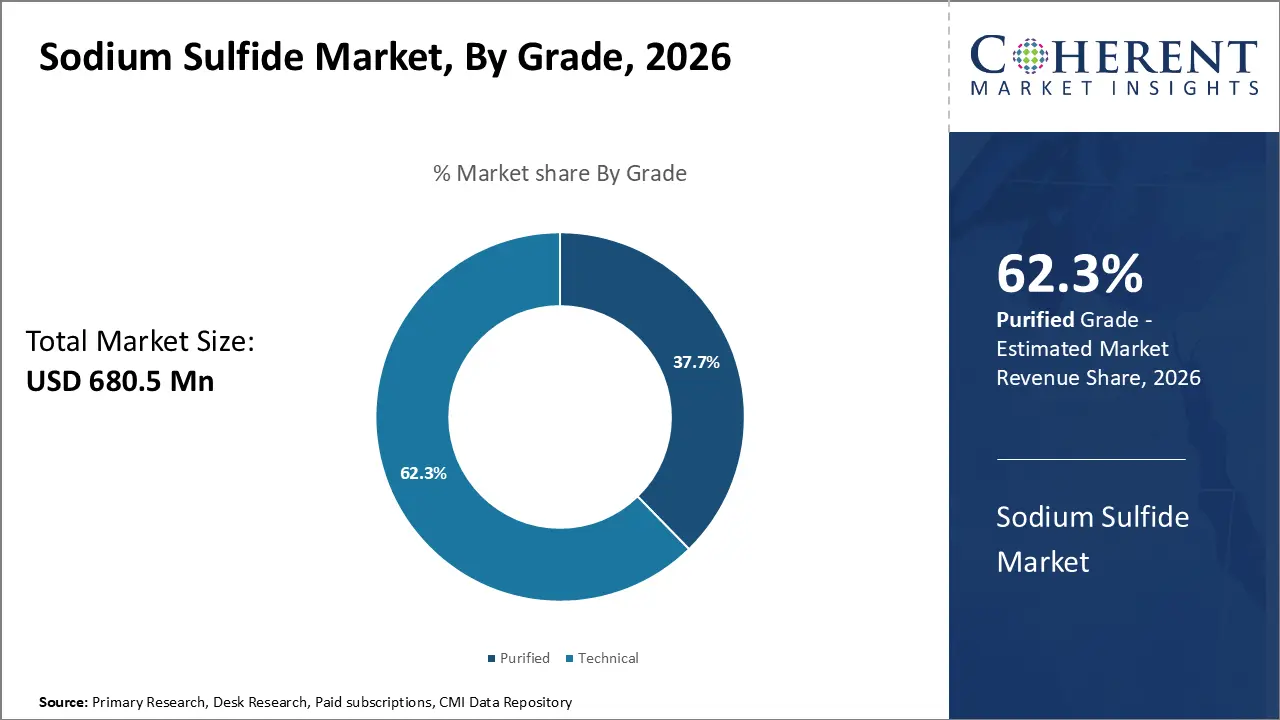
Insights By Grade - Superior purity and consistency drives the dominance of purified grade
In terms of grade, the purified segment is estimated to contribute the highest market share of 62.3% in 2026 due to its high purity and consistency in composition. Purified sodium sulfide undergoes more rigorous refinement than technical grade and minimizes impurities that could interfere with or compromise reactions and applications.
Insights By End-use Industry
Insights By End-use Industry - Integral role in pulping drives pulp and paper industry's dominance
In terms of end-use industry, pulp and paper industry segment is estimated to contribute the highest market share of 23.7% in 2026. As a delignifying agent, sodium sulfide is instrumental in separating lignin from cellulose fibers during both kraft and semichemical pulping methods. Its strong alkalinity and sulfide ions dissolve the lignin binding agents in wood biomass, liberating the pure cellulose suitable for papermaking.
Regional Insights
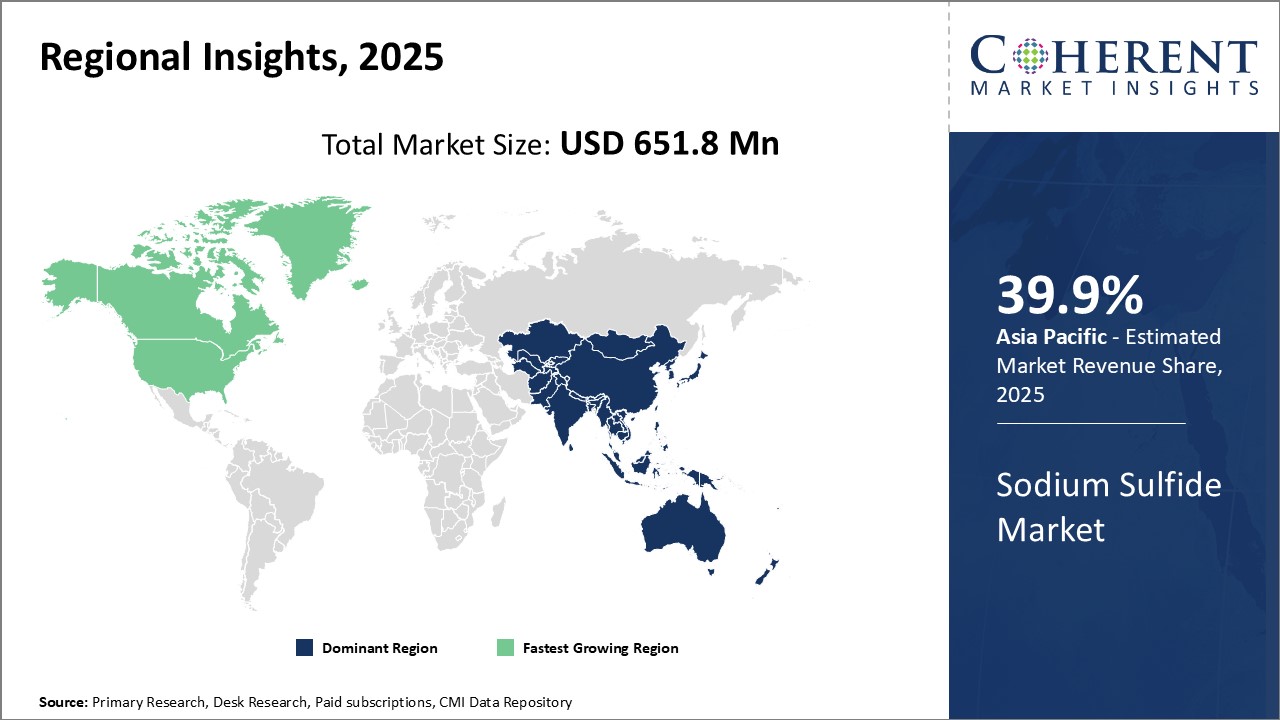
Regional Analysis:
Dominating Region: Asia Pacific
Asia Pacific is expected to dominate the market in 2026 with an estimated share of 39.9%. In Asia Pacific, the dominance in the sodium sulfide market can be attributed to the strong presence of key manufacturing companies and growing end-use industries such as pulp & paper, chemical processing, and water treatment.
Fastest-Growing Region: North America
The North America region exhibits the fastest growth, driven by a burgeoning manufacturing sector across countries like the U.S. and Canada. Rapid industrialization and expansion of key end-use industries such as pulp and paper and personal care have significantly boosted the sodium sulfide consumption.
Sodium Sulfide Market Outlook for Key Countries
Stable Growth Driven by Industrial Demand and Pulp & Paper Industry Expansion in the U.S.
The U.S. sodium sulfide market is dominated by major players with established production facilities. Steady demand from domestic end-use industries ensures stable market conditions. The market is particularly poised for sustainable growth due to rising industrial activities. As a major player in the paper industry, the U.S. has seen substantial growth in sodium sulfide consumption, particularly for pulp & paper processing.
Strong Manufacturing Output and Leather Industry Growth Drive Demand in China
China’s sodium sulfide market growth can be credited to strong manufacturing output and favorable government policies promoting industrial and infrastructure development. As a major player in the leather industry, China has seen substantial growth in sodium sulfide consumption, particularly for leather tanning and processing.
India’s Strong Economic Growth and Rising Industrial Investment
India continues to lead in the Asia Pacific region due to strong economic growth and rising investments in end-use sectors. India benefits from abundant raw material reserves and a significant cattle population, making it a key player in the leather industry. The market in India is expected to grow as the leather sector expands, providing employment and economic benefits.
Japan’s Market Grows with Export Strength and Opportunities in Pulp & Paper and Packaging Industries
Japan sodium sulfide market is mature with limited future potential. However, key Japanese companies contribute significantly to global supply through exports. Japan is a significant exporter of paper and packaging products, particularly to neighboring Asian countries and Western markets. It has a competitive edge due to its highly integrated supply chain, which includes everything from pulp production to paper manufacturing. Japanese companies such as Oji Holdings and Nippon Paper Industries leaders in exporting high-quality products, including tissue and packaging paper.
Market Players, Key Development, and Competitive Intelligence
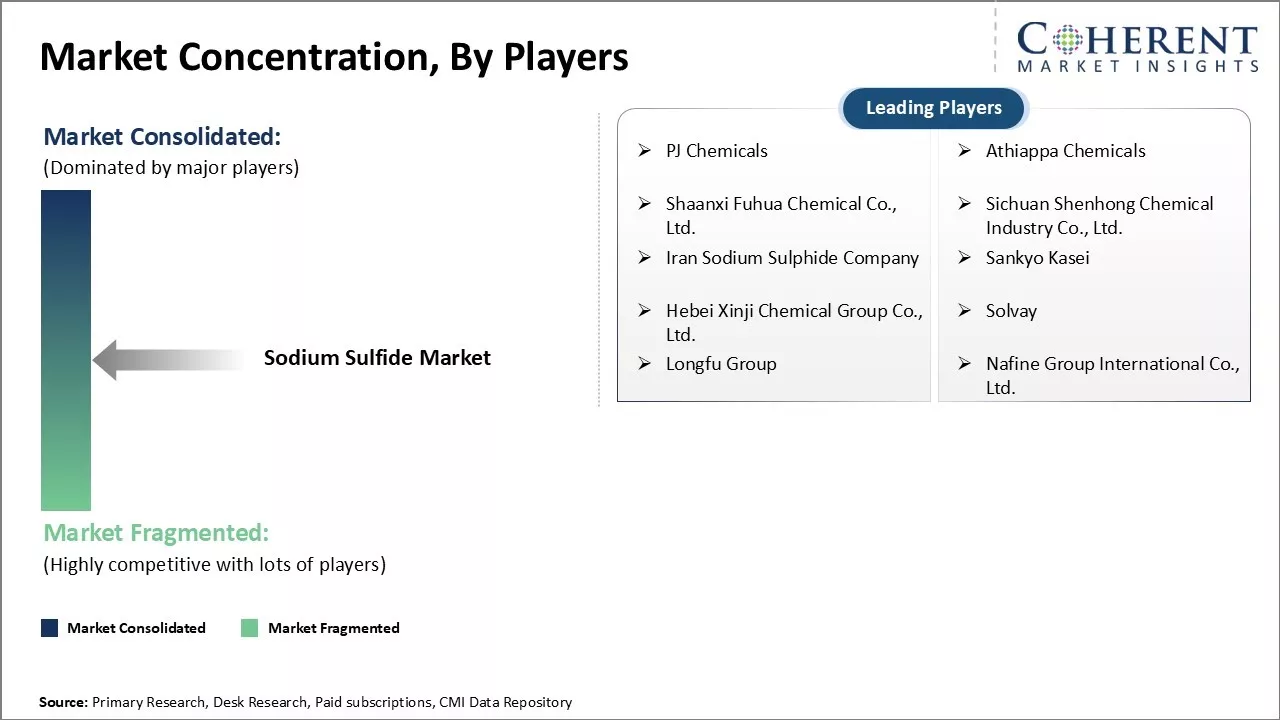
Top Strategies Followed by Sodium Sulfide Market Players
- Established players heavily focus on research and development to stay ahead in the industry. Companies like Haisheng Industry invest over 10% of annual revenue towards innovating products with improved performance characteristics. They routinely file new patents and collaborate with universities on cutting-edge materials research.
- Mid-level players companies compete on cost while maintaining quality. Production facilities in low-cost regions allow Orange Chemical to offer sodium sulfide at competitive bulk pricing. It partners with local recyclers to lower material costs further. Large corporations also form strategic partnerships to expand globally. For example, Enamine has supply agreements with distributors across North America, Europe, and Asia Pacific to access new markets. They provide private label manufacturing for major retailers and brand owners.
- Small-scale players fill specialized market niches. American Elements focuses on niche applications in the electronics and biotech sectors. They customize sodium sulfide grades for these specialized industrial processes.
Emerging Startups in the Sodium Sulfide Market
Several startups are developing innovative technologies to disrupt the industry. Anthropic uses AI to automate sodium sulfide synthesis, reducing waste and improving yields for manufacturers. Their system analyzes massive datasets to optimize chemical reactions.
RePlas focuses on sustainability with a process to produce sodium sulfide from recycled plastics. They are scaling production and collaborating with major oil companies to commercialize the technology. If adopted widely, it could eliminate plastic waste from landfills.
Other startups target niche segments underserved by large firms. Cambrios produces small volumes of ultra-pure sodium sulfide needed for quantum computing and next-gen batteries. They fill critical research needs, contributing to emerging technologies. Grants from government agencies allow ThioChem to develop novel thio-based materials.
- Current Industry Events of 2026
- Market Size Estimation
- Regional Breakdown
- Competitive Landscape
- Customer Intelligence
- Segmental Analysis
- Pricing Analysis
- Key Market Drivers, Challenges & Future Trends
- Customized Insights Section
Market Report Scope
Sodium Sulfide Market Report Coverage
| Report Coverage | Details | ||
|---|---|---|---|
| Base Year: | 2025 | Market Size in 2026: | USD 680.5 Mn |
| Historical Data for: | 2020 To 2024 | Forecast Period: | 2026 To 2033 |
| Forecast Period 2026 to 2033 CAGR: | 4.4% | 2033 Value Projection: | USD 919.9 Mn |
| Geographies covered: |
| ||
| Segments covered: |
| ||
| Companies covered: | PJ Chemicals, Athiappa Chemicals, Shaanxi Fuhua Chemical Co., Ltd., Sichuan Shenhong Chemical Industry Co., Ltd., Iran Sodium Sulphide Company, Sankyo Kasei, Hebei Xinji Chemical Group Co., Ltd., Solvay, Longfu Group, and Nafine Group International Co., Ltd. | ||
| Growth Drivers: |
| ||
| Restraints & Challenges: |
| ||
Market Dynamics
Market Driver - Growing demand from pulp and paper industry
The pulp and paper industry has been a major end-use sector for sodium sulfide over the past few decades. As paper consumption increases globally due to rising population and economic growth, particularly in emerging markets, the demand for wood pulp from the paper industry is also growing. According to data from Food and Agriculture Organization (FAO) of the United Nations reported in 2020, global paper consumption increased from 360million tons to around 430 million tons in 2021.
Market Challenge - Stringent environmental regulations
Stringent environmental regulations across various regions pose a major challenge for this market. Sodium sulfide is mainly used in the paper and pulp industry, where it acts as a reagent in the kraft process to dissolve lignin from the wood. According to data from the United Nations Environment Programme released in 2023, over 50% of chemical companies reported logistical challenges and delayed clearances due to dynamic environmental policies from 2020-2022.
Market Opportunity - Emerging applications in mining industry
The emergence of new applications for sodium sulfide in the mining industry presents lucrative growth opportunities for market players. The International Copper Study Group reported in 2021 that the worldwide copper mine production increased by 5% from 2020 to 2021 and is projected to maintain an upward trend in the coming years to meet the rising requirement of copper in green technologies and infrastructure development.
Analyst Opinion (Expert Opinion)
Key Takeaways from Analyst
One of the key drivers for the market will be growth in paper and pulp industry. Sodium sulfide is used as a de-inking agent and for bleaching of paper which will drive its demand with expected rise in paper production globally. Another growth opportunity can come from water treatment applications. Many regions and countries are focusing on clean drinking water facilities which will drive the use of sodium sulfide as a dechlorinating and detoxifying agent.
Regionally, Asia Pacific currently dominates this market and is expected to continue its leadership position during the forecast years. This can be attributed to large paper production capacities and growth in mining industry across China, India, and other Asian countries. Within Asia Pacific, China is likely to remain the fastest growing and largest consumer of sodium sulfide.
Speak to the analyst
Want personalized insights?
Take the findings above to one of our principal consultants, or have the report rebuilt around the segments, geographies and competitors you actually track.
Market Segmentation
- Product Insights (Revenue, USD Mn, 2021 - 2033)
- Low Ferric
- Anhydrous
- Crystal
- Others
- Grade Insights (Revenue, USD Mn, 2021 - 2033)
- Purified
- Technical
- End-use Industry Insights (Revenue, USD Mn, 2021 - 2033)
- Pulp and Paper Industry
- Water Treatment Industry
- Chemical Industry
- Textile Industry
- Leather Industry
- Others
- Regional Insights (Revenue, USD Mn, 2021 - 2033)
- North America
- U.S.
- Canada
- Latin America
- Brazil
- Argentina
- Mexico
- Rest of Latin America
- Europe
- Germany
- U.K.
- Spain
- France
- Italy
- Russia
- Rest of Europe
- Asia Pacific
- China
- India
- Japan
- Australia
- South Korea
- ASEAN
- Rest of Asia Pacific
- Middle East
- GCC Countries
- Israel
- Rest of Middle East
- Africa
- South Africa
- North Africa
- Central Africa
- North America
- Key Players Insights
- PJ Chemicals
- Athiappa Chemicals
- Shaanxi Fuhua Chemical Co., Ltd.
- Sichuan Shenhong Chemical Industry Co., Ltd.
- Iran Sodium Sulphide Company
- Sankyo Kasei
- Hebei Xinji Chemical Group Co., Ltd.
- Solvay
- Longfu Group
- Nafine Group International Co., Ltd.
Get access to 250+ pages report
Every segment, forecast, competitor profile and data table behind the analysis above — available for instant download.
- ESOMAR Member
- ISO 9001:2015 Certified
- D-U-N-S Registered
- GDPR & CCPA Compliant
Missing comfort of reading report in your local language? Find your preferred language:
Transform your Strategy with Exclusive Trending Reports
Frequently Asked Questions
The Sodium Sulfide Market is estimated to be valued at USD 680.5 Mn in 2026, and is expected to reach USD 919.9 Mn by 2033.
The CAGR of the Sodium Sulfide Market is projected to be 4.4% from 2026 to 2033.
Growing demand from pulp and paper industry and increasing application in waste water treatment activities are the major factors driving the market growth of sodium sulfide.
Stringent environmental regulations and volatility in raw material prices are the major factors hampering the market growth of sodium sulfide.
In terms of product, low ferric segment is estimated to dominate the market revenue share in 2026.
PJ Chemicals, Athiappa Chemicals, Shaanxi Fuhua Chemical Co., Ltd., Sichuan Shenhong Chemical Industry Co., Ltd., Iran Sodium Sulphide Company, Sankyo Kasei, Hebei Xinji Chemical Group Co., Ltd., Solvay, Longfu Group, and Nafine Group International Co., Ltd. are the major players.
Asia Pacific is expected to lead the sodium sulfide market in 2026.