

Process Oil Market Size and Forecast — 2026 - 2033
The Global Process Oil Market size is estimated to be valued at USD 7.58 billion in 2026 and is expected to reach USD 11.94 billion by 2033, exhibiting a compound annual growth rate (CAGR) of 7.4% from 2026 to 2033.
Overview
The Process Oil market includes a wide range of petroleum-derived and synthetic oils used as processing aids in rubber, tire, polymer, textile, and chemical manufacturing. Key product types include naphthenic, paraffinic, and aromatic process oils, each offering different viscosity, solvency, and compatibility characteristics. Naphthenic oils are widely used in tire and rubber applications due to good low-temperature performance, while paraffinic oils are preferred for their stability and low volatility. Aromatic oils provide strong solvency but face regulatory restrictions in some regions. Increasing demand for high-performance tires, plastics, and eco-friendly formulations is driving product innovation, including low-PAH and bio-based process oils.
Key Takeaways
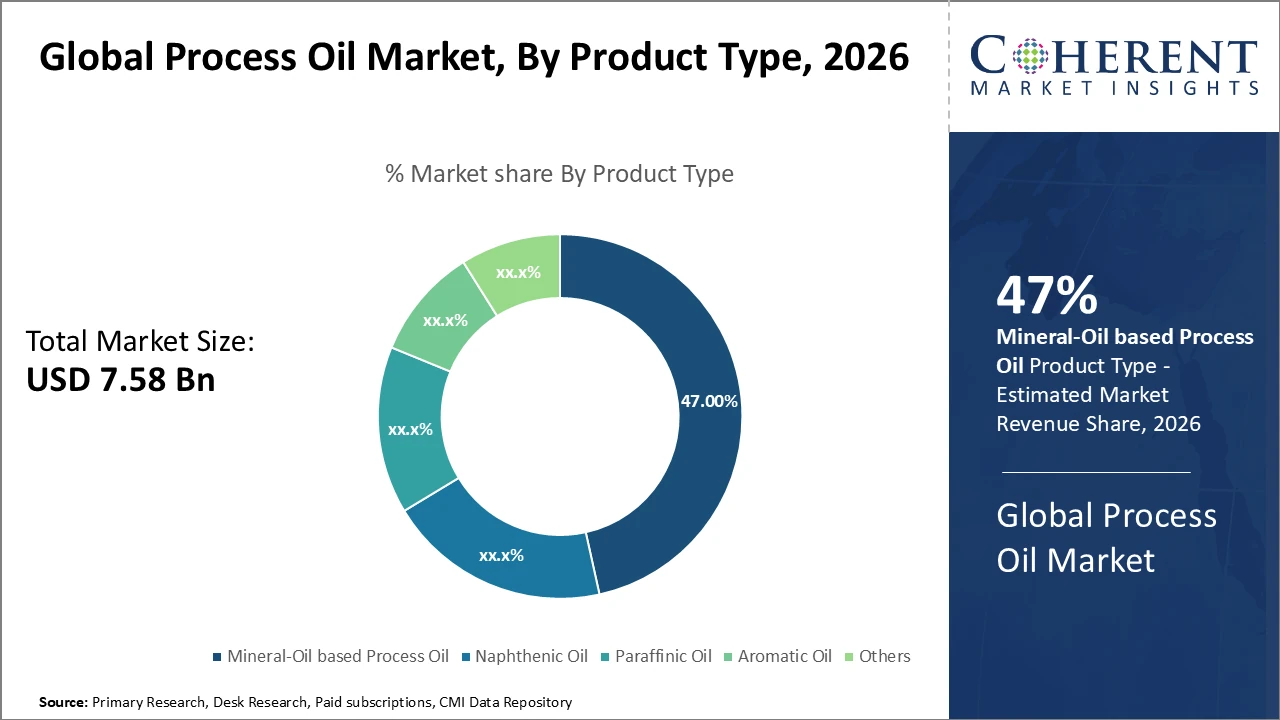
The mineral oil-based process oil segment holds the largest market share, supported by strong demand from tire and rubber manufacturing industries.
The rubber industry application dominates the market, accounting for over 40% share due to automotive production growth and tire replacement demand.
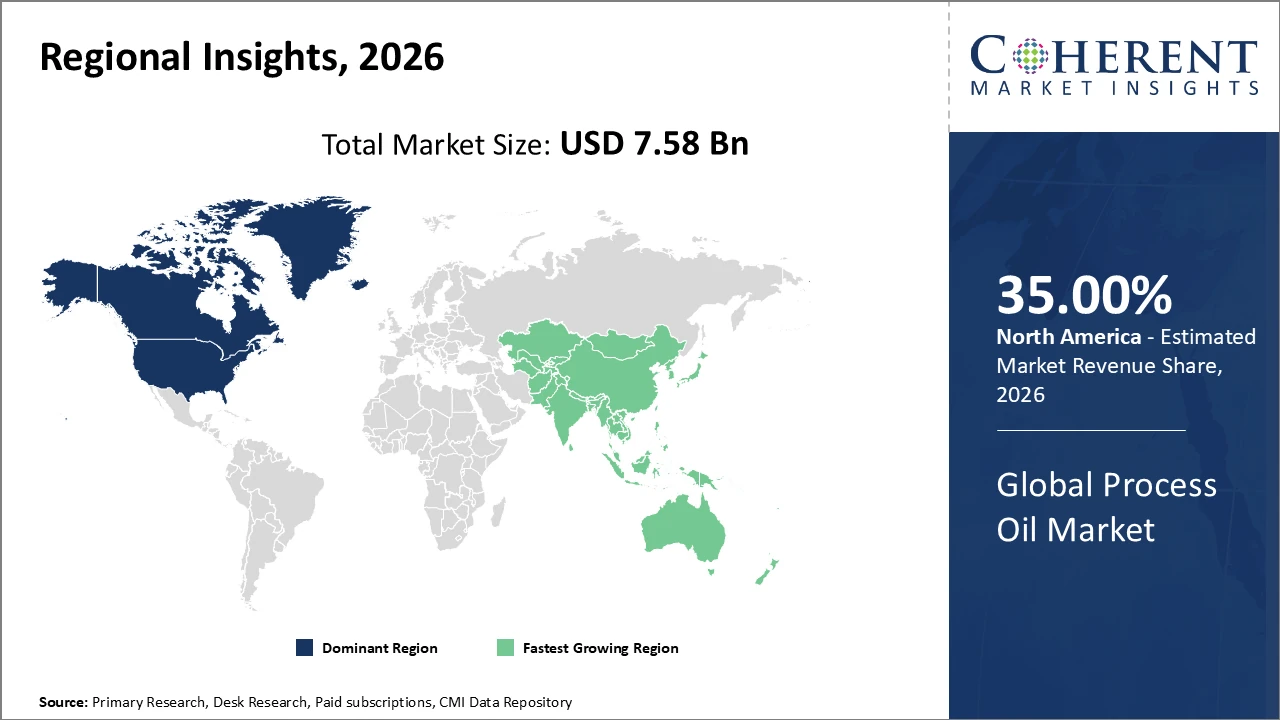
North America leads in processing capacity and technological advancement, contributing significantly to overall revenue generation.
Asia Pacific is the fastest-growing region, driven by rapid industrialization, expanding polymer industries, and rising import dependency.
Process Oil Market Segmentation Analysis
Process Oil Market Insights, By Product Type
Mineral Oil-Based Process Oil dominates the market with a 47% share due to its wide applicability and cost-effectiveness in tire and rubber industries. Its strong chemical stability and compatibility make it the preferred choice for large-scale industrial use. Naphthenic oil is the fastest-growing segment, driven by superior solvency, low-temperature performance, and increasing demand in specialty rubber formulations. Paraffinic and aromatic oils hold smaller shares but remain important for specific applications such as polymers, adhesives, and industrial processing. Other process oils, including customized blends, are emerging to meet evolving performance, sustainability, and application-specific requirements across various end-use industries.
Process Oil Market Insights, By Application
The Rubber Industry segment leads the process oil market with a 42% share, driven by rising automotive production and strong replacement tire demand worldwide. Increasing requirements for improved tire performance, including fuel efficiency, durability, and reduced rolling resistance, further support demand. Plastics & Polymers represent the fastest-growing segment due to growing use of process oils as plasticizers and processing aids in packaging and construction applications. Paints & Coatings and Adhesives & Sealants contribute steadily but show moderate growth compared to core segments. Other applications, including printing inks and industrial lubricants, account for niche demand across specialized industrial uses.
Process Oil Market Insights, By Grade
Technical grade process oils hold the dominant market share due to their widespread use in rubber, polymer manufacturing, and automotive industries. Their balanced performance and cost-effectiveness make them suitable for large-scale industrial applications. Food grade process oils are the fastest-growing segment, driven by stricter regulatory standards and rising demand in food packaging and pharmaceutical machinery, supported by increased investments in safety and compliance. Pharmaceutical grade oils and other specialty grades account for smaller shares but are steadily growing, driven by requirements for high purity, quality assurance, and traceability in sensitive applications across healthcare and niche industrial sectors.
Process Oil Market Trends
The market is shifting toward sustainable and low-impact process oils due to stricter environmental regulations, including Europe’s 2025 restrictions on aromatic content.
Digitalization in supply chain and inventory management is improving efficiency, reducing lead times, and enhancing responsiveness, especially among North American players like ExxonMobil and Chevron.
Rising demand for specialty process oils in emerging applications such as electric vehicle components and advanced polymer composites is driving new growth opportunities.
Process Oil Market Insights, By Geography
North America Process Oil Market Analysis and Trends
North America holds a leading position in the Process Oil market, accounting for approximately 35% of the global share. This dominance is largely driven by strong automotive and tire manufacturing industries in the United States, which create consistent demand for high-quality process oils. The region also benefits from advanced refining technologies and early adoption of sustainable, low-PAH formulations. The presence of major industry players such as ExxonMobil and Chevron further strengthens market stability through large-scale production capacity and efficient supply chains. Continuous innovation and regulatory compliance initiatives continue to support steady revenue growth across the North American market.
Asia Pacific Process Oil Market Analysis and Trends
Asia Pacific is the fastest-growing region in the Process Oil market, registering a CAGR of over 9% from 2026 to 2033. Growth is driven by rapid industrialization, strong expansion of rubber and polymer industries, and rising demand for specialty oils. Increasing imports further support supply requirements as domestic consumption outpaces production capacity. Government initiatives promoting manufacturing growth, along with rising foreign direct investment, are strengthening market development in countries such as China and India. Additionally, global and regional players are expanding refining capacities and distribution networks, enhancing availability and supporting sustained market expansion across the region.
Process Oil Market Outlook for Key Countries
USA Process Oil Market Analysis and Trends
The USA plays a dominant role in the Process Oil market, contributing significantly to North America’s overall market volume. The country benefits from advanced refining infrastructure, reliable access to raw materials, and a highly integrated manufacturing ecosystem. Major companies such as Chevron Phillips Chemical and ExxonMobil have expanded specialty process oil production capacities, strengthening product portfolios for automotive and polymer applications. In 2025, the USA recorded a 7% year-over-year increase in process oil consumption within the rubber industry, driven by strong tire production and replacement demand. This steady growth continues to support market stability and long-term industry expansion.
Germany Process Oil Market Analysis and Trends
Germany is a key market in Europe’s Process Oil industry, driven by its strong automotive, rubber, and chemical manufacturing base. The country’s demand is supported by high-performance tire production, advanced polymer processing, and strict environmental regulations encouraging low-PAH and sustainable process oils. German manufacturers are increasingly adopting naphthenic and specialty process oils to meet quality and compliance standards. The market is also influenced by innovation in green chemistry and circular economy initiatives. Strong presence of automotive OEMs and industrial giants supports steady consumption, while regulatory pressure from the EU continues to shape product development and sustainable formulation trends in the country.
Analyst Opinion
Supply chain optimization is driving growth, with global production capacities increasing in 2025–2026, reflecting a 6.8% year-over-year rise in processing volumes and improving product availability.
Demand-side trends show rising imports of specialized process oils in Asia Pacific, with China and India together recording a 14% import surge in 2025, mainly for polymer and tire applications.
Pricing volatility remains moderate due to stable crude oil prices and steady feedstock supply during 2024–2025, supporting balanced pricing strategies for manufacturers.
Specialty oil adoption in emerging applications like UV-cured coatings grew 11% in North America in 2026, reflecting diversification into niche, high-performance uses.
- Current Industry Events of 2026
- Market Size Estimation
- Regional Breakdown
- Competitive Landscape
- Customer Intelligence
- Segmental Analysis
- Pricing Analysis
- Key Market Drivers, Challenges & Future Trends
- Customized Insights Section
Market Scope
| Report Coverage | Details | ||
|---|---|---|---|
| Base Year: | 2025 | Market Size in 2026: | USD 7.58 billion |
| Historical Data for: | 2020 To 2024 | Forecast Period: | 2026 To 2033 |
| Forecast Period 2026 to 2033 CAGR: | 7.4% | 2033 Value Projection: | USD 11.94 billion |
| Geographies covered: |
| ||
| Segments covered: |
| ||
| Companies covered: | ExxonMobil, Shell Chemicals, Sinopec, PetroChina, Repsol SA, Nynas AB, Saras SpA, Indian Oil Corporation, Mitsubishi Chemical Corporation, Idemitsu Kosan | ||
| Growth Drivers: |
| ||
Process Oil Market Growth Factors
The expanding automotive and tire manufacturing sectors are key growth drivers for the process oil market, with rubber industry consumption rising by 12% in 2025. Rapid industrialization and urbanization in emerging economies are further boosting demand from the polymer industry, where process oils enhance flexibility, durability, and processing efficiency. Increasing regulatory focus on product quality and environmental compliance is encouraging the development of eco-friendly and low-aromatic variants. At the same time, advancements in refining and extraction technologies are improving production efficiency, ensuring stable supply, higher product consistency, and optimized revenue generation across global process oil markets.
Process Oil Market Development
In February 2026, Kazakhstan and China agreed on key terms to expand the Shymkent oil refinery, aiming to double its capacity from over 6 million to 12 million tons per year..
Key Players
Leading Companies of the Market
ExxonMobil
Shell Chemicals
Sinopec
Nynas AB
Saras SpA
Indian Oil Corporation
PetroChina
Repsol SA
Idemitsu Kosan
Mitsubishi Chemical Corporation
Among leading market companies, ExxonMobil strengthened its process oil portfolio by adopting advanced refining technologies, resulting in a 9% increase in specialty oil production in 2025. Similarly, Shell Chemicals expanded its presence through strategic partnerships and the introduction of bio-based process oils, targeting sustainability-driven niche applications. LyondellBasell focused on capacity expansion in the Asia Pacific region, which contributed to a 5% increase in its regional market share in 2026, supported by growing demand from polymer and rubber industries.
Process Oil Market Future Outlook
The Process Oil market is expected to witness steady growth driven by rising demand from automotive, rubber, and polymer industries. Future expansion will be supported by increasing adoption of sustainable, low-PAH, and bio-based process oils in response to stringent environmental regulations. Technological advancements in refining and production processes will enhance product quality and supply efficiency. Growth in electric vehicles and advanced materials will open new application areas, particularly in specialty polymers and composites. Asia Pacific will remain the fastest-growing region, while North America and Europe will focus on innovation and compliance-driven product development, ensuring long-term market stability and diversification.
Process Oil Market Historical Analysis
The Process Oil market has historically evolved alongside growth in the automotive, rubber, and industrial manufacturing sectors. Initially dominated by mineral oil-based products, the market expanded with rising tire production and polymer applications in the late 20th century. Over time, increasing environmental awareness and regulatory standards led to a gradual shift toward low-PAH and more refined formulations. The 2000s and 2010s saw strong demand growth driven by globalization of manufacturing and expansion of the automotive industry in Asia Pacific. Recent years have focused on sustainability, innovation in bio-based oils, and improved refining technologies, shaping a more advanced and diversified market structure.
Sources
Primary Research Interviews:
Refinery operators, chemical engineers, and production managers involved in process oil manufacturing and quality control
Procurement heads, supply chain managers, and plant managers from automotive, rubber, and polymer manufacturing industries using process oils
Executives, R&D scientists, and product development teams from petroleum companies and specialty chemical manufacturers producing naphthenic, paraffinic, and aromatic process oils
Magazines:
Chemical Week – Updates on petrochemical trends and process oil production developments
ICIS Chemical Business – Pricing trends, supply-demand dynamics, and refinery updates
Hydrocarbon Processing – Refining technologies and industrial oil processing innovations
Plastics News – Application trends of process oils in polymers and plastic manufacturing
Journals:
Journal of Petroleum Science and Engineering – Research on refining processes and hydrocarbon oil optimization
Industrial & Engineering Chemistry Research – Studies on process oil formulations and performance enhancement
Journal of Cleaner Production – Studies on sustainable and low-PAH process oil development
Newspapers:
The Wall Street Journal – Energy sector investments and petrochemical industry trends
Financial Times – Global oil market dynamics and industrial chemical sector updates
Reuters Energy – Refining industry developments, pricing, and regulatory updates
Bloomberg Energy – Market analysis, company performance, and crude oil-linked product trends
Associations:
American Petroleum Institute (API) – Standards and guidelines for petroleum-based process oils
European Chemical Industry Council (Cefic) – Regulatory frameworks and chemical industry sustainability initiatives
World Petroleum Council (WPC) – Energy sector insights and refining industry developments
Get access to 250+ pages report
Every segment, forecast, competitor profile and data table behind the analysis above — available for instant download.
- ESOMAR Member
- ISO 9001:2015 Certified
- D-U-N-S Registered
- GDPR & CCPA Compliant
Missing comfort of reading report in your local language? Find your preferred language:
Transform your Strategy with Exclusive Trending Reports
Frequently Asked Questions
ExxonMobil, Saras SpA, Shell Chemicals, and Sinopec lead the market through capacity expansion and innovation.
The market is projected to reach USD 11.94 billion by 2033, growing from USD 7.58 billion in 2026 at a CAGR of 7.4%.
The rubber industry leads, driven by rising automotive production and demand for high-performance tires.
Trends will focus on sustainability, bio-based and low-aromatic oils, and digital supply chain improvements.
The market is competitive with innovation-driven strategies, while facing raw material price volatility and strict environmental regulations.
Companies focus on product diversification, Asia Pacific expansion, partnerships for sustainable solutions, and advanced refining technologies.