

Global N-Methyl-2-Pyrrolidone Market Size and Forecast – 2026-2033
N-Methyl-2-Pyrrolidone Market is estimated to be valued at USD 1,323.1 Mn in 2026 and is expected to reach USD 1,989.4 Mn in 2033, exhibiting a compound annual growth rate (CAGR) of 6.0% from 2026 to 2033.
Key Takeaways
- Based on Application, the Electronics segment is expected to dominate the market with 32.3 % share in 2026, due to its unique chemical properties that make it indispensable in high-tech manufacturing.
- Based on Region, Asia Pacific is expected to lead the N-Methyl-2-Pyrrolidone market with 42.4% in 2026. While, North America is expected to be the fastest growing region during the forecast period.
Market Overview
The N-Methyl-2-Pyrrolidone (NMP) market demand is experiencing steady growth, driven by its widespread use as a solvent in pharmaceuticals, petrochemicals, and electronics. Increasing demand for high-performance materials and eco-friendly alternatives is shaping innovation. Regulatory scrutiny and sustainability trends are influencing production practices and global supply chain dynamics.
Current Events and Its Impact
Current Event | Description and its Impact |
U.S. EPA Risk Management Rule Implementation |
|
European Union NMP Regulatory Framework |
|
Import Export of N-Methyl-2-Pyrrolidone
Between June 2024 and May 2025 (trailing twelve months), the global market recorded 611 shipments of N-Methyl-2-Pyrrolidone, sourced from 183 exporters and delivered to 206 buyers worldwide. In May 2025 alone, there were 51 shipments, showing no year-on-year change from May 2024.
The majority of N-Methyl-2-Pyrrolidone imports came from China, the United States, and India. On the import side, India, Japan, and Vietnam emerged as the top three importing countries. India ranked first with 757 shipments, followed by Japan with 243, and Vietnam in third place with 184 shipments.
- Current Industry Events of 2026
- Market Size Estimation
- Regional Breakdown
- Competitive Landscape
- Customer Intelligence
- Segmental Analysis
- Pricing Analysis
- Key Market Drivers, Challenges & Future Trends
- Customized Insights Section
Segmental Insights
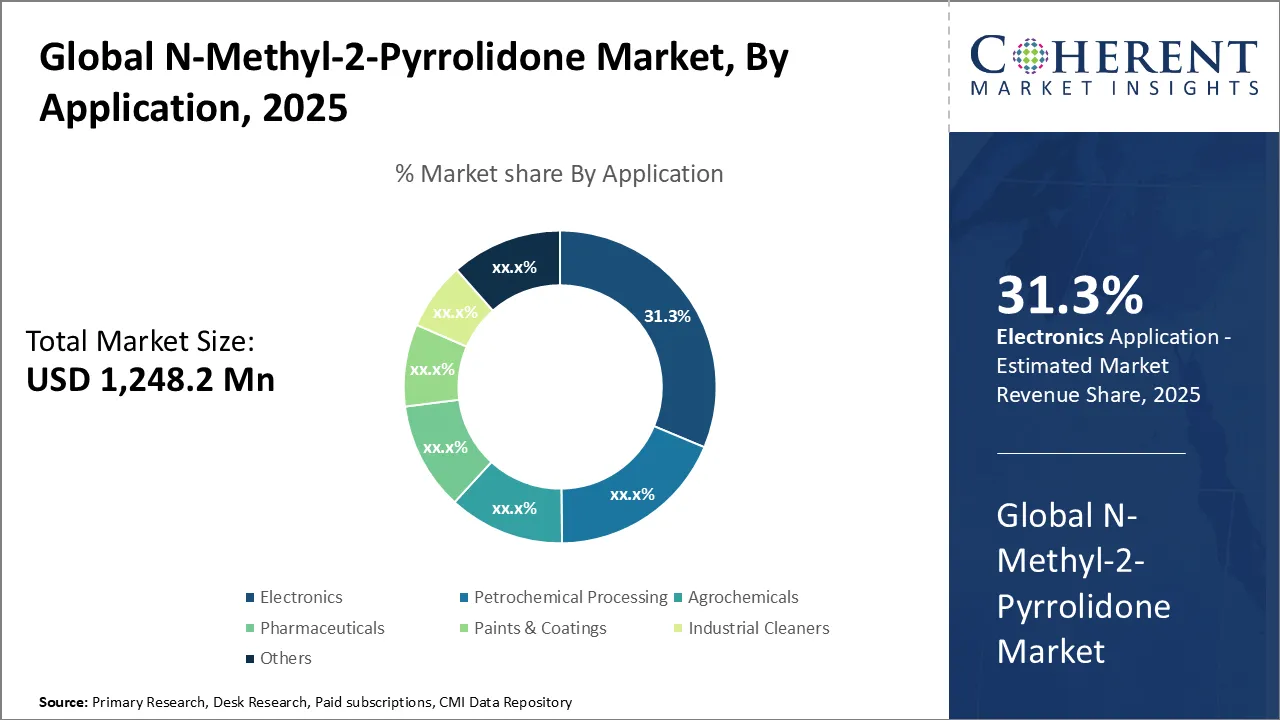
N-Methyl-2-Pyrrolidone Market Insights, By Application - Electronics Segment Is Demanding Due To Its Vital Role in Semiconductor Cleaning and Lithium-Ion Battery Production
In terms of application, the electronics segment is expected to contribute 32.3% share of the market in 2026, due to its unique chemical properties that make it indispensable in high-tech manufacturing. NMP’s excellent solvency, thermal stability, and low surface tension enable precise cleaning and processing of delicate components, especially in semiconductor fabrication and display technologies. It plays a critical role in photoresist stripping and wafer cleaning, ensuring the integrity of microelectronic circuits. Additionally, NMP is widely used in lithium-ion battery production, serving as a solvent for electrode binders, which is essential for electric vehicles and portable electronics. As global reliance on advanced electronics and energy storage solutions continues to grow, NMP remains a key enabler of innovation and performance in this fast-evolving sector.
Regional Insights
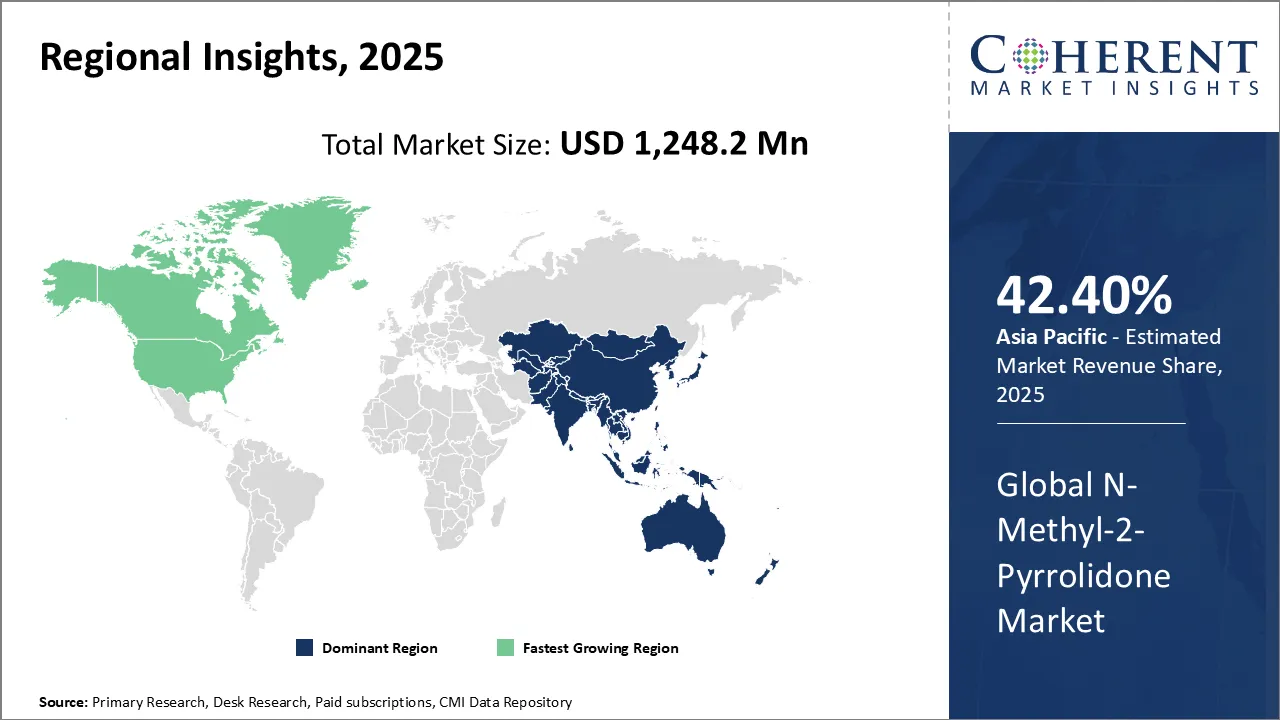
Asia Pacific N-Methyl-2-Pyrrolidone Market Analysis & Trends
The Asia Pacific region is expected to lead the market with a 42.4% share in 2026, due to the region’s booming electronics and automotive industries, which rely heavily on NMP for semiconductor processing and lithium-ion battery production. Rapid industrialization, especially in China, Japan, South Korea, and India, fuels demand across pharmaceuticals, petrochemicals, and coatings. Additionally, the presence of large-scale manufacturing hubs and increasing investments in clean energy technologies, like electric vehicles, further amplify NMP consumption. The region’s cost-effective production capabilities and expanding infrastructure make it a global leader in both supply and demand dynamics.
For instance, in August 2026, EASTCHEM with a leading Australian chemical distributor to supply high-purity N-Methyl-2-Pyrrolidone (NMP). The collaboration met strict moisture content requirements for electronics and industrial cleaning applications, offering ultra-low water levels and cost-effective logistics. The deal marks a strategic shift from Japanese sourcing to diversified global supply.
North America N-Methyl-2-Pyrrolidone Market Analysis & Trends
North America is projected to exhibit the fastest growth in the market in 2026, due to its well-established base of high-tech industries and advanced manufacturing. The region’s robust electronics and lithium-ion battery sectors, especially in the United States, rely heavily on NMP for semiconductor processing and battery electrode formulation. Additionally, North America’s pharmaceutical and petrochemical industries use NMP extensively as a solvent in synthesis and extraction processes. The push for cleaner energy and sustainable technologies is also driving innovation in battery chemistries, where NMP plays a key role1. Combined with ongoing R&D and regulatory shifts, these factors make North America a critical player in the global NMP landscape.
N-Methyl-2-Pyrrolidone Market Outlook Country-Wise
The U.S. N-Methyl-2-Pyrrolidone Market Trends
The United States holds a significant N-Methyl-2-Pyrrolidone (NMP) market share, driven by its advanced industrial landscape and technological innovation. The country’s pharmaceutical sector relies on NMP for drug formulation and synthesis, while its petrochemical industry uses it in extraction and refining processes. Additionally, the growing demand for electric vehicles and energy storage solutions has intensified NMP usage in lithium-ion battery manufacturing. With strong R&D capabilities and regulatory frameworks encouraging cleaner production methods, the U.S. continues to expand its footprint in the global N-Methyl-2-Pyrrolidone market, reinforcing its role as a key consumer and innovator.
For instance, in March 2026, NEI Corporation, in collaboration with HydroGraph Clean Power, launched advanced graphene dispersions for battery applications. The new product line includes N-Methyl-2-Pyrrolidone (NMP)-based formulations, enhancing conductivity and electrode flexibility. These dispersions offer superior performance over traditional carbons, supporting innovation in lithium-ion and sodium-ion battery technologies.
China N-Methyl-2-Pyrrolidone Market Trends
China dominates the global N-Methyl-2-Pyrrolidone (NMP) market due to its expansive lithium-ion battery and electronics manufacturing ecosystem. As the world's largest producer of consumer electronics and electric vehicles, China relies heavily on NMP for electrode processing and semiconductor fabrication. The country's aggressive push toward renewable energy and electrification have further amplified demand, making it a central hub for NMP consumption. With continuous investments in high-tech infrastructure and localized supply chains, China’s N-Methyl-2-Pyrrolidone market size is expected to grow significantly, reinforcing its leadership in both production and application of this critical solvent.
For instance, in June 2026, Wanhua Chemical and ElevenEs, signed a strategic agreement to develop a localized supply chain for battery cathode materials in Europe. The partnership will focus on lithium iron phosphate (LFP) components, including NMP solvents and PVDF binders, aiming to accelerate sustainable energy innovation and strengthen regional battery production capabilities.
Market Report Scope
N-Methyl-2-Pyrrolidone Market Report Coverage
| Report Coverage | Details | ||
|---|---|---|---|
| Base Year: | 2025 | Market Size in 2026: | USD 1,323.1 Mn |
| Historical Data for: | 2020 To 2024 | Forecast Period: | 2026 To 2033 |
| Forecast Period 2026 to 2033 CAGR: | 6.0% | 2033 Value Projection: | USD 1,989.4 Mn |
| Geographies covered: |
| ||
| Segments covered: |
| ||
| Companies covered: | BASF SE, LyondellBasell Industries N.V., Ashland Inc., Shandong Qingyun Changxin Chemical Science-Tech Co., Ltd., Hefei TNJ Chemical Industry Co., Ltd., Puyang Guangming Chemicals Co., Ltd., Zhejiang Realsun Chemical Industry Co., Ltd., Abtonsmart Chemical Co. Ltd., and Balaji Amines Limited. | ||
| Growth Drivers: |
| ||
| Restraints & Challenges: |
| ||
Global N-Methyl-2-Pyrrolidone Market Drivers
Growing demand for N-Methyl-2-Pyrrolidone from the electronic industry
Growing demand for N-Methyl-2-Pyrrolidone from the electronic industry is expected to propel the market growth. The growth of the N-Methyl-2-Pyrrolidone market is also attributed to growth in the electronic industry due to the increasing production of consumer electronic products. Moreover, increasing per capita income of the consumer due to economic growth is further expected to accelerate the market growth of N-Methyl-2-Pyrrolidone over the forecast period.
Rising demand for N-Methyl-2-Pyrrolidone from the automotive industry
Rising demand for N-Methyl-2-Pyrrolidone from the automotive industry in terms of electronic inputs to vehicles is projected to augment market growth. Moreover, increasing industrialization coupled with the growth of rising demand for NMP from the pharmaceutical industry is again expected to accelerate the market growth of N-Methyl-2-Pyrrolidone over the forecast period. For instance, India's Automotive Industry is worth more than US$222 Bn, contributes 8% of the country's total export and accounts for 7.1% of India's Gross Domestic Product (GDP), and is set to become the 3rd largest in the world by 2030.
Analyst Opinion (Expert Opinion)
The Global N-Methyl-2-Pyrrolidone market is entering a phase of structural bifurcation in which end-use quality differentiation, regulatory constraints, and feedstock volatility are dictating commercial outcomes more strongly than historical demand growth. Two clear trajectories are now apparent: (a) a premium, high-purity segment anchored to lithium-ion battery and pharmaceutical applications that will retain price resilience and technical entry barriers; and (b) a commoditised industrial grade segment exposed to substitution pressure, regulatory limitation in major markets, and capacity competition, particularly from Chinese producers.
Regulation is the most immediate, non-cyclical risk for suppliers and formulators. Harmonised classification of NMP as reproductive-toxic (Category 1B) within the EU regulatory framework and tightening of oversight under U.S. TSCA processes are forcing buyers to re-architect formulations or qualify substitutes for EU and North American manufacture or export pathways. These regulatory actions raise compliance cost, force supply-chain revalidation and, for some customers, erect hard geographic constraints on where NMP-containing processes can run.
The lithium-ion battery industry remains the single most consequential demand pocket for high-purity NMP because it is the dominant solvent for PVDF-based cathode slurries. However, technical literature and vendor R&D show active, well-funded migration paths toward NMP-free electrode manufacturing or solvent-recovery and closed-loop systems — technology moves that materially reduce long-term solvent intensity per kWh produced. These technical substitutions will blunt absolute consumption growth even while battery industry volume scales. In short, battery demand will keep the premium grade relevant but will not guarantee broad volume growth for standard grades.
Speak to the analyst
Want personalized insights?
Take the findings above to one of our principal consultants, or have the report rebuilt around the segments, geographies and competitors you actually track.
Market Segmentation
- Global N-Methyl-2-Pyrrolidone Market, By Application (Revenue, USD Mn, 2021 - 2033)
- Electronics
- Petrochemical Processing
- Agrochemicals
- Pharmaceuticals
- Paints & coatings
- Industrial cleaners
- Others
- Global N-Methyl-2-Pyrrolidone Market, By Region (Revenue, USD Mn, 2021 - 2033)
- North America
- U.S.
- Canada
- Latin America
- Brazil
- Argentina
- Mexico
- Rest of Latin America
- Europe
- Germany
- U.K.
- Spain
- France
- Italy
- Russia
- Rest of Europe
- Asia Pacific
- China
- India
- Japan
- Australia
- South Korea
- ASEAN
- Rest of Asia Pacific
- Middle East
- GCC Countries
- Israel
- Rest of Middle East
- Africa
- South Africa
- North Africa
- Central Africa
- North America
- Global N-Methyl-2-Pyrrolidone Market Companies
- BASF SE
- LyondellBasell Industries N.V.
- Ashland Inc.
- Shandong Qingyun Changxin Chemical Science-Tech Co., Ltd.
- Hefei TNJ Chemical Industry Co., Ltd.
- Puyang Guangming Chemicals Co., Ltd.
- Zhejiang Realsun Chemical Industry Co., Ltd.
- Abtonsmart Chemical Co. Ltd.
- Balaji Amines Limited.
Sources
Primary research — Interviews
Interviews with key stakeholder groups across leading global markets (APAC, North America, Europe, Middle East & Africa, Latin America)
- Large-scale N-MP / solvent manufacturers and upstream chemical producers (production managers, commercial heads, export managers). — Examples: production/commercial leads at BASF, Solvay, Ashland, Nippon Shokubai, Ineos (as applicable).
- Downstream formulators and end-users: battery electrolyte developers, lithium-ion battery manufacturers, and EV OEMs (R&D leads, procurement heads).
- Active pharmaceutical ingredient (API) and generic drug manufacturers — formulation scientists, regulatory affairs heads, procurement.
- Electronics and semiconductor fabs and cleaning/processing teams (wet-process engineers, procurement).
- Coatings, paints and adhesives manufacturers (product development managers, procurement).
- Agrochemical formulators and specialty chemical processors (R&D and sourcing leads).
- Environmental, health & safety (EHS) and regulatory compliance officers across chemical plants and large end-users.
- Industrial distributors, chemical traders and logistics/service providers (trade managers, supply chain heads).
- Waste treatment and solvent recovery service providers (operations leads).
- Financial buyers and commodity traders focused on specialty solvents (commodity analysts, traders).
Specific stakeholder interview targets
- Battery materials R&D leads at major battery OEMs and tier-1 suppliers (e.g., LG Energy Solution, CATL, Panasonic).
- Head formulators/regulatory affairs at leading pharmaceutical manufacturers (e.g., Pfizer, Novartis, Cipla).
- Process engineering and procurement heads at semiconductor manufacturers and electronics assemblers (e.g., Samsung, TSMC, Foxconn).
- Product and sourcing managers at coatings and adhesives firms (e.g., AkzoNobel, PPG).
- EHS and sustainability leads at chemical parks and large chemical producers.
- Commercial directors at global chemical distributors (regional hubs: Antwerp, Houston, Shanghai, Dubai, Singapore).
- Port terminal operators and hazardous-cargo handling managers at major ports (e.g., Shanghai, Rotterdam, Houston).
- Regulators and standards officers at agencies responsible for solvent restrictions and workplace exposure limits.
Secondary research — Databases & trade statistics
- UN Comtrade Database (detailed HS trade flows).
- World Trade Organization (WTO) trade statistics.
- China Customs Statistics / General Administration of Customs data.
- Korea Customs Service data portal.
- Japan External Trade Organization (JETRO) trade and industry reports.
- S. International Trade Commission (USITC) trade datasets.
- Eurostat international trade and chemical sector stats.
- Directorate General of Commercial Intelligence and Statistics (DGCIS), India.
- Ministry of Commerce / Customs portals for Brazil, UAE, Turkey (regional trade patterns).
- National chemical industry statistical offices (where available) and national ministries of chemicals.
- Commercial chemical pricing and spot transaction databases (proprietary pricing feeds — used anonymously).
Industry magazines & trade press
- ICIS Chemical Business / ICIS news (market and pricing intelligence).
- Chemical Week.
- IHS Markit (industry newsletters) — (use as trade press; do not list as a consulting client).
- Paint & Coatings Industry (PCI).
- Battery Materials Review / Battery Industry magazines.
- Specialty Chemical Magazine / SpecialChem updates.
- European Chemical News.
- Environmental Leader (regulatory & compliance updates).
Relevant technical & academic journals
- Journal of Industrial and Engineering Chemistry.
- Journal of Hazardous Materials.
- Journal of Pharmaceutical Sciences (formulation & solvent use).
- Electrochimica Acta / Journal of Power Sources (battery electrolyte research).
- Environmental Science & Technology (EHS, fate & transport studies).
- Chemical Engineering Journal.
- Toxicology in Vitro / Regulatory Toxicology and Pharmacology (toxicity and risk assessments).
Newspapers & business press (sectoral & regional)
- Financial Times — chemicals & commodities reporting.
- The Wall Street Journal — industry & regulatory coverage.
- Nikkei Asia — electronics & chemical supply chains (Japan/Asia perspective).
- South China Morning Post — China market and supply-chain developments.
- The Economic Times / The Hindu Business Line — India chemical industry and policy updates.
- Bloomberg News — commodities, corporate developments and M&A.
Associations, standards & industry bodies
- American Chemistry Council (ACC) — chemical sector guidance and statistics.
- European Chemical Industry Council (Cefic) — European industry data and position papers.
- Society for Chemical Manufacturers & Affiliates (SOCMA) / regional specialty-chemical groups.
- International Council of Chemical Associations (ICCA).
- Society of Chemical Industry (SCI).
- International Electrotechnical Commission (IEC) / ISO working groups relevant to safety and testing standards.
- Industry battery consortia and pharmaceutical associations (for end-user inputs).
Public domain & regulatory sources
- European Chemicals Agency (ECHA) — classification, restriction dossiers, and risk assessments for solvents.
- U.S. Environmental Protection Agency (EPA) — toxicity, environmental release and regulatory guidance.
- National Institute for Occupational Safety and Health (NIOSH) / OSHA exposure limits and guidance.
- Ministry of Chemicals & Fertilizers / Central Pollution Control Board (India) — relevant rules and notifications.
- Japan’s Ministry of Economy, Trade and Industry (METI) regulatory notices.
- WHO / ILO publications on solvent health & safety.
- National chemical registries and directive documents (country-level hazard communications).
Proprietary elements
- CMI Data Analytics Tool, and Proprietary CMI Existing Repository of information for last 8 years
*Definition: N-Methyl-2-pyrrolidone (NMP) is an organic compound consisting of a 5-membered lactam. It is a colorless liquid, although impure samples can appear yellow. It is miscible with water and with the most common organic solvents. It also belongs to the class of dipolar aprotic solvents such as dimethyl-form amide and dimethyl sulfoxide. It is used in the petrochemical, polymer, and battery industries as a solvent, exploiting its non-volatility and ability to dissolve diverse materials.
Get access to 250+ pages report
Every segment, forecast, competitor profile and data table behind the analysis above — available for instant download.
- ESOMAR Member
- ISO 9001:2015 Certified
- D-U-N-S Registered
- GDPR & CCPA Compliant
Missing comfort of reading report in your local language? Find your preferred language:
Transform your Strategy with Exclusive Trending Reports
Frequently Asked Questions
The N-Methyl-2-Pyrrolidone Market is estimated to be valued at USD 1,323.1 Mn in 2026, and is expected to reach USD 1,989.4 Mn by 2033.
The CAGR of the N-Methyl-2-Pyrrolidone Market is projected to be 6.0% from 2026 to 2033.
Growing demand for N-Methyl-2-Pyrrolidone from the electronic industry and automotive industry in terms of electronic inputs to vehicles is fuelling the growth of the market in the region.
Growth in the refinery projects coupled with the economic development and establishment of new production plants for increasing production capacities are expected to favor market growth over the forecast period.
Side effects associated with prolonged exposure to NMP and the increasing focus of manufacturers on developing ideal substitutes for NMP are expected to hamper the growth of the market during the forecast period.
Major players operating in the global N-Methyl-2-Pyrrolidone market include BASF SE, LyondellBasell Industries N.V., Ashland Inc., Shandong Qingyun Changxin Chemical Science-Tech Co., Ltd., Hefei TNJ Chemical Industry Co., Ltd., Puyang Guangming Chemicals Co., Ltd., Zhejiang Realsun Chemical Industry Co., Ltd., Abtonsmart Chemical Co. Ltd., and Balaji Amines Limited.
The global N-Methyl-2-Pyrrolidone market was estimated to be valued at around USD 1054.1 Million in terms of revenue in 2026.