

Thermoplastic Elastomers Market Size and Forecast – 2026 to 2033
The thermoplastic elastomers market is estimated to be valued at USD 17.73 Bn in 2026 and is expected to reach USD 29.61 Bn by 2033, exhibiting a compound annual growth rate (CAGR) of 7.6% from 2026 to 2033.
Key Takeaways
- By Type, Styrene Block Copolymer hold the largest market share of 33.9% in 2026 owing to the lightweighting & performance demands in automotive / transportation.
- By Application, Adhesives sealants and coatings expected to hold largest market share of 31.3% in 2026 owing to the growth in end‑use industries.
- By End Use Industry, Automotive acquired the prominent market share of 33.7% in 2026 owing to the lightweighting & fuel efficiency.
- By Region, North America dominates the overall market with an estimated share of 37.2% in 2026 owing to the automotive & mobility‑industry demand.
Market Overview
The global Thermoplastic Elastomers (TPE) market is expanding rapidly as industries increasingly adopt these versatile materials across automotive, construction, medical, electronics, and consumer goods sectors. TPEs offer the flexibility of rubber and the processability of plastics, providing benefits such as recyclability, lightweight properties, and design adaptability. Rising demand for sustainable materials, high-performance components, and innovative formulations drives market adoption. Industrialization, urbanization, and technological advancements in both emerging and developed regions actively propel the growth of the TPE market.
Current Events and their Impact on the Thermoplastic Elastomers Market
Current Events | Description and its impact |
Geopolitical and Trade Developments |
|
Economic and Supply Chain Dynamics |
|
Sector-Specific Demand Trends |
|
End-user Feedback and Unmet Needs in the Thermoplastic Elastomers Market
- Performance Consistency: End-users often report variations in TPE performance across batches, affecting flexibility, hardness, or tensile strength. Industries such as automotive and medical demand consistent quality for safety-critical components. There is a need for more standardized production methods and rigorous quality control to ensure uniform material properties across applications.
- Sustainability and Recyclability: Many users seek TPEs with improved environmental profiles, including bio-based or fully recyclable materials. Current options often fall short of circular economy goals. End-users emphasize the need for sustainable formulations that maintain performance while reducing carbon footprint, enabling compliance with evolving regulations and consumer demand for eco-friendly products.
- Processability and Manufacturing Efficiency: End-users highlight challenges in processing TPEs for complex designs, particularly in injection molding or extrusion. Some grades require specialized equipment or conditions, increasing production costs. There is a strong demand for TPEs that are easier to process, with faster cycle times, lower energy use, and minimal defects.
- Current Industry Events of 2026
- Market Size Estimation
- Regional Breakdown
- Competitive Landscape
- Customer Intelligence
- Segmental Analysis
- Pricing Analysis
- Key Market Drivers, Challenges & Future Trends
- Customized Insights Section
Segmental Insights
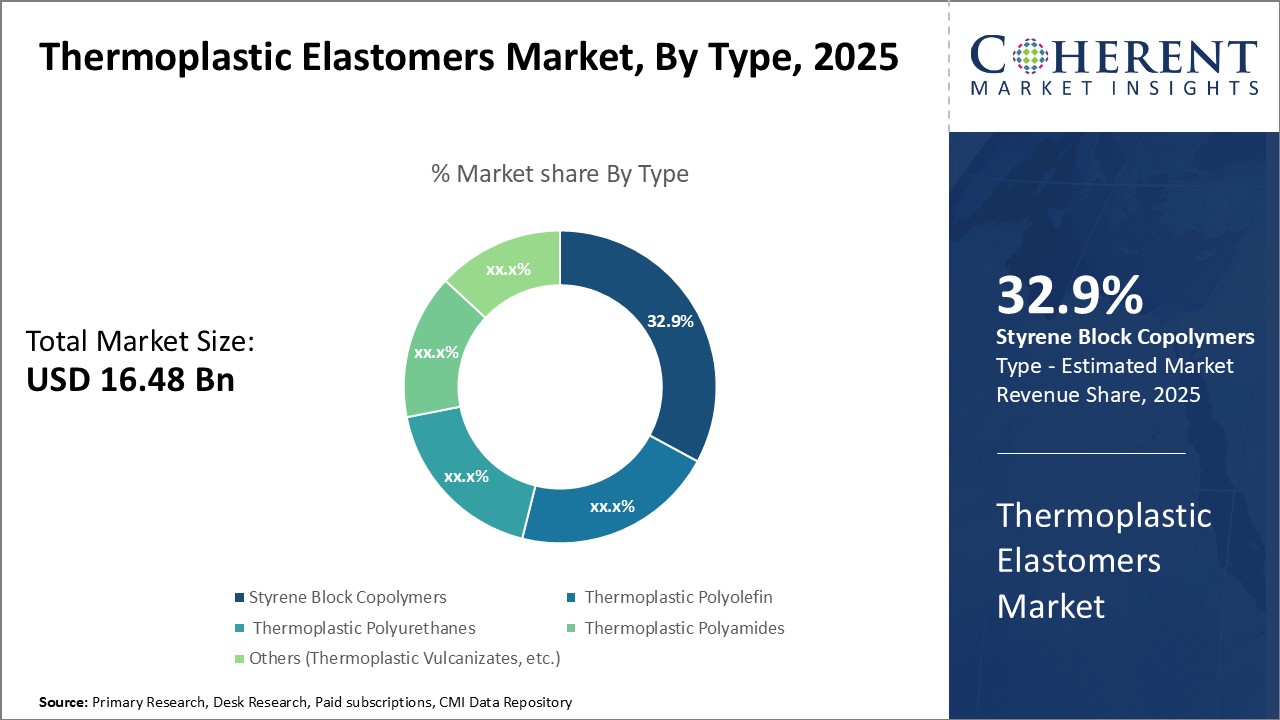
Thermoplastic Elastomers Market Insights, By Type: Styrene Block Copolymer contribute the highest share of the market owing to its technological advances & tailored product development.
Styrene Block Copolymer hold the largest market share of 33.9% in 2026. Styrene Block Copolymers (SBCs) actively propel the growth of the Thermoplastic Elastomers (TPE) market with their outstanding elasticity, clarity, and compatibility with diverse additives. Manufacturers increasingly incorporate SBCs in adhesives, sealants, packaging, and consumer products to leverage their superior processability and soft-touch feel. Their customizable properties, including hardness, tensile strength, and transparency, make them highly versatile. Furthermore, growing demand for lightweight, recyclable, and durable materials in automotive, construction, and electronics sectors drives broader adoption of SBCs in TPE applications. For instance, Kraton Corporation, a global leader in sustainable specialty polymers and biobased products from pine wood pulping by-products, announced a major expansion of its styrene-butadiene-styrene (SBS) block copolymer production at its Belpre, Ohio facility.
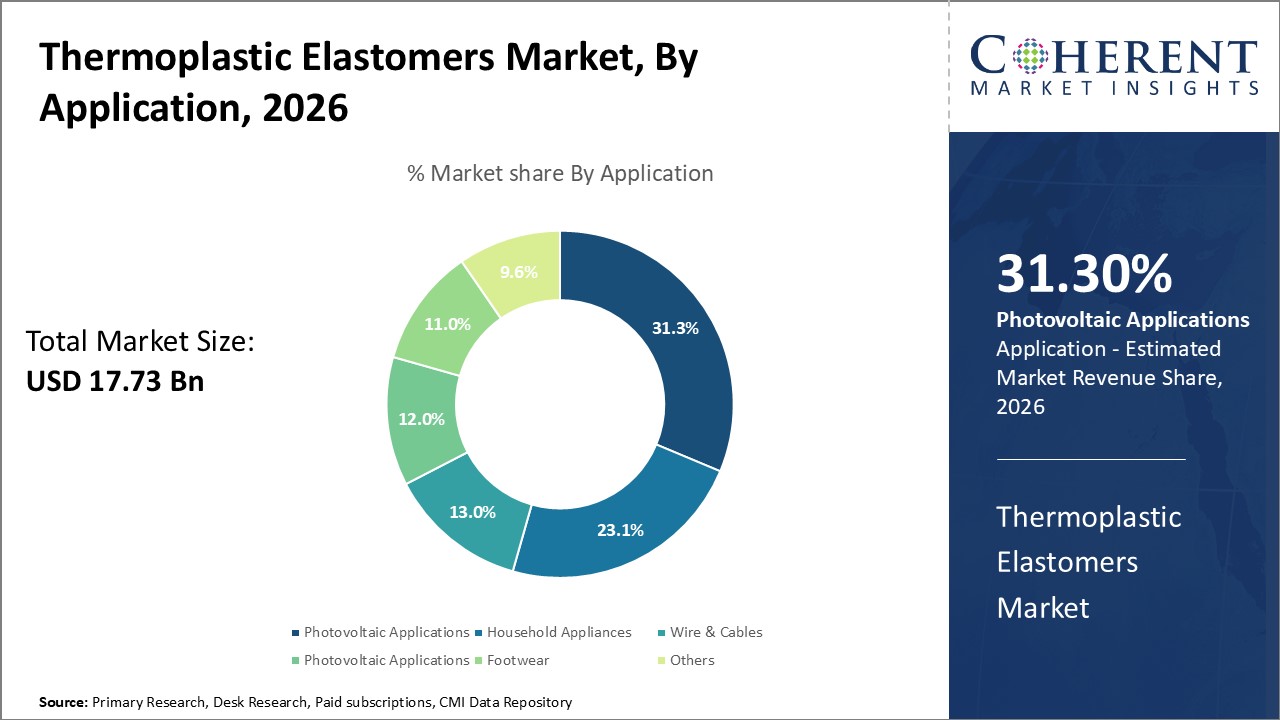
Thermoplastic Elastomers Market Insights, By Application: Adhesives sealants and coatings contribute the highest share of the market owing to its performance advantages of TPES in adhesives, sealants & coatings.
Adhesives sealants and coatings expected to hold the largest thermoplastic elastomers market share of 31.3% in 2026. Thermoplastic Elastomers (TPE) drive growth in adhesives, sealants, and coatings with their strong bonding, flexibility, and resistance to environmental stress. Manufacturers increasingly use TPEs to produce durable, weather-resistant, and chemically stable products that maintain performance over time. Their easy processability and compatibility with diverse substrates streamlines production. Increasing demand for high-performance coatings, sustainable adhesives, and versatile sealants in construction, automotive, and packaging sectors actively boosts TPE adoption, establishing them as a preferred material for advanced bonding and protective applications. For instance, Netherlands-based specialty chemical company Nouryon launched its Expancel HP92 microspheres for thermoplastic fillers in high-pressure automotive manufacturing, including underbody coatings and sealants.
Thermoplastic Elastomers Market Insights, By End Use Industry: Automotive contribute the highest share of the market owing to its electric vehicle (EV) & new mobility trends.
Automotive acquired the prominent market share of 33.7% in 2026. The automotive industry actively boosts Thermoplastic Elastomers (TPE) adoption by seeking lightweight, durable, and high-performance materials for interiors, exteriors, and under-the-hood components. Manufacturers leverage TPEs for their flexibility, vibration-dampening capabilities, and resistance to heat, chemicals, and weathering. Growing emphasis on electric vehicles and fuel efficiency drives the demand for recyclable and multi-functional materials. TPEs also allow innovative designs, improved aesthetics, and easier assembly, prompting automakers to incorporate them in seals, gaskets, trims, and other essential automotive components. For instance, in June 2024, Celanese expanded its materials portfolio for automotive boots and bellows, building on its leadership in thermoplastic elastomer solutions with Hytrel TPC and Santoprene TPV. Such instances are accelerating the thermoplastic elastomers market demand.
Regional Insights
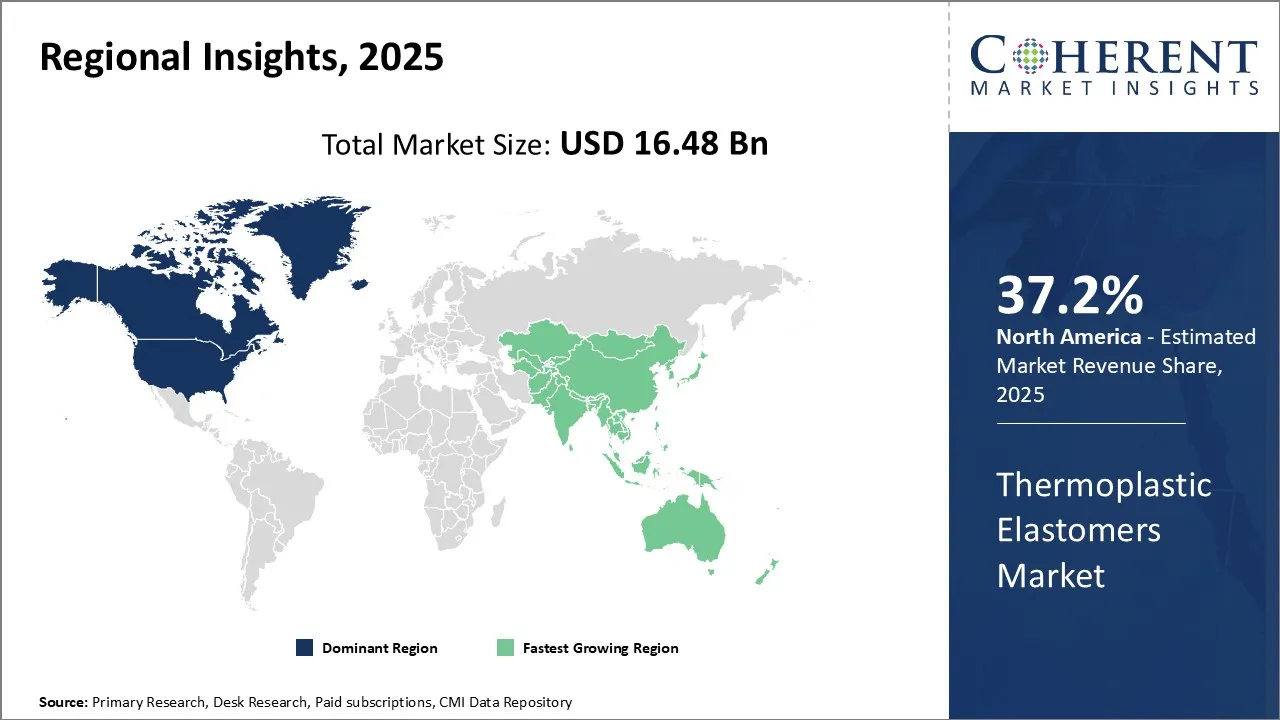
North America Thermoplastic Elastomers Market Trends
North America dominates the overall market with an estimated share of 37.2% in 2026. The North American thermoplastic elastomers (TPE) market is rapidly evolving as industries increasingly demand lighter, recyclable materials in automotive, electronics, medical devices, and packaging. Manufacturers in the U.S. and Canada actively integrate TPEs into vehicle interiors, e-mobility components, flexible electronics, and medical tubing, fueled by material innovation and circular-economy initiatives. Advanced polymer compounding and expanding bio-based TPE options are transforming the market and accelerating the adoption of TPE solutions across multiple sectors.
In LOS ANGELES, LASFIT LINERS launched a new TPE floor liner collection, highlighting its role in the growing automotive trim market with accessories that blend style and functionality.
Europe Thermoplastic Elastomers Market Trends
The European thermoplastic elastomers (TPE) market actively pursues sustainability and high-performance innovation as key growth drivers. Manufacturers develop recyclable and bio-based TPEs to comply with strict environmental regulations and the EU REACH framework. Industries including automotive, electronics, and healthcare increasingly adopt TPEs for lighter, more durable components. Europe’s advanced manufacturing sector drives demand for customized TPE formulations for electric mobility, medical devices, and additive manufacturing, enhancing market sophistication and boosting the adoption of innovative TPE solutions across diverse applications.
Germany-based Actega launched ACTGreen, a line of water-based barrier coatings and next-generation TPE dispersions, advancing sustainable packaging solutions.
United States Thermoplastic Elastomers Market Trends
The U.S. thermoplastic elastomers (TPE) market is rapidly expanding as industries increasingly demand lightweight, versatile materials for automotive, consumer electronics, and medical device applications. Manufacturers actively replace heavier rubbers and plastics with TPEs to leverage their recyclability, design flexibility, and processing efficiency. Strong R&D efforts drive the development of bio-based and high-performance TPE grades, while the rise of e-commerce and renewable mobility actively boosts the use of advanced elastomeric materials in a wide range of components. For instance, GEON® Performance Solutions launched a new TPE manufacturing line at its Ramos Arizpe, Coahuila, Ohio facility to better serve key markets and customers.
United Kingdom Thermoplastic Elastomers Market Trends
The UK thermoplastic elastomers (TPE) market actively evolves through sustainability initiatives and advanced manufacturing trends. Producers develop recyclable and bio-based TPEs to support the country’s circular economy objectives. Industries increasingly use TPEs in automotive interiors, medical tubing, and consumer electronics for lightweight, durable performance. Meanwhile, UK innovation centres and manufacturers create customized TPE formulations to comply with stricter environmental regulations and meet changing application needs, actively enhancing market sophistication and driving broader adoption across diverse sectors. For instance, in February 2024, KRAIBURG TPE released a new Recycling Content TPE for Automotive series, featuring at least 73% recycled content and designed for diverse technical applications.
Thermoplastic Elastomers Market Trend
Sustainability and Eco-Friendly Materials
The TPE market is increasingly shifting toward sustainable solutions, with manufacturers developing bio-based, recyclable, and low-emission materials. End-users in automotive, packaging, and consumer electronics prioritize eco-friendly options to meet regulatory requirements and sustainability goals. This trend encourages innovation in raw material sourcing, production efficiency, and circular economy practices, positioning TPEs as a versatile alternative to traditional plastics and rubbers while supporting greener industrial operations across multiple sectors.
Advanced Material Innovation
Manufacturers are focusing on high-performance TPEs with enhanced mechanical, thermal, and chemical properties. Innovations include improved hardness ranges, elasticity, transparency, and compatibility with additives. These developments cater to industries requiring precise performance, such as medical devices, electronics, and automotive applications. Material innovation enables customized solutions, faster product development cycles, and superior end-product performance, driving TPE adoption over conventional elastomers.
Thermoplastic Elastomers Market Opportunity
Bio‑based and Recycled‑Content Materials
Industry makers now have an opening to supply TPE grades derived from renewable feedstocks or with higher recycled content. Such formulations address corporate sustainability goals and regulatory demands for lower carbon footprints. Firms that deliver these eco‑friendly TPEs while maintaining performance (elasticity, durability) will gain a competitive edge in packaging, footwear, and automotive markets.
Market Report Scope
Thermoplastic Elastomers Market Report Coverage
| Report Coverage | Details | ||
|---|---|---|---|
| Base Year: | 2025 | Market Size in 2026: | USD 17.73 Bn |
| Historical Data for: | 2020 To 2024 | Forecast Period: | 2026 To 2033 |
| Forecast Period 2026 to 2033 CAGR: | 7.6% | 2033 Value Projection: | USD 29.61 Bn |
| Geographies covered: |
| ||
| Segments covered: |
| ||
| Companies covered: | Arkema S.A., Asahi Kasei Corporation, Avient Corporation, Celanese Corporation, Covestro AG, DuPont de Nemours, Inc., Elastron Kimya A.S., Evonik Industries AG, Huntsman International LLC, Mitsui Chemicals, Inc., Kraton Corporation, Eastman Chemical Company, SIBUR, Versalis S.p.A., JSR Corporation, Kuraray Co., Ltd , LCY Chemical Corp, SK Chemicals, Tosoh Corporation, TSRC Corporation, and Interplast | ||
| Growth Drivers: |
| ||
| Restraints & Challenges: |
| ||
Thermoplastic Elastomers Market News
- In July 2025, the Indian helmet manufacturer launched its first motorcycle helmet with thermoplastic elastomer technology, priced at ₹3,599 and certified for dual safety standards.
- In April 2025, S.-based DuPont expanded its single-use bioprocessing portfolio by launching Liveo Pharma TPE Ultra‑Low Temp Tubing, a sterilizable TPE line that stays flexible and durable down to –86 °C.
Analyst Opinion (Expert Opinion)
- As an industry analyst following the thermoplastic elastomers (TPE) market, I believe we are entering a phase where raw material innovation and demand‑pull dynamics are converging to reshape who wins and who merely survives. Over 40 % of TPE revenue originates from automotive applications, reflecting how OEMs are specifying TPEs for seals, overmoulds and cables that demand low density and high performance.
- The pull toward electrification is more than a buzzword—it’s a structural shift. TPE usage in e‑mobility isn’t just replacing rubber, it’s redefining it: battery pack seals, lightweight cable jackets, multi‑component injection‑moulded soft trims. The sector’s heavy reliance on TPEs built for heat stability and chemical resistance (as noted in North America’s market data) underlines that this is not just substitution—it’s up‑engineering.
- At the same time, the layers of sustainability pressure—from brand mandates to regulatory demands—are no longer nice‑to‑have. Material makers who position bio‑based, recycled‑content or low‑VOC TPEs are not just appealing to green credentials—they are meeting value‑chain imperatives. For example, the poly‑styrenes segment held roughly 31.6 % of TPE value in 2023, pointing to how a “commodity” grade still dominates but will need to adapt if it wants growth.
Speak to the analyst
Want personalized insights?
Take the findings above to one of our principal consultants, or have the report rebuilt around the segments, geographies and competitors you actually track.
Market Segmentation
- Type Insights (Revenue, USD Bn, 2021 - 2033)
- Styrene Block Copolymers
- Thermoplastic Polyolefin
- Thermoplastic Polyurethanes
- Thermoplastic Polyamides
- Others (Thermoplastic Vulcanizates, etc.)
- Application Insights (Revenue, USD Bn, 2021 - 2033)
- Photovoltaic Applications
- Household Appliances
- Wire & Cables
- Adhesives
- Sealants and Coatings
- Footwear
- Others (Tires and Tubes etc.)
- End Use Industry Insights (Revenue, USD Bn, 2021 - 2033)
- Automotive
- Transportation
- Building & Construction
- Electrical and Electronics
- Medical & Healthcare
- Others (Consumer Goods etc.)
- Regional Insights (Revenue, USD Bn, 2021 - 2033)
- North America
- U.S.
- Canada
- Latin America
- Brazil
- Argentina
- Mexico
- Rest of Latin America
- Europe
- Germany
- U.K.
- Spain
- France
- Italy
- Russia
- Rest of Europe
- Asia Pacific
- China
- India
- Japan
- Australia
- South Korea
- ASEAN
- Rest of Asia Pacific
- Middle East & Africa
- GCC Countries
- Israel
- Rest of Middle East & Africa
- Key Players Insights
- Arkema S.A.
- Asahi Kasei Corporation
- Avient Corporation
- Celanese Corporation
- Covestro AG
- DuPont de Nemours, Inc.
- Elastron Kimya A.S.
- Evonik Industries AG
- Huntsman International LLC
- Mitsui Chemicals, Inc.
- Kraton Corporation
- Eastman Chemical Company
- SIBUR
- Versalis S.p.A.
- JSR Corporation
- Kuraray Co., Ltd
- LCY Chemical Corp
- SK Chemicals
- Tosoh Corporation
- TSRC Corporation
- Interplast
Sources
Primary Research interviews
- Industry experts and technical managers in polymer and elastomer manufacturing companies
- R&D heads and product development specialists from TPE-producing firms
- Supply chain managers in raw material and polymer distribution companies
- End-users in automotive, construction, healthcare, and consumer goods sectors
Databases
- PubChem
- SciFinder
- Polymer Database (PolymerDatabase.com)
- ChemSpider
- USPTO patent database
Magazines
- Rubber & Plastics News
- Plastics Today
- Modern Plastics Worldwide
- European Rubber Journal
Journals
- Journal of Applied Polymer Science
- Polymer Engineering & Science
- Rubber Chemistry and Technology
- Macromolecular Materials and Engineering
- Materials Today: Proceedings
Newspapers
- The Economic Times (Industry section)
- Financial Times (Chemicals & Materials)
- The Wall Street Journal (Business & Industry section)
Associations
- American Chemical Society (ACS) – Division of Polymeric Materials: Science and Engineering
- European Plastics Converters (EuPC)
- The Rubber Manufacturers Association (RMA)
- Plastics Industry Association (PLASTICS)
- Society of Plastics Engineers (SPE)
Public Domain sources
- Government publications (e.g., U.S. Department of Energy reports on materials)
- WTO and UN Comtrade trade statistics
- Environmental Protection Agency (EPA) chemical safety reports
- National Institute of Standards and Technology (NIST) polymer databases
- Open-access academic articles on thermoplastic elastomers
Proprietary Elements
- CMI Data Analytics Tool
- Proprietary CMI Existing Repository of information for last 8 years
Get access to 250+ pages report
Every segment, forecast, competitor profile and data table behind the analysis above — available for instant download.
- ESOMAR Member
- ISO 9001:2015 Certified
- D-U-N-S Registered
- GDPR & CCPA Compliant
Missing comfort of reading report in your local language? Find your preferred language:
Transform your Strategy with Exclusive Trending Reports
Frequently Asked Questions
The Thermoplastic Elastomers Market is estimated to be valued at USD 17.73 Bn in 2026, and is expected to reach USD 29.61 Bn by 2033.
The CAGR of the Thermoplastic Elastomers Market is projected to be 7.6% from 2026 to 2033.
High demand from automotive industry and growing demand from medical industry are the major factors driving the growth of the global thermoplastic elastomers market.
Fluctuation in raw material prices and availability of substitutes are the major factors hampering the growth of the global thermoplastic elastomers market.
In terms of type, styrene block copolymers is estimated to dominate the market revenue share in 2026.
Arkema S.A., Asahi Kasei Corporation, Avient Corporation, Celanese Corporation, Covestro AG, DuPont de Nemours, Inc., Elastron Kimya A.S., Evonik Industries AG, Huntsman International LLC, Mitsui Chemicals, Inc., Kraton Corporation, Eastman Chemical Company, SIBUR, Versalis S.p.A., JSR Corporation, Kuraray Co., Ltd , LCY Chemical Corp, SK Chemicals, Tosoh Corporation, TSRC Corporation, and Interplast are the major players.
North America is expected to lead the global thermoplastic elastomers market.