

Barcode Scanners Market Size and Forecast
The global barcode scanners market is estimated to be valued at USD 9,206.5 Mn in 2026 and is expected to reach USD 16,192.0 Mn in 2033, exhibiting a compound annual growth rate (CAGR) of 8.4% from 2026 to 2033.
Key Takeaways
- Based on Product Type, the Portable/handheld segment is expected to hold 82.9% of the market share in 2026, due to their versatility, ease of use, and ability to improve operational efficiency across multiple industries.
- Based on End Use, the Retail & Commercial segment is projected to account for the largest share of the barcode scanners market in 2026, due to the critical need for speed, accuracy, and efficiency in daily operations.
- Based on Technology, the Laser Scanner segment is expected to capture the highest share of the barcode scanners market in 2026, due to their speed, accuracy, and reliability in reading barcodes across various environments.
- Based on Region, Asia Pacific is anticipated to lead the global barcode scanners market in 2026 with a 36.8% share. While, North America, with a 29.4% share, will be the fastest growing region during the forecast period.
Market Overview
A barcode scanner is an electronic device designed to read information encoded in the form of bar lines on products and transmit it to a computer system. It captures the data marked on items, facilitating inventory management, tracking, and point-of-sale operations. All barcode readers are equipped with circuitry that analyzes information detected by sensors, and they typically consist of a light source and sensors that capture the encoded data. Moreover, the growing need for efficient data capture, accurate inventory management, and streamlined operational processes is significantly driving barcode scanners market demand across retail, healthcare, logistics, and manufacturing sectors.
Current Events and their Impacts on the Barcode Scanners Market
Current Event | Description and its Impact |
US Trade Policy and Tariff Implementation (2025) |
|
AI-Driven Automation and Industry 4.0 Acceleration |
|
Cybersecurity Threats and Data Protection Evolution |
|
Role of Artificial Intelligence (AI) in the Barcode Scanner Market
The integration of artificial intelligence (AI) in the barcode scanner market is rapidly transforming how businesses capture, analyze, and utilize data. AI-enabled barcode scanners go beyond simple code reading by offering advanced features such as image recognition, predictive analytics, and automatic error detection. These scanners can recognize damaged, partially obscured, or poorly printed barcodes, significantly reducing scanning errors and improving operational efficiency. In addition, AI-powered scanners can integrate with inventory management systems and cloud platforms to provide real-time insights into stock levels, supply chain performance, and consumer behavior. This intelligence enables businesses to optimize workflows, reduce downtime, and make data-driven decisions.
For instance, in February 2025, Newland AIDC introduced its AI-powered NVH220 barcode scanner in Indonesia, aiming to enhance digital transformation across sectors like retail, logistics, and manufacturing. The NVH220 features rugged durability with an IP64 rating and advanced AI capabilities for optimal barcode positioning and reconstruction.
- Current Industry Events of 2026
- Market Size Estimation
- Regional Breakdown
- Competitive Landscape
- Customer Intelligence
- Segmental Analysis
- Pricing Analysis
- Key Market Drivers, Challenges & Future Trends
- Customized Insights Section
Segmental Insights
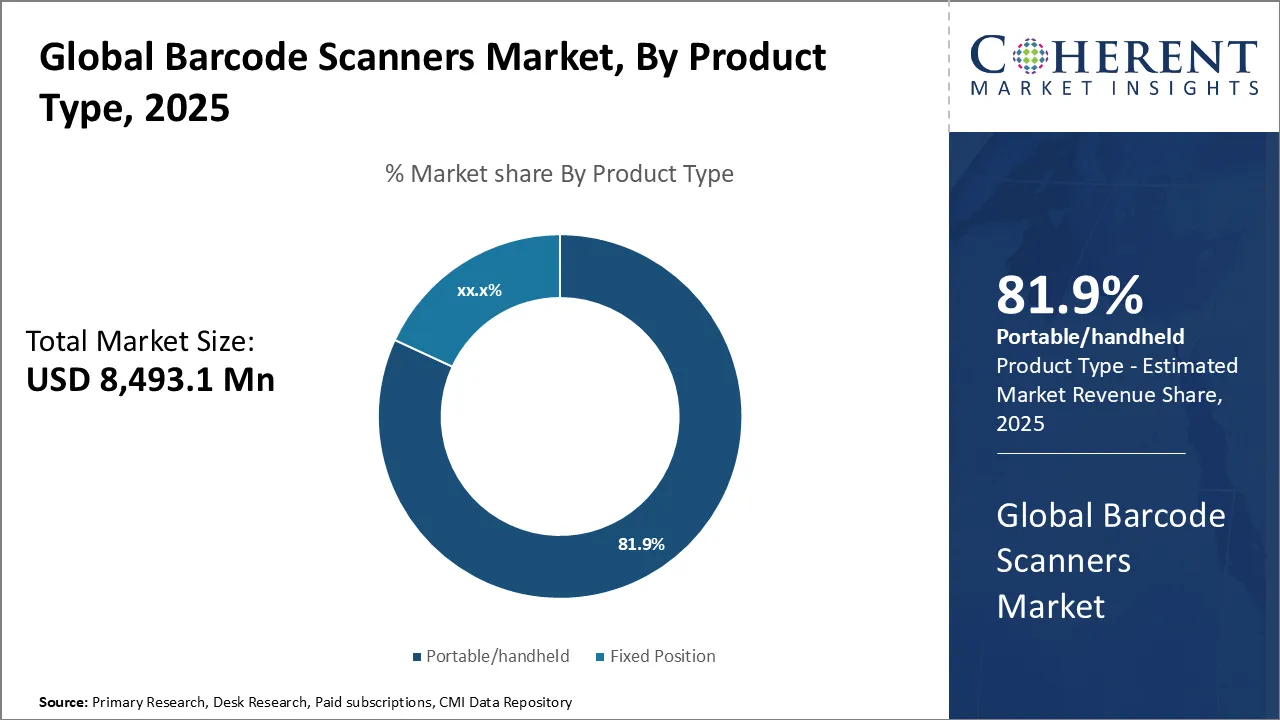
Barcode Scanners Market Insights, By Product Type: Portable/Handheld Segment Dominated the Market Due To Their Versatility, and Ease of Use
in terms of product type, the portable/handheld segment is expected to hold 82.9% share of the global barcode scanners market, due to their versatility, ease of use, and ability to improve operational efficiency across multiple industries. Unlike fixed or stationary scanners, handheld devices allow employees to move freely around warehouses, retail stores, hospitals, and logistics facilities while scanning products, inventory, or patient information. This mobility reduces workflow bottlenecks and enables real-time data capture, making inventory management and supply chain tracking faster and more accurate. Additionally, handheld scanners often come with advanced features such as wireless connectivity, long battery life, and integration with mobile and cloud-based systems, which further enhance convenience and efficiency. Their adaptability to different environments, from retail counters to large distribution centers, makes portable and handheld scanners one of the most sought-after segments, significantly contributing to the growth of the barcode scanners market share.
For instance, in November 2023, Omron Automation unveiled the V460-H, an advanced handheld barcode reader designed to enhance traceability in industrial settings. Equipped with predictive autofocus and patented intelligent lighting, it automatically adjusts to various barcode types and surface conditions, eliminating the need for manual configuration.
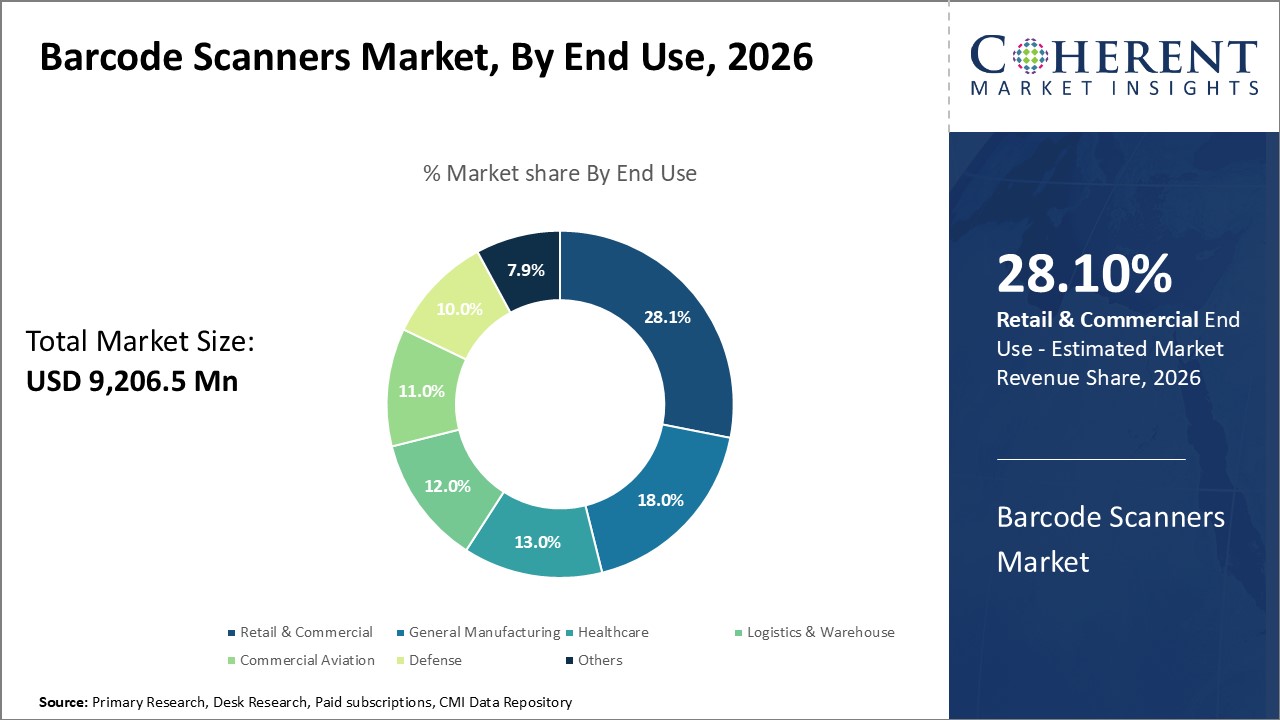
Barcode Scanners Market Insights, By End Use: Retail & Commercial Acquires the largest Market share Due to its Need in Inventory Management and Supply Chain Tracking
in terms of end use, the retail & commercial segment is expected to hold the largest share of the barcode scanner market in 2026, due to the critical need for speed, accuracy, and efficiency in daily operations. Retailers rely on barcode scanners for inventory management, point-of-sale transactions, and supply chain tracking, ensuring that products are correctly priced, stocked, and available for customers. High transaction volumes and fast-paced environments require scanners that can quickly read codes, including damaged or complex 2D barcodes, without slowing operations. Additionally, commercial businesses benefit from integrating barcode scanning with inventory and enterprise resource planning (ERP) systems to monitor stock levels, reduce shrinkage, and optimize replenishment cycles.
for instance, in January 2025, AsReader, a Japanese RFID and barcode scanning technology company, introduced its innovative AsCode system to the U.S. market at the 2025 National Retail Federation (NRF) show in New York. AsCode is a next-generation 2D barcode that offers faster and longer-range scanning compared to traditional QR codes. Its design allows for efficient data management on smartphones, enabling real-time inventory checks and improved data accuracy in retail environments
Barcode Scanners Market Insights, By Technology: Laser Scanner Acquires the dominant Market share Driven by Speed, Accuracy, And Reliability
In terms of technology, the laser scanner segment is projected to hold the largest share of the barcode scanners market in 2026, due to their speed, accuracy, and reliability in reading barcodes across various environments. Unlike other types of scanners, laser scanners can quickly read long-range and high-density barcodes, making them ideal for high-volume applications in retail, logistics, and manufacturing. Additionally, laser scanners are durable and robust, capable of withstanding harsh industrial conditions, which makes them a preferred choice for warehouses, distribution centers, and production lines. Their ability to deliver fast, precise, and reliable data capture contributes significantly to operational efficiency, driving the continued demand for laser scanners and reinforcing their strong position in the barcode scanners market revenue.
For instance, in June 2023, Socket Mobile launched the DuraScan Wear DW930, a wearable laser barcode scanner designed for industries requiring hands-free scanning, such as warehousing, manufacturing, and distribution. This compact device fits comfortably over work gloves, offering extended battery life for long shifts. It features a Class 2 laser that scans through plastic or glass and operates effectively in various lighting conditions.
Regional Insights
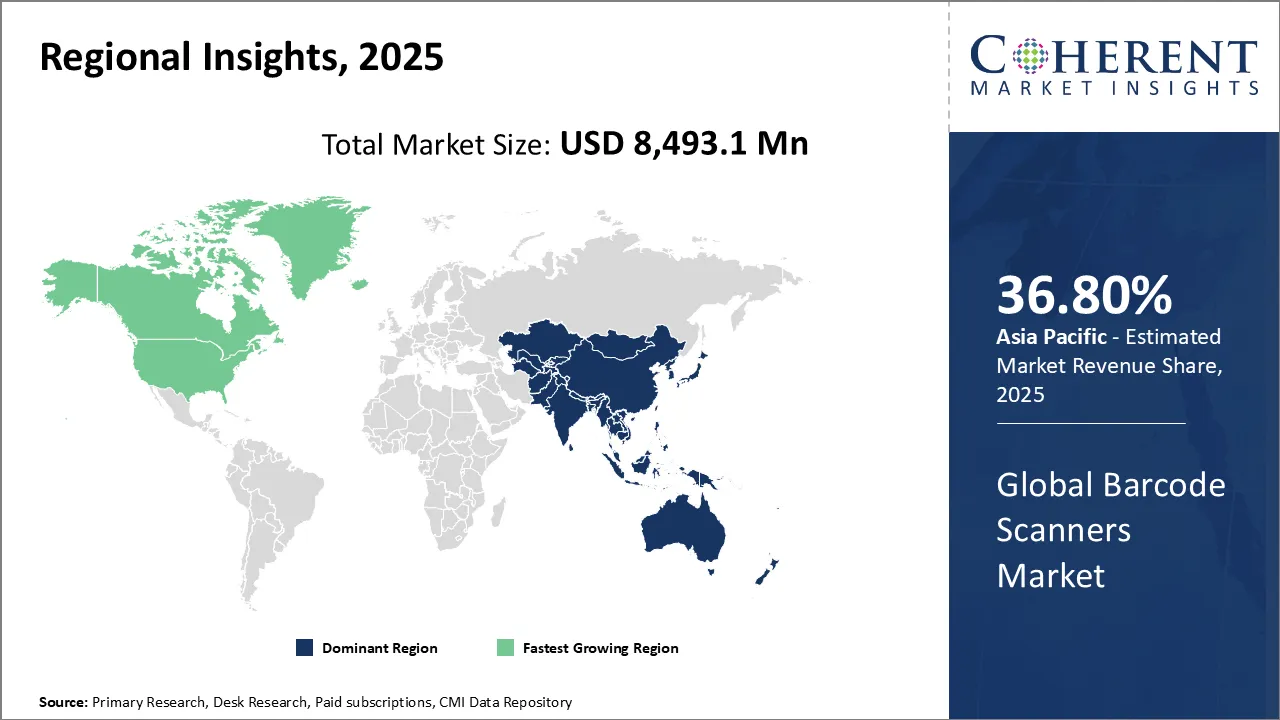
Asia Pacific Barcode Scanners Market Analysis & Trends
Asia Pacific region is projected to lead the market with a 36.80% share in 2026, driven by economical, technological, and industry-specific factors. Rapid industrialization and the expansion of manufacturing hubs across countries like China, India, Japan, and Southeast Asia have increased the need for efficient inventory and supply chain management, making barcode scanners essential for operations. The booming e-commerce and retail sectors in the region are driving the adoption of advanced scanning solutions to ensure accurate order fulfillment, stock tracking, and seamless logistics.
Additionally, the healthcare sector’s growth is fueling demand for barcode scanners to improve patient safety, track medications, and manage medical inventories. Increasing automation across warehouses, distribution centers, and production facilities further contributes to the barcode scanners market share. Moreover, the rising adoption of digital technologies, including AI integration and smart warehouse systems, is enhancing the efficiency and accuracy of barcode scanning, solidifying the barcode scanners market demand in Asia-Pacific.
Top of Form
For instance, in May 2024, Hanwha Vision unveiled the industry's first dual-lens Barcode Reader (BCR) camera, integrating barcode recognition and video surveillance into a single device. Designed for high-speed logistics environments, the AI-enabled camera captures parcel barcodes moving at speeds up to 2 meters per second. It features 4K resolution and a wide field of view with a 25mm lens.
North America Barcode Scanners Market Analysis & Trends
The North America region is expected to exhibit the fastest growth in the market contributing 29.4% share in 2026, propelled by well-established retail and e-commerce ecosystem that relies heavily on barcode scanning technology for inventory management, point-of-sale operations, and supply chain tracking. Accurate and fast data capture is critical to maintaining operational efficiency and meeting consumer expectations for quick deliveries.
Additionally, North America has a high adoption rate of advanced technologies in healthcare, including patient identification, medication tracking, and lab sample management, which heavily depends on barcode scanners to reduce errors and improve safety.
For instance, in June 2026, Omron Automation Americas introduced the VHV5 Ultra-High Performance Barcode Reader, a fixed-mount device engineered for high-speed production lines and challenging direct part marks. Designed to enhance efficiency in industries such as automotive, food packaging, and logistics, the VHV5 boasts an Automated Intelligent Setup that automatically adjusts lighting, focus, and image enhancement.
Barcode Scanners Market Outlook Country-Wise
The U.S. Barcode Scanners Market Trends
The US market is driven by highly advanced retail, logistics, and healthcare sectors that prioritize efficiency and accuracy. Barcode scanners are extensively used for inventory management, point-of-sale operations, and tracking medical supplies. The widespread adoption of automated warehouses, e-commerce fulfillment centers, and regulatory standards for product traceability also fuels the barcode scanners market demand. Businesses are increasingly investing in AI-enabled and 2D barcode scanners to reduce human errors and improve operational efficiency.
For instance, in January 2026, Cognex Corporation introduced the DataMan® 290 and 390 barcode readers, reinforcing its leadership in industrial machine vision. Leveraging advanced AI technology, these readers offer reliable decoding across diverse manufacturing applications. The DataMan 290 is designed for standard barcode reading tasks, while the DataMan 390 provides higher resolution for complex applications.
The U.K. Barcode Scanners Market Trends
In the UK, the demand is primarily influenced by modern retail chains, pharmaceutical distribution, and healthcare facilities. Barcode scanners help streamline operations, ensure accurate inventory control, and maintain compliance with regulatory requirements. The growth of e-commerce and contactless retail systems has further accelerated the adoption of advanced barcode scanning technologies across various sectors.
For instance, in August 2026, Barcode Technologies Ltd announced the launch of RFID Technologies Ltd, marking a strategic expansion into specialized RFID solutions. This new division aims to enhance real-time data capture and operational efficiency across sectors including healthcare, logistics, manufacturing, and retail. The initiative underscores Barcode Technologies' commitment to providing advanced RFID systems, encompassing UHF readers, antennas, tags, labels, and integrated software solutions.
China Barcode Scanners Market Trends
China’s barcode scanner demand is driven by rapid industrialization, a booming retail sector, and expanding e-commerce activities. Companies are increasingly adopting automated supply chains, smart warehouses, and digital inventory management systems, all of which rely on barcode scanning technology. The need to manage high volumes of products efficiently and meet rising consumer expectations has positioned China as a major growth market.
For instance, in June 2024, At Computex 2024, AiGather unveiled its latest barcode reading technology, highlighting its advanced image acquisition capabilities. The company, known for its specialization in barcode scanners, showcased innovations aimed at enhancing scanning efficiency and accuracy. These developments underscore AiGather's commitment to advancing barcode scanning solutions.
GCC Countries Barcode Scanners Market Trends
In the GCC region, modernization of retail, healthcare, and logistics infrastructure is a key driver. Governments are promoting smart technologies to enhance operational efficiency, while businesses are adopting barcode scanners to improve inventory management, supply chain tracking, and service delivery. High investments in retail expansion, logistics hubs, and smart city initiatives are contributing to increased market demand.
For instance, in January 2026, Ford, in collaboration with DB Schenker, inaugurated a state-of-the-art Parts Distribution Center (PDC) in Dubai South. Spanning 41,792 square meters, the facility consolidates Ford’s regional storage and distribution operations into a single, technologically advanced hub. Equipped with 20 container docks and capable of storing approximately 100,000 different parts, the PDC serves key markets across the GCC and Sub-Saharan Africa. The center integrates advanced material handling equipment and utilizes SAP S/4HANA warehouse management software, enabling paperless operations and precise barcode scanning.
Market Report Scope
Barcode Scanners Market Report Coverage
| Report Coverage | Details | ||
|---|---|---|---|
| Base Year: | 2025 | Market Size in 2026: | USD 9,206.5 Mn |
| Historical Data for: | 2020 To 2024 | Forecast Period: | 2026 To 2033 |
| Forecast Period 2026 to 2033 CAGR: | 8.4%2033 Value Projection: | USD 16,192.0 Mn | |
| Geographies covered: |
| ||
| Segments covered: |
| ||
| Companies covered: | Zebra Technologies Corporation, JC Square Inc., Toshiba TEC Corporation, Honeywell International Inc., Wasp Barcode Technologies, Cognex Corporation, Scandit AG, SATO Holdings Corporation | ||
| Growth Drivers: |
| ||
| Restraints & Challenges: |
| ||
Barcode Scanners Market Drivers
- Increasing use of barcode scanners in the healthcare sector is expected to drive growth of the global barcode scanners market during the forecast period
The increasing adoption of barcode scanners in the healthcare sector is playing a significant role in driving the growth of the global barcode scanners market. Healthcare facilities are increasingly relying on barcode scanning technology to improve accuracy in patient identification, medication administration, and inventory management. By automating these processes, barcode scanners reduce the risk of errors, enhance operational efficiency, and ensure compliance with stringent regulatory standards. The growing focus on patient safety, coupled with the need for real-time tracking of medical supplies and pharmaceuticals, is encouraging hospitals, clinics, and laboratories to invest in advanced scanning solutions.
For instance, in July 2025, AMBIR Technology unveiled its latest healthcare-focused barcode scanners—the BR112 USB and BR212 Wireless models, aimed at enhancing patient safety and clinical productivity. Designed for high-demand environments, these scanners efficiently read challenging barcodes on wristbands, syringes, and medication labels.
- Rising preference for retail and manufacturing industry is expected to propel the global barcode scanners market growth over the forecast period
Barcode scanners are being rapidly adopted in retail and manufacturing industries. It has become one of the best solutions for product information capturing. Barcode imprinted on labels help to record information regarding product count, date of manufacturing, date of expiry for perishable products, selling price, date on which the product was supplied to retailer, etc. Major retailers such as Walmart, Costco, Carrefour, and IKEA put barcodes on all their products. This, in turn, is expected to propel the market growth over the forecast period.
Barcode Scanners Market Opportunities
- Implementation of barcode business to maintain assets can provide lucrative business opportunities
Businesses both SMEs and large multi-national conglomerates are both fixed assets and IT assets. It includes laptops, personal computers, office furnishings, and other required peripherals. The work of the asset management staff can be made easier if barcoding is implemented within the business. After the implementation of barcodes, all assets issued to employers are barcoded, scanned, and recorded. Although barcodes are being adopted in large enterprises, its adoption is still low and medium-scale businesses. Major companies can capitalize on these opportunities and gain a competitive edge in the market. These factors are expected to positively influence the barcode scanners market forecast, highlighting strong potential for future growth as more businesses adopt barcode scanning solutions.
Barcode Scanners Market Trends
- Rising production capacity and inorganic strategies
The barcode scanners market is witnessing significant growth driven by rising production capacities and strategic inorganic expansions. Manufacturers are increasingly investing in advanced production facilities to meet the growing demand from retail, logistics, healthcare, and manufacturing sectors. This expansion not only improves supply chain efficiency but also enables the production of more sophisticated and high-performance scanners, including handheld, fixed-mount, and mobile models. In addition, companies are actively pursuing inorganic strategies such as mergers, acquisitions, and strategic partnerships to expand their market reach, diversify product portfolios, and gain access to new technologies. These moves allow businesses to rapidly scale operations, enter emerging regional markets, and strengthen their competitive positioning. Together, the combination of increased production capabilities and targeted inorganic growth initiatives is expected to drive the overall barcode scanners market size, enhancing adoption across industries and creating new revenue opportunities.
For instance, in August 2025, Zebra Technologies announced a $1.3 billion all-cash acquisition of Elo Touch Solutions, aiming to enhance its retail offerings. Elo, known for its touchscreen systems, including self-service kiosks and payment terminals, will expand Zebra's addressable market by $8 billion. The deal, expected to close in 2025, is projected to add $25 million in core profit within three years. Following strong Q2 results, Zebra raised its annual revenue growth forecast to 5%-7% and adjusted earnings per share to $15.25–$15.75.
Analyst Opinion (Expert Opinion)
The barcode scanners market value is increasingly defined by specialized, industry-focused solutions. Retailers using 2D imaging scanners have achieved up to 30% faster checkout times, while logistics warehouses integrating mobile scanners with WMS report over 25% improvement in inventory accuracy. The shift from laser to imaging and omnidirectional scanners underscores the demand for versatility, with major players prioritizing devices capable of reading damaged or poorly printed barcodes.
Wearable scanners in warehouses and manufacturing show productivity gains of 15–20% per operator, while cloud-enabled platforms enhance real-time data visibility. Barcode scanners are now strategic operational assets, and adoption of advanced technologies is essential to maintain efficiency and competitiveness.
Speak to the analyst
Want personalized insights?
Take the findings above to one of our principal consultants, or have the report rebuilt around the segments, geographies and competitors you actually track.
Recent Developments
- In July 2025, Brady Corporation introduced a new line of industrial barcode readers: V4500, V3200, and V2200, boasting a 99.995% reading accuracy. These devices utilize the proprietary CortexDecoder algorithm from Code Corporation and feature dual-field optics for precise scanning of barcodes from various angles and distances. The V4500 and V3200 models integrate with the V1400 industrial cradle, supporting data sharing via eight major industrial protocols, including Profinet and Ethernet/IP.
Market Segmentation
- By Product Type (Revenue, USD Mn, 2021 - 2033)
- Portable/handheld (Rugged scanners, PDA scanners, Automatic readers and Others)
- Fixed Position (Stationary scanners, Presentation scanners, Automatic readers and Others)
- By End-Use (Revenue, USD Mn, 2021 - 2033)
- Retail & Commercial
- General Manufacturing
- Healthcare
- Logistics & Warehouse
- Commercial Aviation
- Defense
- Others
- By Technology (Revenue, USD Mn, 2021 - 2033)
- Pen type Reader
- Laser Scanner
- CCD (Charge Coupled Device) Readers
- Camera Based Reader
- Omni directional barcode Scanner
- Smartphone based Scanner
- RFID (Radio Frequency Identification) Technology
- By Region (Revenue, USD Mn, 2021 - 2033)
- North America
- U.S.
- Canada
- Latin America
- Brazil
- Argentina
- Mexico
- Rest of Latin America
- Europe
- Germany
- U.K.
- Spain
- France
- Italy
- Russia
- Rest of Europe
- Asia Pacific
- China
- India
- Japan
- Australia
- South Korea
- ASEAN
- Rest of Asia Pacific
- Middle East
- GCC Countries
- Israel
- Rest of Middle East
- Africa
- South Africa
- North Africa
- Central Africa
- North America
- Barcode Scanners Market Companies
- Zebra Technologies Corporation
- JC Square Inc.
- Toshiba TEC Corporation
- Honeywell International Inc.
- Wasp Barcode Technologies
- Cognex Corporation
- Scandit AG
- SATO Holdings Corporation
Sources
Primary Research Interviews from the following stakeholders
Stakeholders
- Interviews with retail operations managers, warehouse managers, logistics coordinators, procurement heads, IT managers, and supply chain leads across key global markets.
Specific Stakeholders
- Digital transformation leads at retail chains (e.g., Walmart, Amazon, Reliance Retail, Carrefour)
- Operations and warehouse managers at logistics and e-commerce hubs (e.g., DHL, FedEx, Maersk, Blue Dart)
- IT and infrastructure heads at grocery and convenience store chains (e.g., Tesco, 7-Eleven, Kroger)
- Procurement and supply chain managers at manufacturing facilities and industrial distributors
- Product managers at barcode scanner OEMs and component suppliers (e.g., Honeywell, Zebra Technologies, Datalogic)
- AV and IT integrators supporting retail and warehouse automation projects
Databases
- World Trade Organization (WTO) Trade Statistics
- UN Comtrade Database
- Ministry of Electronics and Information Technology (MeitY), India
- Bureau of Economic Analysis (U.S.)
- Eurostat
- China Customs Statistics
- Korea Customs Service Data Portal
- Japan External Trade Organization (JETRO)
- Directorate General of Commercial Intelligence and Statistics (DGCIS), India
Magazines
- RFID Journal
- Supply Chain Digital
- Logistics Manager
- Modern Materials Handling
- Barcode Magazine
- TechRadar Pro – Enterprise Solutions
- Future Store Guide – Retail Technology Section
Journals
- IEEE Transactions on Automation Science and Engineering
- Journal of Retailing and Consumer Services
- International Journal of Production Research
- Journal of Industrial Information Integration
- International Journal of Logistics Management
Newspapers
- The Wall Street Journal – Technology & Logistics
- The Economic Times – Retail & Supply Chain
- The Hindu Business Line – Technology & Logistics
- Financial Times – Supply Chain & Retail Technology
- Nikkei Asia – Logistics & Electronics
Associations
- GS1 (Global Standards for Barcodes)
- AIM Global – Automatic Identification and Mobility Association
- International Warehouse Logistics Association (IWLA)
- Consumer Technology Association (CTA)
- Indian Retail Association (IRA) – Technology & Automation Forum
- European Association for Automatic Identification (EANA)
Public Domain Sources
- Ministry of Electronics and IT (Government of India)
- National Institute of Standards and Technology (NIST), U.S.
- Ministry of Economy, Trade and Industry (METI), Japan
- U.S. International Trade Commission (USITC)
- NITI Aayog – Digital and Retail Technology Reports
- India Investment Grid – Electronics & Logistics Sector
- EU Single Market Observatory – Retail & Supply Chain Reports
- Reserve Bank of India (RBI) Reports on Logistics, Retail, and Electronics
Proprietary Elements
- CMI Data Analytics Tool, and Proprietary CMI Existing Repository of information for last 8 years
Get access to 250+ pages report
Every segment, forecast, competitor profile and data table behind the analysis above — available for instant download.
- ESOMAR Member
- ISO 9001:2015 Certified
- D-U-N-S Registered
- GDPR & CCPA Compliant
Missing comfort of reading report in your local language? Find your preferred language:
Transform your Strategy with Exclusive Trending Reports
Frequently Asked Questions
The global Barcode Scanners Market size was valued at USD 9,206.5 Mn in 2026 and is expected to reach USD 16,192.0 Mn in 2027.
The market is expected to grow at 8.4% CAGR over the period (2026-2033).
Increasing use of barcode scanners in the healthcare sector is expected to drive growth of the global barcode scanners market during the forecast period.
Portable/Handheld sub-segment holds the largest market share among By Product segment contributing 81.9%% market share in terms of value in 2026.
Asia Pacific region holds the largest share in the global Barcode Scanners market in 2026, accounting for 36.8% share in terms of value.
Key players operating in the global Barcode Scanners market are Zebra Technologies Corporation, JC Square Inc., Toshiba TEC Corporation, Honeywell International Inc., Wasp Barcode Technologies, Cognex Corporation, Scandit AG, SATO Holdings Corporation
Barcode scanners read and decode barcodes to track products, manage inventory, facilitate sales, and streamline logistics efficiently.