

Thermal Imaging Market Analysis & Forecast (2026-2033)
The Global Thermal Imaging Market is anticipated to grow at a CAGR of 8.2% with USD 6.76 Bn market size in 2026 and is expected to reach around USD 11.71 Bn by 2033. Thermal imaging is increasingly used in industrial maintenance, energy systems, and automotive safety for detecting temperature variations that could signal potential equipment failure. In the U.S., the National Institute of Standards and Technology (NIST) has backed thermal imaging in industrial applications, citing its use for predictive maintenance and energy audits.
Key Takeaways
- According to the 2026 report, Surveillance and Security accounted for a leading 38% share of the application market. The increasing demand for enhanced border and perimeter surveillance is driving ongoing growth in this segment of the security market. The 2026 Government Accountability Office (GAO) Report indicates that northern-border apprehensions have more than tripled from fiscal year 2019 (FY2019) to fiscal year 2024 (FY2024). Additionally, the number of cameras, radars, and sensors deployed by the U.S. Customs and Border Protection agency has also risen during this period.
- In the End User market, the Defense and Military sector accounted for a significant share, holding 42% of overall revenue. This demand is driving ongoing military modernization and heightened procurement of surveillance equipment. The U.S. Department of Defense intends to allocate $33.6 billion to the Military Intelligence Program (MIP) in FY2026. For the fiscal year 2026–27, India's defense budget is expected to reach ₹784,678.3 crore, reflecting a 15.2% increase, along with a 21.8% rise in capital expenditure for defense services.
- North America retained its position as the largest global market in 2026, holding a 31.8% share. This leadership can be attributed to significant spending on defense, border security, and the adoption of public safety technologies. The 2026 report indicated that North America maintained the same 31.8% share in 2025. Additionally, in September 2026, the U.S. approved a proposed defense budget request of USD 961.6 billion, while the GAO highlighted that U.S. Customs and Border Protection (CBP) will continue to expand its deployment of surveillance technology.
Segmental Insights
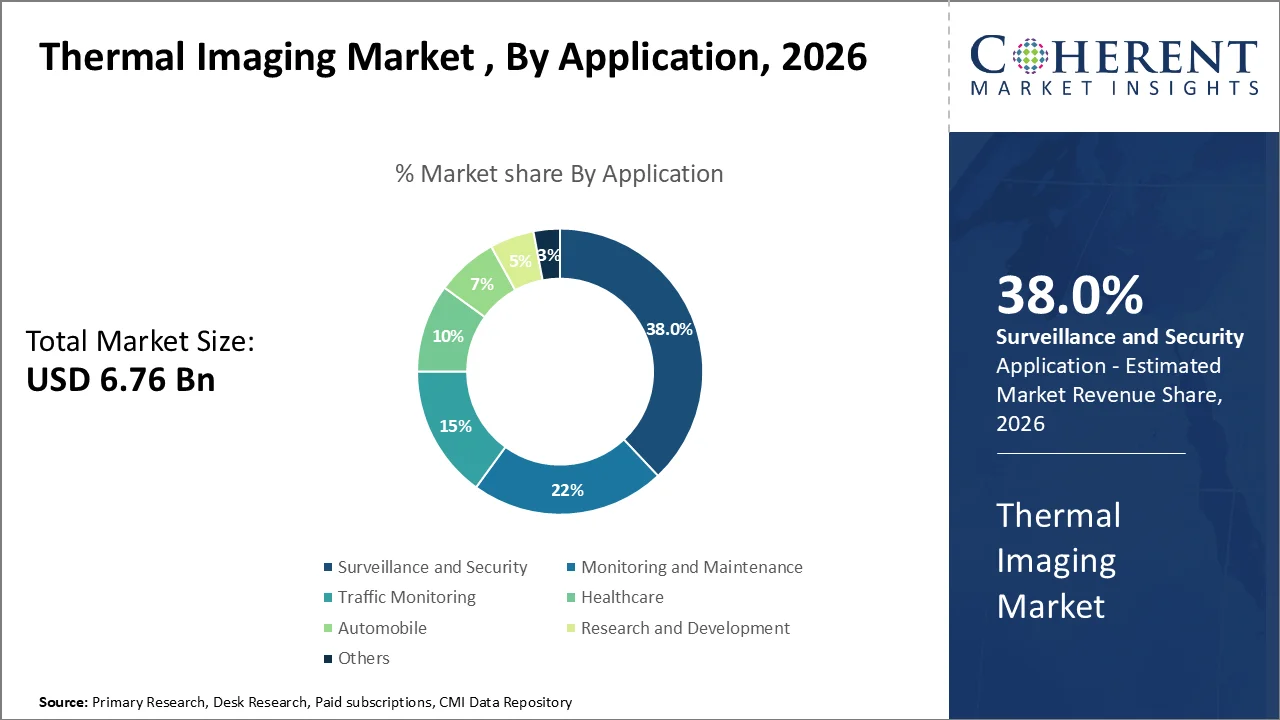
By Application, the Surveillance and Security dominate with 38% of market share in 2026
The Surveillance and Security segment accounted for the largest share of the thermal imaging market, representing 38% in 2026. This segment has led the market due to the ability of thermal cameras to provide 24/7 detection in all conditions, including total darkness, smoke, and adverse weather. According to a GAO report from the United States in 2026, Border Patrol apprehensions at the northern border have increased more than threefold from 2019 to 2024. Additionally, Customs and Border Protection has implemented more surveillance technologies, including cameras, radar systems, and other sensors, to address this growing demand.
There are two main driving forces behind the growth of this segment. First, there is an increased demand for continuous monitoring systems that operate both day and night, driven by escalating border and public safety threats that visible light cameras can no longer adequately address. Second, critical infrastructure, industrial sites, ports, and transportation hubs are increasingly employing thermal analytics to identify threats, enhance response capabilities, and reduce false alarms in these high-risk environments.
On 10 February 2026, Teledyne FLIR introduced new Neutrino ISR Thermal Imaging platform capable of conducting long-range intelligence, surveillance, and reconnaissance activities is suited for this application.
- Current Industry Events of 2026
- Market Size Estimation
- Regional Breakdown
- Competitive Landscape
- Customer Intelligence
- Segmental Analysis
- Pricing Analysis
- Key Market Drivers, Challenges & Future Trends
- Customized Insights Section
By End-User, the Defense and Military Sector dominate with 42% of market share in 2026
border control. The ongoing commitment to defense budgets in this area is evidenced by the U.S. Department of Defense’s request for a Fiscal Year (FY) 2026 budget of USD 961.6 billion, along with the FY 2026 Military Intelligence Program request of USD 33.6 billion. These figures confirm the demand for and purchases of updated and modernized thermal and infrared systems. (Source: War.Gov)
Many contemporary military engagements require enhanced capabilities, relying on reliable thermal imaging to conduct surveillance, support reconnaissance, and provide target acquisition in conditions of reduced visibility. Furthermore, the increased utilization of thermal imaging systems in modern military operations is complemented by defense modernization programs that lead to higher expenditures on unmanned systems platforms, intelligence-based systems, weapon sights, and integrated sensor fusion technologies.
Official developments also highlight these opportunities for development and to the respective sectors. For example, On 26 June 2025, the Pentagon formally released the USD 33.6 billion FY2026 Military Intelligence Program request, underscoring continued spending momentum in defense sensing and surveillance technologies.
Thermal Imaging Market Trends
- The concept of thermal fusion has become increasingly significant in military imaging. In August 2025, the U.S. Army announced that its Binocular Night Vision Device-Fused (BNVD-F) integrates traditional image intensification technology with thermal imaging technology to enhance aircrew situational awareness. According to the Army Infantry website, the ENVG-B is powered by four lithium AA batteries, providing approximately eight hours of battery life. This indicates that fused thermal devices are operational rather than experimental. (Source: ARMY)
- Thermal imaging is increasingly being adopted for firefighting and emergency response operations. According to the U.S. Fire Administration, 81 firefighters lost their lives in the line of duty in 2025, and 405 individuals died in residential fires. This underscores the urgent need for more effective methods of seeing through smoke. In July 2025, the Fire Protection Research Foundation of the NFPA released a report highlighting the necessity for thermal imaging cameras to enhance image quality for firefighters operating in extremely low-light conditions. The report anticipates ongoing advancements in image quality and performance for thermal imaging products. (Source: USFA)
Current Events and Their Impact
Current Event | Description and its Impact |
U.S. Department of Defense Policy Update on Thermal Imaging Systems |
|
European Union Regulations on Thermal Imaging in Public Safety |
|
Regional Insights
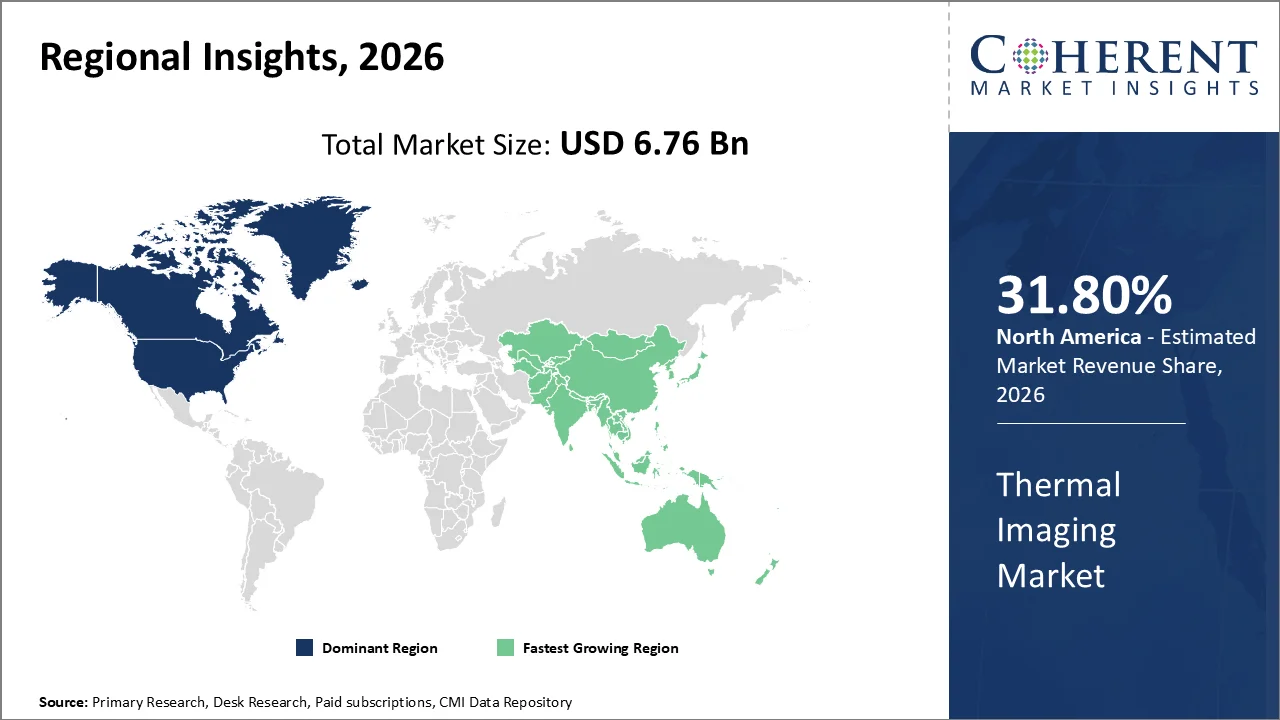
North America Thermal Imaging Market Dominates with Strong Defense and Public Safety Demand
North America currently leads the thermal imaging technology industry, holding a 31.80% market share. This growth can be largely attributed to significant military spending, particularly in the U.S. According to the U.S. Energy Information Administration, 5.9 million commercial buildings in the U.S. consumed 6.8 quadrillion Btu and spent USD 141 billion on energy. This indicates a significant need for building inspections and diagnostics. Additionally, the National Institute of Standards and Technology (NIST) reports that most first-responder groups in the U.S. either already possess or are considering acquiring thermal imaging cameras. (Source: EIA)
Asia Pacific Emerging as the Fastest-Growing Thermal Imaging Market
When comparing regions, it is evident that the growth of thermal imaging technologies is the fastest in the Asia-Pacific region, which holds a 29% market share. This growth has been primarily driven by the modernization of national defense, rapid urbanization, and advancements in industrial automation. The International Federation of Robotics reports that in 2024, Asia accounted for 74% of all new industrial robots, with a total of 401,665 units installed. Notably, China alone installed 295,045 units. Additionally, India's defense spending for the 2026–27 period increased to ₹219,306.47 crore, enabling the purchase of more advanced surveillance and sensing systems. Furthermore, the United Nations Economic and Social Commission for Asia and the Pacific (ESCAP) states that the Asia-Pacific region is home to over 2.2 billion people living in urban areas and is projected to contribute nearly 60% of the world's urban growth by 2040. (Source: IFR)
Country Analysis
United States: Driving North America's Thermal Imaging Market
North America plays a significant role in the global thermal imaging market. With substantial investments in military and national security, the U.S. leads in thermal imaging technology within North America. The Department of Defense’s FY2026 Military Intelligence Program budget request is USD 33.6 billion, supporting continued surveillance and sensing investments. The U.S. Energy Information Administration also reports that 5.9 million commercial buildings consumed 6.8 quadrillion Btu and spent USD 141 billion on energy, reinforcing demand for thermal inspection and energy-audit tools.
China: Key Player in Asia Pacific’s Thermal Imaging Growth
In the Asia Pacific region, China stands out as a key player in the thermal imaging market. The rapid adoption of thermal imaging across both military and civilian sectors is notable. According to the International Federation of Robotics, China had 295,045 industrial robot installations in 2024, accounting for 54% of all installations worldwide. Additionally, the National Bureau of Statistics of China reports that by the end of 2025, 67.89% of permanent residents will live in urban areas. This combination facilitates the use of thermal cameras in sectors such as manufacturing, utilities, transportation, and public safety.
Market Report Scope
Thermal Imaging Market Report Coverage
| Report Coverage | Details | ||
|---|---|---|---|
| Base Year: | 2025 | Market Size in 2026: | USD 6.76 Bn |
| Historical Data for: | 2020 To 2024 | Forecast Period: | 2026 To 2033 |
| Forecast Period 2026 to 2033 CAGR: | 8.2% | 2033 Value Projection: | USD 11.71 Bn |
| Geographies covered: |
| ||
| Segments covered: |
| ||
| Companies covered: | FLIR Systems Inc. (FLIR), Raytheon Company, BAE Systems Inc., L-3 Communications Holdings, Inc., Axis Communications AB, Danaher Corporation, and DRS Technologies Inc. | ||
Who are the Major Companies in Thermal Imaging Market?
Major companies are FLIR Systems Inc. (FLIR), Raytheon Company, BAE Systems Inc., L-3 Communications Holdings, Inc., Axis Communications AB, Danaher Corporation, and DRS Technologies Inc.
Key News
In December 2025, Teledyne FLIR OEM worked with SYPAQ Systems to add Boson thermal infrared cameras to the CorvoX small unmanned aerial system (sUAS) for the Australian Army's DEF129 program. This was done to improve situational awareness.
Analysts Opinion
- The strength of the defense budget bolsters demand for thermal imaging technologies. Analysts indicate that, given the record levels of defense spending in the US, the ongoing emphasis on advanced surveillance, reconnaissance, and sensor systems is reflected in the Department of Defense's request for USD 961.6 billion in their FY2026 budget. Additionally, the current investment climate suggests that the procurement of thermal imaging products will remain stable, even in the face of short-term cyclical downturns, especially for military platforms, ISR payloads, and border security sensors.
Speak to the analyst
Want personalized insights?
Take the findings above to one of our principal consultants, or have the report rebuilt around the segments, geographies and competitors you actually track.
Market Segmentation
- Global Thermal Imaging Market, BY Application
- Surveillance and security
- Monitoring and maintenance
- Traffic monitoring
- Healthcare
- Automobile
- Research and development
- Others (firefighting and personal vision)
- Global Thermal Imaging Market, By End-Users
- Defense and military sector
- Industrial sector
- Commercial sector
- Residential sector
- Global Thermal Imaging Market, By Region
- North America
- U.S.
- Canada
- Europe
- U.K.
- Germany
- Italy
- France
- Russia
- Rest of Europe
- Asia Pacific
- China
- India
- Japan
- ASEAN
- Australia
- South Korea
- Rest of Asia Pacific
- Middle East and Africa
- GCC Countries
- Israel
- Rest of Middle East & Africa
- North America
- Key Players
- FLIR Systems Inc. (FLIR),
- Raytheon Company,
- BAE Systems Inc.,
- L-3 Communications Holdings, Inc.,
- Axis Communications AB,
- Danaher Corporation,
- DRS Technologies Inc.
Sources
Primary Research Interviews
- Military Technology Experts
- Law Enforcement Professionals
- Fire Safety Personnel
Databases
- U.S. Department of Defense (DoD) Database
- National Fire Protection Association (NFPA) Database
- Federal Aviation Administration (FAA) Database
Magazines
- Defense Technology International
- Firehouse Magazine
- Wired Magazine
Journals
- Journal of Infrared and Millimeter Waves
- Sensors and Actuators A: Physical
- Journal of Electronic Imaging
Newspapers
- The New York Times
- The Wall Street Journal
- China Daily
Associations
- Thermal and Infrared Imaging Society (T2IS)
- International Association of Fire Fighters (IAFF)
- Infrared Training Center (ITC)
Public Domain Sources
- U.S. Government Accountability Office (GAO)
- NASA Technical Reports Server (NTRS)
- EU Publications Office
Proprietary Elements
- CMI Data Analytics Tool
- Proprietary CMI Existing Repository of information for last 8 years
Get access to 250+ pages report
Every segment, forecast, competitor profile and data table behind the analysis above — available for instant download.
- ESOMAR Member
- ISO 9001:2015 Certified
- D-U-N-S Registered
- GDPR & CCPA Compliant
Missing comfort of reading report in your local language? Find your preferred language:
Transform your Strategy with Exclusive Trending Reports
Frequently Asked Questions
The Global Thermal Imaging Market is expected to grow at a rate of 8.2% per year, reaching a size of USD 6.76 billion by 2026 and USD 11.71 billion by 2033. The main reason for this growth is that more people are using it in areas like security, surveillance, industrial inspection, defense, and emergency response.
The Surveillance and Security application segment holds the largest share of the Thermal Imaging Market, with 38% of the market in 2026. This is because there is a growing need for better surveillance systems at the border and on the perimeter. This dominance is also due to more money being spent on thermal surveillance technologies because of rising security threats.
The Thermal Imaging Market is led by the Defense and Military sector, which will have 42% of the market share in 2026. This sector is the most important because of the growing need for advanced surveillance, reconnaissance, and situational awareness technologies. This is supported by rising defense budgets around the world, which shows how much money the sector has invested.
Growing need for security and surveillance: As worries about safety grow, especially for protecting infrastructure and watching over borders. Technological advancements: Combining AI with smaller sensors is making thermal imaging easier to use and cheaper. Rising military spending: More money is being spent on defense around the world, which is driving up the demand for thermal imaging technologies.