

Rugged Thermal Cameras Market Size and Share Analysis - 2026 To 2033
The global rugged thermal cameras market size is estimated to reach USD 7,750 Mn in 2026 and is projected to grow at a CAGR of 9.0% during the forecast period (2026-2033), surpassing USD 14,167 Mn by 2033. This is attributable to increasing demand for advanced surveillance and security systems across military, defense, and border monitoring applications, along with rising adoption in industrial inspection and predictive maintenance activities.
Rising military spending is acting as a catalyst triggering growth of rugged thermal cameras market. There is a rapid increase in global military and defense expenditure. For instance, according to the Stockholm International Peace Research Institute (SIPRI), world military expenditure reached approximately USD 2,718 billion in 2024. This, in turn, is creating growth prospects for manufacturers of rugged thermal cameras and other surveillance products.
Key Takeaways from the Rugged Thermal Cameras Market Report
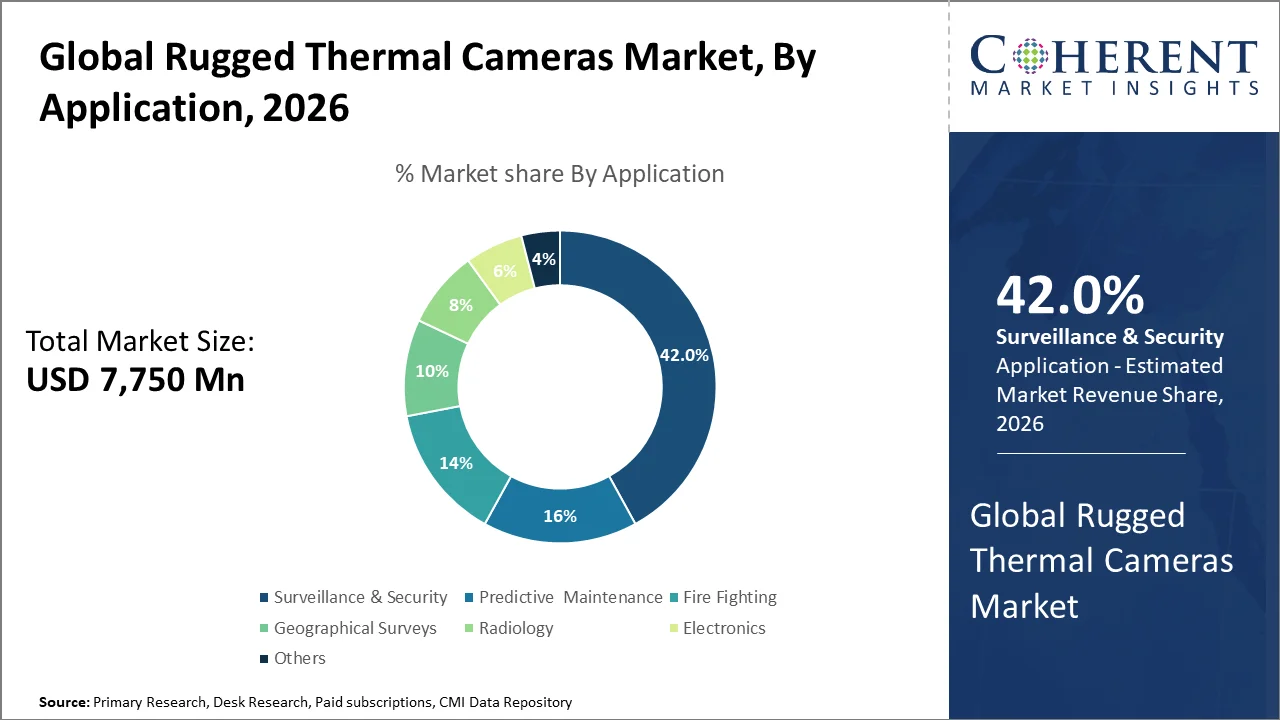
- Security & surveillance segment is expected to lead the market with a share of 42% in 2026 due to increasing adoption of rugged thermal cameras for border security, perimeter monitoring, critical infrastructure protection, and defense surveillance in harsh operating environments. For example, the U.S. Department of Homeland Security is deploying nearly 400 miles of new surveillance technology and 230 miles of Smart Wall systems, boosting demand for rugged thermal cameras for continuous border monitoring.
- Military & defense is forecasted to account for the largest market share of 38% in 2026 because of rising use of rugged thermal cameras for battlefield surveillance, target acquisition, border security, and reconnaissance operations. SIPRI reported a 2.9% increase in global military spending in 2025, supporting higher procurement of defense surveillance systems, including rugged thermal cameras.
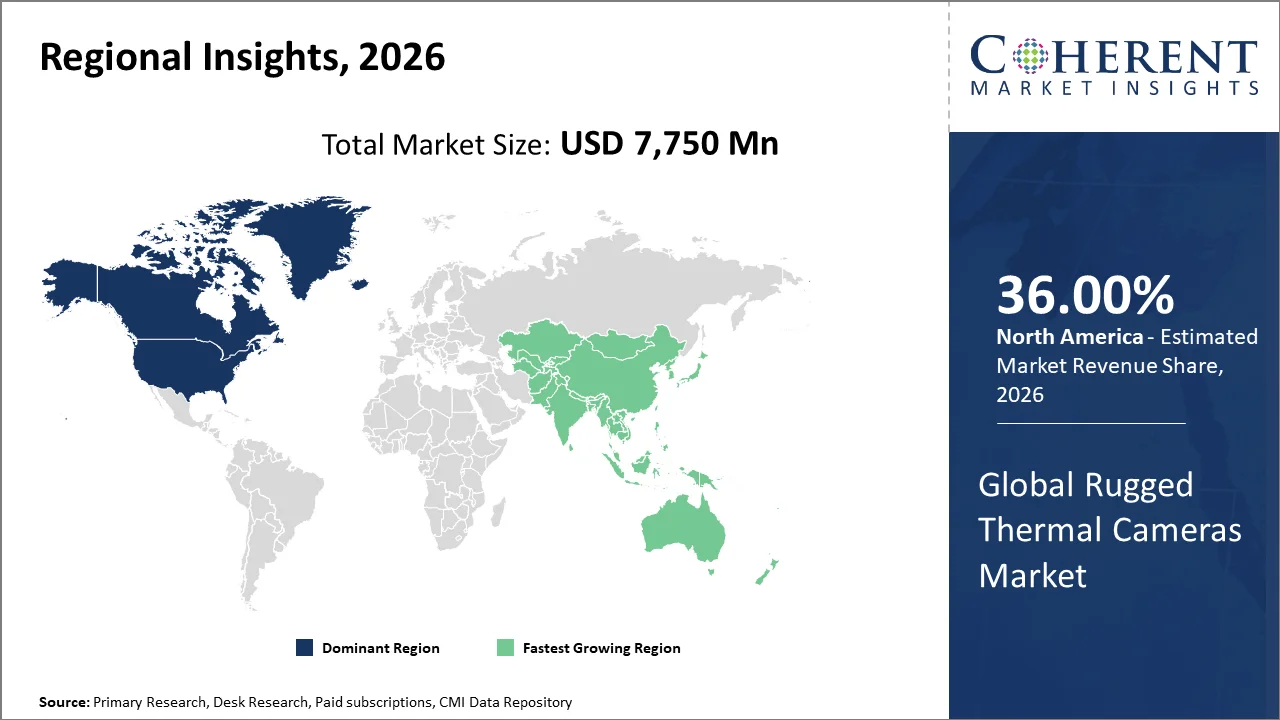
- North America is projected to dominate the global rugged thermal cameras industry with a share of 36% in 2026 due to high defense spending and increasing adoption of industrial automation. For example, the U.S. spent USD 997 billion on defense in 2024, the highest globally, boosting demand for advanced surveillance and reconnaissance systems that use rugged thermal cameras.
- Asia Pacific is poised to emerge as a highly lucrative market for rugged thermal camera manufacturers during the forecast period, registering a CAGR of 10%, thanks to rapid infrastructure development, defense modernization, and increasing investments in industrial automation and public safety. Supporting this trend, military spending in Asia and Oceania reached USD 629 billion in 2024, up 6.3% from 2023.
Rugged Thermal Cameras Market Overview
The global rugged thermal cameras market is projected to register strong growth during the forecast period. This is primarily due to rising demand for durable thermal imaging solutions across defense, industrial, public safety, and infrastructure inspection applications. Similarly, increasing investments in border surveillance, critical infrastructure protection, predictive maintenance, and emergency response operations are boosting sales of rugged thermal cameras.
Rugged thermal cameras are designed to operate reliably in harsh environmental conditions, including extreme temperatures, dust, moisture, vibration, and mechanical shock, making them ideal for mission-critical operations. Rising investments in border surveillance, predictive maintenance, firefighting, search and rescue, and energy infrastructure monitoring are expected to boost growth of rugged thermal cameras market during the forecast period.
Declining manufacturing costs have expanded the adoption of thermal imaging technology, enabling new applications such as drones and specialized smartphones equipped with thermal sensors. These emerging applications are expected to drive demand for rugged thermal cameras during the forthcoming period. In addition, continuous advancements in thermal sensor technology, improved image resolution, AI-powered analytics, and compact camera designs are enhancing the capabilities as well as increasing adoption of rugged thermal cameras across both government and commercial sectors.
Increasing demand for rugged thermal cameras from firefighting and emergency response is expected to boost revenue growth during the forecast period. Firefighters and rescue teams rely on rugged thermal cameras for search-and-rescue missions, hotspot detection, and navigation through smoke-filled environments. Similarly, expansion of critical infrastructure monitoring is fueling demand for rugged thermal cameras. Utilities, transportation networks, and energy facilities are deploying rugged thermal imaging systems to enhance asset monitoring, security, and operational safety.
There is also a rising shift towards uncooled thermal sensors due to their lower cost, compact size, and reduced maintenance requirements. This is encouraging rugged thermal camera companies to continuously upgrade their portfolios. For instance, in May 2026, Leonardo DRS, Inc. announced the launch of Tenum 640 Orbit, an advanced uncooled long-wave infrared (LWIR) thermal camera module optimized for unmanned air, ground, and maritime platforms.
Segmental Insights
Which Application Holds the Largest Share in the Rugged Thermal Cameras Market?
Security & Surveillance to Account for Over Two-Fifths of the Market in 2026
According to Coherent Market Insights’ latest rugged thermal cameras market analysis, security & surveillance segment is set to account for the largest revenue share of 42% in 2026. This dominance is attributable to increasing adoption of thermal imaging systems for perimeter protection, border monitoring, critical infrastructure security, and public safety applications.
For example, the U.S. president announced more than USD 170 billion for immigration and border security programs, increasing investments in surveillance technologies such as thermal cameras, drones, and AI-enabled monitoring systems. This funding is expected to boost the use of rugged thermal cameras for border monitoring, perimeter security, and defense surveillance.
Rugged thermal cameras provide reliable performance in low-light, smoky, dusty, and adverse weather conditions. This is making them indispensable for continuous surveillance across military installations, airports, industrial facilities, and smart city projects. Rising security concerns, growing investments in advanced surveillance infrastructure, and the integration of AI-powered analytics with thermal imaging solutions are set to boost growth of the target segment during the forecast period.
- Current Industry Events of 2026
- Market Size Estimation
- Regional Breakdown
- Competitive Landscape
- Customer Intelligence
- Segmental Analysis
- Pricing Analysis
- Key Market Drivers, Challenges & Future Trends
- Customized Insights Section
Which End Use Segment Dominates the Rugged Thermal Cameras Market?
Rugged Thermal Camera Demand Remains High in Military & Defense Sector
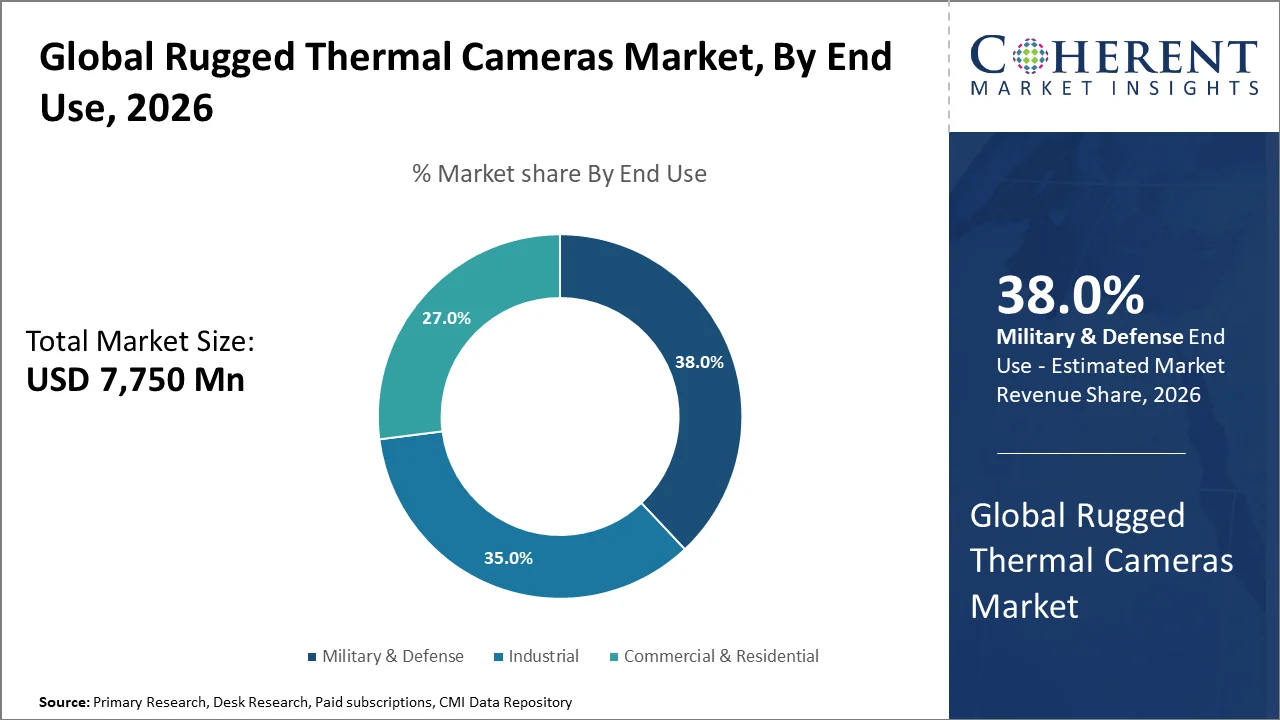
By end use, military & defense segment is projected to lead the global rigged thermal cameras industry, capturing a share of 38% in 2026. This is mostly due to growing adoption of thermal imaging systems for border surveillance, target acquisition, reconnaissance, night vision operations, and force protection.
Defense organizations across the world are increasingly investing in advanced electro-optical and infrared (EO/IR) technologies to improve situational awareness as well as enhance operational effectiveness in challenging environments. In May 2026, Electro Optic Systems Holdings Limited (EOS) completed a fully underwritten institutional placement raising A$150 million, along with a A$40 million strategic investment from defence-focused investors, including Calidus. The funding enhances EOS’s financial position and supports growth initiatives, including the acquisition of MARSS and ongoing investments in advanced defence technologies. This is expected to boost rugged thermal camera sales during the forthcoming period.
Rugged thermal cameras are designed to withstand extreme temperatures, humidity, dust, vibration, and shock, making them ideal for military missions across diverse terrains. Rising defense modernization programs, increasing geopolitical tensions, and higher spending on unmanned systems, armored vehicles, and portable surveillance equipment are also boosting growth of target segment.
Rugged Thermal Cameras Market Growth Drivers
Rising Defense and Border Security Investment
Increasing spending on defense and border security is providing a strong impetus for the growth of the rugged thermal cameras market. Rising terrorism and organized crime are prompting governments worldwide to strengthen surveillance and border protection capabilities. For instance, the This is encouraging the adoption of rugged thermal cameras for surveillance, reconnaissance, target detection, and perimeter security in extreme weather and low-visibility conditions.
For example, in January 2026, the U.S. Army awarded Teledyne FLIR Defense a contract worth up to $32 million to supply advanced electro-optical/infrared (EO/IR) reconnaissance kits for Stryker armored vehicles being delivered to Bulgaria. The systems include long-range thermal imaging for intelligence, surveillance, reconnaissance (ISR), and target detection in all-weather and low-visibility conditions, showing the rising use of rugged thermal imaging technologies in military applications. Thus, rising security threats and increasing defense spending are expected to drive the demand for rugged thermal cameras during the forecast period.
Rugged Thermal Cameras Market Trends
Integration of AI and Edge Analytics
Adoption of artificial intelligence and edge analytics is a key growth-shaping trend in the rugged thermal imaging cameras market. Manufacturers in the contemporary world are increasingly embedding AI-enabled processors in rugged thermal cameras to support real-time anomaly detection, automated threat identification, and predictive maintenance, especially in industrial, defense, and critical infrastructure applications.
For example, in September 2025, Teledyne FLIR OEM launched the Boson+ IQ Thermal Imaging Development Kit at DSEI. The system integrates thermal sensing with Prism AI and edge computing capabilities, enabling real-time object detection and AI-based processing for defense, security, and industrial applications.
Current Events and Their Impact on the Rugged Thermal Cameras Market
Current Event | Description and its Impact |
U.S. Export Reporting Requirements for Thermal Imaging Cameras (2025–2026) |
|
Growing Defense Procurement for Thermal Imaging Systems |
|
Regional Insights
Strong Defense and Industrial Demand Making North America a Dominant Market
North America is projected to hold around a 36% share of the global rugged thermal cameras market in 2026. This dominance is attributed to rising defense spending, advanced manufacturing infrastructure, and increasing adoption of high-end thermal imaging systems. In addition, growing demand from firefighting and emergency response applications is expected to boost rugged thermal camera sales in the region during the forecast period.
The growing adoption of rugged thermal cameras in military surveillance applications, border security, firefighting activities, and industrial inspections, where ruggedness is important in extreme operating conditions, is fueling growth of the market. For example, the United States continues to be the largest spending nation in terms of military expenditure with spending estimated at approximately $916 billion in 2023, supporting the demand for advanced thermal imaging and surveillance systems.
Asia Pacific to Emerge as a Central Hub for Rugged Thermal Camera Manufacturers
Asia Pacific is expected to emerge as the fastest-growing market for rugged thermal cameras during the forecast period, registering a CAGR of over 10%. This is mostly due to rapid industrial expansion, defense modernization, infrastructure development, and rising adoption of advanced surveillance and inspection technologies.
Increasing use of rugged thermal cameras in industrial automation, construction monitoring, and public safety applications is boosting market growth in the region. For example, China’s industrial output has continued expanding strongly, with manufacturing value added reaching about USD 4.66 trillion in 2024. This supports higher deployment of advanced inspection and machine-vision systems, including thermal imaging for quality control and predictive maintenance in factories and infrastructure projects.
Rugged Thermal Cameras Market Outlook – Country-wise
U.S. Rugged Thermal Cameras Market Trends
The United States is expected to remain a leading market for rugged thermal cameras during the projection period. This is due to increasing defense and military investments, rising frequency of climate-related extreme events such as heatwaves, wildfires, and storms, and rapid expansion of critical infrastructure sectors, including data centers, EV charging networks, and power grid modernization programs. These factors are significantly increasing the demand for reliable thermal inspection tools for predictive maintenance and fault detection in critical infrastructure.
China Rugged Thermal Cameras Market Forecast
The rugged thermal cameras market in China is projected to witness strong growth throughout the forecast period. This can be attributed to increasing adoption of advanced surveillance systems across defense and border security applications, rapid expansion of industrial automation and smart manufacturing initiatives, and growing investments in critical infrastructure development. Similarly, rising demand for enhanced safety and monitoring solutions in harsh operating environments such as energy, mining, and transportation sectors is boosting sales of rugged thermal cameras in the country.
Who are the Major Companies in the Rugged Thermal Cameras Market?
Some of the major players in rugged thermal cameras market are Flir Systems, Inc., Fluke Corporation, BAE Systems, Inc., Bosch Security Systems, Raytheon Company, SKF, Leonardo SpA, Thermoteknix Systems Ltd., Axis Communication, and L3 technologies Inc.
Key Strategies Adopted by Industry Players
Top manufacturers of rugged thermal cameras are adopting various organic and inorganic strategies to boost their sales as well as gain a competitive edge in the industry. These include new product launches, distribution agreements, collaborations, partnerships, mergers, acquisitions, and joint ventures.
- In January 2026, Teledyne FLIR OEM introduced the Tura automotive-qualified thermal camera at CES 2026. The camera is designed for advanced driver-assistance systems (ADAS) and autonomous vehicles.
- In September 2025, Hanwha Vision launched its next-generation QVGA AI thermal surveillance camera. The camera is designed to improve perimeter security with AI-based object detection and thermal imaging.
- In November 2025, FOTRIC launched the TK6 Handheld Thermal Imaging Camera. The camera features a 384 × 288 thermal detector and is designed for professional inspection applications.
- In June 2025, Seek Thermal launched a new generation of LWIR thermal sensor technology for automotive applications. It is designed to support functional safety while also delivering cost-effective performance for vehicle systems such as ADAS.
Market Report Scope
Rugged Thermal Cameras Market Report Coverage
| Report Coverage | Details | ||
|---|---|---|---|
| Base Year: | 2025 | Market Size in 2026: | USD 7,750 Mn |
| Historical Data for: | 2020 To 2024 | Forecast Period: | 2026 To 2033 |
| Forecast Period 2026 to 2033 CAGR: | 9.0% | 2033 Value Projection: | USD 14,167 Mn |
| Geographies covered: |
| ||
| Segments covered: |
| ||
| Companies covered: | Flir Systems, Inc., Fluke Corporation, BAE Systems, Inc., Bosch Security Systems, Raytheon Company, SKF, Leonardo SpA, Thermoteknix Systems Ltd., Axis Communication, and L3 technologies Inc. | ||
| Growth Drivers: |
| ||
| Restraints & Challenges: |
| ||
Analyst Opinion (Expert Opinion)
- Growing use in critical industries is fueling rugged thermal cameras market demand. Rugged thermal cameras are increasingly used in firefighting, defense, utilities, oil & gas, and industrial inspections because they can detect heat in smoke, darkness, and harsh environments.
- Lower-cost uncooled thermal sensors are expanding adoption. Improvements in uncooled infrared technology are making rugged thermal cameras smaller, more affordable, and easier to deploy in field operations. Lower ownership costs encourage adoption by industrial users, emergency responders, and infrastructure operators.
- AI and smart analytics are improving inspection efficiency. Manufacturers are integrating AI-powered image analysis, wireless connectivity, and real-time reporting into rugged thermal cameras, helping users detect faults faster and reduce manual inspections. These advanced features increase product value and encourage upgrades to next-generation thermal imaging systems.
Speak to the analyst
Want personalized insights?
Take the findings above to one of our principal consultants, or have the report rebuilt around the segments, geographies and competitors you actually track.
Market Segmentation
- By Application Insights ( Revenue, USD Mn, 2021 - 2033)
- Fire Fighting
- Geographical Surveys
- Surveillance & Security
- Radiology
- Predictive Maintenance
- Electronics
- Others
- By End Use Insights ( Revenue, USD Mn, 2021 - 2033)
- Military & Defense
- Industrial
- Commercial & Residential
- By Region Insights ( Revenue, USD Mn, 2021 - 2033)
- North America
- U.S.
- Canada
- Latin America
- Brazil
- Argentina
- Mexico
- Rest of Latin America
- Europe
- Germany
- U.K.
- Spain
- France
- Italy
- Russia
- Rest of Europe
- Asia Pacific
- China
- India
- Japan
- Australia
- South Korea
- ASEAN
- Rest of Asia Pacific
- Middle East
- GCC
- Israel
- Rest of Middle East
- Africa
- North Africa
- Central Africa
- South Africa
- North America
Sources
Primary Research Interviews
- Chief Executive Officers (CEOs)
- Vice Presidents (VPs)
- Product Managers
- Business Development Managers
- Sales & Marketing Executives
- Thermal Imaging Engineers
- Defense & Security Procurement Managers
- Industrial Inspection Specialists
- System Integrators
- Distributors and Channel Partners
Databases
- UN Comtrade Database
- Eurostat
- U.S. Census Bureau
- World Bank Open Data
- International Trade Centre (ITC) Trade Map
- OECD Data
- International Monetary Fund (IMF) Data
- SIPRI Military Expenditure Database
Magazines
- Military & Aerospace Electronics
- Security Today
- Photonics Media
- Vision Systems Design
- Imaging and Machine Vision Europe
- Electronic Products
Journals
- Infrared Physics & Technology
- IEEE Sensors Journal
- Optical Engineering
- Applied Optics
- Journal of Electronic Imaging
- Sensors (MDPI)
Newspapers
- The Wall Street Journal
- Financial Times
- The Economic Times
- Business Standard
- Nikkei Asia
Associations
- SPIE – The International Society for Optics and Photonics
- Optica (formerly OSA)
- IEEE Photonics Society
- Association for Uncrewed Vehicle Systems International (AUVSI)
- National Defense Industrial Association (NDIA)
- International Association of Chiefs of Police (IACP)
Public Domain Sources
- U.S. Department of Defense (DoD)
- U.S. Department of Homeland Security (DHS)
- NASA
- National Institute of Standards and Technology (NIST)
- European Commission
- European Defence Agency (EDA)
- U.S. General Services Administration (GSA)
- Export-Import Data from National Customs Authorities
- Government Procurement Portals
- Company Annual Reports, SEC Filings, Investor Presentations, and Press Releases
Proprietary Elements
- CMI Data Analytics Tool
- Proprietary CMI Existing Repository of information for last 10 years
Get access to 250+ pages report
Every segment, forecast, competitor profile and data table behind the analysis above — available for instant download.
- ESOMAR Member
- ISO 9001:2015 Certified
- D-U-N-S Registered
- GDPR & CCPA Compliant
Missing comfort of reading report in your local language? Find your preferred language:
Transform your Strategy with Exclusive Trending Reports
Frequently Asked Questions
The global Rugged Thermal Cameras Market is estimated to be valued at USD 7,750 Mn in 2026.
The global Rugged Thermal Cameras Market value is expected to reach USD 14,167 Mn by 2033.
The global Rugged Thermal Cameras Market is poised to exhibit a CAGR of 9.0% from 2026 to 2033.
Major growth factors include increasing defense budgets and declining cost in manufacturing of thermal imaging cameras.
Security & surveillance segment is expected to lead the market with a share of 42% in 2026
Some major companies in the rugged thermal cameras market include Flir Systems, Inc., Fluke Corporation, BAE Systems, Inc., Bosch Security Systems, Raytheon Company, SKF, Leonardo SpA, Thermoteknix Systems Ltd., Axis Communication, and L3 technologies Inc.
North America is set to dominate the global rugged thermal cameras market with a share of 36% in 2026