

Crude Oil Flow Improvers Market Size and Forecast
Crude Oil Flow Improvers Market is estimated to be valued at USD 1,954.9 Mn in 2026 and is expected to reach USD 2,843.8 Mn in 2033, exhibiting a compound annual growth rate (CAGR) of 5.5% from 2026 to 2033.
Key Takeaways
- By Product Type, Paraffin Inhibitors dominates the overall market in 2026 owing to its cold‑climate & subsea operating conditions.
- By Application, Extraction acquired the prominent share of 46% in 2026 as expansion of pipeline & well infrastructure.
- By Region, North America hold the largest market share of 28.90% in 2026 as cost efficiency & regulatory pressures.
Market Overview
Global crude oil flow improvers market is focused on boosting production of crude oil across the globe. Increasing hydraulic fracturing activities, surging demand of crude oil, rising investment for the development of advanced and technical products are some of the factors that can drive the global crude oil flow improvers market growth during the forecast period of 2026-2033. Increasing production from renewable resources and rising research activities will create new and ample opportunities for the market during the forecast period.
Current Events and their Impact on the Crude Oil Flow Improvers Market
Current Events | Description and its impact |
Geopolitical Disruptions in Energy Transportation |
|
Regulatory and Environmental Shifts |
|
Regional Market Dynamics |
|
End-user Feedback and Unmet Needs in the Crude Oil Flow Improvers Market End-user Feedback and Unmet Needs
- Demand for Real-Time Flow Monitoring: End-users express the need for better integration of flow improvers with real-time monitoring systems. Many operators struggle to track additive performance under dynamic flow conditions, resulting in suboptimal dosing and inconsistent results across varying crude compositions and pipeline conditions.
- High Cost of Specialty Chemicals: Many operators cite the high cost of advanced flow improvers—especially drag-reducing agents and paraffin inhibitors—as a barrier to widespread adoption. They seek more affordable, scalable solutions without compromising performance, particularly for use in marginal fields and older pipeline infrastructure.
- Incompatibility with Diverse Crude Blends: Users report challenges in achieving consistent performance when transporting blended or unconventional crudes. Current formulations often lack the flexibility to adapt to fluctuating wax or asphaltene levels, prompting a demand for more customizable, field-specific chemical solutions.
- Current Industry Events of 2026
- Market Size Estimation
- Regional Breakdown
- Competitive Landscape
- Customer Intelligence
- Segmental Analysis
- Pricing Analysis
- Key Market Drivers, Challenges & Future Trends
- Customized Insights Section
Segmental Insights
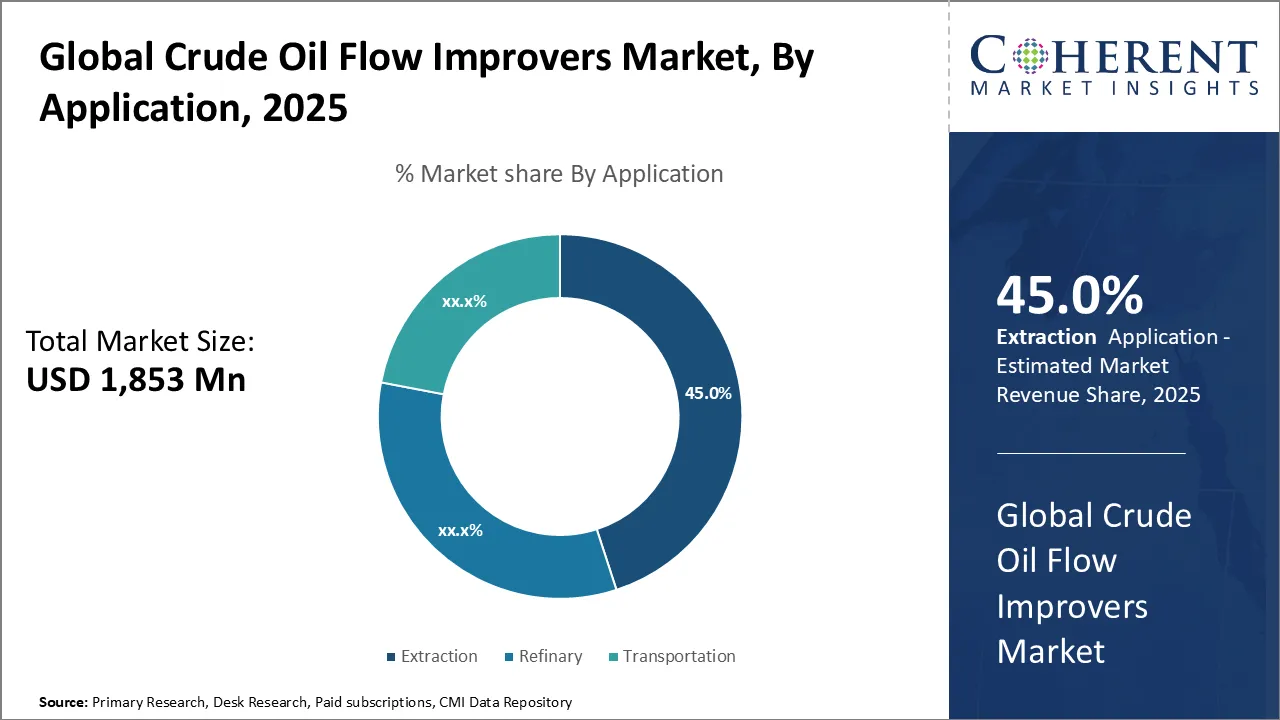
Crude Oil Flow Improvers Market Insights, by Application
Extraction contributes the highest share of the market owing to its pressure to cut operating costs.
Extraction acquired the prominent share of 46.0% in 2026. Growing global oil output, especially from unconventional sources like shale and tight oil, fuels the expansion of the extraction segment in the market. Operators increasingly rely on flow improvers to prevent blockages and maintain flow efficiency during intensified drilling activities, particularly in remote areas and high-wax crude fields. The push for cost-effective production, reduced downtime, and enhanced recovery further boosts demand. Technological advancements in additive formulations and the need to optimize flow in harsh environments also accelerate market growth in this segment.
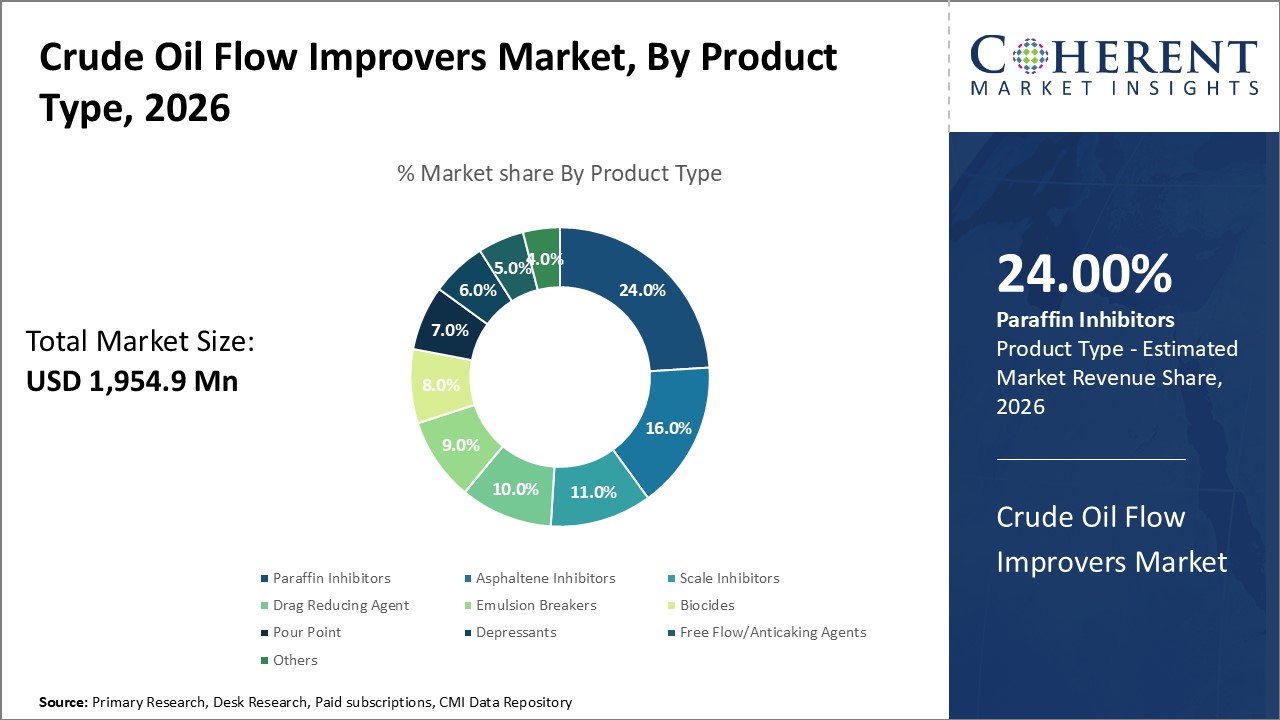
Crude Oil Flow Improvers Market Insights, by Product Type
Paraffin Inhibitors contribute the highest share of the market owing to its escalating heavy / high‑wax crude transport
Rising output of high-wax crude oils, particularly in cold and deepwater regions, drives the demand for paraffin inhibitors as operators work to prevent wax deposition from obstructing pipelines. Offshore drilling and shale exploration continue to grow, requiring efficient flow assurance systems. Manufacturers have developed advanced chemical formulations, while operators increasingly prioritize preventive maintenance to ensure smooth operations. Companies also adopt paraffin inhibitors to reduce operational downtime and comply with environmental regulations, further strengthening their role in oil extraction and transportation. In May 2024, BASF expanded the global production capacity of its Basoflux® paraffin inhibitors at its Tarragona, Spain. This is further propelling the crude oil flow improvers market demand.
Regional Insights
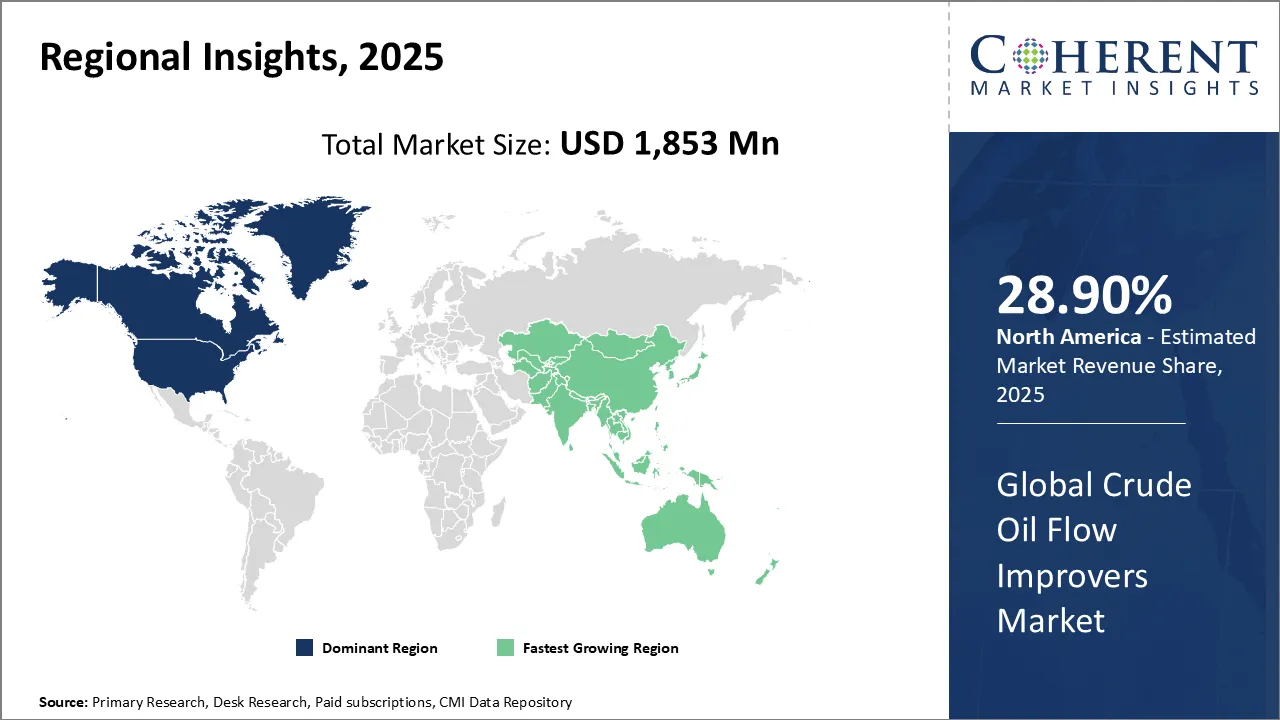
North America Crude Oil Flow Improvers Market Trends
North America leads the global COFI market with a share of 28.90%, with the United States and Canada at the forefront due to extensive shale oil production and hydraulic fracturing that demand improved flow efficiency. Operators in the region continue to invest in pipeline optimization and expansion, increasing the use of drag-reducing agents and viscosity modifiers to boost capacity without major infrastructure costs. Technological advancements, such as polymer-based and nano-additive formulations, enhance performance in cold and deepwater conditions. While environmental regulations and oil price fluctuations pose challenges, they also drive the adoption of sustainable, data-driven, and customized flow improver solutions.
Asia Pacific Crude Oil Flow Improvers Market Trends
China (11.96 M bpd) and India (5.26 M bpd) led Asia-Pacific’s oil imports, which reached 27.36 M bpd in H1 2026. As prices remained low, countries stockpiled crude, driving demand for flow improvers to support export and transport logistics. The dominance of ethylene vinyl acetate and the rapid rise of polyalkyl methacrylate reflected the growth of oil transport in cooler regions. Meanwhile, the rapid expansion of refineries in China and India increased heavy crude throughput, boosting the need for drag-reducing agents and viscosity modifiers to optimize pipeline and refinery performance, further accelerating the crude oil flow improvers market demand.
United States Crude Oil Flow Improvers Market Trends
Limited pipeline capacity from the Permian Basin to the Gulf Coast has widened price differentials. To ease pipeline congestion and maximize throughput, operators are actively using flow improvers like drag-reducing agents while awaiting long-term infrastructure upgrades. U.S. refiners, instead of heavily investing in reconfiguring facilities for domestic light shale, prefer chemical optimizations and blending strategies. This cost-effective approach increases the demand for flow improvers, as it enhances flow efficiency without requiring large capital investments.
Canada Crude Oil Flow Improvers Market Trends
Alberta’s heavy oil and bitumen production drives the demand for flow improvers, as they help maintain viscosity in heated lines and long-distance pipelines while preventing wax buildup. Canada’s sub-zero temperatures raise the risk of wax formation, prompting operators to use paraffin and cold-flow inhibitors to ensure uninterrupted flow during harsh weather. New pipeline projects and reversals, including the Trans Mountain expansion, boost throughput capacity. Operators rely on flow improvers to support these systems and reduce dependence on costly mechanical interventions.
Market Report Scope
Crude Oil Flow Improvers Market Report Coverage
| Report Coverage | Details | ||
|---|---|---|---|
| Base Year: | 2025 | Market Size in 2026: | USD 1,954.9 Mn |
| Historical Data for: | 2020 To 2024 | Forecast Period: | 2026 To 2033 |
| Forecast Period 2026 to 2033 CAGR: | 5.5% | 2033 Value Projection: | USD 2,843.8 Mn |
| Geographies covered: |
| ||
| Segments covered: |
| ||
| Companies covered: | Halliburton Company, BASF SE, LiquidPower Specialty Products Inc., Schlumberger Ltd., Baker Hughes, A GE Company, Nalco Champion, Clariant AG, Evonik Industries AG, Infineum International Limited, Innospec Inc. | ||
| Growth Drivers: |
| ||
| Restraints & Challenges: |
| ||
Crude Oil Flow Improvers Market News
In December 2024, Sanyo Chemical Industries, Ltd. launched NEOPROVER HBF-101, an innovative cold flow improver engineered to significantly boost flow performance under low-temperature conditions.
Crude Oil Flow Improvers Market Trend
Rising Adoption of Advanced Chemical Formulations
Oilfield operators are increasingly shifting toward advanced formulations such as polymer-based drag-reducing agents, low-dosage hydrate inhibitors, and nano-enhanced additives. These chemicals enhance flow performance in extreme conditions like ultra-deepwater, cold climates, and high-pressure pipelines. Operators choose these solutions for their efficiency, versatility with different crude types, and reduced chemical usage. This trend highlights the industry’s growing emphasis on precise dosing, meeting environmental regulations, and achieving long-term cost efficiency in both upstream and midstream operations.
Expansion of Unconventional and Offshore Production
Rising oil production from unconventional sources like shale, tight oil, and deepwater reserves is driving strong demand for flow improvers. Operators face major flow assurance challenges in these environments, including wax, hydrate, and asphaltene buildup. To maintain production efficiency, minimize downtime, and reduce costs, they increasingly rely on chemical flow solutions. This trend underscores how complex extraction conditions are pushing broader adoption of flow improvers across both emerging and established energy markets.
Crude Oil Flow Improvers Market Opportunity
Innovation in Smart Chemical Formulations
Manufacturers can seize opportunities by developing smart flow improvers that automatically adjust to pipeline conditions like temperature, pressure, and crude composition. By introducing innovations such as responsive polymers, AI-integrated dosing systems, and biodegradable formulations, they can increase product value and appeal to environmentally conscious operators. As oil producers prioritize precision and automation to cut waste and lower costs, suppliers that deliver intelligent and efficient solutions are well-positioned to meet shifting market needs and establish a strong foothold in high-performance oilfield chemicals.
Analyst Opinion (Expert Opinion)
- The Crude Oil Flow Improvers (COFI) market is no longer a peripheral segment of oilfield chemicals—it is now a core enabler of modern hydrocarbon logistics and extraction strategy. This market’s growing relevance is not just a function of increased oil production, but of the rising complexity of production environments and transport systems. The demand is particularly acute in ultra-deepwater, Arctic pipelines, and unconventional shale plays, where flow assurance issues like wax deposition, hydrate formation, and high viscosity are no longer technical nuisances—they are production-threatening bottlenecks.
- Operators in the Permian Basin, for example, are currently pushing over 5.9 million barrels per day, much of it through aging infrastructure not originally designed for high-wax tight oil. In such conditions, drag-reducing agents (DRAs) and paraffin inhibitors have moved from optional additives to operational necessities. With pipeline constraints widening Midland-to-Gulf Coast spreads by over USD 3 per barrel in early 2025, companies like Enterprise Products and EnLink Midstream are aggressively investing in DRA technologies to optimize throughput without costly pipeline overhauls.
- The innovation curve is also pushing upward. The success of nano-enhanced additives in Canadian oil sands—where bitumen transport at sub-zero temperatures previously relied heavily on energy-intensive heating—is a testament to the growing role of chemistry over brute-force infrastructure. Instead of scaling pipelines, operators are scaling formulations. Likewise, in the Middle East, ADNOC's recent deployment of polymer-based flow improvers for sour crude transport has allowed it to reduce pumping energy by over 18%, according to internal trials.
- In summary, the COFI market is being reshaped by necessity, not novelty. The need to move more barrels through older or more complex systems, under tighter environmental controls and with fewer capital projects, is elevating flow improvers to strategic enablers. Players who treat these solutions as core operational levers—not just as chemical inputs—will define the next generation of efficient, adaptable oil production.
Speak to the analyst
Want personalized insights?
Take the findings above to one of our principal consultants, or have the report rebuilt around the segments, geographies and competitors you actually track.
Market Segmentation
- Global Crude Oil Flow Improvers Market, By Product Type (Revenue, USD Mn, 2021 - 2033)
- Paraffin Inhibitors
- Asphaltene Inhibitors
- Scale Inhibitors
- Drag Reducing Agent
- Emulsion Breakers
- Biocides
- Pour Point Depressants
- Free Flow/Anticaking Agents
- Others (Hydrate Inhibitors, Wax Dispersants, etc.)
- Global Crude Oil Flow Improvers Market, By Application (Revenue, USD Mn, 2021 - 2033)
- Extraction
- Pipeline
- Refinery
- Global Crude Oil Flow Improvers Market, By Region (Revenue, USD Mn, 2021 - 2033)
- North America
- U.S.
- Canada
- Latin America
- Brazil
- Argentina
- Mexico
- Rest of Latin America
- Europe
- Germany
- U.K.
- Spain
- France
- Italy
- Russia
- Rest of Europe
- Asia Pacific
- China
- India
- Japan
- Australia
- South Korea
- ASEAN
- Rest of Asia Pacific
- Middle East
- GCC Countries
- Israel
- Rest of Middle East
- Africa
- South Africa
- North Africa
- Central Africa
- North America
- Key Players Insights
- Halliburton Company
- BASF SE
- LiquidPower Specialty Products Inc.
- Schlumberger Ltd.
- Baker Hughes
- A GE Company
- Nalco Champion
- Clariant AG
- Evonik Industries AG
- Infineum International Limited
- Innospec Inc.
Sources
Primary Research interviews
- Senior flow assurance engineers from upstream operators
- Technical managers at chemical manufacturers specializing in drag-reducing agents and paraffin inhibitors
- Pipeline operations managers from midstream companies in North America and the Middle East
- R&D specialists from oilfield service providers
Databases
- U.S. Energy Information Administration (EIA)
- International Energy Agency (IEA)
- BP Statistical Review of World Energy
- National Energy Board of Canada
- OPEC Monthly Oil Market Report
Magazines
- Offshore Engineer
- Oil & Gas Journal
- World Pipelines
- Hydrocarbon Processing
Journals’
- Journal of Petroleum Science and Engineering
- Fuel
- Energy & Fuels (ACS Publications)
- Journal of Natural Gas Science and Engineering
Newspapers
- Reuters Energy News
- The Wall Street Journal – Energy Section
- Financial Times – Commodities and Energy
- Bloomberg Energy News
Associations
- Society of Petroleum Engineers (SPE)
- American Petroleum Institute (API)
- International Association for Energy Economics (IAEE)
- Canadian Association of Petroleum Producers (CAPP)
- Pipeline Research Council International (PRCI)
Public Domain sources
- U.S. Department of Energy (DOE) technical papers
- Environmental Protection Agency (EPA) compliance documentation
- Technical presentations and white papers from SPE conferences
- Patent databases (e.g., WIPO, USPTO) related to flow improvers
- Academic thesis repositories (e.g., ProQuest, university libraries)
Proprietary Elements
- CMI Data Analytics Tool, and Proprietary CMI Existing Repository of information for last 8 years
Get access to 250+ pages report
Every segment, forecast, competitor profile and data table behind the analysis above — available for instant download.
- ESOMAR Member
- ISO 9001:2015 Certified
- D-U-N-S Registered
- GDPR & CCPA Compliant
Missing comfort of reading report in your local language? Find your preferred language:
Transform your Strategy with Exclusive Trending Reports
Frequently Asked Questions
The Crude Oil Flow Improvers Market is estimated to be valued at USD 1,954.9 Mn in 2026, and is expected to reach USD 2,843.8 Mn by 2033.
Major players operating in the market include Halliburton Company, BASF SE, LiquidPower Specialty Products Inc., Schlumberger Ltd., Baker Hughes, A GE Company, Nalco Champion, Clariant AG, Evonik Industries AG, Infineum International Limited, and Innospec Inc.
Stringent Regulation along with rising Crude oil prices is one of the major factors that is expected to hamper of the market.
Fracturing of old crude oil wells and Demand for crude oil are the key factors driving growth of the market.
The CAGR of the Crude Oil Flow Improvers Market is projected to be 5.5% from 2026 to 2033.
Among regions, North America accounted for the largest market share in 2026 in the market.